Blog Details

AT&T and Verizon’s 4Q18 results hint at more layoffs as operators gear up for 5G

The 4Q18 results of the two US wireless biggies AT&T and Verizon suggests that headcount reduction remains a common focus. Both operators need to reduce their debt burden ahead of the 5G push.

Some highlights from their financial results:

  • Capex drops as Verizon and AT&T prioritize debt repayment: By global standards, capital intensity for AT&T and Verizon is low. Their capital intensity has been in the range of 12-14%, lower than other European telcos such as DT, Orange and Telefonica (with capex/sales of 14-16%). Capex reported by AT&T and Verizon further declined YoY by 17% and 22%, respectively, in 4Q18. Recent M&A could be a major reason for this, as the companies have increased their focus on debt repayment. AT&T’s debt ratio declined from 56% in 3Q17 to 47.7% in 4Q18; strong free cash flow generation (~$8B in 4Q18) supported this drop. On a similar note, Verizon’s debt ratio also fell from 46% in 3Q17 to 43% in 4Q18; and generated a free cash flow of $17.7B in 2018. This might also be early signs of telcos saving cash and reducing debt to prepare for 5G.
  • Unlike Verizon, AT&T shows revenue growth largely due to Time Warner acquisition: Verizon’s service revenues were flat (up just 0.1% YoY), mostly attributed to its media segment (which saw YoY revenue fall by 6%) and wireline segment (YoY revenue was down by 3.2%). However, AT&T reported strong YoY revenue growth (up 15%) in 4Q18 – primarily due to the WarnerMedia acquisition and strong growth from its wireless business. This is good news for AT&T which posted a YoY rise in revenue for the second consecutive quarter, after declining for seven straight quarters.
  • AT&T asserts its position in the media space, while Verizon chooses to focus on its core competency: Verizon continued its momentum in its mobile segment, as wireless subs saw 1.2M postpaid net adds, and wireless revenues increased 2.7% YoY. However, Verizon wants to just stick to partnerships with other companies and not own content – especially after its after its Go90 video platform debacle (which shut down in mid-2018 due to low viewership and uninspiring original video programming). On the flipside, AT&T’s entertainment segment was a huge let down, as it lost 267,000 and 403,000 subs from its DirecTV Now (streaming service) and satellite service, respectively. This was due to the phase out of its promotional pricing of DirecTV Now subscribers. Despite these setbacks, AT&T remains bullish of its streaming and entertainment business. AT&T is pinning its hopes on its ‘to be launched’ standalone streaming service, which will have content from Turner Media networks, HBO, and WarnerMedia films.
  • Verizon’s profit takes a dent as media business struggles: Facing a $4.6B write-down from its Verizon Media business (formed in 2017 post merger of Yahoo! and AOL), the group has accepted that they might have overpaid for media properties. In a Dec. 2018 8-K filing, Verizon stated that the merger of Yahoo! and AOL achieved lower-than-expected benefits. This was evident in 4Q18 results: Verizon’s net profit fell 89% YoY to $2.1B1.

A year after Trump’s tax reforms, US telecom giants continue to slash headcount

Despite receiving huge tax breaks from the ‘Tax Cuts and Jobs Act of 2017,’ the telco giants continued to slash headcount and offshore jobs. In 4Q18, AT&T and Verizon reduced headcount by 7% and 4%, respectively from 4Q17 levels.

In 4Q17, AT&T recorded a whopping $19B profit and $3B of surplus cash due to the new tax law. Publicly, AT&T announced plans to increase its network spending with an estimated capex of $25B for 2018. However, AT&T fell far short of its own estimates as it spent just $20.7B in 2018 (which was just at par with its 2017 capex). Job cuts were also on the rise. According to the 2019 Communications Workers of America (CWA) report, AT&T cut 10,700 union jobs in 2018 and planned closure of three more call centers. To date, it has closed 44 call centers resulting in 16,000 job losses.

The corporate tax overhaul also did not stop Verizon from lowering its headcount:

  • In December 2018, it announced a 7% cut of its workforce as part of its voluntary separation scheme4
  • In early 2019, the company announced plans to sack 800 staff members (of 11,400 employees) from its Verizon Media business, as it struggled to compete with advertising giants such as Google and Facebook.

These cuts come despite the company’s recent growth in operating cash flow, and reduction in deferred tax liabilities, both related at least in part to the Trump tax law. Further, like AT&T, Verizon’s 2018 capex results were disappointing, as 4Q18 capex was down by 22% YoY.

Moreover, AT&T in its latest earnings also cited its plans to increase usage of automation, artificial intelligence (AI), and other technologies to drive efficiency gains – as demand for legacy services drops. This spells more bad news for headcount levels in the telecom industry. There is lots of hype in the market about how operators are undergoing digital transformations, and how this will bring greater efficiencies and new services. The stark reality is that it also means job cuts.

1Verizon 8-K filing
2AT&T 4Q’17 results
3CWA report
4Verizon announces results of voluntary separation offer

Blog Details

Transition to autonomous vehicles poised to have a big impact on telcos

I’m one of those people who loves driving, but not picky about the actual car. I’ve driven some rusty, falling-apart junkers in my life, lots of forgettable rentals, and too many SUVs – I like driving them all. As long as I’m not stuck in traffic.

What I like less is, the idea of the car driving me. Even worse is the idea of no steering wheel at all, now a reality in some concept cars. Power-steering is a great innovation, true; ask anyone who has ever parallel parked in New York City. But gesture-based steering is another thing. Waving a hand (or wrinkling your nose?) in front of a built-in camera to tell the car to go left or right is a bit much. Even if the car is doing most of the steering, the user (this one, anyways) still wants to be in control. Especially when security and safety are such important considerations. The whole issue of hacking becomes even more frightening in a world of autonomous vehicles.

CES makes a self-driving future seem within (our kids’) reach

So, I’m probably an unlikely analyst to get excited about the self-driving car movement. But I am, especially after visiting CES last week.

Cars were a big part of the show, both on the floor and in conference sessions. Companies from across the (emerging) connected & autonomous vehicle (CAV) ecosystem showed up, from across the globe. There was loads of hype, and way more companies than can survive. But things are getting real.

Some interesting announcements specific to 5G network connectivity from the show include:

  • Continental announced a new V2X solution designed to support both DSRC and Cellular-V2X communication protocols. C-V2X is becoming increasingly important as 5G emerges, but supporting DSRC is still important (more so in certain regions than others, such as the US). Notably, the US Dept. of Transportation just opened up an inquiry on V2X technologies last month.
  • Ford Motor Co. announced that starting in 2022 every new vehicle it sells in the US will be equipped with C-V2X, piggybacking on growing 5G cellular network rollouts. Ford is now reliant on favorable regulatory rulings on C-V2X.
  • Taiwan’s Wistron NeWeb Corporation showed 5G and C-V2X system and modular solutions
  • Audi, Ducati, Ford and Qualcomm demonstrated use cases enabled by C-V2X
  • Veniam and Bosch presented a jointly developed central control unit for V2X data management and communication.
  • Velodyne Lidar announced a new camera, the VelaDome, as well as a new software platform “Vella” which supports the company’s advanced driver assistance system (ADAS).
  • Denso-TomTom: mapping company TomTom has partnered with Japanese company Denso, a key maker of car sensors (e.g. cameras, radars). DENSO will provide processed sensor data to TomTom, which will use it to update its mapping data in real time.
  • California-based Udelv announced it is using Baidu’s self-driving OS in delivery vans that will be supplied to Walmart later this year, in Arizona. Baidu wants Apollo to function similar to Google’s Android, but for cars.
  • IoT software company Wind River announced upgrades to its Chassis automotive software. The updates integrate Chassis with the company’s “Titanium Cloud” virtualization software, aiming to address the reality that “in order for autonomous driving to reach mass production, it will require ultra-low latency and dynamic compute architectures for the cloud as well as in the car.”

Telco interest in connected cars is growing

AT&T has been (justifiably) bragging about its connected car success, and that continued in Las Vegas. The company had 24 million connected car connections in Sept 2018, mostly through partnerships with manufacturers. It also has about 1 million consumer connections for car WiFi hotspots. Impressive numbers, but the network requirements are still fairly limited. AT&T’s VP for IoT Solutions, Joe Mosele noted on a CES panel that this will change. Networks will need very low end-to-end latency (<20ms) to make self-driving a reality. Some edge processing will be required to support this latency; that is one reason AT&T expects edge computing to be important, and why it supports the “central office rearchitected as a data center” (CORD).

It’s not just AT&T. The transition to connected & autonomous vehicles (CAVs) is going to have a big impact on the broader sector of telecommunications network operators (TNOs). New types of companies will see a need for communications network infrastructure, e.g. to support a CAV offering. New companies may find use for old/unused infrastructure or rights of way (e.g. power companies). Telcos will find ways to create things like “super bundles” by adding in monthly car service, and partner with or buy a shared transport provider like Uber or Lyft. Over time the roadway infrastructure itself will change to accommodate different types of vehicles. People who like to drive old cars that aren’t retrofitted with V2X gear may only be allowed in certain parts of a city. Cars will come in more shapes and sizes, have fewer windows, but more screens, cameras, sensors, storage, and networking capability. As the market scales, data consumed per vehicle will rise and use cases will get more complex. The “data center on wheels” term may come to fit. Telcos will have a big role to play.

A slow, patchwork evolution

After 20+ analyst years watching technologies come and go, usually far slower & chaotically than expected, I’m a bit of a cynic. Or a realist, anyways.

A full global transition to connected & autonomous vehicles will take 30-50 years or more, depending on how you define the end state. There will be huge regional variation, partly because of different regulatory regimes. Also important is the reality that CAVs can only function safely within a specified geographical space. Geofencing will be used to control – and slowly grow – the scope of CAV deployments. Autonomous tractors working together to manage large farms, for instance. Pepsi’s experimental snack delivery system, made by Robby Technologies, in use on the University of the Pacific campus in California. More ambitiously, Volvo aims to have a Level 4 robotaxi available in China by 2021, working with Baidu. This effort will be limited to specific areas too, though; the quality of the local maps are essential, not just the network. China’s rapidly changing streets and skyline makes the mapping issue even more demanding.

Telcos need an upside, and cars could help

Telcos have faced weak revenue growth for many years. Given this reality, they are focused on costs: building & managing network infrastructure, as efficiently as possible. With self-driving, though, there is some upside potential. As the autonomous car market evolves, we expect telcos to pursue a range of different approaches. Some will be pure pipe (or bandwidth) suppliers, some will partner selectively with automotive specialists (car makers, ride sharing, etc), some will transform their operations more dramatically to address self-driving. None will be unaffected.

Blog Details

Indian government’s decision to welcome Huawei for 5G trials receives mixed response

The Indian government’s recent decision to invite Huawei for 5G trials has sparked a debate between two opposing bodies. Indian telecom export body TEPC (or Telecom Equipment and Services Export Promotion Council) has proposed a ban on Chinese telecom equipment citing recent similar moves by the US and other developed countries over cybersecurity concerns.

On the other hand, Cellular Operators Association of India (COAI), which represents the country’s telecom operators, defies the proposed ban. The COAI suggests that there is little evidence to confirm the claims of the countries that banned the Chinese giant. COAI’s stance is not surprising considering operators are heavily dependent on Huawei’s kit.

India’s support for including Huawei was expected

Huawei is facing political obstacles in a number of the world’s largest markets – the US, Japan, Australia, and likely more to come. Indian policymakers also have security concerns about Huawei. Those are being set aside, for now.

The Indian government’s openness toward Huawei rests on three major reasons. First, a ban on Chinese telecom equipment would be detrimental to operators who had already purchased gear from Huawei on a long-term supplier’s credit and at discounted prices. Second, Huawei is one of only a few competitive 5G network infrastructure vendors. Third, a wider range of companies taking part in the trials bodes well for 5G growth prospects and gives operators more clout during price negotiations.

Publicly, Huawei has received widespread support from the telcos. That’s clear from a statement issued by Rajan Mathews, head of the COAI: Huawei is “suitably equipped to prepare operators and industry to build 5G capabilities in operations, in organisation and most importantly in the ecosystem and to ensure they are fully compliant with all government requirements.”

AnchorIndia still struggling to develop a local telecom equipment sector

Rival vendors and trade groups oppose the government’s openness towards Huawei. One reason they point to is a need to support local vendors, or local R&D by foreign vendors (e.g. Ericsson’s 5G partnership with India’s IITs).

Currently most of India’s telecom capex goes to foreign vendors, who dominate the Indian market for wireless base stations, transmission equipment, and data/IP gear. Nearly all of India’s telecom network infrastructure is imported. Besides China and Hong Kong, Indian operators import network equipment from South Korea, Vietnam (Samsung Vietnam), Taiwan and the USA. This has resulted in a huge telecom equipment trade deficit.

Further, most handsets sold in India are either just assembled or imported from other countries. Electronic parts such smartphone cameras and screens, PCBs, sensors and camera modules are imported (mostly from Chinese vendors). PCBs are especially important, as they can account for up to 50% or more of the device cost. For the Indian market, generally handset vendors import PCBs which are already loaded with components, and then assemble them in a semi-knocked-down (SKD) format. A PCB constitutes several key components such as memory, wireless chip sets and processors that forms the core to any device.

Indian policymakers continue to search for ways to grow the local vendor market. Some policy ideas are aimed at the supply side, designed to stir up new local innovation and attract venture capital. Some ideas aim at coercing private operators to buy local. These top-down policy ideas will take time to achieve consensus, though. In the meantime, foreign tech companies are announcing new investments in India as a result of US-China trade disputes. That includes a recent decision by Foxconn to move some iPhone assembly to India.

Huawei might face a few hiccups post the import duty hike

In October 2018, the pressure to promote local manufacturing prompted the government to double the import duty to 20% on several types of network equipment. The products include ethernet switches, IP radios, base stations, media gateways, optical transport equipment, MIMO/4G LTE gear, VoIP phones, gateway controllers, packet transport nodes and optical transport product or switches. Further, a 10% customs duty (compared to zero import duty earlier) was also levied on products like printed circuit boards (PCBs).

However, countries such as South Korea and Vietnam which have a free trade agreement (FTA) with India are exempted from these import duty charges. This could be a major hindrance for Chinese network equipment vendors who might lose ground to their peers. It benefits others, though. South Korean giant Samsung is already reaping the benefit of import duty exemption, both from its home base and via its manufacturing hub in Vietnam. A glimpse of this is already seen in the trade data. According to the latest data published by Ministry of Commerce and Industry Trade, telecom equipment imports from Vietnam increased by 35% YoY in the period Jan-Oct 2018, while imports from China/HK fell by 12% YoY for the same comparable period. The import duty hike could also benefit Taiwanese vendors, if Taiwan ever manages to finalize an FTA with India.

Apart from the import duty challenge, market consolidation is also having an impact on Huawei. The industry is just left with four large integrated operators, compared to eight operators in 2017. Huawei’s managed services business in India took a hit after it lost two of its big-ticket clients Vodafone India (which was merged with Idea) and Telenor (which got acquired by Airtel) due to market consolidation. The effects of this are already seen as Huawei shut its Chennai SEZ plant –which assembles telecom equipment– due to reduced demand. Despite these challenges, Huawei hopes that its long-standing customer relationships, robust R&D, and competitively priced products will keep customers coming back.

Blog Details

Operators feel the pinch of rising labor costs

Global telecom operators are facing a cost crunch. Based on MTN Consulting’s analysis, annualized operating profit margins have fallen for five straight quarters, from 13.7% in 2Q17 to 12.7% in 3Q18. This profit dip comes during strong economic times; a recession would make this far worse. Further, telcos need cash to fund their 5G migrations and to pursue M&A opportunities. As the pressure to improve profitability rises, telcos are looking to reduce their labor costs.

Labor costs average over 15% of revenues

For the 12 months ended Sept. 2018, telecom network operator (TNO) capex was $304B, or 16.5% of revenues. This is the single biggest component of costs for most TNOs. Labor costs come in a bit lower at 15.3% of revenues, based on an MTN Consulting analysis of 40 large operators. As TNOs reshape their workforces to meet new requirements – hiring software developers, retaining fewer field engineers – they are getting serious about managing their labor costs more smartly.

Across the globe, TNOs pursue a wide range of business strategies and face a range of relative input costs. Labor costs vary widely as a share of total. Generally, the higher the GDP per capita, the more salient is the issue of labor costs. Also, fixed operators tend to have more employees per subscriber, or per dollar of revenue, than their mobile counterparts. As Figure 1 below shows, mobile operators in emerging markets have the lowest labor cost burdens, in general: Bharti Airtel, Idea Cellular, the MTN Group, Axiata.


*BSNL and MTNL are not shown

Every rule has exceptions, though. Japan-based KDDI, an integrated (fixed-mobile) TNO in a high-income market, reports labor costs totalling just 8% of revenues. In this case, KDDI has abnormally high non-staff costs, in particular sales commission costs and handset expenses: these two totalled $11.7B in FY2018, about 3x the level of staff costs ($3.8B).

Labor cost pressures are rising

Our analysis of 2011-17 finds that many telecom operators are already struggling with labor costs. Some operators, such as BSNL and MTNL (not shown in figure), face labor costs in excess of 50% of revenues. These two operators represent an extreme example of a problem many other TNOs face: laws and union agreements restricting their hiring and firing. These are good things for social welfare, but do pose challenges for telcos facing competitors with more nimble workforces. More commonly, TNO labor costs are in the 10-20% range of revenues. When measured on a per-employee basis, the global average for labor costs in 3Q18 was $57,800 per year, slightly up from the year earlier.

Some of the reasons behind recent TNO labor cost growth include: surge in wages or headcount, rise in pension costs, and in some cases, inflationary pressures.

To substantiate this point, let’s look at the recent labor cost data for a few sample telcos:

  • China Mobile and China Unicom saw a drop in their headcount but their labor costs for 2017 surged by 5% and 12%, respectively. The surge could be attributable to the operators’ strategy to boost the sales and productivity of their broadband business and the consequent increase in compensation of its front-line staff.
  • Despite a 3% drop in headcount, labor costs for Canada-based Rogers increased by 4%. This increase was due to high salaries and pensions paid to the players of Toronto Blue Jays (Canada’s only Major League Baseball team owned by Rogers) and higher TSC merchandise costs. Likewise, BCE’s labor cost was up 5% YoY as its headcount increased by 7% – post the integration of MTS employees.
  • SK Telecom’s labor cost was up 8% YoY in 2017; however, this arose from SKTs formation of a newly formed subsidiary “Home & Service”, in effect insourcing a service which was earlier outsourced to third party vendors. Behind the 8% cost increase is an 18.4% increase in headcount.

Telcos often rely on early retirement plans or come up with outsourcing options to save on their labor costs. Here are recent developments at a few large telcos that exemplify this:

  • In the case of Deutsche Telekom, it introduced an early retirement plan in 2017 for its civil servants which resulted in a 4% YoY decline in its labor costs, compared to revenues, which grew 4.6%” in 2017.
  • In September 2018, Verizon offered a voluntary severance package (VSP) to about 44,000 employees – and it also struck a $700 Mn deal with India based Infosys to outsource over 2,500 IT staff or more.
  • Loss making Indian PSUs –BSNL and MTNL – spent close to 56% and 94% of their revenue toward labor costs in 2017. Contrary to other private players such as Airtel and Idea – which spent only 5% and 6% of its revenues towards staff costs. BSNL and MTNL have a headcount of 185,000 and 25,000, respectively, which makes cutting staff a pressing need for these operators. Both companies have had to resort to voluntary retirement scheme (VRS) to achieve a break-even point. A VRS scheme for MTNL was always on the cards, especially with its huge debt burden (INR170 Bn, approx. US$2.5B).

Automation leading to fewer jobs in Europe

Telecom operators are increasingly using automation, artificial intelligence (AI), and a range of other technologies to drive efficiency gains. Recent trends suggest that most operators headquartered in Europe are either on a hiring freeze or on a lay-off spree (figure, below).

The below developments at some of the leading European telcos exemplify this trend.

  • Telecom Italia reduced its headcount by 1,800 in 2017 – about 3% of its total employees. The operator further plans to downsize its staff by 4,500. Technology investments will make this possible. Under a new plan named ‘DigiTIM’ – Telecom Italia aims to reduce human-operated interactions” by 30% and get 85% of its customers to use self-care apps. It also partnered with Microsoft to use its AI technology to develop chatbots.
  • Similarly, Telefonica reduced its headcount by 5.1% in 2017, as it launched its own AI-powered digital assistant ‘Aura’ to improve customer service. This was accompanied by an 8% drop in the average labor cost per employee, to $62,075.
  • Deutsche Telekom (DT) also plans to restructure its staff and prioritize automation and digitalisation. The company claims these investments will lead to a 1.5B Euros annual reduction in annual “indirect costs.


However, the telco job market is not all about managing decline. Many operators are employing automation and digitalisation and retraining and reskilling their workforce at the same time. 1According to Ernst & Young’s 2018 Global Capital Confidence Barometer, about 57% of the surveyed executives see AI and automation as the most prominent technologies on their boardroom agenda.

Rising M&A, shrinking employee numbers

M&A activity is a part of life for telecom network operators. While many large deals have already been closed in recent years, M&A will continue to reshape the market, blurring the lines between TNOs, webscale, carrier-neutral, media, and other network operators. Given competitive pressures and the need to improve margins, we expect M&A in telecom to remain vigorous. According to Ernst & Young’s 2018 Global Capital Confidence Barometer, there is an increased appetite for M&A in the near term, with 59% of interviewed telecom executives intending to pursue M&A in the next 12 months.

Acquisitions can have a big impact on the average cost of the TNO employee. When BT acquired EE, its average employee costs dropped dramatically. Acquisitions of cable or other fixed operators by mobile TNOs, by contrast, tend to drive labor costs upwards.

M&A deals often result in workforce redundancies as there is a natural overlap of jobs. For example, AT&T has a long history of cutting jobs as part of its M&A evolution. Post its DirecTV acquisition in 2015, AT&T’s headcount reduced from 281,450 in 2015 to 254,000 in 2017. Though no major restructuring has been announced so far, AT&T’s plans to build its own 5G network and its recent purchase of Time Warner could mean that AT&T employees will soon feel the heat.

CenturyLink is following a similar path – as it confirms reduction of 2% of its headcount post its acquisition of Level 3 Communications. In May 2018, CenturyLink’s spokesman Mark Molzen said that

“The combination of two large companies also creates redundant positions that must be addressed to remain competitive. In addition, as part of our ongoing efforts to deliver high levels of customer service, we are implementing best practices and increasing automation. As a result of these two factors, we are reducing our workforce by approximately 2 percent.” 

The largest labor union in the US telecom sector, Communications Workers of America (CWA), estimates that the much-awaited merger of T-Mobile and Sprint could potentially result in huge headcount reductions – about 28,000 jobs. The CWA estimate conflicts with official company estimates, which – perhaps not surprisingly – claim the merger would create new jobs.  This conflict will continue.

In India, the telecom labor market is in a gloomy state as consolidation has become the norm and job losses are mounting. As per a report published by CIEL HR Service, job losses could reach up to 90,000 by 2018. The recent Vodafone and Idea merger, which already cut 5,000 employees, could lay off 2,500 more people in the next few months, as part of realizing its targeted $10 billion “synergy benefits” from the merger. Similarly, post Airtel’s merger with Telenor India, Airtel said only 50% of the latter’s employees would still be employed by the merged entity.

As top-line growth remains low, and new capex requirements are on the way, operators are compelled to reduce their labor costs. To achieve this, we expect telcos to use the tools of both AI and M&A.

————

References:
1 EY Telecommunications Global Capital Confidence Barometer

Cover image: Shutterstock

Blog Details

Improving Africa’s connectivity: more subsea cables are a good start

Over the last two decades, submarine cables have become a key growth enabler for trade and communication between Africa and the rest of the world. Subsea cables play this role elsewhere, but the effect is newer in Africa.

With recent investments, Africa’s position has improved: stark declines in the price of international capacity have supported a surge in the volume of data consumed, generated, transmitted, cloud-hosted and processed real-time over Africa’s communication networks.

But does Africa have enough capacity?

Traffic and subscriptions have exploded; for instance, mobile broadband users in Africa reached 253 million in 2017, from 22M in 2011.  Keeping up with this growth momentum requires continual investments in international connectivity. This article explores recent submarine developments in Africa, identifies bottlenecks, and discusses how they can be addressed.

54 countries and not enough fiber to go around…yet 

With 54 countries recognized by United Nations, Africa has 38 countries with a coastline and 16 that are land-locked. The pace of regulatory liberalization, sophistication of telecom infrastructure, and geopolitical stability is quite uneven across the continent. Much of the African growth journey is confined to 10-15 countries. However, this is set to change. Africa’s boom in the construction of new submarine cables is serving as a growth catalyst for regional terrestrial fiber networks connecting multiple countries, fully or partly funded by institutions like African Development Bank (ADB) and other investors.

These investors hope improved international connectivity can create a better business climate for development, reducing prices. As an example of Africa’s challenges, consider the price of a 100G IP port. In London, it available for a monthly recurring charge of $15,000-20,000. Even in South Africa – the most affordable African destination – a 100G port costs 5X higher. This stifles business viability and compels ISPs, MNOs and MSPs to deploy Nx10G incrementally, forfeiting economies of scale.

30 operational cables serve Africa, across 4 corridors

Africa’s cables cover four connectivity corridors – Africa-Europe, Africa-Latam-US, Africa-Asia and Africa-in-region.

Out of Africa’s 38 countries with seashore, 37 countries have at least one submarine cable landing, including 30 operational, and 7 under construction. The best connected country is Egypt, which lands 15 submarine cables. It’s far more common to have just one cable landing, though. Nine African countries face this dilemma, including the Republic of Congo, Togo, Liberia, Sierra Leone, Guinea, Guinea-Bissau, Gambia, Mauritania, and Sao Tome & Principle. Figure 1 illustrates the distribution of subsea cable landing stations in Africa.

Figure 1


Source: MTN Consulting, LLC

The Djibouti hub needs improved terrestrial connectivity

While the count of 30 submarine cables is an impressive figure, most of the upstream IP connectivity is served by 9 submarine cables. One reason for this is, 13 of the 30 cables are basically passing through Africa to Europe via Djibouti and Egypt, as depicted in Figure 2 below.

Figure 2

Source: Submarine Cable Map 2017 

Most of these cables play little role in the African economy. Djibouti, despite being close to Kenya and landing 11 submarine cables, remains isolated from rest of Africa. One reason for this is lack of fiber infrastructure connecting Djibouti and Egypt to other African countries. Ethio Telecom, the incumbent in neighbouring Ethiopia, has made things worse by showing little apparent interest in expanding connectivity.

July 2018 brought good news, though: Liquid Telecom announced that it would expand its growing pan-Africa network north into Egypt, signing an MoU with Telecom Egypt to link its network from Sudan north into Telecom Egypt’s network via a new cross border interconnection. That will create a 60,000km km fiber network from Cape Town to Cairo, sometimes called the “One Africa” broadband network (see figure, below).

Figure 3

Source: Liquid Telecom

Multiple weaknesses exist in Africa’s international connectivity 

“One Africa” will improve things around Djibouti, but that’s just one of many issues. Africa’s international connectivity needs a number of other improvements:

  • more submarine cables with open access cable landing stations,
  • multi-provider terrestrial backhaul options,
  • fair-play interconnect with other submarine cable systems,
  • carrier neutral datacenters and Internet exchanges for traffic localization,
  • deployment of network automation with software controls

To sustain the continent’s growth momentum, Africa’s network operators need to address these issues over the next 3-5 years. Fortunately, they are making progress.

Africa’s cable boom is driving higher end user bandwidth requirements

Africa’s new cables are beginning to change the definition of a “high” and “low” capacity customer.

Globally, 1G is becoming the new STM1 and increasingly deployed for enterprise connectivity. 10G is the new STM4, and select markets are ready for the 100G leap (“replacing”) STM16 in 2019-20. While Africa is a year or two behind, outside South Africa, the pace of transformation is set to accelerate in 2019-20. That is evident from recently 100G network upgrades undertaken by Liquid Telecom, SEACOM, EASSy and MainOne. Also, AAE1 announced it would upgrade to 200G last month. This comes just 18 months after the cable was ready for service (RFS), and 2 years ahead of schedule. (Figure 4)

Figure 4

Source: AAE1

Webscale network operators are now big in submarine; is South Africa the next stop?

The global submarine cable market is transforming rapidly due to participation from Google, Facebook, Amazon and Microsoft. Put together this group has already invested in 21 submarine cables globally, the majority in 2015-20 period. The only regions where they are yet to invest in submarine cables is the Asia-Europe corridor, Middle East and Africa. These companies are laying the groundwork, though:

  • Microsoft and Amazon have edge network nodes in South Africa and work is underway for cloud datacenters with Teraco to be operational by mid-2019.
  • Google and Microsoft have conducted multiple pilot projects across Africa in the last 3 years to bring affordable Internet to underserved regions.
  • Facebook and Amazon are reportedly scouting for partners for submarine cable builds and announcements are expected in early 2019.

Given their long term plans, it’s likely that the deep pocketed webscale players will soon start to expand their massive hyperscale networks (including new submarine cables) in South Africa in 2019-20. These new cables will have a far-reaching impact on the continent, especially when combined with the terrestrial reach of the One Africa network.

One challenge is that, even if a new cable project is announced and funded in 2019, it would not likely be operational before 2022. The webscale operators are likely to engage in a number of partnerships to meet their capacity needs in the interim. For instance, they may consider linkups with Liquid, MTN, and Orange for west Africa, and SEACOM or EASSy for east Africa.

Complimenting submarine cables with terrestrial networks and datacenters

Submarine cables alone cannot alleviate Africa’s connectivity challenges. They have to be complimented with multi-provider terrestrial fiber networks with cross-border alliances to make regional connectivity “affordable” – where a reasonable target is 1G links priced below $5000 per month, and declining by 15% per year.

Along the western coast of southern Africa, Angola, Nigeria, Ghana, Ivory Coast and Morocco have multiple providers developing terrestrial fiber networks, but cautiously with limited reach. Pricing remains high, inhibiting deployment of 1G and 10G links.

The situation is better on the eastern side of southern Africa, including South Africa, Mozambique, Tanzania, Kenya, Uganda, Zimbabwe and Zambia: multiple regional providers are developing fiber footprints with increasing capillarity. Liquid Telecom, Simbanet, WIOCC and SEACOM lead the market. The capacity pricing is competitive, low enough to trigger widespread usage of 1G and 10G links for the largest mobile network operators. By 2022, the entry of cloud and content provider-sponsored cable projects will trigger steeper price declines and stimulate demand.

Africa also needs datacenters that are truly carrier-neutral, and not selective about their neutrality. Developments in this area include:

  • Teraco in South Africa has datacenters in Johannesburg, Cape Town and Durban, and is at the forefront of the carrier-neutral space. That makes it an attractive acquisition target for a company like Equinix to jumpstart its Africa presence.
  • First generation datacenters, supposedly carrier neutral, are also operational in Kenya and Nigeria, with Tanzania, Uganda, Ghana and Ivory Coast lined up for 2019.
  • A new breed of focused datacenter providers like Rack Center, Rack Africa and Djibouti Data Center (DDC) are gaining traction. Their facilities, though, may need to be retrofitted to support technical requirements of the big webscale players.

Kenya and Nigeria poised for big changes in 2019-20

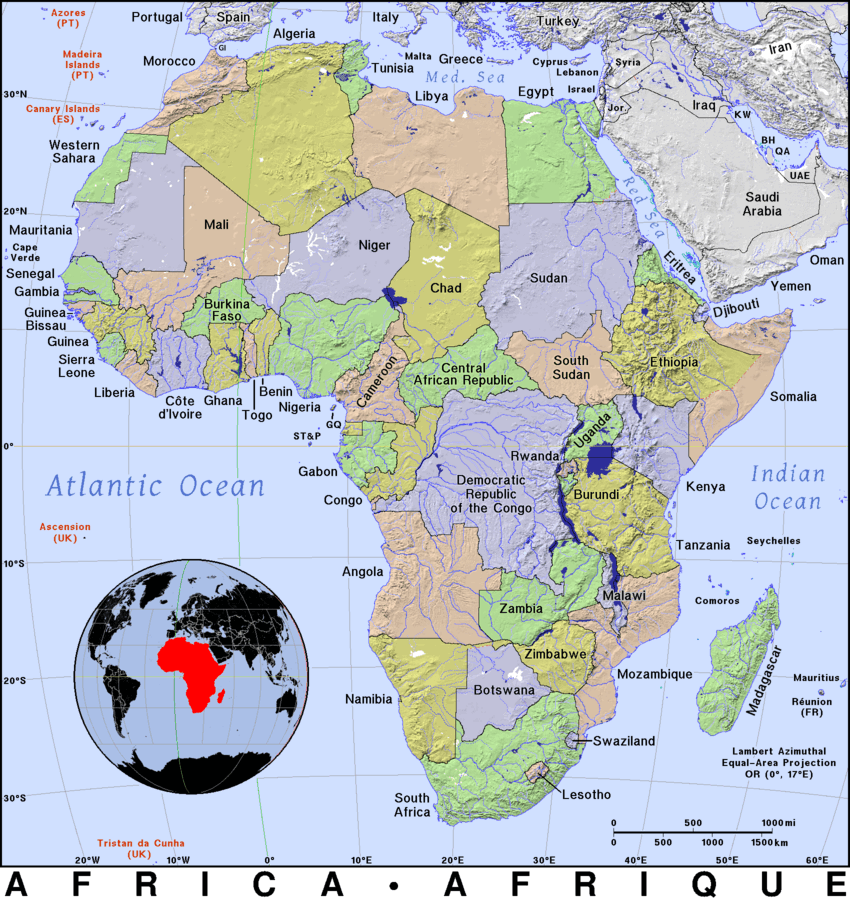
For connected-Africa to be a reality, the playground of new submarine cables, terrestrial networks and datacenters must move beyond South Africa. The two countries set to gain prominence in 2019-20 are Kenya and Nigeria. Both countries land 6 submarine cables each, but differ significantly in terms of cross-border terrestrial fiber connectivity.

Figure 5

Source: https://ian.macky.net/pat/map/afri/afriblu2.gif

Kenya has a distinct lead with robust regional connectivity to Uganda, Tanzania and Rwanda through Liquid Telecom and Simbanet. That is being extended to Malawi, South Sudan, Ethiopia and Djibouti. WIOCC and SEACOM have also created terrestrial routes mirroring their subsea routes to provide connectivity to land locked countries. The provider oligopoly however keeps the market price of 1G and 10G links intimidatingly high.

Nigeria is lagging with respect to regional fiber connectivity. That’s despite the fact that Nigerian operators MainOne and Glo-1 own and operate private submarine cables from Nigeria to Portugal and the UK respectively. MainOne has pursued expansion through Camtel and Orange into Cameroon, Cote D’Ivoire and Senegal. Adding that to its existing links in to Nigeria and Ghana, along with cross-border fiber connectivity to 5 adjoining countries, gives MainOne a regional network spanning 10 countries. For its part, Glo1 operates only in Nigeria and Ghana; its recent focus was developing the Glo2 project, a domestic extension to address the Oil & Gas segment.

Webscale the big open question

Africa has made lots of strides in its international fiber connectivity over the last few years, but has far to go. Impending entry by the globe’s big webscale operators is likely to have a big impact on many markets by 2022, and the effect will filter across Africa in the years after. Between now and then, a lot will happen. One thing to watch is how webscale operators link up with regional telcos and carrier-neutral providers to accelerate their network expansion. Such partnerships happen in other regions too, but Africa will require more of them.

Cover image: Cape Town, South Africa (credit: Dan Grinwis)

Blog Details

Facebook stepped in it this time

Whether you’ve joined the #deletefacebook camp or not, it’s hard to deny that Facebook has dug a deep hole for itself this time.

Yesterday’s NYT report was a harsh assessment of the company’s trustworthiness. It’s worse when combined with the late September news that Facebook had “exposed the personal information of nearly 50 million users”. These two reports – and a range of more brutal looks at the company – highlight the risks of trusting any large company with your data, much less the volume and sensitivity of data which Facebook demands. For a company that relies almost entirely on advertising for revenues, this is serious.

Immensely profitable. Still.

Let’s not cry for Facebook though. It has had an incredible run. The company’s 12 month revenues have grown from under $30B in 2016 to over $50B for the period ended September 2018 (figure); even the relatively modest 31% YoY growth recorded in 3Q18 far outpaces most tech companies.

Facebook’s growth has delivered high profitability rates, whether measured by net margin (38% annualized in 3Q18) or free cash flow to revenues (34% in 3Q18). Its excess cash has allowed it to invest in both capex and internal R&D at relatively high rates. Facebook’s capex deployment ratio (capex to revenues) is now higher than most telecom operators, at 23%.

You could also argue that Facebook’s high rates of proprietary tech investments (R&D) and capex spend on strategic infrastructure (mostly data centers) have driven earnings – not the other way around. In reality, it’s probably been a virtuous circle for FB so far, but that has always remained dependent on its incredible growth rates in usage and ad dollars. As Facebook’s advertisers see millions of users quitting or spending less time on the platform, clicking on fewer ads, and turning fewer of those clicks into transactions – they will find new outlets. Amazon is counting on it, in fact, with its recent foray into ads, and it’s been successful so far.

(For more on Amazon’s strategy, see MTN Consulting’s Webscale Playbook: Amazon).

Effect on vendors

As the figure above hints at, Facebook spends big on the network infrastructure behind its business: for the first nine months of 2018, its capex on Network, IT & Software was $4.47B, about half of the company’s $9.6B total capex. Any slowdown in growth will eventually hit network spending.

Even if Facebook does some development in house, now including chips, it still buys lots of tech (hardware and software). Some companies & markets to watch:

Servers: Facebook works with several contract manufacturers in Taiwan for production, including Quanta Computer, Wistron, and Wiwynn. These companies may see the effects of any slowdown first, if new server orders fall due to slower traffic growth rates, and/or new data center opening dates are delayed.

Chips: as discussed in a previous blog, Facebook made the big decision to self-develop earlier this year. That offers a modest competitive threat to Nvidia, Intel, and Qualcomm. The economic and operational incentive to keep building its own chips hasn’t gone away since then. If any privacy concerns can be unearthed in the chip area, though, Facebook will certainly face them. More interesting is potential impact on Qualcomm. Facebook uses Qualcomm’s chips for the social media’s rural connectivity project, Terregraph. This program could be at risk, even after recent trials in Hungary, Malaysia, and Indonesia.

Subsea communications: Facebook is a founding investor/owner of five major submarine cables: Argentina-Brazil with Globenet, two transatlantic cables (MAREA and HAVFRUE) and two transpacific cables (JUPITER, and PLCN). These projects have long planning cycles and probably would not be affected by a FB slowdown. However, Facebook’s current search for the right cable investment in Africa may be delayed, or require more partners (Google, Microsoft and Amazon are also looking at the region)

Optical components: Lumentum, NeoPhotonics, and Applied Optoelectronics are FB’s main OC vendors; for the same reasons cited above, they could face some volatility in demand from Facebook.

Earnings calls over the next few weeks may be revealing.

Source of photo: Facebook

Blog Details

Alibaba aims to undercut US chipmakers’ dominance

Alibaba entered the club of webscale network operators (WNOs) developing their own chips recently, joining Amazon, Apple, Facebook, and Google. The Chinese e-commerce giant announced plans, in September 2018, to develop its own customized neural network chip, called Ali-NPU, to aid its growing cloud and IoT businesses. But unlike its WNO peers who want more flexibility and cost-efficiency in their operations by running in-house chips, Alibaba’s move is motivated by a grave external risk: the US-China trade war fallout.

A series of trade disputes set alarm bells ringing for Alibaba

Alibaba views its move as a precautionary response to a series of hostile trade events this year, starting with the leading US carriers, Verizon and AT&T, deciding to halt selling phones of the Chinese handset maker, Huawei, in January 2018.

Multiple factors were involved but there’s no doubt that the carriers felt pressure from the US government over national security concerns. This was followed by an even bigger move: an executive order issued by the US President, Donald Trump, prohibiting the Qualcomm-Broadcom deal in March 2018.

The order was driven by national security concerns over the deal’s (mainly indirect) benefits to Huawei and other Chinese institutions. The US Commerce Department’s April 2018 crackdown on the Chinese telecom giant, ZTE, seemed to be the final “wake-up call” for Alibaba. The Commerce Department imposed a seven-year ban on chipset exports to ZTE. The ban was based on some serious misbehavior at ZTE, not just a political stunt. While it was resolved in July 2018, for several months ZTE was forced to essentially cease operations.

ZTE’s problems highlighted how dependent Chinese tech companies remain on US firms in specific markets, including parts of the semiconductor industry. The aftermath of these events prompted Alibaba to pull back its overall presence in the US in June 2018, followed by scaling down expansion of its cloud business, AliCloud, in September 2018.

Alibaba goes rogue

Also at the end of 3Q18, Alibaba started to formalize its chip self-development plans.

The main one involves the recent launch of a semiconductor subsidiary, Pingtouge, that will start manufacturing AI-based chip, Ali-NPU, along with quantum computing processors in the second half of 2019. The subsidiary set-up comes close on the heels of Alibaba acquiring Chinese chipmaker Hangzhou C-SKY Microsystems in April 2018, to boost its chip production capacity.

Earlier this week, the US Commerce Department issued another export ban affecting Alibaba indirectly, this time on the Fujian Jinhua Integrated Circuit Company. Whether well-founded or not, this ban pushes Alibaba (and other Chinese WNOs) further down the road of self-development.

Global expansion unaffected

There are no signs that its supply chain headaches are slowing down Alibaba’s cloud construction efforts.

In fact, following its decision to scale back expansion in the US, Alibaba is looking at South-East Asia, India, and Europe as the “new target markets” for its cloud business. And the company has been aggressive about it – in 2018 alone, Alibaba launched five cloud data center operational sites across three international locations: the UK (2), India (2), and Indonesia (1). That explains the spike in annualized capex and capital intensity for the period ending 2Q18 in the figure below.

The capex growth trend is expected to continue in the medium to long run, given Alibaba’s data center buildout plans along with its efforts to disrupt industries such as hospitality, smart cities, and logistics. (For a complete analysis, see MTN Consulting’s Webscale Playbook: Alibaba, published October 2018).

US-based chip vendors feel the heat

With some semiconductor-related goods in the tariff list, the mounting trade friction between the US and China is making US-based chip developers nervous. That’s understandable as China buys chips more than any other nation in the world, accounting for 29% (US$100 bn) of the global demand for semiconductors, according to a 2016 study by the US Department of Commerce. The threat of new competition from China intensifies concerns.

One US-based vendor facing direct fallout from the ongoing trade dispute is Qualcomm. After the Qualcomm-Broadcom deal fallout in March 2018, another big-ticket merger deal involving Qualcomm became victim to the US-China trade spat. This time, China played spoilsport due to its failure to approve Qualcomm’s US$44 billion deal to acquire the Netherlands-based NXP Semiconductors in July 2018. Adding salt to the wounds, Qualcomm had to pay a massive US$2 billion termination fee to NXP Semiconductors for scrapping the deal.

Another issue is the US chipmakers’ high exposure to Chinese markets that makes them even more vulnerable to the situation. Qualcomm features here again, topping the list with a huge revenue exposure of 65% in FY17. Intel’s biggest market by revenues is China, deriving close to a quarter (23.6%) of revenues in FY17, while NVIDIA accounted for about a fifth (19.5%) of revenues from China during the same period.

US-based webscale operators (Amazon, Facebook, Google, etc.) efforts to design their own chips has already made some vendors nervous, and the trade dispute has only worsened this. Alibaba’s response with its chip push could just be the “tip of the iceberg” as more Chinese companies could follow suit; case in point being Baidu launching its own AI chip, Kunlun, in July 2018.

Beijing’s technology ambitions complement Alibaba’s move but challenges remain

China is looking to use its supportive domestic policies to close the technology gap with the US in the medium to long run. In line with this, it is investing billions of RMB in homegrown chipmakers such as Fujian Jinhua (from this week’s ban) and Tsinghua Unigroup. It also announced plans to create a US$47 billion fund in May 2018 to boost semiconductor industry, and is seeking to surpass the US as the global leader in AI by 2030. Alibaba wants to play a big part in effecting the transition. But this transition will require foreign technology and scarcely available talent.

(Photo credit: Alibaba)

Blog Details

Egypt’s new capital will attract new investment but also lock country into Chinese loans and technology

Egypt is building a new capital city on a desert plot between the Nile River & the Suez Canal, to ease Cairo’s population boom. Labeled “the first smart city in Egypt,” the new, unnamed city ultimately aims to house nearly 6.5 million people. Chinese bank loans are paying for 50-70% of upfront costs. Across the project’s two phases, total costs will reach US$45B. This is an ambitious project, and one of several “megaprojects” being pushed by President Sisi, with Chinese backing.

A loan is a loan

China isn’t actually paying for anything though. While Chinese bank loans may be big, they are still loans, and they come with strict terms. The new capital’s electric rail project is typical: Chinese banks are lending funds only to buy Chinese equipment; the Egyptian side needs to fund the remainder. Interest rates are rumored to be reasonable, around 2-3%, but repayment on the new capital loans begin in late 2019-early 2020, based on the 36-42 month grace period.

And three years grace period isn’t nearly as much as it sounds, with a project this big.  The country’s economy has bounced back since its Nov 2016 IMF bailout, but can’t afford an economic slowdown. Egypt’s portion of project costs are to be funded by selling land in the new capital to property developers.  It’s easy to imagine a worse case scenario for the government, where recession hits Egypt in 2019, property developers go bust in the new capital, relocation rates dwindle, and the government has trouble paying back China in 2020 and beyond. The implications of that are stark.

The new capital: phase 1 targets basic infrastructure 

The “owner” of Egypt’s new capital is the Administrative Capital for Urban Development. ACUD is in charge of both initial construction and management. It has two shareholders: 51% is held by an affiliate of the Ministry of Housing, known as the New Urban Communities Authority (NUCA). The remaining share is held by the Army. ACUD was created with an injection of capital roughly worth US$10.3B.

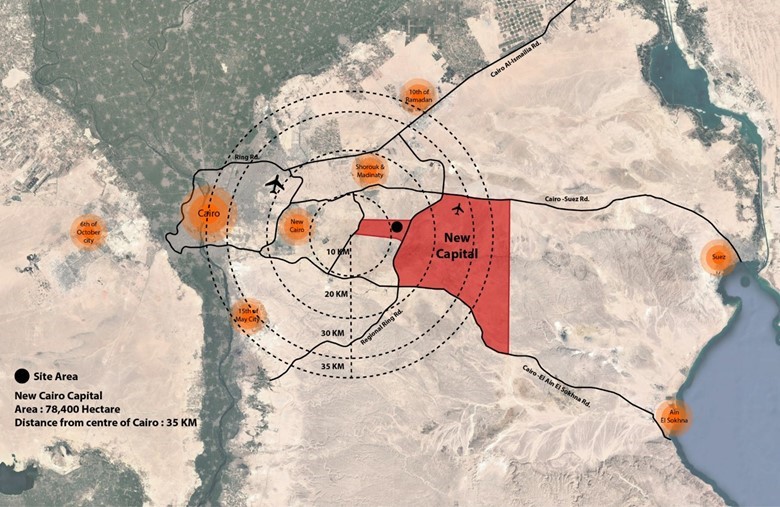
The new capital has been allocated an area of land roughly equivalent to Singapore, or 170,000 “feddans” in local terms.  This plot of land is located about 45km east of central Cairo, and 80km west of the Suez canal.

For Phase 1 of the new capital project, only a portion of the land area is being developed. The initial focus is building a central business district (CBD), local and regional transport (roadways, tunnels, bridges, an airport and a light rail to Cairo), residential real estate complexes, and shopping malls. Communications infrastructure is also part of phase 1.

Telecom market liberalizing but TE still protected

Egypt’s government has liberalized its control of the sector cautiously over the years. The government retains an 80% stake in Telecom Egypt, 13 years after its IPO.  Since this IPO, competition has been introduced slowly in Egypt, and TE has been protected along the way. Even today, for example, TE is the only operator in Egypt allowed to install or operate commercial fiber networks.

TE remains the largest of Egypt’s four operator groups, along with the local units of Etisalat (UAE), Vodafone (UK), and Orange (France). The four accounted for a total $3.7B in telecom revenues for the last twelve months (LTM) covering 3Q17-2Q18.

Egypt’s incumbent operator retains over 90% share in the fixed line market. In mobile services, TE was given a 4G license ahead of its rivals in late 2016 and launched mobile services on its own network a year later.  TE still offers 2G/3G services through Vodafone Orange, in which it owns a 45% stake. The government-TE connection remains important context for the Egypt telecom market.

TE accounts for over half of Egypt’s capex

Most of Egypt’s communications infrastructure is built and owned by the top four providers. Aggregating capex from 2011-2Q18, TE accounted for 29% of the $9.6B total, followed by Vodafone Egypt and Etisalat (26% each), then Orange (19%). TE’s capex has come to dominate in the last two years, fueled primarily by DSL and 4G/LTE infrastructure buildouts, as well as international transmission (Figure 1).

Figure 1: Egypt telecom capex by operator (% total), last 5 annualized periods

Source: MTN Consulting, LLC

Smart city in the desert

Egypt’s new capital is being built in the desert, in an area with almost no fixed physical infrastructure. The capital’s property developers are eager to boast of advanced connectivity and services in order to attract new customers. The basic connectivity goal is multiple layers of high-speed broadband access: FTTH/B to every premise, 4G wireless enhanced by small cells, and public WiFi. Project officials have also noted the importance of cloud connectivity, and are interested in attracting more data center investment to the region, including to the new capital. This will be a “smart city” relative to some others in the region, but won’t be comparable to more experimental projects like Google’s Sidewalk Labs.

Earlier this year, an Egyptian firm was hired to come up with a design for the new capital’s telecom network; more will be known about the results in the months ahead. One near certainty is that China will supply most of the technology; already, Huawei supplied most of the gear used by the University of Canada’s new branch in the new capital.

China raising its profile with the city’s Phase 2

While the city’s communications infrastructure is unsettled, construction for Phase 2 of the new capital is already underway. China remains the driver.

For the CBD expansion part of Phase 2, China Fortune Land Development (CFLD) has already won the construction project, per press reports.  To fund this, new capital officials have been negotiating with the three big Chinese banks regarding a $3.2B loan package. The actual loan terms are still in flux though, and apparently to be finalized by end of 2018. That isn’t stopping CFLD and other Chinese companies from actively pursuing other opportunities related to phase 2, including a petrochemical refinery.

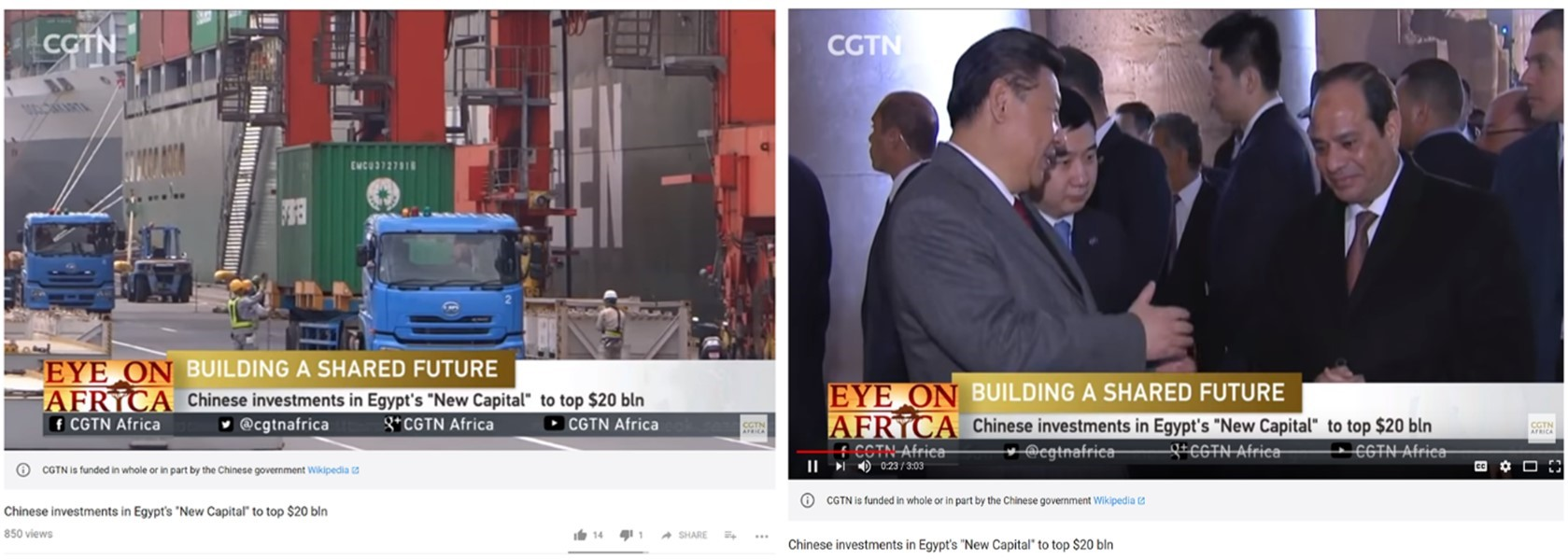
Beyond the new capital, Chinese banks are active investors in Egypt; that has accelerated with Xi Jinping’s “One Belt One Road” campaign (aka Belt and Road Initiative). For instance, the National Bank of Egypt borrowed $600M from the China Development Bank last month.  However, Chinese interests have not taken over; multilateral institutions remain crucial. Most important, the IMF continues support for its original $12B bailout package. The World Bank loaned Egypt $1.15B earlier this month.  Numerous private banks around the Middle East and beyond are important creditors to the Egyptian government as well. China Inc, though, is making a concerted effort to convert its investment into local political influence – through promotional videos, for instance (Figure 2). Most tactics are less visible.

Figure 2: China’s “Building a Shared Future” pitch

Source: youtube.com

China is working hard to reassure OBOR countries that its intentions are pure, focusing on the positives of such projects as the new capital, minimizing such risks as debt traps. Until mid-2018, it was working very well, but more attention is being paid now.  Technology suppliers eager to have a fair shot at projects like the new capital will have to pay attention, too.

–Source of cover image: http://www.acud.eg/


Blog Details

Can India use 5G to improve local vendors’ position in global supply chains?

In the six years since India’s last telecom sector reform, operators have made big investments in their networks, the country’s subscriber levels have grown, and prices have declined. 4G is now well established, and fixed line broadband finally has decent prospects .

Local (aka indigenous) vendors have sat on the sidelines, unable to keep up

While telecom has grown in India, local suppliers have not. India has many globally competitive companies in the IT services and software space, such as TCS, Wipro and Infosys. But hardware manufacturing remains a challenge. The bulk of telecom capex goes to foreign vendors, who dominate Indian markets for wireless base stations, transmission equipment, and data/IP gear. Most local equipment vendors, such as ITI, HFCL, and even Tejas Networks, rely heavily on government set-asides.

This imbalance is reflected in trade data. Over the 5-year 2013-2017 period, imports of telecom equipment were an astounding $58B more than exports in India. Imports have been 10x the value of exports, or higher, in the last three years. (Figure 1).

Figure 1

For the 2012-14 timeframe, 4G network equipment accounted for a good chunk of the deficit. Since then, the smartphone boom has driven deficits higher. Indian regulators started addressing this in 2017, by imposing a 10% duty on smartphone imports. That has been increased twice, and is now at 20%.

The import duties have encouraged foreign device companies to increase local production. That includes an announcement last week from Xiaomi: its supply partner Holitech Technology will build a factory in Tirupati, employing up to 6,000, and producing camera modules, transistors, touch screens, flexible PCBs, and sensors. This adds to Xiaomi’s already significant local production in India. Samsung, Huawei and others also have facilities.

However, even with some handset production now done in India, much of the value added still comes from overseas. Per Ministry of Commerce trade data, parts account for 30-40% or more of total telecom equipment imports (in value). High-end components for handsets are one part of this. The same issue arises with production of network equipment (e.g. routers): even when produced locally, many of the component parts are imported. That includes semiconductor content in particular.

Further, when foreign vendors set up factories in India, it’s generally to sell gear into local markets, not for exports. There are notable exceptions to that, some in the network infrastructure space: for instance, Ericsson’s Pune plant exports microwave gear to Africa, Southeast Asia and other markets. But the value of these exceptions are small, relative to the huge volume of locally produced & sold gear.

Regulators try again: TRAI’s latest report

As India’s telecom deficit has grown, the government has not ignored the problem.

In Sept. 2017, the Telecom Regulatory Authority of India (TRAI) issued a consultation paper, on the topic of promoting local manufacturing of equipment. The paper addressed the trade deficit issue, and highlighted as the primary cause “relentless” competition from China, “known for large-scale production and export of low-cost equipment”. Imports from Sweden, Finland and America were secondary factors.

Earlier this month, the TRAI concluded its inquiry on the topic. The final report is a comprehensive assessment of the factors limiting India’s ability to compete in telecom equipment markets. The document is impressive as an analytic effort. It identifies a wide range of factors & prescribes recommendations in each area: from university training to patent protection to customs reform to the creation of a number of new boards and agencies.

However, it lacks focus. It suggests doing a bit of everything, and with little new funding: for example, the TRAI’s recommended “Telecom Research and Development Fund” (TRDF) would be equipped with $170M at the outset. That’s better than the status quo, but hardware startups are expensive. One of the smaller US venture capital funds focused mainly on communications technology, Kodiak Ventures, manages $681M or roughly 4x that of the proposed TRDF. The most promising India-based startups are not likely to work with a government VC fund that cannot offer competitive levels of funding and other support.

5G is an opportunity, in theory

In the near term, one intriguing opportunity for vendors – whether local or not – is in fixed broadband, where FTTx rollouts are underway at several companies, including Jio, Bharti Airtel, and BSNL. In the longer term, the shift to 5G is a far bigger opportunity.

While India was late to 4G, policymakers hope to change that with 5G. As India’s Telecom Minister, Manoj Sinha, stated recently, “We missed [the] 2G, 3G, and 4G bus but we are not going to miss [the] 5G bus. A lot of work has been done in our department” to ensure that.

India’s Telecom Secretary, Aruna Sundararajan, has been outspoken in saying India should embrace 5G aggressively, not just for services but to help develop India’s export sector. She is also plugging C-DOT as a technology developer. At the MWC event in Barcelona this year, she met with a number of global tech vendors, commenting that “all the players are positioning themselves for India as a big 5G market. One of the leading chipset [suppliers] in a meeting told us that India will have one of the biggest IoT user base[s] and the company is keen to partner with C-DOT for developing various IoT solutions.”

Beyond enthusiasm, the government is making some modest direct investments in 5G. For instance, C-DOT announced in Feb 2018 that it would set up testbeds in Delhi and Bangalore, led by Anurag Gupta (who attended MWC for C-DOT). The goal is to set up the testbeds in phases, starting with the first in Dec. 2018. C-DOT also signed agreements in June 2018 with three UK universities to conduct joint 5G R&D in several areas, including massive MIMO and mmWave.

In addition, India’s IITs recently announced a 5G commitment from the Telecom Department. Press reports suggest a budget of ~$75M, supporting the work of around 200 engineers.  The IIT 5G project will create testbeds across all 5 IIT campuses. At its Delhi campus, IIT will also work with Ericsson on a new 5G “Center of Excellence,” focusing on massive MIMO R&D.

C-DOT could play an intriguing role

The TRAI report suggests creating several new boards and councils, some multi-agency. To a skeptic, this sounds like a recipe for delay and indecision. That same skeptic might wonder if India already has a well-established organization charged with the development of local telecom equipment production.

The Centre for Development of Telematics (C-DOT) is an autonomous agency of the Indian government focused on R&D in the area of telecommunications. It has just over 1,000 employees across two main R&D campuses, in Delhi and Bangalore. C-DOT develops technologies & licenses them to both government-supported entities such as ITI, and local private sector companies like Tejas Networks.

C-DOT’s employee count has grown in recent years, and it has picked up the pace of its transfer of technology (ToT) announcements. Recent policy changes give C-DOT the charge to seek out overseas business more actively.  Under the government’s “Synergy Plan” released in January 2018, C-DOT is to work with ITI and Telecommunications Consultants of India Ltd (TCIL) on future exports of products & services. That includes granting a manufacturing license to ITI for C-DOT’s terabit router.

Several C-DOT partners, including ITI and BEL, are actively looking to increase exports with the help of C-DOT product. C-DOT executives have appeared recently at public conferences, making a direct pitch to help Indian manufacturers increase exports.

R&D wholesale model, limited funding both need to be addressed

While C-DOT has potential to contribute to 5G and other areas, it is currently viewed as merely a government R&D institute, in effect a wholesaler of R&D to local vendors. C-DOT’s manufacturing partners are responsible for implementation and customer support. To thrive, C-DOT will have to participate more fully in individual projects, getting their hands dirty and talking to customers. After all, many vendors – notably Huawei – include R&D engineers in all aspects of the process, through field deployment and maintenance. India’s vendors can’t just rely on an R&D outsourcing body, and one which licenses its products to multiple players. For C-DOT to help Indian industry drum up more overseas business, functional changes will be needed, along with significantly more funding. As a reference point, C-DOT’s entire budget for fiscal year 2016-17 was about $60M. In 2016, Huawei spent $32M on R&D per day.

-end-

Email Matt

Image credit: Shutterstock

Blog Details

Jio sends shock waves across the telecom industry with new FTTH broadband service and JioPhone exchange offer

The recently concluded Annual General Meeting (AGM)1  of Reliance Industries is sure to leave Reliance Jio’s competitors in jitters, as Jio unveiled plans to roll out optical fiber to the home (FTTH) across 1,100 cities in India. Its commercial launch is planned for December 2018. At the same meeting, Jio announced a JioPhone handset offering which will be a major threat to many small handset manufacturers.

Despite not being currently active in the fixed broadband market, JioFiber will benefit from Jio’s wireless internet market share (ranked #1 as per TRAI based on subscriber base) 2. Jio’s recent acquisition of distressed carrier Reliance Communications is also a plus. However, Jio will face hurdles initially given the challenges of underground fiber installation.

Jio hopes to replicate its wireless success with GigaFiber 

After growing from zero to 215 million wireless users in just 22 months on its new 4G network, Jio already has everyone’s eyebrows raised. Jio has now shifted its focus towards its FTTH broadband service via ‘Jio GigaFiber’. The fiber service includes Jio Giga TV, smart home accessories and a landline connection. Jio’s FTTH rollout could kickstart the local broadband market, where penetration is low. TRAI’s March 2018 data estimates that India had only 21.2 million fixed broadband internet users – as against 472.7 million mobile data users.

While Jio is new to the fixed market, Jio has been installing fiber aggressively for the last 4 years. Its fiber optic network now spans over 300,000 kms. That includes metro and access fiber designed to support an eventual FTTH offering. This should allow Jio to differentiate from other Indian operators, which tend to provide fiber optic cables only to the building, and use a variety of technologies for customer access (VDSL, Ethernet, WiFi etc). Jio’s fiber will instead be connected directly to the user’s CPE. Jio does have competition, though. Airtel launched its vectorization-based service, V-Fiber3, in Pune in late 2016. V-Fiber offered up to 100Mbps at launch, but Airtel recently announced upgrades to bring maximum speeds to 300Mbps over W-Fi.

The effect of Jio’s broadband launch is also being felt on the leading fixed player, BSNL, which slashed its broadband plans soon after Jio’s FTTH announcement. In June 2018, BSNL launched two FTTH monthly plans with promotional rates of INR777 ($11.3) and INR1,277 ($18.6) at a speed of up to 50 Mbps and 100 Mbps, respectively. Similarly, Airtel responded to Jio’s fiber announcement by withdrawing FUP (fair usage policy) limits on its fixed broadband plans. Airtel’s 100Mbps monthly broadband plan is priced at INR1,299 ($19.0), and includes a subscription to ‘Amazon Prime’. From an internet speed standpoint, Jio still stands tall as it aims to offer internet speed up to 1Gbps.

Operator Monthly price (INR) Monthly price (USD) Data speed (Mbps) Data cap (GB)
BSNL 777 11.3 50 500
BSNL 1277 18.6 100 750
Airtel 699 10.1 40 3,333
Airtel 1299 18.96 100 3,333


Jio’s purchase of RCom assets will accelerate FTTx network expansion

Last December, RCom announced the sale of its assets to Jio for $3.75 billion4. If the deal goes through, Jio will gain vital assets in the form of spectrum, towers and fiber. The acquisition will also bring opex savings for Jio, as it will avoid some tower related rental expenses. Jio already has 300,000 km of fiber, but this deal will result in addition of 178,000 km of optic fiber to its portfolio. This will help Jio cover a broader section of the population.

Jio’s rich fiber base positions it well for a push into quad play, but the company is sure to face several challenges in FTTH deployment. A major hurdle is getting approvals from state governments and officials for laying fiber and securing the requisite Right of Way (ROW) permits. This process not only delays execution but also increases the cost of implementation. Operators face these challenges elsewhere, but India’s permit process is especially burdensome. The World Bank’s “Doing Business” report5, for instance, places India as nearly last (181st place) among all economies in terms of construction permit process effectiveness. This has contributed to India’s slow fiber rollout.

Moreover, FTTH investments require huge capex especially in rural areas where the penetration is staggeringly low in comparison to national average. Government-supported fiber deployment efforts have struggled in the past, due in part to lack of funding. But the 2014 change in government helped expedite India’s national fiber optic network, now called Bharat Broadband Net Ltd (BBNL)6. This government company aims to rollout 1 million kms of fiber across 250,500 villages by March 2019. This is good news for Jio, and other private operators in need of fiber to fill in FTTH coverage gaps.

Jio continues to disrupt the mobile market, too, with JioPhone offering

The FTTH announcement was not the only news to emerge from Jio’s recent annual meeting. The company also revamped its branded feature phone, the JioPhone.

In July 2017, Jio began selling the JioPhone. The first year of sales was lacklustre, due to a high price point, and non-availability of basic apps. Jio has now addressed both these issues. Through an exchange offer, the device will just cost INR501 ($7.2) – refundable after 3 years of purchase – and will soon support three of the most popular Android apps (WhatsApp, YouTube and Facebook).  Jio is also bundling the device cost with a new ‘Jio SIM”, which includes a prepaid recharge plan valid for six months at just INR594 ($8.6).

When the JioPhone was launched a year ago, Airtel and Idea responded with affordable smartphone offers. They partnered with Karbonn and Itel, respectively, to offer low-end smartphones and with cashback offers. It made sense back then as users could own a smartphone at a slightly higher price than that of JioPhone. But with Jio’s new launch, low-end smartphone makers will have to revamp their pricing model as any handsets costlier than the JioPhone might struggle to find buyers.

Jio also announced release of its top-end variant in the smart feature phone segment – JioPhone 2 – to be launched on August 15th. Priced just at INR2,999 ($43.6), there are not many phones available in this price range. However, a closer look at the phone’s features suggests little difference between the old JioPhone and the JioPhone 2. Apart from a four-way navigation pad and QWERTY keyboard option (which has lost its appeal with the arrival of large screen smartphones), the features of both the phones are similar. They have the same processor, internal storage and RAM, too. The immediate competitor for JioPhone 2 is Airtel’s Karbonn A40 4G7, currently available at INR2,649 ($38.5) on Amazon India. In terms of display and design, it surpasses JioPhone 2 with a 4” IPS LCD display and a resolution of 400×800. However, Karbonn A40 4G fails to impress in terms of battery capacity. With a battery of 2000mAh, JioPhone 2 can last up to 14 hours – whereas Karbonn A40’s 1400mAh battery may not even last for half a day.

At present, 12% of Jio’s total mobile phone subscribers (or about 25 million) are using JioPhone. Jio aims to quadruple its base of JioPhone users to 100 million in the shortest possible time. Though this may seem a tad ambitious it is certainly achievable. Jio’s subsidized device cost and low-priced prepaid recharge plan will be appealing in a market with a limited supply of affordable 4G handsets.

References

  1. Reliance Industries 41st Annual General Meeting (AGM)
  2. TRAI, June 27, 2018
  3. Airtel launches ‘V-Fiber
  4. Reuters: India’s Reliance Jio to buy RCom’s wireless assets in $3.75 billion deal: sources
  5. World Bank’s Doing Business report
  6. Firstpost: Indian government to launch the second phase of BBNL project 
  7. Airtel partners with device manufacturers to offer 4G smartphones