
Blog Details

Rocky path ahead for China Tower as it looks to go public

Mobile tower infrastructure provider China Tower has won approval in Hong Kong for an IPO in what bodes to be the largest IPO in Hong Kong since 2010. Speculation is rife that the IPO could raise up to $10 billion for China Tower. That’s over twice the IPO of Chinese device maker Xiaomi which raised about $4.7 billion in its Hong Kong debut.

Background

China Tower was established in 2015 as part of a government-mandated spin-off exercise. Following transfer of the ownership of the nation’s “Big Three” operators’ tower infrastructure, China Tower was valued then at US$36 billion. Each of China’s major mobile network operators (MNOs) now own a stake in China Tower and get quarterly dividends from their ownership stake in China Tower. The shareholding structure post the deal completion was as follows: China Mobile (38%), China Unicom (28.1%), China Telecom (27.9%) and China Reform Corporation (6%).

The government’s primary motive in creating China Tower was to bring greater efficiency into the sector, freeing up capital for the telcos to make higher value investments. Another key goal is to encourage China Tower to diversify into new service areas & end user markets.

China Tower’s stellar 2017 faces challenges in 2018 as leasing rates decline  

China Tower is the largest tower infrastructure provider worldwide, with a portfolio of 1.9 million towers and 2.7 million tenants. Further, China Tower is buoyant as 4G remains a strong impetus behind mobile data consumption. This trend is reflected in its 2017 results (see Figure 1) as it recorded an operating margin of 11.2% compared to 9.1% in 2016; and its revenues were up 23% reaching CNY68.7 billion ($10.6 billion).

Figure 1
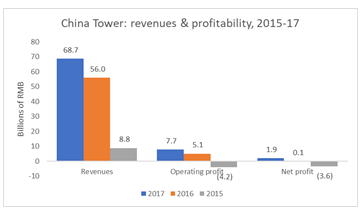
Source: China Tower’s IPO filing

Despite the strong 2017 results, China Tower has some risks on the horizon.

China’s three main telecom network operators (TNOs) have shared infrastructure-related costs for several years through a joint network sharing agreement. The goal was to cut redundant cost towards construction of towers. This agreement predated the creation of China Tower as an independent entity. In the last year, however, China’s operators have faced rising leasing costs. China Mobile and China Telecom’s tower leasing expenses as a percentage of total opex (excl D&A) were 7.8% and 5.8% in 2017, for instance, up from 6.2% and 4.5% in 2016. China Unicom’s tower leasing expenses as a percentage of total opex (excl D&A) also rose from 7.6% in 2016 to 8.5% in 2017.

The jump in leasing expenses has compelled the operators to renegotiate their tower rental agreements with China Tower.

Figure 2
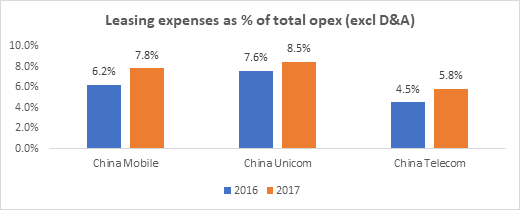
Source: 20F forms filed with the SEC.

Price negotiations aren’t easy for China Tower, since the big three operators are its customers as well as shareholders. The Feb 2018 tower leasing charges suggest that China Tower was too generous in its pricing to the operators. The tower company reduced the mark-up margin rate (a fee charged over and above the overhead costs) of its 5-year agreement from 15% to 10%. It also agreed to provide discounted rates for co-tenancies on towers. It agreed to offer a 30% discount (up from 20%) in its pricing if the site is shared by two operators; and up to 40% discount (up from 30%) for more than two operators. The lower rental fee agreements will have an impact on its profitability which can only be seen when the IPO is out.

Growth in small cell & DAS segments are a silver lining for China Tower

5G networks in China are slated for commercial operation starting no later than 2020. In fact, China Mobile is on track to beat this, as it plans to launch 5G in 2019 itself by partnering with Viavi Solutions. According to Ericsson’s latest report, by 2023 China will add more than 300 million mobile data subscriptions, driving data traffic up to 18EB per month. This promises huge demand for large scale network build out which suggests more business for China Tower.

Figure 3
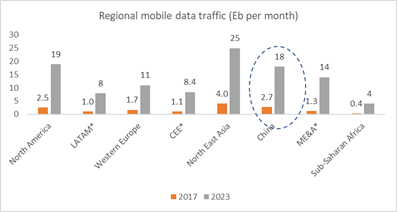

Source: Ericsson Mobility Report – June 2018.
Note: LATAM=Latin America; CE&E= Central and Eastern Europe; ME&A= Middle East & Africa

In the infant stage of commercial deployment, both 4G and 5G network will co-exist. Wireless networks need to improve their network density, though. Typically, 5G networks will operate on millimeter spectrum (3–5 GHz spectrum bands) which need higher frequency reuse, and this suggests more base stations to match the same level of 4G coverage.  For the MNOs, apart from improving the density of 5G macro cells they also need to utilize small cells and distributed antennae to supplement coverage. This promises huge growth potential for China Tower’s small cell business, which commenced operations in 2017. Moreover, China Tower already has 16,798 DAS sites and recorded exponential revenue growth since 2015, from CNY45 million ($6.7 million) in 2015 to CNY1,284 million ($192 million) in 2017. With the growing demand for wireless coverage inside buildings and tunnels, the future for this segment looks promising for China Tower – which currently contributes a meagre 2% to the revenue.

US-China trade war is bad news for the Hong Kong IPO market

While China Tower gears up for its IPO, it remains cautious about timing: Hong Kong’s financial exchanges will be impacted from the ongoing trade tussle between China and the US. China’s telecom industry is already facing the heat due to tariffs imposed on Chinese imports to the US. This is a setback for the operators as this would mean increased equipment costs, resulting in a possible decline in their profitability. The after-effects to this will also be felt by China Tower, as the big three operators are its major shareholders. The growing trade war between China and the US will also lead to continuous market volatility (at least till the end of 2018) which will significantly impact the Hong Kong IPO market. This was already seen to some extent in Xiaomi’s IPO filing. Early this year, there were rumors that Xiaomi’s IPO would be valued at nothing less than $10 billion, but it managed to raise just about $4.7 billion. Nonetheless, it remains the biggest IPO since 2014.

China Tower will likely experience a daunting task ahead especially with the US-China trade war looming over Hong Kong stocks. And Trump’s recent move to block China Mobile from the US market on security grounds comes as another sign that the trade dispute between the nations will not end anytime soon.


Blog Details

Alibaba Takes On Amazon, Google, And Microsoft Head-On In India’s Cloud Market

It’s a battle between the emerging giant of the east and the pioneers of the west in the highly competitive Indian cloud computing market, as Alibaba prepares to take on the “big three”: Amazon, Microsoft, and Google.

The Chinese ecommerce behemoth, which announced international ambitions for its cloud business (called Alibaba Cloud/AliCloud or AliYun) in 2015, recently launched a cloud data center in Mumbai, India. Alibaba has been active in India since 2007, but this data center is the first notable cloud investment made by any Chinese player in India.

Alibaba’s decision to open an India-based data center looks like a step to kill two birds with one stone: grab cloud market share from the big three, and, allay data privacy fears by establishing a local data center. This was a logical move, and low risk given the company’s deep pockets; it has over $33B in cash & stock on hand. Alibaba’s progress in India’s SME segment is worth watching over the next few quarters. Alibaba aims to be a top global cloud player, and India is one important testing ground. It will also test Alibaba’s ability to navigate some messy international political conflicts.

AWS, Azure, and GCP all opened data centers in India in 2016-17

Global cloud giants Amazon and Microsoft continue to scale up their cloud businesses in India: Amazon pumped US$215 million mid last year into its Indian data services arm, which offers cloud computing solutions. Microsoft recently partnered with the Indian ecommerce giant Flipkart and ride hailing services provider Ola to provide custom solutions via its Azure platform. Google completed three data centers across India in 2017.

The table below summarizes the India presence & cloud capabilities of the world’s largest webscale network operators. Amazon, Microsoft & Google are shown first, as they have the largest presence locally, followed by Alibaba. Apple, Facebook, Baidu, and Tencent each have India operations but no local data center (yet).

Table 1: Webscale network operators in India: local presence & data centers

Company Commercial Operations Network Infrastructure
Amazon
  • Amazon India opened June 2013
  • Acquired local payments company Emvantage Payments Pvt. Ltd. in 2016
  • AWS India has six office locations in Bengaluru, Chennai, Hyderabad, Mumbai, New Delhi and Pune
  • Launched its India network with two data centers in Mumbai in 2016
  • Since the launch, AWS customer base in India grew by more than 50% from 75,000 in 2016 to 120,000 in 2017
Microsoft
  • Active since 1988
  • 6,500 employees
  • First of the top three cloud vendors to launch cloud data centers in India at three locations in 2015: Pune, Chennai, and Mumbai
  • Serves Central India, South India, and West India regions respectively
  • Provides all three forms of cloud: public, private and hybrid
  • Has more than 9,000 cloud partners in India
Google
  • Started operations in 2004
  • Approximately 1,850 employees
  • Launched its first cloud region in Mumbai, India in 2017, hosted across three data centers
  • Primarily serves West India and South India regions
Alibaba
  • Active in India since 2007, mostly through notable investments in online retail (Snapdeal), digital payments (PayTM), and online grocery (BigBasket)
  • First India-based data center launched in Mumbai in January 2018
  • Provides large-scale computing, storage resources, and Big Data processing capabilities
Apple
  • Started operations in 1996
  • Opened a development center in Hyderabad in 2016, and an app accelerator facility in Bengaluru in 2017
  • None in India currently
Facebook
  • Started operations in 2010
  • Has offices in Hyderabad, Mumbai, and Delhi NCR
  • None in India currently
Baidu
  • Launched its India office in Delhi NCR in 2015 which employs ~10 people
  • Claims to have 45 million active monthly users in India for its mobile applications
  • None in India currently
Tencent
  • Active since 2015 through investments in Indian startups such as Practo (2015), Hike Messenger (2016), Flipkart (2017) and Ola (2017)
  • Announced reviving its India business in early 2018, with an investment of US$200 million in gaming
  • None in India currently

Source: MTN Consulting

Alibaba is the only Chinese webscale provider with a data center in India.

Mumbai data center to support a range of cloud capabilities, including AI-based solutions

According to Alex Li (Asia Pacific General Manager – Alibaba Cloud), Alibaba’s new Mumbai facility is a “mega-scale” (aka webscale) data center that will cater to the regional customers in the Indian peninsula, and could support the regional cloud needs for the next 3-5 years. Prior to its construction, Alibaba provided services to a number of Indian companies through its data centers located elsewhere. Now Alibaba will be better positioned to serve these existing customers more cheaply and reliably, while offering localized services to address the increasing market demand from small and medium enterprises (SMEs).

The Mumbai data center provides a broad suite of cloud computing and data intelligence capabilities that include elastic computing, database, storage and CDN, networking, analytics and big data, containers, middleware, and security. In addition, Alibaba Cloud may introduce its proprietary AI-based offering, ET Brain, into the Indian market. ET Brain has applications in industrial manufacturing, city administration, urban transport, and logistics. This strategic step could help capture the lucrative infrastructure and government sectors in the country, as AliCloud has started to do in Malaysia where its City Brain AI-based offering is used to help ease traffic woes. Such an offering could play into the Indian government’s Smart Cities Initiative.

Alibaba will target the underpenetrated yet growing SME segment

In evaluating services, large enterprises tend to emphasize brand, reliability and global coverage issues. SMEs are more open to a new entrant, niche provider as long as the price is right. This is the case in India’s cloud services market. As cloud adoption rates grow in India, Alibaba sees an opening for itself in targeting the country’s 51 million-strong SMEs. This effort is a key part of Alibaba’s globalization strategy.

As a new cloud entrant, Alibaba needs to build its brand and customer confidence. Partnerships will help Alibaba build compelling service offerings. That’s especially important in the network space, where Alibaba needs on-ramps to its cloud network. Recognizing this, the Chinese cloud giant has partnered with Global Cloud Xchange (GCX), a subsidiary of Reliance Communications, to enable direct access to Alibaba Cloud Express Connect via GCX’s CLOUD X Fusion service. Prior to this, AliCloud relied on Tata Communications’ IZOTM Private Connect service.

But can it survive the increased scrutiny over data security concerns on Chinese players?

Alibaba’s reasonably priced offerings seem positioned well to gain interest in the Indian SME market. However, Alibaba is a Chinese company, and viewed as such by Indian government authorities. Many countries, including India, have raised concerns around data security and privacy in their dealings with Chinese tech companies.

Just a few months before AliCloud’s Mumbai data center launch, in fact, Alibaba faced a huge controversy in India: its internet browser offering, UCWeb, came under the Indian government’s lens for allegedly sending personal data on its Indian users to Chinese servers. Alibaba risked a ban if found guilty. A few months later, their mobile browser application was taken down from Google Play Store.

With this case fresh on the Indian public’s mind, Alibaba has worked hard to alleviate the fears of Indian customers and government authorities surrounding data security and privacy prior to its cloud data center launch. The company claims to comply with highest cyber protection standards recognized by a number of international organizations. For instance, Alibaba Cloud is the first Asian cloud provider to complete the assessment for the Cloud Computing Compliance Controls Catalogue (C5) set out by the Federal Office for Information Security in Germany with the additional requirements. This definitely boosts Alibaba’s credentials, as only five cloud providers, including Amazon and Microsoft, have obtained the C5 validation.

Blog Details

Facebook’s Plan To Design Its Own AI Chips Has Set Alarm Bells Ringing For Qualcomm, Nvidia And Intel

[Ed. note: see Sept. 2018 publication, Webscale Network Operators: 3Q18 Market Landscape]

Rumors about Facebook’s likely entry in the hardware segment were put to rest after the company posted job openings for chip designers. Facebook was looking for candidates specialized in architecting and designing ASIC and FPGA chips, to help build “custom solutions targeted at multiple verticals including AI/ML, compression, and video encoding.” Facebook has data center applications on the mind, such as live video content filtering, but the company may also be building chips to support its Oculus virtual reality headset and long-planned smart speaker.

Facebook’s chip plans are risky but may bring increased control over supply chain

Facebook’s recent move to make its own artificial intelligence (AI) chips and get a foothold in the hardware segment is a step in the right direction, as it looks to reduce dependence on chip manufacturers (Intel, Nvidia and Qualcomm) while putting a lid on its costs. However, designing a chip is by no means a simple task and not a core competency at Facebook. Matching the performance and efficiency of Intel, Nvidia and others will be a challenge.

Why would Facebook take the risk? It’s loaded with cash ($41.7B in Dec 2017) and used to making high-stakes tech investments. But the chip market is competitive, and Facebook has substantial buying power – it could certainly rely on the open market. Time to market may improve with self-design, for sure. However, another benefit may be more persuasive: Facebook gets greater control over intellectual property rights and information flow. It likely has a few surprises in store.

Big technology investments needed to support social networking

Facebook’s growth has been driven by acquiring and strengthening complementary services to its social networking business, such as WhatsApp and Instagram. Supporting this growth enticed Facebook to build a huge core network.

Like other webscale providers, Facebook works with contract manufacturers to build custom servers and other gear for their massive data centers. Facebook has played an important industry role in this regard, serving as an early sponsor for both the Open Compute Project (OCP) and Telecom Infrastructure Projects (TCP). Now Facebook is testing the waters in consumer electronics markets, initially with its Oculus virtual reality headsets, a smart speaker to be launched in 2018, and complementary AI software. These efforts have contributed to both high capital spending and R&D expenses at Facebook (Figure 1).

Facebook believes that creating its own custom designed chips will result in better integration of hardware and software, and give it tighter control over the development of the product. One factor behind Facebook’s chip push is an interest in running AI algorithms in-house, to avoid sharing with third-party vendors like Intel or Qualcomm. Not every webscale company can do this, but Facebook is positioned better than most due to its deep capex budget & its pioneering work at the OCP, TIP, and other groups.

Working in Facebook’s favor is its recent partnership with Intel to manufacture its own AI processor last year.

Impact of Facebook’s entry into the semiconductor space on the big chipmakers

In the past two years, there has been growing tension between the tech players building cloud networks and the vendors they rely on, mainly Intel, Qualcomm, and Nvidia. Historically the largest cloud builders, “webscale network operators” (WNOs) in our terminology, have heavily relied on Intel’s microprocessors and Nvidia’s GPUs to power their data centers (Figure 2).

However, Facebook is not the only WNO to look at building its own chip. Many webscale providers are starting to look in-house to build custom AI chips to reduce costs and improve on efficiency. For instance, Google developed an AI chip, Cloud Tensor Processing Unit (TPU), two years back, to boost its AI workloads. Google released a latest version this month, indicating that Nvidia’s dominance as a supplier of AI chips could soon be in jeopardy. Similarly, Apple plans to build its own chips for its Mac desktops by 2020, thus reducing its dependence on Intel. Amazon is building its own custom hardware to improve its Alexa enabled devices. Microsoft has launched a new cloud service for image-recognition projects powered by its FPGA technology, codenamed “Project Brainwave”.  This will rely on Intel Stratix 10 chips and support a neural network based on the ResNet-50 architecture. Microsoft claims that this new technology will be capable of handling AI tasks rapidly enough to be used for real-time jobs and at a reduced cost in comparison to the graphics chips (e.g. NVIDIA) used in machine learning tasks.

As webscale tech players build more of their own chips, traditional chip developers are getting nervous.

One company affected in a big way by Facebook’s move is Qualcomm. Facebook’s new chips may be used to power its VR headset, Oculus Go, which currently runs on a Qualcomm Snapdragon 821 chip. This could be a huge blow for Qualcomm. And it comes at a time when Qualcomm is already struggling after its legal battle with Apple, an attempted acquisition from Broadcom, and a still-pending merger with NXP.

The chip vendor’s fears are not just theoretical. Webscale players have already had an impact on the supply chain, hurting server vendors like IBM and HPE in past years by going to white box/contract manufacturing. Now they’re big enough to design their own chips. That cuts out the middleman, avoids having to share secret IP, maybe speeds time to market, and may result in some proprietary advances.

Facebook will have to win back faith amidst data privacy scandal

While Facebook engineers will continue to find ways to make their network cheaper and smarter, the company faces more complex challenges in the area of data privacy & public perceptions.

Facebook’s privacy practices have come under global scrutiny in recent months, due to the recent Cambridge Analytica and Android call data scandals, not helped by a photo tagging-related lawsuit. As a consumer-facing brand with plans to build its own IoT hardware, a lot is at stake. The company needs to build trust and improve transparency. It cannot do this while also maximizing ad revenue growth. Not all Facebook executives seem willing to accept this.

Amid all the public outcry, the launch of Facebook’s smart speaker has unsurprisingly been delayed. With recent news that Amazon’s Alexa has some interesting privacy-related glitches, Facebook’s decision is probably best. Now seems like a good time to focus on the basics.

Blog Details

Alibaba’s revenue growth from cloud rises steeply, as it looks to outdo Amazon and Microsoft

Top US-based tech providers Amazon, Alphabet/Google and Microsoft dominate the cloud space but they are set to face stiff competition from China’s leading cloud provider Alibaba.

MTN Consulting tracks these and similar operators of webscale (aka hyperscale) cloud networks as part of its “Webscale Network Operator” (WNO) market segment.

AliCloud launched nine years ago, now going global

Alibaba established its cloud computing division in 2009, three years after Amazon launched AWS, and went global by 2015. The Chinese company has set up data centers across the Middle East, Singapore, Japan and Europe through its cloud division (Alibaba Cloud, also known as AliCloud or AliYun). It has been ambitious from the start. In 2015, Simon Hu, President of Alibaba Cloud, predicted the company would surpass Amazon by 2019: “Our goal is to overtake Amazon in four years, whether that’s in customers, technology, or worldwide scale.”

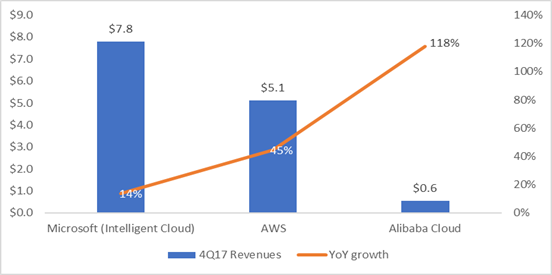
Simon’s goal may have sounded a bit far-fetched then, but with a whopping 118% YoY revenue growth from its cloud segment in 4Q17 (as shown in Figure 1), Alibaba is beginning to live up to its ambitions. While still small on an absolute basis, Alibaba has a history of rapid, aggressive expansion into new markets – it is a serious player in the cloud now.

Figure 1: Webscale network operators’ 4Q17 cloud* revenues (in US$B) and YoY growth rate

Source: company filings

Key takeaways from 4Q17 results

Fourth quarter earnings for top WNOs revealed continued strong growth overall, along with some competitive & strategic shifts. Highlights for the top few providers:

Amazon’s sales hit $60B in 4Q17, up 38% YoY, backed by strong sales in the holiday season, and its net profit was also up 148% in the same period. However, operating margins were low for Amazon’s North America segment, which in FY2017 generated just $2.8B in operating profit on revenues of $106.1B. Amazon Web Services (AWS) is a different story. AWS is Amazon’s cash cow business as it continues to generate profit for its group, despite incurring losses from its international segment. As shown in Figure 1, AWS segment’s 4Q17 revenues were $5.1B (up 45% YoY). In the same period, AWS’ operating profit was $1.35B (up 46% YoY) and was also a major contributor to the company’s overall profitability.

On an annual basis, the AWS segment recorded revenues of $17.5B in 2017, (up 43% over FY2016) and now contributes to about 10% of the company’s sales, from just 3% in 2011. AWS’ operating profit for full-year 2017 was $4.3B (with a margin of 25%), much higher than the 3% margin recorded by Amazon’s North America retail segment.

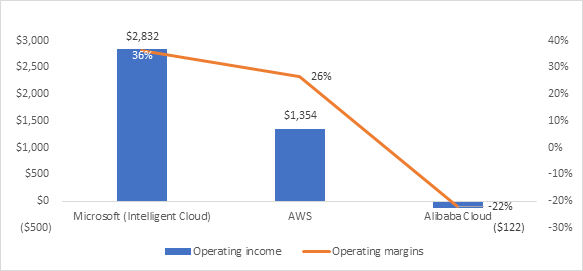
Figure 2: WNO 4Q17 cloud operating profit (US$M) and margin (profit as % of revenues)

Source: company filings

Microsoft’s revenues from Intelligent Cloud* were $7.7B in 4Q17, up 14% YoY. The majority of Intelligent Cloud revenues come from Azure, which grew by 98% during the same period. Intelligent Cloud operating profit was $2.8B, up 18% YoY, giving the division an operating margin of 36% (Figure 2). A key differentiator for Microsoft is its hybrid cloud strategy, which aims to help enterprise users exploit their legacy IT investments. It hit the right note with its acquisition last month of storage vendor, Avere Systems. This acquisition will further enhance Azure’s enterprise capabilities, as Microsoft can merge Avere’s storage capabilities into its own Azure cloud services. That will enable large and complex high-performance workloads to run in Azure.

Alibaba’s cloud computing segment recorded strong revenue growth in 4Q17 (up 118% YoY) but continued to incur losses from this division (Figure 2). In the same period, its cloud segment incurred an operating loss of RMB793M ($122M), and a negative operating margin of around 22%. Unlike Amazon and Microsoft, which generate a good chunk of profits from their cloud segments, Alibaba’s continual losses from its cloud segment are a reminder that its focus is on growth and not profitability. With a free cash flow (operating cash flow – capex) of over $7B in Q4’17, Alibaba has enough cash to plow into its cloud business.

Alphabet’s overall 4Q17 result was promising. Its 2017 corporate revenues crossed $100B for the first time, posting $32.3B in 4Q17 alone. This 24% YoY growth was mainly due to advertising and mobile search. For the first time, Google disclosed its cloud revenues, a little over $1Bn in 4Q17. That figure is lower than that of AWS and Microsoft Azure, but Google Cloud is relatively new. Alphabet has spent over $30B in capex in the last three calendar years, the bulk of which went to its data center and subsea cable network. Alphabet aims to leverage this investment far beyond search. It continues to connect new regions to its Google Cloud Platform, with data centers opening in the Netherlands & Montreal, Canada already this year. The GCP’s network now has 15 regions, 44 zones, and over 100 points of presence.

Alibaba will retain an advantage in China, and is now eyeing global expansion

The cloud computing business in China has long been dominated by domestic players, as the US tech giants find it difficult to make inroads due to the strict laws around censorship and content regulation. The recent stringent law around cross border data transfer will only make life harder for foreign cloud companies, as they are required to store data locally. That will benefit Alibaba, as well as the smaller cloud operations of Baidu and Tencent.

Further, the government restricts foreign ownership of cloud services in China, as they can provide services only via a partnership arrangement with domestic cloud providers in China. For instance, AWS is currently operating in China by partnering with Beijing Sinnet Technology (Sinnet), as AWS is banned from operating under its own brand name in China. In Nov 2017, Amazon sold its hardware to Sinnet, as the law prohibits foreign companies from owning technologies for cloud services. Along similar lines, Apple and Microsoft are currently operating in China through Guizhou on the Cloud Big Data (GCBD) and 21Vianet Group. With US cloud companies forced to wade through tricky regulatory waters in China, Alibaba again benefits.

Alibaba has invested heavily in expanding its network of data centers, and is developing its own proprietary technologies for the AliCloud (Figure 3). As part of its global expansion, India is an initial focus. This will not be easy, as Amazon is clearly the leader in the Indian market. And with Amazon’s failed attempt to flourish in China, the company has all the more reason to defend its turf in India. However, Alibaba has deep pockets and ambitions, too, as it launched a new data center in India in Dec 2017 and in Malaysia recently.

Figure 3: Self-developed infrastructure for the Alibaba Cloud

Source: Alibaba’s 2017 Investor Day.

At the recently concluded Mobile World Congress (MWC) in Spain, Alibaba made clear its intentions to compete in European cloud markets. At the event, AliCloud introduced several new cloud offerings aimed at HPC (high performance computing) workloads, and AI and other data-intensive workloads. To establish a supporting technology ecosystem in Europe, AliCloud is partnering with Vodafone Germany, the Met Office UK and Station F (a France-based startup company). Alibaba hopes to make commercial progress with these new services, and showcase its capabilities in the fields of AI and big data. Ultimately it aims to leverage innovations in these fields across multiple industries. AliCloud’s global expansion is off to a good start.


*Note: For this analysis, we have considered AWS revenue for Amazon and Google Cloud for Alphabet. For Microsoft, we considered total revenues for its Intelligent cloud segment, as the company does not report stand-alone revenues for Azure.


Blog Details

Commentary: US Senate Intel hearing & implications for Chinese vendors

What happened The US Senate Intelligence Committee held an open hearing on “Worldwide Threats” yesterday. Among many topics covered was the national security implications of US telcos deploying equipment from Chinese vendors. Huawei and ZTE, in particular. The six witnesses presented a united front on this issue, summarized best by FBI Director Chris Wray’s statement:

“We’re deeply concerned about the risks of allowing any company or entity that is beholden to foreign governments that don’t share our values to gain positions of power inside our telecommunications networks.”

NSA director Admiral Michael Rogers agreed: “You need to look long and hard at companies like this.”

What we think

The US market – still the world’s largest – remains largely closed to Chinese telecommunications equipment vendors. That’s despite multiple forays by the largest player, Huawei. Lack of access to the US market hasn’t stopped Huawei from growing into a giant, with 2017 revenues exceeding US$93B. And that’s part of the problem. If Huawei had a slim chance at US entry 5 years ago, that prospect is now more elusive.

While the US has been a problem, Huawei has succeeded in two similarly hard to tackle markets: Japan, where local suppliers once dominated, and the UK, where national security concerns are in theory similar. Huawei’s UK success may be due to smart politicking, but it was helped by the UK’s relative lack of a domestic telecom equipment market. (Sorry, Marconi). That’s not the case in the US. And the US has more at stake on the security front, given geopolitical rivalries.

With today’s hearing, it’s clear that things are not about to get easier for Huawei and ZTE, in (and around) the US market. Analysts & commentators can debate whether this is fair, but this is unlikely to change the outcome. An important question remains, though: what real tools do US policymakers have in this situation, given interconnected supply chains and Huawei’s already huge position globally?

Reference graphic

The below figure compares Huawei’s reported 2017 revenues with several other vendors supplying equipment to telcos. Total company revenues are shown, except for NEC & Fujitsu.

Sources: public filings and announcements

*Data covers most recent 12 month period publicly available.

Also see China Mobile to go (more) global?, or this article at devex: China’s role in the race to connect the next billion

Blog Details

Commentary: ZTE’s fixed broadband win at Rostelecom

What happened

Rostelecom recently awarded ZTE 70% of a large access network modernization project. ZTE will provide its C350M/C300M MSAN product for the first stage, using VDSL, and move to G.vectoring and G.fast in the second stage. Rostelecom is currently testing the proposed second stage solutions.

What we think

ZTE is one of the world’s largest network infrastructure vendors, and one of just a few with a full set of fixed broadband products. It’s a top supplier domestically, and has a large number of overseas broadband deployments. Many of ZTE’s international accounts are on the small side, though.

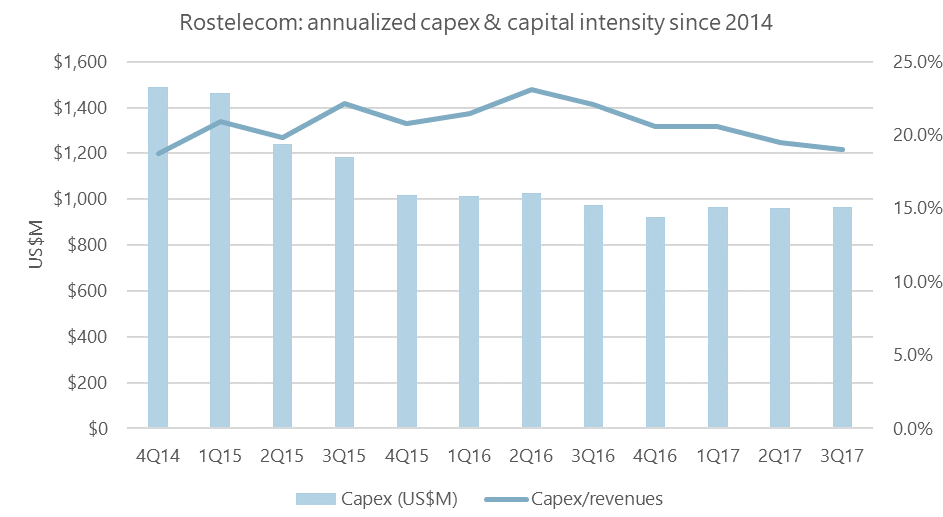
Rostelecom is Russia’s largest fixed operator, including in pay TV where it has over 10M customers. The company spent about US$1B on capex in the 12 months ended Sept. 2017. Capital intensity has fallen to about 20% (figure), but that’s still high by global standards.

This is a nice win for ZTE, helping it validate its fixed broadband credibility with a major account. Russia has faced political & macroeconomic turmoil recently, but it is a large market, and ZTE is one of only a few competitive vendors. Given the recent slowing of China’s infrastructure market, having a potential growth account like Rostelecom could come in handy for ZTE.

Reference graphic

The figure below illustrates Rostelecom’s annualized (12 month) capital expenditures (capex) and capex/revenue ratio (capital intensity) since 2014.

Source: MTN Consulting, LLC

Also see First few 3Q17 telecom vendor reports: YTD revenues down 3.4%, or this article from the Financial Times: Apple found guilty of price-fixing in Russia over iPhone prices


Blog Details

A Telecom Analyst’s Take On CES 2018

For most of my career, I’ve been focused on the telecom industry and its components. I’ve been to dozens of telecom-focused conferences & exhibitions, in Asia and the Americas. I had never been to a consumer-focused show, though. In order to learn a bit (and check out some cool new devices), I spent a few days at CES in Las Vegas last week.

It was as chaotic as promised, but also a geek’s paradise. Loads of new tech was shown off in AI, IoT and smart cars. Telcos had a limited presence, but another type of network operator – those building webscale networks – was well represented.

Webscale at CES

Of the biggest companies building webscale networks, most had some sort of CES presence.

As covered widely elsewhere, Google’s Assistant and Amazon’s Alexa were hard to hide from, and overpowered Microsoft Cortana’s limited presence. Apple’s late 2017 decision to postpone the launch of its HomePod (powered by Siri) prevented it from making any kind of CES splash. The absence of Apple in the market, and Cortana’s failure to withstand the competition, left the turf wide open for Google to take on Amazon.

Monorail sponsorship paying off for Google

Chinese providers Baidu and Alibaba were also standouts; both sent impressive speakers and invested heavily in booth space. Baidu’s CES presence had self-driving as the centerpiece. The company formally announced its “Apollo 2.0” platform, in collaboration with 90 partners. Its booth showcased partners’ applications of Apollo in various mobility scenarios, including passenger vehicles, public buses and shared transport services. At the event’s “Mobile Innovation” keynote session, Baidu’s COO Qi Lu expanded on the driving focus, saying the company is “scaling everything around cars”. One positive for vendors: Lu argued that the transition to 5G should accelerate because of advances in AI – and the attendant need for more speed, security, and mobility.

For its part, Alibaba positioned itself well as an industry matchmaker at CES. It sponsored dozens of tiny suppliers in its “sourcing” tent – all of which use the Alibaba platform to serve customers. These suppliers sold every type of electronic under the sun. Some don’t even have products; Alibaba GM Kuo Zhang explained that he encouraged Chinese companies with “incomplete ideas” to come to CES, to meet people. On the buyer side, Alibaba explained in a breakout session how it aims to “de-risk” transactions by providing services like virtual reality factory inspection. That not only drives commerce on Alibaba.com, it also generates lots of traffic for the Alibaba Cloud to manage.

To provide some context, Figure 1 illustrates network-related spending for the top 8 webscale network operators, in 2016. As shown, Baidu & Alibaba are among the smaller companies, but both are growing quickly.

Figure 1

Source: MTN Consulting, LLC

Robots? Be patient. Drones? Watch your head.

CES had hundreds of companies demo’ing robotics of various flavors. This is far from my usual focus, but intriguing. Luckily, I got an hour before CES opened to tour the robotics section. Lots of neat toys, but my impression is the space is very early stage. In a conference session, a speaker noted that the closest thing to a mass market consumer robotic device so far is a vacuum cleaner, iRobot’s Roomba. While this is now being equipped with WiFi connectivity, app control, and dead zone detectors, (because, why not), it’s a simple product yet still only has sold 20 million units since its 2002 release; Apple sold over 200 million iPhones in its last fiscal year.

Beyond household appliances, there is a lot of innovation around sports & games. For instance, one exhibitor demo’d a robotic ping-pong player; cool, but rudimentary so far, and hard to see a mass market application. They will come, though.

Omron’s ping-pong playing robot

As for drones, also beyond my usual telecom focus, they were all over the place. Up, down, and in your face. The range of applications (agricultural monitoring, vaccine delivery), form factors, and swarming capability was impressive. But as with many devices, drones come along with privacy and security issues. China’s drone industry is proliferating rapidly, and aiming for US growth. That could raise some national security implications. With news last week that Huawei & ZTE are facing political opposition in the US again, watch this space.

IoT devices

For anyone skeptical of the Internet of Things, CES did not disappoint. Loads of ideas seemed to have little practical use, or were overly complex. The Daily Beast’s recap put it well: CES Was Full of Useless Robots and Machines That Don’t Work. The popular Internetofshit Twitter feed suggested CES should just be renamed IOS.

But this is too easy a critique. The market is young, and the barriers to entry are low – naturally lots of inane ideas get floated. And let’s not forget that major innovations often have unexpected sources, or look silly at the time. One exhibitor, Petrics, was presenting a smart dog bed last week, equipped with sensors to monitor weight & activity. I laughed at first, but the only pet I own is a desert tortoise. Not much of a commitment. Dog-owners, though, spend hundreds of dollars per year on food and medical care. In the US, it works out to about 1% of spending for the “average” household; pet-owning households spend more. Dogs are often integral members of their owners’ family, so naturally health is important. IoT for pets could go somewhere.

Petrics’ Smart Pet Bed

Who will benefit from this sort of thing? Telcos clearly want a piece of any IoT action, and have home networking & monitoring solutions to target this, on top of connectivity. The actual revenues from these sorts of consumer-focused services are largely speculative though.

Among the many reasons for this: interoperability in the IoT space is not well developed. That was made clear at the CES session on “Connected Ecosystems”. These devices not only have to work on their own – which they often don’t – but also interoperate with other devices. T-Mobile VP for IoT and M2M, Balaji Sridharan, noted that there is “huge value in two or more IoT systems talking to each other,” as interoperability is mostly ad-hoc right now. Zigbee’s President, Tobin Richardson, says it aims to help create a “frictionless environment” for connecting devices, but admitted this is extraordinarily complex in practice. Even for a relatively simple use case, lighting, just defining “on” and “off” in a standard is not straightforward. And Zigbee is not the only standards/certification body to consider; the Open Connectivity Foundation is also important. There are also a wide range of other standards, certification, energy usage, and other bodies relevant to specific types of equipment in the home (televisions, speakers, etc.) and for general safety (e.g. NSF International).

Beyond ease of use and interoperability, security & privacy is crucial in the home. Sridhar Kumaraswamy, who oversees Home Systems for Philips Lighting, noted that devices & home networks must not only be secure when installed, but easy to keep updated since consumers tend to be busy and not technically sophisticated. Currently, IoT is very much a “caveat emptor” environment for consumers. On that note, Amazon Web Services’ GM for IoT Analytics & Applications, Sarah Cooper, noted that AWS assumes it cannot secure every device on the network, so it focuses on monitoring “behavior and deviations.” That’s increasingly the approach taken by cloud-based providers.

The rise of “AI first” companies

Companies old and new see the benefits of artificial intelligence (AI)-based tools; that was an important theme at CES. Some are going further, and putting AI at the center of their messaging. Baidu and Google speakers both emphasized last week that they were “AI first” companies, or had AI at the center of their strategies. IBM is getting there, as it develops Watson and leverages recent acquisitions. These three companies are between 17 (Baidu) and 106 years old (IBM), though. While all three are positioned well now (along with several others), is this market likely to be kind to incumbents? Over three years, maybe, but 10 or 15? The shift to autonomous autos alone is likely to create some new industry giants we haven’t yet heard of.

As awe-inspiring (and frightening) as some AI innovations are – especially when combined with robotics – it’s early. Humans are still in control. The singularity isn’t here yet. Moreover, AI has limitations. Lacking a moral code is one; as Cisco’s VP for Worldwide Services Strategy & Innovation, Rajat Mishra, noted, “we cannot outsource morality to AI.” That puts the brakes on lots of things. Or should. IBM Watson’s CTO Robert High reminded the audience of another limit of today’s AI: “these things are not deterministic, so you should not apply to applications that require high levels of accuracy” such as financial statement auditing.

One takeaway from CES overall, in the AI arena: tech companies are not being frank about job loss questions. When this issue arises, the answer is often something like this: AI will improve the drudgery of jobs, and let employees focus on more meaningful tasks; some job loss may occur in the transition, but it will be the dull jobs that go away. There is plenty of truth to that. But it’s also true that companies are already investing in AI, and it’s often specifically in order to reduce headcount. The use of things like chatbots in call centers won’t decimate entire industries, but things will get worse. This is something we’re watching closely in the telco arena. We expect telcos to be get more aggressive about cutting staff count in the next 2 years, and AI tools are one way to get there.

Blog Details

Microsoft & Google pressure Amazon’s prime spot in the cloud; Apple may be prepping for entry

After a decade of dominance in the public cloud market, Amazon’s top spot came under immense strain in 2017. Years of investment in networks & cloud services began to pay off for Microsoft’s Azure and the Google Cloud Platform (GCP). Apple is also making noises in the cloud.

Tides shifting in 2017

At year-end 2016, Amazon’s Amazon Web Services (AWS) was the public cloud’s market leader, as it had been for many years. Per the Cloud Security Alliance, in 2016, AWS had a 42% share of the public cloud application installed base, Azure had 29%, and GCP had 3% (as did IBM’s SoftLayer).

Capex spend has been strong at Amazon’s rivals for many years, though, and it appeared to pay off in 2017.

As shown in the figure below, capex has grown at all three since 2012, but faster at Google and Microsoft. Each of these “webscale network operators” (WNOs) spend capex on items unrelated to the cloud, for instance Amazon’s fulfillment centers, or Microsoft’s retail outlets. But the big driver in the last few years has been cloud capex, concentrated around construction (or expansion, or retrofitting) of data centers, and supporting infrastructure such as data center interconnect.

MTN Consulting - cloud capex WNO

All this cloud investment has created an intense rivalry, with the new entrants pushing hard on Amazon’s top spot. Large and medium enterprise customers (such as Target, Apple, Dropbox, and Spotify) are now looking at alternatives, including a partial shift from Amazon to other leading cloud service providers. Amazon’s loss of such enterprises from the AWS fold has hurt operating margins, not just topline growth.

Microsoft’s “not so soft” approach appears to be hurting Amazon’s AWS margins

Amazon’s AWS unit has continued to grow fast in 2017, but at declining rates: year-over-year (YoY) revenue growth for AWS was 42% in 3Q17, down substantially from 3Q16. By contrast, Microsoft’s Azure revenues have grown at an average of more than 90% in recent quarters (chart, below).

MTN Consulting AWS-Azure rev grate

More important, after margin declines in 2016, Azure saw improvement in the last two quarters. As the chart below shows, Microsoft’s “Intelligent Cloud” (Azure) margins have improved YoY for the last two quarters, while AWS margins did the opposite. The two companies’ margins converged somewhat in both 3Q16 and 3Q17, but Microsoft’s overall level is safely higher. 

MTN Consulting AWS-Azure margins

To support Azure’s growth, Microsoft has invested on multiple fronts, including acquisitions. For instance, the company recently acquired Cycle Computing, a startup software developer that allows businesses to run apps in the cloud, a lucrative business for cloud vendors. As Cycle Computing has been a long-time partner with AWS and Google, Microsoft gets some new customers out of this acquisition: the existing Cycle Computing customers on AWS and Google Cloud will be asked to migrate to Azure, along with the future customers.

Microsoft has also invested heavily in network capex, partnering with such vendor suppliers as ADVA (100G optical for DCI); Cisco (Cisco Cloud Services Router 1000V); Ericsson (IoT accelerator); Huawei (a jointly engineered server product for hybrid cloud apps on the Azure Stack); Mellanox (40G Ethernet switches); Qualcomm (evaluating the new Qualcomm Centriq 2400 processor for cloud applications); and, many others.

Cloud is one of Google’s three big bets

Google Cloud Platform, the tech giant’s cloud division, currently lags far behind AWS but is trying to catch up. The renewed focus on cloud is a result of Google exploring growth outside its core advertising business. This continues to grow nicely, but remains highly vulnerable to economic headwinds.

Google’s CEO Sundar Pichai says “Cloud” is among the top three bets of the firm going forward. Unlike Microsoft, Google does not break out revenues (or report margins) for its cloud business separately. However, we know that GCP is a big part the company’s growing “Google Other” segment, which was 12.3% of total revenues in 3Q17 (3Q16: 10.8%). Google’s CFO Ruth Porat confirms that GCP is a main driver for growth in this segment. One metric of GCP’s growth is the number of big (>$0.5M) cloud deals signed per quarter; the total in 2Q17 was 3x the total for 2Q16.

To support this growth, cloud-specific investments have increased significantly in 2017; overall capex was $3.5B in 3Q17, up 39% YoY, benefiting server manufacturing partners Inventec & Quanta Computer. Cloud opex is rising as well, due to new cloud technical & sales staff hires.

Google racks PRY_20

Google’s push into the cloud market is only a few quarters old

The moderate gains made so far by Google in the cloud market are impressive, considering they just started in 4Q15, with the appointment of VMware co-founder Diane Greene to head its cloud business.

Prior to Greene’s appointment, Google was mostly perceived as the Internet search and advertising giant, which struggled to market cloud solutions to enterprises. The perception has since changed a bit, with GCP’s aggressive pricing strategy and incremental market gains. The GCP got a big boost in September 2017 with a win at Salesforce. Earlier this month, Google made another important hire: Diane Bryant, Intel’s former datacenter unit head, is becoming the COO of Google Cloud.

With this impressive team, Google is now looking to outperform AWS by 2022. Five years is ambitious, but not impossible. To succeed, Google is looking to position itself as a cloud solutions provider for AI- and Big Data-based applications, as these two technologies are considered as next big key adopters to cloud. Google is starting to reap some results from this new positioning. For instance, it recently struck a deal with Zebra Medical Vision to host its AI algorithms on Google’s cloud.

However, Google has to do much more than enticing big-ticket enterprise customers to switch. For rapid growth, and to support an AWS-like breadth of offerings, Google would need a sizable acquisition. Google’s biggest acquisition so far has been Motorola for US$12.5 billion. It would be looking to make a similar-sized acquisition in the medium term to help catch up to Amazon. Per the rumor mill, Salesforce and Workday are options, among many others.

 In the long run, Apple’s project “Pie” could eat into Amazon’s “share of pie”

While Amazon is focused on Microsoft and Google in the short to medium run, Apple may be secretly beefing up its own cloud capabilities to battle Amazon in the long run.

Currently, Apple’s role in the cloud has been mostly in the SaaS space through its iCloud service. However, a number of indicators point to Apple pursuing its own cloud computing strategy beyond SaaS; for example:

  1. Secret restructuring of its cloud computing operations under a project code named “Pie”: This includes moving the infrastructure for Siri, iTunes, Apple Music and Apple News onto a single proprietary cloud platform called “Pie”.
  2. Reduced reliance on other cloud operators to run its iCloud and other services: Apple is having issues relying on other cloud providers, as slow networks and outages disrupt Apple’s services. In late 2015, Apple started exploring how to build its own cloud infrastructure and end dependence on other cloud players completely, through “Project McQueen”.
  3. Increased investments around data centers: in 2017, the company announced two massive data centers in Iowa and Nevada, with construction costs of US$1.3B and US$1.0B respectively.

All the above specifics clearly suggest Apple aims to make a foray into the cloud market. But by no means guarantee it. Apple does not enjoy being predictable.

Amazon fights back

Amazon is not sitting back in face of these threats. The company is adopting a three-pronged strategy of “Innovate-Invest-Collaborate” in the cloud.

As the cloud pioneer, AWS continues to “Innovate”: expanding cloud platform functionalities from 280 new features in 2013 to 1,000 new features in 2016; launching a joint innovation center in Qingdao, China in 2017; rolling out a the AWS Snowmobile, Snowmobile.6824c527b221bfcd0fc284a04576b23d0d5edc1fwhich is a physical data transfer service using a 45-foot long container on a truck. That’s for transport to and/or between AWS data centers. Amazon also continues to “Invest” in (or acquire) cloud-related companies, including cyber security company Harvest.ai in January 2017, Thinkbox Software in March 2017, and GameSparks in July 2017.

The “collaborate” aspect of Amazon’s strategy involves collaboration with rivals where Amazon is weak. For instance, Amazon announced a surprise partnership with Microsoft in October 2017, to launch a free software tool for developers, Gluon, which allows them to build AI and cognitive systems. The alliance is seen as countering Google’s TensorFlow tool, which is already popular among developers. In 1Q17, Amazon teamed up with rival VMware to develop software to help companies move on-premises applications to the public cloud. These moves are significant for Amazon, as it looks to counter its peers in specific product segments in order to maintain its #1 position and lift margins.

For more information about MTN Consulting’s coverage of webscale network operators, please email us.

(Photo sources: Google & AWS)


Blog Details

Telco-OTT Battle Is Looming In India As Net Neutrality Policy Is Reviewed

Globally, operators are experiencing a rough patch, with sliding core revenues combined with an ongoing need to invest and maintain their networks. The wide usage of apps and services provided by OTTs, purchased easily from a smartphone or other device (e.g. Apple TV, Roku player), are drawing attention & dollars away from the more-expensive traditional telco platforms. With the success of OTT services, telecom operators globally are re-strategizing their traditional offerings. That’s true in India as well; recent service innovations include Vodafone India’s app Vodafone Play, and Jio and Airtel’s partnership with Hotstar and SonyLiv, respectively.

India’s telco-OTT tensions and net neutrality

Like their counterparts in the US, Indian telcos have found multiple ways to complicate life for OTTs and their users.

Telecom network operators (TNOs, or telcos) in the past have either blocked OTTs or throttled internet speed for selective apps on their networks. Notably, in 2014 Airtel introduced differential pricing for VoIP services, such as Skype and Viber. The mobile operator then launched Airtel Zero in mid-2015, which gave preferential treatment to a few select OTTs. Airtel is India’s largest mobile operator, so these were controversial moves – and they helped to spur the current debate on net neutrality in India.

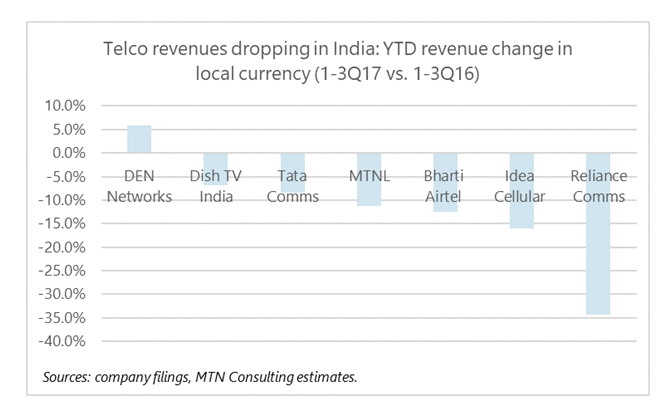
Just recently, in November 2017 the Indian regulator TRAI announced a net neutrality recommendation, concluding that telcos cannot unfairly prioritize content. This was a win for OTTs. India’s telecom regulators are now pursuing more open, pro-consumer policies than the US FCC, which today voted to end America’s version of net neutrality. However, the TRAI’s recommendation still needs to be formally adopted by the government, and India’s telcos are lobbying hard for relief. In fairness, this comes at a tough time for them, as they’re facing high debt and weak revenues, made worse recently by the rapid growth of new entrant Jio. The figure below shows how stark the revenue declines have been for many in recent quarters.

Smartphones are the platform of choice for OTTs in India

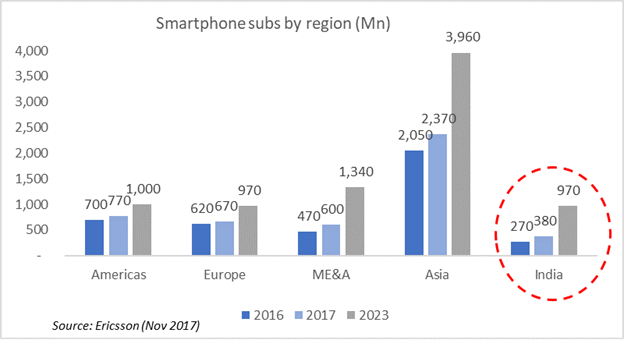
While India’s fixed broadband networks are underdeveloped, it has an enormous base of smartphones. As shown below, by 2023, Ericsson expects India to have 970 million smartphone users, after growing at a 17% CAGR from 2017 . That’s the same as the entire region of Europe.

Given India’s smartphone-centric broadband market, smartphones play a huge role in launching new OTT services and partnerships. For new revenues, telcos are looking at apps and content. A common approach is to bundle traditional offerings with OTT services such as media/cloud storage/video/music, to drive data usage and help migrate users to higher-priced plans.

For instance, video-streaming. Vodafone India has won deals with Eros NowHOOQ, and Amazon’s Prime Video. Vodafone has also partnered with Netflix in a deal which includes carrier-billing, and free Netflix service for a year under a few of the post-paid plans. Netflix plans to strike similar deals with India’s Airtel DTH and Videocon d2h. Starting from scratch, Jio is carving out a niche for itself with app-based services such as JioPlay, Jio Beats, Jio VoD and Jio Security.

As a result of India’s rising smartphone penetration and OTT service adoption, data traffic is booming. Ericsson expects data traffic per smartphone in India to reach 18 GB/month by 2023, from the current 3.9 GB/month. Telcos, of course, claim to worry they’ll be stuck carrying all this traffic, while OTT providers function as free riders of telco network assets. So far, that argument hasn’t held up with regulators.

(Photo credit: Mpho Mojapelo)

Blog Details

Understanding The Carrier-Neutral Market (And Why Revenues Will Pass $40B This Year)

MTN Consulting has just published a “Market Review” of the carrier-neutral network operator (CNNO) sector. The report assesses the key role that these tower, data center, and bandwidth specialists are playing in the downsizing of the telecom sector. While many telcos are shrinking, the CNNO sector is growing >10% per year. Revenues for the 25 CNNOs we track should surpass $40B this year, and approach $60B by 2020 (Figure 1).

mtnc-cnno revs through 2020

Takeaways from the study include:

  • CNNO revenue growth has been steady around 10-15% YoY for several years, in line with the growing telco (& other provider) need for low cost, carrier-neutral network resources. 3Q17 revenue growth for CNNOs was 13.1% (Telco Network Operators: 1.0%; Webscale Network Operators: 23%).
  • CNNO capex rose 11% YoY in 3Q17, to $3.6B. Tower specialists spent 24% of their revenues on capex, data center specialists over 43% due to higher (and lumpy) investments in developing new sites. Tower providers’ incremental capex in new sites is primarily for small cells. Bandwidth specialists’ capital intensity has been over 50% for the last 5 quarters, due to the influence of new builds (NBN in particular).
  • CNNO capex hit $15B on an annualized basis in 3Q17; the biggest spenders were Equinix, Level 3, Australia’s NBN, Crown Castle, Digital Realty, American Tower, and Zayo.
  • M&A is a big factor in the sector’s growth, but just one. CNNOs are growing organically too, and expanding their business models to require a broader mix of equipment (Crown Castle is looking at edge computing, for instance). Technology-related operating expenses can be quite high, for repairs & maintenance of old plant, and energy costs in particular.
  • Total capex across telecom, Webscale, & CNNO was $355B in 4Q16-3Q17 (Figure 2).

mtnconsulting 3Q17 capex-summ5

The report also assesses CNNOs’ network holdings across four main categories: fiber, data centers, towers, and small cells. Most big operators have assets in multiple areas, and that will increase over time. Tower companies are building small cells, for instance, while bandwidth specialists are extending their fiber routes to small cell sites.

Table 1 provides a snapshot of the infrastructure assets for a sample of the CNNOs covered in this report.

Table 1: CNNO network assets (excerpt)

mtnc cnno1