
Blog Details

Telco capex in 3Q17 up 4% YoY (preliminary); what’s in store for 2018?

Not all telcos have reported, but a large sample (of 60 companies) has spent US$50.2B on capex in 3Q17. That’s up 4% year-over-year (YoY), after adjustments for acquisitions.

A 4% growth rate for telco capex is relatively high by recent standards (Fig. 1). LTE spending declines have plagued YoY capex comparisons since 2015. In this same time frame, the Webscale sector – led by Alphabet (Google), Amazon, Apple, Facebook, & Microsoft – has increased capex by double digit percentages in most quarters.
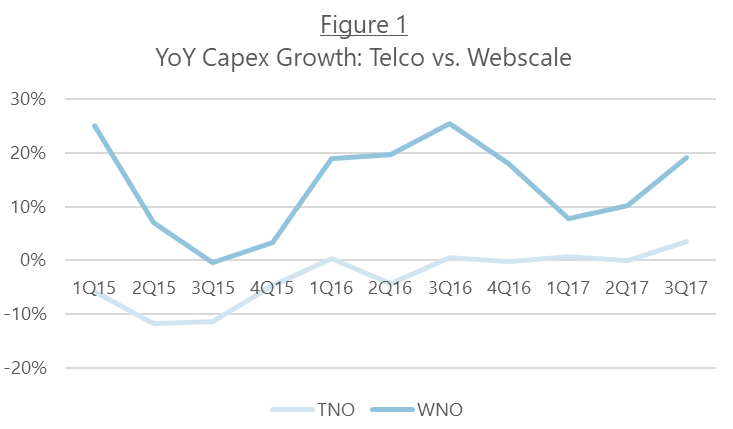
Source: Company filings. Preliminary results of 60 telcos (ex-China), and 17 webscale providers

Looking forward, Webscale sector capex will continue to grow much faster than telcos, by 5-15% per year. The outlook for telco capex remains challenged, however.

Weak top-line growth not just a short-term problem

In 3Q17, telco revenues grew just 0.8% for the sum of the 60 companies we’ve captured to date. That pushed down the annualized growth rate to under 1% (Fig. 2).
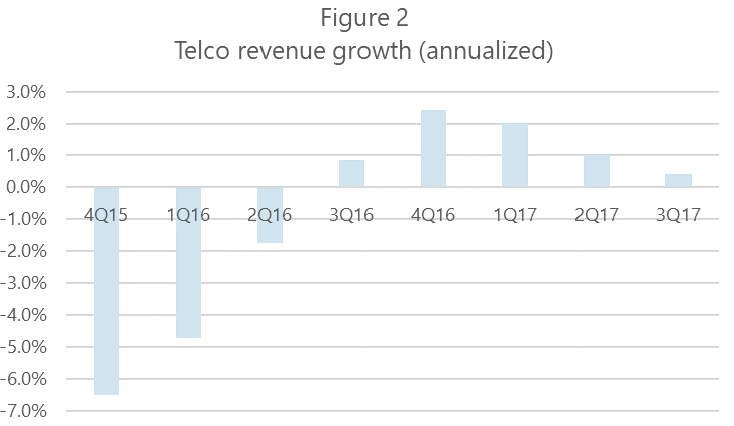
Source: Company filings. Preliminary results for 60 telcos. China excluded from the chart

Telecom operator revenues have been challenged for several years, and it’s not a regional problem, or one that will go away soon. Many telcos are facing margin squeeze as subscriptions decline in key areas (e.g. consumer broadband), & mobile churn remains too high. Telcos like KDDI and (many) others are investing in new service areas based, for instance, on IoT. Seeing a return from these investments has been slow, though.

3Q17 results & operator plans

Capex for our group of 60 was $50.2B in 3Q17, up 3.6% YoY. That pushed annualized capital intensity for the group to 15.3% in 3Q17, up slightly from 15.2% a year ago. (Note that the sample of 60 excludes China).

As telcos move to more software-based networks, most aim to keep a lid on network spending – at least, the capex component of network spend. That was clear from 3Q17 earnings calls, for instance:

  • Telefonica says its “radical network virtualization” helps to optimize capex, enable faster deployments, and incorporate big data into network planning. Its capex has been in the 16-17% of revenue range steadily since 2014, though, without a noticeable decline. Looking ahead, Telefonica suggests a “distinctive declining capex trend” will be needed to drive growth in free cash flow and reductions in net debt
  • NTT projects capex of 1,700 Billion Yen for the fiscal year ended March 2018. That’s flat year-over-year. But the last 6 months of the year (4Q17-1Q18) will fall YoY, from 1,034B Yen to 942B Yen.
  • Deutsche Telekom’s 9.24B Euros in capex so far this year is up nicely (+12%), but the company projects capex in its core market of Germany to be flat through 2021 at around 4.3B/year; only regulatory relief would bring any upside.
  • Comcast’s capital intensity was 15.6% in 3Q17, but will average 15.0% for the full year. The company is under pressure from rising content costs (despite ownership of NBCUniversal; AT&T, take note!).
  • Orange is spending €7.2 billion on capex this year, from 7.0B in 2016, with a practical focus on raising 4G & FTTx coverage. Fiber investments helped Orange grow its base of “very high-speed broadband” customers to 24.6M households in September, up 46% YoY.

Not all bad news for vendors

The telco shift to more virtualized, software-driven, open sourced networks is real, and it will bring many benefits, but it doesn’t guarantee lower capex. That’s in part because it’s a very gradual shift for most. Big telcos with millions of subscribers & thousands of employees do not change processes that quickly. Many big operators are raising capex, or at least keeping levels flat despite revenue declines. At the global level, though, a 5-10% drop in telco capex is likely next year. The changes by technology area & region will be more extreme; more on this topic soon.

A side note on this week’s news: AT&T-Time Warner and net neutrality

Two major events took place in the US this week: the US Department of Justice (DoJ) announced it would file suit to block AT&T’s purchase of Time Warner, and the FCC made clear it would soon be gutting net neutrality provisions. What’s the impact on capex?

The AT&T situation is too complex & politicized to assess yet. I was never a big believer in the merger, in part because of Comcast’s troubles, within an (already) integrated content-cable group. It seemed a big gamble, given AT&T’s lack of history in content, and limited experience with large cross-sector acquisitions. It also would clearly distract the company during a time of industry upheaval. So, if the merger falls apart, it wouldn’t be the worst thing for AT&T. In the meantime, I would not be surprised if it targeted a bit more of its total capex overseas, in Latin America, pending more certainty.

Regarding net neutrality, my two cents: the FCC’s new rules will have approximately zero impact on US telecom capex. They may change the distribution by company slightly, and you can be sure Verizon, AT&T and others advertise loudly any investment that can be positioned as “new,” and incented by the FCC rule change. But that’s marketing, not reality.

(Photo credit: Jason Blackeye)
Blog Details

Indian Operators Divesting Tower Assets To Raise Cash

Faced with tough competition and high debt, Indian telecom operators are spinning off their tower assets to investors or independent tower companies to improve their financial situation. The 2016 sale of Tata Teleservices’ tower business (Viom) to ATC, and RCom’s planned sale of its tower unit (Reliance Infratel) to Brookfield are just two examples.

Operators in many other regions have divested towers to raise cash, not just India. This is part of an ongoing trend, enabled by the maturity of independent asset management companies. Such divestments in India, though, come against a backdrop of urgent debt reduction needs. Funding network capex while navigating this transition will be a challenge.

Do operators really gain from tower divestments?

Though operators benefit from a cash influx after an infrastructure sale, the devil is in the details. Tower sales typically come with long-term leaseback arrangements, with pre-determined pricing levels locked in. Operators need to set aside sufficient funds for recurring rental costs.

There have been instances where tower companies have shutdown service to operators following rental defaults; RCom is one case. Since the details of the outgoing rental costs incurred by operators are not revealed, it does question the merit of the tower sale. On the other hand, many towers remain underutilized, and operators see benefits not only from the initial sale but in lower ongoing costs as tower space is shared. It also helps them avoid new tower construction, hence avoiding some capex (all else equal).

In India, mobile operators increasingly are focused on their main telecom business, relying for tower assets on a mix of dedicated private equity firms and pure tower infrastructure companies. Deals continue to happen. For instance, now that Vodafone’s acquisition of Idea Cellular has been approved by the antitrust regulator, Bharti Infratel will likely try to buy Vodafone’s 42% stake in Indus Towers. It’s also possible that, post-merger, Vodafone/Idea’s combined 20,000 towers will be acquired by ATC.

Below are a few cases of Indian operators selling towers, or their holdings in tower subsidiaries. Two are completed deals, one is in progress, and two are still under discussion.

Tower asset transfers are affected directly by the broader services market, and M&A changes at that level. We’re seeing this now in India. Vodafone’s merger with Idea, for instance, set to complete in 1H18, is forcing a realignment of ownership in Indus Towers. RCOM’s hoped-for big payout from its tower sale to Brookfield is now in question, since the RCOM-Aircel merger collapsed. Meanwhile, Jio continues to push aggressively to expand, keeping margin pressure high on rivals.

Mobile market consolidation might free up capital for network expansion

In the wake of heavy competition and high debt, Indian operators are exploring various financial deals, not just asset spinoffs.

The recent Tata Teleservices (TTSL) sale of its mobile arm to Airtel, and Vodafone-Idea merger, may just be a silver lining for the Indian telecom mobile market. Over the next five years, we might see a drop in the number of mobile players from 9 to 5. Such consolidation should be beneficial for operators, which can merge network and spectrum holdings. That would free up more capital to invest in network expansions and upgrades; recently Indian operator capex has dipped. Tata Communications’ capital intensity (capex/revenues) averaged just 9.5% for the last three fiscal years, for instance.

With growing demand for a complex range of new mobile services (including in the IoT space), there is a strong argument that operators shift tower management to independent, specialized companies, and focus on providing better quality of service and coverage. India may soon provide a test for that argument.

Blog Details

Weak network spending climate becoming more apparent

Fidelity’s “Communications Equipment” index is up nearly 11% so far this year, tracking just a few points behind the S&P 500’s YTD gain of about 15%. Looking ahead, though, the communications equipment sector remains challenged, something 3Q17 earnings are making clear.

Ericsson, Nokia and ZTE in a similar boat

Vendors selling mainly to communications markets are reporting sluggish demand. In 3Q17, revenues declined by 4% and 9% YoY at the networks divisions of Ericsson and Nokia, respectively (for Nokia’s trend, see figure below).

Multiple regions are seeing the same issue: weak telco revenue growth is constraining more rapid investment. LTE networks are in place, ready for growth & upgrade via software (mainly). Fixed broadband networks remain expensive to construct, and the video revenue upside is proving to be a challenge for many operators, including AT&T.

ZTE doesn’t break out carrier revenues on a quarterly basis. Corporate revenues fell 5% YoY in 3Q17, and ZTE says carrier demand is stronger than average. We’ve estimated 1% YoY growth for ZTE’s carrier group in 3Q17, in local currency. The China capex outlook is cloudy, though, something which both ZTE and Huawei will have to face next year. They also, I suspect, will reinvigorate their vendor financing programs, as has already come up in Brazil with a potential buyout of Oi with involvement from the China Development Bank.

The figure below confirms, though, that it’s not just ZTE, Ericsson and Nokia facing issues. Many suppliers reported YoY revenue declines in 3Q17.

3q17v2

Accenture’s result is modest evidence that telcos continue to increase spending on services & software, but not definitive as Accenture includes telecom in a larger Communications, Media & Technology (CM&T) vertical.

Adtran’s growth is due largely to an acquisition, namely of CommScope’s active fiber access product line, in late 2016.

Corning’s growth is more interesting. Many vendors are reporting a shortage in actual fiber optic cable supply over the last year or two. New factories or expansions have been announced by CorningFurukawa, and most recently Prysmian. These tend to tie in to specific large telco (or national government) fiber builds, as with Verizon’s FiOS and the NBN in Australia. The economics of these builds require video service profitability, in general, and that has been mixed lately.

Telco capex datapoints not reassuring, but it’s early

Many telcos have reported already, including Rogers & Verizon, Telefonica, Orange, America Movil, AT&T, Telenor, and DoCoMo. Occasionally a big operator reports capex growth, unapologetically – referring to the revenue opportunities that might come with that. DoCoMo comes closest to this model so far. Its capex for the last two quarters is up 9% YoY, in part to support new services in the “Smart Life” business. Most, though, are talking down capex, emphasizing that the bulk of 4G work is done, fiber capex is more targeted & tactical than 2 years ago, etc.

On Telefonica’s 3Q17 earnings call, for instance, COO Angel Vila noted that:

“CapEx is on a declining trend in Spain. We have already 97% LTE coverage. I think it’s close to 70% fiber-to-the-home coverage. We will continue deploying fiber, but reduce speed and focusing on connecting… the CapEx trend in Spain is already declining in terms of CapEx to revenues.”

Many operators have similar stories. Vendors will have to seek out the ones with more budget flexibility. Even with some success, though, it’s likely we will see a pickup in M&A activity around the communications equipment sector over the next 1-2 years.

Blog Details

First Few 3Q17 Telecom Vendor Reports: YTD Revenues Down 3.4%

If you’re looking for a capex bump in the telecom sector, results for 3Q17 so far won’t reassure you.

The vendors that have reported are not seeing much growth. For six vendors (or divisions) with high exposure to telecom, annualized revenues continued their decline in 3Q17 (figure).

vendor-1

On a nine month (year to date) basis, revenues for this same group were $33.2B, down 3.4% from $34.4B in 1-3Q16.

This is not a random sample, just a view on the early reporters. Many more significant vendors in the sector have yet to report. However, the weak spending trend is consistent with what many vendors have been reporting for several quarters. It’s also consistent with operators cutting their capex targets.

The figure below shows YoY % change in revenues for each of the 6 companies/divisions, for the last five quarters.

vendor-2

The steady negatives at Ericsson are concerning, as is the 3Q17 decline at ZTE. That could signal weakness in China, where operators were already guiding down capex projections. Juniper’s telecom/cable revenues declined, but that was one point of the vendor’s recent segmentation, to highlight growth differences: its “Cloud” segment is up 16% YTD.

Adtran’s growth is due partly to its CommScope acquisition, so hard to decipher. Wipro is a small services/software player in telecom, and hasn’t been helped by a weak Indian spending climate. Corning, though, is reporting steady YoY growth in optical communications segment revenues, noting yesterday “especially strong demand” for its carrier products, where Verizon is an important customer.

More to come soon, as more vendors report.

(Photo credit: Maarten van den Heuvel)

Blog Details

Cisco Buys BroadSoft For $1.9B In A Cloud & Collaboration-Driven Deal

Cisco Systems is one of the largest suppliers to network operators worldwide, including telcos. Its growth strategy from the start has been reliant heavily on acquisitions, and 2017 has been no exception.

Today the vendor announced it would buy Gaithersburg, Maryland-based BroadSoft for $1.9B. BroadSoft’s software & services help telcos deliver hosted, cloud-based Unified Communications to their enterprise customers. This plays into Cisco’s collaboration offerings.

A mature target for Cisco

BroadSoft’s revenues for the last 4 quarters were $355M. That’s less than 1% of Cisco’s corporate revenues, or about 8% of the division it will be rolled into (see first figure, below). But Cisco often buys companies with no revenues, just a promising technology and/or team. BroadSoft is a relatively mature target for Cisco: it was founded in 1998, and reached its 100th customer milestone over a decade ago (May 2005). The deal size is also manageable for Cisco. Totaling $1.9B, the offer is $55/share, all-cash. Cisco had over $70B in cash & short-term investments at the end of July, so the company’s coffers will be just fine after this transaction.

This is Cisco’s eighth acquisition in 2017. That sounds like a lot, and is, but integrating acquired products & teams effectively is one of Cisco’s core strengths.

revs-mtnconsulting

Cisco’s margins still high, but revenues are falling

Cisco remains loaded with cash, but growth is another issue. Despite heavy R&D spending ($6.1B in FY2017) and an aggressive M&A strategy, Cisco’s revenues have declined for 7 straight quarters, on a year-over-year (YoY) basis. The company’s saving grace are its reliably high margins. Gross margin dropped below 60% in FY2013, but it has averaged over 62% for the last three years. It generates healthy free cash flow each quarter, over $22B for the first two quarters of 2017.

During the late 1990s tech bubble, Cisco was one of the hot stocks in the new “Internet” market – and the company billed itself as “empowering the Internet generation”. That tagline has changed multiple times, but Cisco still sits in a sweet spot of the  infrastructure market: its routers & switches retain high market share with some of the largest network builders around. The market is more competitive now, though, and much “softer” in its technology demands.

Established companies with high share have to scurry to adapt to these shifts: they need to be ready for the next big thing, but also want to leverage their established markets – and extend technology life cycles when possible. With the growth of the cloud, vendors like Cisco have a larger role to play in enabling services, not just building networks. That’s one reason why some key Cisco rivals, e.g. IBM, HPE, SAP, and now Huawei, are investing heavily in cloud networks. It also is a factor in Cisco’s interest in BroadSoft’s capabilities.

What does this deal bring to Cisco?

BroadSoft’s focus is helping telcos roll out & manage new “unified communications” services for their enterprise customers. With 1,720 employees worldwide, BroadSoft claims 25 of the top 30 global “telecommunications service providers” (telcos) as customers. That doesn’t imply global coverage for each of the 25, just 1 (at a minimum) country deployment, but it is impressive scope.

Collectively the vendor is in a total of 80 countries, and its (service provider) customers have deployed 13 million UC subscriber lines over its software. Verizon & Telstra are both major customers, accounting for over 10% of BroadSoft’s revenues recently (Verizon in 2016; Telstra in 2014). Other announced customers include AT&T, BT, Orange Business Services, and Vonage. Overall, revenue from customers outside the US accounted for 48% of sales in 2016, so it has good geographic diversity for a small supplier.

Upon close of this deal in around 1Q18, Broadsoft’s employees will join Cisco’s Unified Communications Technology group, which appears in the vendor’s “Collaboration” segment in financial reporting. Cisco’s collaboration revenues were $4.3B for the FY ended July 2017, down 2% YoY.  The BroadSoft deal should help that segment’s near term prospects, mildly. If BroadSoft’s revenues are added to Cisco’s for both the FY17 and FY16 periods, though, Cisco’s Collaboration revenues would still have fallen last year, by a slighter 0.7%. Clearly the hope is that Cisco’s corporate umbrella (and sales organization) will accelerate combined growth.

sga-mtnconsulting

There’s likely to be some benefit on the cost side. BroadSoft’s gross margins are actually higher than Cisco, but the former has high selling costs. BroadSoft sells through its own sales force in part, not just distributors, VARs, and other partners – as some similar sized companies do rely more heavily on. BroadSoft’s SG&A expenses have averaged over 45% of revenues for the last two years. Cisco’s comparable ratio is about 23% (figure, above). Scale clearly has some benefits.

(Photo credit: James Padolsey)

Blog Details

Early Telco Reporters Verizon & Rogers Provide Mixed Signals For Vendors

The first sizable telcos reported 3Q17 earnings this morning: Verizon and Rogers. Both can point to reassuring bottom line results. For the 9 months ended September, operating & net margins improved year-over-year, as did earnings per share. Rogers’ EPS through September was C$2.66, up 24% YoY, while Verizon’s $2.80 EPS for the same period was up 32% YoY. The results contain some negatives, too; some company-specific, but some illustrative of broader market challenges.

Wireless not always a growth driver

Rogers was an early mover in Canada’s LTE market, and continues to grow its postpaid subscriber base: 8.8M in September 2017, up 3.3% from 3Q16. That 8.8M amounts to roughly 25% of Canada’s population. Wireless revenue growth this year has averaged 5% YoY. The company’s operating margins are reliably in the 40-50% range; in 3Q17, the figure of 47.9% was up a bit from 47.1% in 3Q16. What helps keep the margins high are stable ARPUs and fairly low churn. Rogers’ blended (postpaid + prepaid) wireless ARPU for the year so far is C$61.94, up just under 3% from the 2016 period. Churn in retail postpaid is 1.11% so far this year, down a bit from 1.19% YoY.

Verizon, also a first mover in the US’ LTE market, retains high operating margins in its wireless division: 46.2% for 3Q17, from 44.9% in 3Q16. However, core service revenues are falling: $47.2B in wireless service revenues for 1-3Q17, down 6% YoY. Total wireless division revenues also fell, by a more modest 3.1%. The difference is equipment. Verizon regularly charges more in “cost of equipment” than it books in equipment revenues; that’s not changing. However, Verizon closed the gap significantly in 2017. The implicit loss (or subsidy) from its wireless device sales was $2.4B YTD17, down from $3.1B in 1-3Q16. This narrowing may not be sustainable. New device releases and sales/distribution strategies can often lead to spikes in equipment subsidies.

On the plus side, nearly 95% of Verizon’s subscribers are on smartphones (from 93% a year ago). Churn also remains low at Verizon: for the high value retail postpaid segment, Verizon’s churn was 1.02% so far this year, essentially unchanged from the 0.98% in 1-3Q16.

Cord cutters and OTT

Wireline accounts for about 30% of revenues at Verizon, and 25% at Rogers (over a cable network). Like most big incumbents with fixed access networks (PSTN or cable TV), both offer video platforms combining voice, data & video over an operator-provided CPE. To do this, they’ve invested heavily in network upgrades, workforce training, and sales & marketing over the last 5+ years.

Despite this investment and overall subscriber growth, both operators are reporting net losses in video/TV subscribers. Consumers have far more OTT video options now. Performance over mobile networks often isn’t good (or economical) enough for heavy video users. The incentive to keep your telco/cable-provided Internet service but cancel video is growing stronger.

Rogers’ reported sub losses have been ongoing; its TV subscribers are now 1.75M, down 4% from the prior year. This was worsened due to Rogers’ growing pains with platform development. It spent nearly half a billion C$ trying to develop a proprietary IPTV platform, similar to BCE’s “Fibe TV” platform, before having to write it off. It’s changed strategy, and will now license the Comcast-developed X1 platform.

Verizon’s had more luck with its custom FiOS box. However, it also lost video subscribers in 3Q17. Overall net adds for FiOS in 3Q17 were 59,000: +66K for Internet, +11K for voice, and -18K for video. Margins remain low in wireline, despite some YoY improvement; EBITDA/revenues so far this year in wireline is 21.2% from 17.1% in 1-3Q16. Further, to sustain its wireline business Verizon’s capital spending is higher as a % of revenues: 14.6% so far this year, from 10.9% YTD16.

Overall revenue trends point to caution

The figure below shows recent YoY revenue trends for the two operators. Rogers’ trend is relatively steady; its early lead in LTE and market-leading broadband position has helped with this consistency. The growth rate is just 2-4% per year though.

Verizon’s growth has been negative until recently, held back by weak mobile service revenues. A modest improvement helped push Verizon’s YoY growth to Rogers’ level in 3Q17, +2.5%. Another factor benefiting Verizon’s measured growth recovery is mobile device equipment revenues, up 5.4% so far this year, to 13.5% of corporate revenues.

rogersvz-mtnconsulting2

Even with slow top-line growth, both Rogers & Verizon generate healthy free cash flow in typical quarters, including $3B for Verizon in 3Q17 and C$372M for Rogers in the same period. They have high debt typical of telcos, but interest costs are on the low end.

Verizon capex 13-14% of revenues, selective M&A activity likely to continue

On the capex front, Verizon is big but not hard to predict: its annualized capital intensity has been in the narrow 13-14% of revenues range for several years now. Variations in the past have come from quick buildouts to gain market position. As Verizon and other telcos move to more software-centric networks, these variations will be less common and less extreme. It’s unlikely that we’ll see Verizon’s capital intensity rise above the 15% mark anytime soon. For 4Q17, Verizon will likely spend about the same as 4Q16, plus maybe 1-2%.

Verizon’s capex is constrained not just by revenue growth & software-based expansion, but also the need to reserve capital for spectrum and acquisitions. Earlier this year, Verizon purchased Straight Path and its spectrum holdings for $3.1B; in early 2015, Verizon spent $9.9B for AWS-3 spectrum in FCC auctions. On the company’s balance sheet, in fact, the value of spectrum assets (“wireless licenses”) is now slightly higher than net property, plant & equipment (PP&E, net): $88B v. $87B.

And Verizon has a healthy track record of acquisitions. That includes a recent deal to purchase fiber optic assets in Chicago from WOW. That deal was just $225M and for one metro area, but it’s a reminder that Verizon and other deep-pocketed telcos are constantly considering build v. buy alternatives. That’s more the case now, as a sector of neutral network operators (NNO) has matured.

rogersvz-mtnconsulting1

Rogers’ capex levels are looking up

As part of its 3Q17 earnings release, Rogers added C$100M to its 2017 target capex (now C$2.35B-C$2.45B). That modest change is, Rogers says, due to “strong growth in our wireless segment and the intended investment of those incremental profits to further enhance the quality of our networks”.

Even with that, Rogers’ full year 2017 capex/revenues is likely to settle around 16%, low by its historic standards. That’s down, in small part, because of a slowdown in its “NextBox” service while a new platform is being developed: Rogers is set to launch its white label partnership with Comcast sometime in 2018. An X1 success would mean more capex at Rogers. Comcast and it supplier partners, though, may be the main beneficiaries of this growth. At least initially. If the platform takes off and helps reverse Rogers’ video sub declines – and lift ARPUs – you can expect more investment in the core of the network to keep the cord cutters at bay.

(Photo credit: Bernd Schulz)

Blog Details

Communications Sector M&A Dominated By Infrastructure In 3Q17

October’s seen a few mergers already, including Airtel-TTSL, a tower sale by Zain and the long-rumored Sprint-T-Mobile transaction (confirmed yesterday). Some interesting deals came out of 3Q17 too, especially in infrastructure markets.

63 M&A transactions announced, including OTT/cloud deals

The communications services sector saw 63 merger and acquisition (M&A) transactions announced in 3Q17. These deals accounted for a total $17.4B in deal value. Infrastructure targets accounted for 56% of deal value across 13 deals. Crown Castle’s $7.1B purchase of Lightower was the biggest by far, and exemplifies the quarter’s focus on towers, data centers, and fiber networks.

Other infrastructure deals announced last quarter include:

  • Equinix: $295M for Spanish data center provider Itconic;
  • Verizon: $225M for WOW’s fiber optic network in metro Chicago;
  • Iron Mountain: $128M for Colorado-based MAG Data Centers;
  • Keppel DC REIT: $78M for a colocation data center in Ireland, from Dataplex;
  • Zayo: $3.5M for a data center in Colorado.

Several small deals involving fiber optic and related assets were announced without valuation: FirstLight Fiber’s acquisition of 186 Communications; Neural Path-Infinity Fiber; Ufinet-IFX Networks; and EQT Infrastructure-Spirit Communications. Also, South Africa’s Dimension Data Holdings decided to sell its fiber & wireless business to Vulatel; Dimension’s view on the network assets is that they are no longer core to its “value proposition”.

Fixed-mobile-integrated services: 28 deals totaling a modest $5.2B

3Q17 also saw 28 deals targeting fixed and/or mobile service operations: 18 fixed, 7 mobile, and 3 for integrated (fixed & mobile) assets. There were no very large (>$10B) telco deals announced in 3Q17, though several earlier ones are still pending (including AT&T-Time Warner and Vodafone-Idea Cellular).

Two sizable deals in 3Q17 were international in scope: Vodacom South Africa’s $2.6B purchase of a 35% stake in Kenya’s Safaricom, and Omantel’s $846M acquisition of a 10% stake in Kuwait-based Zain. Most other significant deals were domestic in nature, including:

  • USA: Cincinnati Bell-Hawaiian Telecom ($650M, July 10); T-Mobile US-Iowa Wireless (value unknown; Sept. 26)
  • South Africa: Blue Label Telecoms-45% stake in Cell C ($424M, July 27)
  • Hungary: DIGI-Invitel ($164M, July 11)
  • Russia: Renova Group-AKADO ($120M, July 11)
  • Austria: Hutchison Drei Austria-Tele2 Austria ($112M, July 30)
  • Thailand: AIS-CS Loxinfo ($79M, September 14)
  • Australia: Superloop-NuSkope ($12M, Sept. 10)

Lowering network & selling costs (relative to size) are common dominators across most transactions. Some transactions markedly improve competitiveness through more scale or better access to a customer segment; for instance, Hutchison Drei bought Tele2’s Austria operation to jump into a strong #2 overall position in the market, behind America Movil’s Telekom Austria.

OTT/Cloud network operators also buying companies

Notably, Alphabet/Google made five notable acquisitions in 3Q17, Facebook 3, and Alibaba 2. Their targets are spread across a range of sectors, in line with their business scope. Lots of action centered around Artificial Intelligence in 3Q17, something OTT/cloud operators anticipate having a role in their networks. Alphabet acquired two firms in this space: Bangalore-based Halli Labs, and Belarus-based AIMatter. Baidu acquired Seattle-based Kitt.ai, and Facebook bought conversational AI startup Ozlo.

Infrastructure demand rising, or unstable?

With all the infrastructure deal activity in 3Q17, some wonder if this indicates rising demand for basic network assets. Does it suggest a strong growth outlook for the “neutral network operators” (NNOs) focused on neutral operations of towers, data centers and fiber networks?

The sector is growing, to be sure, especially member companies like Equinix with aggressive M&A strategies. Private equity (PE) is driving much of the deal activity in this sector. That was the case with 3Q17’s biggest deal: Crown Castle bought Lightower from PE owners including Berkshire Partners and Pamlico Capital. This quarter, there’s an even more audacious deal underway in the sector, with a PE consortium looking into an $11B Indian cell tower deal. That is motivated, at least in part, by high debt among many Indian operators & tower companies.

Which brings us back to the market outlook. In telecom, PE firms tend to buy, reorganize, and sell assets – they’re generally not in it for the (very) long-haul. Publicly traded NNOs like Crown Castle provide exit opportunities for the PE investors – as it did for Lightower last quarter. The fact that several PE firms are raising big infrastructure funds now is a positive for telecom dealmaking.  Telecom network operators seem almost certain to continue slimming down their asset base in light of weak top-line growth. PE firms will surely be around to pick up some assets when the price is right.

Blog Details

Decades-Long Copper Retirement Process Is Just Starting For Verizon And AT&T

Incumbent telcos in markets like the US have built their networks gradually, over many decades. In the access plant, the trend towards more fiber began in the 1990s – but applications, products, and overall economics have come together just in the last several years. The speed of fiber deployment varies by operator; it’s driven by the company’s overall broadband strategy, but constrained by financial and accounting issues. Despite the apparent rush to fiber, we have several more decades before big telcos get rid of all their copper cables.

Fiber getting some good press

Recent disasters have highlighted the reliability advantages of fiber, beyond its (cost per) bandwidth benefits. The US Federal Communications Commission (FCC) Chairman Ajit Pai noted recently that the effects of recent hurricanes on Puerto Rico’s cell network were far worse than Houston. The reason, Pai argued, was that most of Houston’s cell backhaul is done on fiber (versus copper in PR), and buried fiber is far more resilient to water damage than copper cables. Houston also made out well versus the big 2005 hurricane, Katrina. The FCC estimated only about 300 of the 7,804 cell sites in Harvey’s path went down during Harvey, from over 1,000 sites during Katrina.

This is a new twist on the safety debate. In the past, the debate has focused more on the fact that fiber-based broadband services (such as Verizon’s FiOS) require a battery backup to ensure emergency operations .

Despite Chairman Pai’s praise of fiber, incumbent telcos still face a myriad of rules relating to fiber deployment – especially if a retirement of copper-based service is involved. The rules aim at protecting consumers who rely on the network, and other operators who interconnect with the incumbent. Public notice of any planned retirements is required. That’s why we’re hearing more about copper phase-outs lately, mainly from Verizon, AT&T and CenturyLink. The topic is also coming up in the FCC’s 2017 Wireline Infrastructure NOPR.

Actual change is far slower than the news flow

Look a bit closer, and the headlines are less impressive.

Verizon, for instance, announced copper retirements in eight states last month. The states include some of Verizon’s largest incumbent operations, including New York, Pennsylvania, and New Jersey. However, they are not statewide shutdowns. They’re for “select towns and cities” in these eight states. The process is typically done by individual central office, or “wire center”. One example: Verizon plans to retire all copper terminated at the “FKLNMAMC” wire center in Franklin, Massachusetts by August 2018. This is a tactical process that’s planned very carefully.

These retirements are important, as they symbolize a transition to all-IP, all-fiber networking that telcos have been working towards for many years. But they are piecemeal, given Verizon’s scale. The company had $46B of cables, poles, and conduit on its balance sheet last year; the copper parts of this are not disappearing overnight. All else equal, copper retirements are first targeting wire centers with lots of enterprise customers, and denser residential neighborhoods with above average disposable incomes – both areas where there is likely to be competition to protect against.

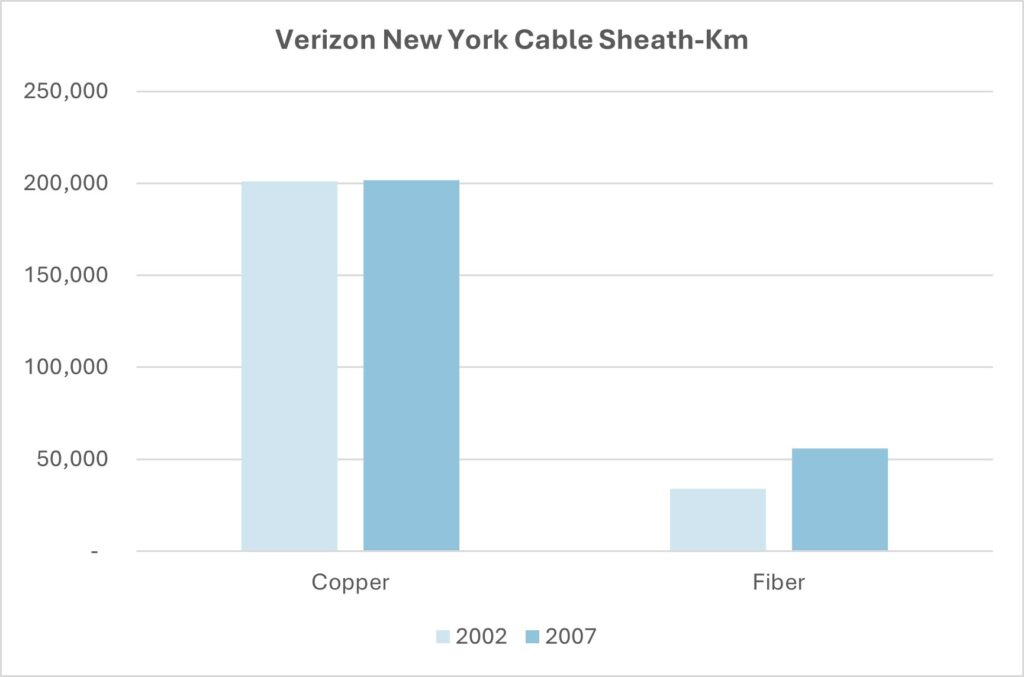
Very little new copper is being deployed, but Verizon and other incumbents are eager to leverage what’s installed. In the case of Verizon’s New York operations, the figure below illustrates how vast that (copper) base is.

Source: FCC Report 43-07, the ARMIS Infrastructure Report (2007 & 2002)


More flexibility, please

The current regulatory climate in Washington, DC is favorable to incumbent telcos, i.e. those running fixed networks with universal service obligations. Their views on net neutrality debates are now in favor at the FCC. Mergers & acquisitions are welcomed by the Trump administration’s Federal Trade Commission (FTC). The smart regulatory lawyers working for telcos are trying to use this favorable climate to their advantage.

Relatedly, copper retirement filings have ticked up at the FCC lately, from a range of incumbents. As part of this, incumbents are requesting more flexibility, especially in reporting requirements: shorter lead time, fewer details disclosed, etc. Based on the current climate, they might get what they want at the FCC. And at the state level, incumbents tend to be even more tightly knit to regulators, which will come in handy during retirement-related debates.

Competitive carriers should be concerned. Google’s investment in fiber, and its failure to scale, reminds us how hard it is to overbuild – which is the only option once the copper is gone.

Blog Details

India’s RCom Under Pressure After Its Failed Merger With Aircel

Reliance Communications’ (RCom) long-planned merger with Aircel, part of Maxis, fell apart last week in the face of legal and regulatory hurdles. This news comes as multiple operators in India are struggling with debt and declining margins.

Both RCom and Aircel face debt issues and declining revenues

The primary reason behind the planned RCom-Aircel merger was to consolidate and reduce losses. The combined entity would have become India’s fourth largest in terms of subscriber base, and the scale would have (hopefully) enabled both to better manage their debt. RCom’s total debt is roughly INR470B, while Aircel’s is INR200B. Both are also facing revenue declines; in 1Q17, for instance, RCom’s revenues fell by 24% QoQ , while Aircel’s QoQ drop was far worse at 47%.

The merger’s failure opens up a debate on the survival of India’s weaker operators, burdened with debt and some on the verge of insolvency.

Grim industry outlook

Many of India’s operators today are in dire straits, facing high competition and coping with high levels of financial stress. In addition to RCom and Aircel, Tata Teleservices (TTSL), for instance, has a debt burden of INR340B, and is considering exiting the business.

Given the large number of players in the market and the high capital investment needed to compete, more consolidation was always in the cards. Earlier this year, Airtel acquired the India operations of Telenor and its over 40M subscribers, for instance. Vodafone India’s pending merger with Idea Cellular is likely to be completed in 2018, producing a combined entity with ~400 million customers. Vodafone hopes for “substantial cost and capex synergies” from the merger.

After these big deals, the remaining players have fewer options to revive their business. Without a good M&A option, selling assets to raise cash is one option being explored. Spectrum sales may come in handy, but it’s a buyer’s market. In the event of a failure to sustain their business, an operator can be compelled to surrender spectrum (one possible outcome facing TTSL).

Uncertain future for RCom and Aircel

The future for Aircel and RCom looks bleak, as competition is heating up. Most Indian operators are facing the heat of Jio’s September 2016 nationwide launch. Jio’s aggressive pricing, though, has been especially difficult for RCom and Aircel to replicate.

RCom desperately wanted this merger as it was vital for its debt reduction efforts. The merger would have resulted in a combined entity with an asset base of close to INR650B (US$10B) and a net worth of INR350B. This greater scale would have allowed faster debt repayments and a 40% overall debt reduction for RCom by the end of 2017. Moreover, tower companies are pressuring RCom to pay back dues on its tower rental contracts. RCom has to pay American Tower Company and Bharti Infratel about INR200-250M each; and about INR95M to GTL Infra (including its unit CNIL).

RCom had plans for selling the towers of the combined RCom-Aircel entity to Brookfield Asset Management to clear a significant portion of its debt. But with the merger now being called off, the tower deal will have to be reassessed. Brookfield had apparently wanted to buy the combined tower base for up to INR110B. RCom is still hopeful about reviving its business by deploying 4G services, via a spectrum agreement with Jio. It also hopes to monetize its 2G and 3G spectrum and sell some real estate assets. But RCom has a long way to go in growing and sustaining its subscriber base in a highly disruptive mobile market.

Can Jio bailout RCom from this crisis?

Despite Mukesh Ambani, founder of Jio, and Anil Ambani, owner of RCom, denying all rumors surrounding a possible merger, it would not be a surprise if it happens.

In early 2016, the companies entered into a spectrum sharing deal, where RCom sold its spectrum in nine circles to Jio and approved spectrum sharing in another 17 circles; fiber sharing was also involved. By most accounts, the deal was a success for Jio, as it enabled a quick national launch. The deal has brought fewer benefits to RCom, which is now incurring losses and running out of funds for network expansion.

RCom might also be considering a bail out option. In June 2017, RCOM requested government support (through an “inter-ministerial group”) to withdraw the 10% cross holding restriction. This rule states that operators are not authorized to own more than 10% equity in two different operators in the same circle, thus hinting at a possible sale of its equity to operators. Considering its past association with RCom, Jio seems the most likely other operator to buy equity in RCom. And if such a deal takes place, it will provide Jio with greater access to RCom’s towers, fiber and spectrum. Only time can answer if Mukesh Ambani will come to his brother’s aid in bailing him out from this crisis.

(Photo credit: Pablo Garcia Saldana)

Blog Details

Security Specialist Barracuda Reports 7% Revenue Growth; Margins Still An Issue

Barracuda Networks, a security/data protection solution vendor, yesterday reported $94.3M in revenues for the quarter ended August (~3Q17). That’s 7% growth from the prior year (June-August 2016). This growth rate would satisfy many companies, including lots of vendors selling into telecom networks.

Margins not going in the right direction

For Barracuda, a vendor focused on cloud-based security solutions to a wide range of vertical markets, the 7% is a step down. After going public in November 2013, Barracuda’s YoY revenues grew steadily in double digits. This was organic growth, largely, as the company’s few acquisitions had minimal revenue impact. In the last three quarters, YoY revenue growth has been in the 6-8% range. Some growth moderation is normal, as the company started from a small base. But this comes at a time when Barracuda is still struggling to make money. As shown in the figure, operating margins (operating income/revenues) have fallen in the last few quarters, and they were already low.

barracuda-mtnconsulting

IPO in November 2013

Despite low or negative margins, Barracuda has managed to stay free cash flow positive for every quarter since going public in November 2013. For the last 2 years, its average quarterly FCF was +$12.3M. Not a lot for a big vendor like Cisco or HPE (both competitors), but enough to leave a small one like Barracuda with a cash reserve of $207M as of August. That could be handy both for small M&A transactions, or as a buffer against a few more low-margin quarters. (Note that Barracuda’s net income has been in the 1-4% of revenues range for the last 7 quarters).

Several security rivals are losing money outright, including Palo Alto, Symantec, and FireEye, and Proofpoint. This last one is interesting. Proofpoint bills itself as a security-as-a-service provider, playing into a similar cloud-based security market. The company’s latest annual revenues of $376M puts it just $23M ahead of Barracuda (comparing fiscal year to fiscal year). Proofpoint’s current market cap is roughly 3x Barracuda, though. Proofpoint is growing much faster, with revenues up 42% in 2016. That growth has not come with positive margins; Proofpoint’s net loss was 30% of revenues for the year. Many expect Proofpoint (and Palo Alto Networks, and others) to grow out of their losses.

Made in California

Barracuda has physical products (e.g. the Next-Generation Firewall), not just software, and manufactures these appliances in California. To some, that might suggest higher production costs and/or slower delivery to customers. Barracuda’s cost of revenue is relatively low though, averaging 24% of revenues for the last 8 quarters. Turnaround time is also quick. Barracuda says most orders are received in the same quarter as the revenues are ultimately booked. One thing that helps here is, around 70% of Barracuda’s revenue comes from the US market, a figure that hasn’t changed much since going public. Also helpful is Barracuda’s vast distributor network, which should accelerate customer acceptance.

Balancing the revenue model

Barracuda gets revenues from both physical appliances, and subscriptions. In 2013-14, appliances accounted for 30% of revenues, with subscriptions the remainder. Since then, appliance revenues have been falling, down to under 20% of total in 3Q17. That’s not necessarily a problem. Subscriptions bring recurring revenues, after all. Further, if the margins on subscription services are high enough, giving away the appliance for free may even be an option. That’s not the case here.

Barracuda’s renewal rates are high, at 92% for the 6 months ended August. There’s no guarantee that will persist, though. Moreover, customers are opting for shorter contract lengths in fiscal year 2017. This adds uncertainty to revenue projections, and generates more work for the sales force. Average contract length, and Barracuda’s sales costs, should be watched closely.