Blog Details

Quantifying the energy cost savings from 2G/3G network shutdowns

With each passing day, the 2G and 3G layers of telcos’ mobile networks are looming as heavy loads on operating expenses (opex). That’s due to multiple issues but especially energy consumption and related costs. With the existence of a 4G layer in these networks and the coming, if not already deployed, energy-hungry 5G layer, such loads become even heavier. Even before 5G has become widespread, energy costs averaged to about 4% of telco opex in 2021, based on an MTN Consulting study

Quantifying base station energy costs by generation

Many telcos publish data on their energy consumption, and sometimes provide breakdowns for different parts of the network. But there are no existing estimates on the specific impact of maintaining 2G/3G networks alongside 5G. This blog attempts to quantify the effect of these older 2/3G mobile networks on a typical telco’s energy bill. 

To accomplish this, first, we need to have a closer look at overall electrical energy consumption for mobile telcos, and then break down this consumption into parts, identifying what portion of total energy relates to the base station and what parts of the base station consume the most energy.

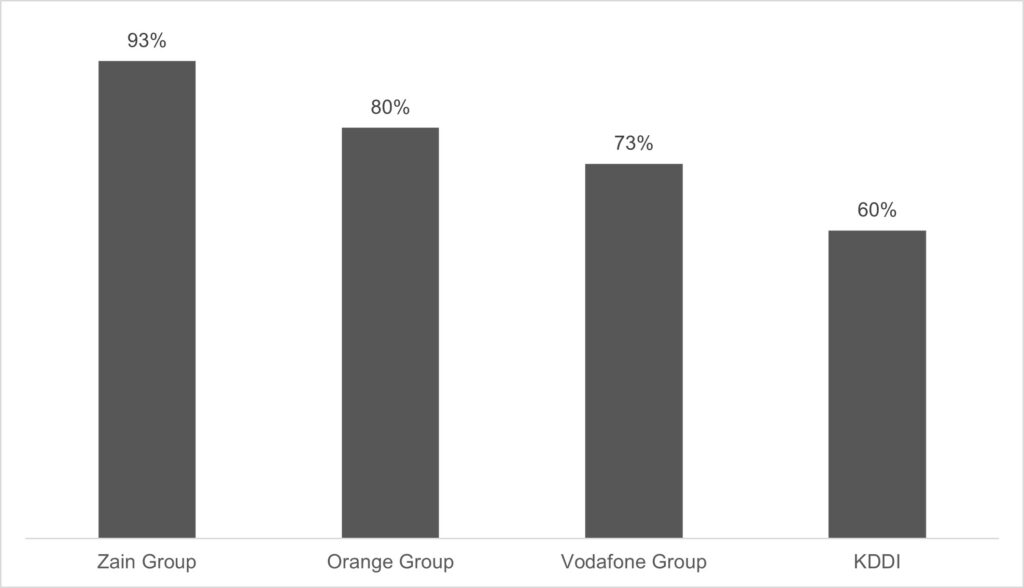
One complication is that a pure “mobile telco” is rare: most telcos providing mobile services also provide many other services, and operate network assets well beyond the mobile RAN. Some telcos providing mobile services began their lives long ago as fixed operators. Some started as mobile but acquired or built fixed assets to support converged offerings. Some have provided both fixed and mobile services from the start. Some provide cloud or other services mainly aimed at enterprise markets. The energy consumption patterns differ across operator types. Figure 1 illustrates this, for a few large telco groups.  

Figure 1: Mobile network as % of total network usage, select telcos


Source: public reports and MTN Consulting estimates

To remove this confusion, we will consider mobile telecom companies that still rely exclusively on providing mobile telecom services. For such operators, the mobile network accounts for about 90% of total company energy consumption and costs. There is some limited variation around this 90% figure, due to vendor choice, network topology, and traffic mix, but 90% is a reasonable estimate. 

Taking KDDI as an example from Figure 1, this company provides a range of services that are not mobile related; MTN Consulting estimates that KDDI’s mobile network accounts for only about 60% of total company energy consumption. But for Zain, this ratio is 93% as this company is almost exclusively focused on mobile services. 

After concluding that about 90% of a mobile-only network provider’s energy consumption is from the mobile network, we need to dive deeper inside the mobile network to find the network elements that contribute most directly to energy consumption.

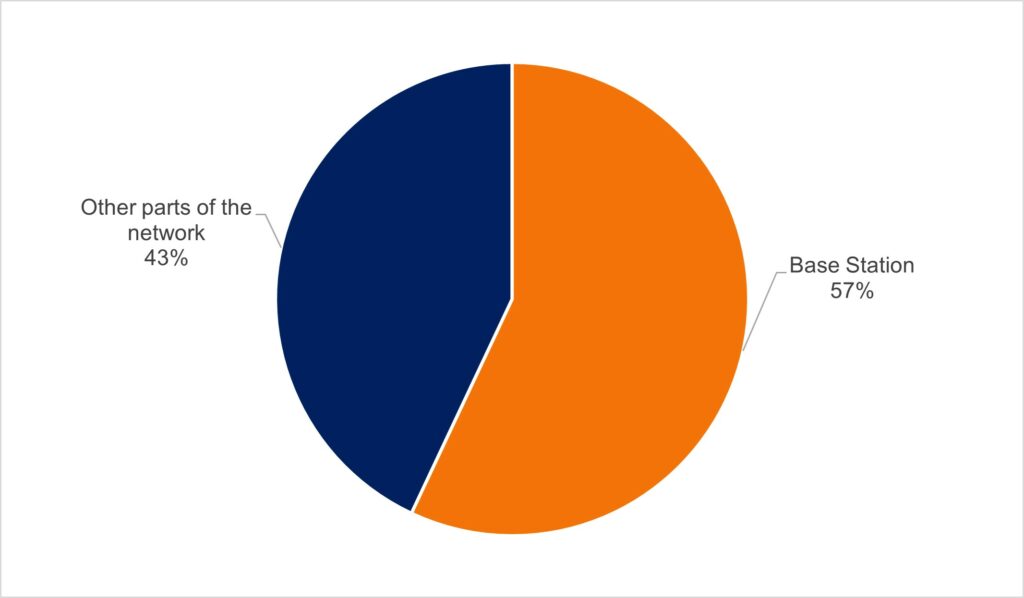
The mobile network consists of different parts like core, transport, and base stations. As shown in Figure 2, the base stations, or the mobile radio access network (mobile RAN), account for about 57% of network energy consumption for a mobile operator. Expressed differently, the mobile RAN accounts for about 51.3% (i.e. 90% * 57%) of total company energy consumption for a mobile-only operator, such as Zain.  

Figure 2: Base station’s contribution to mobile network energy consumption 


Source: IEEE Communications Surveys and Tutorials

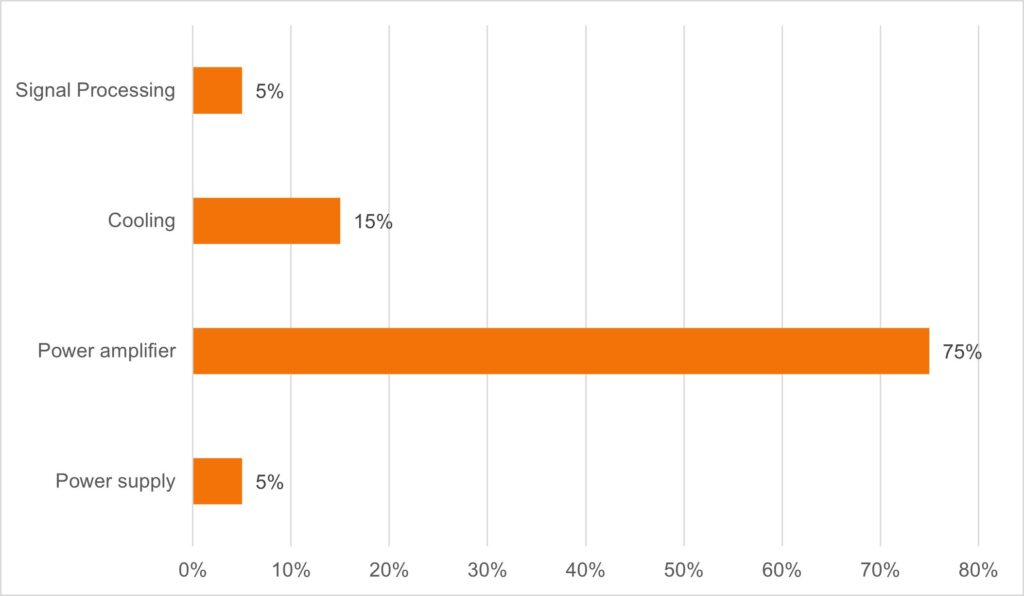
Now we need to examine the base station and have a closer look at the base station elements and their corresponding energy consumption. As shown in figure 3, the base station element that consumes the largest portion of energy is the power amplifier (PA), which consumes around 75% of total base station energy consumption as shown in figure 3.

Figure 3: Base station energy consumption distribution by network element  


Source: Journal of Energy

As shown above, the power amplifier element is the biggest energy consumer in a mobile-only telco network. The power amplifier accounts for about 38% of total company energy consumption: 75% * 57% * 90%. So if a mobile network operator turns off the 2G network layer, the bulk of energy savings will come from shutting down the power amplifier that corresponds to the 2G network. 

Now that we have quantified the amplifier’s contribution to total energy use, will this 38% figure be enough to measure the benefits of shutting down the 2G and 3G layers? Actually, we still need one more number: the energy consumption of the power amplifier for each technology. In other words, what is the energy consumption percentage for each of these technology layers? Let us have a look at this in Figure 4.

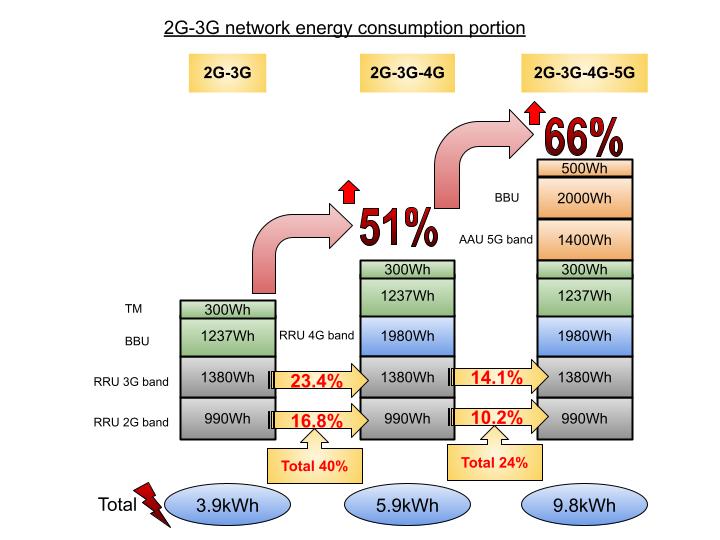
Figure 4 is a presentation of the key components in a base station and their typical energy consumption, in three different network configurations. The columns show the configuration of a typical base station, and the rows are the affecting elements, mainly the power amplifiers. The gray colored boxes are the elements needed for the 2G and the 3G layer, blue colored boxes are the elements needed for the 4G layer, green colored boxes are the elements needed for 2G, 3G, and 4G, and lastly, the orange colored boxes are elements needed for the 5G layer.

Figure 4: Energy consumption of key components in a base station, across three network configurations

Sources: MTN Consulting; Huawei Technologies

The values inside the elements represent the maximum energy consumption of that element. So as shown in figure 4, in 2G/3G only, the base station consumes 3.9kWh. By adding a 4G layer onto the base station, you increase the energy consumption of this base station by 51%. By adding a 5G layer on top of the 2G, 3G and 4G base station, you can expect another 66% increase in energy consumption. The red arrows in Figure 4 indicate these increases in maximum energy consumption.

That 66% figure illustrates one thing that is scary about 5G: yes, it may offer revenue upside, but it also consumes lots of power to operate 5G, which costs money and has climate impacts.

For this blog, though, what we really need to know is the contribution to total energy consumption of the legacy network elements as you upgrade to newer technology. These values are presented in figure 4 in the yellow arrows. So, in 2G/3G/4G base stations, about 40% additional energy is consumed by holding on to the 2G and the 3G layer. Similarly, in a combined 2G/3G/4G/5G base station, roughly 24% extra energy is consumed because of still holding the 2G and the 3G layers in this base station.

We now have the estimates we need to find the impact of supporting the 2G/3G network layers alongside 4G/5G for a typical mobile operator.  

Approaches to 2G/3G network shutdowns vary depending on current network design

Right now telcos are wrestling with the best way to deal with legacy networks, while they upgrade to 5G. The ideal solution depends on the current position of the operator’s network. In the following table, you can see some potential paths to 2G/3G network shutdowns and the impact on energy consumption. In the first scenario, where the telco currently has only 2G and 3G network layers, an upgrade straight to 5G would result in an approximate 50% reduction in energy costs. In the last scenario shown on the bottom of the table, where an operator is simultaneously operating 2G, 3G, 4G, and 5G networks, the ideal solution is to shut down the 2G and 3G layers. This would save an estimated 40% in base station energy consumption. 

Of course, energy costs are not the only factor in planning 2G/3G network shutdowns: spectrum, regulatory, legacy service revenue, and other factors also matter. But telcos nowadays are very focused on reducing their opex burden whenever possible, given weak revenue growth. As such, energy costs are a central focus of most telcos.

Table 1: Energy usage impact of 2G/3G shutdown scenarios

Mobile network’s current scope Likely migration path for 2G/3G shutdowns % reduction in energy use for typical base station
2G and 3G network Upgrade straight to 5G, bypassing 4G, then shut down both 2G and 3G 50.0%
2G and 4G network Upgrade to 5G then shut down the 2G layer 30.1%
3G and 4G network Upgrade to 5G, then shut down the 3G layer 33.2%
2G, 3G and 4G network Upgrade to 5G, then shut down both 2G and 3G layers 39.9%
3G, 4G and 5G network After upgrading all sites to 5G, shut down the 3G layer 33.2%
2G, 4G and 5G network After upgrading all sites to 5G, shut down the 2G layer 30.1%
2G, 3G, 4G and 5G network The operator is ready to shutdown both the 2G layer and the 3G layers 39.9%

Source: MTN Consulting

The above table represents cost savings for the “typical” mobile-only telco we described early in the blog. In follow-up blogs, we expect to detail the impacts of 2G/3G network shutdowns for a few specific mobile operators in different regions of the world.

*

The author, Samir Ahmad, is a telecommunications and IT consultant based in Amman, Jordan. Samir has a Master’s in Telecommunication, Electrical, Electronics, and Communications Engineering, from the University of Sydney, and a B.S. in Electrical Engineering – Communications & Electronics, from the Jordan University of Science & Technology. Prior to entering the consulting field in 2017, Samir worked for Zain Jordan for 8+ years, most recently as Expert, RF Planning and Optimization.  

Blog Details

Telco capital intensity hits 10 year peak in 2Q22

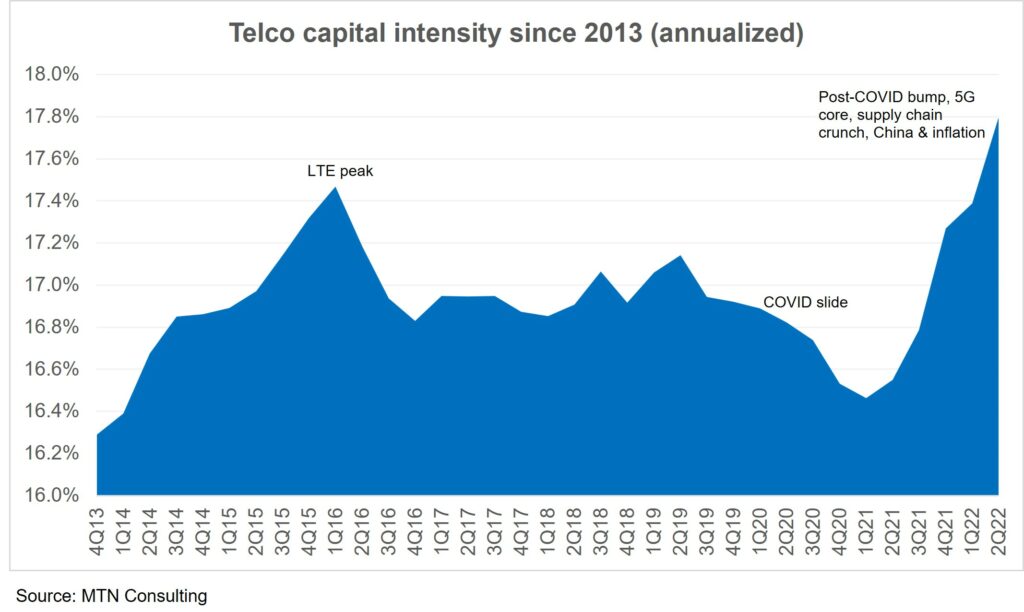
Vendors continue to wrestle with supply chain constraints in the telecom sector. That’s clear from several recent vendor earnings reports, including those issued by Dell, HPE, and Ciena in recent weeks. Telco spending, though, has surged in recent quarters. With 2Q22 results now compiled, the industry has reached a new capex peak. For the 12 months ended June 2022, telco capex was $329.5 billion (B), while the ratio of capex to revenues (i.e. capital intensity) was 17.8%. Both figures represent new record highs, at least for the 46 quarter (11.5 year) period that MTN Consulting data covers (1Q11-2Q22).  

On the supply side, vendors selling into the telco vertical are seeing some growth, in aggregate. For the broadly defined “telco network infrastructure” (telco NI) market, revenues were $60.1B in 2Q22 (up 4.1% YoY), or $237.6B on an annualized basis, up 6.7% YoY. The telco NI market includes some vendor revenue streams which dip into telco opex, not capex, but there is usually a correlation between total capex and vendor revenues.

The figure below illustrates telco capital intensity over the last several years.

What’s behind recent capex growth

One factor behind the recent capex spending spike is a post-COVID bump. Economies shutdown during COVID, depressing network spend. The capital intensity effect is shown in the figure, above (“COVID slide”). Capex also dropped in absolute terms. Annualized capex bottomed out at $299.8B in 2Q20. Some of the current growth is just making up for lost time. The quarterly average hasn’t changed much, if you expand the time horizon. For the last ten quarters, from 1Q20 (the onset of COVID) through 2Q22, telco capex averaged out to about $77.9B per quarter. For the ten pre-COVID quarters, the average was $78.5B.

Another factor is many telcos are scaling up initially small 5G deployments, and beginning to build out 5G SA core networks. 5G RAN builds have been underway for several years, but the spending has been small to start due both to the software-centric nature of 5G networks and telcos’ desire to wait for new revenue models to emerge. Incidentally, a shift to 5G core spending tends to benefit a different type of vendor – not just the Ericssons and Nokias of the world. Cloud providers AWS, Azure and GCP, for instance, are all actively involved in helping telcos with 5G core migrations. Their collective revenues in the telco vertical were about $3.4B for the 12 months ended June 2022, up nearly 80% YoY. Many of the vendors involved in this are less vulnerable to supply chain issues.

Another capex plus: fiber spending is strong in a number of markets, especially the US but also in Europe, Australia, China, and India. That’s to support FTTx deployments but also to connect together all the new radio infrastructure needed to support 5G. Government subsidies and other investment incentives are a factor as well. Vendors focused on fiber optics are seeing strong growth right now. For instance, Corning and Clearfield saw their telco vertical revenues grow by 25% and 84% YoY in 2Q22, respectively.

Supply chain limitations have a mixed effect. They sometimes mean delay or cancellation of projects, which cuts capex in the short term. They also can mean price increases, though, as telcos push suppliers to accelerate timelines or adjust designs to work with available alternatives. This can result in projects costing more than expected. Let’s not forget, though, that a huge portion of telco spend is unaffected by current supply chain constraints. Services- and software- focused vendors – like Accenture, Amdocs, IBM, Infosys, TCS and Tech Mahindra – are not citing supply chain issues as a drag on results. 

Inflation is a bit more straightforward. This has impacted the entire telecom food chain, from chips to components to systems to services. All else equal it causes an increase in US$ capex, though the impact on capital intensity is less clear. 

Finally, there’s China. Given how closed a market this is, there’s not as much attention paid to it nowadays. But China’s capex has been growing recently. For the 2Q22 annualized period, Chinese telco capex totaled $58.3B, up 12% from 2Q21. That growth comes despite efforts to share costs on the network side.

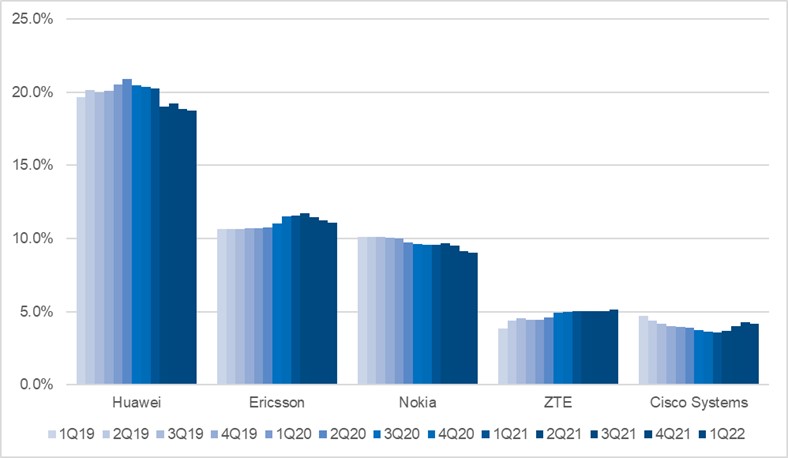
China is also relevant to the vendor share question. Huawei continues to rank at the top of the global telco network infrastructure (telco NI) market. For the 2Q22 annualized period, we estimate its telco NI share at 18.7%, far ahead of Ericsson (10.9%) and Nokia (8.9%). This surprises some, as Huawei has become a non-factor in many markets over the last two years. Yet Huawei’s stability is no mystery. It’s dominant at home, and local telcos have been spending big, and steering more of their capex dollars to local suppliers over the last couple of years. Huawei also has a huge customer list overseas – these revenue streams don’t just disappear overnight, especially since many telcos remain loyal to the vendor.

Hardware hit hardest in supply chain crunch

Vendors recorded about $237.6B in sales to the telco vertical for the 2Q22 annualized period. This is a huge market, with many different players; MTN Consulting stats track 132. Some supply the latest and greatest hardware innovations. They often have high margins but can also be subject to supply chain hiccups. Vendors specializing in solutions which revolve more around software and/or services tend to have different constraints. Labor cost and availability is always a concern, but hardware is rarely an issue. We believe the current supply chain disruptions will improve in the next couple of quarters, though. Even those vendors hit by short-term supply issues are generally optimistic. For instance, Gary Smith, Ciena’s CEO, noted last week that “Despite supply chain challenges and elongated lead times, strong secular demand trends show no signs of abating. And we remain confident that the fundamental macro drivers propelling this demand are durable over the long term.”

The biggest near-term risk to that is China’s ongoing series of COVID shutdowns. Longer term, the bigger risk is any interruption to Taiwan’s ability to continue functioning as an independent, self-governing country – it plays a key role in the telecom supply chain, and that of many other sectors. This issue is the elephant in the room that few like to address, but all vendors need to have a plan for this worst case scenario.

*

Source of cover image: iStock

Blog Details

Vendor landscape continues to shift in telecom market as cloud and 5G scale

Telco network spending has been on the rise over the last few quarters. Vendor sales of network infrastructure to the telco vertical (“Telco NI”) totaled $55.5B in 1Q22, up 5.7% YoY. On an annualized basis, Telco NI revenues through 1Q22 were $234.8B, the highest total in our 1Q13-1Q22 database and 6.8% higher than the 1Q21 annualized figure. Telco capex has been strong the last few quarters, and vendors are benefiting. The growth is not dramatic, but any kind of growth at all in telecom is a plus, and often a surprise.

As telco spending has risen post-COVID, the top few vendors remain at the top. While share always varies a bit by quarter, the biggest five network equipment providers (NEPs; excludes China Comservice) have collectively accounted for about 50% of the Telco NI market over the last few years. Figure 1 shows annualized share evolution for these vendors, from 1Q19 through 1Q22.

Figure 1: Annualized market share of top 5 NEPs in the telco vertical, 1Q19-1Q22

Source: MTN Consulting

While the top 5 remain the same and their aggregate share of wallet is stable, there are some significant shifts underway in the vendor landscape.

What drives these shifts? Some are driven by financial machinations or politics, but most are aimed at improving competitive positioning. More specifically, improving a vendor’s ability to address key customer needs. In the telco vertical, these include: deploying telco cloud functions and architectures; monetizing new network capabilities, in particular 5G; lowering the cost of transport and routing; improving the energy efficiency of networks; automating networks; lowering the cost of customer acquisition and retention; and, developing revenue streams in new areas like mobile payments, digital advertising, home networking, connected cars and security. There are probably more shifts underway nowadays because 5G cores are beginning to be implemented in a big way, and Huawei’s problems continue to open up new opportunities for smaller vendors.

Most of the shifts in the vendor landscape involve smaller players, outside the top 5. Ericsson’s acquisition of Vonage is an exception; MTN Consulting published a blog post on this deal in May. Setting aside the top 5, ongoing changes in the vendor landscape fall into a few broad categories.

Growth of the cloud providers

Alphabet (GCP), Amazon (AWS), and Microsoft (Azure) together booked approximately $3 billion in revenues to the telco vertical for the 1Q22 annualized period, from less than half a billion USD in 2Q18-1Q19. They now partner with telcos on a range of areas, as MTN Consulting mapped out in the report “Telcos aim for the cloud by partnering with webscale cloud providers.” Their aggregate share of Telco NI is now about 1.3%, around the same as Accenture and a bit more than IBM. They have a long way to go, but they are already making a dent in the market and continue to invest heavily in the telco vertical.

Most of the cloud providers’ success in telecom stems from organic investment, but not all; Microsoft has completed three acquisitions that accelerated its push into telecom: Affirmed Networks, Metaswitch, and AT&T’s Network Cloud.

Vendor partnerships with webscalers

As webscalers began to make a real dent in the telecom market in 2020, traditional telco-facing vendors realized they could benefit from some joint development and marketing ventures with the webscalers. That was especially apparent as telcos began to deploy 5G cores and needed cloud smarts from their suppliers. Over the last three years, most big telco-focused vendors have entered into partnerships with traditional telco-facing vendors like Ericsson, Nokia, NEC, Fujitsu, and Amdocs. Some of these are generic, some are customized for specific large telco accounts, e.g. Telecom Italia.

Restructuring and realignment 

Dell, including its majority holding in VMWare, saw its revenues in the telco vertical rise steadily in the 2019-21 period. The company’s 2021 revenues in telecom amounted to just over $2.7B. VMWare is responsible for much of this, boosted by its Telco Cloud offerings. Late last year, Dell spun out its majority holding in VMWare. This was aimed partly at raising cash, but also at creating more value in VMWare, which has a different business model and profit margins than parent Dell. The two retain strong connections and partnerships, including in the telco space.

Since the Dell-VMWare spin-off in 4Q21, a bigger shift has occurred: in May 2022, Broadcom agreed to acquire VMWare, for $61 billion. Broadcom says the deal will combine its software portfolio with VMWare’s multi-cloud offerings. Telco is only one of many reasons for this deal, not a central one. Prior to the deal, Broadcom alone did have some small position in Telco NI, due largely to previous acquisitions (Brocade, and CA Technologies). The synergies involved in this deal seem questionable, but importantly Broadcom claims it will allow VMWare to operate with a degree of independence.

In the same quarter as Dell’s spinoff of VMWare, IBM separated its services group into a new company, Kyndryl. This deal was also driven by an interest in separating two companies with significantly different business models and profit margins. Both go after telco business though. Red Hat is at the core of IBM’s efforts to improve its penetration of the telco sector, and it has had some success. Kyndryl inherits many relationships with telcos cultivated by IBM’s services group over the years. That includes deals with Bharti in India, including a blockbuster $1.4B deal for IT operations outsourcing, way back in 2004. Interestingly, 5G monetization is front and center of Kyndryl’s messaging for the telco vertical, which is a similar driver to what’s behind Ericsson-Vonage.

Still pending: CommScope has been attempting to spin out its Home (CPE) division for several quarters, but there is no confirmed buyer. There’s some chance that the company will just reintegrate the division, as options are limited. Acquisition by private equity is likely being considered, though.

Telcos investing directly in technology supply

There are a few cases of telcos either creating a vendor in-house or acquiring a large ownership stake in one which already exists:

  • Rakuten Symphony: Rakuten’s creation of Symphony is most notable in recent years – the highest stakes, and probably the most expensive. Payoffs may be many years down the road, as more telcos consider open RAN for brownfield networks and Symphony develops more of a track record.
  • Tata Sons-Tejas Networks: Tejas Networks sold a controlling stake (43.4%) in July 2021 to Tata Sons group, which wants to help Tejas grow. The Tata group includes a telecom division, Tata Communications, with $2.3B in 2021 revenues, making it India’s fourth largest private telco. Tejas is focused on optical networks.
  • Verizon-Casa: in April 2022, Verizon announced it would invest $40M in one of its smaller vendors, Casa Systems, at the same time as agreeing to a multi-year contract.
  • NTT-NEC: further back, in June 2020, NTT announced a $560M investment into key supplier NEC, for a 4.8% stake in the company. This aimed partly at helping NEC expand its 5G offerings and leverage an opening in the global market for wireless technology opened up when Huawei began to face supply chain and political constraints in 2019-20.

Vendor-vendor M&A deals

The vendor landscape also continues to be impacted by more traditional M&A deals, where a vendor acquires another technology supplier. Some of the recent transactions include: 

  • NEC: this Japanese vendor has committed to expand in the mobile technology space, with focus on open RAN. Earlier in July, NEC agreed to acquire Aspire Technology Unlimited, an Ireland-based systems integrator, to help with this pursuit.
  • ADVA-Adtran: these two small but profitable wireline vendors announced plans to merge in late 2021, and the deal just closed. The new company, ADTRAN Holdings, may have a leg up in pursuing the many transport network upgrades and broadband access buildouts underway worldwide right now. The new ADTRAN may also be better able to deal with supply chain constraints, which continue to be an issue for smaller NEPs.
  • Sterlite: this India-based optical supplier has been growing over the last few quarters, exploring overseas markets for fiber optics, launching a small range of wireless products, and acquiring a UK-based systems integrator, Clearcomm Group, in 2021.
  • Accenture: has spent heavily on a wide range of acquisitions in the last two years, across industry verticals. Deals impacting telecom include Arca, a Spanish engineering services company, in 2020; umlaut, a German network engineering, testing and analytics company, in 2021; and Advocate Networks, a technology consultancy and managed services provider, in 2022.
  • Aviat-Ceragon: most mergers are friendly, where both sides agree. As Elon Musk’s attempted purchase of Twitter reminded the world, there are also less friendly forms of acquisition. This Aviat-Ceragon deal is basically a hostile takeover of Ceragon, proposed by Aviat. It’s still pending and the two parties may not come to agreement. However, the motive is worth noting. Aviat’s hope is that the deal would give the combined company more scale and better margins, and a stronger ability to compete with Huawei, Ericsson and Nokia in the wireless transport space as opportunities arise for 5G backhaul & fronthaul and support for private wireless networks.

Finally, one significant acquisition involves a large established telco-facing vendor acquiring telco assets. In September 2021, Ciena acquired AT&T’s “Vyatta” virtual switching and routing technology.  As Ciena said at the time, the deal aims to address “the growing market opportunity to transform the edge, including 5G networks and cloud environments.” Many shifts in the vendor landscape aim at this same opportunity.

*

Photo by Hans-Peter Gauster on Unsplash

Blog Details

Telecom’s top 3 vendors betting big on enterprise expansion; Huawei has early lead

Telco NI’s top 3

Telcos buy products & services from dozens of different vendors. Our research tracks 130. Some are relatively easy to classify into a segment, e.g. Corning, a “cabling & connectivity” vendor in our terminology. Most are much harder. Even those which may once have been called NEPs (network equipment providers), such as Ericsson, went beyond the implications of this term long ago. They also provide software and services, and most of their future development – measured by both R&D spend and acquisitions – is targeted towards software and the cloud.

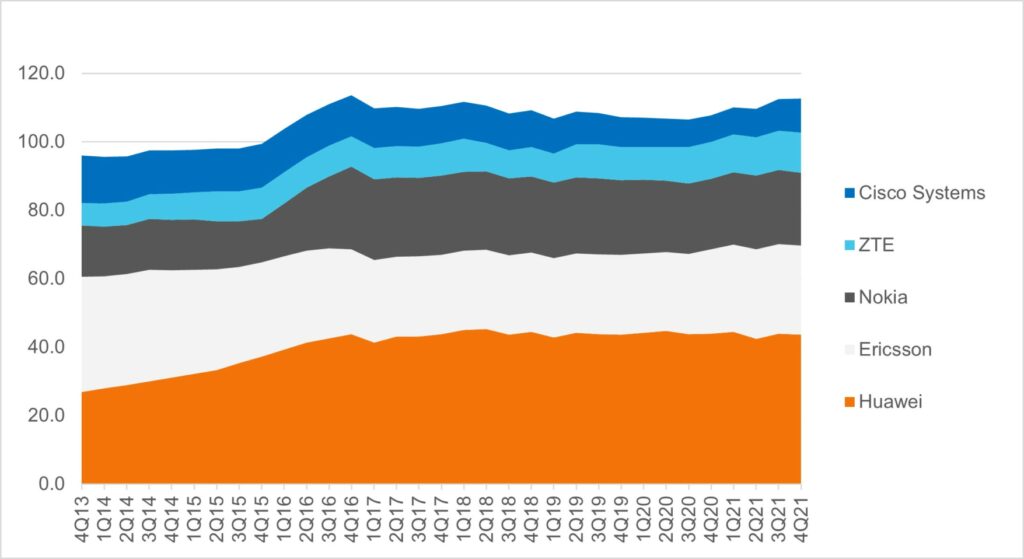
Setting aside the vendor classifications, there is less dispute about who the overall top suppliers are in telecom. According to MTN Consulting’s most recent vendor share report on this “telco network infrastructure” (telco NI) market, the top 3 are Huawei, Ericsson, and Nokia. Nobody else comes close. ZTE and Cisco round out the top 5, if you set aside the strange creature that is China Comservice, a services specialist which is majority-owned by China’s telcos. Figure 1 illustrates recent trends in annualized telco NI revenues for these top 5.

Figure 1: Vendor revenues in telco vertical, annualized ($B)


Source: MTN Consulting

Top 3 trying to expand beyond telecom

Focusing on the top 3, all face challenges related to addressable market. For Ericsson and Nokia, the common issue is that telco spending is relatively flat, even with the occasional growth spurt from a new generation of technology (e.g. 5G RAN). For Huawei, the problem is due to US-driven supply chain restrictions and boycotts by a number of countries that used to be important markets for the vendor.

Prior to Huawei’s current issues, its diversification was impressive, as its huge consumer business helped offset some of the risk in focusing on one primary market, telcos. But Huawei’s consumer business revenues have collapsed in the last 2 years: they ended 1Q22 at approximately 209.7B RMB (annualized), from 462.9B RMB  in the 1Q20 annualized period. Its carrier revenues have also fallen, as overseas telcos have been reticent to commit, but the drop is modest due to strong support from Chinese telcos and key overseas partners. Still, the writing is on the wall. Huawei recognized two years ago that it needed to reinvent itself, committing more to R&D and exploring new business opportunities beyond telco. One major focus is finding ways to expand its enterprise market. Its starting point in this expansion is a strong position in global optical and IP markets, and a solid offering for data centers. The company’s April analyst event made clear that its datacom group would play a central role in attacking the enterprise (CloudCampus, SD-WAN, Wi-Fi 6 and 7, etc.), as would Huawei Cloud

Both Ericsson and Nokia also view enterprise as important. Ericsson is focused mainly on private wireless, and acquired Cradlepoint in large part to pursue this opportunity. Ericsson’s microwave transport gear, security and software, and IoT solutions also have applications outside the telco. Nokia has a larger enterprise business to begin with. It’s also pursuing private wireless, and trying to leverage its wireline gear (optical and IP) further into enterprise markets. It also has had success in the webscale market, including a data center switching at Microsoft recently.

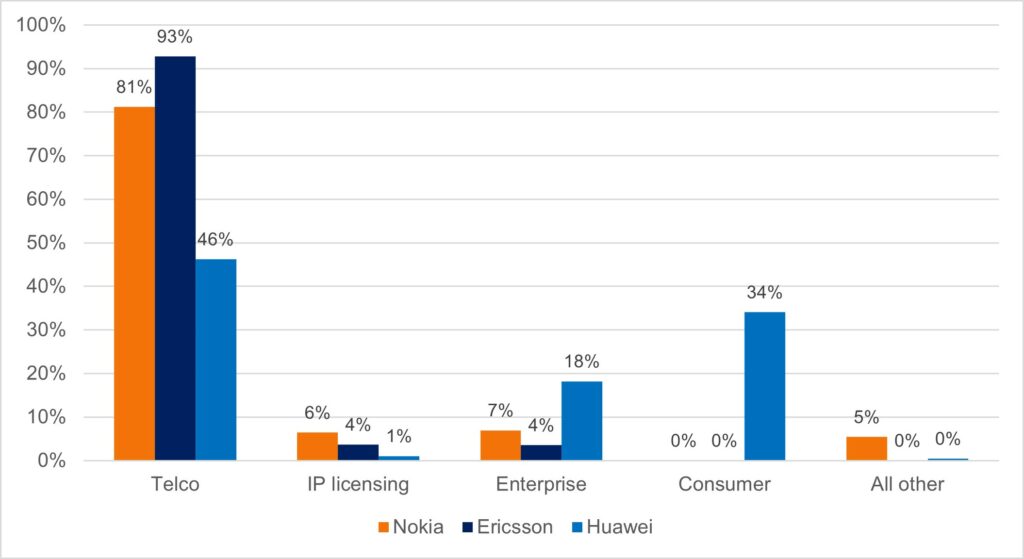
Figure 2 illustrates the revenue breakdown for these three vendors into several major categories: telco, enterprise, consumer, IP licensing, and all other.

Figure 2: Annualized revenues by market, % total (2Q21-1Q22) 

Source: MTN Consulting

 As shown above, Huawei gets less than half its corporate revenues from telcos, even after Consumer’s decline. What may surprise some is how much of its revenue base comes from enterprise. For the 1Q22 annualized period, the enterprise market accounted for 18% of Huawei revenues. Nokia and Ericsson recorded 7% and 4%, respectively.

Moreover, enterprise as a percent of total revenues was about the same for Ericsson and Nokia two years ago, in the 1Q20 annualized period. For Huawei, though, enterprise has nearly doubled, from about 9.7% in 2Q19-1Q20 to 18.2% in the most recent four quarters. As Huawei has faced pressure in other markets, the enterprise has proved to be more resilient. And Huawei has plowed new resources into enterprise to grow it further.

The enterprise is not a hobby  

To date, Huawei’s big enterprise wins are mostly in China. For the company overall, 65% of 2021 revenues were in China. It’s likely that well over 80% of enterprise division revenues are in China. But this was true of Huawei’s carrier group revenues in the early years. With any new product line or market, Huawei has usually penetrated Chinese accounts first while it has ramped up resources overseas to support an expansion. 

Clearly there is no guarantee that Huawei’s enterprise group will thrive outside China. For larger enterprises subject to public pressure, some will still be concerned about the politics of picking Huawei. Even without concerns about appearances, Huawei’s reputation has taken a hit over the last couple of years, which it is working to overcome. Another challenge is channels. Even for the large enterprise targets – such as big banks, government agencies, railways, and energy companies – Huawei will need to rely on channel partners. It can’t develop its own internal team as it did with telco; there are too many enterprises, and the average size is too small. Huawei needs to identify the best country and vertical markets to attack, and develop a network of trusted, certified partners to both sell into this market and support it after the sale. Enterprise market leader Cisco has invested heavily in building and maintaining its network of channel partners for decades. Huawei also has to battle numerous vendors with established positions in specific enterprise verticals (e.g. energy) or product areas (e.g. Ethernet switching).

All this won’t be easy, but don’t count out Huawei. It has exceeded expectations many times in the past, and views the enterprise as crucial to growth. One indicator of the importance of the enterprise market to Huawei is its leadership. For most of the last half of the 2010s through 2020, Yan Li Da served as Enterprise group president. Yan was in charge of international marketing for Huawei’s early 2000s push into overseas optical markets. That push was key to Huawei initially establishing its name in the global telecom market. Yan is now on Huawei’s board of directors. 

*

Cover image: Marvin Meyer on Unsplash 

Blog Details

After failure to adapt to 4G, telcos need to evolve

It was the Greek philosopher Heraclitus who coined the phrase, “Change is the only constant in life.”

Well over a thousand years later, Benjamin Franklin continued the thought, saying, “When you are finished changing, you are finished.”

From the wheel to the internet and beyond, the need for change, for new ideas, new technologies, has been a defining element of humanity. Through trial and error, innovators conceive of an idea, conduct research, prove their hypotheses, and develop and refine their concepts. Such research and development have become absolutely vital to the success of the telecommunications industry. Without R&D, humanity might never have evolved past the rotary-dial telephone. There would be no internet, no cell phones, none of the technological marvels we often take for granted … amazing tools that our predecessors likely could not have envisioned even in their dreams.

Or… perhaps they did. After all, the myriad technologies of science fiction are continually becoming science fact. For example, many of the technologies of the original “Star Trek” are commonplace today. The communicators, viewscreens and tricorders of that fictional future exist today as cell phones, laptops, video chats, and advanced sensor packages.

AT&T is another example. Back in 1993, the telecommunications provider (telco) aired commercials that examined what its researchers were developing, and extrapolated the impact of those technologies on the future. The commercials accurately predicted global positioning systems, laptops, tablets, smart watches, keyless entry and on-demand video entertainment … in an era before most homes even had internet connections or home computers.

That was nearly three decades ago. In the time since, you’d expect that AT&T would be spending more on R&D, particularly this far into the digital age.

You’d be wrong.

From 2000 to 2021, AT&T’s annual spending on R&D hovered between 0.7 percent to 1.3 percent of its total revenue. For 16 of those 22 years, AT&T’s R&D expenditures remained less than 1 percent of the company’s total revenue.

Surprised?

Don’t be.

Other telcos show much the same spending pattern. From 2018 to 2020, SK Telecom spent an annual average of a mere 2.2 percent of its revenue for R&D expenses. Telefonica spent less, at 2 percent. NTT spent 1.9 percent; Chunghwa Telecom, 1.8 percent; Orange, 1.6 percent; Comcast and KT Corp., 1.1 percent; and China Telecom, 1.0 percent. Most others, including AT&T (0.7 percent) and LG Uplus (0.4 percent), spent less than one percent of their overall revenue on R&D.

“Telcos (tend to) spend very little on R&D, instead relying mainly on their suppliers for innovation,” Matt Walker, chief analyst at MTN Consulting. “The world has hundreds of telcos but only a few dozen significant suppliers, so some of this is inevitable. The smaller telcos can’t afford to do it all themselves,” said Walker, as they often lack the staffing or the financial resources to conduct their own R&D.

On top of their lack of spending, telcos are also largely slow to innovate. When 4G wireless debuted, telcos rejoiced at the idea of earning new revenues from the networks, which were expensive. However, the majority of the revenue from the new networks went to the companies that build telecommunications devices, like Apple; app companies; content providers, like Netflix; and cloud services companies. This left telcos out in the cold, as they could buy the technology needed to provide 4G, but not truly profit from it.

When 5G networks emerged, the telcos spent big, again hoping for a revenue upside from the investment. Thus far, however, they are in the same position where 4G left them … not benefitting financially, and still wary of spending much on their own innovation and R&D.

“This arrangement worked alright when telcos had limited competition from other sectors,” Walker noted. “However, in the last five years or so, these new ‘big tech’/webscale players have begun encroaching on different aspects of the telco turf.”

Are telcos doomed to repeat the same mistakes? Hopefully not.

Should they be spending more on R&D to help develop new revenue streams? Yes.

Are there examples of leaders in the sector to learn from? Yes.

Telcos should not have to wait on their downstream vendors to innovate and create new technologies, from which they can benefit. Instead, they should take advantage of the growing and rapidly evolving technologies and innovate on their own.

Indeed, some industry leaders are already beginning to call for such a paradigm shift. Aaron Boasman-Patel, vice president of AI & Customer Experience at TM Forum, and Brian Smyth, Accenture’s Global Comms & Media Innovation Lead, conducted research on the matter, the results of which they published in their white paper, “The tech-driven telco.”

“At the most basic level, the world has changed since the telco business model was introduced,” said Smyth. “… At Accenture, we see three mega trends, the first one being the customer – so how we live our life, how we engage with civil society and government, how we work; the second being business model reinvention, … how technology transforms not only customer experiences, but also how customers buy into products and services. We’re seeing within this also a big focus on partnership and partnering together with other organizations to offer new services and experiences.”

“And then finally, it’s the technology revolution. So, in telcos a lot of talk today is around 5G, edge networks, and a lot of this is the confluence of these three points of customer imagination, reinvention, and the technology revolution I think are all leading to this transformation from the traditional telco” to a more tech-driven model.”

Added Boasman-Patel, “If you don’t evolve, then you’re not going to be able to take a slice of the pie – the $700 billion worth of new revenues which are out there today. … If you think about, what we’ve seen through the pandemic, telecoms shares have increased by about 4.8 percent compared to other industries like semiconductors and electronics up by nearly 50 percent, media technology, high 35 percent. … I think when you get above 20% of (revenue spending), whether in industrial manufacturing, or sensor management or whatever it may be, that’s where you can start to say you have become a true techco,” he said.

In November 2021, Ericsson, the world’s second-largest supplier of technology to telcos,  surprised many observers by announcing that it was purchasing Vonage, a cloud communications company. That one company would acquire another is standard fare for financial news. Also, it wouldn’t be unprecedented for a telco to buy one of its vendors. The November deal, however, was the reverse: Ericsson, a vendor/supplier to telcos, was buying Vonage, a telco.

“That deal was surprising because it was a traditional vendor buying what seemed to be a telecom provider/telco, i.e. Vonage,” noted Walker.

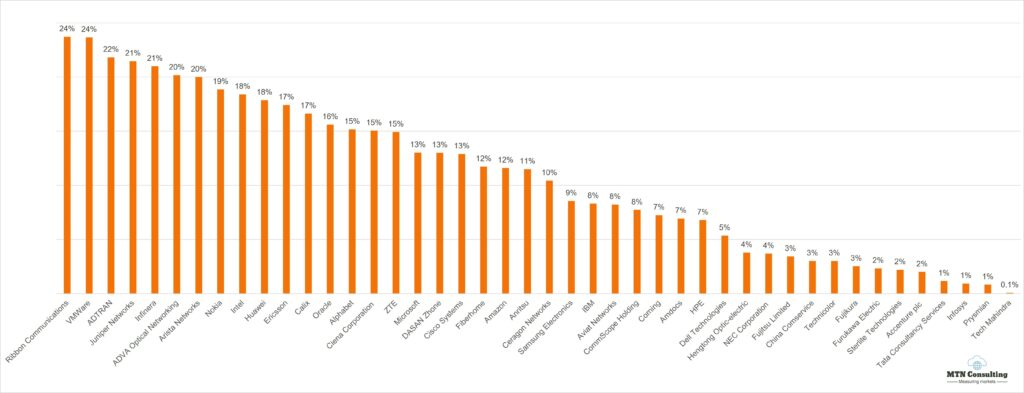
Unlike the typical telco, vendors do usually spend quite a bit on R&D. Ericsson, for example, spent an annual average of 17 percent of its revenue for 2019-2021. Many others spend less, including Alphabet and ZTE (15 percent each); Microsoft (13 percent); Amazon (12 percent); Samsung (9 percent) and IBM (8 percent). In contrast, Ribbon Communications spent 24 percent; Juniper Networks (21 percent); Nokia (19 percent); and Huawei (18 percent). Alphabet and Microsoft are included in these figures because their cloud divisions GCP and Azure, respectively) have become important suppliers to telcos.

Figure 1: R&D spending as % of revenues for select Telco NI vendors, 2019-21 average


Source: MTN Consulting

Ericsson made the $6.2 billion deal in the hopes that, if approved by regulators, its acquisition will help it work with telcos to better monetize apps and services. Ericsson has mapped out a plan to help their telco customers get new sources of revenue from the new networks currently being built.  Its acquisition of Vonage means that it now has a telco subsidiary with a dedicated R&D mission. Indeed, unlike the regular low numbers shown at other telcos, Vonage’s R&D numbers tend to trend higher.  In 2011, Vonage spent 1.8 percent of its revenue of R&D. In 2014, that number rose to 2.4 percent. In 2019, it hit 5.8 percent, then rose to a high of 6.5 percent in 2020 before dipping to 5.7 percent.

Indeed, Vonage hews closer to the “techco” model favored by Boasman-Patel and Smyth than it does to that of a standard telco model.

“I think mindsets are really important here to drive that change,” said Smyth. “A really interesting example is Microsoft. When Satya Nadella took over Microsoft in 2014, at that point they were hugely profitable as an organization, but not very exciting. And Satya talked about actually wanting to build an organization and products and services that customers would love. And they had missed big trends at this point. They had missed things like search (engines) and mobile, and a lot of people were questioning whether Microsoft’s best days were really behind it at that point, where he came in with this focus on building this growth mindset.

Smyth continued, “The growth mindset is actually … about shifting from the sort of know-it-all to the learn-it -all mindset and being hungry and open to change and collaboration. And what we’ve seen since is a 10x growth in the market cap of Microsoft. And an incredible performance and a complete refresh of the brand, attracting young talent, attracting the next generation of sort of leaders across new technology domains and re-cementing their position in future technologies, whether it’s cloud, or now looking at the metaverse.”

Vonage, like Microsoft, leaned into its own evolution.

“Vonage was no longer just a telco” by the time Ericsson announced the acquisition deal in 2021, said Walker. “It started life as this, but had evolved more into a hybrid in the last five years, creating lots of its own intellectual properties (IP). From 2018 to 2021, Vonage spent about 6 percent of revenues on R&D, way higher than the average telco, and closer to a vendor.”

Indeed, Vonage’s most recent annual report tells the story of its evolution from telco to techco: ““Founded in 2001, Vonage was among the first companies to provide Voice over Internet Protocol technology offering feature-rich, low-cost home phone services. Through a series of strategic acquisitions and organic growth, Vonage since has transformed from a VoIP-based residential service provider to a global leader in business cloud communications.”

Vonage also has a long list of patents, which helps fuel its innovations.

“Vonage does some things that don’t look like what a vendor (Ericsson) would normally do,” noted Walker. “But Vonage’s R&D creations (will) allow Ericsson, in theory, to provide valuable support to its other telco customers in an important area, i.e. monetizing the network through use of APIs,” or Application Programming Interfaces, which permit different applications to communicate.

Although most U.S. telcos continue to play it safe, telcos in the United Kingdom have begun to increase their R&D sending. In 2020, they spent over 1 billion pounds (1.2 billion pounds, or $1.56 billion USD) on R&D … the first time they have done so in nearly 10 years.

According to the British Office for National Statistics, the telco sector boosted its R&D spending by 4.5 percent during 2020, to 1.03 billion pounds. They last spent that type of money on R&D in 2011, when they spent 1.04 billion pounds.

However, not surprisingly for a time during a pandemic, UK R&D spending by telcos and all other industries remained in the shadow of pharmaceutical sector, which boosted its R&D spending by 6 percent to 5.02 billion pounds ($6.19 billion USD).

“There’s a demand from industry to actually partner and collaborate with (communications service providers) to build out these new services,” said Smyth. “… It’s quite interesting from some of the initial feedback we’re hearing there is a desire on the CSP side to really just offer connectivity solutions, sell connectivity. So, I think what industry is looking for is support in solving their business problems. And I think there’s great opportunity for CSPs as they’re building the scalable platforms to actually go in and partner and co-create with industry to build solutions.”

4G set sail some years ago, and telcos largely missed the boat. It’s still relatively early in the rise and growth of 5G. Hopefully, telcos will learn from the mistakes they made with 4G. If they prioritize creating and funding new R&D initiatives, they can evolve into more technology-driven companies. This will allow them to benefit, in terms of technology and revenues, from 5G.

It’s not too late for telcos to fully get on board with 5G … before that opportunity also sails out of reach.

About the author

Melvin Bankhead III is the founder of MB Ink Media Relations, a boutique public relations firm based in Buffalo, New York. An experienced journalist, he is the president of the Buffalo Association of Black Journalists, and a former editor at The Buffalo News.  

*

Cover image: iStock

Blog Details

Telcos are upgrading their workforce, but it comes at a price

One of the many telecom stats we track is “labor costs”, i.e. what telcos spend in salaries and benefits to support their workforce. Not a lot of other analyst firms track labor costs, if any. It’s not an easy one to track, as telcos aren’t required to report it, and the data can be hidden. But it is essential to understanding the telco’s business and challenges they face.

What’s important to know about labor costs and the telco workforce in general?

Labor costs represent a lot of money. The capex spent by telcos on their networks gets lots of attention, and for good reason. It’s a huge cost, at roughly 17% of revenues across the globe. Yet spending on the workforce is nearly as much as capex. In 2021, telco capex was $326 billion (B), while labor costs totaled $273B. Some telcos spend significantly more on labor costs than capex. Saudi Telecom (stc), for instance, spent $2.6B on labor costs in 2021, 60% more than that year’s $1.6B capex figure for the company. The labor cost to capex ratio exceeded 1 for a number of other large telcos in 2021, including: Chunghwa (1.26), Orange (1.10), Singtel (1.2), Telecom Argentina (1.20), Telefonica (1.23), and Telstra (1.26).

Labor costs are not just salaries. When we say “labor costs”, we mean to capture the fully-loaded cost of an employee. That includes salaries and wages, short-term benefits, retirement benefits, any required government contributions, and share-based compensation. Labor costs are around 20-60% more than just direct salaries, depending on the company. Some companies report the breakout of the various categories, but many do not. For Verizon and AT&T, we estimate the labor cost to salary ratio as 1.4.

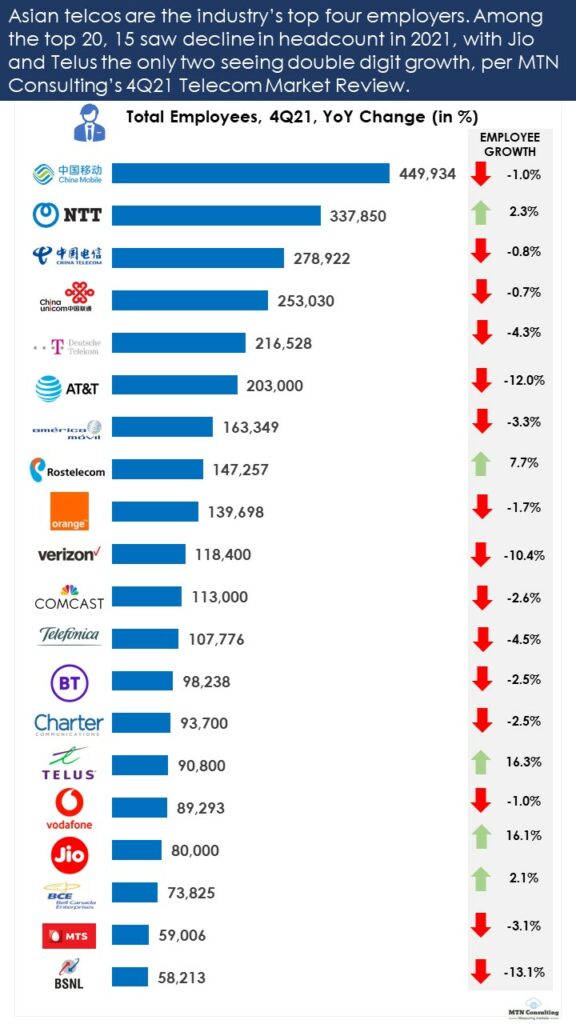
Headcount is falling. As MTN Consulting detailed in its 4Q21 market review for the telco sector, headcount in the telco industry continued to fall last year. Total employees dropped 2% in 2021, to 4.69 million. Only 5 of the top 20 telcos increased headcount in 2021. The 2021 decline follows a much worse 3.7% drop for the industry in 2020, when COVID forced cutbacks, office closures and acceleration of timelines for digital transformation and automation programs. Prior to COVID, telcos were already in staff-cutting mode, but COVID sped up the process. Looking down the road a bit, telco headcount should fall to ~4.4M by 2026. Figure 1 illustrates changes in 2021 for the top 20 telco employers.

Figure 1: Total employees and YoY % change of top 20 telcos, 2021

Source: MTN Consulting

Labor cost per employee is rising. Amidst this drop in headcount, average labor costs have been rising. From $49.2K in 2017, the average telco employee in 2021 cost $57.6K, or 17% more. Prior to 2018, labor costs per employee were flat for most of the last decade, hovering around US$50K per employee. The inflationary pressures of late 2021 may have played a small role, but more important is the changing nature of a telco. With deployment of software-based platforms in the network, and digitization of a whole range of processes across the company, a different type of employee is required. Some may be younger, but their skills are in demand and can be costly. There is rising competition for these employee types, including from cloud providers like GCP and AWS.

Labor costs a large part of opex. The rising cost per employee is interesting, but even more important may be labor cost’s contribution to opex. As a percentage of opex, excluding the non-cash items of depreciation & amortization, labor costs can exceed 30%. That was the case for a number of large telcos in 2021, including BCE (labor costs equal to 32.6% of opex ex-D&A), BT (31.7%), KPN (30.8%), Swisscom (39.8%), and Telecom Italia (35.9%). Some of these companies face constraints in how they structure their workforce, for instance, union rules limiting layoffs or locking in salary increases. On average, labor costs account for about 22% of opex ex-D&A.

The labor cost burden isn’t equal across markets. Telcos across the globe face similar price levels for their technology inputs. Prices vary somewhat, of course, but the variation is rarely on the order of 3-5x. More important is the variation in technology choices made across different markets, and the way they finance capex. For labor costs, though, the variation in the cost of an employee can be huge. Labor markets are highly localized, even with a more remote/hybrid workforce than in the past. The average employee at UAE-based Du, for instance, cost US$199.8K in 2021, nearly 6x that of another UAE-based telco, Etisalat ($34.0K). The reason for that is most of Etisalat’s workforce is in lower cost countries such as Pakistan, Egypt, and Morocco, whereas Du operates solely out of high-cost UAE.

Telcos investing in upskilling. As telcos deploy more software in their networks and digitally transform all aspects of their operations (including sales & customer support), many are investing heavily in upskilling their employee base. Vodafone, for instance, says “the transformation into a new generation connectivity and digital services provider requires new skills and capabilities in our organization, such as software engineering, automation and data analysis.” Vodafone invested an average of 470 Euros in FY2021 on “training each employee to build future capabilities.” Similar things are occurring at many other telcos, including Deutsche Telekom, which is investing in “upskilling and reskilling programs with a focus on digital skills”. There is also a growing focus on hiring younger employees with skills more appropriate to the digital age.

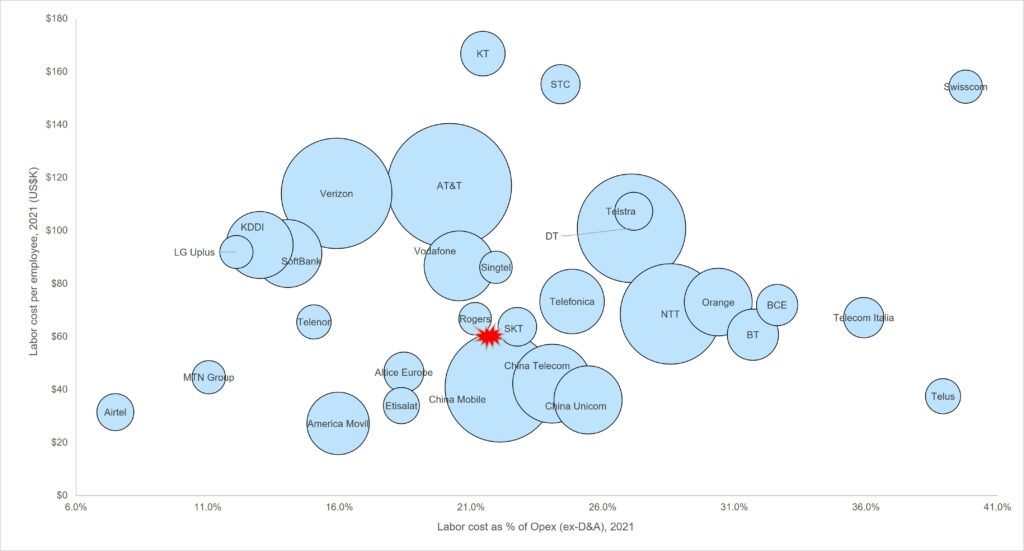
Propensity to adopt automation varies widely. Vendors talk a lot about how their solutions allow customers to do more with less: automate tasks and processes which previously required manual intervention. This has always been a part of the telecom industry, from the days when telcos migrated away from manual telephone switchboards. It continues to be important as telcos aim to lower their cost of operations, deploy services more rapidly, and maintain network quality. The importance of automation varies widely across country and operator, however. Companies which face high unit labor costs tend to be more eager to adopt automation, all else equal. When labor costs are a relatively high portion of overall opex, that eagerness multiplies. Figure 2 below illustrates the issue.

Figure 2: Labor cost burden variation across 30 large telcos, 2021

Source: MTN Consulting
Notes: Size of bubble is indicator of relative revenues. Red star icon represents the global average. 

For 30 large telcos, the above figure shows labor cost as a % of opex (ex-D&A) on the x-axis, and labor cost per employee on the y-axis. The companies in the top right quadrant tend to be more open to automation, while the bottom left (low labor costs) are the opposite. Swisscom is a bit of an outlier, as its labor costs are so high. That’s a reason for Swisscom’s adoption of Red Hat’s Ansible Automation Platform in 2018, for instance. Other big telcos with an economic inclination to automate include: Telefonica, DT, Telstra, NTT, Orange, BT, BCE, and Telecom Italia.

One thing that telcos won’t be automating anytime soon is the CEO. The top few managers in many leading telcos continue to earn millions of US$ per year, and there often seems to be little relationship between these sky-high pay packages and the company’s performance. Light Reading detailed this situation recently in an insightful article. LR notes that the ratio of CEOs’ pay packages with the median employee in 2021 was 312:1 for T-Mobile, 231:1 for AT&T, 166:1 for Verizon, and 106:1 for Telefonica. Swisscom’s CEO Urs Schaeppi had to make do with a relatively paltry margin of 14:1.

*

Cover image credit: Scott Webb on Unsplash

Blog Details

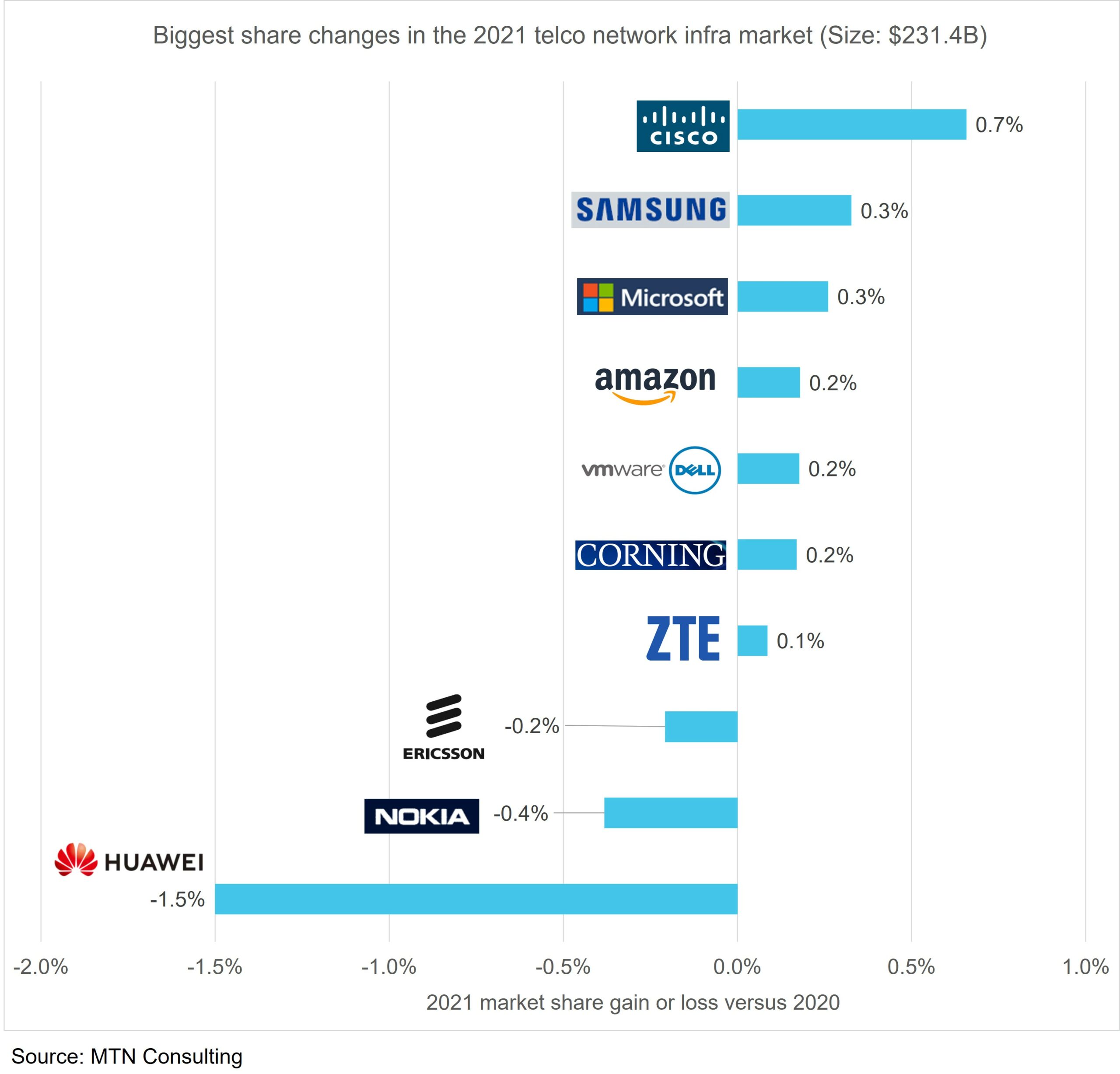
Cisco, Samsung, and ZTE benefit most from Huawei bans in 2021 telco NI market

2021 results for the 100+ vendors selling into the telco market are just about finalized. Contrasting 2021 “telco network infrastructure” (Telco NI) share with 2020, Cisco clearly came out on top, gaining 0.7% share in a market worth $231.4 billion (B). Cisco was helped both by a telco shift in 5G spending towards core networks, and Huawei’s entity list troubles. Samsung’s share growth of 0.3% was due to a big win with Verizon and a growing telco interest in seeking RAN alternatives beyond Ericsson and Nokia. ZTE, which has escaped the US entity list to date, also picked up some unexpected 5G wins but its growth is more broad-based due to optical, fixed broadband, and emerging market 4G business.

Dell (including VMWare), Microsoft, and Amazon also picked up share as telcos have begun investing in 5G core and cloud technologies. Their growth has little to do with Huawei, and more due to telcos’ ongoing changes to network architecture and service deployment patterns. Corning was an unexpected winner in 2021, gaining 0.2% share on the back of fiber-rich wireless deployments and government support for rural fiber builds.

On the flip side, both Nokia and Ericsson lost share in the overall telco NI market in 2021. Their RAN revenues benefited from Huawei’s troubles in 2020 but telco spending has since shifted towards product areas with more non-Huawei competition. Both vendors are attempting to diversify beyond the telco market, with Nokia so far having more success; its non-telco revenues grew 12% in 2021.

Huawei’s share of telco NI declined to 18.9% in 2021, down from a bit over 20% in both 2019 and 2020. The US Commerce Department’s entity list restrictions were issued in May 2019 but hit the hardest in late 2020 and 2021, after Huawei’s inventory stockpiles began running out.

Huawei’s messaging on its recent fall is muddled. During its annual report webcast yesterday, it cited three factors behind its 2021 revenue decline: supply continuity challenges, a drop in Chinese 5G construction, and COVID. In MTN Consulting’s opinion, supply continuity was the main factor. A related factor were the many government-imposed restrictions on using Huawei gear around the world, especially in Europe where 5G spending was strong in 2021. The other two factors cited by Huawei’s CFO, however, are misleading. Chinese telco network spending, overall, was relatively strong in 2021: total capex for the big three telcos was $52.8B, up 8% from 2020. Without this rise, Huawei’s 2021 results would have been worse. As for COVID, few other vendors cite the pandemic as a factor restraining 2021 telco spend. More vendors cite the opposite: 2021 spending was strong in part because telcos were forced to delay many projects during COVID’s early spread.   

To date, Huawei’s troubles have impacted RAN markets the most, but in 2022 and 2023 will begin spreading more clearly to IP infrastructure, optical, microwave, fixed broadband, and other areas. A number of vendors are eager to pursue new opportunities as this happens, including Adtran/ADVA, Ciena, Cisco, CommScope, DZS, and Infinera. The CEO of Infinera, in fact, said on its 4Q21 earnings call that “it was a nice taste, a nice appetizer in 2021, but…we said all along that we would see the design wins and RFPs really scaling and we thought that we’d see revenues from that really beginning to take hold as we got into 2023.”

To date, Huawei has been unable to fully adapt to the supply chain restrictions put in place in 2019. It remains the global #1 in telco NI, however, due to dominance in China and a huge installed base across the globe. The company is investing heavily in carrier services & software, Huawei Cloud and new product areas. One certainty is that it won’t simply fade away, despite the current decline.

Blog Details

What Can President Biden Do to End the Disinformation Age?

On Jan. 6, 2020, something extraordinarily dangerous occurred. During Congress’ certification of the Electoral College votes from the 2020 election, armed protesters stormed the Capitol Building, overwhelming police officers and forcing lawmakers to seek shelter. What made this occurrence so out-of-the-ordinary was that the protesters were supporters of then-President Donald J. Trump, who had been defeated in his bid for re-election by former Vice President Joe Biden.

Five people died in the attack, or as a result of the attack. Brian Sicknick, a Capitol Police officer, died of his injuries after a savage beating from the insurrectionists. Ashli Babbitt, a Trump supporter, was shot and killed by Capitol Police. Three other Trump supporters died that day, as well: Kevin D. Greeson, who suffered a fatal heart attack; Rosanne Boyland, who was apparently trampled by in the crowd as they attempted to breach police lines; and Benjamin Philips, founder of a pro-Trump website called Trumparoo, who reportedly suffered a fatal stroke.

As for what sparked the violence? Disinformation.

What is that, anyway?

According to Merriam-Webster, disinformation is “false information deliberately and often covertly spread (as by the planting of rumors) in order to influence public opinion or obscure the truth.” In other words, disinformation is always intentional.

This is in contrast to misinformation, which is simply “incorrect or misleading information.” Admittedly, members of the news media frequently use these terms interchangeably. That needs to change, because they could not be any more different.

Misinformation can happen by accident, and be a simple mistake without malicious intent. Disinformation, however, is intentionally malicious, as it purposefully aims to spread falsehoods.

In this case, Trump, prior to Election Night, continually claimed (falsely) that the election was rigged against him.   Later, rather than accept his election loss, Trump loudly and frequently insisted (again, falsely) that the election was stolen from him. He claimed that a massive plot of voter fraud had robbed him of his second term and, after various state recounts failed to sway the election results, took to the courts in an effort to prove his case. In the overwhelming majority of the court cases, the Trump campaign’s arguments were heard and dismissed, typically for lack of evidence, although all too often for improper legal preparation.

Trump, throughout it all, continued to call upon his followers to resist, to “Stop the Steal,” and hinted that there would be violence if the so-called plot against him didn’t end. And his followers believed his disinformation,  culminating with their storming the Capitol Building.

The events of Jan. 6 demonstrate one of the most visible – and increasingly common — outcomes of disinformation: violence.

HOW DID THIS ALL START?

Let’s walk things back a bit. Over a decade ago, an Ohio State University study warned that news consumers, rather than access a diverse array of ideas, instead were migrating to news networks that reinforced the beliefs they already held. That bias has, in the decade-plus since, metastasized into the disinformation age we see today, as people increasingly looked at their own values and points-of-view as “correct,” and any dissenting viewpoint as “wrong.” In time, dissenters were attacked as being “anti-American.” Even the way people perceived the world is different, with the concept of “common ground” having been relegated to the dustbin of social history.

At some point, many people stopped considering their opinions as merely their own beliefs, but as “facts.”  With a growing segment of the population, even considering facts counter to what they believed led to cognitive dissonance, defined as a “psychological conflict resulting from incongruous beliefs and attitudes held simultaneously.”  More, it has been shown that attempting to “simple change someone’s mind” on a deeply held belief actually triggers parts of the brain associated with self-identity and negative emotions. In other words, the brain actually rejects concepts that run counter to what the person believes.

So, now you know why people “believe the crazy things they do,” and why they aren’t swayed by facts. Even when that information is wrong, they still believe it. And then they spread their bad beliefs, their “alternative facts,” creating a dangerous, and ever-growing, cycle that eventually leads to the demise of objective facts, and of truth.

Fun fact: Science, journalism, and voting, the bedrock of politics, rely on the idea that facts are objective, not subjective, and are thus reliable. When one starts to question whether “truth” is real or not, it jeopardizes belief in those institutions. And that can lead to outcomes like we see today, with a growing, partisan divide between those who believe in science, in journalism … and those who do not.

Disinformation sparks lack of trust in journalism, science, and political structures. That lack of trust creates a void. And ironically enough, as nature abhors a vacuum, something will always attempt to fill that empty space.

Enter disinformation.

On Dec. 30, 2020, Sen Ben Sasse, R-Nebraska, noted that “America has always been fertile soil for groupthink, conspiracy theories, and showmanship. But Americans have common sense. We know up from down, and if it sounds too good to be true, it probably is. We need that common sense if we’re going to rebuild trust.”

However, Emily Dreyfuss, editor of Harvard University’s Media Manipulation Casebook, warns that the proliferation of disinformation has a way of overriding common sense:

“Social science studies have shown that the more a person hears something or is exposed to something, the more true it sounds. It’s kind of a glitch in the human brain. It has evolutionarily served us before. But in a disinformation ecosystem, it really is dangerous. And what these hashtags do, what viral slogans and all of these – even memes – what they do is they take really complicated, nuanced issues that people can debate about, that people feel passionate about, and they distill them down to this really simple piece of information that becomes unstoppable in some ways.”

These days, everyone has their own definition of reality. Even as I write this, many in this country believe, whole-heartedly, in two different, conflicting, realities. In one, Biden won the 2020 presidential election, making him the president-elect. In the other, Trump won re-election by a landslide. In the first, people believe that an authoritarian president with aspirations to dictatorship was unseated. In the latter, people believe that the Chosen One was brought down by a massive conspiracy of fraud

It is important to point out that, for the purpose of this presentation, we will be preceding with the objective reality: that Biden won the U.S. presidency with 81.2 million votes, compared to Trump’s 74.2 million; that Biden won the Electoral College vote, 306 to Trump’s 232; that the Electoral College certified that victory; and that the U.S. Congress certified the Electoral College results.

I bring this up because the current social and political atmosphere is a direct result of disinformation. Indeed, the repeated assertion that the election was “stolen” from Trump directly led to the assault on Congress. 

Elizabeth Neumann, former assistant secretary of counterterrorism at the Department of Homeland Security, put it simply:

“A huge portion of the base of the Republican party has now bought into a series of lies that the election was stolen from them, that there is rampant fraud, and, therefore, their voice is no longer heard.”

Indeed, Hallie Jackson, chief White House correspondent for NBC News, mentioned this in December 2020. She referenced Trump counselor Kellyanne Conway’s 2017 comment that “alternative facts” were used to estimate the size of the crowd present at Trump’s inauguration. Jackson warned that the U.S. is “reaching peak alternative fact-cism,” adding that “here we are four years later and it’s not just alternative facts … It’s alternative realities.”

Effectively, those who attacked Congress firmly believed the alternate reality pushed by Trump and his allies. Despite the lack of provable facts behind the argument, this disinformation radicalized Trump’s followers to the brink of violence. One more push, provided by Trump himself, and the insurrection exploded.

But how did we get to that point?

Let’s take a look.

AUTHENTIC HUMAN CONNECTIONS

The entire concept of social media hinges on the idea that it creates social connections online between people. The key word in that simplified explanation is “people.” When you’re on social media, you expect to be communicating and sharing ideas with other people. That honest communication, the authenticity of the human connection, is what makes the entire concept of social media thrive. 

Let’s be honest: we humans worship celebrities. From composers to pop singers, actors of stage and screen, athletes to politicians, we equate celebrity with power. The more popular a person is, the more power we assume that they have.  (Money, of course, is also associated with power. But more money does not automatically equate to more popularity or influence – at least, not in the eyes of the public.  After all, if you had a list of the world’s top billionaires, how many of the names would you actually recognize?)

So, popularity equals power online. On social media, popularity is measured in the number of followers, and the number of accounts that respond to your posts. And if the popularity isn’t enough, there’s a more personal payoff for social media users: a quick high, as though you’ve taken a drug. According to the research magazine Now:

Neuroscientists are studying the effects of social media on the brain and finding that positive interactions (such as someone liking your tweet) trigger the same kind of chemical reaction that is caused by gambling and recreational drugs.

 According to an article by Harvard University researcher Trevor Haynes, when you get a social media notification, your brain sends a chemical messenger called dopamine along a reward pathway, which makes you feel good. Dopamine is associated with food, exercise, love, sex, gambling, drugs … and now, social media. Variable reward schedules up the ante; psychologist B.F. Skinner first described this in the 1930s. When rewards are delivered randomly (as with a slot machine or a positive interaction on social media), and checking for the reward is easy, the dopamine-triggering behavior becomes a habit.

In other words … “Hello. My name is Social Media User, and I am an addict.”

So, you have a system that a) rewards social media users by giving them more influence and power when they attain enough followers, and b) provides an addictive instant-high reward system. And we tend to believe that the system is honest and fair and true.

The problem, of course, is that it isn’t.

ENTER THE BOTS

Bots, as we’ve covered before, are automated computer algorithms that have been programmed to perform specific tasks. One of the things that makes them so useful is that they can be programmed to simulate human interaction. A common example of bots is the automated customer service that many websites offer. Bots are designed to automatically perform tasks that a human would normally perform.

However, technological aids such as bots jeopardize that human connection we were discussing, particularly when social media users’ all-too-human responses are driven not by a post conceived by a human, but by a computer algorithm designed to provoke an emotional, and sometimes irrational, response.

For a long time, Trump was at the top of the news cycle, so he’s an easy example. Large parts of his popularity, prior to his general exile from social media, were because of his social media followers, who he frequently rewarded by mentioning them. Indeed, during the first presidential debate of the 2016 election campaign, he noted that he had 30 million followers on Twitter and Facebook. That number had, prior to Jan. 6, 2021, risen to 88.5 million followers on Twitter, and 35.1 followers on Facebook. An impressive following, to be sure.

But was it real?

A 2016 Oxford University study revealed that, between the first and second presidential debates that year, more than a third of pro-Trump tweets, and nearly a fifth of pro-Clinton tweets, came from bot-controlled accounts — a total of more than a million tweets.

The study also found:

  • During the debates, the bot accounts created up to 27 percent of all Twitter traffic related to the election
  • By the time of the election, 81 percent of the bot-controlled tweets involved some form of Trump messaging

And this isn’t just a problem during high-profile events like presidential debates. Two years later, a Pew Research Center study showed that bots had made a disproportionate impact on social media.  In summer 2017, the center examined 1.2 million tweets that shared URL links to determine how many of them where actually posted by bots, as opposed to people. The findings were worrisome:

  • Sixty-six percent of all tweeted links were posted by suspected bots, which suggests that links shared by bots are actually more common than links shared by humans.
  • Sixty-six percent of links to sites dealing with news and current events were posted by suspected bots. Higher numbers were seen in the areas of adult content (90 percent), sports (76 percent), and commercial products (73 percent).
  • Eighty-nine percent of tweeted links to news aggregation sites were posted by bots.
  • Putting it all a bit more in perspective: The 500 people who were the most active online generated only an estimated six percent of links to news sites. In contrast, the 500 most active bot accounts were responsible for 22 percent of the tweeted links to popular news and current events sites. In other words, bot accounts tweeted more than three times as much as their human-controlled counterparts.

In other words, bots had essentially seized control of a large portion of social media. The digital province of humans was, instead, being partially ruled by bots. A few more examples of how that manifests, and the results:

  • In 2016, Congress passed the Better Online Ticket Sales Act, which banned the use of bots to “circumvent a security measure, access control system, or other technological control or measure on an Internet website or online service that is used by the ticket issuer to enforce posted event ticket purchasing limits or to maintain the integrity of posted online ticket purchasing order rules.”
  • November 2018: The FBI warned that “Americans should be aware that foreign actors—and Russia in particular—continue to try to influence public sentiment and voter perceptions through actions intended to sow discord. They can do this by spreading false information about political processes and candidates, lying about their own interference activities, disseminating propaganda on social media, and through other tactics.” The statement was a joint release with the Department of Homeland Security, the Department of Justice, and the Office of the Director of National Intelligence.
  • February 2019: A study showed that bots, including thousands based in Russia and Iran, were much more active during the 2018 midterm elections than previously thought. In nearly every state, more than a fifth of Twitter posts about the elections in the weeks before Election Day were posted by bots.
  • 2019: Twitter detected and removed more than 26,600 bot-controlled accounts. Granted, that sounds like a lot, until you consider that, at the time, the platform had more than 330 million active users.
  • May 2020: Researchers determine that nearly half of the Twitter accounts posting information about COVID-19 were, in fact, actually bots. Researchers found more than 100 fake narratives about COVID-19 being published by the bot accounts, including conspiracy theories “about hospitals being filled with mannequins,” or that the spread of the coronavirus was connected to 5G wireless towers.
  • September 2020: Facebook and Twitter warn that the Russian group that interfered in the 2016 presidential election had again set up a network of fake accounts, as well as a website designed to look like a left-wing news site.
  • October 2020: Emilio Ferrara, a data scientist at the University of Southern California in Los Angeles, warns that bot-controlled social media accounts have become more sophisticated and harder to detect.

As we’ve discovered, bots are excellent at shaping ongoing public narratives to influence public opinion. Another example: Bots have been discovered being used by scammers to write and post fake consumer reviews for ride-share companies, restaurants, hotels, and many other industries. The very information you rely upon to make informed decisions might have been subtly influenced by bots designed to shift your thinking along a predetermined narrative.

But, of course, the bots don’t just appear out of thin air. They are created, and controlled, by humans.

SEND IN THE TROLLS

According to Merriam-Webster, a troll is a person who intentionally antagonizes others online by posting inflammatory, irrelevant, or offensive comments or other disruptive content.

Now, this isn’t necessarily a bad thing. Trolls, of course, can serve a useful purpose in society by generating conversations that people may be reluctant to begin. Writing and publishing a controversial post can be a useful way to get people talking.

Of course, there’s the other kind of troll that is more concerning. Some people post disinformation in order to control the narrative. This type of troll has no interest in an honest, open dialogue. Rather, they want to spread their message, regardless of how harmful it is. And that is always a danger in a social media environment … particularly in a politically polarized nation further traumatized by a global pandemic.

To a large degree, trolls are responsible for a great deal of the disinformation plaguing the internet. Some countries establish troll farms to carry out disinformation campaigns against other sovereign nations, or even just to target specific individuals. As has been previously established, Russia did just that during the 2016 election campaign, acting both to support Trump and weaken Democratic nominee Hillary Rodham Clinton.

Trolling has always been a problem on the internet, but it picked up in 2020 during the COVID-19 crisis.

“Because so many in such a brief span of time have experienced the pandemic and indirectly the sudden increase in unemployment, the contagion effect associated with trolling behavior should be more extensive,” warns Dr. Kent Bausman, a Maryville University professor in the Online Sociology program. “Therefore, what may be grotesquely cathartic at the individual level simultaneously blooms into a toxic form of expression that ultimately erodes collective good will.”

Adds Jevin West, an associate professor at the University of Washington’s Information School: “It is difficult to measure whether trolls during this crisis are worse than others, but are we seeing a lot of troll activity and misinformation. We are swimming in a cesspool of (disinformation). The pandemic likely makes it worse because increased levels of uncertainty (create) the kinds of environments that trolls take advantage of.”

Trolls can simply post disinformation on social media networks. And, of course, that’s a relatively simple task. But, to really make an impact, they turn to more automated techniques.

Bots, anyone?

 DIGITAL PANDEMIC

With the help of bots and trolls, disinformation spreads like wildfire over social media networks. Clare Wardle, of First Draft News, a truth-seeking non-profit based at Harvard’s Shorenstein Center, covered this in an interview with the BBC:

“In the early days of Twitter, people would call it a ‘self-cleaning oven,’ because yes there were falsehoods, but the community would quickly debunk them. But now we’re at a scale where if you add in automation and bots, that oven is overwhelmed.

“There are many more people now acting as fact-checking and trying to clean all the ovens, but it’s at a scale now that we just can’t keep up.”

For example, fake content was widespread during the 2016 presidential campaign. Facebook has estimated that 126 million of its platform users saw articles and posts promulgated by Russian sources. Twitter has found 2,752 accounts established by Russian groups that tweeted 1.4 million times in 2016. Despite billions of dollars spent annually by big tech on R&D, they still haven’t solved these problems.

Dreyfuss, who is also a Harvard Shorenstein Center journalist, explained recently why disinformation is so pervasive:

“A lot of these media manipulation campaigns, and especially when it comes to vaccine hesitancy, they really prey on existing social ledges and cultural inequalities. So groups of people who may already be hesitant and distrustful of doctors are often targeted. …  But in that environment where people are looking for answers and there aren’t necessarily simple and easy answers readily available, into that environment flows disinformation.”

Indeed, disinformation poses a clear threat — particularly when people desperately need information like health guidelines during a global pandemic. It can also stoke anger and spark violence, as we saw on Jan. 6.

It is disingenuous to suggest that all of Trump’s supporters advocate the violence that occurred in the Capitol attack. What is known, however, is the composition of the mobs that ran riot at the Capitol.

According to ABC News:

 “Members of far-right groups, including the violent Proud Boys, joined the crowds that formed in Washington to cheer on President Donald Trump as he urged them to protest Congress’ counting of Electoral College votes confirming President-elect Joe Biden’s win. Then they headed to the Capitol. Members of smaller white supremacist and neo-Nazi groups also were spotted in the crowds. Police were photographed stopping a man identified as a leading promoter of the QAnon conspiracy theory from storming the Senate floor.”

White supremacy and neo-Nazi philosophies, of course, are forms of disinformation that have a negative impact on society because they a) promulgates a false narrative of inherent racial superiority to its believers, and b) cause varied and widespread types of harm to those they deem “inferior.” Conspiracy theories also are forms of disinformation spreading contradictory and often nonsensical ideas.

Security officials and terrorism researchers warn that the embrace of conspiracy theories and disinformation causes a “mass radicalization,” which increases the potential for right-wing violence.

Back in December 2020, National Public Radio delivered this warning:

“At conferences, in op-eds and at agency meetings, domestic terrorism analysts are raising concern about the security implications of millions of conservatives buying into baseless right-wing claims. They say the line between mainstream and fringe is vanishing, with conspiracy-minded Republicans now marching alongside armed extremists at rallies across the country. Disparate factions on the right are coalescing into one side, analysts say, self-proclaimed ‘real Americans’ who are cocooned in their own news outlets, their own social media networks and, ultimately, their own ‘truth.’

BAD ACTORS

The debate over free speech vs. hate speech has persisted … oh, pretty much since forever. Granted, the U.S. Supreme Court has never “created a category of speech that is defined by its hateful conduct, labeled it hate speech, and said that that is categorically excluded by the First Amendment.” Because of that, hate speech cannot be made illegal simply because of its hateful content. However, when you examine the context, then “speech with a hateful message may be punished, if in a particular context it directly causes certain specific, imminent, serious harm — such as a genuine threat that means to instill a reasonable fear on the part of the person at whom the threat is targeted that he or she is going be subject to violence.”

That said, after the Capitol attack, social media platforms moved to further restrict hate speech, conspiracy theories, and other harmful disinformation. Granted, they had been attempting to do so for years, but critics said that the companies’ pattern of what they considered half-measures had helped cause the crisis.

“Blame for the violence (at Congress) will appropriately fall on Trump and his enablers on Capitol Hill and in right-wing media,” said Roger McNamee, an early advisor to Facebook founder Zuckerberg. “But internet platforms — Facebook, Instagram, Google, YouTube, Twitter, and others — have played a central role.”

The Capitol attack had been organized on social media platforms for months. Red State Succession, a Facebook group, was administered by a group that called for a revolution on Jan. 6. After Buzzfeed reporter Ryan MacNamee exposed the group, Facebook shut it down the same day as the attack. Without Buzzfeed’s alert, Facebook may still today be booking revenues based on the ads served up to supporters of this group. Any thoughtful observer would wonder why Facebook doesn’t spend more on self-policing. It’s worth noting that Facebook ended 3Q20 with nearly $56 billion of cash and cash equivalents on its books, over twice what it had before Trump took office. The company has benefited enormously from looking the other way.

McNamee warns that internet platforms “amplify hate speech, disinformation and conspiracy theories, while only selectively enforcing their terms of service.” It is an argument with which others agree.

 Let’s face it: While we’d like to blame trolls for all of the disinformation free-flowing on social media, we can’t. To some degree, this is because the tech companies that run the social media platforms a) have a difficult time keeping up with the sheer amount of false information, and b) possibly have no real interest in reining in such information, as doing so might negatively impact their financial goals.

Admittedly, there is evidence to support both arguments. For example, in March 2020, Twitter made an effort to update its Developer Policy. It sought to, among other goals:

  • Take “a more proactive approach to improving the health of our developer platform by continuing to remove bad actors, which resulted in over 144,000 app suspensions during the last six months.”
  • Ask that “developers clearly indicate (in their account bio or profile) if they are operating a bot account, what the account is, and who the person behind it is, so it’s easier for everyone on Twitter to know what’s a bot – and what’s not.”

In the context of U.S. politics, critics blasted the effort as too little, too late, and demanded that the platform do more to remove disinformation from its content. One critic, CNN journalist Lisa Ling, attacked Twitter on Jan. 2, 2021, saying, “At least you’re trying to call out disinformation but so much damage has been done. TRY TO FIX IT! Our country has never been more divided and you have played a massive role in it.”

James Murdoch, the youngest son of Rupert Murdoch, recently continued that theme in a joint statement with his wife Kathryn:

“Spreading disinformation — whether about the election, public health or climate change — has real world consequences,” the two said. “Many media property owners have as much responsibility for this as the elected officials who know the truth but choose instead to propagate lies. We hope the awful scenes we have all been seeing will finally convince those enablers to repudiate the toxic politics they have promoted once and forever.”

Indeed, after the November election, Newsmax, and elements of Fox News began to walk back their false “massive voter fraud” narrative, as the threat of legal liability became too great to ignore.

And in the aftermath of the Capitol insurrection, Twitter and Facebook moved more aggressively against disinformation – specifically against Trump. Twitter temporarily shuttered Trump’s account for 12 hours, noting that he had violated the platform’s standards against disinformation and glorifying violence. The next day, Facebook suspended Trump’s account on their platform and on Instagram until after Biden’s inauguration.

“We believe the risks of allowing the President to continue to use our service during this period are simply too great,” wrote Facebook chief executive Mark Zuckerberg. “Therefore, we are extending the block we have placed on his Facebook and Instagram accounts indefinitely and for at least the next two weeks until the peaceful transition of power is complete.”

After that, social media companies began banning Trump from their platforms, or restricting his use. In addition, they stepped up their battles against disinformation by targeting content that glorified violence, much of which involved Trump, QAnon adherents, or idealogues for support neo-Nazi or White supremacist beliefs. A few examples:

Guy Rosen, vice president of integrity at Facebook, summarized measures that had been implemented, or were going to be implemented for Facebook and Instagram, that were designed to battle the spread of hate speech and incitements to violence. The measures included:

  • Taking “enforcement action consistent with our policy banning militarized social movements like the Oathkeepers and the violence-inducing conspiracy theory QAnon.
  • We’ve also continued to enforce our ban on hate groups including the Proud Boys and many others. We’ve already removed over 600 militarized social movements from our platform.”
  • Boosting the “requirement of Group admins to review and approve posts” prior to publication”
  • “Automatically disabling comments … (in groups with) a high rate of hate speech or content that incites violence”
  • Using artificial intelligence to identify and remove content that likely violates Facebook policies.

Again, critics say the moves are too little, too late.

“While I’m pleased to see social media platforms like Facebook, Twitter and YouTube take long-belated steps to address the President’s sustained misuse of their platforms to sow discord and violence, these isolated actions are both too late and not nearly enough,” said Sen. Mark R. Warner, D-Virginia. “Disinformation and extremism researchers have for years pointed to broader network-based exploitation of these platforms.”

A growing number of people on both sides of the political divide have called for more regulation of social media platforms. Trump and conservatives want more regulations because they say they believe that the platforms censor conservatives … even though ample evidence exists showing that conservatives rule the platforms – making their argument more disinformation. Democrats and liberals are also calling for change, mostly because of how much hate speech exists online that can be directly traced to conservatives.

“The social media sphere is, at its core, a connection and amplification machine, which can be used for both bad and good,” says Morten Bay, a research fellow at the University of Southern California Annenberg’s Center for the Digital Future. “… But unlike, say, the ‘public square’ that social media CEOs want their platforms to be, we have no established ethics for social media, and so neither platforms nor users know what can be considered good and right, except for obvious cases, like extremism and hate speech,” Bay noted. “If we did, most people would know how to handle trolls best, which is to simply ignore them.”

However, human nature makes it difficult to ignore trolls, as we’re compelled to respond to information that we either strongly believe in, or seriously disagree with. Add in that fact that trolls and bots tend to reinforce the messaging of other trolls and bots, and you begin to see a feedback loop that can easily spread. As a result, online discourse can quickly get hijacked by disinformation specialists, whether they are human or not.

WHAT CAN BIDEN DO?

In December 2020, a group of Democratic lawmakers asked Biden to, after his inauguration, combat the “infodemic” of disinformation plaguing America:

“Understanding and addressing misinformation – and the wider phenomena of declining public trust in institutions, political polarization, networked social movements, and online information environments that create fertile grounds for the spread of falsehoods – is a critical part of our nation’s public health response.”

In a previous blog, we discussed what Biden, once inaugurated as president of the United States, might do to enhance our security and protect our privacy on the digital front. The purpose was to relay suggestions on approaches that could be used to deal with threats to our privacy and security in the form of cyberattacks, over-reaching retailers, and the abuse of authority when using biometric technologies such as facial recognition.  

However, the blog did not delve into the threat posed by disinformation. Let’s correct that now, and reflect upon the various actions the newly inaugurated president can help bring the Disinformation Age to an end.

REGULATION OF SOCIAL MEDIA COMPANIES

President Biden should consider several of the recommendations proposed by the Forum on Information and Democracy:

  • New transparency standards “should relate to all platforms’ core functions in the public information ecosystem: content moderation, content ranking, content targeting, and social influence building.”
  • “Sanctions for non-compliance could include large fines, mandatory publicity in the form of banners, liability of the CEO, and administrative sanctions such as closing access to a country’s market.”
  • “Online service providers should be required to better inform users regarding the origin of the messages they receive, especially by labelling those which have been forwarded.”

Getting a bit more in-depth, Biden should:

  • Set new legal guidelines establishing that “whoever finances dissemination of fake news, or orders it from an institution, (will be held legally responsible) for the disinformation,” and held accountable.
  • Draft new definitions of protected speech, designed to eliminate hate speech as a protected class of free speech. Biden can, perhaps, take cues from Germany’s laws, in which, as Wired describes, there are limitations to freedom of speech:

 Germany passed laws prohibiting Volksverhetzung—“incitement to hatred”—in 1960, in response to the vandalism of a Cologne synagogue with black, symmetrical swastikas. The laws forbid Holocaust denial and eventually various forms of hate speech and instigation of violence, and they’re controversial chiefly outside Germany, in places like the US, which is subject to interpretive, precedent-based common law and, of course, a rousing if imprecise fantasy of “free speech.” 

  • Establish new rules, perhaps in the form of additions to the Communications Decency Act of 1996, defining acceptable content, and setting penalties for violations of those definitions. (In 2017, Germany passed its Network Enforcement Act, a law requiring internet companies to remove “obviously illegal” content within 24 hours of being notified about it, and other illegal content within a week. (It should be noted that, unlike the United States, Germany has long had some of the world’s toughest laws involving hate speech. For example, denying the Holocaust or inciting hatred against minorities results in federal criminal charges. Companies can be fined up to $57 million for content that is not deleted from the platform.
  • Make it illegal to profit from disinformation. “Clickbait” in general is designed to generate profit from brand-building and/or ad revenues. Profiting from disinformation should result in legal action and financial penalties against the executives running the companies that violate the regulation.
  • Require social media platforms to police the accuracy of their content, and hold them legally liable for any disinformation published on their platform. This would require changes to the Communications Decency Act, specifically, Section 230.
  • Consider the recommendation of the News Media Alliance, which sent Biden’s staffers suggestions on how to “work with Congress on a comprehensive revision” of Section 230 in order to remove legal immunity for platforms that “continuously amplify – and profit from – false and overtly dangerous content.” This would be a punitive measure that would affect only those platforms that refuse to alter their format.
  • Demand “real name” requirements for social media platforms, in which the accounts can only be opened with a photocopy of a government-issued ID card. Admittedly, there would be a loss of privacy here, but it would lead to a decrease in the frequent “mob” mentality we see online, and an increase in the accountability of account users for their content. For verification, require the platform to confirm the account applicant’s information with two-factor verification: one via text or email, and the other via snail mail, such as a code sent in a letter. (Corporate accounts would likewise have to have verifiable people behind the accounts.)
  • Require social media platforms to pay for news content that was created not on the platform, but by a journalism outlet. The platform should be required to pay the originating news outlet for the use of its content. Australia took the lead on this type of legislation back in December 2020.
  • Require social media platforms to ban the use of bot-controlled accounts, and require big tech to use its deep pockets to scrutinize accounts more closely in order to detect and delete such accounts.

NEW EDUCATION GUIDELINES

  • The U.S. Department of Education should be ordered to develop better training for students in the areas of critical thinking and news literacy. These guidelines should them be disseminated to states for consideration in elementary education.
  • The Education Department should launch grants “to support partnerships between journalists, businesses, educational institutions, and nonprofit organizations to encourage news literacy.”

NEW REGULATION OF JOURNALISM OUTLETS

  • Expand the reach of the Federal Communications Commission to include newspapers, as well as cable and online news outlets. Currently, the FCC covers only radio and broadcast television.
  • Reestablish the Fairness doctrine, a communications policy established 1949 by the FCC. The rule, which applied to licensed radio and television broadcasters, required them to present “fair and balanced coverage of controversial issues of interest to their communities, including by devoting equal airtime to opposing points of view.” The FCC repealed the guidance in 1987. Biden should also update the FCC guidance to include cable news channels and online news outlets. He should then push for the Fairness doctrine to be made into law, and ensure that adherence to the law is a vital part of the licensing for broadcast, cable and online journalism outlets.
  • Set new legal guidance, based on the Fairness doctrine, defining what constitutes factual, objective news, as opposed to the “slanted” takes we see so often on news platforms such as Huffington Post, MSNBC, Fox News, Breitbart, One America Network and NewsMax. Hold news outlets accountable for broadcasting disinformation.
  • Establish concrete definitions over what constitutes a news outlet, as opposed to a venue for entertainment. Ban disinformation from being disseminated by news outlets.

CONCLUSION

These are but a few of the approaches that President Biden might take to end the Disinformation Age. He’ll need to make changes to education, as well as the laws and regulations governing education and social media platforms. Of course, some of the above recommendations will likely be seen as controversial. Some need to be fleshed out within legislative and regulatory bodies. And, of course, there will be those that will inevitably argue that fighting disinformation is a violation of the freedom of speech.

What good is this freedom, though, when it is being abused to spread disinformation? The freedom of speech already has one intelligent exception: the classic “shouting fire in a crowded theater.” If we can make that exception, which is aimed at preventing harm, then we should do the same with disinformation. After all, disinformation is all about taking advantage of others, which inevitably leads to harm. No one should have the right to cause harm in the name of politics, or some insane idea of racial superiority, or because of belief in some fantastical conspiracy myth.

Disinformation does not benefit society. It tears it apart. If the “United” – currently divided – States of America is to continue as a coherent nation, we would do well to remember that.

Abraham Lincoln, after accepting the Illinois Republican Party’s nomination as U.S. senator, spoke in 1858 on the “agitation” caused by differing opinions on slavery. Although the White supremacy component of the agitation is smaller today than it was in Lincoln’s day, I believe parts of the speech still apply, particularly if we apply it to the “agitation” of disinformation:

 If we could first know where we are, and whither we are tending, we could better judge what to do, and how to do it.

 We are now far into the fifth year, since a policy was initiated, with the avowed object, and confident promise, of putting an end to slavery agitation.

 Under the operation of that policy, that agitation has not only, not ceased, but has constantly augmented.

 In my opinion, it will not cease, until a crisis shall have been reached, and passed –

 A house divided against itself cannot stand.

About the author

Melvin Bankhead III is the founder of MB Ink Media Relations, a boutique public relations firm based in Buffalo, New York. An experienced journalist, he is a former syndicated columnist for Cox Media Group, and a former editor at The Buffalo News.  


Note from MTN Consulting

MTN Consulting is an industry analysis and research firm, not a company that typically comments on politics. We remain focused on companies who build and operate networks, and the vendors who supply them. That isn’t changing. However, we are going to dig into some of the technology issues related to these networks and networking platforms which are having (or will have) negative societal effects.

Image credits: (1) iStock, by Getty Images (cover); (2) Gayatri Malhotra (Biden flag); (3) Charles Deluvio (troll doll); (4) Joshua Hoehne (smartphone close-up); (5) Joshua Bedford (Abraham Lincoln statue).


Blog Details

On the digital front, what can President Biden do to enhance our security and protect our privacy?

After Joseph R. Biden Jr. takes the oath of office on Jan. 20, 2021, the newly inaugurated president of the United States will need to contend with an America in turmoil.

Naturally, the scourge of COVID-19, and its devastating impact on the nation, will be near or at the top of his list of Things That Must Be Dealt with Immediately. With over 311,000 deaths and total and more than 3,000 more deaths per day (as of Dec. 18, 2020), he has no choice but to respond to that grim reality. Recently released vaccines from Pfizer and Moderna will no doubt be very useful weapons in his arsenal.

However, America is also still reeling from Russia’s ongoing, unprecedented cyberattack against U.S. governmental agencies and corporations. Even though tens of billions of dollars had been spent to prevent such an attack, it had gone undetected for most of a year — and remains an ongoing concern.

Toss in the fact that states and consumers are becoming more wary of the power wielded by corporations and social media platforms to use your personal data for their own ends and profit – effectively turning you into a monetized resource for their exploitation.

And, of course, there is also the growing concern that facial recognition technology is being weaponized against underrepresented minorities in the U.S – invading their privacy and possible violating their rights.

When it is all added up, it becomes clear that America is on the precipice of a digital war. The only question as yet unanswered is, when all is said and done, will the war for cybersecurity and digital privacy be decided in our favor, or in the favor of those that would exploit us for money and power?

Soon-to-be President Biden has several options available to deal with these issues. Let’s explore what we know, and what Biden might do.

CYBERSECURITY

What We Know

 The U.S. government had spent billions of dollars in creating a new war room for U.S. Cyber Command, while also installing Einstein, a web of sensors throughout the nation that was designed to detect and avert cyberattacks. Unfortunately, according to the U.S. intelligence community, Russia designed its most recent attacks to bypass Einstein, slipping their assault past the sensor web and into the computer infrastructure of corporations and government agencies.

The list of impacted agencies is large: The U.S. Commerce, Homeland Security, Treasury and Energy departments reported having been hit, as did the Pentagon, the U.S. Postal Service, and the National Institutes of Health.

Although the sheer breadth of the attacks was stunning in its size — indeed, it is believed that the attack is one of the largest ever — it has not been revealed what information might have been stolen, or whether the hacks succeeded in changing or destroying data.

Investigators have yet to determine whether any classified systems were breached. Still, the intrusion seems to be one of the biggest ever, with the amount of information put at risk dwarfing other network intrusions.

However, it is known that the hackers exploited a weakness in the cyber infrastructure. The attackers accessed software from SolarWinds, an Austin, Texas-based company. SolarWinds’ Orion software, which is designed to monitor computer networks, is used by thousand of companies and by many federal agencies, making it an inviting target.

Indeed, SolarWinds estimated, in a Securities and Exchange Commission filing on Dec. 14, that perhaps as many as 18,000 of its customers may have been impacted by the breaches.

On Dec. 13, the U.S. Cybersecurity and Infrastructure Security Agency (CISA) ordered all  federal agencies “to immediately disconnect or power down affected SolarWinds Orion products from their network.” CISA is part of the Department of Homeland Security which, on Dec. 16, announced that it, the FBI and the Office of the Director of National Intelligence (DNI) had formed a joint team to “coordinate a whole-of-government-response to this significant cyber incident.”

Aside from that, there has been no comment from President Donald Trump regarding the attack. Critics are saying that Trump’s silence is more proof that he refuses to take a stand against Russia, no matter the provocation.

Meanwhile, CISA is warning that “this threat poses a grave risk to the (federal government) and state, local, tribal, and territorial governments as well as critical infrastructure entities and other private sector organizations.”

What Biden Can Do:

Once in the White House, Biden has a wealth of options at his disposal:

  • Declare, in no uncertain terms, that Russia is responsible for various intrusions into corporate, state, and U.S. governmental computer systems and that such actions need to be halted immediately.
  • Determine how many government agencies, states, and corporations use the same or similar software, and order researchers to find a) more diverse software for computer monitoring, or b) create ways to strength the security of the software to resist intrusion.
  • Form an agreement with other nations to refuse to sell any software or computer hardware (or parts) to Russia, Russia-controlled nations and territories, or Russian-headquartered businesses.
  • Create an equivalent to the National Transportation Safety Board. Rather than investigate accidents and transportation standards, this proposed agency would “track attacks, conduct investigations into the root causes of vulnerabilities and issue recommendations on how to prevent them in the future,” says Alex Stamos, director of the Stanford Internet Observatory. Stamos is former chief information security officer of Yahoo and Facebook.
  • Make sure Congress passes a law requiring companies and government agencies to reveal every time their cybersecurity is breached. Currently, no such law exists to force such compliance in areas other than medical or banking information. As Stamos notes, you “can’t respond to the overall risk as long as we’re discussing only a fraction of the significant security failures.”
  • Implement harsh financial sanctions of the leaders of Russia’s technology industries.
  • Launch federal investigations into the cyberattacks in an effort to identify individual hackers. If possible, prosecute the hackers and their superiors.
  • Establish a ban on all Russian-created software and hardware in the United States. Such a ban should include Kaspersky Labs, which is currently prohibited from selling to the federal government, but remains free to sell otherwise.
  • Conduct mandatory cybersecurity “stress tests” of state and federal governmental computer systems, as well as those utilized by major corporations, banks, hospital systems and insurance companies.
  • Update all federal government computer systems to include stronger security.
  • Launch a series of retaliatory cyberattacks against the business holdings of Russia President Vladimir Putin’s most ardent financial backers and where he banks himself.

Not only would these changes result in a more digitally secure America, but they would also provide a massive boost to the U.S. economy. As the COVID-19 pandemic continues to rage, MTN Consulting’s research has shown that the pandemic has proved beneficial to parts of the communications industry, as:

  • “The sudden, widespread need to work and study from home has increased demand for the cloud services offered by many webscale players.”
  • “Technology investments by the webscale sector are also (surging, with research and development) spending increased by 17% in 3Q20 to $46.1 billion.”
  • “Webscale spending on … network infrastructure has also spiked,” with total capital expenditures rising 25 percent year-over-year “to hit $34.7 billion in 3Q20. A good portion of capex in 2020 has supported the growth of ecommerce activity, which was given a lift by pandemic-related lifestyle changes. However, the Network/IT/Software portion of capex grew 31% YoY in 3Q20 to $16.0 billion. New data center construction slowed in 2020 but rapid growth of traffic and cloud services adoption forced operators to invest heavily in new servers and other incremental capacity additions.”

A sudden, technology industry-wide push to secure the nation’s cyber infrastructure would create jobs, inject large amounts of money into the economy, and, of course, make the country more secure. A win-win for a newly installed president.

CONSUMER PRIVACY

What We Know

In recent weeks, we’ve seen state governments open a new front in the war for digital privacy. People have become more aware of the fact that social media platforms and other telecommunications companies collect your personal data, store it, and then use it to fuel their marketing efforts, or sell the data to other business entities. However, it is difficult to tell what company is doing what to/with the data, as many companies are not remotely transparent about what happens after they acquire the data.

Americans are very much aware that their everyday lives – both online and off – are being watched closely by various corporate interests.  In a 2019 Pew Research Center survey, it was revealed that a majority of Americans admitted that they believe their lives — online and off —were being heavily monitored both by corporate interests and the federal government.

“Roughly six-in-ten U.S. adults say they do not think it is possible to go through daily life without having data collected about them by companies or the government,” the report warned.

Granted, the Pew report also admitted that “data-driven products and services are often marketed with the potential to save users time and money or even lead to better health and well-being.” Still, 81 percent of those surveyed expressed the belief that “the potential risks they face because of data collection by companies outweigh the benefits, and 66% say the same about government data collection.” The report also noted that 79 percent of respondents worry about how their data is used by companies, while 64 percent worry about the same data’s use by the government. Indeed, “most also feel they have little or no control over how these entities use their personal information.”

Enter the Federal Trade Commission. On Dec. 14, the FTC ordered Amazon, Discord, Facebook, Reddit, Snap, Twitter, WhatsApp YouTube, and ByteDance, which operates TikTok, to “provide data on how they collect, use, and present personal information, their advertising and user engagement practices, and how their practices affect children and teens.”

In a statement, the FTC commissioners said that: 

These digital products may have launched with the simple goal of connecting people or fostering creativity. But, in the decades since, the industry model has shifted from supporting users’ activities to monetizing them. This transition has been fueled by the industry’s increasing intrusion into our private lives. Several social media and video streaming companies have been able to exploit their user-surveillance capabilities to achieve such significant financial gains that they are now among the most profitable companies in the world.

Never before has there been an industry capable of surveilling and monetizing so much of our personal lives. Social media and video streaming companies now follow users everywhere through apps on their always-present mobile devices. This constant access allows these firms to monitor where users go, the people with whom they interact, and what they are doing. But to what end? Is this surveillance used to build psychological profiles of users? Predict their behavior? Manipulate experiences to generate ad sales? Promote content to capture attention or shape discourse? Too much about the industry remains dangerously opaque.

A few days later, another gauntlet was thrown. Thirty-eight state attorneys general filed an antitrust lawsuit against Google – its third in under two months. hit Google with the company’s third antitrust complaint in less than two months.

“Google sits at the crossroads of so many areas of our digital economy and has used its dominance to illegally squash competitors, monitor nearly every aspect of our digital lives, and profit to the tune of billions,” said New York Attorney General Letitia James.

In other words, states were worried that Google had used its massive amounts of data on what people do online to benefit itself at the expense of its competitors. Sound familiar?

Meanwhile, a leaked Google document detailing the company’s plan to undermine European Union legislation for its own ends has EU lawmakers on the alert. According to the New York Times:

“Academic allies” would raise questions about the new rules. Google would attempt to erode support within the European Commission to complicate the policymaking process. And the company would try to seed a trans-Atlantic trade dispute by enlisting U.S. officials against the European policy.

For many officials in Brussels, the document confirmed what they had long suspected: Google and other American tech giants are engaged in a broad lobbying campaign to stop stronger regulation against them.

As MTN analyst Matt Walker puts it, “Big tech wants to serve up ads to exactly the right person, at the right time, in the right place – and the only way to do this is by a massive invasion of what many would consider private information.”

According to Zenith Media, about $587 billion was spent on digital advertising  in 2020.

Another firm, Magna, says that digital ad spending, which it estimates rose 8 percent in 2020, will comprise 59 percent all global ad spending by year end. This eclipses traditional advertising such as television, radio, print and out-of-home, which Magna estimates has fallen 18 percent from 2019.

What Biden Can Do

Many groups and organizations, including Public Citizen and the Parent Coalition for Student Privacy, have offered recommendations of this matter. Like on the subject of cybersecurity, Biden has a variety of options:

  • If Democrats win both Senate runoff races in Georgia this January, then Democrats will control the U.S. Senate and Biden may consider expanding the responsibilities of the Consumer Financial Protection Bureau to include regulation of social media platforms and corporations in the realms of consumer privacy and data usage. Created in 2010 by the Obama administration, in which Biden served as vice president, the CFPB’s current mandate is consumer protection in the financial sector. However, it already has experience engaging “with the data economy in a number of ways. Its enforcement actions have required it to look at how financial entities are using social media and algorithms to sell to consumers. The agency has become active in enforcing privacy matters. It has also taken steps toward improving data portability principles and building a regulatory sandbox.”
  • Limit access by others to our digital lives. As we’ve noted previously, an increasing number of employers, schools and the federal governmental agencies are requiring access to our digital accounts.  S. border enforcement agents are demanding that travelers unlock their devices and provide passwords. Schools are utilizing services that allow them to access students’ devices and social media accounts. All of those entities should be required to obtain a warrant prior to being granted access. After all, the right not to incriminate yourself IS spelled out in the U.S. Constitution.
  • Ban social media platforms and other companies from using consumer data without express written permission from said consumers. Companies should have a standardized form governing whether to grant permission to companies to sell or share their personal data.
  • Require all companies and lobbying entities to have fully transparent systems in place as to how data is collected and used.
  • Require all entities that collect consumer data to publish an annual notice to consumers whose data they use
  • Ban anonymous social media accounts. In other words, social media accounts must have a verifiable name, address, phone number and email address prior to account’s activation. Said information must be confirmed every two years.  (This might help diffuse some of the mob mentality currently evident on social media platforms.)
  • Hold social media responsible for the content that they publish. Ban content that advocates harm against others based on race, gender, gender ID, sexual orientation, race, ethnicity, religion, etc.
  • The previous suggestion could work alongside a redesign or elimination of Section 230, a section of the Communications Decency Act of 1996. The section shields internet companies from liability over the content they publish. In recent years, Republicans – notably Trump – and Democrats are argued for reforming or abolishing the rule. Indeed, Bruce Reed, Biden’s top technology adviser, advises reforming Section 230 in a book he coauthored, “Which Side of History? How Technology Is Reshaping Democracy and Our Lives.” In it, he and coauthor James Steyer, a Stanford University lecturer, argue that if internet companies and social media platforms “sell ads that run alongside harmful content, they should be considered complicit in the harm. If their algorithms promote harmful content, they should be held accountable for helping redress the harm. In the long run, the only real way to moderate content is to moderate the business model.”
  • Companies should be required to establish easier ways for consumers to manage their devices’ and accounts’ privacy settings.
  • After it was revealed that many members of Congress simply didn’t comprehend how social media platforms work, even though they were trying to regulate the industry, members of Congress should be required to be briefed annually on the current state of the social media, as well as its impact on their constituents.
  • Require technology companies to create more secure privacy settings for minors using social media.
  • Push the Federal Communications Commission to reassert net neutrality, a rule that banned telecommunications operators from blocking or slowing internet traffic originating from unaffiliated Internet access providers.

FACIAL RECOGNITION

What We Know

In the above discussion on privacy, one area that we neglected to delve into is the impact of facial recognition on privacy. A fundamental aspect of the American criminal justice system is that people are innocent until proven guilty, an axiom more commonly known as the “presumption of innocence.”  This is echoed in the Fifth Amendment to the U.S. Constitution, which states, in part that no person “shall be compelled in any criminal case to be a witness against himself.” In other words, when people “take the Fifth,” they are exercising their right not to incriminate themselves.

By contrast, the growing usage of facial recognition technology, which is widely recognized as a tool to enhance security and identify potential criminal suspects, jeopardizes people’s right to privacy, as well as that presumption of innocence. Indeed, on Dec. 22, 2020, New York Gov. Andrew M. Cuomo signed into law of the nation’s first statewide ban on using biometric identifying technology such as facial recognition in schools. The law bans the use of such technology in schools until July 1, 2022, or until after the state Education Department has conducted extensive research into whether the technology should be used in schools.

“This technology is moving really quickly without a lot of concern about the impact on children,” said Stefanie Coyle, deputy director of education policy for the New York Civil Liberties Union. “This bill will actually put the brakes on that.”

Even scientists are growing concerned about the assault of privacy posed by facial recognition systems, with many calling for “a firmer stance against unethical facial-recognition research. It’s important to denounce controversial uses of the technology, but that’s not enough, ethicists say. Scientists should also acknowledge the morally dubious foundations of much of the academic work in the field — including studies that have collected enormous data sets of images of people’s faces without consent, many of which helped hone commercial or military surveillance algorithms.”

With the growing push in retail spheres toward more protections of consumers’ privacy, is it so surprising that a similar push would eventuate in other areas? The controversy of using facial recognition to surveil public spaces has been under debate for some time – particularly as people grow a deeper understanding of how unreliable the systems are when dealing with people who are not White men.

Indeed, in December 2019, a National Institute of Standards and Technology study demonstrated the results of testing 189 facial recognition systems from 99 companies. The study found that the majority of the software had some form of bias. Indeed, among the broad findings were these troubling revelations:

  • One-to-one matching revealed higher error rates for “Asian and African American faces relative to images of Caucasians. The differentials often ranged from a factor of 10 to 100 times, depending on the individual algorithm.”
  • Among U.S.-made software, “there were similar high rates of false positives in one-to-one matching for Asians, African Americans and native groups (which include Native American, American Indian, Alaskan Indian and Pacific Islanders). The American Indian demographic had the highest rates of false positives.”

Such errors in identifying criminal suspects can be devastating to those innocents who are caught up in a criminal investigation. One prevalent example comes from January 2020 in Michigan: Detroit police arrested Robert Williams, a Black man, as a suspect in a shoplifting case. However, they were following the lead of a facial recognition scan, which had incorrectly identified Williams as the suspect. The charges were later dropped, but the damage was done: Williams’ “DNA sample, mugshot, and fingerprints — all of which were taken when he arrived at the detention center — are now on file. His arrest is on the record,” said the  American Civil Liberties Union. “… Given the technology’s flaws, and how widely it is being used by law enforcement today, Robert likely isn’t the first person to be wrongfully arrested because of this technology. He’s just the first person we’re learning about.”

Side view of conceptual face recognition technology.

As previously mentioned, there is a growing view that facial recognition technology is being weaponized against underrepresented minorities in the United States. In recent months, in the time since the deaths – some would say murders — of George Floyd and Breonna Taylor at the hands of White police officers, civil rights groups have pointed to the use of facial recognition technologies by law enforcement at protests. Also, critics of Trump have noted similar technologies in use by law enforcement at protests against the now-outgoing president.  And with growing awareness of the growing right-wing and White supremacist influences in law enforcement, people are wary of permitting any more advances that can be used in an oppressive fashion.

As I indicated in a previous essay on facial recognition systems,  such digital tools are used for a variety of purposes, many of them beneficial. However, as I also demonstrated, those tools are also extremely easy to abuse, particularly in the hands of governments and the law enforcement community. And in today’s politically explosive environment, all it takes is the wrong person in elected office to turn a beneficial tool into a weapon for suppression.

There is, of course, the “Big Brother” scenario: George Orwell’s dystopian nightmare of a totalitarian government that maintains control through constant electronic surveillance of its citizens. Although people argue that “such things can never happen here,” a great many things have happened in America over the last four years that people once argued only happened in dictatorships or “Third-World” countries. For example, armed, unidentifiable “security officers” never used to roam America’s streets, grabbing up citizens and transporting them to places unknown. Attorneys working for elected officials didn’t use to call for the deaths of their client’s perceived enemies. White supremacists didn’t openly accept orders from the president of the United States.  Conspiracy theorists didn’t publicly tout their illogical views while running for, or working in, public office. And the president of the Unites States, and his supporters in Congress, didn’t flatly assert that an election was fraudulent just because he lost it.

A lot can happen in a nation “where it can’t possibly happen here.” In fact, many of the examples cited above used to “only happen overseas.” Of course, if something happens overseas, it should not be all that difficult to believe that it could happen here in America. Which is why the following developments, here and abroad, are so troubling:

  • In April 2019, it was revealed that the Chinese government was using facial recognition technology to surveil Uighurs, a mostly Muslim ethnic group. As the New York Times also reported, hundreds of thousands of Uighurs were surveilled, arrested, and then imprisoned in secret camps.
  • In January 2020, Amnesty International warned that, “In the hands of Russia’s already very abusive authorities, and in the total absence of transparency and accountability for such systems, the facial recognition technology is a tool which is likely to take reprisals against peaceful protest to an entirely new level.” The warning came as a Moscow court took on a case by a civil rights activist and a politician who argued that Russia’s surveillance of public protests was a violation of their right to peacefully assemble.
  • Six months later, in Portland, Oregon, unidentified “federal police officers” began detaining those protesting police violence. Portland Mayor Ted Wheeler called them Trump’s “personal army,” and Attorney General Bill Barr acknowledged sending the officers. Many of those detained were imprisoned for a short time, then released, often with no charges being filed and no way to identify the officers involved.
  • In the summer of 2020, Black Lives Matter protesters, as well as those protesting Trump’s policies, complained that they were being surveilled by police officers using facial recognition software.
  • And in December 2020, it was revealed that Huawei is marketing facial recognition software to the Chinese government that is reportedly capable of sending “automated ‘Uighur alarms’ to government authorities when its camera systems identify members of the oppressed minority group.” On Dec. 16, it was revealed that tech giant Alibaba also possessed a similar system.

America is a nation too often consumed by racial tensions. Indeed, we see increasingly violent rhetoric and actions of right-wing activists, who are in turn often fueled by and, in turn, fuel right-wing media and White supremacist ideologies.  So when we see other countries cracking down on racial minorities, it is important to remember that the same thing can happen here. It is equally important to remember that race-based violence and suppression are a long part of America’s history, built into its very foundation.

And with racially coded language in political speeches such as “Take Back America” and “Make America Great Again,” underrepresented minorities see themselves being blamed for America’s failures by a rising number of politicians who identify with or are followed by conspiracy theorists and/or White supremacists. Regretfully, the accusers are not mature enough to recognize their own culpability in such failures because they can’t see past their own self- interest.

What Biden Can Do

This is one area in which Biden will absolutely need a majority in Congress with which he can work. If he gains that advantage, he can:

  • Follow the lead of soon-to-be Vice President Kamala Harris, who, as part of a group of legislators, sent letters to the FBI, the Equal Employment Opportunity Commission (EEOC), and the FTC to point out research showing how facial recognition can produce and reinforce racial and gender bias. Harris asked “that the EEOC develop guidelines for employers on the fair use of facial analysis technologies and called on the FTC to consider requiring facial recognition developers to disclose the technology’s potential biases to purchasers.”
  • Take the suggestion from IBM and Microsoft to craft a federal law regulating the use of facial recognition systems.
  • Order an evaluation of all facial recognition technology in use by government agencies, as well as state and local law enforcement agencies, to determine their accuracy dealing with diverse groups of people.
  • Offer incentives to companies that crack the bias problem in facial recognition technologies
  • Set a new federal threshold for such systems, at least 85 percent accuracy for all racial/ethnic groups, before use by law enforcement agencies.
  • In federal cases, ban use of facial recognition tech when it is being used as the primary reason for probable cause.

CONCLUSION

These are but a few of the approaches Biden can take to improve America’s cybersecurity infrastructure while improving consumer privacy. There are, of course, likely many more ideas out there that experts will recommend.

I hope he keeps an open mind and considers them.

About the author

Melvin Bankhead III is the founder of MB Ink Media Relations, a strategic communications firm based in Buffalo, New York. An experienced journalist, he is a former syndicated columnist for Cox Media Group, former editor at The Buffalo News, and current instructor at Hilbert College.

Note from MTN Consulting

MTN Consulting is an industry analysis and research firm, not a company that typically comments on politics. We remain focused on companies who build and operate networks, and the vendors who supply them. That isn’t changing. However, we are going to dig into some of the technology issues related to these networks and networking platforms which are having (or will have) negative societal effects.

Image credits: (1) Gayatri Malhotra (cover); (2) John Salvino ; (3) iStock, by Getty Images.

Blog Details

Post-pandemic chip M&A splurge targets the data center market; room for more consolidation in 2021

After a prolonged hiatus, M&A activity in the semiconductor landscape ramped up significantly this year, nearing the record levels of 2015. The consolidation surge was particularly notable during the second half of 2020. These deals targeted many end use markets but the common thread is the cloud data center market: remote work and study amid the COVID-19 pandemic has spiked demand for cloud-based tools and services. The dealmaking is not yet done. Next year is likely to witness more consolidation among chipmakers, despite geopolitical tensions between the US and China and stringent regulatory scrutiny serving as impediments to deal completion.

Flurry of chip deals bring cheers to an otherwise muted first half

Chip M&A activity had a quiet first half of the year, as COVID-19 created high levels of uncertainty and steep drops in GDP. Stock markets settled in 2H20, though, and big companies found ways to operate amidst a pandemic. COVID-19 remains a severe problem for many major economies, but improved business sentiment and a gradual economic recovery have fostered a strong climate for M&A.

With year-to-date announced deals already topping $100B in value, 2020 is turning out to be a blockbuster year for chip M&A. The mega-deal kickstart to the chip M&A frenzy was Analog Devices’ $20.9B acquisition of rival chipmaker Maxim Integrated Products in July 2020. This was followed by Nvidia’s acquisition of chip design house Arm for $40B in September 2020, the year’s biggest deal so far. The month of October saw a string of M&A agreements featuring the $9B acquisition of Intel’s NAND SSD business by SK Hynix, AMD’s $35B deal to acquire Xilinx, and Marvell’s $10B acquisition of Inphi.

Figure 1: Timeline of semiconductor M&A in 2H20

Source: MTN Consulting

Chipmakers aim at the lucrative cloud data center market

None of the big chip deals are focused narrowly on a single end market, but one key market is of common interest to all – the cloud data center. The deals differ from each other in terms of sub-market focus, though, stretching from power engineering and networking, to computing and storage – see Figure 2 below:

Figure 2: Data center aspects of 2020’s big chip M&A transactions

Source: MTN Consulting

Networking & Power Engineering

Networking and power management form the vital foundation of any data center infrastructure. Optical modules help connect not just the server racks inside data centers but also the data centers to one another across different locations. With the acquisition of Inphi, Marvell aims to target this space by providing interconnect solutions that enable seamless and speedy movement of data between and inside data centers.

Chips for power management have grown in significance over the years to control the biggest expense of running a data center, i.e. power utility costs. Analog Devices is seeking to address this issue through Maxim Integrated’s data center power chips, which also permit greater computational capability to data center operators.

Computing

Data centers typically house thousands of servers that process and run applications along with high performance computing (HPC) workloads. The processing and computational tasks are carried out by server processor chips that come in various forms: CPU, GPU, FPGA (field-programmable gate array), and ASIC (application-specific integrated circuit). Intel, AMD, Nvidia, Xilinx, and Infineon are some of the leading server processor vendors developing either one or most of the chip types.

The acquisitions announced by AMD and Nvidia relate to expansion into new server chip types, and also rivaling Intel as a more formidable force. AMD is looking to dent Intel’s customer base with the acquisition of Xilinx. The FPGA pioneer Xilinx had earlier managed to end Intel’s exclusivity with some its customers such as Microsoft. Meanwhile, GPU maker Nvidia will gain access to server CPU designs through its Arm acquisition. Arm-based server processors are already being adopted by webscalers like Amazon for its data centers. For now, Intel is looking to counter these developments through in-house efforts aimed at the server GPU market for data centers, extending its presence across all the four chip types.

Storage

On the storage side of things for data centers, Intel has agreed to sell off its NAND SSD business to SK Hynix. The assets sold include Intel’s NAND component and wafer business along with the NAND manufacturing plant in Dalian, China, but exclude Intel’s “Optane” memory business. Intel’s NAND memory chips are mostly used in smartphones but also data centers to support in-memory processing demands of the cloud. The business acquisition will elevate SK Hynix’s market share in the NAND memory market, which is currently dominated by Samsung Electronics.

Three key factors are fueling M&A among chipmakers

Three key factors discussed below are driving chip companies to go on a shopping spree:

  • New applications: Key emerging applications based on AI/ML along with new evolving markets in edge computing, self-driving vehicles, and 5G have opened new frontiers for chipmakers. This is in addition to the ever-increasing demand for more media-intensive content such as images, audio, and video streaming over cloud that require faster server processors and networking capabilities for seamless and speedy transmission to end users.
  • Faster time to market: Apart from the obvious reasons of expanding into new markets and accessing proprietary technologies, chipmakers are increasingly exploring M&A to cut down on the costly and lengthy R&D timeline associated with developing advanced process nodes and chips, thus enabling faster scaling. Slowdown in Moore’s law is also pushing chipmakers to look elsewhere.
  • Improved market conditions: A low interest rate environment has enabled chipmakers to borrow modestly and finance acquisitions. Rising stock prices are also aiding large chipmakers such as AMD and Nvidia to fund their purchase either partially or entirely in stocks. Notably, Nvidia surpassed Intel as the largest US chipmaker by market cap in July 2020

More chip industry consolidation on cards but not without hurdles

The M&A activity in the chip market landscape is likely to continue into next year, but probably not at the scale of what has transpired so far in 2020. Even though the deal-making drivers discussed above will persist in 2021, future deals may confront more obstacles related to COVID-19 and geopolitics.

With COVID-19 expected to play out well into 2021, delays in deal-making would keep the deal volumes limited as carrying out negotiations, due-diligence, and audits would be challenging with travel restrictions and limited in-person meetings. For companies having long-term or strong working relationships with prospective acquirer or targets, the pandemic would be less of a worry, as seen with Nvidia-Arm or AMD-Xilinx for instance. These pairings shared strong working relationships prior to acquisition.

Geopolitical tensions between the US and China upsets the stability needed to make M&A deals happen. That’s especially true in the chip sector. With the situation not expected to get any better even under the Biden administration, China has been gearing towards chip self-sufficiency by pouring billions of dollars to support the growth of its domestic chip industry and advanced chip development. Furthermore, open-source chip architectures such as RISC-V have opened the gates for Chinese tech firms like Huawei. Chipmakers will be wary of snapping up companies amid a hostile business climate.

Last but not the least is the regulatory hurdle that an M&A transaction must go through before the final deal closure. Big-ticket deals are subjected to increased scrutiny due to wide-ranging issues such as strict antitrust laws, national security threats, access to proprietary technology, and sanctions imposed under trade disputes. All the chip M&A deals discussed above are pending regulatory approval, in multiple jurisdictions. Among them, the Nvidia-Arm deal is likely to raise eyebrows among the watchdogs, especially in Europe and China. China could essentially prove to be a spoilsport in the Nvidia-Arm deal: Chinese tech firms currently use UK-based Arm’s intellectual property to design chips, which could change post acquisition by US-based Nvidia. If China blocks this transaction, it would not be the first time. Two years ago, China blocked US-based Qualcomm from completing its acquisition of the Netherlands-based chipmaker NXP Semiconductors.