
Blog Details

THE RISE OF DIGITAL ADVERTISING AND THE DEATH OF OBJECTIVE JOURNALISM

In the beginning, the people of Earth told their truths, voiced their opinions, and advertised their wares and services in print media such as newspapers and magazines.

And the people of Earth looked upon their works, and called it good.

In time, humanity harnessed the power of parts of the electromagnetic spectrum. And lo, the people of Earth told their truths, voiced their opinions, and advertised their wares and services on radio.

And the people of Earth looked upon their works, and called it good.

In time, humanity harnessed the power of more of the electromagnetic spectrum. And lo, the people of Earth told their truths, voiced their opinions, and advertised their wares and services on television.

And the people of Earth looked upon their works, and called it good.

In time, humanity harnessed the power of even more of the electromagnetic spectrum. And lo, the people of Earth told their truths, voiced their opinions, and advertised their wares and services in the digital realm.

And the people of Earth looked upon their works, and … well, that’s where all kinds of things got screwed up … particularly for news outlets.

Getting to the point

Of course, “screwed up” is a completely subjective interpretation of the current reality of the state of journalism.  Still, I consider it appropriate. At least as it relates to digital marketing and social media. An advantage of my journalism career starting in 1997 and ending in 2018 is that I was able to watch in real time as journalism as a whole shifted to accommodate the new reality of the internet.  I’ve also been able to watch as the rise and growth of social media was seemingly accompanied by a loss of many Americans’ critical thinking skills and, from there, a hyper-partisan nation where your political affiliation dictated your news source.

My biased version of history notwithstanding, there is no arguing that there has been a massive shift in how journalism is defined and perceived in this country. With the rise of the internet came the birth of social media. With social media came an expansion of where people could share their news and voice their opinions.

Where things got “screwed up,” as I said, is when people stopped looking at their opinions as their own thoughts and biases, and started perceiving them as “facts.”  And then they spread these “alternative facts” (more on this later) via social media. And as the social media platforms gained power, and truth became more and more subjective, news organizations lost power.

Recent news

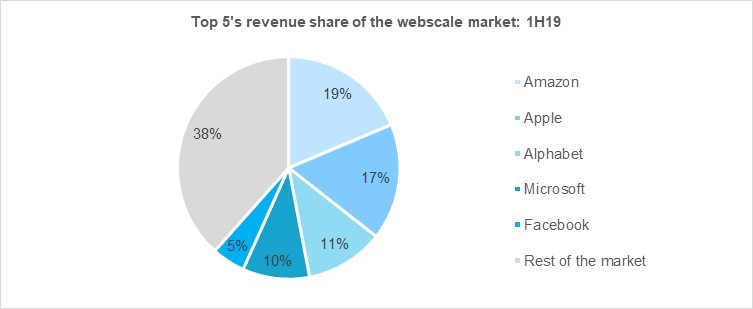
Digital advertising has fueled the growth of Facebook, Google, Baidu, Tencent, and other internet services companies. The companies don’t charge their users, which enhances the social media platforms’ popularity. Still, the proliferation of the social media platforms hasn’t been the best thing for the news business. Indeed, digital companies have been in the news fairly often in recent years, as has their connection to news outlets. A few examples:

  • In fall 2019, it became apparent that the two reigning giants of digital advertising would have to acknowledge a third member of the club. Facebook and Google, which had ruled the industry for most of the decade, was about to be joined by Amazon. Indeed, Amazon’s advertising revenue has continued to grow, with even its 1Q20 numbers, from the beginning of the COVID-19 crisis, showing a year-over-year increase of 44 percent. Still, that growth comes with a price. Amazon is owned by Jeff Bezos, the owner of The Washington Post. The Post’s investigative reporting on President Donald J. Trump drew Trump’s wrath, and that rage spilled over onto Amazon.
  • A growing number of companies, in response to the growing repercussions of the Black Lives Matter protests, have been removing their ads from Facebook. The companies have been declaring solidarity with the #StopHateForProfit boycott, which is being led by a coalition of civil rights groups. Among the more than 400 companies is the retailer Patagonia, which tweeted on June 21 that “Patagonia is proud to join the Stop Hate for Profit campaign. We will pull all ads on Facebook and Instagram, effective immediately, through at least the end of July, pending meaningful action from the social media giant.” In a later series of tweets, the company said:

“From secure elections to a global pandemic to racial justice, the stakes are too high to sit back and let the company continue to be complicit in spreading disinformation and fomenting fear and hatred. As companies across the country work hard to ensure that Americans have access to free and fair elections this fall, we can’t stand by and contribute resources to companies that contribute to the problem.”

  • Amid this backdrop, media buying agency GroupM predicted that “digital advertising on platforms such as Google, Facebook and Alibaba is set this year to overtake spending on traditional media for the first time, a historic shift in market share that has been accelerated by the coronavirus pandemic. Excluding online ads sold by old media outlets such as news publishers or broadcasters, digital marketing is predicted to account for more than half the $530 (billion) global advertising industry in 2020, according to GroupM, the media buying agency owned by WPP.”

It is that latter point that shows the phenomenal power of digital advertising. Indeed, the Internet Advertising Bureau (IAB) has tracked U.S. digital advertising revenues almost since its beginning. To give you an idea of how much and how quickly digital advertising has grown, the IAB reported that, in 1996, revenues from such advertising had reached $267 million. By 2000, a mere four years later, that number had grown to $8.2 billion. as the calendar rolled forward, so, too, did the ad spending, soaring to $12.5 billion in 2005; $26.0 billion in 2010; $59.6 billion in 2015; exceeding $100 billion for the first time in 2018; and hitting $124.6 billion in 2019. That’s roughly 10 times the 2005 figure.

Is that spending worth it? According to Statista, the average return-on-investment for each dollar spent on digital advertising was about $11 in 2018, “making it the medium with the highest return on advertising spending (or ROAS).”

What does all this have to do with journalism?

A whole heck of a lot, actually.

A less biased history of technology and journalism

Journalism has always been fueled by three forces: retail sales, subscribers, and advertisers. When journalism was pretty much only newspapers and magazines, the businesses survived on revenue generated by the sales of copies in retail venues such as shops and newsstands; via paid subscriptions, which allowed the copies to be mailed to the recipients; and through what advertisers paid to have their wares and services mentioned in print.

In time, however, radio rose up. Although the first radio program was broadcast in Canada on December 24, 1906, it took several more years before the first radio news broadcast would occur.  On Aug. 31, 1920, a Detroit radio station aired the first radio news broadcast. Shortly thereafter, for a one-time cost of purchasing a radio (as well as the cost of powering the device), listeners could hear news and entertainment without needing to pay for it.  Unfortunately, sales of the radios themselves didn’t benefit the news outlets, and the subscription model didn’t work for radio, either.  As a result, radio news outlets relied on corporate sponsorships and advertisers. Newspapers and magazines continued as normal, but kept a wary eye on their new competitor.

Television was next, with the 1922 transmission via radio waves of a still picture. The technology was improved in 1925, with the successful transmission of a live human face.

Meanwhile, the federal government decided to regulate these new technologies, starting with the Federal Communications Act in 1934. The law created the Federal Communications Commission (FCC). Here’s how the FCC was initially described, according to “That’s the Way It Is: A History of Television News in America,” by Charles L. Ponce de Leon:

(The FCC) was responsible for overseeing the broadcasting industry and the nation’s airwaves, which, at least in theory, belonged to the public. Rather than selling frequencies, which would have violated this principle, the FCC granted individual parties station licenses. These allowed licensees sole possession of a frequency to broadcast to listeners in their community or region. This system allocated a scarce resource—the nation’s limited number of frequencies—and made possession of a license a lucrative asset for businessmen eager to exploit broadcasting’s commercial potential. …  As part of this process, they had to demonstrate to the FCC that at least some of the programs they aired were in the “public interest.” Inspired by a deep suspicion of commercialization, which had spread widely among the public during the early 1900s, the FCC’s public-interest requirement was conceived as a countervailing force that would prevent broadcasting from falling entirely under the sway of market forces.

In reality, however, the FCC tended to be “unusually sympathetic to the businessmen who owned individual stations and possessed broadcast licenses and made it quite easy for them to renew their licenses. They were allowed to air a bare minimum of public-affairs programming and fill their schedules with the entertainment programs that appealed to listeners and sponsors alike. By interpreting the public-interest requirement so broadly, the FCC encouraged the commercialization of broadcasting and unwittingly tilted the playing field against any programs—including news and public affairs—that could not compete with the entertainment shows that were coming to dominate the medium.”

The National Broadcast Company’s Red Network launched the first daily radio news program on Feb. 24, 1930. The Columbia Broadcasting System (CBS) followed on Sept. 29, 1930, with radio broadcaster Lowell Thomas as the host. Thomas made history again in 1939, when he simultaneously read a news report over radio and television, making it the first television news broadcast.

It wasn’t until Sept. 2, 1963, that the concept of a daily news program translated to television, when Walter Cronkite anchored the first daily half-hour news program on network television for CBS. For well over a decade, ABC, NBC, and CBS ruled television news – until the June 1, 1980, launch of the Cable News Network, better known as CNN. The creation of a 24-hour television news network forever changed the way news was delivered. In response, all three network broadcasters dropped their 30-minute daily programs and went on to create longer-form news shows, including morning news broadcasts.

Throughout all these changes, news outlets continued to operate pretty much as they had at the very beginning. Newspapers and magazines continued to rely on retail sales, subscribers, and advertising revenue. Radio and television broadcasters relied far more heavily on advertising revenue. As time marched on, both print and broadcast news outlets updated how they gathered and spread the news as technology evolved.

But their time-tested business models were about to be upended by one new technology that would change everything.

The advent of the Internet

The world-spanning phenomenon known as the internet began as a Department of Defense research project in 1969. A few quick facts about it, mostly courtesy of Vox:

  • “The internet began as ARPANET, an academic research network that was funded by the military’s Advanced Research Projects Agency (ARPA, now DARPA).”
  • “… In 1973, software engineers … began work on the next generation of networking standards for the ARPANET. These standards, known as TCP/IP, became the foundation of the modern internet. ARPANET switched to using TCP/IP on January 1, 1983.”
  • “During the 1980s, funding for the internet shifted from the military to the National Science Foundation. The NSF funded the long-distance networks that served as the internet’s backbone from 1981 until 1994. In 1994, the Clinton Administration turned control over the internet backbone to the private sector. It has been privately operated and funded ever since.”
  • As of April 2020, nearly 4.57 billion people “were active internet users,” encompassing 59 percent of the global population.
  • And no, despite the hype, former Vice President Al Gore did not create the internet. In truth, he never claimed that he had. What he did say, in a 1999 interview with CNN, was he “took the initiative in creating the internet.” The actual inventors of the internet, TCP/IP designers Bob Kahn and Vint Cerf, have said that “Gore was “the first political leader to recognize the importance of the internet and to promote and support its development” — particularly with his sponsorship of the 1991 High Performance Computing and Communications Act (HPCCA). Kahn and Cerf say that law “became one of the major vehicles for the spread of the internet beyond the field of computer science.”

In 1994, three years after the HPCCA’s passage, the founding of Netscape and Yahoo! helped to kickstart mass-market adoption of the web and email, respectively. Online searches were simplified by Google’s arrival in 1998. Hundreds of other Internet companies were founded in the latter half of the 1990s — too many, as it turned out. However, the advertising-supported model of free Internet services survived the dotcom bubble’s collapse in 2001.

 The trouble starts

In 2004, the Pew Research Center published its first annual State of the News Media Report. In the report’s inaugural edition, Pew noted that then-President George W. Bush had told ABC News in December 2002 that he “preferred to get his news not from journalists but from people he trusted, who ‘give me the actual news’ and ‘don’t editorialize.’” Indeed, a New Yorker writer noted that senior White House staff “saw the news media as just another special interest group whose agenda was making money, not serving the public – and surveys suggest increasingly that the public agrees.”

These observations were some of the earliest warnings that a sharply partisan divide was coming over previously agreed-upon norms such as truth, facts, and the mission of journalism.  Indeed, the 2004 report went on to warn:

Some argue that as people move online, the notion of news consumers is giving way to something called “pro­sumers,” in which citizens simultaneously function as consumers, editors and producers of a new kind of news in which journalistic accounts are but one element.

 With audiences now fragmented across hundreds of outlets with varying standards and agendas, others say the notions of a common public understanding, a common language and a common public square are disappearing.

 For some, these are all healthy signals of the end of oligarchical control over news. For others, these are harbingers of chaos, of unchecked spin and innuendo replacing the role of journalists as gatekeepers over what is fact, what is false and what is propaganda. Whichever view one prefers, it seems everything is changing.

Sound familiar?

Going back to digital for a moment … among the 2004 Pew report’s conclusions, two items stand out:

  • The biggest question may not be technological but economic…If online proves to be a less useful medium for subscription fees or advertising, will it provide as strong an economic foundation for newsgathering as television and newspapers have? If not, the move to the Web may lead to a general decline in the scope and quality of American journalism, not because the medium isn’t suited for news, but because it isn’t suited to the kind of profits that underwrite newsgathering. 
  • Those who would manipulate the press and public appear to be gaining leverage over the journalists who cover them. Several factors point in this direction. One is simple supply and demand. As more outlets compete for their information, it becomes a seller’s market for information. Another is workload. The content analysis of the 24 ­hour­ news outlets suggests that their stories contain fewer sources.

So, at the time, news outlets weren’t yet certain of what to make of using the internet to gather and disseminate news. And concerns about manipulation of the media were already on people’s radar.

The fuse is lit

The 2008 presidential campaign of Barack Obama, and his 2009 inauguration, exacerbated the racism and xenophobia of many White Americans. Fox News, which had been known for its motto of being “fair and balanced,” immediately launched racist attacks on Obama and his wife, Michelle:

  • May 2008: Fox News contributor Liz Trotta joked that then-candidate Obama should be assassinated.
  • June 6: On the Fox News program “America’s Pulse,” host E.D. Hill referred to a celebratory fist bump shared by the Obamas to celebrate his acceptance as the Democratic presidential nominee as a “terrorist fist jab.” Hill was dropped from her show a week later.
  • June 11: A Fox News chyron referred to Michelle Obama as “Obama’s Baby Mama.”

Things would only deteriorate from there.

Amid the sharply partisan tone of Fox News and other conservative news outlets, the explosion in growth of social media platforms occurred. As the BBC noted:

 Clearly the enabler of the modern form of “fake news” – or, if you like, misinformation – has been the explosive growth of social media.

“In the early days of Twitter, people would call it a ‘self-cleaning oven’, because yes there were falsehoods, but the community would quickly debunk them,” (says Clare Wardle of First Draft News, a truth-seeking non-profit based at Harvard’s Shorenstein Center). “But now we’re at a scale where if you add in automation and bots, that oven is overwhelmed.

“There are many more people now acting as fact-checking and trying to clean all the ovens, but it’s at a scale now that we just can’t keep up.”

One example of the latter comment is the proliferation of bots in social media. As has been noted elsewhere, bots serve a useful purpose for social media companies. Regrettably, they also represent a danger to social media platforms in that they can rapidly spread misinformation and propaganda. Indeed, the malicious use of bots helped sway public opinion in the 2016 election, in which Russia used them to help position Trump into a better position for him to win election to the presidency.

In addition, in 2009, an Ohio State University study warned that more Americans, rather than seeking to be informed by their news outlets, were instead increasingly flocking to news that reinforced their own prejudices. Conservatives headed to Fox News; liberals, to CNN and MSNBC.

Meanwhile, during Obama’s two terms in office, the Pew Research Center noticed something else happening to journalism: tech companies were increasingly becoming involved in their operations:

In 2013, the business of journalism saw another twist in its digital evolution: An influx of new money – and interest – from the tech world.

 At this point, professional newsgathering is still largely supported by advertising directed to such legacy platforms as print and television and, secondarily, by audience revenues (mostly subscriptions). But other ways of paying for news are becoming more visible. Much of the momentum is around this high-profile interest from the tech world, in the form of venture capital and individual and corporate investments, which bring with them different skill sets and approaches to journalism.

 But as the tech companies continued to invest, and more advertising shifted to the digital world, news outlets found themselves “competing for an increasingly smaller share of those dollars.” As a result, even as news outlets fought a battle against an increasingly partisan readership, it was also fighting a war on a different front: namely, against the impact and influence of technology companies and social media platforms. According to the conclusions in Pew’s 2016 report:

  • It has been evident for several years that the financial realities of the web are not friendly to news entities, whether legacy or digital only. There is money being made on the web, just not by news organizations. 
  • Increasingly, the data suggest that the impact these technology companies are having on the business of journalism goes far beyond the financial side, to the very core elements of the news industry itself. In the predigital era, journalism organizations largely controlled the news products and services from beginning to end, including original reporting; writing and production; packaging and delivery; audience experience; and editorial selection. Over time, technology companies like Facebook and Apple have become an integral, if not dominant player in most of these arenas, supplanting the choices and aims of news outlets with their own choices and goals. 
  • The ties that now bind these tech companies to publishers began in many ways as lifelines for news organizations struggling to find their way in a new world. First tech companies created new pathways for distribution, in the form of search engines and email. The next industry overlap involved the financial model, with the creation of ad networks and app stores, followed by developments that impact audience engagement … Now, the recent accusations regarding Facebook editors’ possible involvement in “trending topics” selections have shined a spotlight on technology companies’ integral role in the editorial process.

Meanwhile, as the end of Obama’s second term neared, the lines of partisan perception had been drawn: CNN, MSNBC, The New York Times, The Washington Post, and many other news outlets were firmly perceived as “liberal.” Fox News, Breitbart, The New York Post and the Wall Street Journal were counted as “conservative.”

By June 16, 2015, when Trump descended an escalator in Trump Tower to announce his candidacy for the 2016 presidential election, the opposing forces of technology companies and news outlets were about to combust.

Things go boom

You know what happened next:

  • The bot attacks from Russia that manipulated social media, influenced the very facts Americans used to vote, and continue to be a clear and present danger to American democracy.
  • Fox News effectively becoming a part of the Trump campaign. Indeed, Fox News, Trump’s news outlet of choice during his campaign, stopped using its motto “fair and balanced” in August 2016 – one month after Trump was confirmed as the Republican presidential nominee. In June 2017, five months after Trump’s inauguration, Fox News officially dropped the motto.

Meanwhile, we’ve seen new phrases that shatter our understanding of once-simple concepts such as truth or facts. Trump advisor Kellyanne Conway coined the phrase “alternative facts” on Jan. 21, 2017, in an effort to defend false estimates by then White House press secretary Sean Spicer on the size of the crowd gathered in Washington for Trump’s inauguration.

And, of course, there is “fake news,” which was popularized by Hillary Rodham Clinton in a speech on Dec. 8, 2016. While refuting the Pizzagate conspiracy theory,  she noted “the epidemic of malicious fake news and false propaganda that flooded social media over the past year. It’s now clear that so-called fake news can have real-world consequences. This isn’t about politics or partisanship. Lives are at risk… lives of ordinary people just trying to go about their days, to do their jobs, contribute to their communities.”

Less than a month later, then-President-elect Trump made use of the phrase during press conference in which he said “you’re fake news” to CNN reporter Jim Acosta.  A day or so later, on Jan. 11, 2017, he tweeted (in all-caps) about various news investigations into his political and business dealings, “FAKE NEWS – A TOTAL POLITICAL WITCH HUNT!” Since then, he’s made “fake news” a standard response to virtually any news report that casts him in a negative light.

And that brings us to today, when Americans are increasingly growing wary of the role social media platforms play in delivering the news… particularly when those platforms have been shown to be receptive to inflammatory points of views. The current ad boycott of Facebook is but one example.

The reach of technology companies, political partisanship, and social media platforms has had a definite impact on modern journalism. Unlike previous technological advances such as radio and television, digital technology’s influence on news outlets has changed the very nature of journalism, as well as how journalism is perceived. Indeed, even as more than half of Americans get their news from social media, a Pew Research Center study shows that:

  • Almost all Americans – about nine-in-ten (88%) – recognize that social media companies have at least some control over the mix of news people see.
  • About six-in-ten (62%) say social media companies have too much control over the mix of news that people see on their sites, roughly four times as many as say that they don’t have enough control (15%).
  • Just 21% say that social media companies have the right amount of control over the news people see.
  • While social media companies say these efforts are meant to make the news experience on their sites better for everyone, most Americans think they just make things worse. A majority (55%) say that the role social media companies play in delivering the news on their sites results in a worse mix of news.
  • About eight-in-ten U.S. adults (82%) say social media sites treat some news organizations differently than others
  • As large majorities say that the tone of American political debate has become more negative in recent years, about a third of U.S. adults (35%) say that uncivil discussions about the news are a very big problem when it comes to news on social media. Additionally, about a quarter (27%) say that the harassment of journalists is a very big problem associated with news on social media.

The questions that remain are simple:

  • Will we continue to tolerate the outsized influence of technology companies on journalism?
  • Should social media companies be legally required to police the accuracy of their content?
  • Should social media platforms ban all political advertising?
  • Will Americans see the value of paying a fee for news content, as long as the content is objective and of high quality?
  • And, finally, will Americans see past their own prejudices to force news outlets to present news that is not only factually accurate, but free from bias?

Time will tell.

About the author

Melvin Bankhead III is the founder of MB Ink Media Relations, a boutique public relations firm based in Buffalo, New York. An experienced journalist, he is a former syndicated columnist for Cox Media Group, and a former editor at The Buffalo News.


Note from MTN Consulting

MTN Consulting is an industry analysis and research firm, not a company that typically comments on politics. We remain focused on companies who build and operate networks, and the vendors who supply them. That isn’t changing. However, we are going to dig into some of the technology issues related to these networks and networking platforms which are having (or will have) negative societal effects.

Image credits: (1) iStock, by Getty Images (cover); (2) Will Francis; (3) CBS; (4) Shutterstock; (5) CNN‘s Twitter feed.


Blog Details

DIGITAL PRIVACY, PART TWO: WHAT CAN WE DO ABOUT OUR DATA’S PRIVACY?

As I indicated in Part One of these reports on digital privacy, digital tools such as facial recognition are used for many beneficial purposes. However, as I demonstrated, those tools are also extremely easy to abuse, particularly in the hands of governments and the law enforcement community.

One of the films of the blockbuster film series, the Marvel Cinematic Universe, demonstrated the threat in a most capable manner.

Reel life reflecting real life

In “Captain America: The Winter Soldier,” Steve Rogers, the titular super-soldier, finds himself in a race against time to stop a deadly conspiracy that is fueled by abuse of digital surveillance. It’s discovered that the government security agency SHIELD has been infiltrated by a terrorist group known as Hydra. As Hydra scientist Arnim Zola explains, “Hydra was founded on the belief that humanity could not be trusted with its own freedom. What we did not realize is that if you try to take that freedom, they resist. (World War II) taught us much. Humanity needed to surrender its freedom willingly. After the war … the new Hydra grew. For 70 years, Hydra has been secretly feeding crises, reaping war. … Hydra created a world so chaotic that humanity is finally ready to sacrifice its freedom to gain its security.”

Hydra infiltrator Jasper Sitwell explains how digital information is being used to determine the targets for the imminent lethal uprising. “The 21st century is a digital book. Zola taught Hydra how to read it. Your bank records, medical histories, voting patterns, emails, phone calls, your damn SAT scores. Zola’s algorithm evaluates people’s past to predict their future. … And then the Insight helicarriers [heavily armed aerial transports] scratch people off the list a few million at a time.”

Yeah, that’s a frightening scenario: “Big Brother” writ large. Depending on your age and education, you might wonder what the hit CBS television show has to do with digital privacy. After all, the reality TV show is designed for entertainment. But the phrase “Big Brother” debuted in George Orwell’s 1949 novel “1984,” in which a totalitarian government maintains control through constant electronic surveillance of its citizens. Today, the phrase “Big Brother” is “a synonym for abuse of government power, particularly in respect to civil liberties, often specifically related to mass surveillance.”

And, as I demonstrated in the previous essay, digital information, particularly facial recognition, can easily be misused and abused … as demonstrated by these most recent examples, which were made public after the last essay was published:

  • In Michigan, Robert Williams, a Black man, was arrested by Detroit police in his driveway. Police thought Williams was a suspect in a shoplifting case. However, the inciting factor for the arrest was a facial recognition scan, which had incorrectly suggested that Williams was the suspect. And while the charges were later dropped, the damage was done: Williams’ “DNA sample, mugshot, and fingerprints — all of which were taken when he arrived at the detention center — are now on file. His arrest is on the record,” says the American Civil Liberties Union, which has filed a complaint with Detroit police department.
  • In May, Harrisburg University announced that two of its professors and a graduate student had “developed automated computer facial recognition software capable of predicting whether someone is likely going to be a criminal. With 80 percent accuracy and with no racial bias, the software can predict if someone is a criminal based solely on a picture of their face.” On June 23, over 1,500 academics condemned the research paper in a public letter. In response, Springer Nature will not be publishing the research, which the academics blasted as having been “based on unsound scientific premises, research, and methods which … have [been] debunked over the years.” The academics also warn that it is not possible to predict criminal activity without racial bias, “because the category of ‘criminality’ itself is racially biased.”

Today, we’ll explore another aspect of digital privacy — namely, how much of a threat your own digital footprint can pose to your security. Because, as has become readily apparent, humanity doesn’t need “to surrender its freedom willingly.” It’s already done it.

I always feel like somebody’s watching me

Not too long ago, my wife and I were relaxing. I was reading a book; she was watching television. She asked me a question about the drug commercial that had just aired, and we laughed while discussing how the “minor” side effects of the drug didn’t sound all that minor. In the midst of our laughter, her phone started talking, telling us all about the drug.

She hadn’t touched the phone, which was sitting beside her on the couch.

I said, “Skynet is real.” She picked up the phone, put it into sleep mode, and set it back down, all without directly looking at it. And then, of course, for the next week or so, her supposed interest in the drug influenced what kind of ads popped up on her phone and laptop.

They say it’s not being paranoid if people really are out to get you. And they are out to get you … or your data, anyway.

The thing is, both of us have voice recognition software on our phones. With it, we can instruct our phones to open a specific app, call a person, search Google for information, and various other tasks.  It just never occurred to us that the phones could listen in without our specifically activating the voice-recognition software.

But we’re not the only ones creeped out by our devices’ antics. A few years ago, users of Amazon’s Alexa reported that the AI assistant would abruptly laugh for no apparent reason. Sometimes, the laughter would come in response to a user query. Other times, the user would be sitting silently when Alexa would suddenly chuckle. The laughter disturbed a lot of Alexa users. One user tweeted, “Lying in bed about to fall asleep when Alexa on my Amazon Echo Dot lets out a very loud and creepy laugh… there’s a good chance I get murdered tonight.”

Admittedly, we know that it’s highly unlikely that our phones, or Alexa, are going to pick up a weapon and come after us. While some say the age of Skynet is inching ever closer, most of us realize that it’s not all that likely that all of our machines are going to rise up and wipe us out … the repeated attempts of GPS notwithstanding. (Ever had your GPS tell you to “Turn right” … while you’re in the middle of a bridge over a very wide and deep river? I have!)

They say it’s not being paranoid if people really are out to get you. And they are out to get you … or your data, anyway. Corporations want your data, which fuels their marketing; social media platforms want your data, which fuels their interconnectivity, as well as the demographic data they can use for targeting their ads; the government wants your data, to fuel their research, voting, and criminal justice databases; and hackers want your data so they can steal your money.

The ACLU breaks down its concerns over privacy and technology into the categories of Internet privacy; cybersecurity; location tracking; privacy at borders and checkpoints; medical and genetic privacy; consumer privacy; and workplace privacy.

Internet privacy

In 2019, the Pew Research Center published the results of a survey in which a majority of Americans admitted their belief that their activities — both online and offline —were being monitored by the government and companies. “Roughly six-in-ten U.S. adults say they do not think it is possible to go through daily life without having data collected about them by companies or the government,” the report warned.

Although the report acknowledges that “data-driven products and services are often marketed with the potential to save users time and money or even lead to better health and well-being,” 81 percent of respondents said that “the potential risks they face because of data collection by companies outweigh the benefits, and 66% say the same about government data collection. At the same time, a majority of Americans report being concerned about the way their data is being used by companies (79%) or the government (64%). Most also feel they have little or no control over how these entities use their personal information.”

There are various aspects of Internet privacy:

  • Consumer Online Privacy: One of the concerns that many consumers have is how their data is collected online, and what happens to it afterward. Ever Googled a retail website and then, shortly afterward, ads for that website start popping up in the margins of whatever other website you’re looking at? Your Internet Search Provider likely sold your information, or the website left “cookies” on your computer that allowed it to target you for the ads. Because ISPs are in the perfect position to see everything we do online, Maine regulates how they operate by requiring that they gain permission from users before using their data. Others are using Virtual Private Networks to put barriers between their devices and the ever-watching eyes of the ISPs. Maine is an outlier, though, and VPNs can be inconvenient and costly.
  • Social Networking Privacy: When you’re not at work, you would think that what you post on social media is your own private business. But increasingly, employers, school and the federal government are requiring access to our digital lives. U.S. border enforcement agents are demanding that travelers unlock their devices and provide passwords. Schools are utilizing services that allow them to access students’ devices and social media accounts. The concern about overreach has become so widespread that some states have taken steps to prevent employers from researching the habits and postings of job applicants on social media, or trying to require that employees surrender passwords to their accounts.
  • Cell Phone Privacy: You know from movies, television shows and the news that your digital devices also act as reliable tracking devices. Indeed, recent events alone have shown that the tech can track stolen devices; allow advocacy and voting rights groups to track the movements of protesters (and communicate with them); and allow companies like Venntel can collect and then sell data from citizen’s phones to government agencies, which can lead to warrantless tracking of their activities.
  • Email Privacy: One of the biggest stories in 2016 was the hacking of emails that belonged to the Democratic National Committee and then-presidential candidate Hillary Clinton. Today, concerns remain over just how private our emails really are, creating opportunities for services that give you more control Mozilla is now offering Firefox Relay, which effectively acts as call forwarding in the form of email aliases that are connected to your real account, but doesn’t allow others access to your real account.  Google is also offering new features to make Gmail safer.
  • Cybersecurity: As our reliance on our digital devices continues to grow, and the technology that connects those devices continues to improve, it can be argued that we are increasing the opportunities for hackers to exploit that same dependence. As the prevalence of hacker attacks grow, so does the need to protect computers, databases, electronic systems, mobile devices, networks and servers. A recent poll showed that most companies’ electronic security breaches were the result of poorly planned security infrastructure. Yet, even though U.S. business losses in cybersecurity attacks averaged $1.41 million in 2018, with over 68 million sensitive records exposed in 2019, the United States faces a coming shortage of cybersecurity experts. At a time when 5G is fast becoming the go-to resource of connectivity, it needs to be considered that the expansion of 5G could also lead to a massive expansion of internet-connected devices, which will raise the stakes for cybersecurity even higher. One such concern, from Consumer Watchdog, is that “all the top 2020 cars have Internet connections to safety critical systems that leave them vulnerable to fleet wide hacks,” which could lead to “a 9-11 scale catastrophe.”  

Location Tracking

The very nature of a cell phone requires that the device be tracked from tower to tower to maintain the integrity of calls.  Since mobile companies store that location data, the government can obtain a great deal of information about you from your movements. Similarly, the mobile company might sell that information. By triangulating cell towers, your location data can reveal where you live, your doctor’s office, your school, your workplace, your place of worship, your friends’ homes … the list goes on.

Back in 2013, whistleblower Edward Snowden revealed that the National Security Agency was obtaining almost 5 billion records a day from cellphones around the world. This collection effort allowed U.S. intelligence officials to track phones, the phones’ users, and map out the relationships of the phones’ users to other users and their phones. This meant that people around the world, Americans among them, were caught up in the NSA’s web, where that data was stored … all without a warrant.

However, the pace at which technology evolves means that, for every advance that can be used for oppressive purposes, a counter will shortly follow. In September 2019, protesters in Hong Kong were well aware of the fact that Chinese authorities monitored WiFi and the Internet. They turned to Bridgefy, a Bluetooth-based app that does not use the Internet and, as a result, is more difficult for the Chinese authorities to trace.

Privacy at Borders and Checkpoints

People carry a great deal of information —personal and professional — on their phones and other devices. Typically, they take steps to ensure that said information doesn’t fall into the wrong hands.  For example, my phone contains my emails, as well as access to my various social media accounts.  My communications with my clients are accessible via my laptop and my cell phone.  As a result, I keep my devices pass-coded. However, a growing problem is that of government agents attempting to gain access to travelers’ devices without a warrant. An argument can be made that the Constitutional prohibition on unreasonable search and seizure appears to be under assault, as government agents at border crossings demand access to travelers’ devices.

Medical and Genetic Privacy

What would you do if your employer, acting upon a question from your health insurance company, asked you to submit the results of that DNA testing you had performed via Ancestry.com or 23andMe? Right now, your medical and genetic information is protected under the provisions of the 1996 Health Insurance Portability and Accountability Act (signed by President Bill Clinton), the 2008 Genetic Information Nondiscrimination Act (signed by President George W. Bush). Meanwhile, you are protected from being denied health insurance because of pre-existing conditions by the 2010 Affordable Care Act (signed by President Barack Obama). But these laws, intended to protect Americans from predatory health care, may not be as strong as we think they are:

  • The ACA, which is more commonly known as “Obamacare,” has been under relentless attack by the Trump administration. Indeed, during the writing of this report, the Trump administration has asked the U.S. Supreme Court to “invalidate” the ACA. If it falls, insurance companies could again deny coverage to those with pre-existing conditions. It should be noted that a 2017 U.S. Department of Health and Human Services analysis estimated that between 61 million and 133 million Americans have a preexisting condition.
  • In 2017, a committee in the Republican-controlled House of Representative approved HR 1313, “a bill that would let companies make employees get genetic testing and share that information with their employer — or pay thousands of dollars as a penalty.” The bill died from inaction after Democrats won the House in the 2018 midterm elections.
  • In 2018, police in California identified a serial killer by matching his DNA with DNA from members of his family who had signed up for a genealogy website called GEDmatch. Since then, questions have been raised about the accessibility of such data to law enforcement agencies.
  • Consumer genetics testing companies frequently sell your data, often to pharmaceutical companies. This is a modern spin on the case of Henrietta Lacks, a poor Black woman who was treated for cervical cancer in 1951. Researchers discovered that her cells were incredibly resilient, and where other cancer patients’ cell samples would die, Lacks’ cells would continue to live and thrive. Without Lacks’ permission, researchers used her cells to conduct research into “the effects of toxins, drugs, hormones and viruses on the growth of cancer cells without experimenting on humans. They have been used to test the effects of radiation and poisons, to study the human genome, to learn more about how viruses work, and played a crucial role in the development of the polio vaccine.” Although the discovery was a boon to the worlds of science and medicine, the fact remains that Lacks’ medical and genetic information was used without her permission in what is now an industry worth more than $1 billion annually, as of 2019.
  • The GINA law bans employers and health care companies from using genetic data to deny you coverage or employment. However, “companies with fewer than 15 people are exempt from this rule, as are life insurance, disability insurance, and long-term care insurance companies — all of which can request genetic testing as part of their application process.”
  • What happens if companies make your medical or genetic information part of the interview process? Granted, some state and federal laws protect against genetic discrimination, but those laws do not cover everything.

Consumer Privacy

I mentioned earlier that companies want your data for their marketing. Indeed, it’s been shown that Facebook, for example, looks at its customers as less like people and more like products to be sold to advertisers. A Vermont law forced some transparency on companies that sell our information, but very little is actually known about who has access to our information, and what happens to it after it is sold. California has taken steps to address that lack of knowledge, but it is too early to see what kind of impact the law is having.

…take a closer look at the various apps you keep on your devices. How much access do those apps have to your private information? For example, do you really need to grant “Candy Crush” access to your microphone, camera, and location?

Workplace Privacy

When you’re at work, you likely don’t expect to have privacy. A 2018 study showed that 50 percent of companies monitor their workers’ emails and social media accounts, “along with who they met with and how they utilized their workspaces.” Fast forward a year, and 62 percent of companies were “leveraging new tools to collect data on their employees.” And even in the current work-from-home reality of COVID-19, employers are still keeping an eye on their workers. For example, random screenshots of your workers’ screens will tell you what they’re actually doing. Indeed, “monitoring software can track keystrokes, email, file transfers, applications used and how much time the employee spends on each task.” Also, if you ever use your personal phone for business purposes? You could be risking all of your personal data should your employment be terminated.

A hopeless situation?

Earlier, I mentioned a 2019 Pew Research Center study showing that “roughly six-in-ten U.S. adults” believed they were being monitored by the government and companies., and that they “do not think it is possible to go through daily life without having data collected about them by companies or the government.” The report also noted that most Americans feel “they have little or no control over how these entities use their personal information.”

With that information as a backdrop, it is important to realize that what may seem like a hopeless situation actually is an opportunity. Granted, U.S. laws on privacy have fallen behind the pace of technology, and it has been shown that those in charge of regulating technology and social media platforms often do not understand the very technologies they’ve been charged with monitoring. As a 2018 Brookings Institution paper warns:

“This is where we are with data privacy in America today. More and more data about each of us is being generated faster and faster from more and more devices, and we can’t keep up. It’s a losing game both for individuals and for our legal system. If we don’t change the rules of the game soon, it will turn into a losing game for our economy and society.”

Indeed, news reports seem to bear this out. From the Snowden revelations in 2013, to the 2017 Equifax breaches that exposed the data of nearly 146 million Americans, to the 2018 Cambridge Analytica scandal and beyond, more and more attention is being paid to the subject of data privacy. But that just means that we’re more aware. What can we actually do about it?

Recommendations

First of all, I strongly recommend that you make use of the one aspect of your digital data that you do control —namely, your device privacy settings.  Some of the data sharing our devices perform is within our ability to control. However, it is important to remember than many aspects of it are not.

Second, take the time to actually read the privacy policies of the digital devices and online services that you use. As the Brookings Institution has noted, perhaps the concept of “informed consent was practical two decades ago, but it is a fantasy today. In a constant stream of online interactions, especially on the small screens that now account for the majority of usage, it is unrealistic to read through privacy policies. And people simply don’t.” The fact that so many people don’t bother to read those polices effectively makes them complicit when their own data is used against them.

Third, take a closer look at the various apps you keep on your devices. How much access do those apps have to your private information? For example, do you really need to grant “Candy Crush” access to your microphone, camera, and location?

And then, of course, are the ideas that you could demand from digital service companies.

Pitch these ideas to lawmakers, activists, and journalists to force companies to discuss them:

  • Demand that companies establish easier ways to manage your devices’ privacy settings
  • Demand that companies be transparent over how they store, and if they share, your information.
  • Demand “real name” requirements for social media, in which the accounts can only be opened with a photocopy of a government-issued ID card. Admittedly, there would be a loss of privacy here, but it would lead to a decrease in the frequent “mob” mentality we see online, and an increase in the accountability of account users for their content.
  • Companies should have a standardized form governing whether to grant permission to companies to sell or share their personal data.
  • Question lawmakers to ensure that they understand the technologies they’re attempting to regulate.
  • Demand that, if someone is cleared of criminal charges, any biometric data that was gathered as a result of the arrest be deleted within 30 days.
  • Require that greater scrutiny be given to digital applications coming from foreign countries that have a history of intellectual property theft.
  • Demand that lawmakers reveal if they have any financial ties to technology companies
  • Require technology companies to create more secure privacy settings for minors using social media.

Admittedly, some of the above suggestions may be long shots, particularly given how much money technology companies and their lobbyists have at their disposal. This would seem an impossible task, taking back control of our digital data.

However, to put it into a historical context: Women’s right to vote, the end of slavery, and same-sex marriage were once considered impossible tasks, too.

About the author

Melvin Bankhead III is the founder of MB Ink Media Relations, a boutique public relations firm based in Buffalo, New York. An experienced journalist, he is a former syndicated columnist for Cox Media Group, and a former editor at The Buffalo News.


Note from MTN Consulting

MTN Consulting is an industry analysis and research firm, not a company that typically comments on politics. We remain focused on companies who build and operate networks, and the vendors who supply them. That isn’t changing. However, we are going to dig into some of the technology issues related to these networks and networking platforms which are having (or will have) negative societal effects.

Image credit: iStock, by Getty Images

Blog Details

DIGITAL PRIVACY, PART ONE: THE DANGERS OF FACIAL RECOGNITION

There’s been a lot of talk in recent weeks regarding facial recognition technology. Much of the conversation has centered on privacy concerns. Other aspects concern the technical flaws in the software, which impacts the technology’s accuracy. Still others center on the demonstrated gender and racial biases of such systems, and the potential of governments and police forces using facial recognition to weaponize racial bias.

Indeed, the media has been following the conversations. Reports have dealt with China’s current use of facial recognition in its crackdown on a minority group; the questionable accuracy of the technology itself, particularly when involving people of color; and, of course, the intersection of privacy, law enforcement and racial bias when U.S. agencies and local police forces use facial recognition technologies.

A few other examples:

  • Concern that PimEyes, which identifies itself as a tool to help prevent the abuse of people’s private images, could instead “enable state surveillance, commercial monitoring and even stalking on a scale previously unimaginable.”
  • Concern that use of Clearview AI’s facial recognition system could easily be abused, as the app’s database was assembled by “scraping” pictures from social media, enabling the company to access your name, address and other details — all without your permission. The app, although not available to the public, is being “used by hundreds of law enforcement agencies in the U.S, including the FBI.” In May, Clearview AI announced that it would cease selling its software to private companies.
  • In response to the mask-related laws connected to the spread of COVID-19, tech companies have been attempting to update their facial recognition software so that it still works even when the subject of the scan is wearing a face mask.
  • Business Insider, Wired, U.S. News & World Reports, Popular Mechanics, the Guardian, and the Washington Post have all published reports on ways to defeat facial recognition systems.
  • IBM’s announcement, in a letter to Congress, that “IBM no longer offers general purpose IBM facial recognition or analysis software. IBM firmly opposes and will not condone uses of any technology, including facial recognition technology offered by other vendors, for mass surveillance, racial profiling, violations of basic human rights and freedoms, or any purpose which is not consistent with our values and Principles of Trust and Transparency. We believe now is the time to begin a national dialogue on whether and how facial recognition technology should be employed by domestic law enforcement agencies.”
  • Amazon’s announcement that they are “implementing a one-year moratorium on police use of Amazon’s facial recognition technology. We will continue to allow organizations like Thorn, the International Center for Missing and Exploited Children, and Marinus Analytics to use Amazon Rekognition to help rescue human trafficking victims and reunite missing children with their families.”
  • Microsoft CEO Brad Smith confirmed that the company “will not sell facial-recognition technology to police departments in the United States until we have a national law in place, grounded in human rights, that will govern this technology.”
  • Other tech companies — NEC and Clearview AI among them — restated their commitment to providing facial recognition technology to police departments and governmental agencies.

So, yes, people are talking about facial recognition technology. And as the conversation grows, more people and corporations joining the conversation. MTN Consulting, like Amazon, IBM and Microsoft, and others, is expressing alarm at how the technology is used and, in a growing number of instances, abused.

Oddly, many people don’t know a great deal about the technology, such as how it works, how accurate it is, or how much of a threat it poses.

Let’s explore:

What is facial recognition?

According to the Electronic Frontier Foundation, facial recognition “is a method of identifying or verifying the identity of an individual using their face. Facial recognition systems can be used to identify people in photos, video, or in real-time. Law enforcement may also use mobile devices to identify people during police stops.”

How does it work?

According to Norton, a picture of your face is saved from a video or photograph. The software then looks at the way your face is constructed. In other words, it “reads the geometry of your face. Key factors include the distance between your eyes and the distance from forehead to chin. The software identifies facial landmarks — one system identifies 68 of them — that are key to distinguishing your face. The result: your facial signature.”

Next, your facial signature, “is compared to a database of known faces. And consider this: at least 117 million Americans have images of their faces in one or more police databases. According to a May 2018 report, the FBI has had access to 412 million facial images for searches.”

Finally, the system determines whether your face matches any of the other stored images.

How is it used?

Facial recognition has many uses. For example, the 2002 film “Minority Report” imagined the potential outcomes of the technology. In the film, when the main character, played by Tom Cruise, enters a mall, he is inundated by personalized greetings and advertising, all holographic, and all keyed to his facial scan – particularly, his eyes. Later, he enters the subway system, and facial recognition is again used, this time in lieu of immediate payment or carrying identification.

“Minority Report,” in its own way, was prescient in its prediction that facial recognition software would be everywhere, although it primarily addressed the commercial applications. In real life, however, the technology is used by both corporations and governments. A few examples:

  • The Moscow Times recently reported that Russia plans to equip more than 43,000 Russian schools with facial recognition. The 2 billion ruble ($25.4 million) project, named “Orwell,” will “ensure children’s safety by monitoring their movements and identifying outsiders on the premises, said Yevgeny Lapshev, a spokesman for Elvees Neotech, a subsidiary of the state-controlled technology company Rusnano. According to Vedomosti, a Russian-language business daily, “Orwell” has already been in more than 1,608 schools.
  • Mobile phones are sold with facial recognition software that is used to unlock the phone, replacing the need for a password or PIN. Many companies – including Apple, Guangdong OPPO, Huawei, LG, Motorola, OnePlus and Samsung — offer phones with this technology.
  • As for laptops, Apple is lagging behind other manufacturers at the moment. The company recently announced that it is planning to add facial recognition software to its MacBook Pro laptop and iMac screen lines. Meanwhile, Acer, Asus, Dell, HP, Lenovo, and Microsoft. have offered the technology in its laptops for years.

There are, of course, many other ways in which the technology is used:

  • The U.S. government uses it at airports to monitor passengers.
  • Some colleges use it to monitor classrooms, as it can be used for security purposes, as well as something simpler like taking roll.
  • Facebook uses it to identify faces when photos are uploaded to its platform, so as to offer members the opportunity to “tag” people in the photos.
  • Some companies have eschewed security badges and identification cards in favor of facial recognition systems.
  • Some churches use it to monitor who attends services and events.
  • Retailers use surveillance cameras and facial recognition to identify regular shoppers and potential shoplifters. (“Minority Report,” anyone?)
  • Some airline companies scan your face while your ticket is being scanned at the departure gate.
  • Marketers and advertisers use it at events such as concerts. It allows them to target consumers by gender, age, and ethnicity.

 So, what’s the concern?

Well, there are three main concerns, mainly in the areas of privacy, accuracy, and governmental abuse. There is, however, a strong thread of racism that is integral to all three concerns.

Privacy

Although using a facial scan to gain access to your phone is more secure than, say, a short password, it isn’t perfect. There are some concerns about how and where the data is stored.

Admittedly, many people use facial recognition systems for fun. Specialized apps designed for, or that offer, the technology include B612, Cupace 4.8, Face App 4.2, Face Swap (by Microsoft), and Snapchat. The apps permit you to scan your face, and swap it with, say, that of a friend or film star.

The easy accessibility of such apps is a boon for those who would use them. However, the very popularity of the apps give rise to certain questions. For example, if the company stores the facial images in the cloud, how good is the security? How accessible is the data to third parties? Does the company ever sell that data to other companies? A simple leak of data, or a more aggressive hacking of the database, could result in many peoples’ data being compromised.

Another privacy aspect involves monitoring people without their knowledge or consent. People going about their daily business don’t typically expect to be monitored … but there are exceptions, depending on where you live.  Last year, China was accused of human rights abuses in Xinjiang, a province populated by hundreds of thousands of the mostly Muslim ethnic group known as Uighurs. The New York Times reported on how the government used facial recognition systems to identify Uighurs, who were then seized and imprisoned in clandestine camps. Millions of others are monitored daily to track their activities.

In the U.S., reports circulated that some police departments were using technology developed by Clearview AI. The startup had scraped billions of photos from social media accounts in order to assemble a massive database that law enforcement officials could access – all without people’s consent. In other words, any photos that you’ve posted on SnapChat, Twitter, Facebook, Instagram, or other social media platform, could be part of the database without your knowledge. The only way you would find out is if the police connect your face to a crime and come knocking on your door.

Indeed, Clearview AI has raised the ire of the American Civil Liberties Union, the European Data Protection Board, members of the U.S. Senate, as well as provincial and federal watchdogs in Canada.

Admittedly, some will argue that, although the collection of the data is likely an invasion of people’s privacy, the data itself is useful to assist law enforcement. Granted, that interpretation is subjective, but relevant to the argument at hand. However, it also assumes two things: that people being surveilled by the police are suspects; and that the technology is accurate.

In both cases, however, the reverse is often true. And because of that, innocent people can be surveilled without their knowledge or consent; the wrong people can end up arrested, tried and convicted for crimes they didn’t commit; and racial bias can be weaponized. More on that latter point in a bit.

Accuracy

In December 2019, researchers at Kneron decided to put facial recognition to the test. Using images of other people —in the form of 2-D photos, images stored on cell phones, and 3-D printed masks — they managed to penetrate security at various locations. Although most sites weren’t fooled by the 2-D image or video copies, the 3-D mask sailed through most of the scans, including at a high-speed rail station in China and point-of-sales terminals. Worse, the team was able to pass through a self-check-in terminal at the Schiphol Airport, one of Europe’s three busiest airports, with a picture saved on a cell phone. They were also able to unlock at least one popular cell phone model.

So, we know that the face-matching aspect of facial recognition can be fooled. Granted, one might argue that using a 3-D printer isn’t that common an occurrence. However, given that the worldwide sales of 3-D printers generated $11.58 billion USD in 2019; that 1.42 million units were sold in 2018; and that annual global sales are expected to hit 8.04 million units by 2027, it can be safely assumed that 3-D masks pose a risk to facial recognition systems.

Still, obvious attempts to beat the system notwithstanding, there’s an even deeper concern regarding facial recognition — the face-matching aspect of the software isn’t always that accurate, and it has shown a demonstrated bias against women and people of color:

  • In 2018, the ACLU used Amazon’s facial recognition tech to scan the faces of members of Congress. Amazon’s “Rekognition” tool “incorrectly matched 28 members of Congress, identifying them as other people who have been arrested for a crime. The members of Congress who were falsely matched with the mugshot database we used in the test include Republicans and Democrats, men and women, and legislators of all ages, from all across the country.”
  • The FBI admitted in October 2019 that its facial recognition database “may not be sufficiently reliable to accurately locate other photos of the same identity, resulting in an increased percentage of misidentifications.”
  • In the United Kingdom, police departments use facial recognition systems that generate results with an error rate as high as 98 percent. In other words, for every 100 people identified as suspects, 98 of them were not, in fact, actual suspects.
  • In June 2019, a problem with a Chinese company’s facial recognition system went viral after one employee’s facial scan, used to clock into and out of work, “kept matching (the) employee’s face to his colleagues, both male and female. People started joking that the man must have one of those faces that looks way too common.”
  • Back in January, Robert Williams, a Black man, was arrested by Detroit police in his driveway. He then spent over 24 hours in a “crowded and filthy cell,” according to his attorneys. Police thought Williams was a suspect in a shoplifting case. However, the inciting factor for the arrest was a facial recognition scan, which had incorrectly suggested that Williams was the suspect. And while the charges were later dropped, the damage was done: Williams’ “DNA sample, mugshot, and fingerprints — all of which were taken when he arrived at the detention center — are now on file. His arrest is on the record,” says the American Civil Liberties Union, which has filed a complaint with Detroit police department. “Study after study has confirmed that face recognition technology is flawed and biased, with significantly higher error rates when used against people of color and women. And we have long warned that one false match can lead to an interrogation, arrest, and, especially for Black men like Robert, even a deadly police encounter. Given the technology’s flaws, and how widely it is being used by law enforcement today, Robert likely isn’t the first person to be wrongfully arrested because of this technology. He’s just the first person we’re learning about,” the ACLU warns.
  • In May, Harrisburg University announced that two of its professors and a graduate student had “developed automated computer facial recognition software capable of predicting whether someone is likely going to be a criminal. With 80 percent accuracy and with no racial bias, the software can predict if someone is a criminal based solely on a picture of their face.” On June 23, over 1,500 academics condemned the research paper in a public letter. In response, Springer Nature will not be publishing the research, which the academics blasted as having been “based on unsound scientific premises, research, and methods which … have [been] debunked over the years.” The academics also warn that it is not possible to predict criminal activity without racial bias, “because the category of ‘criminality’ itself is racially biased.”

As I indicated earlier, aspects of racism exist with the argument surrounding facial recognition. It’s not just that the technology can be used in a discriminatory manner (more on that later). It is also because the scan results themselves can show bias against women and people of color.

“If you’re black, you’re more likely to be subjected to this technology and the technology is more likely to be wrong. That’s a hell of a combination.”

-Congressman Elijah Cummings, March 2017.

In 2012, a joint university study that was co-authored by the FBI showed that the accuracy of facial recognition scans was lower for African Americans than for other demographics. The software also misidentifies “other ethnic minorities, young people, and women at higher rates.” The fact that more recent studies, including some as recent as last year, show these same problems indicates that the bias is known, and yet is still not being addressed.

Another joint university study, this one published in 2019, found that the facial recognition software used by Amazon, IBM, Kairos, Megvii, and Microsoft were significantly less accurate when identifying women and people of color. Among their findings were that Kairos and Amazon’s software performed better on male faces than female faces; that their software performed much better on light-skinned faces than on darker faces; that they perform the worst on dark-skinned women, with Kairos showing an error rate of 22.5 percent, and Amazon showing an error rate of 31.4 percent; and that neither company showed an error rate for lighter-skinned men.

In December 2019, a National Institute of Standards and Technology study demonstrated the results of testing 189 facial recognition from 99 companies. The study found that the majority of the software had some form of bias. Indeed, among the broad findings:

  • One-to-one matching revealed higher error rates for “Asian and African American faces relative to images of Caucasians. The differentials often ranged from a factor of 10 to 100 times, depending on the individual algorithm.”
  • Among U.S.-made software, “there were similar high rates of false positives in one-to-one matching for Asians, African Americans and native groups (which include Native American, American Indian, Alaskan Indian and Pacific Islanders). The American Indian demographic had the highest rates of false positives.”
  • For software made in Asian countries doing one-to-one matching, there was no dramatic difference in false positives for Asian and Caucasian faces.
  • “For one-to-many matching, the team saw higher rates of false positives for African American females. Differentials in false positives in one-to-many matching are particularly important because the consequences could include false accusations.”

As we discussed earlier, three of America’s top technology companies recently announced that they would temporarily halt, or end altogether, the sale of facial recognition technology to police departments. The announcement by Amazon, IBM and Microsoft surprised police departments, market analysts and journalists for a specific reason: those particular companies had previously shown no real interest in what advocates for racial justice and civil rights had to say.

Although such advocates have complained for years about the threat posed to their communities by mass surveillance, and corporate complicity in that surveillance, it wasn’t until nationwide protests against police brutality and systemic racism that America’s top tech companies began to listen. As we’ve already determined, facial recognition is not all that accurate when dealing with people who are not White men. Even low error rates can result in mistaken arrests. And, as there is a demonstrated police bias against people of color, as shown in arrest rates, the idea of such technology being abused when used against “suspects” of color is not so unbelievable.

In a March 2017 hearing of the U.S. House of Representatives’ oversight committee, ranking member Elijah Cummings warned against law enforcement’s use of facial recognition software. “If you’re black, you’re more likely to be subjected to this technology and the technology is more likely to be wrong,” Cummings said. “That’s a hell of a combination.”

So, we know that the technology isn’t foolproof, that it discriminates against women and people of color, and that it being increasingly used by governmental agencies and police departments.

What can this lead to?

Remember the earlier observation about China?

Governmental Abuses

Last year, PBS went undercover into China’s Xinjiang province to investigate accusations of mass surveillance and detentions of Uighurs, a mostly Muslim ethnic group.  As the New York Times reported, hundreds of thousands of Uighurs were then seized and imprisoned in clandestine camps, while millions of others are monitored daily to track their activities.

In January, Amnesty International warned that, “In the hands of Russia’s already very abusive authorities, and in the total absence of transparency and accountability for such systems, the facial recognition technology is a tool which is likely to take reprisals against peaceful protest to an entirely new level.”  The warning came as a Moscow court took on a case by a civil rights activist and a politician who argued that Russia’s surveillance of public protests was a violation of their right to peacefully assemble.

And, of course, we have the United States, where governmental agencies and police departments use demonstrably racially biased facial recognition software.

As the ACLU reported after Amazon, IBM and Microsoft halted or ended the sale of facial recognition technology to law enforcement agencies, “racial justice and civil rights advocates had been warning (for years) that this technology in law enforcement hands would be the end of privacy as we know it. It would supercharge police abuses, and it would be used to harm and target Black and Brown communities in particular.”

The ACLU warned that facial technology “surveillance is the most dangerous of the many new technologies available to law enforcement. And while face surveillance is a danger to all people, no matter the color of their skin, the technology is a particularly serious threat to Black people in at least three fundamental ways”:

  • The technology itself is racially biased (see above).
  • Police departments use databases of mugshots, which “recycles racial bias from the past, supercharging that bias with 21st century surveillance technology. … Since Black people are more likely to be arrested than white people for minor crimes like cannabis possession, their faces and personal data are more likely to be in mugshot databases. Therefore, the use of facial recognition technology tied into mugshot databases exacerbates racism in a criminal legal system that already disproportionately polices and criminalizes Black people.”
  • Even if the algorithms were equally accurate across race (again, see above), “government use of face surveillance technology will still be racist (because) … Black people face overwhelming disparities at every single stage of the criminal punishment system, from street-level surveillance and profiling all the way through to sentencing and conditions of confinement.”

And, indeed, fresh concerns about law enforcement’s use of facial recognition technologies have surfaced as the Black Lives Matter protests gain steam in the wake of George Floyd’s May 25th death, while unarmed, under the knee of a White police officer. The protests, which consist of American citizens exercising their First Amendment rights, have been met by heavily armored police, aerial surveillance by drones, fake cellular towers designed to capture the stored data on protesters’ phones, covert government surveillance, and threats from President Donald J. Trump.

Of course, it would be wrong to say that all police officers, all governmental officials, are racist. It would be ludicrous, however, to say that the various systems that make up the infrastructure of the United States do not have a strong foundation that is racist in origin – particularly when it comes to law enforcement.

As the ACLU warned, “(the) White supremacist, anti-Black history of surveillance and tracking in the United States persists into the present. It merely manifests differently, justified by the government using different excuses. Today, those excuses generally fall into two categories: spying that targets political speech, too often conflated with ‘terrorism,’ and spying that targets people suspected of drug or gang involvement.” One currently relevant example is the FBI surveillance program that targets what the federal government considers to be “Black Identity Extremists” — the FBI’s way of justifying surveillance of Black Lives Matter activists, much as it kept a close watch on the Rev. Dr. Martin Luther King Jr. during the civil rights protests of the 1960s.

That some of America’s technology companies have decided, at least for now, to no longer be complicit in exacerbating racist policies is something to be applauded. However, it remains to be seen how long these changes will last, who will follow their lead … and whether any important lessons will be learned.

Time will tell.

About the author

Melvin Bankhead III is the founder of MB Ink Media Relations, a boutique public relations firm based in Buffalo, New York. An experienced journalist, he is a former syndicated columnist for Cox Media Group, and a former editor at The Buffalo News.


Note from MTN Consulting

MTN Consulting is an industry analysis and research firm, not a company that typically comments on politics. We remain focused on companies who build and operate networks, and the vendors who supply them. That isn’t changing. However, we are going to dig into some of the technology issues related to these networks and networking platforms which are having (or will have) negative societal effects.


Image credit: iStock, by Getty Images

Blog Details

BOTS: A CLEAR AND PRESENT DANGER

So … let’s talk about bots.

You’ve probably heard about them already … most likely connected to social media and the 2016 presidential election.

But, do you know what they are? Or what makes them so dangerous?

Let’s review:

What’s a bot?

A bot is an automated program that has been programmed to perform a specific task. By their nature, bots themselves are neutral. One of the things that makes them so useful is that they can be programmed to simulate human interaction. A common example of bots is the automated customer service that many websites offer. You log in, seek customer service, and a chat window opens. The person you end up talking to may, in fact, not be a person at all.

How do they work?

Bots are designed to automatically perform tasks that a human would normally perform. For example, you could pick up your phone, enter your search engine (we’ll use Google), and type in “What are bots?” Or, you could simply say, “Hey, Google … what are bots?” And your phone, thanks to the bot linked to your voice recognition software, would answer you. In many ways, bots simplify our lives. Regrettably, they increasingly also make things more complex and difficult.

Why should you care?

Ever been enraged when, after waiting a long time for ticket sales to open to your favorite event, the event sells out in mere minutes? In December 2016, President Barack Obama signed the “Better Online Ticket Sales Act,” which banned “the circumvention of control measures used by Internet ticket sellers to ensure equitable consumer access to tickets for certain events.” In other words, it banned people from using bots to scoop up huge numbers of tickets in order to resell them, usually at exorbitant rates, on secondary markets.

Unconvinced? In 2018, the Pew Research Center released a study showing that bots were making a disproportionate impact on social media. During a six-week period in the summer of 2017, the center examined 1.2 million tweets that shared URL links to determine how many of them where actually posted by bots, as opposed to people. Among the findings:

  • Sixty-six percent of all tweeted links were posted by suspected bots, which suggests that links shared by bots are actually more common than links shared by humans.
  • Sixty-six percent of links to sites dealing with news and current events were posted by suspected bots. Higher numbers were seen in the areas of adult content (90 percent), sports (76 percent), and commercial products (73 percent).
  • Eighty-nine percent of tweeted links to news aggregation sites were posted by bots.
  • The 500 most active bot accounts were responsible for 22 percent of the tweeted links to popular news and current events sites. On the human side of the equation, the 500 most active human users were responsible only an estimated six percent of those links.

In other words, social media, which was designed by humans for use by humans, has instead become the province of bots.

And then, of course, there’s always the chance that the information that you read and share on social media, the information that helps you decide how to vote, has been subtly influenced by bots designed to shift your thinking along a predetermined narrative.

In 2016, Scottie Nell Hughes, a conservative political commentator, told CNN anchor Anderson Cooper that “(the) only place that we’re hearing that Donald Trump honestly is losing is in the media or these polls. You’re not seeing it with the crowd rallies, you’re not seeing it on social media—where Donald Trump is two to three times more popular than Hillary Clinton on every social media platform.”

Trump himself touted his social media popularity during the campaign, saying during the first presidential debate that he had 30 million followers on Twitter and Facebook. That apparent popularity, in the eyes of a culture that translates “worth and fame” into support on social media, made Trump look even more like a winner among his followers.

However … what if those numbers were, in fact, a lie?

In 2016, an Oxford University study revealed that, between the first and second presidential debates, more than a third of pro-Trump tweets, and nearly a fifth of pro-Clinton tweets, came from bot-controlled accounts — a total of more than a million tweets.

The study also found:

  • During the debates, the bot accounts created up to 27 percent of all Twitter traffic related to the election
  • By the time of the election, 81 percent of the bot-controlled tweets involved some form of Trump messaging
  • On Election Day, as Trump’s victory became apparent, traffic from automated pro-Trump accounts abruptly stopped.

What about today?

Today, the race for the White House has begun once again, with Trump facing a challenger in former Vice President Joe Biden.

And the bots, as you might expect, are at it again. This time, however, people and social media platforms are better armed, and better prepared to fight back.

  • In November 2018, the FBI warned that “Americans should be aware that foreign actors—and Russia in particular—continue to try to influence public sentiment and voter perceptions through actions intended to sow discord. They can do this by spreading false information about political processes and candidates, lying about their own interference activities, disseminating propaganda on social media, and through other tactics.” The statement was a joint release with the Department of Homeland Security, the Department of Justice, and the Office of the Director of National Intelligence.
  • In February 2019, a study showed that bots, including thousands based in Russia and Iran, were much more active during the 2018 midterm elections than previously thought. In nearly every state, more than a fifth of Twitter posts about the elections in the weeks before Election Day were posted by bots.
  • In 2019, Twitter detected and removed more than 26,600 bot-controlled accounts. Granted, that sounds like a lot, until you consider that, at the time, the platform had more than 330 million active users. Still, for Twitter — which is known for its openness, as well as for its reluctance to set truth and authenticity as a rule for its accounts — it was a start. The company’s efforts, however, are like fighting the tide with a bucket; for every bot account that is deleted, many, many more are already being created. The platform has also begun flagging tweets by Trump that it says glorify violence or are factually inaccurate.
  • In September 2019, a study by the University of Southern California’s Information Sciences Institute showed that “although social media service providers put increasing efforts to protect their platforms, malicious bot accounts continuously evolve to escape detection. In this work, we monitored the activity of almost 245 (thousand) accounts engaged in the Twitter political discussion during the last two U.S. voting events. We identified approximately 31 (thousand) bots. … We show that, in the 2018 midterms, bots (learned) to better mimic humans and avoid detection.”
  • Because social media platforms have a global reach, they also have a global impact. In March, ProPublica revealed that, since August 2019, it had been tracking more than 10,000 Twitter accounts it suspected of being part of an influence campaign linked to the Chinese government. “Among those are the hacked accounts of users from around the world that now post propaganda and disinformation about the coronavirus outbreak, the Hong Kong protests and other topics of state interest,” the report said.
  • In May, NortonLifeLock has begun offering BotSight, which it calls “a new tool to detect bots on Twitter in real-time” that will quantify “disinformation on Twitter, one tweet at a time.”
  • On June 11, Twitter announced that it had closed down more than 170,000 accounts connected to China’s government. The accounts were designed to spread “geopolitical narratives favorable to the Communist Party of China,” by disseminating misinformation about the Hong Kong protests, COVID-19, and other issues.

What can you do?

You have the facts. Now, you need to decide what to do.

Yes, some bots, such as those used in customer service, exist to make our lives easier. However, it has been shown, time and again, that they also represent a tool that can be used to damage our democracy. In a nation that prides itself on “one person, one vote,” the fact that bots can actively tamper with the information people use to determine how they will vote is a clear and present danger to our nation’s security.

If you’re concerned that bots are a threat, then contact Twitter, Facebook, and the other social media platforms. Demand that they ban the use of bot-controlled accounts, and that they find ways to scrutinize accounts more closely in order to detect and delete such accounts. If they refuse to act, then contact your elected representative in the Senate and the House of Representatives. Demand that they pressure the social media platforms to act.

The integrity of our elections system goes beyond partisan politics. It is, in fact, the fabric that keeps this country together.

About the author

Melvin Bankhead III is the founder of MB Ink Media Relations, a boutique public relations firm based in Buffalo, New York. An experienced journalist, he is a former syndicated columnist for Cox Media Group, and a former editor at The Buffalo News.


Reference Materials

See active hyperlinks within the text, above.

Note from MTN Consulting

MTN Consulting is an industry analysis and research firm, not a company that typically comments on politics. We remain focused on companies who build and operate networks, and the vendors who supply them. That isn’t changing. However, we are going to dig into some of the technology issues related to these networks and networking platforms which are having (or will have) negative societal effects.

For context on this series, see our June 8, 2020 post, “It’s time for tech to take a stand.” Questions or comments can be directed to Matt Walker, MTN Consulting’s Chief Analyst (matt@www.mtn-c.com).

Image credit: iStock, by Getty Images

Blog Details

It’s time for tech to take a stand

In 2000, Google famously incorporated a simple catchphrase into its corporate code of conduct: “Don’t be evil.”

The idea, said Google, was that “everything we do in connection with our work at Google will be, and should be, measured against the highest possible standards of ethical business conduct.”

Google’s founders recognized that the growth of its search and ad platforms was turning the company into a powerful entity with the ability to shape user’s understanding of the world. While the “don’t be evil” catchphrase was mocked by some, it did at least imply that the company saw that its growing power came with certain responsibilities. The tech industry could use more of this sentiment in 2020.

Chaos in the streets is a feature, not a bug

Fast forward 20 years, 3.5 years after Facebook helped elect Donald Trump to the presidency, and America is in crisis.

The country is now run by a president who, as Jim Mattis, Trump’s first Secretary of Defense, put it, “is the first president in my lifetime who does not try to unite the American people—does not even pretend to try. Instead, he tries to divide us.” There are parallels in this to how Trump ran his 2016 campaign, deftly using Facebook and other social media to micro-target his messaging.

Since George Floyd was killed by a Minneapolis police officer on May 25, and the video of the killing went viral, protests have spread nationwide, to even the smallest of towns. Some opportunists have used the protests for looting, as is always the case, and some far-right, pro-Trump actors have deliberately engaged in looting and vandalism in order to give cover to any resulting police crackdowns. The bulk of the violence, though, is top-down. Egged on by Trump, police officers and an array of other armed security officers have reacted to largely peaceful assemblies of their fellow Americans with violent tactics and gear designed for fighting wars.

Patrick Skinner, a writer, former intelligence officer, and now police officer in Georgia, implied this violence was by design on his Twitter feed recently:

“Don’t let us off the hook by saying this orgy of violence is a failure in training. It is not. It is the result of training for war. Don’t say it’s a lack of a few de-escalation power points. It is not. It is the result of training for war. Our entire mindset is a war on crime.”

Racism didn’t start with Trump, nor did the militarization of the police. But this President has used a unified right-wing mass media propaganda machine and the tech industry’s social media tools to make both hip again. Cultivating a tough-guy image, he once urged a police group, “Please don’t be too nice” to suspects. Note his focus: “Suspects,” as opposed to convicted criminals.

Today, hundreds of thousands (if not millions) are protesting to be heard, at great personal risk, while the COVID-19 pandemic rages on. Republican politicians are under pressure to preserve an image of a good economy, in hopes of a Trump re-election, so public health concerns take a back seat. The political movement that claimed to be concerned with the lives of the unborn, and responds to “Black Lives Matter” chants with the inane “All Lives Matter,” is now persuading the public to overlook the 100,000+ deaths from COVID-19 and just get back to work.

In my home state of Arizona, which has a population of over 7 million, more than 1,000 people have died from COVID-19. Prior to this, I lived in Thailand for a decade. That country, which has more than 70 million — more than 10 times than that of Arizona — has recorded fewer than 100 COVID-19 deaths. And Arizona’s gross domestic product per capita (nominal) is over five times that of Thailand. What good is wealth if elected leaders don’t use it to invest in things like public health for their constituents?

As Mattis said in his recent statement, “We are witnessing the consequences of three years without mature leadership.”

Tech executives continue to hedge their bets

We are also witnessing how obsessed with money the rich and powerful of this country have become.

The hundreds of Internet companies to make it big since Google’s advent have become even bigger since Trump’s 2017 tax reform directed massive tax cuts to corporations and high-income individuals. Their top execs have become far wealthier. Even with extreme levels of unemployment and a steep GDP drop inevitable in 2020, these folks are doing just fine.

Surely, you would think, the largely liberal (so we’re told) tech sector would have spoken out by now, publicly critiquing not only specific acts of police violence but, more importantly, the messaging sent from the top. Yet, when we surveyed the top few execs of the largest companies in the U.S. Internet and telecom sectors, we came up largely dry. If wealth is supposed to free you to do and say what you want, the results have been revealing (Table 1).

Table 1: Public comments on George Floyd and Racism by Tech Execs 

Company Market cap (U.S. $B) Tech executive Public comments
Alphabet                 977.0 Sundar Pichai, CEO Posted a picture of a modified Google search home page, with new text: “We stand in support of racial equality, and all those who search for it.” Pichai’s post: “Today on US @Google and @YouTube homepages we share our support for racial equality in solidarity with the Black community and in memory of George Floyd, Breonna Taylor, Ahmaud Arbery & others who don’t have a voice. For those feeling grief, anger, sadness and fear, you are not alone.”
Amazon              1,220.0 Jeffrey Wilke, CEO, Consumer Two tweet thread: (1) “A friend who is a Black man sent me an email today that included: “The narrative that security of accomplishment will somehow lead to equality in this country for people of color, especially Black men, is a false narrative. It is simply not real.” (2) “Since I’ve subscribed to this idea — that facilitating achievement was the key to solving the problem — I looked in the mirror and asked “Have I done enough? Have I listened carefully enough?” Clearly the answer to both is “no.””
Amazon              1,220.0 Andrew Jassy, CEO, Amazon Web Services Tweeted “*What* will it take for us to refuse to accept these unjust killings of black people? How many people must die, how many generations must endure, how much eyewitness video is required? What else do we need? We need better than what we’re getting from courts and political leaders.”
Amazon              1,220.0 Jeff Bezos, COB & CEO Posted an essay on Instagram called “Maintaining Professionalism in the Age of Black Death is…A Lot”. Bezos’ personal intro to the essay: “The pain and emotional trauma caused by the racism and violence we are witnessing toward the black community has a long reach. I recommend you take a moment to read this powerful essay from @goldinggirl617, especially if you’re a manager or leader.”
Apple              1,380.0 Tim Cook, CEO, Director Tweeted “Minneapolis is grieving for a reason. To paraphrase Dr. King, the negative peace which is the absence of tension is no substitute for the positive peace which is the presence of justice. Justice is how we heal.”
Disney                 211.9 Robert Iger, Executive COB Tweeted “Below is a link to a statement we sent to our fellow @Disney employees. It’s from Bob Chapek, our CEO, Latondra Newton, our Chief Diversity Officer, and me. Thank you.” The link is a letter to Disney employees that discusses George Floyd.
Microsoft              1,390.0 Satya Nadella, CEO, Director Re-tweeted a Microsoft Corp. post that it would be using its platform to “amplify voices from the Black and African American community at Microsoft.”. Nadella’s post says, “There is no place for hate and racism in our society. Empathy and shared understanding are a start, but we must do more. I stand with the Black and African American community and we are committed to building on this work in our company and in our communities.”
Netflix                 184.6 Reed Hastings, COB, President, CEO Retweeted a video promoting non-violence, which said: “Some protestors in Brooklyn calling to loot the Target, but organizers are rushing in front of the store to stop them, keep things non-violent #nycprotest”
Snap                   27.4 Evan Spiegel, CEO, Co-Founder, Director Posted a Snapchat with intro saying, “We condemn racism. We must embrace profound change. It starts with advocating for creating more opportunity, and for living the American values of freedom, equality and justice for all. Our CEO Evan’s memo to our team:”, followed by a link to a message written by Evan to his team members.
Twitter                   24.3 Jack Dorsey, CEO, Director Active participant in online discussion, largely through re-tweets, several of which highlight police violence. In May, raised Trump’s ire by flagging one of his tweets for “glorifying violence.” An important but small step, though: the New York Times reviewed a set of Trump tweets for the week of May 24th, and found at least 26 out of 139 posts contained clearly false claims.
Verizon                 237.4 Hans Vestberg, COB, CEO Pinned a Tweet and posted the video on Instagram as well as from Verizon’s Twitter feed of a video clip of himself speaking up on the death of Floyd, captioned “We cannot commit to the brand purpose of moving the world forward unless we are committed to helping ensure we move it forward for everyone. We stand united as one Verizon.”
Verizon                 237.4 Ronan Dunne, EVP, CEO Consumer Group Tweeted, “While it’s hard to find the right words, we need to do more than speak — we need to listen and act. I’ll do my part to learn and help elevate the voices that will drive the change we want and need to see in the world. #ForwardTogether”, followed by a link to a video of CEO Hans Vestberg speaking on the subject.

Note: all posts are from the May 30-June 3 timeframe; exact dates available in links.

Most prominent execs have simply kept their heads down. One big exception is Jack Dorsey of Twitter, who appears to have had a recent awakening as to the power of his company’s platform and how well it has been manipulated by the powers that be. Watch Jack.

Snap CEO Evan Spiegel has also started to find a voice, first deciding to stop promoting (for free) content from Trump on Snap, and saying that Snap needs to “embrace profound change.”

Many more execs have issued bland, low-risk statements, sometimes head-scratchingly vague, as with the Verizon CEO’s focus on “the brand purpose of moving the world forward.” Apple CEO Tim Cook quoted the Rev. Dr. Martin Luther King Jr. on Twitter, saying “positive peace” requires the “presence of justice.” Cook also sent a letter to employees which received some public praise.

Yet the Cook letter also risked almost nothing, for Apple as a company and Cook personally. Silicon Valley VC Vinod Khosla pointed this out in response, saying that “it’s easy to support equality & justice…it’s when one has to give up something to support it that belief in our real values show up. @tim_cook easy to talk but why do you suck up to @realDonaldTrump?”

Exactly the point.

Let’s not forget, we are talking about some of the wealthiest, most powerful people in America. The few who have spoken recently are clearly in favor of equality, and pro-human rights, but their statements read as largely vacuous lip service. Recall that clause within the U.S. Declaration of Independence, “All men are created equal.” Inspirational, yes, but, at the time, white male property owners just happened to be a little more “equal” than others.

Words are easy to toss around, then and now. Actions count.

If you have ever read the Bible, whether as a believer or a student of philosophy, this quote seems apt: “To whom much is given, much will be required.”

What can tech do?

The first step to fixing a problem is accepting that you have one. Some tech companies have arrived at this point, notably Twitter.

The second step, in this case, is deciding that you have the resources to fix the problem. On that note, some market data may come in handy.

Figure 1 below illustrates just how deep the pockets are in the sector of webscale network operators, tracked by MTN Consulting. The “webscale” sector encompasses big companies in the Internet services industry like Facebook and Google who have built out their own physical network infrastructure to support their services and operations, with data centers taking up much of the spending. The figure shows the free cash flow generated in 2019, and year-end cash reserves, of U.S.-based webscale players.

Figure 1: Free cash flow and cash & short term investments at year-end in the webscale sector, 2019

Source: MTN Consulting, “Webscale Network Operators: 4Q19 Market Review

These are immense companies which have recorded profit margins far above most other sectors, and for many years. There’s always pressure to grow profits more, or use more of the cash for mergers and acquisitions in order to position for growth of forestall new competitors. But saying that they can’t afford to improve their platforms is a hard argument to make.

Then there’s another question: Why should they bother? Many will read this and, even if they oppose Trump, may think it’s not tech’s job to get involved in politics. It’s not a tech CEO’s job to combat rising authoritarianism, racism, or the metaphorical shredding of the Constitution. That, they will argue, is the job of voters.

However, these tech and telecom CEOs do have a responsibility to ensure their platforms are not used and manipulated by evil actors to do evil things. Not just for moral reasons, but also to ensure their platforms can thrive over the long-term. It’s been clear for at least 3.5 years that many are failing at this aspect of their job.

MTN Consulting’s contribution

MTN Consulting is an industry analysis and research firm, not a company that typically comments on politics. We remain focused on companies who build and operate networks, and the vendors who supply them. That isn’t changing. However, we are going to dig into some of the technology issues related to these networks and networking platforms which are having (or will have) negative societal effects.

Specifically, over the next few weeks, we will issue reports on:

  • Bots on social media platforms: How they work, how they shape public opinion, and how they can directly impact elections
  • Privacy: How social media and telecom companies exploit user data to sell more ads, and how this user data is often sold to and misused by third parties (including government actors)
  • Digital advertising and journalism: How tech companies’ takeover of advertising markets has impacted the news industry and complicated citizens’ efforts to get reliable information
  • Deep fakes: How machine learning and artificial intelligence (AI) research, much of it done by the webscale sector, is about to make it even harder to distinguish fact from fiction; how that may reduce the value of social media platforms; and how both webscale players and users will have to cope.

For those of you accustomed to seeing us write about data centers, optical fiber, mobile radio access networks and similarly dry topics, have no fear – that will all continue. This is a moment in time, however, when sitting on the sidelines of more consequential debates is no longer an option.

-end-

Photo by Khalid Naji-Allah, Executive Office of the Mayor via AP

Blog Details

Coronavirus will accelerate consolidation in vendor market

The S&P 500 Index fell 12% yesterday after a weekend full of bad news surrounding the coronavirus and its spread. This health crisis is rapidly turning into an economic crisis.   

A lot can happen in three weeks

In a report published 3 weeks ago, MTN Consulting concluded that vigorous consolidation in the vendor market was likely for 2020:

“As enticing as 5G may be, many factors are holding back a telco capex surge right now, including supply chain issues surrounding China-U.S. trade and Huawei, as well as business model uncertainties around how telcos will monetize 5G. The rest of 2020 is likely to be challenging for vendors, as telcos continue to slim assets, share networks, deploy more software, embrace open networking, and delay or downsize major network upgrades pending a more certain investment climate…Add in the coronavirus, which is already impacting telecom supply chains, and 2020 is looking like a potentially bleak year for the vendors selling into the telco market.”

Since the “Bumpy road ahead for 5G transition” report was published, coronavirus has spread rapidly throughout the world. While several Asian countries have gotten it under control, the US, Canada, and most of Europe has shut down normal life to slow the spread and avoid healthcare system overload. In the US, the social distancing, quarantines and curfews that initially seemed like short-term necessities are now looking like they may be long-term solutions until a workable vaccine is produced. Everyone is being encouraged to work from home (WFH), and students are being forced into online learning as schools close. This is unprecedented. As author Stephen King tweeted yesterday, “This is going to change America, long-term.”

Stay healthy, keep your company afloat, and prepare for the long term

Given the highly contagious element of coronavirus and its relatively high mortality rate, everyone should be first and foremost concerned with health and safety issues. But business leaders also need to keep their eyes on the horizon, to consider how their companies can escape this crisis afloat and prosper in the long run.

As coronavirus lingers, both telecom operators and their suppliers are going to see demand erosion. This could be severe in the next 6-12 months. Many companies in telecom will struggle to survive during this period, even with government stimulus. It’s hard to know how bad it will get. As a NYSE trader said yesterday, “It’s very hard to model what that real impact is going to be… because it’s going to be very large.”

Based on current trends, a few things will likely happen to telecom in 2020:

  • telco revenues will fall in most countries, along with consumer spending overall
  • major telcos will layoff staff in the thousands
  • telco capex will decline in 2020 by 5% at minimum
  • mobile operators will stretch their 4G networks, and slow 5G network deployment rates
  • telcos will actively lobby for state relief on multiple fronts, from subsidies to antitrust review of mergers to reimbursement for Chinese vendor rip and replace efforts
  • Some governments, including the US, Canada and most of Europe, will consider massive stimulus projects in areas like physical infrastructure – in particular fiber construction – but most support will take 1-2 years to materialize 
  • China’s government will double down on state support for its tech sector

Based on this likely path, there will be severe pressure on many vendors selling into the telco market. That’s where M&A comes in.

Consolidation will pick up once markets stabilize

MTN Consulting tracks quarterly revenues for over 100 vendors, with a focus on those selling into the telecom network operator (TNO, or telco) market. As part of this, we track entry and exit into the market, as well as M&A among vendors. In the telecom vendor space, M&A is an ongoing reality – a way to enter new markets, and to improve your cost position. Huawei’s nonstop growth has added pressure on others to team up, as with Nokia’s 2015-6 acquisition of Alcatel-Lucent. Even though M&A often fails, it often appears to be the only option for a company under pressure.

Looking ahead to 2020, a number of vendors will be hit hard by the inevitable downturn facing the telecom market. Those vendors most at risk are the ones highly leveraged to the telco market, as telco spending may take a deep cut in 2020. Other signs of vulnerability include relatively low operating margins, limited cash reserve, and/or high debt loads. Some of the companies that have weak spots going into the coronavirus downturn are shown in Table 1, below. Potential problem areas are shaded red.

Table 1: Select telecom vendors and their financial position as of 4Q19 

Company 4Q19 revenue (M) Currency Telco/total revenues Operating margin Cash months of opex Net debt to Revenue* 
Adtran        116.0 USD 100% -12.1%          2.47         (0.71)
Aviat Networks          56.0 USD 47% -1.8%          2.00         (0.52)
Casa Systems        113.0 USD 100% 8.8%          3.32          1.58
Ceragon Networks        286.0 USD 80% 2.8%          0.26         (0.03)
CommScope Holding     2,299.0 USD 82% -14.7%          0.68          4.02
Infinera        385.0 USD 87% -15.6%          0.73          0.65
Kudelski        208.0 USD 48% -0.5%          1.77          1.87
Ribbon Communications        161.0 USD 71% 13.0%          0.96          0.09
Technicolor     1,033.0 Euro 51% -0.1%          0.23          1.18

Sources: FT, MTN Consulting
*Net debt = total debt minus cash & short term investments.

Several companies in Table 1 face a challenging 2020. Two are US-based companies still recovering from major acquisitions, CommScope Holding (ARRIS) and Infinera (Coriant). These vendors focus on connectivity/cabling and optical transmission, respectively. The other two, Kudelski and Technicolor, are European companies with exposure to the media segment and cable television, in particular. In addition, several of the companies in Table 1 are highly exposed to a single product market within the telecom space: microwave for Ceragon and Aviat, access for Adtran and Casa. Diversification can help in a downturn.

Telecom’s two biggest (publicly traded) vendors are not included in Table 1. Nokia is probably the subject of the most M&A rumors nowadays, due to a relatively slow start in 5G commercial rollouts. Nokia benefits from its US ties, though, as well as its good position outside the telco vertical, in transport, energy and government networks. By contrast, Ericsson gets almost all its revenues from telcos, and has bet big on a quick 5G uptake. Given both companies’ broad exposure to telco spending, though, 2020 will be a jittery year for both vendors.

Photo by CDC on Unsplash.

Blog Details

Commercialization of 5G in Saudi Arabia

The fifth generation of wireless technology (5G) is steadily growing in the Kingdom of Saudi Arabia (KSA). During 2019, all three operators launched 5G service and are continuously increasing its coverage. The next major step for KSA, which the world is watching closely, is the development of cost-effective and viable 5G in vertical industries such as oil and gas, marine navigation, and connected cars.

Recommendations
While KSA is an early leader in 5G, the following steps can be pursued to improve the commercialization of 5G in KSA:

  • Develop a long-term roadmap to shutdown 2G and 3G services.
  • Subsidize the cost of 5G devices.
  • Enable vertical markets for 5G in consultation with relevant stakeholders. Provide a near term deadline to shutdown 3G services


KSA Overview

Saudi Arabia, officially the Kingdom of Saudi Arabia, is the world’s 13th largest country by geographical area. The kingdom is bordered by Jordan and Iraq to the north, Kuwait to the northeast, Qatar, Bahrain, and the United Arab Emirates to the east, Oman to the southeast and Yemen to the south and it is separated from Egypt and Israel by the Gulf of Aqaba. It is the only nation with both a Red Sea coast and a Persian Gulf coast, and most of its terrain consists of arid desert, lowland and mountains (Figure 1).

Figure 1


Source: Nations Online Project

The Saudi economy is the largest in the Middle East and the 18th largest in the world. It also has one of the world’s youngest populations; about 40 percent of its 34.5 million people are under the age of 25. And, it also has one of the world’s highest immigrant population, about 30% of total. Immigrants account for around 70 per cent of the employed population and 80 per cent of the private sector workforce.

Telecom Market Overview

Government

The Ministry of Communications and Information Technology (MCIT) oversees all information and communication technology matters in the Kingdom. It sets up policies and supervises ICT activities to contribute towards the socio-economic development of the country and citizens.

The regulator, CITC (Communications and Information Technology Commission) is responsible for regulating the affairs of the ICT and postal sectors in the Kingdom. CITC aims to create a highly competitive environment, provide excellent services to subscribers, and establish an attractive ecosystem for investors. It is also responsible for issuing ICT licenses (telecommunications licenses; radio frequency licenses; numbering licenses; and equipment licenses) and monitoring license obligations.

Telecom Operators

STC, Mobily and Zain Saudi Arabia are the three long-established mobile network operators (MNOs) in the country. The state owned and incumbent operator STC founded in 1998 lost its monopoly to Mobily in 2004. Zain, newest to the market, started its operations in 2008.

The mobile telecom sector has more than 42 million subscribers led by STC followed by Mobily and Zain respectively. Virgin Mobile Saudi Arabia and Lebara Saudi Arabia operates as MVNOs in the Kingdom. They utilize the infrastructure and radio spectrum of the MNOs to provide services.

STC and GO Telecom are the two fixed telecommunication licensed entities in the Kingdom.

Infrastructure

Fiber Optic Networks

Fiber optic penetration is on the rise due to vigorous efforts of the government and the industry since 2017. According to the MCIT two million urban dwellings were covered with fiber optic networks (FTTx) at the end of fiscal year 2018, with 0.78M subscribers or nearly double the 2015 total. Overall subscription for fixed broadband service stood at 33.7% of for the same period. (Figure 2).

Figure 2

Source: MCIT 2018 Annual Report https://www.mcit.gov.sa/en/publications

Satellite Connectivity

KSA is a member of the 21 member-state Arab Satellite Communications Organization. ARABSAT is a satellite operator that provides broadcasting and telecommunication services across the Middle East, Africa and Europe. KSA has so far launched 16 low-earth orbit satellites.

Submarine Cable Connectivity

KSA is considered as an important hub for submarine networks in the Middle East region, along with the UAE, Oman and Qatar. As of now, there are 13 in-service submarine cable systems connecting the Kingdom to neighboring countries as well to other continents.

Spectrum

KSA’s three operators have been offering 2G, 3G and 4G using a variety of bands. 2G is primarily offered through 900 and 1800, 3G via 2100 while 4G is running on 1800, 2300 and 2600 MHz frequency bands.

5G in KSA

KSA is one of the early adopters of 5G in the Middle East. One key reason is the concentrated effort made by both government and industry in its development. For instance, during the initial period of 2018, the government established the National 5G Task Force to speed up the availability of 5G. It also increased regulatory certainty through the Unified License scheme and released a sizeable amount of spectrum. Furthermore, in February 2019, the MCIT released an additional 400 MHz in mid-band (3.5 GHz) spectrum, taking the combined spectrum available for mobile services, including 5G, to around 1,000 MHz.

Operators have been deploying 5G after successfully completing trials. Zain has so far launched commercial 5G services in 27 cities, STC is deploying 5G home broadband services in a number of cities while Mobily has signed a memorandum of understanding with Huawei for the development 5G in the Kingdom. Zain has also recently launched 5G roaming service between KSA and Kuwait.

Huawei, Nokia, Cisco and Ericsson are all important players in providing the required radio access and core infrastructure for KSA’s 5G rollouts. For instance, STC says that it has blended Huawei and Cisco core networks with Ericsson and Nokia radio access networks.

Key Challenges – 5G

The KSA’s key challenge is the commercialization aspect of 5G in conjunction with the heavy baggage of 2G, 3G and 4G networks.

The second, smaller hurdle – directly connected to the first one – is the availability of affordable 5G devices in the market. The current cost of a 5G device hovers around US$1,000 (~SAR 3,500). Close to 50% of the immigrant population is low-skilled and employed in low-paid jobs and thus are not eager to join the 5G bandwagon, at least in the near future.

The third hurdle will be the enablement of 5G in vertical markets. The list of stakeholders is long and complex. With many open as well as clandestine political agendas, it won’t be easy to come up with a solution. The concerned governmental agencies along with the corresponding industries (education, finance, health, maritime, telecommunication, tourism, transportation, etc.) will eventually face an uphill battle.

Recommendations

KSA is one of the richest countries of the world with a GDP per capita of over $23K at the end of 2018. The IMF expects the KSA economy to decrease by 0.2% in 2019 and grow by the same amount on average per year through 2024. In the telecom sector, the state-controlled structure has landed the operators in a reasonable financial state. With little possibility of any structural change and enough spectrum for 5G, the existing operators as compared to many other markets have few things to worry about, at least in the near term.

At the same time, to further streamline the process of effective and meaningful commercialization of 5G, the following steps can be considered by the government and the industry:

2G and 3G Services Shutdown: A long-term roadmap is needed to shutdown 2G and 3G services. 4G has been available since 2011, and 5G’s penetration throughout the kingdom will grow significantly in coming years. Thus it is prudent to have an effective plan to shut down 2G and 3G networks. At the same time the immigrant population (particularly the low-paid and /or low-skilled segment) has a high tendency to save money for families in their home countries. Thus they prefer cheaper 2G/3G phones over more tech-savvy and high-end devices. Regulators and operators should jointly consider developing a detailed roadmap for the discontinuation of 2G/3G services. It will free up capacity, reduce the number of network elements, reduce carbon footprint, reduce operators’ annual license costs, and allow spectrum to be returned to the regulator or to be reused for 5G if possible. In a nutshell, it will improve networks’ quality of service and the overall financial health of operators. Transition issues such as QoS (quality of service) degradation and vendor contract renegotiation are manageable.

5G Device Cost: Operators may further increase their due diligence with the device suppliers to lower the cost of 5G devices to attract the low-paid immigrant population. The current cost of a 5G device in KSA hovers around US$1,000 as compared to $10-$30 for 2G/3G phones.

Vertical Markets: The success of 5G to a large extent depends on its enablement in vertical industries. An effective roadmap is needed to strengthen 5G in IoT (Internet of Things), AI (Artificial Intelligence), and V2X (vehicle to everything – connected cars) markets.

– end –

Source of feature image: Kemo Sahab (location: Al Bahah, Saudi Arabia)

Other sources:
https://www.worldometers.info/world-population/saudi-arabia-population/
http://worldpopulationreview.com/countries/largest-countries-in-the-world/
https://www.cia.gov/library/publications/the-world-factbook/geos/sa.html
http://theconversation.com/which-countries-have-the-most-immigrants-113074
http://gulfmigration.org/media/pubs/exno/GLMM_EN_2018_05.pdf
http://www.mondaq.com/saudiarabia/x/532718/Telecommunications+Mobile+Cable+Communications/Telecoms+In+The+Kingdom+Of+Saudi+Arabia+An+Overview
https://www.mcit.gov.sa/en/page/98877
https://www.citc.gov.sa/en/AboutUs/AreasOfwork/Pages/default.aspx
https://www.tamimi.com/law-update-articles/an-overview-of-telecoms-licensing-in-saudi-arabia/
https://www.thenational.ae/world/mena/saudi-arabia-launches-new-communication-satellite-1.822624
https://www.submarinenetworks.com/en/stations/asia/cable-landing-stations-in-saudi-arabia
https://www.gsmarena.com/network-bands.php3?sCountry=SAUDI+ARABIA
https://knoema.com/pjeqzh/gdp-per-capita-by-country-statistics-from-imf-1980-2024?country=Saudi%20Arabia
https://www.gsma.com/r/mobileeconomy/mena/
https://www.commsupdate.com/lists/country/saudi-arabia/
https://www.telecompaper.com/international/news/all/saudi-arabia
https://www.telecomreview.com/index.php/articles/reports-and-coverage/3173-four-global-vendors-are-laying-the-foundation-for-5g-in-ksa
https://saudi.souq.com/sa-en/kgtel-k80-black-dual-sim-black-32822535/i/

Blog Details

Indian telco sector faces potential bankruptcies and steep capex cutbacks to cope with October court decision

The Indian telecom sector is left in tatters following the Supreme Court’s verdict that supported the Department of Telecommunications (DoT) in a dispute with the telcos over how levies are calculated. Already ridden with massive revenue declines (Figure 1) and a collective debt of almost INR7,800B (US$110 billion), Indian telcos have little cash left for future investments including the upcoming 5G spectrum auctions.

Figure 1

Source: MTN Consulting

Airtel and Vodafone-Idea are under severe financial stress, with the latter on the verge of bankruptcy

The court’s verdict on adjusted gross revenue (AGR) had significant financial implications on Airtel and Vodafone Idea Limited (VIL). In 3Q19, these two telcos reported combined losses of about $10.5B (Figure 2) as they set aside funds towards AGR dues.

The debate over AGR definition between the DoT and the operators goes back to 2005. The AGR definition is crucial as it has massive financial repercussions for both operators and the government. For instance, the telcos are required to pay 3-5% of the AGR towards spectrum usage charges, and nearly 8% of AGR as license fees.

DoT considers revenues from core and non-core business as AGR, while operators argue that AGR should include revenue only from core business and exclude revenues from dividend, interest income or gains on the sale of assets. Now with the Supreme Court verdict favoring the government’s stance, Airtel and VIL are liable to pay INR216B ($3B) and INR283B ($3.9B), respectively, towards AGR dues. For context, Airtel’s 2Q19 revenues amounted to $2.98B while VIL recorded $1.62B; AGR is significant for both.

Figure 2

Source: MTN Consulting

The liabilities incurred by the operators are huge mainly due to the interest and fines levied since 2005. With both operators already reeling under financial stress amidst the rapid growth of rival Jio, the operators’ strategy to hike prepaid tariffs does not come as a surprise. In the first week of December, Airtel, VIL, and Jio all hiked rates on prepaid plans by more than 40% and are in talks with TRAI to set up a floor price, a minimum tariff for mobile voice and data services. Jio’s decision to join the bandwagon of hiking prices could be the first sign of stability in the sector that has been battered for almost three years.

While both Airtel and VIL are in trouble, Airtel has more options. It plans to raise $3 billion to pay the government, which could involve the sale of its stake in its tower arm Bharti Infratel. VIL has not made clear its plan. It is precariously placed with piled up debt and huge subscriber losses. VIL’s debt to equity ratio increased from 181% in 3Q18 to 487% in 3Q19 (Figure 3). Further, VIL’s subscriber base declined to 311M subscribers in 3Q19 compared to 422M a year back. VIL’s parent entities Aditya Birla and Vodafone are also shying away from making additional investments in the merged entity. With mounting losses and no backing from the parent groups, chances of revival for VIL are low. An urgent sale to a rival operator is possible.

Jio is getting stronger amid Airtel’s and VIL’s financial crisis

Reliance Jio (Jio)’s entry into the telecom sector in 2016 has come down hard on established players like Airtel and VIL. Post Jio’s entry, the industry witnessed intense price competition setting off a sector wide consolidation resulting in just three private operators. Unlike Airtel and VIL, Jio has not been impacted much by the recent court decision on AGR. Jio’s total fine amounts to just $1.8M, given that it started operations in India only three years ago. Moreover, Jio’s parent company (RIL) is forming a new subsidiary that will hold its digital and mobility businesses, including Jio, and transfer all of Jio’s pending liabilities to other divisions within RIL. Post this restructuring process, Jio will be net debt-free with just spectrum related dues to pay. All of this helps Jio manage its cash flows better and will place Jio in a strong position with enough cash to fund for the upcoming spectrum auctions.

So, what lies ahead for the sector?

The next few quarters will be a testing phase for Airtel and VIL, as they seek relief measures from the government to stay afloat. Amid the AGR issue, the government decided to defer spectrum auction installments due from the telcos in FY21 and FY22 by 2 years. This is just a temporary relief, though, and it relates to older spectrum purchases – these operators need fresh spectrum for 5G.

The AGR ruling will be a major hindrance in the telcos’ ability to take part in 5G auctions. For instance, the current suggested base price for 5G is marked at INR4,920M ($69M) per Mhz, with a minimum sale of 20 MHz blocks. This would mean investing around INR100B ($1.4B) for 20 Mhz. The recommended price for the same band in countries like Korea, Spain, the UK and Italy is up to 6 times cheaper. For India’s telcos, spectrum cost constitutes a significant portion of total capex. Considering their financial woes, Airtel and VIL might not even bid for the upcoming 5G auctions at the current price.

Unavailability of adequate spectrum is a related concern. The Indian regulator had put up 300 Mhz of spectrum in the 3.3-3.5 Ghz bands, however with 125Mhz set aside for defense and space organizations, the telcos are left with just 175Mhz spectrum to bid for. Scarce resources get expensive quickly. To help address this, a minimum 100 Mhz block should be assigned per operator for better 5G enablement and deployment, but freeing up this much spectrum will be a challenge.

To justify future investments in 5G, both in spectrum and network infrastructure, telcos will also have to command significant pricing power in new 5G services, which currently seems unlikely.

Blog Details

Is the cloud Apple’s next big bet?

As the four-way tussle unfolds among the top tech giants – Apple, Amazon, Google, and Microsoft – for the “world’s most valuable company” tag, Apple could be covertly prepping its entry into the fast-growing cloud computing space.

Ironically, a big operational chunk of Apple’s services (Siri, iTunes, Apple Music, etc.), rely on third-party cloud providers. For instance, Apple apparently shells out US$30 million per month for Amazon’s cloud services and also employs Google’s cloud services. It has also reportedly used Microsoft’s Azure platform.

Despite spending massively on renting cloud resources, the iPhone-maker has been plagued by network outage troubles, along with privacy breach concerns in the past. These issues have compelled Apple to beef up its own data center infrastructure to wean itself from reliance on rival cloud providers. Up until now, Apple‘s cloud presence is limited to iCloud, which is essentially a SaaS-based content storage offering for consumer markets – much different from what big cloud rivals offer.

Due to recent expansion efforts, Apple currently owns a total of nine data center sites worldwide, out of which two are under construction (see footprint map below). These data centers meet Apple device users’ demand for services such as iTunes, iCloud, and Apple Music.


Source: MTN Consulting

These nine data centers are also a nice starting point for a cloud business. Apple needs far more infrastructure of its own, but we believe that Apple will look to target the enterprise market with its own cloud computing solutions. Below are a few rationales to suggest that Apple is on its way to make this long-term goal a reality.

#1. Exploring revenue diversity to cut business dependence on iPhone sales

  • Apple’s flagship product and cash cow, iPhone, continues to drag the overall top line. Annualized sales revenues from iPhone declined by 14% YoY in 3Q19. As a result, total company annualized revenues declined by 2% YoY during the same period.

  • The iPhone accounts for more than half (54.7%) of Apple’s total annualized revenues in 3Q19. However, it battles declining loyalty among customers who feel less motivated to buy/upgrade due to less-valued features. Customers are being obliged to pay Apple’s premium mostly for improved camera capabilities in newer models as they are still functionally identical to the iPhone X launched in 2017. To offset its impact partly, Apple is now focusing on non-flagship businesses in “Services” and “Wearable, Home and Accessories”.
  • The Services business, Apple’s second biggest segment, along with the Wearables unit will be key in the near term as sales of iPhone are likely to remain sluggish. The Services unit doubled its contribution to Apple’s total topline since 2015 from 9% to 18% in 2019, implying the growing clout of the segment.
  • But there is a downside – Services and Wearable units are mostly dependent on iPhone sales because they largely operate on handset devices. This is where Apple’s own cloud offerings turn into a desirable plan as it would remain relatively immune to such business inter-dependencies.

#2. Existing efforts to revamp infrastructure (Pie and McQueen) support a cloud push

  • Apple’s cloud quest commenced around 2016 with an infrastructure restructuring program for merging its services (including Siri, iTunes, Apple Music and Apple News) onto a single proprietary cloud platform called “Pie”.
  • Apple is physically relocating its employees in cloud services and related departments scattered across various locations at one place under this project. The aim is to have more control on the infrastructure and resources for improved user experience.
  • Apple also kicked off a self-sufficient cloud infrastructure project called “McQueen” a few years back, in a bid to reduce dependence on other leading cloud vendors such as Amazon and Google.
  • In line with this, Apple announced investments of US$10B late last year to build new and expand existing data centers across the US over a five-year period. Out of this, ~US$4.5B has been likely spent so far.
  • Apple is also expected to open its first data center on the Chinese mainland (Guizhou province) by 2020, construction of which has picked up speed this year. A second data center in the country is also coming up in Ulanqab City. Both these data centers will primarily host iCloud data of Chinese users.
  • Currently, most of iCloud’s data is hosted on Amazon’s AWS or Google’s GCP, according to the iOS Security Guide published by Apple. The current expansion drive will reduce Apple’s reliance on third-party cloud vendors.
  • Once the objectives of both these projects are achieved, Apple could look to venture into the public cloud market – exactly how Amazon started out, i.e. by meeting its own cloud needs first and then renting out excess cloud capacity to the enterprises.

#3. Rising cloud demand driving rivals’ business growth

  • Amazon, considered to be the cloud pioneer, continues to achieve glory and robust business growth in the cloud market through new business models despite being in existence for over a decade. Its cloud computing unit (AWS), which started off as a storage service for its core e-commerce business, has emerged as the most lucrative business and a profit machine – AWS has consistently accounted for >50% of Amazon’s overall operating income per quarter this year.
  • Microsoft is slowly catching up with Amazon in the cloud race, as its cloud business is growing from strength to strength and driving the company’s overall business. In 2Q19, Microsoft’s cloud segment, which includes Azure cloud, emerged as the biggest business unit.
  • Google’s cloud offering might be a distant third behind AWS and Azure but is making modest advances with aggressive pricing strategy in the cloud arena. The Google Cloud segment, which includes its public cloud offering Google Cloud Platform (GCP) along with G Suite tools (Gmail, Hangouts, Calendar, Google+ and Docs), now generates US$8B in annual revenues.
  • With strong earnings and growth still being reported by the “Big Three” cloud providers, Apple could be motivated to replicate the success of its rivals. Out of the top 5 webscale network operators (WNOs), only Apple and Facebook lack cloud offerings (see chart below).

#4. Strong M&A appetite to enter new focus areas

  • Apple’s recent billion-dollar acquisition deal involving Intel’s smartphone modem business reveals the company’s strong desire for M&A to pursue new priorities. The deal ensured Apple’s entry into the 5G-enabled handsets race, albeit a bit late.
  • With a strong kitty of cash and short-term investments worth US$100.5B at the end of September 2019, Apple could go for a similar deal within the cloud space. But instead of acquiring a cloud player, the iPhone-maker may have other plans.
  • Since Apple already has expertise in building cloud infrastructure somewhat with its own data centers, it could instead look to buy a chip company (or assets) that would develop customized chips to power its data centers – a ploy already in practice by cloud rivals. Interestingly, Apple is building in-house custom ARM-based chips for its future Mac lineup.
  • Like 5G, Apple’s potential entry in the public cloud market would again be relatively a late one. To counter established cloud rivals, it would have to compete on network security and reliability, making a chip company acquisition more sensible for Apple.

Potential target market could be much beyond developers

Apple’s initial aim would be to catch the low-hanging fruit – the iOS developers’ market – to sell its cloud offerings. Apple is known to create solutions and platforms that are purposely built for its own ecosystem, and its potential cloud offerings would not be any different. This is one of the aspects developers would lean towards, especially for the development of iOS-based applications, as they could access interfaces and platforms in tune with Apple’s ecosystem for OS development.

Privacy and security are Apple’s priorities with its current portfolio of devices and services. These attributes would help Apple target high-value cloud clients. Government cloud deals, which are always sensitive, are a potential target for Apple. The recent US$10B cloud deal between Microsoft and the Department of Defense is an example.

For small-and-medium enterprises and users with limited IT expertise, current offerings from Amazon and other cloud providers are complex to use. This is where Apple could tap the “bottom of pyramid” with an intuitive and easy-to-use cloud platform.

Despite expansive efforts, Apple may still fall short of becoming a formidable cloud force

The cloud trio of Amazon, Microsoft, and Google would undoubtedly be impacted by Apple’s potential entry to the cloud scene – they would lose a customer (or potential one) and gain a competitor. But Apple is known to focus on high-end markets with priority to profits over market share. Apple may not offer mass-market cloud solutions as its rivals do – just as its iPhones are targeted at a premium consumer base. Apple’s purpose would be to offer reliable cloud computing solutions that operate in its own ecosystem and provide a quality user experience. All this could also end up being a futile endeavor for Apple due to its inexperience relative to cloud rivals. High profile acquisitions or hires will help, though, and Apple has plenty of cash for both. Apple taking the “cloud” path could prove to be a game-changer in the fortunes of the company that is desperately seeking for a life beyond iPhone.


Blog Details

UAE – The First 5G Market in MENA

Unlike many other countries in the MENA (Middle East and North Africa) region, 5G services are already available in the United Arab Emirates (UAE). Etisalat and Du, UAE’s only two operators, are both deploying 5G on the 3.5 GHz frequency band. In May 2019, Etisalat became the first operator in the MENA region to commercially launch 5G service.

Recommendations
For effective commercialization of 5G, operators should focus on device costs and finding ways to subsidize the cost if needed. For their part, government administrators should consider the following:

  • Provide a near term deadline to shutdown 3G services
  • Provide a longer-term deadline to shutdown 2G services
  • Put a strong emphasis on enabling vertical markets
  • Ease regulations for new entrants


UAE overview

The United Arab Emirates or UAE is at the southeast end of the Arabian Peninsula on the Persian Gulf, bordering Oman to the east and Saudi Arabia to the south and west. It also shares maritime borders with Qatar to the west and Iran to the north. UAE is a federation of seven emirates consisting of Abu Dhabi (the capital), Ajman, Dubai, Fujairah, Ras Al Khaimah, Sharjah and Umm Al Quwain (Figure 1). UAE has one of the world’s highest percentage of immigrants: more than 70% of the overall population. At the end of 2018, the UAE’s population was 10.4 million, up from just 3.0M in 2000 (per the IMF).

Figure 1

Source: Nations Online Project

Telecom Market Overview

Government

The Telecommunications Regulatory Authority or TRA is the federal telecommunications regulatory agency of the UAE. It was established in 2003 to regulate the Information Communications and Telecommunications (ICT) sector. In 2013, its role was extended to include responsibility for the overall digital infrastructure in the country. TRA is also responsible for representing UAE in the international ICT forums.

Telecom Operators

Etisalat and du are the only two telecom network operators in the UAE. The UAE government owns large ownership stakes in both operators, and limits competition in the sector. The creation of du in 2007 added a second competitor to the mobile market, but fixed line competition only began in 2015. At the end of September 2019, Etisalat has 10.54 million while du has 7.736 million mobile subscribers. Thus, UAE has about 186% mobile penetration rate, one of the highest in the world. UAE has also the highest smartphone adoption rate in the MENA region, and second only to Singapore, with smartphones accounting for 85% of total connections in Q2 2018.

Figure 2 shows the growth of the UAE’s population and mobile subscriber base from 2000-18.

Figure 2

Sources: IMF and ITU

The MVNO phenomena was started in 2017 with the launch of Virgin Mobile by du, which was immediately followed by Etisalat’s Swyp. These Mobile Virtual Network Operators are targeting the younger tech-savvy generation. The packages offered by these MVNOs are tailored more towards mobile data rather than phone calls and SMS services.

Etisalat and du have extensively deployed optical fiber throughout the country. FTTH (fiber to the home) service is also widely available in UAE. Based on September 2018 stats from the FTTH Council MENA, the UAE ranked number one (globally) with a 95.7% FTTH penetration rate. A small geography and a high average income both facilitate this. While competition in fixed line is only a few years old, du has built up a noticeable market share.

Figure 3 below illustrates revenues for the two companies by type, in 3Q19.

Figure 3

Source: company earnings reports

5G

Etisalat awarded contracts to both Huawei and Ericsson for the rollout of its 5G mobile network in February 2019. It plans to deploy 900 5G-enabled base station sites during 2019-20. Etisalat’s rival du plans to deploy 700 5G base stations during the same time frame. Huawei and Nokia are du’s 5G network suppliers. ZTE’s Axon 10 Pro 5G is one of the first 5G handsets (if not the first) that was launched by both operators in the UAE.

Connectivity

The UAE has two key landing stations for connectivity with international submarine cables. The Fiber-Optic Link Around the Globe (FLAG), South East Asia-Middle-East-Western Europe 3 (SEA ME WE 3), SEA-ME-WE 4 and Asia-Africa-Europe-1 (AAE-1) lands at the port of Fujairah, whereas SEA-ME-WE 5 lands at Kalba.

UAE also uses satellite earth stations such as 3 Intelsat (1 Atlantic Ocean and 2 Indian Ocean), 1 Arabsat, etc., for connectivity.

Spectrum

In November 2018, the regulator TRA issued 100 MHz to each of the two incumbent operators in the 3.3 to 3.8 GHz frequency range to offer 5G services. This free issuance of spectrum is hugely beneficial for operators’ financial health and network rollout.

In addition to this C-band assignment, the regulator is also looking at the 1427 MHz-1518 MHz, 24.25 GHz – 27.5 GHz and bands above 40 GHz for 5G. Both Etisalat and du also have spectrum assignments in 800, 900, 1800 and 2100 MHz bands to offer 2G, 3G and 4G services. Etisalat additionally uses the 2600 MHz band to provide 4G LTE service.

Key Challenges

The UAE’s key challenge is the commercialization aspect of 5G in conjunction with the heavy baggage of 2G, 3G and 4G networks.

UAE is one of the richest countries of the world with a GDP per capita of over $40K. The IMF expects the UAE economy to grow at 1.6% in 2019 and 2.5% per year through 2025. In the telecom sector, the duopoly and state-controlled structure has landed the operators in a reasonable financial state. With little possibility of a third player, the two operators as compared to many other markets have few things to worry about, at least in the near term.

Recommendations

To further streamline the process of effective and meaningful commercialization of 5G, the following steps may be considered:

  • 3G Shutdown: TRA and operators may come up with a near term deadline to close down the 3G networks. The slower and less spectrally efficient 3G is definitely not required when better 4G and 5G networks are available. The 2100 MHz band which is used to operate 3G is not primarily used for 4G and 5G worldwide and thus keeping it for future use may not be worthwhile. Eventually, it will free up capacity, reduce the number of network elements and further improve their networks’ quality of service and overall financial health. Transition issues such as QoS degradation and vendor contract renegotiation are manageable.
  • 2G Shutdown: The operators also have a huge customer base of low ARPU, price sensitive customers. The vast majority of these customers are expats (immigrants) and a large number of them have come from a poor and less educated background. With high tendency to save money for families in their home countries, cheaper 2G/3G phones are preferred over more tech-savvy and high-end devices. Regulators and operators should jointly consider developing a detailed roadmap for the discontinuation of 2G services. The roadmap may look into such issues as: the availability of low cost 4G and 5G phones, as most of the available low-end phones are not capable of operating on 4G/5G networks; reengineering of the required section of the networks including disposal of unnecessary elements; and, creation of awareness programs. Furthermore, 2G primarily operates in the 900 MHz band which has not been recommended for 4G and 5G.
  • 5G Device Cost: Operators may further increase their due diligence with the device suppliers to lower the cost of 5G devices to attract masses. The current cost of a 5G device in UAE hovers around USD 800-1,200 as compared to $10-$30 for 2G/3G phones.
  • Vertical Markets: It will be difficult to have a good return on 5G investments without its enablement in vertical industries. An effective roadmap is needed to strengthen 5G in IoT (Internet of Things), AI (Artificial Intelligence), V2X (vehicle to everything – connected cars), etc., markets. The list of stakeholders is long and with perhaps many open as well as clandestine political agendas, it won’t be easy to come up with such a roadmap. The seven emirates and ministries / regulators along with the corresponding industries (education, finance, health, maritime, telecommunication, tourism, transportation, etc.) will eventually face an uphill battle.
  • New Entrants: With 5G and its enormous possibilities in vertical industries, the regulator (TRA) may conduct another round of due diligence on the viability of new entrants in the telecom space.


-Photo by Robert Bock (Unsplash).