Blog Details

Cell tower companies pondering what to be when they grow up

Cellnex steps into fiber and data center infrastructure through new joint venture with DT

Europe’s largest cell tower specialist, Cellnex, is creating a joint venture with DT in the Netherlands for the two parties’ tower assets. DT’s contribution is its 3,150 Dutch towers while Cellnex adds another 984. The combined entity will be known as Cellnex Netherlands BV, or Cellnex NL. T-Mobile Netherlands will have access to Cellnex NL’s sites through a long-term lease-back arrangement.

Small deal with a twist

This is a small deal, relative to Cellnex’s size. Cellnex ended 3Q20 with 50,185 tower sites under its management, and is in the process of acquiring 24,500 European towers from CK Hutchison. However, there is a twist that makes the deal more significant. Cellnex and DT are also creating a new, independently managed fund called “Digital Infrastructure Vehicle” (DIV), whose aim is to invest in fiber networks, cell towers, and data centers across Europe.

DIV’s initial owners are Cellnex and DT, with exact ownership stakes unclear from public reports. DIV will be led by the DT side: Vicente Vento, co-founder of Deutsche Telekom Capital Partners. DIV is likely to pursue third party investments to help it grow, most likely through acquisition of existing properties across Europe. DT’s CEO Tim Hottges says that DIV’s goal is to “identify and promote exceptional digital infrastructure projects in partnership with Europe’s leading telecommunications group and the leading tower company”, and that is has an existing pipeline of projects under consideration.

Cellnex deal raises business model questions

At MTN Consulting, we classify Cellnex as a carrier-neutral network operator (CNNO), specialized in owning and selling access to network assets on a neutral basis to multiple service providers. Most CNNOs specialize in either towers, fiber, or data center assets. However, over the years there has been some blending across the infrastructure types, especially towers and fiber. Most of that has been via acquisition, as for example Crown Castle’s $7.1B acquisition of Lightower in 2017. Tower companies have also been branching into small cell development through organic investments, and building fiber out to the small cell and between their tower assets. Some data center specialists have also invested in high-capacity fiber routes linking their facilities, for instance Equinix.

The Cellnex deal with DT raises questions about what extent CNNOs should own assets across the tower/fiber/data center boundaries. The traditional CNNO business model is to function similar to a real estate holding company. CNNOs spend most of their capex on property investments, not network equipment. They generally function as wholesalers of simple network services (e.g. space on a tower, a colocation cage, dark fiber) to other providers who have their own end user customer base. Telcos are going through massive adjustments, though, looking to raise cash and simplify their own business models. That may involve spinning off more of their passive network assets, and also creating investment vehicles like DIV to attempt to profit from the growth of this adjacent market.

Our forecast for CNNO expansion: capex and M&A equally important

As explained in our recently published network operator capex forecast, MTN Consulting expects the CNNO sector to grow its asset base over the next several years as it has historically: through a blend of high capex and acquisition of both small existing CNNOs and assets from other sectors.

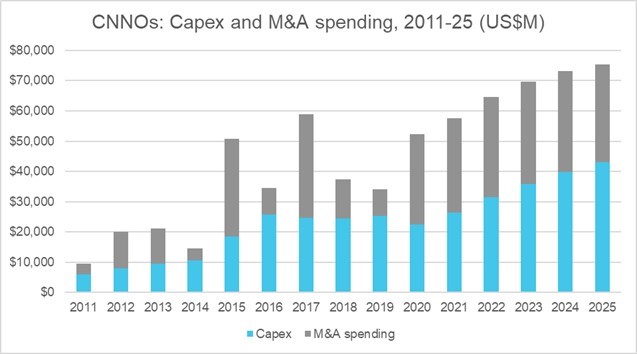
Over the 2011-19 period, CNNO capex totaled $152.9B, while M&A spend was $127.7B. For the 2019-25 period, we expect capex to again outpace M&A but not by much: 2020-25 capex is projected to total $199B, with M&A spend amounting to $194B (figure, below). 
CNNO capex

Source: MTN Consulting

We expect capital intensity to come in at the relatively low rate of 30% in 2020, rising gradually to 40% by 2025 as CNNOs find fewer big M&A opportunities for expansion. M&A starts out high (40% of revenues in 2020) and scales back gradually to 30% of revenues by 2025. In reality, both data series will be much choppier this, especially M&A because of the nature of big deals.

As a result of all this investment, we expect the asset base of all segments within CNNO to grow considerably: 

  • Data centers: From 635 data centers and approximately 56 million net rentable square feet in 2019, the DC segment will reach 727 data centers and 73.3M NRSF by 2025. Historically the average NRSF per data center has been declining but we expect this to reverse as CNNOs invest in higher power, larger footprint designs leveraging some of the efficiencies gained by the webscale sector. NRSF per facility was 88K in 2019, but is likely to grow to 101K by 2025.
  • Towers: In 2019, there were roughly 2.5M towers within this segment, of which just under 2 million (or 80% of total) were managed by a single company, China Tower. We expect the tower segment to reach 3.1M total towers by 2025, and China’s share to decline slightly to 78%. The average global tenancy ratio will rise incrementally, from 1.62 in 2019 to 1.68 in 2025. That’s driven by tenancy improvements in China, primarily, which currently has a lower tenancy rate than seen elsewhere.
  • Fiber/bandwidth: measured in fiber route miles, the footprint of this segment more than tripled between 2011 and 2019, reaching 553K. By 2025, we expect fiber route mileage for this sector to grow to just under 880K.

The Cellnex-DT deal makes clear that some CNNOs are eager to own assets across these three segments. 

American Tower’s acquisition of Telefonica-linked tower business reinforces tower specialization

 Specializing in just one type of infrastructure will continue to be preferred by a number of large CNNOs.

On January 13, a week before the Cellnex-DT deal, Telefonica announced a sale of most of its tower infrastructure to American Tower, for 7.7 billion Euros, in cash. Specifically, AT is acquiring the Latin American and European tower assets held by Telxius, an arms-length infrastructure affiliate of Telefonica. Telxius is 50.01% owned by Telefonica, 40% by KKR (a private equity group), and 9.99% by Pontegadea, the personal investment vehicle of founder of the Zara fashion group, Amancio Ortega. Notably, American Tower is not acquiring the submarine assets also owned by Telxius, for which Telefonica is seeking a separate buyer.

Cellnex was apparently in the running to acquire the Telefonica assets, but got outbid by American Tower. That may be a blessing in disguise considering Cellnex is already in the process of acquiring 24,500 towers from CK Hutchison in Europe.

Despite the name, American Tower is already a global provider. As of 3Q20, only 41,000 of its 181,000 wireless properties were in the US market. However, Europe only accounted for 3% of AT properties; the Telxius deal will raise that significantly, and help position AT as a rival to Cellnex, at least in Spain and Germany. AT already has a big Latin American presence, with over 40,000 towers there at 3Q20’s end. In total, AT is acquiring 30,722 towers from Telxius, adding over 17% to AT’s global tower count.

Cellnex’s new infrastructure JV with DT, the Digital Infrastructure Vehicle (DIV), represents a tower CNNO venturing into fiber and data centers, albeit indirectly. American Tower’s acquisition of Telxius towers represents a more traditional deal: a tower specialist getting bigger, expanding its share of multiple geographic markets. American Tower does have some fiber assets but in general the company has avoided expansion into other types of infrastructure.

AT’s preference has some support in the investment community. Elliot Management lobbied last summer against Crown Castle’s choice to spend so heavily on its fiber business, for instance. Similarly, a well known financial analyst in the tower space, Jonathan Lawrence with Pinpoint Capital Advisors, recently argued that “You don’t want to detract from your core tower business. New business offerings such as fiber or data centers, where we have started to see tower companies invest, take significant expertise and resources to manage effectively.”

MTN Consulting expects there to be more than one approach to this issue. There are some clear synergies to owning both towers and fiber assets, or data centers and fiber. The assets have to be priced right to make entry into the adjacent market worthwhile, first and foremost, as the CNNO market is a relatively low margin business. 

Telco turmoil creates opportunities for CNNOs to grow

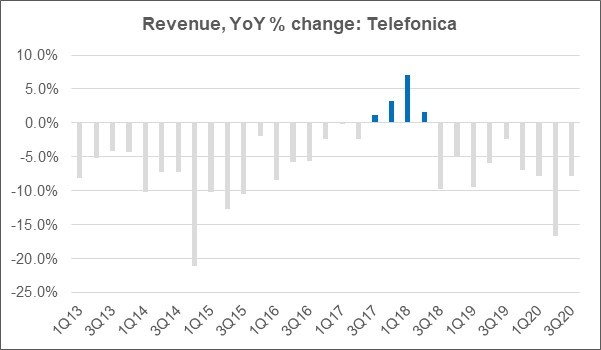
From the telco side, Telefonica’s decision to sell Telxius assets reflects the parent company’s ongoing financial challenges. A weak top line is the starting point: Telefonica’s revenues have been on the decline since 2018 (figure, below).
telefonica revenue1

Source: MTN Consulting

Telefonica ended 3Q20 with 52.5 Billion Euros in debt (financial liabilities), with only 5.9B of cash on hand. The fact that the 7.7B Euro deal with AT is all-cash is a big plus for the company. It may also help Telefonica justify a more liberal capex budget as it continues with 5G buildouts and participates in 5G-related spectrum auctions this year, including in the UK. For the first 9 months of 2020, Telefonica spent 4.1B on capex (excluding spectrum), from 5.2B in the same period in 2019.

It’s notable that Telefonica is among the most aggressive telcos in its embrace of open RAN and open networking in general. Telefonica has also been especially active in its collaboration with the webscale sector, establishing cloud partnerships with GCP (2020; 5G mobile edge computing), Azure (2019; service design), and AWS (2018; digital transformation). Eagerness to work with webscale operators and an open approach to network disaggregation are hallmarks of the more capex-constrained telcos.


Blog Details

Coronavirus will accelerate consolidation in vendor market

The S&P 500 Index fell 12% yesterday after a weekend full of bad news surrounding the coronavirus and its spread. This health crisis is rapidly turning into an economic crisis.   

A lot can happen in three weeks

In a report published 3 weeks ago, MTN Consulting concluded that vigorous consolidation in the vendor market was likely for 2020:

“As enticing as 5G may be, many factors are holding back a telco capex surge right now, including supply chain issues surrounding China-U.S. trade and Huawei, as well as business model uncertainties around how telcos will monetize 5G. The rest of 2020 is likely to be challenging for vendors, as telcos continue to slim assets, share networks, deploy more software, embrace open networking, and delay or downsize major network upgrades pending a more certain investment climate…Add in the coronavirus, which is already impacting telecom supply chains, and 2020 is looking like a potentially bleak year for the vendors selling into the telco market.”

Since the “Bumpy road ahead for 5G transition” report was published, coronavirus has spread rapidly throughout the world. While several Asian countries have gotten it under control, the US, Canada, and most of Europe has shut down normal life to slow the spread and avoid healthcare system overload. In the US, the social distancing, quarantines and curfews that initially seemed like short-term necessities are now looking like they may be long-term solutions until a workable vaccine is produced. Everyone is being encouraged to work from home (WFH), and students are being forced into online learning as schools close. This is unprecedented. As author Stephen King tweeted yesterday, “This is going to change America, long-term.”

Stay healthy, keep your company afloat, and prepare for the long term

Given the highly contagious element of coronavirus and its relatively high mortality rate, everyone should be first and foremost concerned with health and safety issues. But business leaders also need to keep their eyes on the horizon, to consider how their companies can escape this crisis afloat and prosper in the long run.

As coronavirus lingers, both telecom operators and their suppliers are going to see demand erosion. This could be severe in the next 6-12 months. Many companies in telecom will struggle to survive during this period, even with government stimulus. It’s hard to know how bad it will get. As a NYSE trader said yesterday, “It’s very hard to model what that real impact is going to be… because it’s going to be very large.”

Based on current trends, a few things will likely happen to telecom in 2020:

  • telco revenues will fall in most countries, along with consumer spending overall
  • major telcos will layoff staff in the thousands
  • telco capex will decline in 2020 by 5% at minimum
  • mobile operators will stretch their 4G networks, and slow 5G network deployment rates
  • telcos will actively lobby for state relief on multiple fronts, from subsidies to antitrust review of mergers to reimbursement for Chinese vendor rip and replace efforts
  • Some governments, including the US, Canada and most of Europe, will consider massive stimulus projects in areas like physical infrastructure – in particular fiber construction – but most support will take 1-2 years to materialize 
  • China’s government will double down on state support for its tech sector

Based on this likely path, there will be severe pressure on many vendors selling into the telco market. That’s where M&A comes in.

Consolidation will pick up once markets stabilize

MTN Consulting tracks quarterly revenues for over 100 vendors, with a focus on those selling into the telecom network operator (TNO, or telco) market. As part of this, we track entry and exit into the market, as well as M&A among vendors. In the telecom vendor space, M&A is an ongoing reality – a way to enter new markets, and to improve your cost position. Huawei’s nonstop growth has added pressure on others to team up, as with Nokia’s 2015-6 acquisition of Alcatel-Lucent. Even though M&A often fails, it often appears to be the only option for a company under pressure.

Looking ahead to 2020, a number of vendors will be hit hard by the inevitable downturn facing the telecom market. Those vendors most at risk are the ones highly leveraged to the telco market, as telco spending may take a deep cut in 2020. Other signs of vulnerability include relatively low operating margins, limited cash reserve, and/or high debt loads. Some of the companies that have weak spots going into the coronavirus downturn are shown in Table 1, below. Potential problem areas are shaded red.

Table 1: Select telecom vendors and their financial position as of 4Q19 

Company 4Q19 revenue (M) Currency Telco/total revenues Operating margin Cash months of opex Net debt to Revenue* 
Adtran        116.0 USD 100% -12.1%          2.47         (0.71)
Aviat Networks          56.0 USD 47% -1.8%          2.00         (0.52)
Casa Systems        113.0 USD 100% 8.8%          3.32          1.58
Ceragon Networks        286.0 USD 80% 2.8%          0.26         (0.03)
CommScope Holding     2,299.0 USD 82% -14.7%          0.68          4.02
Infinera        385.0 USD 87% -15.6%          0.73          0.65
Kudelski        208.0 USD 48% -0.5%          1.77          1.87
Ribbon Communications        161.0 USD 71% 13.0%          0.96          0.09
Technicolor     1,033.0 Euro 51% -0.1%          0.23          1.18

Sources: FT, MTN Consulting
*Net debt = total debt minus cash & short term investments.

Several companies in Table 1 face a challenging 2020. Two are US-based companies still recovering from major acquisitions, CommScope Holding (ARRIS) and Infinera (Coriant). These vendors focus on connectivity/cabling and optical transmission, respectively. The other two, Kudelski and Technicolor, are European companies with exposure to the media segment and cable television, in particular. In addition, several of the companies in Table 1 are highly exposed to a single product market within the telecom space: microwave for Ceragon and Aviat, access for Adtran and Casa. Diversification can help in a downturn.

Telecom’s two biggest (publicly traded) vendors are not included in Table 1. Nokia is probably the subject of the most M&A rumors nowadays, due to a relatively slow start in 5G commercial rollouts. Nokia benefits from its US ties, though, as well as its good position outside the telco vertical, in transport, energy and government networks. By contrast, Ericsson gets almost all its revenues from telcos, and has bet big on a quick 5G uptake. Given both companies’ broad exposure to telco spending, though, 2020 will be a jittery year for both vendors.

Photo by CDC on Unsplash.

Blog Details

Indian telco sector faces potential bankruptcies and steep capex cutbacks to cope with October court decision

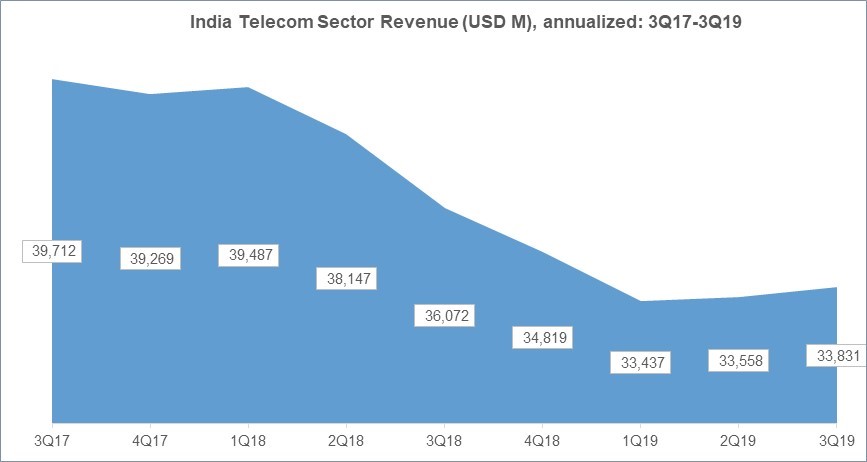
The Indian telecom sector is left in tatters following the Supreme Court’s verdict that supported the Department of Telecommunications (DoT) in a dispute with the telcos over how levies are calculated. Already ridden with massive revenue declines (Figure 1) and a collective debt of almost INR7,800B (US$110 billion), Indian telcos have little cash left for future investments including the upcoming 5G spectrum auctions.

Figure 1

Source: MTN Consulting

Airtel and Vodafone-Idea are under severe financial stress, with the latter on the verge of bankruptcy

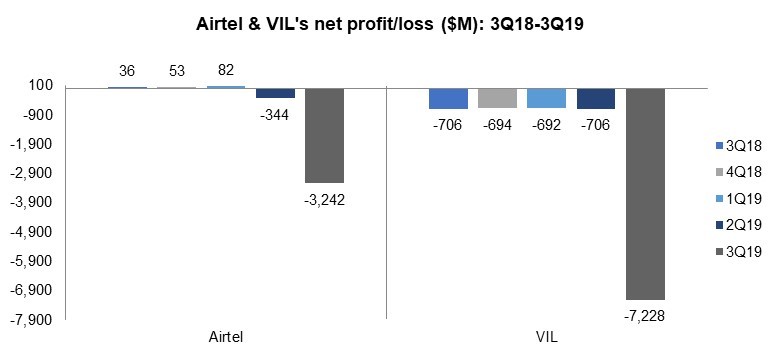
The court’s verdict on adjusted gross revenue (AGR) had significant financial implications on Airtel and Vodafone Idea Limited (VIL). In 3Q19, these two telcos reported combined losses of about $10.5B (Figure 2) as they set aside funds towards AGR dues.

The debate over AGR definition between the DoT and the operators goes back to 2005. The AGR definition is crucial as it has massive financial repercussions for both operators and the government. For instance, the telcos are required to pay 3-5% of the AGR towards spectrum usage charges, and nearly 8% of AGR as license fees.

DoT considers revenues from core and non-core business as AGR, while operators argue that AGR should include revenue only from core business and exclude revenues from dividend, interest income or gains on the sale of assets. Now with the Supreme Court verdict favoring the government’s stance, Airtel and VIL are liable to pay INR216B ($3B) and INR283B ($3.9B), respectively, towards AGR dues. For context, Airtel’s 2Q19 revenues amounted to $2.98B while VIL recorded $1.62B; AGR is significant for both.

Figure 2

Source: MTN Consulting

The liabilities incurred by the operators are huge mainly due to the interest and fines levied since 2005. With both operators already reeling under financial stress amidst the rapid growth of rival Jio, the operators’ strategy to hike prepaid tariffs does not come as a surprise. In the first week of December, Airtel, VIL, and Jio all hiked rates on prepaid plans by more than 40% and are in talks with TRAI to set up a floor price, a minimum tariff for mobile voice and data services. Jio’s decision to join the bandwagon of hiking prices could be the first sign of stability in the sector that has been battered for almost three years.

While both Airtel and VIL are in trouble, Airtel has more options. It plans to raise $3 billion to pay the government, which could involve the sale of its stake in its tower arm Bharti Infratel. VIL has not made clear its plan. It is precariously placed with piled up debt and huge subscriber losses. VIL’s debt to equity ratio increased from 181% in 3Q18 to 487% in 3Q19 (Figure 3). Further, VIL’s subscriber base declined to 311M subscribers in 3Q19 compared to 422M a year back. VIL’s parent entities Aditya Birla and Vodafone are also shying away from making additional investments in the merged entity. With mounting losses and no backing from the parent groups, chances of revival for VIL are low. An urgent sale to a rival operator is possible.

Jio is getting stronger amid Airtel’s and VIL’s financial crisis

Reliance Jio (Jio)’s entry into the telecom sector in 2016 has come down hard on established players like Airtel and VIL. Post Jio’s entry, the industry witnessed intense price competition setting off a sector wide consolidation resulting in just three private operators. Unlike Airtel and VIL, Jio has not been impacted much by the recent court decision on AGR. Jio’s total fine amounts to just $1.8M, given that it started operations in India only three years ago. Moreover, Jio’s parent company (RIL) is forming a new subsidiary that will hold its digital and mobility businesses, including Jio, and transfer all of Jio’s pending liabilities to other divisions within RIL. Post this restructuring process, Jio will be net debt-free with just spectrum related dues to pay. All of this helps Jio manage its cash flows better and will place Jio in a strong position with enough cash to fund for the upcoming spectrum auctions.

So, what lies ahead for the sector?

The next few quarters will be a testing phase for Airtel and VIL, as they seek relief measures from the government to stay afloat. Amid the AGR issue, the government decided to defer spectrum auction installments due from the telcos in FY21 and FY22 by 2 years. This is just a temporary relief, though, and it relates to older spectrum purchases – these operators need fresh spectrum for 5G.

The AGR ruling will be a major hindrance in the telcos’ ability to take part in 5G auctions. For instance, the current suggested base price for 5G is marked at INR4,920M ($69M) per Mhz, with a minimum sale of 20 MHz blocks. This would mean investing around INR100B ($1.4B) for 20 Mhz. The recommended price for the same band in countries like Korea, Spain, the UK and Italy is up to 6 times cheaper. For India’s telcos, spectrum cost constitutes a significant portion of total capex. Considering their financial woes, Airtel and VIL might not even bid for the upcoming 5G auctions at the current price.

Unavailability of adequate spectrum is a related concern. The Indian regulator had put up 300 Mhz of spectrum in the 3.3-3.5 Ghz bands, however with 125Mhz set aside for defense and space organizations, the telcos are left with just 175Mhz spectrum to bid for. Scarce resources get expensive quickly. To help address this, a minimum 100 Mhz block should be assigned per operator for better 5G enablement and deployment, but freeing up this much spectrum will be a challenge.

To justify future investments in 5G, both in spectrum and network infrastructure, telcos will also have to command significant pricing power in new 5G services, which currently seems unlikely.

Blog Details

UAE – The First 5G Market in MENA

Unlike many other countries in the MENA (Middle East and North Africa) region, 5G services are already available in the United Arab Emirates (UAE). Etisalat and Du, UAE’s only two operators, are both deploying 5G on the 3.5 GHz frequency band. In May 2019, Etisalat became the first operator in the MENA region to commercially launch 5G service.

Recommendations
For effective commercialization of 5G, operators should focus on device costs and finding ways to subsidize the cost if needed. For their part, government administrators should consider the following:

  • Provide a near term deadline to shutdown 3G services
  • Provide a longer-term deadline to shutdown 2G services
  • Put a strong emphasis on enabling vertical markets
  • Ease regulations for new entrants


UAE overview

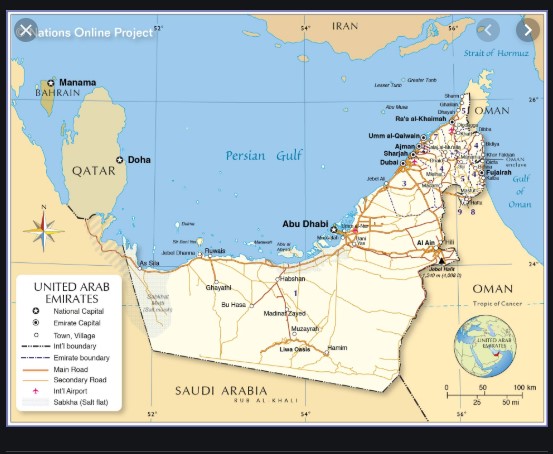
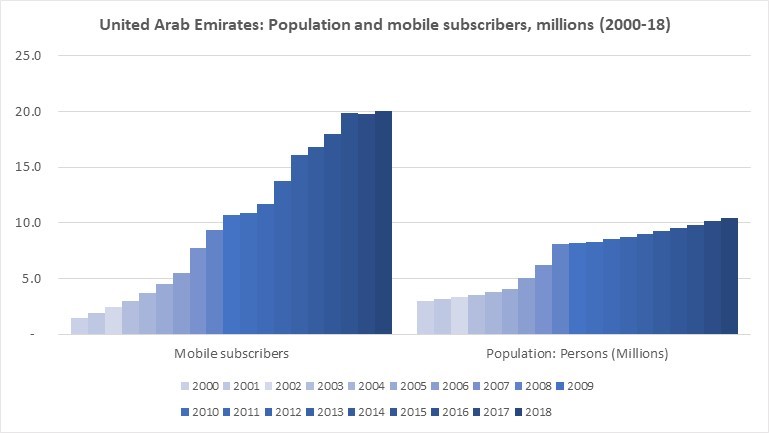
The United Arab Emirates or UAE is at the southeast end of the Arabian Peninsula on the Persian Gulf, bordering Oman to the east and Saudi Arabia to the south and west. It also shares maritime borders with Qatar to the west and Iran to the north. UAE is a federation of seven emirates consisting of Abu Dhabi (the capital), Ajman, Dubai, Fujairah, Ras Al Khaimah, Sharjah and Umm Al Quwain (Figure 1). UAE has one of the world’s highest percentage of immigrants: more than 70% of the overall population. At the end of 2018, the UAE’s population was 10.4 million, up from just 3.0M in 2000 (per the IMF).

Figure 1

Source: Nations Online Project

Telecom Market Overview

Government

The Telecommunications Regulatory Authority or TRA is the federal telecommunications regulatory agency of the UAE. It was established in 2003 to regulate the Information Communications and Telecommunications (ICT) sector. In 2013, its role was extended to include responsibility for the overall digital infrastructure in the country. TRA is also responsible for representing UAE in the international ICT forums.

Telecom Operators

Etisalat and du are the only two telecom network operators in the UAE. The UAE government owns large ownership stakes in both operators, and limits competition in the sector. The creation of du in 2007 added a second competitor to the mobile market, but fixed line competition only began in 2015. At the end of September 2019, Etisalat has 10.54 million while du has 7.736 million mobile subscribers. Thus, UAE has about 186% mobile penetration rate, one of the highest in the world. UAE has also the highest smartphone adoption rate in the MENA region, and second only to Singapore, with smartphones accounting for 85% of total connections in Q2 2018.

Figure 2 shows the growth of the UAE’s population and mobile subscriber base from 2000-18.

Figure 2

Sources: IMF and ITU

The MVNO phenomena was started in 2017 with the launch of Virgin Mobile by du, which was immediately followed by Etisalat’s Swyp. These Mobile Virtual Network Operators are targeting the younger tech-savvy generation. The packages offered by these MVNOs are tailored more towards mobile data rather than phone calls and SMS services.

Etisalat and du have extensively deployed optical fiber throughout the country. FTTH (fiber to the home) service is also widely available in UAE. Based on September 2018 stats from the FTTH Council MENA, the UAE ranked number one (globally) with a 95.7% FTTH penetration rate. A small geography and a high average income both facilitate this. While competition in fixed line is only a few years old, du has built up a noticeable market share.

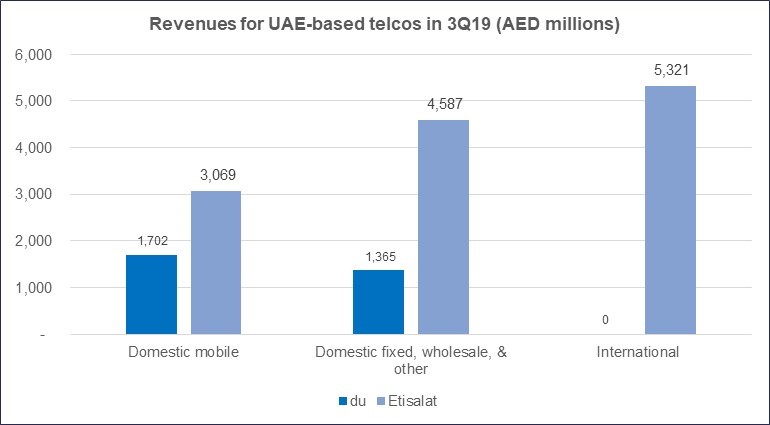
Figure 3 below illustrates revenues for the two companies by type, in 3Q19.

Figure 3

Source: company earnings reports

5G

Etisalat awarded contracts to both Huawei and Ericsson for the rollout of its 5G mobile network in February 2019. It plans to deploy 900 5G-enabled base station sites during 2019-20. Etisalat’s rival du plans to deploy 700 5G base stations during the same time frame. Huawei and Nokia are du’s 5G network suppliers. ZTE’s Axon 10 Pro 5G is one of the first 5G handsets (if not the first) that was launched by both operators in the UAE.

Connectivity

The UAE has two key landing stations for connectivity with international submarine cables. The Fiber-Optic Link Around the Globe (FLAG), South East Asia-Middle-East-Western Europe 3 (SEA ME WE 3), SEA-ME-WE 4 and Asia-Africa-Europe-1 (AAE-1) lands at the port of Fujairah, whereas SEA-ME-WE 5 lands at Kalba.

UAE also uses satellite earth stations such as 3 Intelsat (1 Atlantic Ocean and 2 Indian Ocean), 1 Arabsat, etc., for connectivity.

Spectrum

In November 2018, the regulator TRA issued 100 MHz to each of the two incumbent operators in the 3.3 to 3.8 GHz frequency range to offer 5G services. This free issuance of spectrum is hugely beneficial for operators’ financial health and network rollout.

In addition to this C-band assignment, the regulator is also looking at the 1427 MHz-1518 MHz, 24.25 GHz – 27.5 GHz and bands above 40 GHz for 5G. Both Etisalat and du also have spectrum assignments in 800, 900, 1800 and 2100 MHz bands to offer 2G, 3G and 4G services. Etisalat additionally uses the 2600 MHz band to provide 4G LTE service.

Key Challenges

The UAE’s key challenge is the commercialization aspect of 5G in conjunction with the heavy baggage of 2G, 3G and 4G networks.

UAE is one of the richest countries of the world with a GDP per capita of over $40K. The IMF expects the UAE economy to grow at 1.6% in 2019 and 2.5% per year through 2025. In the telecom sector, the duopoly and state-controlled structure has landed the operators in a reasonable financial state. With little possibility of a third player, the two operators as compared to many other markets have few things to worry about, at least in the near term.

Recommendations

To further streamline the process of effective and meaningful commercialization of 5G, the following steps may be considered:

  • 3G Shutdown: TRA and operators may come up with a near term deadline to close down the 3G networks. The slower and less spectrally efficient 3G is definitely not required when better 4G and 5G networks are available. The 2100 MHz band which is used to operate 3G is not primarily used for 4G and 5G worldwide and thus keeping it for future use may not be worthwhile. Eventually, it will free up capacity, reduce the number of network elements and further improve their networks’ quality of service and overall financial health. Transition issues such as QoS degradation and vendor contract renegotiation are manageable.
  • 2G Shutdown: The operators also have a huge customer base of low ARPU, price sensitive customers. The vast majority of these customers are expats (immigrants) and a large number of them have come from a poor and less educated background. With high tendency to save money for families in their home countries, cheaper 2G/3G phones are preferred over more tech-savvy and high-end devices. Regulators and operators should jointly consider developing a detailed roadmap for the discontinuation of 2G services. The roadmap may look into such issues as: the availability of low cost 4G and 5G phones, as most of the available low-end phones are not capable of operating on 4G/5G networks; reengineering of the required section of the networks including disposal of unnecessary elements; and, creation of awareness programs. Furthermore, 2G primarily operates in the 900 MHz band which has not been recommended for 4G and 5G.
  • 5G Device Cost: Operators may further increase their due diligence with the device suppliers to lower the cost of 5G devices to attract masses. The current cost of a 5G device in UAE hovers around USD 800-1,200 as compared to $10-$30 for 2G/3G phones.
  • Vertical Markets: It will be difficult to have a good return on 5G investments without its enablement in vertical industries. An effective roadmap is needed to strengthen 5G in IoT (Internet of Things), AI (Artificial Intelligence), V2X (vehicle to everything – connected cars), etc., markets. The list of stakeholders is long and with perhaps many open as well as clandestine political agendas, it won’t be easy to come up with such a roadmap. The seven emirates and ministries / regulators along with the corresponding industries (education, finance, health, maritime, telecommunication, tourism, transportation, etc.) will eventually face an uphill battle.
  • New Entrants: With 5G and its enormous possibilities in vertical industries, the regulator (TRA) may conduct another round of due diligence on the viability of new entrants in the telecom space.


-Photo by Robert Bock (Unsplash).

Blog Details

5G Challenges and Opportunities in Pakistan – A Perspective

5G is moving full steam ahead in many developed economies. Recent announcements from both vendors and operators confirm this notion with news of 5G network rollouts and availability of 5G-enabled devices.

Many developing nations on the other hand are lagging behind, including Pakistan. Impediments in Pakistan include a slow return-on-investment, a shortage of disposable income, and lack of urgency towards innovation. (National spending on R&D, for instance, is just 0.3% for Pakistan, versus 0.8% for India and 2.0% for China.) These and other obstacles make the enablement of 5G both more challenging and interesting.

Very briefly, the aim of this blog to look at the outlook for 5G in Pakistan, including some of the challenges and the opportunities the technology could bring to this nation of 217 million.

Background

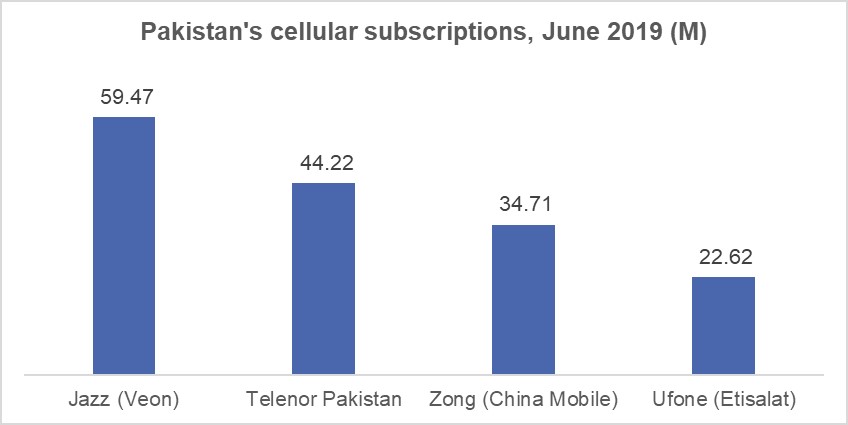
Pakistan has more than 161 million cellular subscribers including 69 million 3G/4G-LTE users divided among four cellular operators. Jazz is the mobile leader with around 60 million users while Telenor Pakistan stands at number two with approximately 44 million users (figure).

An interesting element of the cellular market is that the parent companies of all the operators reside outside Pakistan. Jazz is part of VEON, Telenor Pakistan is 100% owned by Norway based Telenor Group, Zong is a subsidiary of China Mobile and Ufone belongs to Etisalat.

Source: Pakistan Telecommunication Authority (PTA)

The supplier’s market is primarily in the hands of Chinese vendors. Huawei and ZTE are the incumbents in the radio access network (RAN). However, things started to change in the fall of 2018. One reason is the restrictions put on these two vendors by the Trump administration, which have allowed Nokia to reenter the market. Telenor Pakistan is in the process of swapping all its radio sites from ZTE to Nokia while Jazz is planning for the same, over fewer sites. Ericsson is a non-player in the RAN market, but did win an optimization project at Jazz in Feb 2018.

Even with regulatory & supply chain risk related to Chinese vendors, the transmission network (including backhaul) is not likely to be swapped. Transmission networks in Pakistan rely almost entirely on China. Ericsson can hardly be seen in the market. It has a very small footprint in the transmission network while NEC supports backhaul (via microwave radio hops) in Telenor’s network.  Core networks are usually supplied by the radio access vendor. Within the RAN, Huawei has up to 60% market share of the installed base, with ZTE capturing virtually all the remainder (prior to the recent swaps).

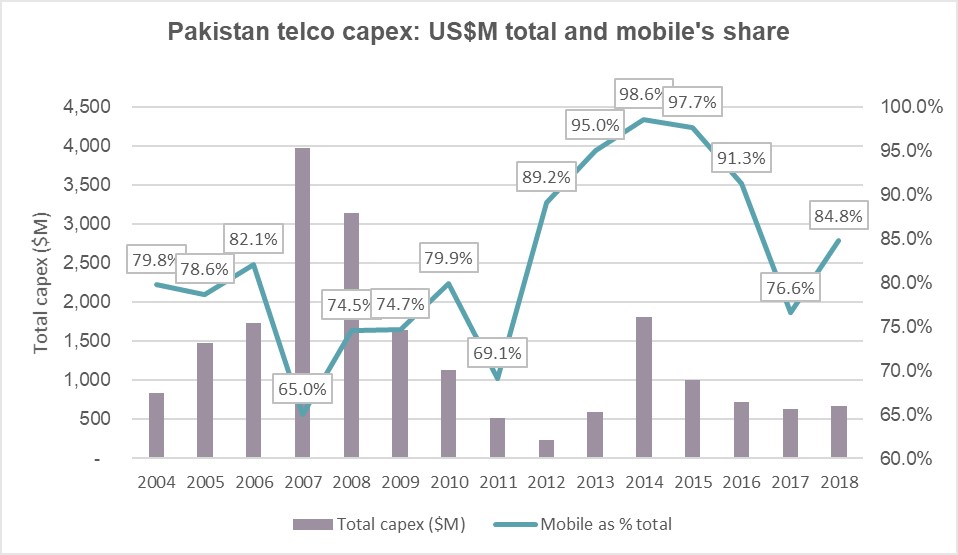
According to the Pakistan Telecommunication Authority, telco capex has averaged to well over US$1B per year since 2004 (figure, below). Variations tend to be driven by new licenses, technology upgrade cycles, and macroeconomic factors.

Source: PTA. Note: total includes Cellular, LDI (Long Distance International), LL (Local Loop) and WLL (Wireless Local Loop).

Over the 2004-18 15-year period, mobile cellular operators accounted for just under 80% of industry capex. With 5G buildouts approaching, total capex should soon see a bump, and mobile’s contribution may rise above 90% again.

Challenges

The telecom sector of the country faces many common and a few unique challenges. One of the key obstacles to progress comes from the non-implementation of Telecom Policy 2015.

The Ministry of IT and Telecommunication issued the National Telecommunication Policy in 2015. This policy secured Pakistan’s government a “Government Leadership” award from the GSMA in 2017. However, actual implementation of this policy has been lacking to date. This failure will curtail the development of 5G and Pakistan’s overall telecommunication sector.

There are many other challenges, some common to developing nations and some unique to Pakistan.

Common Challenges:

Lack of a frequency spectrum roadmap

Wireless communications cannot take place without the air waves (frequency spectrum), which are under the control of national governments. Governments often consider spectrum as a cash cow, particularly when it comes to mobile communications. The mobile telco industry on the other hand desires effective auctions and nominal license fees, and some level of certainty about the future. Hence, it is important that governments / regulators provide a mid to long term spectrum roadmap, update it on a regular basis, and ensure that operators use the same effectively.

According to the Telecom Policy 2015, the Ministry was required to provide a 3-year rolling Spectrum Strategy where it will lay out the future plans for this scarce resource. However, more than three years have been passed and the industry still hasn’t received the strategy. According to Saad Asif, a telecom consultant who has worked at both Jazz and Telenor Pakistan, “there is an urgent need for a Spectrum Outlook which will help service providers to make informed investment decisions.”

Costly / Bureaucratic Right-of-Way (RoW) granting process

Leasing RoW assets can be a lucrative way of making additional income, particularly in countries which lack either an investment-friendly national RoW policy, its implementation, or both. The situation is not different in Pakistan as noted recently by Rizwan Mir, CEO of Universal Service Fund, “Pakistan lacks effective tariff and policy controls on Right of Ways for laying fiber”.

5G will require deployment of a huge number of small cells as well as optical fiber. Tens of thousands of cell sites are currently accommodating traffic through microwave radios and down the road a good majority of those have to be switched to fiber. This requires an effective mechanism for expeditious treatment of right-of-way. This mechanism doesn’t yet exist, despite the telecom policy’s mandate.

Unique Challenges (in recent times):

Pending License Renewal

In 2004, the government issued 900 and 800 MHz licenses to Jazz, Telenor and Paktel (now Zong) for a period of fifteen years. These licenses were issued on the principle of technology neutrality i.e. they can be used for GSM, 3G, 4G, etc. In practice these are mainly used for providing 2G GSM services. The licenses were awarded at the price of US$291 million for a total of 13.6 MHz. The bandwidth includes a portion of spectrum in both 900 and 1800 MHz.

The renewal process for these licenses was started a couple of years ago, but hasn’t been concluded due to difference of opinions on the license cost. Service providers are demanding to buy at the same cost of $291 million, which turns out to be $7.31 million per MHz. However, the government has established a per-MHz cost based on frequency auctions conducted in 2016 and 2017, and asked the regulator (Pakistan Telecommunication Authority) and spectrum manager (Frequency Allocation Board) to implement the same.

The price per MHz cost from these auctions in 2016-17 turns out to be $39.5 million for 900 MHz and $29.5 million for 1800 MHz, which is quite high. The newer cost, if implemented, will be approximately 60% higher than 2004. Mobile operators are contesting these prices, and the matter is currently under judicial consideration before the Islamabad High Court.

Currency (PKR) Devaluation

The currency has been devalued by more than 40% to its value of January 2018. During January 2018 the exchange rate was USD 1 to PKR 110 and now in August 2019 it is hovering around PKR 160.

This is impacting the overall country and the telecom sector is not immune. The impact is three pronged at least – reduction in profit margins, decrease in available CAPEX for new investments (as nearly all equipment is imported) and increase in OPEX. Consultant Saad Asif adds that “this devaluation is resulting in a substantial increase in OPEX due to rising energy costs”.

Opportunities

Currently, 3G and 4G/LTE data services are often not up to par in Pakistan, even in major cities. The fault lies not only in the network but also the heavy penetration of low-grade smart phones. The performance benchmarks placed by the regulator for the rollout of 3G and 4G services are rather low.

The following are some of the opportunities emerging with 5G in Pakistan:

Improvement in current data service with better performance benchmarks

Telecom network engineers have to make trade-offs between coverage and capacity. These two parameters have a direct impact on KPIs (key performance indicators) such as voice quality, data rates, throughputs, etc.

Two reasons for poor network performance in Pakistan:

(1) the thresholds and benchmarks set by the regulator in the 3G/4G licenses of operators were kept quite low. Operators only have to maintain data rates of 256 kbps and 2 Mbps for 3G and 4G users respectively.

(2) most users care more about price than quality of service. Pakistan’s low ARPU illustrates this: Telenor’s Pakistan branch recorded an ARPU of just 12 NOK in 2Q19, less than half of Telenor Myanmar’s 25 NOK/month.

As any improvement in the QoS requires investment in the network, operators are frequently unwilling to take this approach since it may negatively impact their ROI (return on investment).

The PTA needs need to address this disincentive to build robust, resilient networks. That can come either as part of the current license renewal exercise (if operator(s) decide to use it for 3G /LTE services), or at the time of future 5G auctions. Waiting until 2029 for the next renewal of 3G/4G licenses is not an attractive fallback plan.

Internet of Things (IoT)

IoT is agnostic to mobile technology i.e. it can be operated using any generation of cellular technology. IoT is in the early stages of growth in the country and according to Cisco by 2030, 500 billion devices will be using Internet across the globe.

IoT can benefit multiple industries in Pakistan, particularly the public utilities to reduce mismanagement and corruption. For example: use of smart meters for electric and gas connections can substantially reduce the visits of utilities’ personnel to homes / facilities. Another use could be the procurement of water tankers to address the shortage of water through a connectivity among IoT modules, cellular networks and water supplier systems.

mHealth

A large segment of Pakistan’s population lacks access to basic health service. Initiatives have been taken both by public and private organizations but so far have had disappointing results.

The lack of education and information sharing is harmful to the promotion of mHealth, particularly in rural areas. Illiteracy rates are high in villages and remote areas, where mHealth is needed the most. The concerned ministries and regulators in partnership with private businesses need to strengthen the existing setups and establish new programs for the promotion of mHealth to build trust, and provide training to healthcare professionals and society at large.

As Pakistan’s 4G networks mature and operators evolve to 5G, remote diagnostics and eventually surgery have potential. Society needs to have systems in place to benefit from these new technologies, though, so the government needs to get to work.

Source of cover image: Huawei.

Blog Details

Vendor sales to telcos up ~2% in 2Q19 so far

About 20% of telecom’s 100 or so key vendors have now reported second quarter 2019 (2Q19) results. From these early vendor results, there are modest signs of a ramp-up in 5G-related spending.

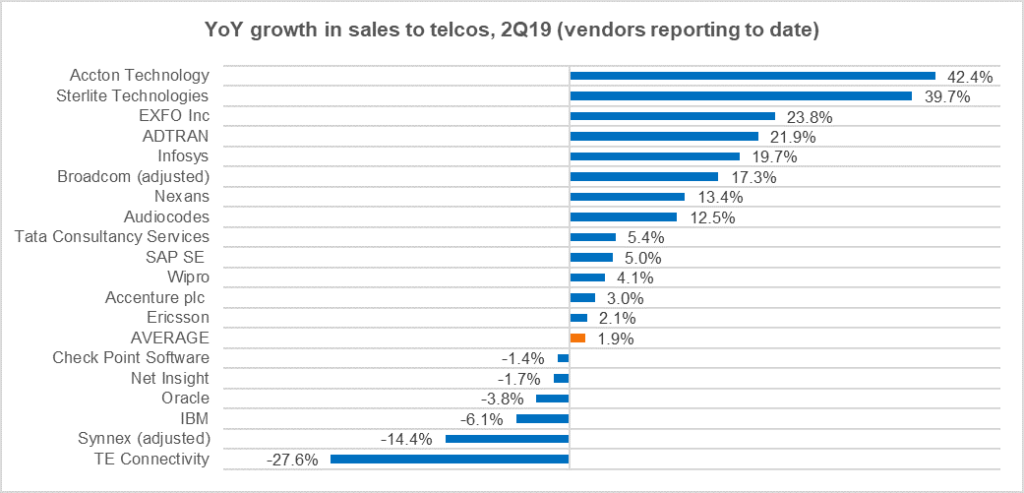
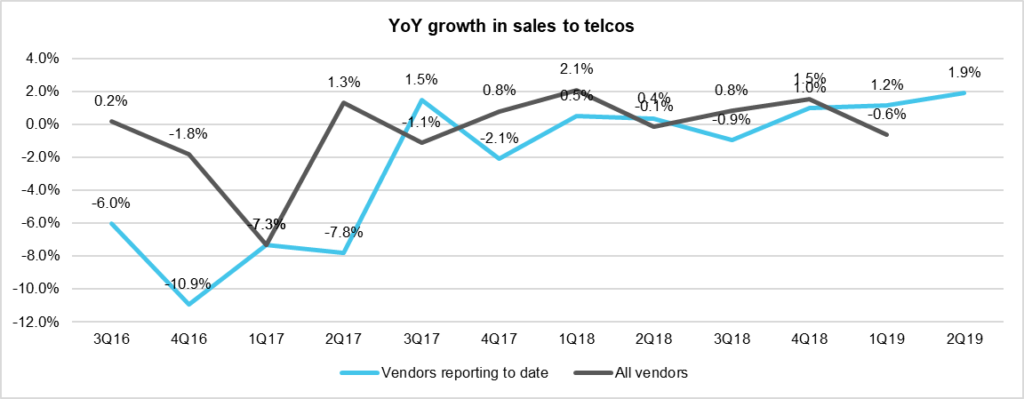
Preliminary totals indicate growth of +1.9% YoY in vendor revenues to telecom operators (or telcos). Revenues for all vendors dropped last quarter, by 0.6% YoY, so this would be a slight trend reversal.

Ericsson only big NEP to report so far

Of the vendors reporting so far, the only large Network Equipment Provider (NEP) is Ericsson. (We also track IT services providers, and fiber/cabling vendors selling to telcos). Ericsson is also by far the largest to report so far, accounting for over 50% of reported revenues.

Per MTN Consulting estimates, Ericsson’s telco sales grew 2.1% YoY (on a USD basis), near the market average of 1.9% to date (see figure, below). That’s the fastest growth seen by Ericsson in several years, but it appears to have come at a price. Ericsson notes a negative margin impact from its push for “strategic contracts” in the Networks division.

There is a broad range of growth rates around the Ericsson-driven average. Vendors are finding growth in different aspects of the market, including high-capacity switches & open networking (Accton), high-speed test equipment (EXFO), 5G-related services & software (Infosys, TCS, Wipro), FTTx (Adtran, Nexans), and digital transformation consulting (Accenture). Some of these vendors sell to multiple segments, some are more specialized in the telecom vertical.

Source: MTN Consulting estimates of vendor sales to telcos (adjusted for M&A, US$ basis)

Some vendors also saw revenue dips in the telco segment, per our estimates; that includes Oracle and IBM, most importantly. These two vendors sell a range of software and services to telcos, as well as some network equipment, but are facing new competition. For example just last week Microsoft signed a large cloud deal with AT&T, a multiyear collaboration to help lower the company’s network and IT costs, moving more apps to the public cloud. At the same time, AT&T also expanded an existing cloud partnership with IBM. Both Oracle and IBM have annual sales to telcos in the $2-3B range, so don’t count them out.

The revenue drop shown above for TE Connectivity is estimated: SubCom is now part of Cerberus Capital, and does not report. However, SubCom’s pipeline was weak at the time of acquisition and deal integration usually causes a slowdown. Parts of the submarine market are picking up though, due to webscale investment and much-needed gap-filling in the Middle East & Africa. Nexans appears to be a beneficiary. Corning, Prysmian and other key fiber suppliers have not yet reported.

Growth trajectory remains modest

The figure below compares YoY growth rates for the sample with the market, i.e. the sum of all companies in MTN Consulting’s telecom vendor share coverage database.

Source: MTN Consulting

When including all vendors (black line, above), revenues have largely been flat over the last several quarters.  The sample of companies reporting appears broadly similar. However, on the demand side, guidance from telcos on expected spending levels (capex and network opex) was quite conservative for 2Q19. The final growth rate for 2Q19 vendor revenues in the telco vertical will likely be below +2%.

To reiterate findings from our latest (1Q19) telco sector Market Review:

Telco profit margins remain tight, nothing new for the telecom industry. Operators are getting more concerned about debt, though. The net debt (debt minus cash) of the global telco sector was roughly half of revenues in 2018, after having been in the 30-40% range of revenues at the cusp of the LTE buildout cycle. Few telcos have room in their budgets for a 5G capex splurge.

Telco network investments continued a declining trend, as capex touched $70B in 1Q19, down almost 2.5% YoY. The weak 1Q19 result and continued supply side uncertainty does not bode well for 2019. The slowdown could be due to operator caution about market demand. Yet competitive realities will require operators to spend big on 5G and fiber in 2019-20. The market’s average capital intensity will exceed 17% by the end of this year.

We expect to publish further commentary on the market after Nokia and Samsung report next week.

Blog Details

Webscale operators take their battle to space

After spending billions for improved connectivity on land (data centres) and sea (submarine cables), top webscale network operators (WNOs) are now looking to conquer another frontier – outer space.

In April 2019, Amazon announced plans to build a network of 3,000+ satellites in space to provide broadband internet connectivity. Dubbed “Project Kuiper”, Amazon’s satellite initiative seeks to provide high-speed, low-latency broadband internet connectivity to the unserved and underserved communities worldwide, by launching low Earth orbit satellites. Interestingly, Amazon’s newly announced ambitions created a lot of buzz in the media despite being a late entrant to the scene – Amazon’s webscale peers, Alphabet and Facebook, confirmed their plans to launch low-orbit satellites much earlier.

Google, before its mid-2015 name change to Alphabet, filed a patent way back in September 2014 (and published by US Patent Office in January 2017) detailing efforts to build a global-scale communication system with 1,000+ satellites. Facebook confirmed speculations of building its own internet satellite “Athena” in July 2018. Besides, Apple hired top satellite executives from Alphabet in April 2017, hinting its entry into satellite-based internet services. Another webscale operator, Microsoft, announced plans in 2017 to beam high-speed internet into rural America, though by different means – using unused television airwaves. Beyond the webscale space, several space technology companies have recently launched broadband-focused satellites into orbit, including SpaceX, Telesat and OneWeb.

More than just bridging the digital divide

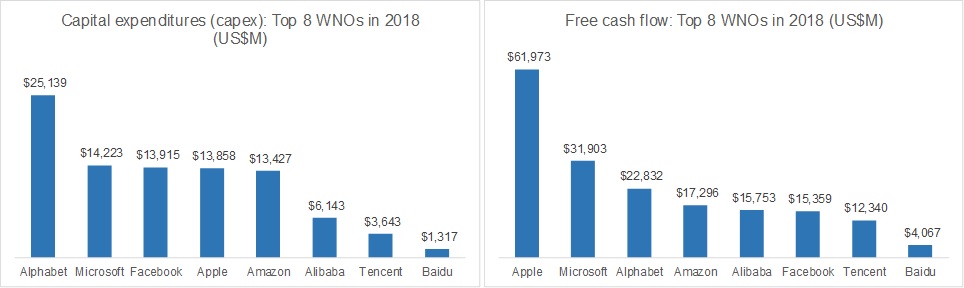
One aim of these operators is to remove the digital barrier in unserved markets, but it is not the only goal. Space initiatives, such as launching communication satellites, require heavy investments in the form of capex to build equipment and related infrastructure. For non-traditional players such as WNOs, it becomes all the more important to acquire the complex underlying technical expertise and technology for space programs – and that is expensive. Fortunately, the key webscale players pushing satellite have a history of large network investments and high levels of free cash flow, as the below chart shows for 2018. These WNOs seem well placed to advance their satellite ambitions further in the coming years.

Source: MTN Consulting, LLC

With the mammoth investments required for satellite, WNOs certainly expect benefits arising from their respective space pursuits to trickle down into earnings in the long term. In the short to medium run, WNOs look to reap rich dividends operationally. These include customer base expansion, operational flexibility and cross-selling opportunities – each explained below.

Customer base expansion

WNOs thrive on internet connectivity as most of their core businesses – retail, advertising, digital content, and cloud – require internet-based platforms to operate. With satellite-based internet services in unserved and underserved markets, WNOs such as Amazon, Facebook and others will be able to break into untapped markets and add new customers onto their platforms. Access to such huge potential markets could provide massive business opportunities and a much-needed thrust for these WNOs, as they look to cope with market saturation in many of their operating regions.

Operational flexibility

Better control and flexibility are other key benefits that could come with satellite-based internet delivery. As these satellite networks are (in general) exclusively owned by the respective WNOs, network vulnerability could be reduced, allowing them to control and secure the internet traffic better. Events such as a traffic hijack that disrupted Google services a few months back could be less likely to recur as WNOs gain autonomy over their satellite network infrastructure. More importantly, it could reduce WNOs’ dependence on the telcos. The big WNOs investing in satellite already have vast subsea network investments, and continue to build on this. Alphabet (Google) is building two private intercontinental subsea cable networks in the next two years. However, for wired connectivity to customers, WNOs rely heavily on local telcos. Satellite-based internet delivery could provide a way around the telcos in certain situations.

Cross-selling

As WNOs deploy their satellite networks, internet service delivery will be the main product initially. However, this could eventually become a platform to support their core businesses. And Amazon is exploring this option in a big way already.

Late last year, Amazon launched two wholly-owned satellite ground stations called “AWS Ground Station” and is planning to have additional 10 ground stations across different regions by mid-2019. The ground stations, all co-located with AWS data centres, will let customers connect with third-party satellites and send information to Amazon’s data centres for analysis, on an as-needed, pay-as-you-go basis. With the recent announcement of launching its own satellites in the orbit, Amazon can cross-sell its cloud and other services by leveraging its wholly-owned infrastructure. This business model could also pave the way for other WNOs, such as Google, Apple, and Facebook, which already operate data centres across locations and have satellite-based internet plans in pipeline.

Regulatory hurdle is high in the satellite market 

Deploying satellites though come with a major challenge for any operator – seeking regulatory approvals. All the satellite launches by the US companies, irrespective of their launch sites located anywhere in the world, are regulated by the US regulatory agency, the Federal Communications Commission (FCC). SpaceX’s road to approval at the FCC is illustrative of the agency’s importance – and the need to beef it up.

On April 27, SpaceX received approval from the FCC to deploy 1,500+ broadband satellites at a lower orbit than originally planned – SpaceX had earlier gained approval from FCC in November 2018 to launch 4,000+ satellites, but at a higher orbit.

With a long-term plan to deploy 12,000+ satellites into orbit, SpaceX has faced its share of hurdles to receive the necessary approvals. The FCC’s stated concern has been the risk of collisions with other satellites in similar orbits, along with the space debris left behind after mission completion. On the “orbital junk” issue, the FCC’s guidelines are dated – with compliance measures last updated in 2004. With all the new satellite investment coming, the FCC will need to revise its guidelines to address the impending risk. Unfortunately regulatory agencies are not known for moving fast.

[Note: This article first appeared in Telecomasia.net]

Blog Details

AT&T and Verizon 1Q19 earnings: careful capex management and ongoing layoffs

Background

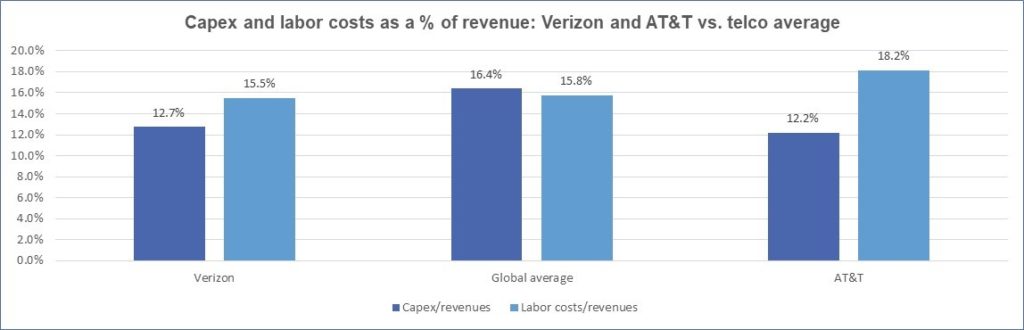
AT&T and Verizon both reported first quarter 2019 (1Q19) earnings this week. Analysts expecting a capex bump from 5G were disappointed. Capital expenditures (capex) fell at both companies on a year-over-year (YoY) basis, down 14% at AT&T and 6% at Verizon. Capital intensity at AT&T fell to what is probably an all-time low in 1Q19: capex is now 11.2% of revenues, on a 12-month annualized basis. Verizon’s 12.5% annualized capital intensity is also near its all-time low. Both telcos continue to cut headcount: their combined employees fell by over 11,000 in just three months, from December 2018 to March 2019.

Our view

AT&T and Verizon continue to hype 5G and aim to position themselves as 5G leaders – even before the network capabilities and services are really there. This is not a new phenomenon, or unique to the US.

While they want brand leadership, that doesn’t mean they want to spend as much on 5G as they can. In this environment, they prefer to spend as little as needed. Top-line revenue growth has been weak, and operating margins flat. Both telcos are spending big on acquisitions and other investments as they expand into cloud and media markets. They’re also paying down their debt. For example, AT&T’s year-end 2019 goal is net debt of $150B, from $169B currently – that requires selling assets, including office properties and a Hulu investment. Actual capex outlays on 5G-capable networks will be incurred gradually, as they can be justified. Marketing is much easier and faster to scale than network construction.

Moreover, some aspects of network construction are getting cheaper & easier. Open networking/open source solutions have matured dramatically over the last few years. Both telcos are using solutions from this community in some aspect of their 5G deployments, even if not the RAN. AT&T is more vocal; it has plans to deploy up to 60,000 “white box” cell site gateway routers across its mobile network (eventually). Earlier this month, AT&T demonstrated the UfiSpace white box (running Vyatta’s OS) at the Open Networking Summit in San Jose. Verizon is also incorporating more open source projects into its network. At both companies, the direct impact of this is small now, but white boxes as a share of telco capex will grow over time.

Even as both telcos spend cautiously on 5G, they are cutting headcount. AT&T’s total employees fell 2.2% in three months, to 262.3K. Verizon’s fall was steeper, down 3.5% from December 2018 to 139.4K employees.

Source: MTN Consulting, LLC

When telcos lay off employees – including voluntary retirement schemes – some cuts are related to mergers and “redundancies”, but most are part of a natural evolution. Operators are always in search of scale economies. Networks are more automated now, requiring fewer people to run than in the past. When operators converge business lines, fewer salespeople are needed. Both AT&T and Verizon have, like most telcos, been shrinking their workforce for many years.

Even with these cuts, they both spend much more on their staff than on capex (figure, above). This gap has remained wide for several years. Their capital spending has declined to record lows, and can’t sink much further as a percent of revenues. In order to fund a 5G uptick in capex, while also keeping debt in check, both operators will continue to slim their workforce.

-END-

Photo credit: Shutterstock.

Blog Details

AT&T and Verizon’s 4Q18 results hint at more layoffs as operators gear up for 5G

The 4Q18 results of the two US wireless biggies AT&T and Verizon suggests that headcount reduction remains a common focus. Both operators need to reduce their debt burden ahead of the 5G push.

Some highlights from their financial results:

  • Capex drops as Verizon and AT&T prioritize debt repayment: By global standards, capital intensity for AT&T and Verizon is low. Their capital intensity has been in the range of 12-14%, lower than other European telcos such as DT, Orange and Telefonica (with capex/sales of 14-16%). Capex reported by AT&T and Verizon further declined YoY by 17% and 22%, respectively, in 4Q18. Recent M&A could be a major reason for this, as the companies have increased their focus on debt repayment. AT&T’s debt ratio declined from 56% in 3Q17 to 47.7% in 4Q18; strong free cash flow generation (~$8B in 4Q18) supported this drop. On a similar note, Verizon’s debt ratio also fell from 46% in 3Q17 to 43% in 4Q18; and generated a free cash flow of $17.7B in 2018. This might also be early signs of telcos saving cash and reducing debt to prepare for 5G.
  • Unlike Verizon, AT&T shows revenue growth largely due to Time Warner acquisition: Verizon’s service revenues were flat (up just 0.1% YoY), mostly attributed to its media segment (which saw YoY revenue fall by 6%) and wireline segment (YoY revenue was down by 3.2%). However, AT&T reported strong YoY revenue growth (up 15%) in 4Q18 – primarily due to the WarnerMedia acquisition and strong growth from its wireless business. This is good news for AT&T which posted a YoY rise in revenue for the second consecutive quarter, after declining for seven straight quarters.
  • AT&T asserts its position in the media space, while Verizon chooses to focus on its core competency: Verizon continued its momentum in its mobile segment, as wireless subs saw 1.2M postpaid net adds, and wireless revenues increased 2.7% YoY. However, Verizon wants to just stick to partnerships with other companies and not own content – especially after its after its Go90 video platform debacle (which shut down in mid-2018 due to low viewership and uninspiring original video programming). On the flipside, AT&T’s entertainment segment was a huge let down, as it lost 267,000 and 403,000 subs from its DirecTV Now (streaming service) and satellite service, respectively. This was due to the phase out of its promotional pricing of DirecTV Now subscribers. Despite these setbacks, AT&T remains bullish of its streaming and entertainment business. AT&T is pinning its hopes on its ‘to be launched’ standalone streaming service, which will have content from Turner Media networks, HBO, and WarnerMedia films.
  • Verizon’s profit takes a dent as media business struggles: Facing a $4.6B write-down from its Verizon Media business (formed in 2017 post merger of Yahoo! and AOL), the group has accepted that they might have overpaid for media properties. In a Dec. 2018 8-K filing, Verizon stated that the merger of Yahoo! and AOL achieved lower-than-expected benefits. This was evident in 4Q18 results: Verizon’s net profit fell 89% YoY to $2.1B1.

A year after Trump’s tax reforms, US telecom giants continue to slash headcount

Despite receiving huge tax breaks from the ‘Tax Cuts and Jobs Act of 2017,’ the telco giants continued to slash headcount and offshore jobs. In 4Q18, AT&T and Verizon reduced headcount by 7% and 4%, respectively from 4Q17 levels.

In 4Q17, AT&T recorded a whopping $19B profit and $3B of surplus cash due to the new tax law. Publicly, AT&T announced plans to increase its network spending with an estimated capex of $25B for 2018. However, AT&T fell far short of its own estimates as it spent just $20.7B in 2018 (which was just at par with its 2017 capex). Job cuts were also on the rise. According to the 2019 Communications Workers of America (CWA) report, AT&T cut 10,700 union jobs in 2018 and planned closure of three more call centers. To date, it has closed 44 call centers resulting in 16,000 job losses.

The corporate tax overhaul also did not stop Verizon from lowering its headcount:

  • In December 2018, it announced a 7% cut of its workforce as part of its voluntary separation scheme4
  • In early 2019, the company announced plans to sack 800 staff members (of 11,400 employees) from its Verizon Media business, as it struggled to compete with advertising giants such as Google and Facebook.

These cuts come despite the company’s recent growth in operating cash flow, and reduction in deferred tax liabilities, both related at least in part to the Trump tax law. Further, like AT&T, Verizon’s 2018 capex results were disappointing, as 4Q18 capex was down by 22% YoY.

Moreover, AT&T in its latest earnings also cited its plans to increase usage of automation, artificial intelligence (AI), and other technologies to drive efficiency gains – as demand for legacy services drops. This spells more bad news for headcount levels in the telecom industry. There is lots of hype in the market about how operators are undergoing digital transformations, and how this will bring greater efficiencies and new services. The stark reality is that it also means job cuts.

1Verizon 8-K filing
2AT&T 4Q’17 results
3CWA report
4Verizon announces results of voluntary separation offer

Blog Details

Improving Africa’s connectivity: more subsea cables are a good start

Over the last two decades, submarine cables have become a key growth enabler for trade and communication between Africa and the rest of the world. Subsea cables play this role elsewhere, but the effect is newer in Africa.

With recent investments, Africa’s position has improved: stark declines in the price of international capacity have supported a surge in the volume of data consumed, generated, transmitted, cloud-hosted and processed real-time over Africa’s communication networks.

But does Africa have enough capacity?

Traffic and subscriptions have exploded; for instance, mobile broadband users in Africa reached 253 million in 2017, from 22M in 2011.  Keeping up with this growth momentum requires continual investments in international connectivity. This article explores recent submarine developments in Africa, identifies bottlenecks, and discusses how they can be addressed.

54 countries and not enough fiber to go around…yet 

With 54 countries recognized by United Nations, Africa has 38 countries with a coastline and 16 that are land-locked. The pace of regulatory liberalization, sophistication of telecom infrastructure, and geopolitical stability is quite uneven across the continent. Much of the African growth journey is confined to 10-15 countries. However, this is set to change. Africa’s boom in the construction of new submarine cables is serving as a growth catalyst for regional terrestrial fiber networks connecting multiple countries, fully or partly funded by institutions like African Development Bank (ADB) and other investors.

These investors hope improved international connectivity can create a better business climate for development, reducing prices. As an example of Africa’s challenges, consider the price of a 100G IP port. In London, it available for a monthly recurring charge of $15,000-20,000. Even in South Africa – the most affordable African destination – a 100G port costs 5X higher. This stifles business viability and compels ISPs, MNOs and MSPs to deploy Nx10G incrementally, forfeiting economies of scale.

30 operational cables serve Africa, across 4 corridors

Africa’s cables cover four connectivity corridors – Africa-Europe, Africa-Latam-US, Africa-Asia and Africa-in-region.

Out of Africa’s 38 countries with seashore, 37 countries have at least one submarine cable landing, including 30 operational, and 7 under construction. The best connected country is Egypt, which lands 15 submarine cables. It’s far more common to have just one cable landing, though. Nine African countries face this dilemma, including the Republic of Congo, Togo, Liberia, Sierra Leone, Guinea, Guinea-Bissau, Gambia, Mauritania, and Sao Tome & Principle. Figure 1 illustrates the distribution of subsea cable landing stations in Africa.

Figure 1


Source: MTN Consulting, LLC

The Djibouti hub needs improved terrestrial connectivity

While the count of 30 submarine cables is an impressive figure, most of the upstream IP connectivity is served by 9 submarine cables. One reason for this is, 13 of the 30 cables are basically passing through Africa to Europe via Djibouti and Egypt, as depicted in Figure 2 below.

Figure 2

Source: Submarine Cable Map 2017 

Most of these cables play little role in the African economy. Djibouti, despite being close to Kenya and landing 11 submarine cables, remains isolated from rest of Africa. One reason for this is lack of fiber infrastructure connecting Djibouti and Egypt to other African countries. Ethio Telecom, the incumbent in neighbouring Ethiopia, has made things worse by showing little apparent interest in expanding connectivity.

July 2018 brought good news, though: Liquid Telecom announced that it would expand its growing pan-Africa network north into Egypt, signing an MoU with Telecom Egypt to link its network from Sudan north into Telecom Egypt’s network via a new cross border interconnection. That will create a 60,000km km fiber network from Cape Town to Cairo, sometimes called the “One Africa” broadband network (see figure, below).

Figure 3

Source: Liquid Telecom

Multiple weaknesses exist in Africa’s international connectivity 

“One Africa” will improve things around Djibouti, but that’s just one of many issues. Africa’s international connectivity needs a number of other improvements:

  • more submarine cables with open access cable landing stations,
  • multi-provider terrestrial backhaul options,
  • fair-play interconnect with other submarine cable systems,
  • carrier neutral datacenters and Internet exchanges for traffic localization,
  • deployment of network automation with software controls

To sustain the continent’s growth momentum, Africa’s network operators need to address these issues over the next 3-5 years. Fortunately, they are making progress.

Africa’s cable boom is driving higher end user bandwidth requirements

Africa’s new cables are beginning to change the definition of a “high” and “low” capacity customer.

Globally, 1G is becoming the new STM1 and increasingly deployed for enterprise connectivity. 10G is the new STM4, and select markets are ready for the 100G leap (“replacing”) STM16 in 2019-20. While Africa is a year or two behind, outside South Africa, the pace of transformation is set to accelerate in 2019-20. That is evident from recently 100G network upgrades undertaken by Liquid Telecom, SEACOM, EASSy and MainOne. Also, AAE1 announced it would upgrade to 200G last month. This comes just 18 months after the cable was ready for service (RFS), and 2 years ahead of schedule. (Figure 4)

Figure 4

Source: AAE1

Webscale network operators are now big in submarine; is South Africa the next stop?

The global submarine cable market is transforming rapidly due to participation from Google, Facebook, Amazon and Microsoft. Put together this group has already invested in 21 submarine cables globally, the majority in 2015-20 period. The only regions where they are yet to invest in submarine cables is the Asia-Europe corridor, Middle East and Africa. These companies are laying the groundwork, though:

  • Microsoft and Amazon have edge network nodes in South Africa and work is underway for cloud datacenters with Teraco to be operational by mid-2019.
  • Google and Microsoft have conducted multiple pilot projects across Africa in the last 3 years to bring affordable Internet to underserved regions.
  • Facebook and Amazon are reportedly scouting for partners for submarine cable builds and announcements are expected in early 2019.

Given their long term plans, it’s likely that the deep pocketed webscale players will soon start to expand their massive hyperscale networks (including new submarine cables) in South Africa in 2019-20. These new cables will have a far-reaching impact on the continent, especially when combined with the terrestrial reach of the One Africa network.

One challenge is that, even if a new cable project is announced and funded in 2019, it would not likely be operational before 2022. The webscale operators are likely to engage in a number of partnerships to meet their capacity needs in the interim. For instance, they may consider linkups with Liquid, MTN, and Orange for west Africa, and SEACOM or EASSy for east Africa.

Complimenting submarine cables with terrestrial networks and datacenters

Submarine cables alone cannot alleviate Africa’s connectivity challenges. They have to be complimented with multi-provider terrestrial fiber networks with cross-border alliances to make regional connectivity “affordable” – where a reasonable target is 1G links priced below $5000 per month, and declining by 15% per year.

Along the western coast of southern Africa, Angola, Nigeria, Ghana, Ivory Coast and Morocco have multiple providers developing terrestrial fiber networks, but cautiously with limited reach. Pricing remains high, inhibiting deployment of 1G and 10G links.

The situation is better on the eastern side of southern Africa, including South Africa, Mozambique, Tanzania, Kenya, Uganda, Zimbabwe and Zambia: multiple regional providers are developing fiber footprints with increasing capillarity. Liquid Telecom, Simbanet, WIOCC and SEACOM lead the market. The capacity pricing is competitive, low enough to trigger widespread usage of 1G and 10G links for the largest mobile network operators. By 2022, the entry of cloud and content provider-sponsored cable projects will trigger steeper price declines and stimulate demand.

Africa also needs datacenters that are truly carrier-neutral, and not selective about their neutrality. Developments in this area include:

  • Teraco in South Africa has datacenters in Johannesburg, Cape Town and Durban, and is at the forefront of the carrier-neutral space. That makes it an attractive acquisition target for a company like Equinix to jumpstart its Africa presence.
  • First generation datacenters, supposedly carrier neutral, are also operational in Kenya and Nigeria, with Tanzania, Uganda, Ghana and Ivory Coast lined up for 2019.
  • A new breed of focused datacenter providers like Rack Center, Rack Africa and Djibouti Data Center (DDC) are gaining traction. Their facilities, though, may need to be retrofitted to support technical requirements of the big webscale players.

Kenya and Nigeria poised for big changes in 2019-20

For connected-Africa to be a reality, the playground of new submarine cables, terrestrial networks and datacenters must move beyond South Africa. The two countries set to gain prominence in 2019-20 are Kenya and Nigeria. Both countries land 6 submarine cables each, but differ significantly in terms of cross-border terrestrial fiber connectivity.

Figure 5

Source: https://ian.macky.net/pat/map/afri/afriblu2.gif

Kenya has a distinct lead with robust regional connectivity to Uganda, Tanzania and Rwanda through Liquid Telecom and Simbanet. That is being extended to Malawi, South Sudan, Ethiopia and Djibouti. WIOCC and SEACOM have also created terrestrial routes mirroring their subsea routes to provide connectivity to land locked countries. The provider oligopoly however keeps the market price of 1G and 10G links intimidatingly high.

Nigeria is lagging with respect to regional fiber connectivity. That’s despite the fact that Nigerian operators MainOne and Glo-1 own and operate private submarine cables from Nigeria to Portugal and the UK respectively. MainOne has pursued expansion through Camtel and Orange into Cameroon, Cote D’Ivoire and Senegal. Adding that to its existing links in to Nigeria and Ghana, along with cross-border fiber connectivity to 5 adjoining countries, gives MainOne a regional network spanning 10 countries. For its part, Glo1 operates only in Nigeria and Ghana; its recent focus was developing the Glo2 project, a domestic extension to address the Oil & Gas segment.

Webscale the big open question

Africa has made lots of strides in its international fiber connectivity over the last few years, but has far to go. Impending entry by the globe’s big webscale operators is likely to have a big impact on many markets by 2022, and the effect will filter across Africa in the years after. Between now and then, a lot will happen. One thing to watch is how webscale operators link up with regional telcos and carrier-neutral providers to accelerate their network expansion. Such partnerships happen in other regions too, but Africa will require more of them.

Cover image: Cape Town, South Africa (credit: Dan Grinwis)