
Blog Details

Early Telco Reporters Verizon & Rogers Provide Mixed Signals For Vendors

The first sizable telcos reported 3Q17 earnings this morning: Verizon and Rogers. Both can point to reassuring bottom line results. For the 9 months ended September, operating & net margins improved year-over-year, as did earnings per share. Rogers’ EPS through September was C$2.66, up 24% YoY, while Verizon’s $2.80 EPS for the same period was up 32% YoY. The results contain some negatives, too; some company-specific, but some illustrative of broader market challenges.

Wireless not always a growth driver

Rogers was an early mover in Canada’s LTE market, and continues to grow its postpaid subscriber base: 8.8M in September 2017, up 3.3% from 3Q16. That 8.8M amounts to roughly 25% of Canada’s population. Wireless revenue growth this year has averaged 5% YoY. The company’s operating margins are reliably in the 40-50% range; in 3Q17, the figure of 47.9% was up a bit from 47.1% in 3Q16. What helps keep the margins high are stable ARPUs and fairly low churn. Rogers’ blended (postpaid + prepaid) wireless ARPU for the year so far is C$61.94, up just under 3% from the 2016 period. Churn in retail postpaid is 1.11% so far this year, down a bit from 1.19% YoY.

Verizon, also a first mover in the US’ LTE market, retains high operating margins in its wireless division: 46.2% for 3Q17, from 44.9% in 3Q16. However, core service revenues are falling: $47.2B in wireless service revenues for 1-3Q17, down 6% YoY. Total wireless division revenues also fell, by a more modest 3.1%. The difference is equipment. Verizon regularly charges more in “cost of equipment” than it books in equipment revenues; that’s not changing. However, Verizon closed the gap significantly in 2017. The implicit loss (or subsidy) from its wireless device sales was $2.4B YTD17, down from $3.1B in 1-3Q16. This narrowing may not be sustainable. New device releases and sales/distribution strategies can often lead to spikes in equipment subsidies.

On the plus side, nearly 95% of Verizon’s subscribers are on smartphones (from 93% a year ago). Churn also remains low at Verizon: for the high value retail postpaid segment, Verizon’s churn was 1.02% so far this year, essentially unchanged from the 0.98% in 1-3Q16.

Cord cutters and OTT

Wireline accounts for about 30% of revenues at Verizon, and 25% at Rogers (over a cable network). Like most big incumbents with fixed access networks (PSTN or cable TV), both offer video platforms combining voice, data & video over an operator-provided CPE. To do this, they’ve invested heavily in network upgrades, workforce training, and sales & marketing over the last 5+ years.

Despite this investment and overall subscriber growth, both operators are reporting net losses in video/TV subscribers. Consumers have far more OTT video options now. Performance over mobile networks often isn’t good (or economical) enough for heavy video users. The incentive to keep your telco/cable-provided Internet service but cancel video is growing stronger.

Rogers’ reported sub losses have been ongoing; its TV subscribers are now 1.75M, down 4% from the prior year. This was worsened due to Rogers’ growing pains with platform development. It spent nearly half a billion C$ trying to develop a proprietary IPTV platform, similar to BCE’s “Fibe TV” platform, before having to write it off. It’s changed strategy, and will now license the Comcast-developed X1 platform.

Verizon’s had more luck with its custom FiOS box. However, it also lost video subscribers in 3Q17. Overall net adds for FiOS in 3Q17 were 59,000: +66K for Internet, +11K for voice, and -18K for video. Margins remain low in wireline, despite some YoY improvement; EBITDA/revenues so far this year in wireline is 21.2% from 17.1% in 1-3Q16. Further, to sustain its wireline business Verizon’s capital spending is higher as a % of revenues: 14.6% so far this year, from 10.9% YTD16.

Overall revenue trends point to caution

The figure below shows recent YoY revenue trends for the two operators. Rogers’ trend is relatively steady; its early lead in LTE and market-leading broadband position has helped with this consistency. The growth rate is just 2-4% per year though.

Verizon’s growth has been negative until recently, held back by weak mobile service revenues. A modest improvement helped push Verizon’s YoY growth to Rogers’ level in 3Q17, +2.5%. Another factor benefiting Verizon’s measured growth recovery is mobile device equipment revenues, up 5.4% so far this year, to 13.5% of corporate revenues.

rogersvz-mtnconsulting2

Even with slow top-line growth, both Rogers & Verizon generate healthy free cash flow in typical quarters, including $3B for Verizon in 3Q17 and C$372M for Rogers in the same period. They have high debt typical of telcos, but interest costs are on the low end.

Verizon capex 13-14% of revenues, selective M&A activity likely to continue

On the capex front, Verizon is big but not hard to predict: its annualized capital intensity has been in the narrow 13-14% of revenues range for several years now. Variations in the past have come from quick buildouts to gain market position. As Verizon and other telcos move to more software-centric networks, these variations will be less common and less extreme. It’s unlikely that we’ll see Verizon’s capital intensity rise above the 15% mark anytime soon. For 4Q17, Verizon will likely spend about the same as 4Q16, plus maybe 1-2%.

Verizon’s capex is constrained not just by revenue growth & software-based expansion, but also the need to reserve capital for spectrum and acquisitions. Earlier this year, Verizon purchased Straight Path and its spectrum holdings for $3.1B; in early 2015, Verizon spent $9.9B for AWS-3 spectrum in FCC auctions. On the company’s balance sheet, in fact, the value of spectrum assets (“wireless licenses”) is now slightly higher than net property, plant & equipment (PP&E, net): $88B v. $87B.

And Verizon has a healthy track record of acquisitions. That includes a recent deal to purchase fiber optic assets in Chicago from WOW. That deal was just $225M and for one metro area, but it’s a reminder that Verizon and other deep-pocketed telcos are constantly considering build v. buy alternatives. That’s more the case now, as a sector of neutral network operators (NNO) has matured.

rogersvz-mtnconsulting1

Rogers’ capex levels are looking up

As part of its 3Q17 earnings release, Rogers added C$100M to its 2017 target capex (now C$2.35B-C$2.45B). That modest change is, Rogers says, due to “strong growth in our wireless segment and the intended investment of those incremental profits to further enhance the quality of our networks”.

Even with that, Rogers’ full year 2017 capex/revenues is likely to settle around 16%, low by its historic standards. That’s down, in small part, because of a slowdown in its “NextBox” service while a new platform is being developed: Rogers is set to launch its white label partnership with Comcast sometime in 2018. An X1 success would mean more capex at Rogers. Comcast and it supplier partners, though, may be the main beneficiaries of this growth. At least initially. If the platform takes off and helps reverse Rogers’ video sub declines – and lift ARPUs – you can expect more investment in the core of the network to keep the cord cutters at bay.

(Photo credit: Bernd Schulz)

Blog Details

Decades-Long Copper Retirement Process Is Just Starting For Verizon And AT&T

Incumbent telcos in markets like the US have built their networks gradually, over many decades. In the access plant, the trend towards more fiber began in the 1990s – but applications, products, and overall economics have come together just in the last several years. The speed of fiber deployment varies by operator; it’s driven by the company’s overall broadband strategy, but constrained by financial and accounting issues. Despite the apparent rush to fiber, we have several more decades before big telcos get rid of all their copper cables.

Fiber getting some good press

Recent disasters have highlighted the reliability advantages of fiber, beyond its (cost per) bandwidth benefits. The US Federal Communications Commission (FCC) Chairman Ajit Pai noted recently that the effects of recent hurricanes on Puerto Rico’s cell network were far worse than Houston. The reason, Pai argued, was that most of Houston’s cell backhaul is done on fiber (versus copper in PR), and buried fiber is far more resilient to water damage than copper cables. Houston also made out well versus the big 2005 hurricane, Katrina. The FCC estimated only about 300 of the 7,804 cell sites in Harvey’s path went down during Harvey, from over 1,000 sites during Katrina.

This is a new twist on the safety debate. In the past, the debate has focused more on the fact that fiber-based broadband services (such as Verizon’s FiOS) require a battery backup to ensure emergency operations .

Despite Chairman Pai’s praise of fiber, incumbent telcos still face a myriad of rules relating to fiber deployment – especially if a retirement of copper-based service is involved. The rules aim at protecting consumers who rely on the network, and other operators who interconnect with the incumbent. Public notice of any planned retirements is required. That’s why we’re hearing more about copper phase-outs lately, mainly from Verizon, AT&T and CenturyLink. The topic is also coming up in the FCC’s 2017 Wireline Infrastructure NOPR.

Actual change is far slower than the news flow

Look a bit closer, and the headlines are less impressive.

Verizon, for instance, announced copper retirements in eight states last month. The states include some of Verizon’s largest incumbent operations, including New York, Pennsylvania, and New Jersey. However, they are not statewide shutdowns. They’re for “select towns and cities” in these eight states. The process is typically done by individual central office, or “wire center”. One example: Verizon plans to retire all copper terminated at the “FKLNMAMC” wire center in Franklin, Massachusetts by August 2018. This is a tactical process that’s planned very carefully.

These retirements are important, as they symbolize a transition to all-IP, all-fiber networking that telcos have been working towards for many years. But they are piecemeal, given Verizon’s scale. The company had $46B of cables, poles, and conduit on its balance sheet last year; the copper parts of this are not disappearing overnight. All else equal, copper retirements are first targeting wire centers with lots of enterprise customers, and denser residential neighborhoods with above average disposable incomes – both areas where there is likely to be competition to protect against.

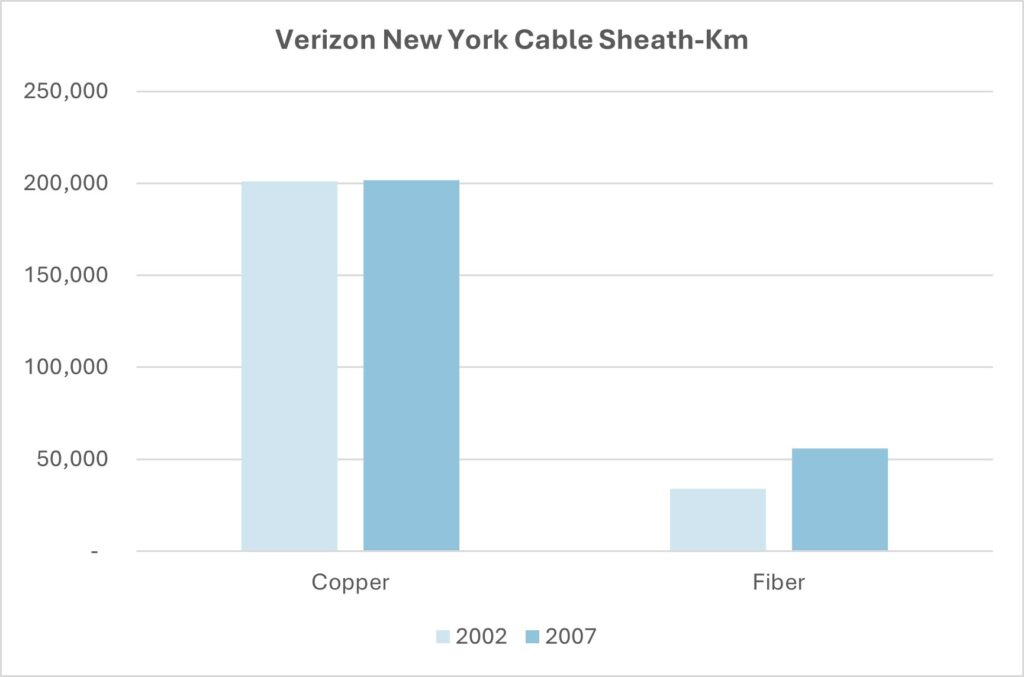
Very little new copper is being deployed, but Verizon and other incumbents are eager to leverage what’s installed. In the case of Verizon’s New York operations, the figure below illustrates how vast that (copper) base is.

Source: FCC Report 43-07, the ARMIS Infrastructure Report (2007 & 2002)


More flexibility, please

The current regulatory climate in Washington, DC is favorable to incumbent telcos, i.e. those running fixed networks with universal service obligations. Their views on net neutrality debates are now in favor at the FCC. Mergers & acquisitions are welcomed by the Trump administration’s Federal Trade Commission (FTC). The smart regulatory lawyers working for telcos are trying to use this favorable climate to their advantage.

Relatedly, copper retirement filings have ticked up at the FCC lately, from a range of incumbents. As part of this, incumbents are requesting more flexibility, especially in reporting requirements: shorter lead time, fewer details disclosed, etc. Based on the current climate, they might get what they want at the FCC. And at the state level, incumbents tend to be even more tightly knit to regulators, which will come in handy during retirement-related debates.

Competitive carriers should be concerned. Google’s investment in fiber, and its failure to scale, reminds us how hard it is to overbuild – which is the only option once the copper is gone.

Blog Details

India’s RCom Under Pressure After Its Failed Merger With Aircel

Reliance Communications’ (RCom) long-planned merger with Aircel, part of Maxis, fell apart last week in the face of legal and regulatory hurdles. This news comes as multiple operators in India are struggling with debt and declining margins.

Both RCom and Aircel face debt issues and declining revenues

The primary reason behind the planned RCom-Aircel merger was to consolidate and reduce losses. The combined entity would have become India’s fourth largest in terms of subscriber base, and the scale would have (hopefully) enabled both to better manage their debt. RCom’s total debt is roughly INR470B, while Aircel’s is INR200B. Both are also facing revenue declines; in 1Q17, for instance, RCom’s revenues fell by 24% QoQ , while Aircel’s QoQ drop was far worse at 47%.

The merger’s failure opens up a debate on the survival of India’s weaker operators, burdened with debt and some on the verge of insolvency.

Grim industry outlook

Many of India’s operators today are in dire straits, facing high competition and coping with high levels of financial stress. In addition to RCom and Aircel, Tata Teleservices (TTSL), for instance, has a debt burden of INR340B, and is considering exiting the business.

Given the large number of players in the market and the high capital investment needed to compete, more consolidation was always in the cards. Earlier this year, Airtel acquired the India operations of Telenor and its over 40M subscribers, for instance. Vodafone India’s pending merger with Idea Cellular is likely to be completed in 2018, producing a combined entity with ~400 million customers. Vodafone hopes for “substantial cost and capex synergies” from the merger.

After these big deals, the remaining players have fewer options to revive their business. Without a good M&A option, selling assets to raise cash is one option being explored. Spectrum sales may come in handy, but it’s a buyer’s market. In the event of a failure to sustain their business, an operator can be compelled to surrender spectrum (one possible outcome facing TTSL).

Uncertain future for RCom and Aircel

The future for Aircel and RCom looks bleak, as competition is heating up. Most Indian operators are facing the heat of Jio’s September 2016 nationwide launch. Jio’s aggressive pricing, though, has been especially difficult for RCom and Aircel to replicate.

RCom desperately wanted this merger as it was vital for its debt reduction efforts. The merger would have resulted in a combined entity with an asset base of close to INR650B (US$10B) and a net worth of INR350B. This greater scale would have allowed faster debt repayments and a 40% overall debt reduction for RCom by the end of 2017. Moreover, tower companies are pressuring RCom to pay back dues on its tower rental contracts. RCom has to pay American Tower Company and Bharti Infratel about INR200-250M each; and about INR95M to GTL Infra (including its unit CNIL).

RCom had plans for selling the towers of the combined RCom-Aircel entity to Brookfield Asset Management to clear a significant portion of its debt. But with the merger now being called off, the tower deal will have to be reassessed. Brookfield had apparently wanted to buy the combined tower base for up to INR110B. RCom is still hopeful about reviving its business by deploying 4G services, via a spectrum agreement with Jio. It also hopes to monetize its 2G and 3G spectrum and sell some real estate assets. But RCom has a long way to go in growing and sustaining its subscriber base in a highly disruptive mobile market.

Can Jio bailout RCom from this crisis?

Despite Mukesh Ambani, founder of Jio, and Anil Ambani, owner of RCom, denying all rumors surrounding a possible merger, it would not be a surprise if it happens.

In early 2016, the companies entered into a spectrum sharing deal, where RCom sold its spectrum in nine circles to Jio and approved spectrum sharing in another 17 circles; fiber sharing was also involved. By most accounts, the deal was a success for Jio, as it enabled a quick national launch. The deal has brought fewer benefits to RCom, which is now incurring losses and running out of funds for network expansion.

RCom might also be considering a bail out option. In June 2017, RCOM requested government support (through an “inter-ministerial group”) to withdraw the 10% cross holding restriction. This rule states that operators are not authorized to own more than 10% equity in two different operators in the same circle, thus hinting at a possible sale of its equity to operators. Considering its past association with RCom, Jio seems the most likely other operator to buy equity in RCom. And if such a deal takes place, it will provide Jio with greater access to RCom’s towers, fiber and spectrum. Only time can answer if Mukesh Ambani will come to his brother’s aid in bailing him out from this crisis.

(Photo credit: Pablo Garcia Saldana)

Blog Details

China Mobile To Go (More) Global?

Buying opportunities

During the 2008-9 financial crisis, some wondered (including me) if the relatively flush Chinese operators would use the downturn as a buying opportunity into overseas telco markets. China Mobile seemed promising, given its (now even higher) cash reserve. CM did make a small move before the crash, when in 2007 it bought into Pakistan’s mobile market.

What’s actually happened in the last decade was, not much.

China Mobile has continued to invest in Pakistan, helping its “Zong” unit become the third-ranked player in the market. This year, roughly $200M of China Mobile’s 2017 capex will support Zong, to expand 3G/4G coverage. That’s less than 1% of CM’s projected capex of 176B RMB for this year, though. Overseas growth simply hasn’t been a priority for CM or its main rivals, given the size and growth rate of the domestic market.

State ownership implications

Chinese government entities retain majority control over each of the big 3 telcos. There’s nothing nefarious about this; it used to be common in most of Europe, and still pops up in a handful of other large countries. But it does clearly color investment priorities.

That’s certainly been the case in China. The government has been aggressive in using its ownership stakes, not just regulations, to manage the sector. China Mobile’s choice to invest in Pakistan in 2007, as opposed to say its neighbor to the east, was part of a larger strategy. That’s now culminated in the China Pakistan Economic Corridor.

Bailing out Oi?

With that, one recent story is interesting.

China Daily reported last week that China Mobile might be buying Oi (once known as Telemar), a Brazilian operator plagued by debt issues and undergoing restructuring.

Assuming it’s true, CM’s primary motivation would be ROI (return on investment). However. The China Development Bank would also be involved, per the story. CDB has been an active overseas lender in the telecom sector for many years (in Africa, for instance). It’s also active in Latin American telecom, partly through a $1B 2009 loan to America Movil. CDB has more of a political role than China’s other banks.

CDB lending is typically tied to some commitment to rely heavily on Chinese technology, and/or Chinese labor. As such, a CM/CDB-led acquisition/bailout of Oi will benefit Chinese tech vendors, all else equal. Ericsson, Nokia, Cisco and others active in Brazil will have to watch this very closely.

The bigger question is, will CM start to spend more of its cash stockpile overseas? It has 5B RMB in debt, true, but in the first six months of 2017 its free cash flow was 53B RMB, over 10 times that. Its cash and cash equivalents balance in June was 406B RMB, around US$61B. That’s plenty of buffer to expand, especially with support from the China Development Bank.

Blog Details

Cloud R&D And Network Investment

A little accounting background: To expense or capitalize R&D

There’s an ongoing debate in accounting circles (yes, they argue) about whether R&D spending should be expensed or capitalized.

Under US GAAP, R&D is expensed. Another set of reporting standards, IFRS, require development-related spending to be capitalized. Once an internal project has met certain criteria, mostly related to technical feasibility, capex rules apply. For instance: let’s say Tencent spends $1M researching new data center cooling systems, all for basic research – no actual design or prototyping. That spending shows up in opex under IFRS. If Tencent then spends another $1M on a small-scale trial based on its research, IFRS says this spending is capitalized. Digital Marketing Agency

Most cloud providers report in US GAAP, but not all. And some that do report US GAAP results, report non-GAAP (e.g. IFRS) results for comparison sake. That may just be to pretty up earnings, in some cases, but there’s also sound reason to push some R&D into capex. If you want companies to spend more R&D, in general, you would let them pay for it over time. Fluctuations in capex are much easier to deal with than operating expenses.

Selling tech to cloud providers

Vendors of all stripes, including those from the telecom world, are eager to sell to cloud providers. They have enormous technology budgets. Much of that is internal, but the external spend share has been climbing due to network investments. In the cloud space there is a fairly direct link between internal R&D and (mostly external) capex.

For telecom service providers (aka telcos), there is also a link. But few telcos have big R&D budgets to rely upon. There are notable exceptions to this, such as NTT, Verizon, AT&T, Telefonica, China Mobile, China Telecom, China Unicom, etc.). But they’re exceptions. Even NTT’s R&D spend is just over 2% of opex, and this is high for a telco. In the cloud space, Priceline –  a travel website with a small cloud – also spends about 2% of opex on R&D. The average spend in cloud is well over 10% of opex, and has been rising.

Moreover, telco R&D spending is weighted towards the “R” part of “R&D”. They tend to lean heavily on vendors for products that are already fully developed.

The R&D-capex link

The chart below hints at why it’s worth watching R&D budgets carefully, if you’re trying to sell tech to a cloud player.

mtnconsulting employee-rd.png

Higher levels of R&D spend, as a share of total opex, suggest higher capex levels on a per-employee basis.

This is just correlation, not causation. But much R&D spend (even when expensed) spills over directly into capex. The lag depends on the project. Some cloud provider R&D is focused on practical near-term issues, such as server design. Artificial intelligence R&D has a longer time horizon.

The cases of Facebook & Microsoft

In many ways Facebook is a standout, even outlier (as in the figure above, top right bubble). Its R&D spend is no exception. Facebook spent 46% of its 2016 opex on R&D, the highest among large cloud players (it was 36% in 2012). The company spends big on product development, innovates quickly, and has high labor costs. It also recorded the highest capital expenditures (capex) per employee in our group, at over $250,000 per employee. And this is nothing new; Facebook’s capex has been high since the start, averaging a telco-level 16% of revenues since 2006.

Microsoft makes for an interesting comparison. This is an older, more established company than Facebook – a tanker in the ocean, which takes some time to change directions. On an absolute level, Microsoft’s total capex last year ($9.1B) was more than double Facebook’s, but Microsoft spends far less capex per employee (about 30%). Given Microsoft’s legacy, though, its cloud commitment has been serious: capex per employee at Microsoft was just over $30K in 2012, it is now just under $80K. On a per revenue basis, capex also rose, from 4% capital intensity in 2012 to 10.6% in 2016. During this growth, Microsoft’s R&D spend was a steady ~20% of opex on R&D. Its R&D emphasis has shifted to cloud though; now, one of three stated R&D goals is to “build the intelligent cloud platform” (June 2017 10K).

Cloud employees don’t work cheap

R&D is conducted by people, still (sorry AI fans), and they require competitive salaries. In the cloud sector, R&D employees tend to be highly skilled and expensive. Apple is a standout in our database. In CY2016 its operating expense per employee (ex-D&A) worked out to just under $1.2 million. Facebook, Alphabet, and Twitter – other household names in pricey Silicon Valley – also recorded high opex, in the $700-900K per employee in CY16. At the other end of the spectrum is Cognizant, an India-based IT services vendor with its own cloud; its annual opex per employee was just over $40K last year.

Capex always includes a healthy share of labor costs, across sectors; telco and cloud are no exception. In a given sector, though, the amount of labor in capex can vary dramatically by company. Labor might be just 20% of total capex for a cloud provider based in Asia, but over 50% for one based in Silicon Valley. If you track capex, then, being able to assess the relative contribution of internal labor costs is important.

More to come on this topic soon.