Blog Details

Cell tower companies pondering what to be when they grow up

Cellnex steps into fiber and data center infrastructure through new joint venture with DT

Europe’s largest cell tower specialist, Cellnex, is creating a joint venture with DT in the Netherlands for the two parties’ tower assets. DT’s contribution is its 3,150 Dutch towers while Cellnex adds another 984. The combined entity will be known as Cellnex Netherlands BV, or Cellnex NL. T-Mobile Netherlands will have access to Cellnex NL’s sites through a long-term lease-back arrangement.

Small deal with a twist

This is a small deal, relative to Cellnex’s size. Cellnex ended 3Q20 with 50,185 tower sites under its management, and is in the process of acquiring 24,500 European towers from CK Hutchison. However, there is a twist that makes the deal more significant. Cellnex and DT are also creating a new, independently managed fund called “Digital Infrastructure Vehicle” (DIV), whose aim is to invest in fiber networks, cell towers, and data centers across Europe.

DIV’s initial owners are Cellnex and DT, with exact ownership stakes unclear from public reports. DIV will be led by the DT side: Vicente Vento, co-founder of Deutsche Telekom Capital Partners. DIV is likely to pursue third party investments to help it grow, most likely through acquisition of existing properties across Europe. DT’s CEO Tim Hottges says that DIV’s goal is to “identify and promote exceptional digital infrastructure projects in partnership with Europe’s leading telecommunications group and the leading tower company”, and that is has an existing pipeline of projects under consideration.

Cellnex deal raises business model questions

At MTN Consulting, we classify Cellnex as a carrier-neutral network operator (CNNO), specialized in owning and selling access to network assets on a neutral basis to multiple service providers. Most CNNOs specialize in either towers, fiber, or data center assets. However, over the years there has been some blending across the infrastructure types, especially towers and fiber. Most of that has been via acquisition, as for example Crown Castle’s $7.1B acquisition of Lightower in 2017. Tower companies have also been branching into small cell development through organic investments, and building fiber out to the small cell and between their tower assets. Some data center specialists have also invested in high-capacity fiber routes linking their facilities, for instance Equinix.

The Cellnex deal with DT raises questions about what extent CNNOs should own assets across the tower/fiber/data center boundaries. The traditional CNNO business model is to function similar to a real estate holding company. CNNOs spend most of their capex on property investments, not network equipment. They generally function as wholesalers of simple network services (e.g. space on a tower, a colocation cage, dark fiber) to other providers who have their own end user customer base. Telcos are going through massive adjustments, though, looking to raise cash and simplify their own business models. That may involve spinning off more of their passive network assets, and also creating investment vehicles like DIV to attempt to profit from the growth of this adjacent market.

Our forecast for CNNO expansion: capex and M&A equally important

As explained in our recently published network operator capex forecast, MTN Consulting expects the CNNO sector to grow its asset base over the next several years as it has historically: through a blend of high capex and acquisition of both small existing CNNOs and assets from other sectors.

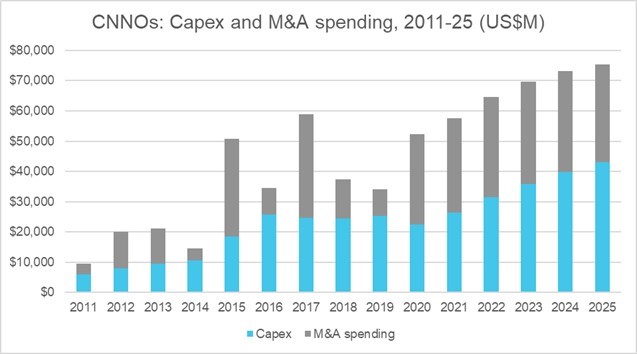
Over the 2011-19 period, CNNO capex totaled $152.9B, while M&A spend was $127.7B. For the 2019-25 period, we expect capex to again outpace M&A but not by much: 2020-25 capex is projected to total $199B, with M&A spend amounting to $194B (figure, below). 
CNNO capex

Source: MTN Consulting

We expect capital intensity to come in at the relatively low rate of 30% in 2020, rising gradually to 40% by 2025 as CNNOs find fewer big M&A opportunities for expansion. M&A starts out high (40% of revenues in 2020) and scales back gradually to 30% of revenues by 2025. In reality, both data series will be much choppier this, especially M&A because of the nature of big deals.

As a result of all this investment, we expect the asset base of all segments within CNNO to grow considerably: 

  • Data centers: From 635 data centers and approximately 56 million net rentable square feet in 2019, the DC segment will reach 727 data centers and 73.3M NRSF by 2025. Historically the average NRSF per data center has been declining but we expect this to reverse as CNNOs invest in higher power, larger footprint designs leveraging some of the efficiencies gained by the webscale sector. NRSF per facility was 88K in 2019, but is likely to grow to 101K by 2025.
  • Towers: In 2019, there were roughly 2.5M towers within this segment, of which just under 2 million (or 80% of total) were managed by a single company, China Tower. We expect the tower segment to reach 3.1M total towers by 2025, and China’s share to decline slightly to 78%. The average global tenancy ratio will rise incrementally, from 1.62 in 2019 to 1.68 in 2025. That’s driven by tenancy improvements in China, primarily, which currently has a lower tenancy rate than seen elsewhere.
  • Fiber/bandwidth: measured in fiber route miles, the footprint of this segment more than tripled between 2011 and 2019, reaching 553K. By 2025, we expect fiber route mileage for this sector to grow to just under 880K.

The Cellnex-DT deal makes clear that some CNNOs are eager to own assets across these three segments. 

American Tower’s acquisition of Telefonica-linked tower business reinforces tower specialization

 Specializing in just one type of infrastructure will continue to be preferred by a number of large CNNOs.

On January 13, a week before the Cellnex-DT deal, Telefonica announced a sale of most of its tower infrastructure to American Tower, for 7.7 billion Euros, in cash. Specifically, AT is acquiring the Latin American and European tower assets held by Telxius, an arms-length infrastructure affiliate of Telefonica. Telxius is 50.01% owned by Telefonica, 40% by KKR (a private equity group), and 9.99% by Pontegadea, the personal investment vehicle of founder of the Zara fashion group, Amancio Ortega. Notably, American Tower is not acquiring the submarine assets also owned by Telxius, for which Telefonica is seeking a separate buyer.

Cellnex was apparently in the running to acquire the Telefonica assets, but got outbid by American Tower. That may be a blessing in disguise considering Cellnex is already in the process of acquiring 24,500 towers from CK Hutchison in Europe.

Despite the name, American Tower is already a global provider. As of 3Q20, only 41,000 of its 181,000 wireless properties were in the US market. However, Europe only accounted for 3% of AT properties; the Telxius deal will raise that significantly, and help position AT as a rival to Cellnex, at least in Spain and Germany. AT already has a big Latin American presence, with over 40,000 towers there at 3Q20’s end. In total, AT is acquiring 30,722 towers from Telxius, adding over 17% to AT’s global tower count.

Cellnex’s new infrastructure JV with DT, the Digital Infrastructure Vehicle (DIV), represents a tower CNNO venturing into fiber and data centers, albeit indirectly. American Tower’s acquisition of Telxius towers represents a more traditional deal: a tower specialist getting bigger, expanding its share of multiple geographic markets. American Tower does have some fiber assets but in general the company has avoided expansion into other types of infrastructure.

AT’s preference has some support in the investment community. Elliot Management lobbied last summer against Crown Castle’s choice to spend so heavily on its fiber business, for instance. Similarly, a well known financial analyst in the tower space, Jonathan Lawrence with Pinpoint Capital Advisors, recently argued that “You don’t want to detract from your core tower business. New business offerings such as fiber or data centers, where we have started to see tower companies invest, take significant expertise and resources to manage effectively.”

MTN Consulting expects there to be more than one approach to this issue. There are some clear synergies to owning both towers and fiber assets, or data centers and fiber. The assets have to be priced right to make entry into the adjacent market worthwhile, first and foremost, as the CNNO market is a relatively low margin business. 

Telco turmoil creates opportunities for CNNOs to grow

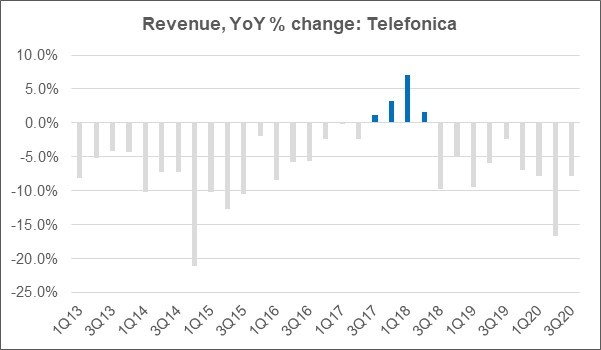
From the telco side, Telefonica’s decision to sell Telxius assets reflects the parent company’s ongoing financial challenges. A weak top line is the starting point: Telefonica’s revenues have been on the decline since 2018 (figure, below).
telefonica revenue1

Source: MTN Consulting

Telefonica ended 3Q20 with 52.5 Billion Euros in debt (financial liabilities), with only 5.9B of cash on hand. The fact that the 7.7B Euro deal with AT is all-cash is a big plus for the company. It may also help Telefonica justify a more liberal capex budget as it continues with 5G buildouts and participates in 5G-related spectrum auctions this year, including in the UK. For the first 9 months of 2020, Telefonica spent 4.1B on capex (excluding spectrum), from 5.2B in the same period in 2019.

It’s notable that Telefonica is among the most aggressive telcos in its embrace of open RAN and open networking in general. Telefonica has also been especially active in its collaboration with the webscale sector, establishing cloud partnerships with GCP (2020; 5G mobile edge computing), Azure (2019; service design), and AWS (2018; digital transformation). Eagerness to work with webscale operators and an open approach to network disaggregation are hallmarks of the more capex-constrained telcos.

Blog Details

Rocky path ahead for China Tower as it looks to go public

Mobile tower infrastructure provider China Tower has won approval in Hong Kong for an IPO in what bodes to be the largest IPO in Hong Kong since 2010. Speculation is rife that the IPO could raise up to $10 billion for China Tower. That’s over twice the IPO of Chinese device maker Xiaomi which raised about $4.7 billion in its Hong Kong debut.

Background

China Tower was established in 2015 as part of a government-mandated spin-off exercise. Following transfer of the ownership of the nation’s “Big Three” operators’ tower infrastructure, China Tower was valued then at US$36 billion. Each of China’s major mobile network operators (MNOs) now own a stake in China Tower and get quarterly dividends from their ownership stake in China Tower. The shareholding structure post the deal completion was as follows: China Mobile (38%), China Unicom (28.1%), China Telecom (27.9%) and China Reform Corporation (6%).

The government’s primary motive in creating China Tower was to bring greater efficiency into the sector, freeing up capital for the telcos to make higher value investments. Another key goal is to encourage China Tower to diversify into new service areas & end user markets.

China Tower’s stellar 2017 faces challenges in 2018 as leasing rates decline  

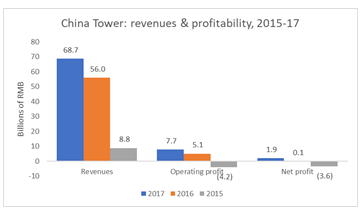
China Tower is the largest tower infrastructure provider worldwide, with a portfolio of 1.9 million towers and 2.7 million tenants. Further, China Tower is buoyant as 4G remains a strong impetus behind mobile data consumption. This trend is reflected in its 2017 results (see Figure 1) as it recorded an operating margin of 11.2% compared to 9.1% in 2016; and its revenues were up 23% reaching CNY68.7 billion ($10.6 billion).

Figure 1

Source: China Tower’s IPO filing

Despite the strong 2017 results, China Tower has some risks on the horizon.

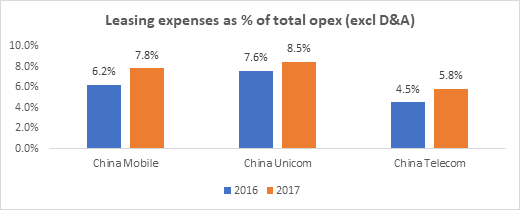
China’s three main telecom network operators (TNOs) have shared infrastructure-related costs for several years through a joint network sharing agreement. The goal was to cut redundant cost towards construction of towers. This agreement predated the creation of China Tower as an independent entity. In the last year, however, China’s operators have faced rising leasing costs. China Mobile and China Telecom’s tower leasing expenses as a percentage of total opex (excl D&A) were 7.8% and 5.8% in 2017, for instance, up from 6.2% and 4.5% in 2016. China Unicom’s tower leasing expenses as a percentage of total opex (excl D&A) also rose from 7.6% in 2016 to 8.5% in 2017.

The jump in leasing expenses has compelled the operators to renegotiate their tower rental agreements with China Tower.

Figure 2

Source: 20F forms filed with the SEC.

Price negotiations aren’t easy for China Tower, since the big three operators are its customers as well as shareholders. The Feb 2018 tower leasing charges suggest that China Tower was too generous in its pricing to the operators. The tower company reduced the mark-up margin rate (a fee charged over and above the overhead costs) of its 5-year agreement from 15% to 10%. It also agreed to provide discounted rates for co-tenancies on towers. It agreed to offer a 30% discount (up from 20%) in its pricing if the site is shared by two operators; and up to 40% discount (up from 30%) for more than two operators. The lower rental fee agreements will have an impact on its profitability which can only be seen when the IPO is out.

Growth in small cell & DAS segments are a silver lining for China Tower

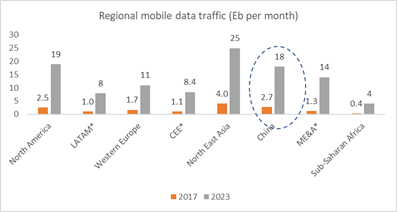
5G networks in China are slated for commercial operation starting no later than 2020. In fact, China Mobile is on track to beat this, as it plans to launch 5G in 2019 itself by partnering with Viavi Solutions. According to Ericsson’s latest report, by 2023 China will add more than 300 million mobile data subscriptions, driving data traffic up to 18EB per month. This promises huge demand for large scale network build out which suggests more business for China Tower.

Figure 3


Source: Ericsson Mobility Report – June 2018.
Note: LATAM=Latin America; CE&E= Central and Eastern Europe; ME&A= Middle East & Africa

In the infant stage of commercial deployment, both 4G and 5G network will co-exist. Wireless networks need to improve their network density, though. Typically, 5G networks will operate on millimeter spectrum (3–5 GHz spectrum bands) which need higher frequency reuse, and this suggests more base stations to match the same level of 4G coverage.  For the MNOs, apart from improving the density of 5G macro cells they also need to utilize small cells and distributed antennae to supplement coverage. This promises huge growth potential for China Tower’s small cell business, which commenced operations in 2017. Moreover, China Tower already has 16,798 DAS sites and recorded exponential revenue growth since 2015, from CNY45 million ($6.7 million) in 2015 to CNY1,284 million ($192 million) in 2017. With the growing demand for wireless coverage inside buildings and tunnels, the future for this segment looks promising for China Tower – which currently contributes a meagre 2% to the revenue.

US-China trade war is bad news for the Hong Kong IPO market

While China Tower gears up for its IPO, it remains cautious about timing: Hong Kong’s financial exchanges will be impacted from the ongoing trade tussle between China and the US. China’s telecom industry is already facing the heat due to tariffs imposed on Chinese imports to the US. This is a setback for the operators as this would mean increased equipment costs, resulting in a possible decline in their profitability. The after-effects to this will also be felt by China Tower, as the big three operators are its major shareholders. The growing trade war between China and the US will also lead to continuous market volatility (at least till the end of 2018) which will significantly impact the Hong Kong IPO market. This was already seen to some extent in Xiaomi’s IPO filing. Early this year, there were rumors that Xiaomi’s IPO would be valued at nothing less than $10 billion, but it managed to raise just about $4.7 billion. Nonetheless, it remains the biggest IPO since 2014.

China Tower will likely experience a daunting task ahead especially with the US-China trade war looming over Hong Kong stocks. And Trump’s recent move to block China Mobile from the US market on security grounds comes as another sign that the trade dispute between the nations will not end anytime soon.

Blog Details

Understanding The Carrier-Neutral Market (And Why Revenues Will Pass $40B This Year)

MTN Consulting has just published a “Market Review” of the carrier-neutral network operator (CNNO) sector. The report assesses the key role that these tower, data center, and bandwidth specialists are playing in the downsizing of the telecom sector. While many telcos are shrinking, the CNNO sector is growing >10% per year. Revenues for the 25 CNNOs we track should surpass $40B this year, and approach $60B by 2020 (Figure 1).

mtnc-cnno revs through 2020

Takeaways from the study include:

  • CNNO revenue growth has been steady around 10-15% YoY for several years, in line with the growing telco (& other provider) need for low cost, carrier-neutral network resources. 3Q17 revenue growth for CNNOs was 13.1% (Telco Network Operators: 1.0%; Webscale Network Operators: 23%).
  • CNNO capex rose 11% YoY in 3Q17, to $3.6B. Tower specialists spent 24% of their revenues on capex, data center specialists over 43% due to higher (and lumpy) investments in developing new sites. Tower providers’ incremental capex in new sites is primarily for small cells. Bandwidth specialists’ capital intensity has been over 50% for the last 5 quarters, due to the influence of new builds (NBN in particular).
  • CNNO capex hit $15B on an annualized basis in 3Q17; the biggest spenders were Equinix, Level 3, Australia’s NBN, Crown Castle, Digital Realty, American Tower, and Zayo.
  • M&A is a big factor in the sector’s growth, but just one. CNNOs are growing organically too, and expanding their business models to require a broader mix of equipment (Crown Castle is looking at edge computing, for instance). Technology-related operating expenses can be quite high, for repairs & maintenance of old plant, and energy costs in particular.
  • Total capex across telecom, Webscale, & CNNO was $355B in 4Q16-3Q17 (Figure 2).

mtnconsulting 3Q17 capex-summ5

The report also assesses CNNOs’ network holdings across four main categories: fiber, data centers, towers, and small cells. Most big operators have assets in multiple areas, and that will increase over time. Tower companies are building small cells, for instance, while bandwidth specialists are extending their fiber routes to small cell sites.

Table 1 provides a snapshot of the infrastructure assets for a sample of the CNNOs covered in this report.

Table 1: CNNO network assets (excerpt)

mtnc cnno1

Blog Details

Indian Operators Divesting Tower Assets To Raise Cash

Faced with tough competition and high debt, Indian telecom operators are spinning off their tower assets to investors or independent tower companies to improve their financial situation. The 2016 sale of Tata Teleservices’ tower business (Viom) to ATC, and RCom’s planned sale of its tower unit (Reliance Infratel) to Brookfield are just two examples.

Operators in many other regions have divested towers to raise cash, not just India. This is part of an ongoing trend, enabled by the maturity of independent asset management companies. Such divestments in India, though, come against a backdrop of urgent debt reduction needs. Funding network capex while navigating this transition will be a challenge.

Do operators really gain from tower divestments?

Though operators benefit from a cash influx after an infrastructure sale, the devil is in the details. Tower sales typically come with long-term leaseback arrangements, with pre-determined pricing levels locked in. Operators need to set aside sufficient funds for recurring rental costs.

There have been instances where tower companies have shutdown service to operators following rental defaults; RCom is one case. Since the details of the outgoing rental costs incurred by operators are not revealed, it does question the merit of the tower sale. On the other hand, many towers remain underutilized, and operators see benefits not only from the initial sale but in lower ongoing costs as tower space is shared. It also helps them avoid new tower construction, hence avoiding some capex (all else equal).

In India, mobile operators increasingly are focused on their main telecom business, relying for tower assets on a mix of dedicated private equity firms and pure tower infrastructure companies. Deals continue to happen. For instance, now that Vodafone’s acquisition of Idea Cellular has been approved by the antitrust regulator, Bharti Infratel will likely try to buy Vodafone’s 42% stake in Indus Towers. It’s also possible that, post-merger, Vodafone/Idea’s combined 20,000 towers will be acquired by ATC.

Below are a few cases of Indian operators selling towers, or their holdings in tower subsidiaries. Two are completed deals, one is in progress, and two are still under discussion.

Tower asset transfers are affected directly by the broader services market, and M&A changes at that level. We’re seeing this now in India. Vodafone’s merger with Idea, for instance, set to complete in 1H18, is forcing a realignment of ownership in Indus Towers. RCOM’s hoped-for big payout from its tower sale to Brookfield is now in question, since the RCOM-Aircel merger collapsed. Meanwhile, Jio continues to push aggressively to expand, keeping margin pressure high on rivals.

Mobile market consolidation might free up capital for network expansion

In the wake of heavy competition and high debt, Indian operators are exploring various financial deals, not just asset spinoffs.

The recent Tata Teleservices (TTSL) sale of its mobile arm to Airtel, and Vodafone-Idea merger, may just be a silver lining for the Indian telecom mobile market. Over the next five years, we might see a drop in the number of mobile players from 9 to 5. Such consolidation should be beneficial for operators, which can merge network and spectrum holdings. That would free up more capital to invest in network expansions and upgrades; recently Indian operator capex has dipped. Tata Communications’ capital intensity (capex/revenues) averaged just 9.5% for the last three fiscal years, for instance.

With growing demand for a complex range of new mobile services (including in the IoT space), there is a strong argument that operators shift tower management to independent, specialized companies, and focus on providing better quality of service and coverage. India may soon provide a test for that argument.

Blog Details

Communications Sector M&A Dominated By Infrastructure In 3Q17

October’s seen a few mergers already, including Airtel-TTSL, a tower sale by Zain and the long-rumored Sprint-T-Mobile transaction (confirmed yesterday). Some interesting deals came out of 3Q17 too, especially in infrastructure markets.

63 M&A transactions announced, including OTT/cloud deals

The communications services sector saw 63 merger and acquisition (M&A) transactions announced in 3Q17. These deals accounted for a total $17.4B in deal value. Infrastructure targets accounted for 56% of deal value across 13 deals. Crown Castle’s $7.1B purchase of Lightower was the biggest by far, and exemplifies the quarter’s focus on towers, data centers, and fiber networks.

Other infrastructure deals announced last quarter include:

  • Equinix: $295M for Spanish data center provider Itconic;
  • Verizon: $225M for WOW’s fiber optic network in metro Chicago;
  • Iron Mountain: $128M for Colorado-based MAG Data Centers;
  • Keppel DC REIT: $78M for a colocation data center in Ireland, from Dataplex;
  • Zayo: $3.5M for a data center in Colorado.

Several small deals involving fiber optic and related assets were announced without valuation: FirstLight Fiber’s acquisition of 186 Communications; Neural Path-Infinity Fiber; Ufinet-IFX Networks; and EQT Infrastructure-Spirit Communications. Also, South Africa’s Dimension Data Holdings decided to sell its fiber & wireless business to Vulatel; Dimension’s view on the network assets is that they are no longer core to its “value proposition”.

Fixed-mobile-integrated services: 28 deals totaling a modest $5.2B

3Q17 also saw 28 deals targeting fixed and/or mobile service operations: 18 fixed, 7 mobile, and 3 for integrated (fixed & mobile) assets. There were no very large (>$10B) telco deals announced in 3Q17, though several earlier ones are still pending (including AT&T-Time Warner and Vodafone-Idea Cellular).

Two sizable deals in 3Q17 were international in scope: Vodacom South Africa’s $2.6B purchase of a 35% stake in Kenya’s Safaricom, and Omantel’s $846M acquisition of a 10% stake in Kuwait-based Zain. Most other significant deals were domestic in nature, including:

  • USA: Cincinnati Bell-Hawaiian Telecom ($650M, July 10); T-Mobile US-Iowa Wireless (value unknown; Sept. 26)
  • South Africa: Blue Label Telecoms-45% stake in Cell C ($424M, July 27)
  • Hungary: DIGI-Invitel ($164M, July 11)
  • Russia: Renova Group-AKADO ($120M, July 11)
  • Austria: Hutchison Drei Austria-Tele2 Austria ($112M, July 30)
  • Thailand: AIS-CS Loxinfo ($79M, September 14)
  • Australia: Superloop-NuSkope ($12M, Sept. 10)

Lowering network & selling costs (relative to size) are common dominators across most transactions. Some transactions markedly improve competitiveness through more scale or better access to a customer segment; for instance, Hutchison Drei bought Tele2’s Austria operation to jump into a strong #2 overall position in the market, behind America Movil’s Telekom Austria.

OTT/Cloud network operators also buying companies

Notably, Alphabet/Google made five notable acquisitions in 3Q17, Facebook 3, and Alibaba 2. Their targets are spread across a range of sectors, in line with their business scope. Lots of action centered around Artificial Intelligence in 3Q17, something OTT/cloud operators anticipate having a role in their networks. Alphabet acquired two firms in this space: Bangalore-based Halli Labs, and Belarus-based AIMatter. Baidu acquired Seattle-based Kitt.ai, and Facebook bought conversational AI startup Ozlo.

Infrastructure demand rising, or unstable?

With all the infrastructure deal activity in 3Q17, some wonder if this indicates rising demand for basic network assets. Does it suggest a strong growth outlook for the “neutral network operators” (NNOs) focused on neutral operations of towers, data centers and fiber networks?

The sector is growing, to be sure, especially member companies like Equinix with aggressive M&A strategies. Private equity (PE) is driving much of the deal activity in this sector. That was the case with 3Q17’s biggest deal: Crown Castle bought Lightower from PE owners including Berkshire Partners and Pamlico Capital. This quarter, there’s an even more audacious deal underway in the sector, with a PE consortium looking into an $11B Indian cell tower deal. That is motivated, at least in part, by high debt among many Indian operators & tower companies.

Which brings us back to the market outlook. In telecom, PE firms tend to buy, reorganize, and sell assets – they’re generally not in it for the (very) long-haul. Publicly traded NNOs like Crown Castle provide exit opportunities for the PE investors – as it did for Lightower last quarter. The fact that several PE firms are raising big infrastructure funds now is a positive for telecom dealmaking.  Telecom network operators seem almost certain to continue slimming down their asset base in light of weak top-line growth. PE firms will surely be around to pick up some assets when the price is right.

Blog Details

India’s RCom Under Pressure After Its Failed Merger With Aircel

Reliance Communications’ (RCom) long-planned merger with Aircel, part of Maxis, fell apart last week in the face of legal and regulatory hurdles. This news comes as multiple operators in India are struggling with debt and declining margins.

Both RCom and Aircel face debt issues and declining revenues

The primary reason behind the planned RCom-Aircel merger was to consolidate and reduce losses. The combined entity would have become India’s fourth largest in terms of subscriber base, and the scale would have (hopefully) enabled both to better manage their debt. RCom’s total debt is roughly INR470B, while Aircel’s is INR200B. Both are also facing revenue declines; in 1Q17, for instance, RCom’s revenues fell by 24% QoQ , while Aircel’s QoQ drop was far worse at 47%.

The merger’s failure opens up a debate on the survival of India’s weaker operators, burdened with debt and some on the verge of insolvency.

Grim industry outlook

Many of India’s operators today are in dire straits, facing high competition and coping with high levels of financial stress. In addition to RCom and Aircel, Tata Teleservices (TTSL), for instance, has a debt burden of INR340B, and is considering exiting the business.

Given the large number of players in the market and the high capital investment needed to compete, more consolidation was always in the cards. Earlier this year, Airtel acquired the India operations of Telenor and its over 40M subscribers, for instance. Vodafone India’s pending merger with Idea Cellular is likely to be completed in 2018, producing a combined entity with ~400 million customers. Vodafone hopes for “substantial cost and capex synergies” from the merger.

After these big deals, the remaining players have fewer options to revive their business. Without a good M&A option, selling assets to raise cash is one option being explored. Spectrum sales may come in handy, but it’s a buyer’s market. In the event of a failure to sustain their business, an operator can be compelled to surrender spectrum (one possible outcome facing TTSL).

Uncertain future for RCom and Aircel

The future for Aircel and RCom looks bleak, as competition is heating up. Most Indian operators are facing the heat of Jio’s September 2016 nationwide launch. Jio’s aggressive pricing, though, has been especially difficult for RCom and Aircel to replicate.

RCom desperately wanted this merger as it was vital for its debt reduction efforts. The merger would have resulted in a combined entity with an asset base of close to INR650B (US$10B) and a net worth of INR350B. This greater scale would have allowed faster debt repayments and a 40% overall debt reduction for RCom by the end of 2017. Moreover, tower companies are pressuring RCom to pay back dues on its tower rental contracts. RCom has to pay American Tower Company and Bharti Infratel about INR200-250M each; and about INR95M to GTL Infra (including its unit CNIL).

RCom had plans for selling the towers of the combined RCom-Aircel entity to Brookfield Asset Management to clear a significant portion of its debt. But with the merger now being called off, the tower deal will have to be reassessed. Brookfield had apparently wanted to buy the combined tower base for up to INR110B. RCom is still hopeful about reviving its business by deploying 4G services, via a spectrum agreement with Jio. It also hopes to monetize its 2G and 3G spectrum and sell some real estate assets. But RCom has a long way to go in growing and sustaining its subscriber base in a highly disruptive mobile market.

Can Jio bailout RCom from this crisis?

Despite Mukesh Ambani, founder of Jio, and Anil Ambani, owner of RCom, denying all rumors surrounding a possible merger, it would not be a surprise if it happens.

In early 2016, the companies entered into a spectrum sharing deal, where RCom sold its spectrum in nine circles to Jio and approved spectrum sharing in another 17 circles; fiber sharing was also involved. By most accounts, the deal was a success for Jio, as it enabled a quick national launch. The deal has brought fewer benefits to RCom, which is now incurring losses and running out of funds for network expansion.

RCom might also be considering a bail out option. In June 2017, RCOM requested government support (through an “inter-ministerial group”) to withdraw the 10% cross holding restriction. This rule states that operators are not authorized to own more than 10% equity in two different operators in the same circle, thus hinting at a possible sale of its equity to operators. Considering its past association with RCom, Jio seems the most likely other operator to buy equity in RCom. And if such a deal takes place, it will provide Jio with greater access to RCom’s towers, fiber and spectrum. Only time can answer if Mukesh Ambani will come to his brother’s aid in bailing him out from this crisis.

(Photo credit: Pablo Garcia Saldana)

Blog Details

Mobile operators & towers: to own or not?

Over the last few years, the independent tower sector has grown dramatically. Much of the growth has come from asset spin-offs: a mobile operator sells some portion of its towers to a specialist, in exchange for cash and a commitment to lease the towers back. The logic is simple: the telco raises cash, and outsources the nuisance of running a relatively undifferentiated part of its operations. The tower company grows its network, and gets a long-term customer.

China Tower

In the case of China, things are different (once again): the China Tower Company was created by a government-mandated spin-off exercise. No cash exchanged hands, but each of China’s major operators now own a stake in China Tower. This independent company is hoping to use its towers for other services, such as electric car charging stations.  While the government involvement was unique, the deal was premised on the same idea motivating most tower spin-offs: mobile operators don’t need to own their own towers.

Axiata buying towers

That belief is not universal, though. An example of this is Axiata, which has over 320M mobile customers spread across 10 countries. Axiata is buying towers, not selling.

Last month Axiata closed a deal to buy 13,000 towers in Pakistan from PMCL, for nearly $1B. This follows a smaller deal earlier in the summer, the $89M acquisition of Pakistan’s Tanzanite Tower Private Ltd and its 700 towers. Axiata says the two deals make its tower subsidiary, “edotco”, among the world’s top 10 tower owners. More important is Pakistan, where its vast tower holdings make it the leading independent – in a market where tower sharing had struggled until recently.

Small cells & fiber

As telcos pursue a mix of own/rent strategies, the independent tower sector will continue evolving. One driver is the need for small cell coverage. That will likely get more important as 5G gets closer.

There’s a related need to deploy more network intelligence closer to the end user. This need drove an interesting deal earlier this week: European tower player Cellex paid 133M Euros, for just 30 towers, from Dutch provider Alticom. Cellnex explains that the towers position them well for 5G: they’re long-range, supporting 15km radius cells, and are suitable for hosting caching servers for data processing and storage. As 5G networks evolve, we may see tower companies get in the business of operating more of the edge intelligence in the network.