Blog Details

Telco capital intensity hits 10 year peak in 2Q22

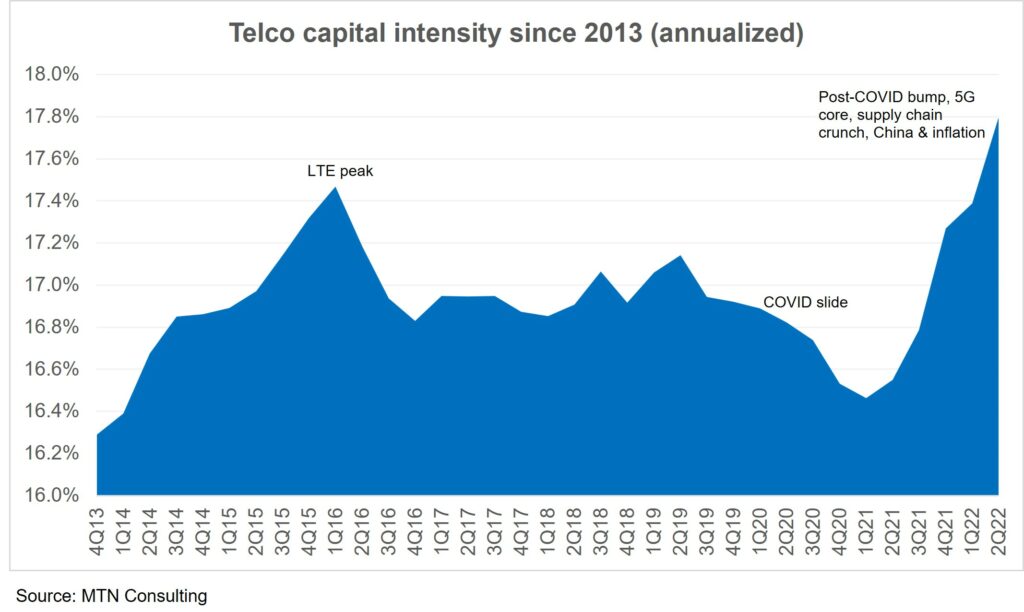
Vendors continue to wrestle with supply chain constraints in the telecom sector. That’s clear from several recent vendor earnings reports, including those issued by Dell, HPE, and Ciena in recent weeks. Telco spending, though, has surged in recent quarters. With 2Q22 results now compiled, the industry has reached a new capex peak. For the 12 months ended June 2022, telco capex was $329.5 billion (B), while the ratio of capex to revenues (i.e. capital intensity) was 17.8%. Both figures represent new record highs, at least for the 46 quarter (11.5 year) period that MTN Consulting data covers (1Q11-2Q22).  

On the supply side, vendors selling into the telco vertical are seeing some growth, in aggregate. For the broadly defined “telco network infrastructure” (telco NI) market, revenues were $60.1B in 2Q22 (up 4.1% YoY), or $237.6B on an annualized basis, up 6.7% YoY. The telco NI market includes some vendor revenue streams which dip into telco opex, not capex, but there is usually a correlation between total capex and vendor revenues.

The figure below illustrates telco capital intensity over the last several years.
What’s behind recent capex growth

One factor behind the recent capex spending spike is a post-COVID bump. Economies shutdown during COVID, depressing network spend. The capital intensity effect is shown in the figure, above (“COVID slide”). Capex also dropped in absolute terms. Annualized capex bottomed out at $299.8B in 2Q20. Some of the current growth is just making up for lost time. The quarterly average hasn’t changed much, if you expand the time horizon. For the last ten quarters, from 1Q20 (the onset of COVID) through 2Q22, telco capex averaged out to about $77.9B per quarter. For the ten pre-COVID quarters, the average was $78.5B.

Another factor is many telcos are scaling up initially small 5G deployments, and beginning to build out 5G SA core networks. 5G RAN builds have been underway for several years, but the spending has been small to start due both to the software-centric nature of 5G networks and telcos’ desire to wait for new revenue models to emerge. Incidentally, a shift to 5G core spending tends to benefit a different type of vendor – not just the Ericssons and Nokias of the world. Cloud providers AWS, Azure and GCP, for instance, are all actively involved in helping telcos with 5G core migrations. Their collective revenues in the telco vertical were about $3.4B for the 12 months ended June 2022, up nearly 80% YoY. Many of the vendors involved in this are less vulnerable to supply chain issues.

Another capex plus: fiber spending is strong in a number of markets, especially the US but also in Europe, Australia, China, and India. That’s to support FTTx deployments but also to connect together all the new radio infrastructure needed to support 5G. Government subsidies and other investment incentives are a factor as well. Vendors focused on fiber optics are seeing strong growth right now. For instance, Corning and Clearfield saw their telco vertical revenues grow by 25% and 84% YoY in 2Q22, respectively.

Supply chain limitations have a mixed effect. They sometimes mean delay or cancellation of projects, which cuts capex in the short term. They also can mean price increases, though, as telcos push suppliers to accelerate timelines or adjust designs to work with available alternatives. This can result in projects costing more than expected. Let’s not forget, though, that a huge portion of telco spend is unaffected by current supply chain constraints. Services- and software- focused vendors – like Accenture, Amdocs, IBM, Infosys, TCS and Tech Mahindra – are not citing supply chain issues as a drag on results. 

Inflation is a bit more straightforward. This has impacted the entire telecom food chain, from chips to components to systems to services. All else equal it causes an increase in US$ capex, though the impact on capital intensity is less clear. 

Finally, there’s China. Given how closed a market this is, there’s not as much attention paid to it nowadays. But China’s capex has been growing recently. For the 2Q22 annualized period, Chinese telco capex totaled $58.3B, up 12% from 2Q21. That growth comes despite efforts to share costs on the network side.

China is also relevant to the vendor share question. Huawei continues to rank at the top of the global telco network infrastructure (telco NI) market. For the 2Q22 annualized period, we estimate its telco NI share at 18.7%, far ahead of Ericsson (10.9%) and Nokia (8.9%). This surprises some, as Huawei has become a non-factor in many markets over the last two years. Yet Huawei’s stability is no mystery. It’s dominant at home, and local telcos have been spending big, and steering more of their capex dollars to local suppliers over the last couple of years. Huawei also has a huge customer list overseas – these revenue streams don’t just disappear overnight, especially since many telcos remain loyal to the vendor.

Hardware hit hardest in supply chain crunch

Vendors recorded about $237.6B in sales to the telco vertical for the 2Q22 annualized period. This is a huge market, with many different players; MTN Consulting stats track 132. Some supply the latest and greatest hardware innovations. They often have high margins but can also be subject to supply chain hiccups. Vendors specializing in solutions which revolve more around software and/or services tend to have different constraints. Labor cost and availability is always a concern, but hardware is rarely an issue. We believe the current supply chain disruptions will improve in the next couple of quarters, though. Even those vendors hit by short-term supply issues are generally optimistic. For instance, Gary Smith, Ciena’s CEO, noted last week that “Despite supply chain challenges and elongated lead times, strong secular demand trends show no signs of abating. And we remain confident that the fundamental macro drivers propelling this demand are durable over the long term.”

The biggest near-term risk to that is China’s ongoing series of COVID shutdowns. Longer term, the bigger risk is any interruption to Taiwan’s ability to continue functioning as an independent, self-governing country – it plays a key role in the telecom supply chain, and that of many other sectors. This issue is the elephant in the room that few like to address, but all vendors need to have a plan for this worst case scenario.

*

Source of cover image: iStock

Blog Details

Post-pandemic chip M&A splurge targets the data center market; room for more consolidation in 2021

After a prolonged hiatus, M&A activity in the semiconductor landscape ramped up significantly this year, nearing the record levels of 2015. The consolidation surge was particularly notable during the second half of 2020. These deals targeted many end use markets but the common thread is the cloud data center market: remote work and study amid the COVID-19 pandemic has spiked demand for cloud-based tools and services. The dealmaking is not yet done. Next year is likely to witness more consolidation among chipmakers, despite geopolitical tensions between the US and China and stringent regulatory scrutiny serving as impediments to deal completion.

Flurry of chip deals bring cheers to an otherwise muted first half

Chip M&A activity had a quiet first half of the year, as COVID-19 created high levels of uncertainty and steep drops in GDP. Stock markets settled in 2H20, though, and big companies found ways to operate amidst a pandemic. COVID-19 remains a severe problem for many major economies, but improved business sentiment and a gradual economic recovery have fostered a strong climate for M&A.

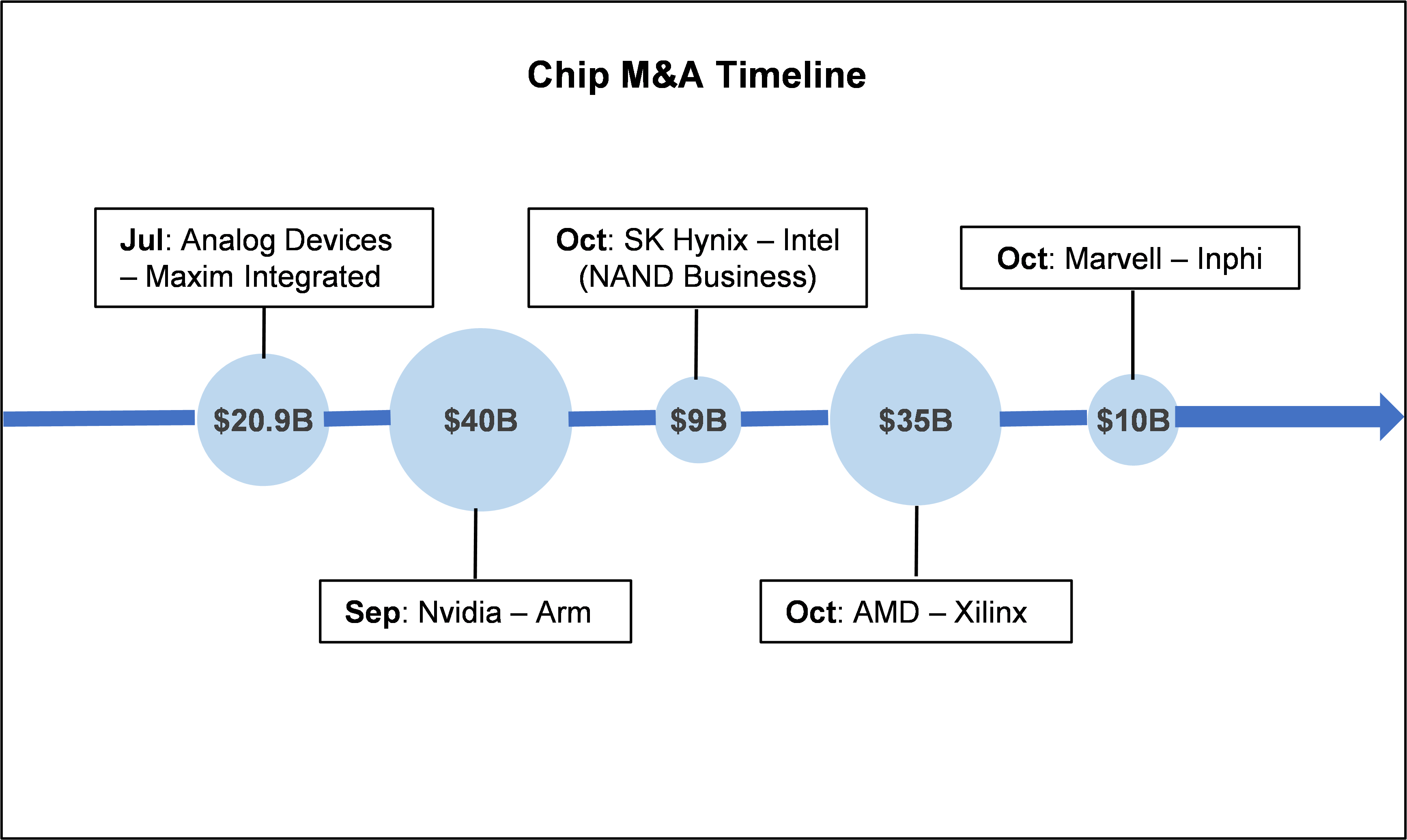
With year-to-date announced deals already topping $100B in value, 2020 is turning out to be a blockbuster year for chip M&A. The mega-deal kickstart to the chip M&A frenzy was Analog Devices’ $20.9B acquisition of rival chipmaker Maxim Integrated Products in July 2020. This was followed by Nvidia’s acquisition of chip design house Arm for $40B in September 2020, the year’s biggest deal so far. The month of October saw a string of M&A agreements featuring the $9B acquisition of Intel’s NAND SSD business by SK Hynix, AMD’s $35B deal to acquire Xilinx, and Marvell’s $10B acquisition of Inphi.

Figure 1: Timeline of semiconductor M&A in 2H20

Source: MTN Consulting

Chipmakers aim at the lucrative cloud data center market

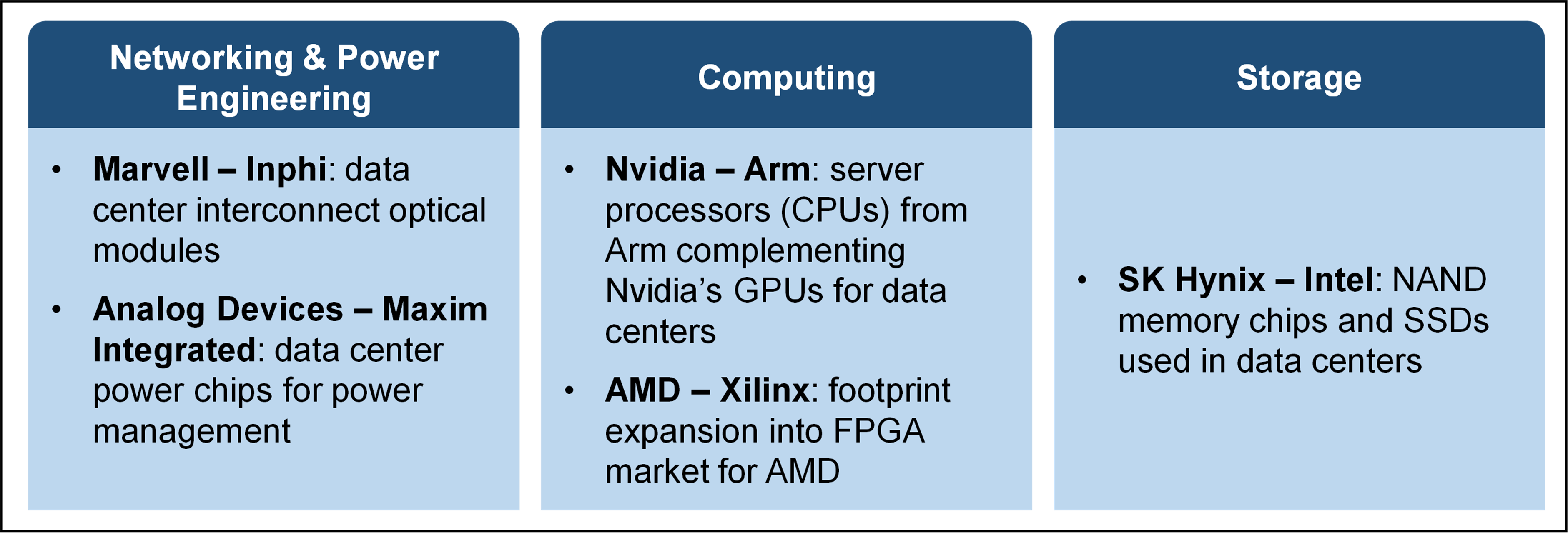
None of the big chip deals are focused narrowly on a single end market, but one key market is of common interest to all – the cloud data center. The deals differ from each other in terms of sub-market focus, though, stretching from power engineering and networking, to computing and storage – see Figure 2 below:

Figure 2: Data center aspects of 2020’s big chip M&A transactions

Source: MTN Consulting

Networking & Power Engineering

Networking and power management form the vital foundation of any data center infrastructure. Optical modules help connect not just the server racks inside data centers but also the data centers to one another across different locations. With the acquisition of Inphi, Marvell aims to target this space by providing interconnect solutions that enable seamless and speedy movement of data between and inside data centers.

Chips for power management have grown in significance over the years to control the biggest expense of running a data center, i.e. power utility costs. Analog Devices is seeking to address this issue through Maxim Integrated’s data center power chips, which also permit greater computational capability to data center operators.

Computing

Data centers typically house thousands of servers that process and run applications along with high performance computing (HPC) workloads. The processing and computational tasks are carried out by server processor chips that come in various forms: CPU, GPU, FPGA (field-programmable gate array), and ASIC (application-specific integrated circuit). Intel, AMD, Nvidia, Xilinx, and Infineon are some of the leading server processor vendors developing either one or most of the chip types.

The acquisitions announced by AMD and Nvidia relate to expansion into new server chip types, and also rivaling Intel as a more formidable force. AMD is looking to dent Intel’s customer base with the acquisition of Xilinx. The FPGA pioneer Xilinx had earlier managed to end Intel’s exclusivity with some its customers such as Microsoft. Meanwhile, GPU maker Nvidia will gain access to server CPU designs through its Arm acquisition. Arm-based server processors are already being adopted by webscalers like Amazon for its data centers. For now, Intel is looking to counter these developments through in-house efforts aimed at the server GPU market for data centers, extending its presence across all the four chip types.

Storage

On the storage side of things for data centers, Intel has agreed to sell off its NAND SSD business to SK Hynix. The assets sold include Intel’s NAND component and wafer business along with the NAND manufacturing plant in Dalian, China, but exclude Intel’s “Optane” memory business. Intel’s NAND memory chips are mostly used in smartphones but also data centers to support in-memory processing demands of the cloud. The business acquisition will elevate SK Hynix’s market share in the NAND memory market, which is currently dominated by Samsung Electronics.

Three key factors are fueling M&A among chipmakers

Three key factors discussed below are driving chip companies to go on a shopping spree:

  • New applications: Key emerging applications based on AI/ML along with new evolving markets in edge computing, self-driving vehicles, and 5G have opened new frontiers for chipmakers. This is in addition to the ever-increasing demand for more media-intensive content such as images, audio, and video streaming over cloud that require faster server processors and networking capabilities for seamless and speedy transmission to end users.
  • Faster time to market: Apart from the obvious reasons of expanding into new markets and accessing proprietary technologies, chipmakers are increasingly exploring M&A to cut down on the costly and lengthy R&D timeline associated with developing advanced process nodes and chips, thus enabling faster scaling. Slowdown in Moore’s law is also pushing chipmakers to look elsewhere.
  • Improved market conditions: A low interest rate environment has enabled chipmakers to borrow modestly and finance acquisitions. Rising stock prices are also aiding large chipmakers such as AMD and Nvidia to fund their purchase either partially or entirely in stocks. Notably, Nvidia surpassed Intel as the largest US chipmaker by market cap in July 2020

More chip industry consolidation on cards but not without hurdles

The M&A activity in the chip market landscape is likely to continue into next year, but probably not at the scale of what has transpired so far in 2020. Even though the deal-making drivers discussed above will persist in 2021, future deals may confront more obstacles related to COVID-19 and geopolitics.

With COVID-19 expected to play out well into 2021, delays in deal-making would keep the deal volumes limited as carrying out negotiations, due-diligence, and audits would be challenging with travel restrictions and limited in-person meetings. For companies having long-term or strong working relationships with prospective acquirer or targets, the pandemic would be less of a worry, as seen with Nvidia-Arm or AMD-Xilinx for instance. These pairings shared strong working relationships prior to acquisition.

Geopolitical tensions between the US and China upsets the stability needed to make M&A deals happen. That’s especially true in the chip sector. With the situation not expected to get any better even under the Biden administration, China has been gearing towards chip self-sufficiency by pouring billions of dollars to support the growth of its domestic chip industry and advanced chip development. Furthermore, open-source chip architectures such as RISC-V have opened the gates for Chinese tech firms like Huawei. Chipmakers will be wary of snapping up companies amid a hostile business climate.

Last but not the least is the regulatory hurdle that an M&A transaction must go through before the final deal closure. Big-ticket deals are subjected to increased scrutiny due to wide-ranging issues such as strict antitrust laws, national security threats, access to proprietary technology, and sanctions imposed under trade disputes. All the chip M&A deals discussed above are pending regulatory approval, in multiple jurisdictions. Among them, the Nvidia-Arm deal is likely to raise eyebrows among the watchdogs, especially in Europe and China. China could essentially prove to be a spoilsport in the Nvidia-Arm deal: Chinese tech firms currently use UK-based Arm’s intellectual property to design chips, which could change post acquisition by US-based Nvidia. If China blocks this transaction, it would not be the first time. Two years ago, China blocked US-based Qualcomm from completing its acquisition of the Netherlands-based chipmaker NXP Semiconductors.

Blog Details

US crackdown on Chinese mobile apps to hit TikTok and WeChat

US crackdown on Chinese mobile apps to hit TikTok and WeChat; next step could affect their use of US technology

This week the Trump White House issued separate Executive Orders banning US companies and people from transacting with either ByteDance, TikTok’s current parent company, or the WeChat messaging service run by Chinese webscale giant Tencent. In effect these orders ban TikTok and WeChat from operating in the US, at least once the order takes effect on September 20. 

Note that this is 6 days after the May supply chain restrictions on Huawei are due to take effect. September is going to be a turbulent month for US-China relations and the broader tech industry.

Chinese ownership at issue

The orders are concerned with data security and censorship stemming from the Chinese ownership of WeChat and TikTok. As they are phrased, the orders affect WeChat directly but TikTok indirectly through a restriction on its current parent company, ByteDance. Hence, TikTok may get a reprieve if it is sold off to a US company like Microsoft

TikTok has been in the news for months and a frequent target of China hawks, and discerning parents. It’s a catchy app, loved by millions. But it is also an incredibly invasive app configured to learn everything it can about your device and the network to which it is connected. And it’s owned by a Chinese company, ByteDance, no matter what legal games are played to make it appear otherwise. 

WeChat is a messaging platform, or THE messaging platform of choice in China, widely used for much more than staying in touch – mobile payments, for instance. It’s not a household name among most Americans but overseas Chinese use it widely. WeChat and Weixin, the domestic brand of the same platform, had a combined 1.2 billion active users as of March 2020.  

The last year of debates around Huawei have reminded us all that the Chinese government has incredible powers to do what it wants with Chinese companies, especially if a national security rationale can be contrived. There is a solid rationale for restricting these companies’ operations in the US, or any other country not willing to give its network secrets away to China, and the US is not the first to make this decision. India similarly banned both apps last month, along with dozens of others.

Beyond network security, there is the issue of content censorship. An American teenager went viral on TikTok several months ago by cleverly inserting views about Xinjiang into a makeup tutorial, after she claims she had been censored for discussing the subject directly. Meanwhile, WeChat’s censorship of content on its platform, even private conversations, has been common knowledge for many years. 

Implications of EO on networks

The ink is barely dry on these EOs and there is much online debate about the implications and legality of the move. They are probably legal, based upon citation to the International Emergency Economic Powers Act and the National Emergencies Act, and despite First Amendment concerns. In my opinion this issue might have been better handled by the FCC, which could have conducted a public investigation, and then established general principles to apply to the next TikTok or WeChat. But the Trump White House is not big on process, always eager to push the boundaries of what it is allowed to do, and there’s an election coming up. 

So the question becomes, what’s next? Let’s assume the orders go into effect, even if they need some clarification down the road. It’s not clear how much they affect Tencent’s broader operations, for instance, including its many investments in affiliate companies in the gaming and video sectors. That will be ironed out, eventually.

What’s interesting to me is what may happen in the network arena. I suspect the next step will be to target how these companies build their networks. Just as the US government can restrict Huawei from accessing US-origin technology, it can do the same for Tencent and TikTok, and the many other cloud/tech players in China attempting to spread their wings globally, many with a US presence.

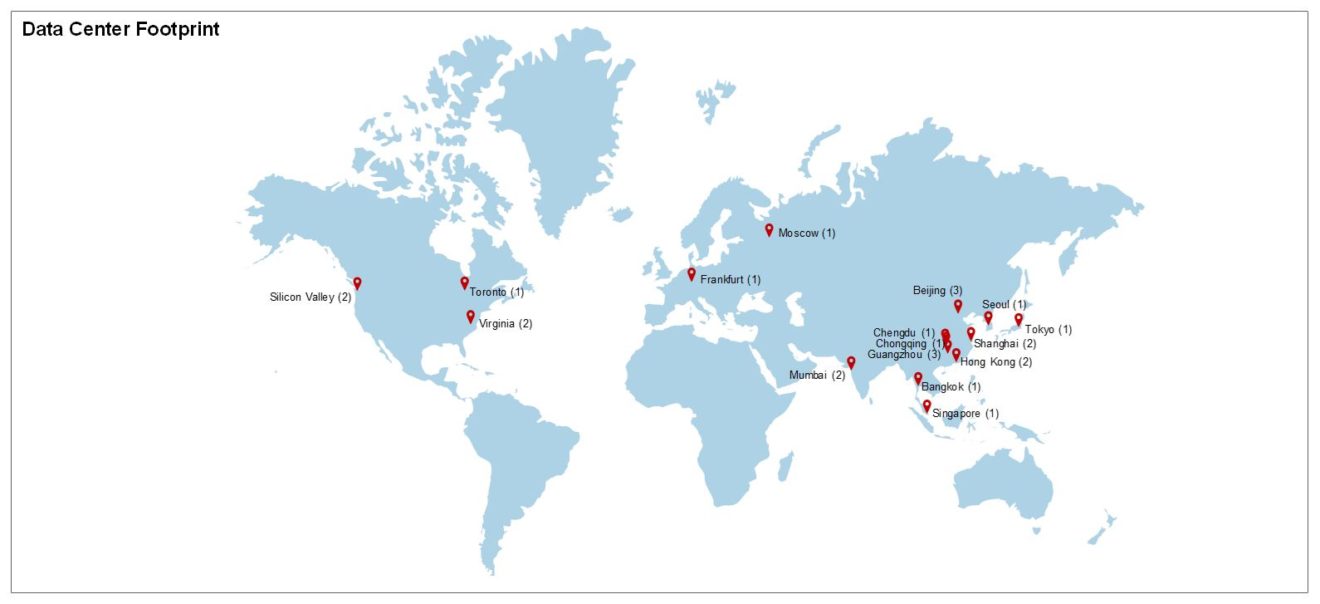
Tencent’s data center footprint

Tencent's data center footprint 1Q20

Hammering down on network design

Tencent, Alibaba, Xiaomi, and several other Chinese tech companies build large data centers using, at least in part, US-origin technology. Many of the firms are building global operations, and some have infrastructure in the US. If the US has security concerns about their scope of operations, ownership, and intentions, then it may limit the companies’ access to certain US-origin technology. In fact, we predicted this would happen in a Commentary published in June. While the EO doesn’t clearly reference this aspect, it seems inevitable that some arm of the US (yes, even under a President Biden) will restrict the Chinese cloud players’ access to US tech. That would affect Tencent in a big way, as it has data centers spread across the globe and spent nearly $5B in capex in 2019.

In building out their clouds, much of the technology the Chinese players use is produced locally. That’s not the case for chips, though. Even though they have been building their self-design capabilities for several years, Chinese webscale players continue to buy most high-end chips directly from US suppliers. And even for their self-designed chips, for production the Chinese option SMIC is not the solution. Alibaba’s Pintouge chip unit has been relying largely on Taiwan-based TSMC, while Baidu has partnered with Samsung.

Tencent is also working on chip self-design, but at a much earlier stage. It relies even more heavily than Alibaba and Baidu on US companies for building out its network, including AMD, Intel, Nvidia, and Qualcomm. It also uses Acacia and (Finland-based) Nokia for data center interconnect optical transport. These vendors will be affected by the EOs eventually, and should expect to lose some sales. We should also expect the Chinese government to keep up the pressure on SMIC to mature production capacity, and expect the subsidies to keep flowing.

One other inevitability, in my opinion, is a crackdown on Zoom. It’s amazing to me that it hasn’t happened yet. The logic of limiting Zoom’s US access is essentially the same as for WeChat and TikTok: Chinese ownership, requires disclosure of private device and network information to function, and at least some history of censorship.

Blog Details

Tough times at Huawei in 1Q20

Tough times at Huawei in 1Q20 

If you’re a Huawei watcher – and who isn’t in telecom nowadays – keeping up with the newsflow of the last few months has been a challenge. The company has long generated a lot of press, but this is different.

Looking at just the last three months, three things seem clear. One, US policymakers from both major parties are skeptical of Huawei. At a minimum, they oppose use of Huawei in US networks; at the fringes, some would like to put Huawei out of business. Two, a number of large countries aligned with the US are unable to resist Huawei’s offering, and/or not eager to cope with bullying from China Inc. Three, Huawei sees self-sufficiency as even more important now than a year ago, and the Chinese state budget will support that desire.

Pressure on Huawei 

The most important recent speech on Huawei was delivered at last month’s Munich Security Conference by Nancy Pelosi, Speaker of the US House of Representatives. Her speech reminds us that concerns about Huawei are generally bipartisan in the US. Pelosi warned that “China is seeking to export its digital autocracy through its telecommunication giant, Huawei, threatening economic retaliation against those who do not adopt their technologies….We must instead move towards . . . an internationalization of digital infrastructure that does not enable autocracy.”

Some other recent developments causing headaches for Huawei’s management team include:

  • Huawei’s rags to riches story has taken hits lately. On December 25, 2019, WSJ published a biting investigative piece called “State Support Helped Fuel Huawei’s Global Rise: China’s tech champion got as much as $75 billion in tax breaks, financing and cheap resources as it became the world’s top telecom vendor”
  • Chinese state officials continue to exert political pressure to support Huawei; recently the Chinese ambassador to Germany threatened retaliation if Berlin excludes Huawei from developing its 5G network. This is not only wrong, it is self-defeating for a company that is trying to appear a purely private concern.
  • Some European telcos (notably Vodafone) are being forced to rip and replace Huawei equipment in their network; even when these efforts are subsidized, it will make telcos think twice about future commitments.
  • On February 6, Trump’s attorney general, Bill Barr, suggested having a US company invest directly (or acquire) one of the two European mobile RAN suppliers, Nokia or Ericsson. While unlikely to take place, there is real support for US government subsidies to the growing ecosystem of open RAN vendors based in the US.
  • In early February the US Department of Justice charged Huawei with  racketeering and conspiracy to steal trade secrets in a new indictment. Around the same time, the WSJ reported that U.S. officials said they have obtained evidence of Huawei’s ability to access mobile networks through a “back door,” and have shared such information with several European governments in recent months
  • In late February Intel entered the 5G base station chip market, threatening indirectly Huawei’s competitive positioning in the 5G RAN market

Also, let’s not forget that Huawei’s CFO remains under house arrest in Canada pending the outcome of an extradition hearing.

Huawei is keeping its eye on the long-term prize

Despite a growing list of problems, Huawei has had plenty of wins lately, and appears focused on the long term.

In December, Telefonica Deutschland awarded its 5G rollout to Huawei and Nokia, jointly. In January, the UK chose to allow Huawei participation in 5G networks, with some limitations (by market share and application). Also in January, India’s regulator allowed Huawei and ZTE to participate in 5G trials.

In late February Huawei announced it had secured more than 90 commercial 5G contracts to date, versus 79 for Ericsson. Huawei also made the most of an MWC-less February, communicating with analysts and customers virtually via webinars and targeted briefings. Huawei also reorganized recently, creating the “Cloud & AI” business unit, to function in parallel to the legacy Carrier, Enterprise, and Consumer business groups. For telcos considering a bet on further Huawei deployment, these are all positive signs.

Behind the scenes, though, I suspect Huawei sees the writing on the wall – its US problems did not start with Trump, and they won’t end with a new President. As such, Huawei continues to work towards its long-term goal of self-sufficiency. This is not new, but has been accelerated by recent events. It’s especially important at the chip level. For instance, Huawei has increased its investments recently in subsidiary HiSilicon, increased collaboration with local chipmaker SMIC, and placed orders with Taiwan-based TSMC to be fulfilled out of China-based factories in Nanjing. Huawei has an enormous R&D budget and always-growing ambitions, so its efforts to bypass the US for technology development will persist. 

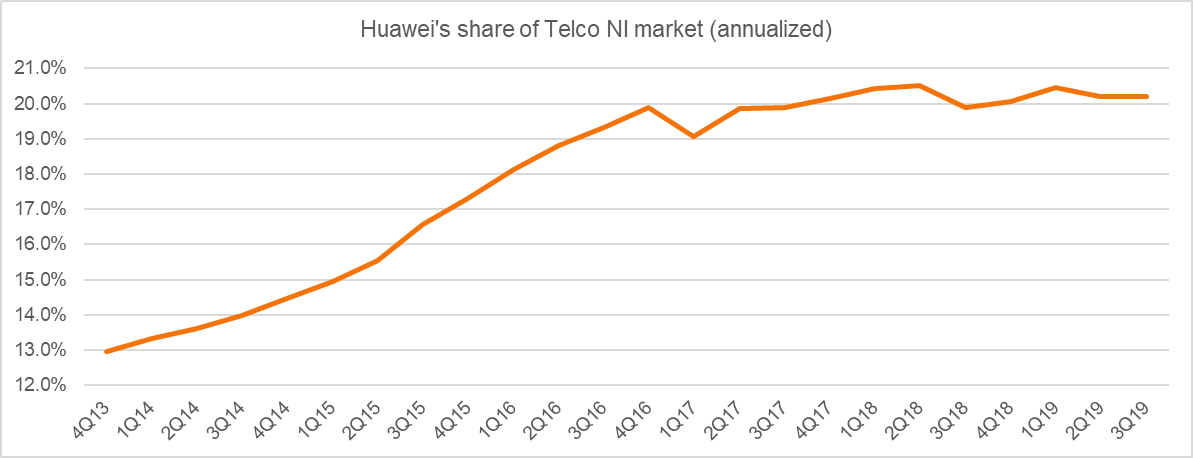
v4q19-3

Source: MTN Consulting

Blog Details

Alibaba aims to undercut US chipmakers’ dominance

Alibaba entered the club of webscale network operators (WNOs) developing their own chips recently, joining Amazon, Apple, Facebook, and Google. The Chinese e-commerce giant announced plans, in September 2018, to develop its own customized neural network chip, called Ali-NPU, to aid its growing cloud and IoT businesses. But unlike its WNO peers who want more flexibility and cost-efficiency in their operations by running in-house chips, Alibaba’s move is motivated by a grave external risk: the US-China trade war fallout.

A series of trade disputes set alarm bells ringing for Alibaba

Alibaba views its move as a precautionary response to a series of hostile trade events this year, starting with the leading US carriers, Verizon and AT&T, deciding to halt selling phones of the Chinese handset maker, Huawei, in January 2018.

Multiple factors were involved but there’s no doubt that the carriers felt pressure from the US government over national security concerns. This was followed by an even bigger move: an executive order issued by the US President, Donald Trump, prohibiting the Qualcomm-Broadcom deal in March 2018.

The order was driven by national security concerns over the deal’s (mainly indirect) benefits to Huawei and other Chinese institutions. The US Commerce Department’s April 2018 crackdown on the Chinese telecom giant, ZTE, seemed to be the final “wake-up call” for Alibaba. The Commerce Department imposed a seven-year ban on chipset exports to ZTE. The ban was based on some serious misbehavior at ZTE, not just a political stunt. While it was resolved in July 2018, for several months ZTE was forced to essentially cease operations.

ZTE’s problems highlighted how dependent Chinese tech companies remain on US firms in specific markets, including parts of the semiconductor industry. The aftermath of these events prompted Alibaba to pull back its overall presence in the US in June 2018, followed by scaling down expansion of its cloud business, AliCloud, in September 2018.

Alibaba goes rogue

Also at the end of 3Q18, Alibaba started to formalize its chip self-development plans.

The main one involves the recent launch of a semiconductor subsidiary, Pingtouge, that will start manufacturing AI-based chip, Ali-NPU, along with quantum computing processors in the second half of 2019. The subsidiary set-up comes close on the heels of Alibaba acquiring Chinese chipmaker Hangzhou C-SKY Microsystems in April 2018, to boost its chip production capacity.

Earlier this week, the US Commerce Department issued another export ban affecting Alibaba indirectly, this time on the Fujian Jinhua Integrated Circuit Company. Whether well-founded or not, this ban pushes Alibaba (and other Chinese WNOs) further down the road of self-development.

Global expansion unaffected

There are no signs that its supply chain headaches are slowing down Alibaba’s cloud construction efforts.

In fact, following its decision to scale back expansion in the US, Alibaba is looking at South-East Asia, India, and Europe as the “new target markets” for its cloud business. And the company has been aggressive about it – in 2018 alone, Alibaba launched five cloud data center operational sites across three international locations: the UK (2), India (2), and Indonesia (1). That explains the spike in annualized capex and capital intensity for the period ending 2Q18 in the figure below.

The capex growth trend is expected to continue in the medium to long run, given Alibaba’s data center buildout plans along with its efforts to disrupt industries such as hospitality, smart cities, and logistics. (For a complete analysis, see MTN Consulting’s Webscale Playbook: Alibaba, published October 2018).

US-based chip vendors feel the heat

With some semiconductor-related goods in the tariff list, the mounting trade friction between the US and China is making US-based chip developers nervous. That’s understandable as China buys chips more than any other nation in the world, accounting for 29% (US$100 bn) of the global demand for semiconductors, according to a 2016 study by the US Department of Commerce. The threat of new competition from China intensifies concerns.

One US-based vendor facing direct fallout from the ongoing trade dispute is Qualcomm. After the Qualcomm-Broadcom deal fallout in March 2018, another big-ticket merger deal involving Qualcomm became victim to the US-China trade spat. This time, China played spoilsport due to its failure to approve Qualcomm’s US$44 billion deal to acquire the Netherlands-based NXP Semiconductors in July 2018. Adding salt to the wounds, Qualcomm had to pay a massive US$2 billion termination fee to NXP Semiconductors for scrapping the deal.

Another issue is the US chipmakers’ high exposure to Chinese markets that makes them even more vulnerable to the situation. Qualcomm features here again, topping the list with a huge revenue exposure of 65% in FY17. Intel’s biggest market by revenues is China, deriving close to a quarter (23.6%) of revenues in FY17, while NVIDIA accounted for about a fifth (19.5%) of revenues from China during the same period.

US-based webscale operators (Amazon, Facebook, Google, etc.) efforts to design their own chips has already made some vendors nervous, and the trade dispute has only worsened this. Alibaba’s response with its chip push could just be the “tip of the iceberg” as more Chinese companies could follow suit; case in point being Baidu launching its own AI chip, Kunlun, in July 2018.

Beijing’s technology ambitions complement Alibaba’s move but challenges remain

China is looking to use its supportive domestic policies to close the technology gap with the US in the medium to long run. In line with this, it is investing billions of RMB in homegrown chipmakers such as Fujian Jinhua (from this week’s ban) and Tsinghua Unigroup. It also announced plans to create a US$47 billion fund in May 2018 to boost semiconductor industry, and is seeking to surpass the US as the global leader in AI by 2030. Alibaba wants to play a big part in effecting the transition. But this transition will require foreign technology and scarcely available talent.

(Photo credit: Alibaba)

Blog Details

Egypt’s new capital will attract new investment but also lock country into Chinese loans and technology

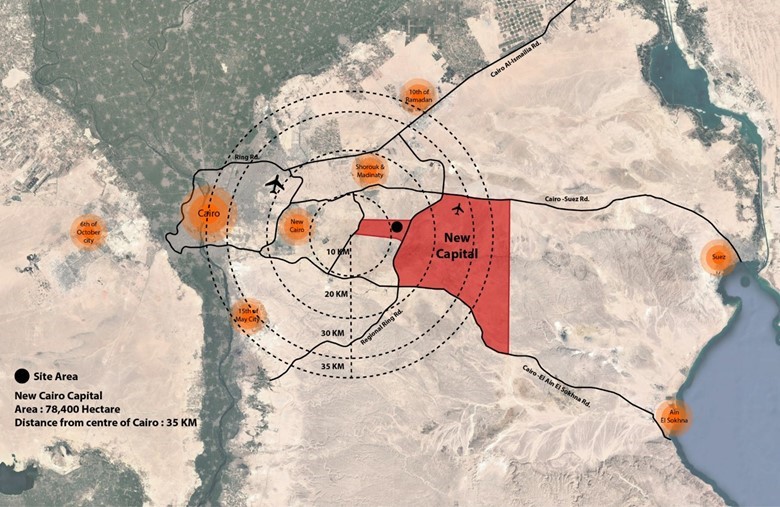
Egypt is building a new capital city on a desert plot between the Nile River & the Suez Canal, to ease Cairo’s population boom. Labeled “the first smart city in Egypt,” the new, unnamed city ultimately aims to house nearly 6.5 million people. Chinese bank loans are paying for 50-70% of upfront costs. Across the project’s two phases, total costs will reach US$45B. This is an ambitious project, and one of several “megaprojects” being pushed by President Sisi, with Chinese backing.

A loan is a loan

China isn’t actually paying for anything though. While Chinese bank loans may be big, they are still loans, and they come with strict terms. The new capital’s electric rail project is typical: Chinese banks are lending funds only to buy Chinese equipment; the Egyptian side needs to fund the remainder. Interest rates are rumored to be reasonable, around 2-3%, but repayment on the new capital loans begin in late 2019-early 2020, based on the 36-42 month grace period.

And three years grace period isn’t nearly as much as it sounds, with a project this big.  The country’s economy has bounced back since its Nov 2016 IMF bailout, but can’t afford an economic slowdown. Egypt’s portion of project costs are to be funded by selling land in the new capital to property developers.  It’s easy to imagine a worse case scenario for the government, where recession hits Egypt in 2019, property developers go bust in the new capital, relocation rates dwindle, and the government has trouble paying back China in 2020 and beyond. The implications of that are stark.

The new capital: phase 1 targets basic infrastructure 

The “owner” of Egypt’s new capital is the Administrative Capital for Urban Development. ACUD is in charge of both initial construction and management. It has two shareholders: 51% is held by an affiliate of the Ministry of Housing, known as the New Urban Communities Authority (NUCA). The remaining share is held by the Army. ACUD was created with an injection of capital roughly worth US$10.3B.

The new capital has been allocated an area of land roughly equivalent to Singapore, or 170,000 “feddans” in local terms.  This plot of land is located about 45km east of central Cairo, and 80km west of the Suez canal.

For Phase 1 of the new capital project, only a portion of the land area is being developed. The initial focus is building a central business district (CBD), local and regional transport (roadways, tunnels, bridges, an airport and a light rail to Cairo), residential real estate complexes, and shopping malls. Communications infrastructure is also part of phase 1.

Telecom market liberalizing but TE still protected

Egypt’s government has liberalized its control of the sector cautiously over the years. The government retains an 80% stake in Telecom Egypt, 13 years after its IPO.  Since this IPO, competition has been introduced slowly in Egypt, and TE has been protected along the way. Even today, for example, TE is the only operator in Egypt allowed to install or operate commercial fiber networks.

TE remains the largest of Egypt’s four operator groups, along with the local units of Etisalat (UAE), Vodafone (UK), and Orange (France). The four accounted for a total $3.7B in telecom revenues for the last twelve months (LTM) covering 3Q17-2Q18.

Egypt’s incumbent operator retains over 90% share in the fixed line market. In mobile services, TE was given a 4G license ahead of its rivals in late 2016 and launched mobile services on its own network a year later.  TE still offers 2G/3G services through Vodafone Orange, in which it owns a 45% stake. The government-TE connection remains important context for the Egypt telecom market.

TE accounts for over half of Egypt’s capex

Most of Egypt’s communications infrastructure is built and owned by the top four providers. Aggregating capex from 2011-2Q18, TE accounted for 29% of the $9.6B total, followed by Vodafone Egypt and Etisalat (26% each), then Orange (19%). TE’s capex has come to dominate in the last two years, fueled primarily by DSL and 4G/LTE infrastructure buildouts, as well as international transmission (Figure 1).

Figure 1: Egypt telecom capex by operator (% total), last 5 annualized periods

Source: MTN Consulting, LLC

Smart city in the desert

Egypt’s new capital is being built in the desert, in an area with almost no fixed physical infrastructure. The capital’s property developers are eager to boast of advanced connectivity and services in order to attract new customers. The basic connectivity goal is multiple layers of high-speed broadband access: FTTH/B to every premise, 4G wireless enhanced by small cells, and public WiFi. Project officials have also noted the importance of cloud connectivity, and are interested in attracting more data center investment to the region, including to the new capital. This will be a “smart city” relative to some others in the region, but won’t be comparable to more experimental projects like Google’s Sidewalk Labs.

Earlier this year, an Egyptian firm was hired to come up with a design for the new capital’s telecom network; more will be known about the results in the months ahead. One near certainty is that China will supply most of the technology; already, Huawei supplied most of the gear used by the University of Canada’s new branch in the new capital.

China raising its profile with the city’s Phase 2

While the city’s communications infrastructure is unsettled, construction for Phase 2 of the new capital is already underway. China remains the driver.

For the CBD expansion part of Phase 2, China Fortune Land Development (CFLD) has already won the construction project, per press reports.  To fund this, new capital officials have been negotiating with the three big Chinese banks regarding a $3.2B loan package. The actual loan terms are still in flux though, and apparently to be finalized by end of 2018. That isn’t stopping CFLD and other Chinese companies from actively pursuing other opportunities related to phase 2, including a petrochemical refinery.

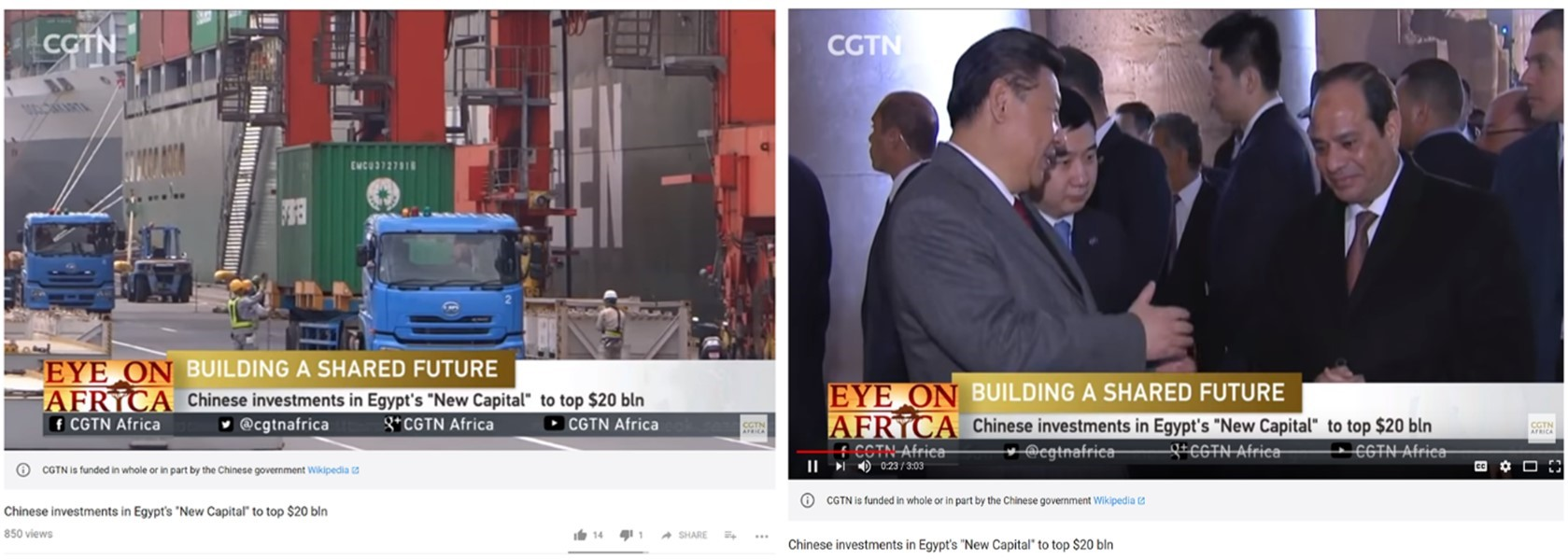
Beyond the new capital, Chinese banks are active investors in Egypt; that has accelerated with Xi Jinping’s “One Belt One Road” campaign (aka Belt and Road Initiative). For instance, the National Bank of Egypt borrowed $600M from the China Development Bank last month.  However, Chinese interests have not taken over; multilateral institutions remain crucial. Most important, the IMF continues support for its original $12B bailout package. The World Bank loaned Egypt $1.15B earlier this month.  Numerous private banks around the Middle East and beyond are important creditors to the Egyptian government as well. China Inc, though, is making a concerted effort to convert its investment into local political influence – through promotional videos, for instance (Figure 2). Most tactics are less visible.

Figure 2: China’s “Building a Shared Future” pitch

Source: youtube.com

China is working hard to reassure OBOR countries that its intentions are pure, focusing on the positives of such projects as the new capital, minimizing such risks as debt traps. Until mid-2018, it was working very well, but more attention is being paid now.  Technology suppliers eager to have a fair shot at projects like the new capital will have to pay attention, too.

–Source of cover image: http://www.acud.eg/


Blog Details

Rocky path ahead for China Tower as it looks to go public

Mobile tower infrastructure provider China Tower has won approval in Hong Kong for an IPO in what bodes to be the largest IPO in Hong Kong since 2010. Speculation is rife that the IPO could raise up to $10 billion for China Tower. That’s over twice the IPO of Chinese device maker Xiaomi which raised about $4.7 billion in its Hong Kong debut.

Background

China Tower was established in 2015 as part of a government-mandated spin-off exercise. Following transfer of the ownership of the nation’s “Big Three” operators’ tower infrastructure, China Tower was valued then at US$36 billion. Each of China’s major mobile network operators (MNOs) now own a stake in China Tower and get quarterly dividends from their ownership stake in China Tower. The shareholding structure post the deal completion was as follows: China Mobile (38%), China Unicom (28.1%), China Telecom (27.9%) and China Reform Corporation (6%).

The government’s primary motive in creating China Tower was to bring greater efficiency into the sector, freeing up capital for the telcos to make higher value investments. Another key goal is to encourage China Tower to diversify into new service areas & end user markets.

China Tower’s stellar 2017 faces challenges in 2018 as leasing rates decline  

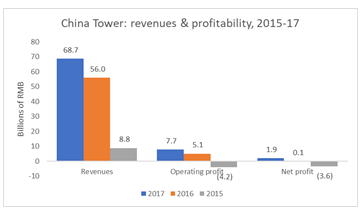
China Tower is the largest tower infrastructure provider worldwide, with a portfolio of 1.9 million towers and 2.7 million tenants. Further, China Tower is buoyant as 4G remains a strong impetus behind mobile data consumption. This trend is reflected in its 2017 results (see Figure 1) as it recorded an operating margin of 11.2% compared to 9.1% in 2016; and its revenues were up 23% reaching CNY68.7 billion ($10.6 billion).

Figure 1

Source: China Tower’s IPO filing

Despite the strong 2017 results, China Tower has some risks on the horizon.

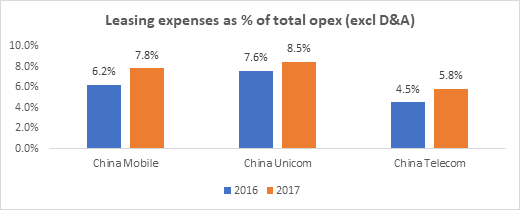
China’s three main telecom network operators (TNOs) have shared infrastructure-related costs for several years through a joint network sharing agreement. The goal was to cut redundant cost towards construction of towers. This agreement predated the creation of China Tower as an independent entity. In the last year, however, China’s operators have faced rising leasing costs. China Mobile and China Telecom’s tower leasing expenses as a percentage of total opex (excl D&A) were 7.8% and 5.8% in 2017, for instance, up from 6.2% and 4.5% in 2016. China Unicom’s tower leasing expenses as a percentage of total opex (excl D&A) also rose from 7.6% in 2016 to 8.5% in 2017.

The jump in leasing expenses has compelled the operators to renegotiate their tower rental agreements with China Tower.

Figure 2

Source: 20F forms filed with the SEC.

Price negotiations aren’t easy for China Tower, since the big three operators are its customers as well as shareholders. The Feb 2018 tower leasing charges suggest that China Tower was too generous in its pricing to the operators. The tower company reduced the mark-up margin rate (a fee charged over and above the overhead costs) of its 5-year agreement from 15% to 10%. It also agreed to provide discounted rates for co-tenancies on towers. It agreed to offer a 30% discount (up from 20%) in its pricing if the site is shared by two operators; and up to 40% discount (up from 30%) for more than two operators. The lower rental fee agreements will have an impact on its profitability which can only be seen when the IPO is out.

Growth in small cell & DAS segments are a silver lining for China Tower

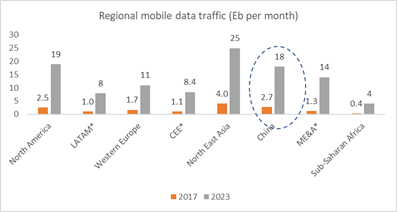
5G networks in China are slated for commercial operation starting no later than 2020. In fact, China Mobile is on track to beat this, as it plans to launch 5G in 2019 itself by partnering with Viavi Solutions. According to Ericsson’s latest report, by 2023 China will add more than 300 million mobile data subscriptions, driving data traffic up to 18EB per month. This promises huge demand for large scale network build out which suggests more business for China Tower.

Figure 3


Source: Ericsson Mobility Report – June 2018.
Note: LATAM=Latin America; CE&E= Central and Eastern Europe; ME&A= Middle East & Africa

In the infant stage of commercial deployment, both 4G and 5G network will co-exist. Wireless networks need to improve their network density, though. Typically, 5G networks will operate on millimeter spectrum (3–5 GHz spectrum bands) which need higher frequency reuse, and this suggests more base stations to match the same level of 4G coverage.  For the MNOs, apart from improving the density of 5G macro cells they also need to utilize small cells and distributed antennae to supplement coverage. This promises huge growth potential for China Tower’s small cell business, which commenced operations in 2017. Moreover, China Tower already has 16,798 DAS sites and recorded exponential revenue growth since 2015, from CNY45 million ($6.7 million) in 2015 to CNY1,284 million ($192 million) in 2017. With the growing demand for wireless coverage inside buildings and tunnels, the future for this segment looks promising for China Tower – which currently contributes a meagre 2% to the revenue.

US-China trade war is bad news for the Hong Kong IPO market

While China Tower gears up for its IPO, it remains cautious about timing: Hong Kong’s financial exchanges will be impacted from the ongoing trade tussle between China and the US. China’s telecom industry is already facing the heat due to tariffs imposed on Chinese imports to the US. This is a setback for the operators as this would mean increased equipment costs, resulting in a possible decline in their profitability. The after-effects to this will also be felt by China Tower, as the big three operators are its major shareholders. The growing trade war between China and the US will also lead to continuous market volatility (at least till the end of 2018) which will significantly impact the Hong Kong IPO market. This was already seen to some extent in Xiaomi’s IPO filing. Early this year, there were rumors that Xiaomi’s IPO would be valued at nothing less than $10 billion, but it managed to raise just about $4.7 billion. Nonetheless, it remains the biggest IPO since 2014.

China Tower will likely experience a daunting task ahead especially with the US-China trade war looming over Hong Kong stocks. And Trump’s recent move to block China Mobile from the US market on security grounds comes as another sign that the trade dispute between the nations will not end anytime soon.