
Blog Details

Post-pandemic chip M&A splurge targets the data center market; room for more consolidation in 2021

After a prolonged hiatus, M&A activity in the semiconductor landscape ramped up significantly this year, nearing the record levels of 2015. The consolidation surge was particularly notable during the second half of 2020. These deals targeted many end use markets but the common thread is the cloud data center market: remote work and study amid the COVID-19 pandemic has spiked demand for cloud-based tools and services. The dealmaking is not yet done. Next year is likely to witness more consolidation among chipmakers, despite geopolitical tensions between the US and China and stringent regulatory scrutiny serving as impediments to deal completion.

Flurry of chip deals bring cheers to an otherwise muted first half

Chip M&A activity had a quiet first half of the year, as COVID-19 created high levels of uncertainty and steep drops in GDP. Stock markets settled in 2H20, though, and big companies found ways to operate amidst a pandemic. COVID-19 remains a severe problem for many major economies, but improved business sentiment and a gradual economic recovery have fostered a strong climate for M&A.

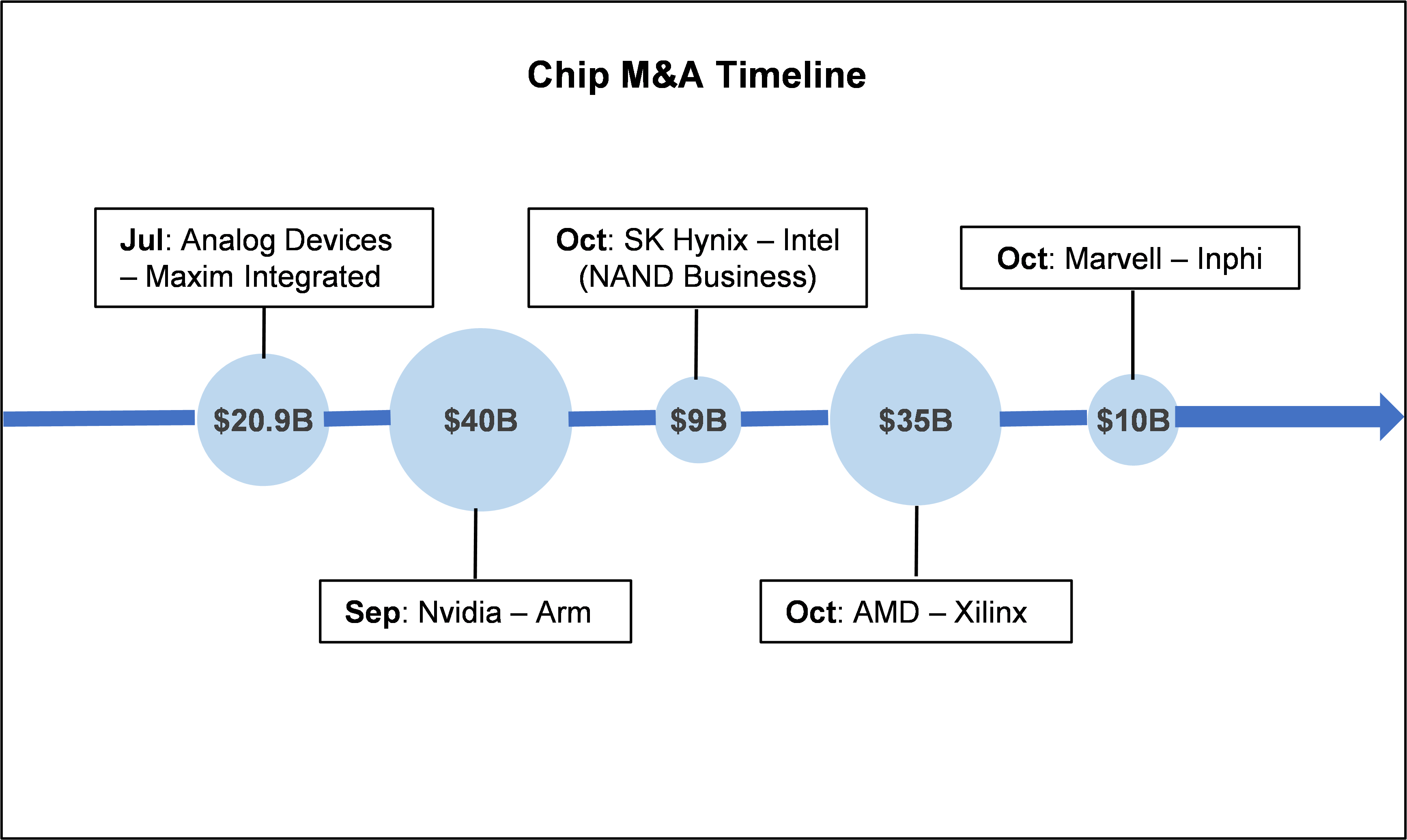
With year-to-date announced deals already topping $100B in value, 2020 is turning out to be a blockbuster year for chip M&A. The mega-deal kickstart to the chip M&A frenzy was Analog Devices’ $20.9B acquisition of rival chipmaker Maxim Integrated Products in July 2020. This was followed by Nvidia’s acquisition of chip design house Arm for $40B in September 2020, the year’s biggest deal so far. The month of October saw a string of M&A agreements featuring the $9B acquisition of Intel’s NAND SSD business by SK Hynix, AMD’s $35B deal to acquire Xilinx, and Marvell’s $10B acquisition of Inphi.

Figure 1: Timeline of semiconductor M&A in 2H20
Source: MTN Consulting

Chipmakers aim at the lucrative cloud data center market

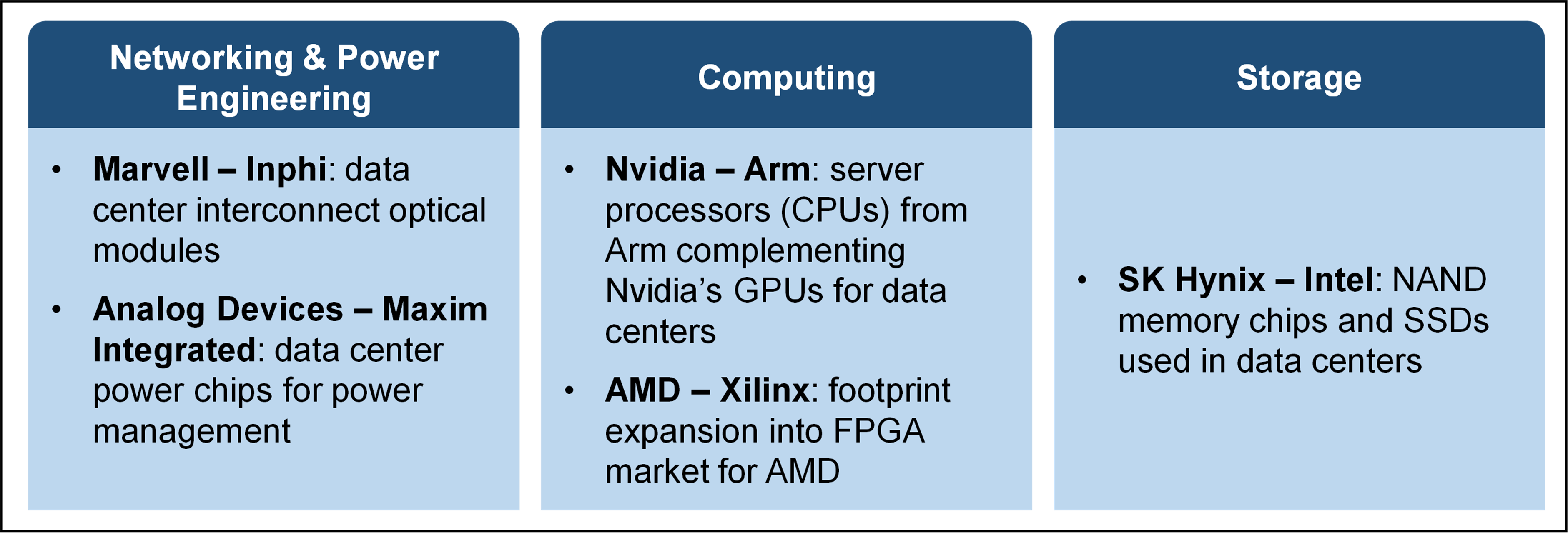
None of the big chip deals are focused narrowly on a single end market, but one key market is of common interest to all – the cloud data center. The deals differ from each other in terms of sub-market focus, though, stretching from power engineering and networking, to computing and storage – see Figure 2 below:

Figure 2: Data center aspects of 2020’s big chip M&A transactions
Source: MTN Consulting

Networking & Power Engineering

Networking and power management form the vital foundation of any data center infrastructure. Optical modules help connect not just the server racks inside data centers but also the data centers to one another across different locations. With the acquisition of Inphi, Marvell aims to target this space by providing interconnect solutions that enable seamless and speedy movement of data between and inside data centers.

Chips for power management have grown in significance over the years to control the biggest expense of running a data center, i.e. power utility costs. Analog Devices is seeking to address this issue through Maxim Integrated’s data center power chips, which also permit greater computational capability to data center operators.

Computing

Data centers typically house thousands of servers that process and run applications along with high performance computing (HPC) workloads. The processing and computational tasks are carried out by server processor chips that come in various forms: CPU, GPU, FPGA (field-programmable gate array), and ASIC (application-specific integrated circuit). Intel, AMD, Nvidia, Xilinx, and Infineon are some of the leading server processor vendors developing either one or most of the chip types.

The acquisitions announced by AMD and Nvidia relate to expansion into new server chip types, and also rivaling Intel as a more formidable force. AMD is looking to dent Intel’s customer base with the acquisition of Xilinx. The FPGA pioneer Xilinx had earlier managed to end Intel’s exclusivity with some its customers such as Microsoft. Meanwhile, GPU maker Nvidia will gain access to server CPU designs through its Arm acquisition. Arm-based server processors are already being adopted by webscalers like Amazon for its data centers. For now, Intel is looking to counter these developments through in-house efforts aimed at the server GPU market for data centers, extending its presence across all the four chip types.

Storage

On the storage side of things for data centers, Intel has agreed to sell off its NAND SSD business to SK Hynix. The assets sold include Intel’s NAND component and wafer business along with the NAND manufacturing plant in Dalian, China, but exclude Intel’s “Optane” memory business. Intel’s NAND memory chips are mostly used in smartphones but also data centers to support in-memory processing demands of the cloud. The business acquisition will elevate SK Hynix’s market share in the NAND memory market, which is currently dominated by Samsung Electronics.

Three key factors are fueling M&A among chipmakers

Three key factors discussed below are driving chip companies to go on a shopping spree:

  • New applications: Key emerging applications based on AI/ML along with new evolving markets in edge computing, self-driving vehicles, and 5G have opened new frontiers for chipmakers. This is in addition to the ever-increasing demand for more media-intensive content such as images, audio, and video streaming over cloud that require faster server processors and networking capabilities for seamless and speedy transmission to end users.
  • Faster time to market: Apart from the obvious reasons of expanding into new markets and accessing proprietary technologies, chipmakers are increasingly exploring M&A to cut down on the costly and lengthy R&D timeline associated with developing advanced process nodes and chips, thus enabling faster scaling. Slowdown in Moore’s law is also pushing chipmakers to look elsewhere.
  • Improved market conditions: A low interest rate environment has enabled chipmakers to borrow modestly and finance acquisitions. Rising stock prices are also aiding large chipmakers such as AMD and Nvidia to fund their purchase either partially or entirely in stocks. Notably, Nvidia surpassed Intel as the largest US chipmaker by market cap in July 2020

More chip industry consolidation on cards but not without hurdles

The M&A activity in the chip market landscape is likely to continue into next year, but probably not at the scale of what has transpired so far in 2020. Even though the deal-making drivers discussed above will persist in 2021, future deals may confront more obstacles related to COVID-19 and geopolitics.

With COVID-19 expected to play out well into 2021, delays in deal-making would keep the deal volumes limited as carrying out negotiations, due-diligence, and audits would be challenging with travel restrictions and limited in-person meetings. For companies having long-term or strong working relationships with prospective acquirer or targets, the pandemic would be less of a worry, as seen with Nvidia-Arm or AMD-Xilinx for instance. These pairings shared strong working relationships prior to acquisition.

Geopolitical tensions between the US and China upsets the stability needed to make M&A deals happen. That’s especially true in the chip sector. With the situation not expected to get any better even under the Biden administration, China has been gearing towards chip self-sufficiency by pouring billions of dollars to support the growth of its domestic chip industry and advanced chip development. Furthermore, open-source chip architectures such as RISC-V have opened the gates for Chinese tech firms like Huawei. Chipmakers will be wary of snapping up companies amid a hostile business climate.

Last but not the least is the regulatory hurdle that an M&A transaction must go through before the final deal closure. Big-ticket deals are subjected to increased scrutiny due to wide-ranging issues such as strict antitrust laws, national security threats, access to proprietary technology, and sanctions imposed under trade disputes. All the chip M&A deals discussed above are pending regulatory approval, in multiple jurisdictions. Among them, the Nvidia-Arm deal is likely to raise eyebrows among the watchdogs, especially in Europe and China. China could essentially prove to be a spoilsport in the Nvidia-Arm deal: Chinese tech firms currently use UK-based Arm’s intellectual property to design chips, which could change post acquisition by US-based Nvidia. If China blocks this transaction, it would not be the first time. Two years ago, China blocked US-based Qualcomm from completing its acquisition of the Netherlands-based chipmaker NXP Semiconductors.

Blog Details

US crackdown on Chinese mobile apps to hit TikTok and WeChat

US crackdown on Chinese mobile apps to hit TikTok and WeChat; next step could affect their use of US technology

This week the Trump White House issued separate Executive Orders banning US companies and people from transacting with either ByteDance, TikTok’s current parent company, or the WeChat messaging service run by Chinese webscale giant Tencent. In effect these orders ban TikTok and WeChat from operating in the US, at least once the order takes effect on September 20. 

Note that this is 6 days after the May supply chain restrictions on Huawei are due to take effect. September is going to be a turbulent month for US-China relations and the broader tech industry.

Chinese ownership at issue

The orders are concerned with data security and censorship stemming from the Chinese ownership of WeChat and TikTok. As they are phrased, the orders affect WeChat directly but TikTok indirectly through a restriction on its current parent company, ByteDance. Hence, TikTok may get a reprieve if it is sold off to a US company like Microsoft

TikTok has been in the news for months and a frequent target of China hawks, and discerning parents. It’s a catchy app, loved by millions. But it is also an incredibly invasive app configured to learn everything it can about your device and the network to which it is connected. And it’s owned by a Chinese company, ByteDance, no matter what legal games are played to make it appear otherwise. 

WeChat is a messaging platform, or THE messaging platform of choice in China, widely used for much more than staying in touch – mobile payments, for instance. It’s not a household name among most Americans but overseas Chinese use it widely. WeChat and Weixin, the domestic brand of the same platform, had a combined 1.2 billion active users as of March 2020.  

The last year of debates around Huawei have reminded us all that the Chinese government has incredible powers to do what it wants with Chinese companies, especially if a national security rationale can be contrived. There is a solid rationale for restricting these companies’ operations in the US, or any other country not willing to give its network secrets away to China, and the US is not the first to make this decision. India similarly banned both apps last month, along with dozens of others.

Beyond network security, there is the issue of content censorship. An American teenager went viral on TikTok several months ago by cleverly inserting views about Xinjiang into a makeup tutorial, after she claims she had been censored for discussing the subject directly. Meanwhile, WeChat’s censorship of content on its platform, even private conversations, has been common knowledge for many years. 

Implications of EO on networks

The ink is barely dry on these EOs and there is much online debate about the implications and legality of the move. They are probably legal, based upon citation to the International Emergency Economic Powers Act and the National Emergencies Act, and despite First Amendment concerns. In my opinion this issue might have been better handled by the FCC, which could have conducted a public investigation, and then established general principles to apply to the next TikTok or WeChat. But the Trump White House is not big on process, always eager to push the boundaries of what it is allowed to do, and there’s an election coming up. 

So the question becomes, what’s next? Let’s assume the orders go into effect, even if they need some clarification down the road. It’s not clear how much they affect Tencent’s broader operations, for instance, including its many investments in affiliate companies in the gaming and video sectors. That will be ironed out, eventually.

What’s interesting to me is what may happen in the network arena. I suspect the next step will be to target how these companies build their networks. Just as the US government can restrict Huawei from accessing US-origin technology, it can do the same for Tencent and TikTok, and the many other cloud/tech players in China attempting to spread their wings globally, many with a US presence.

Tencent’s data center footprint

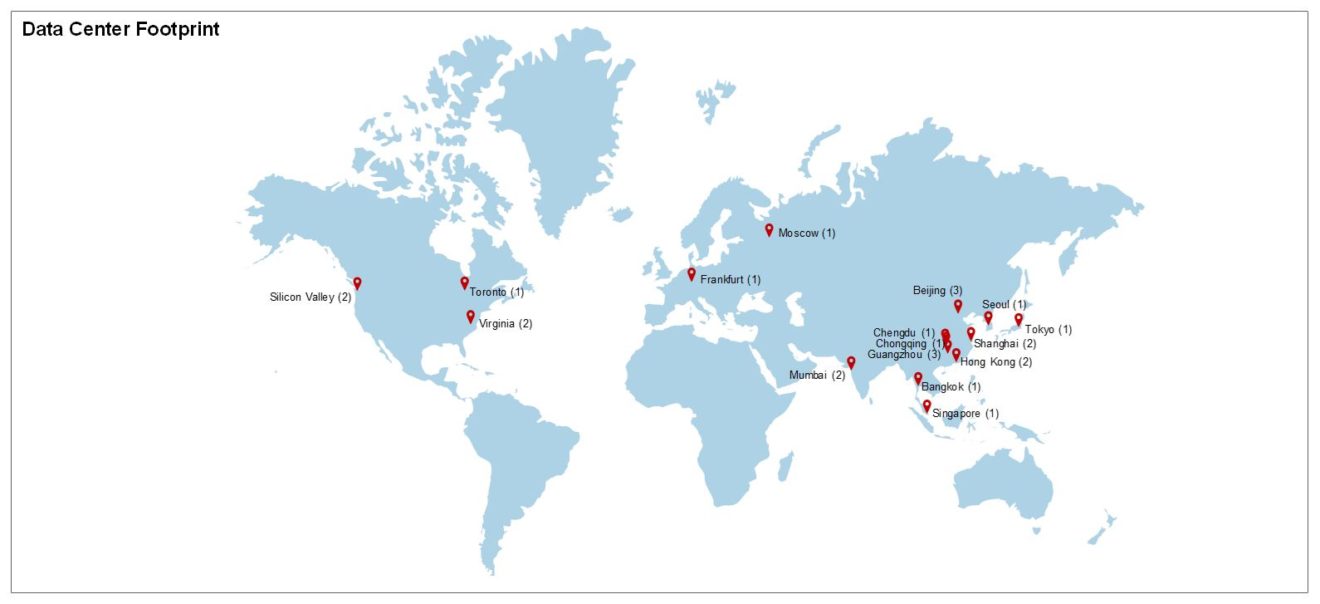
Tencent's data center footprint 1Q20

Hammering down on network design

Tencent, Alibaba, Xiaomi, and several other Chinese tech companies build large data centers using, at least in part, US-origin technology. Many of the firms are building global operations, and some have infrastructure in the US. If the US has security concerns about their scope of operations, ownership, and intentions, then it may limit the companies’ access to certain US-origin technology. In fact, we predicted this would happen in a Commentary published in June. While the EO doesn’t clearly reference this aspect, it seems inevitable that some arm of the US (yes, even under a President Biden) will restrict the Chinese cloud players’ access to US tech. That would affect Tencent in a big way, as it has data centers spread across the globe and spent nearly $5B in capex in 2019.

In building out their clouds, much of the technology the Chinese players use is produced locally. That’s not the case for chips, though. Even though they have been building their self-design capabilities for several years, Chinese webscale players continue to buy most high-end chips directly from US suppliers. And even for their self-designed chips, for production the Chinese option SMIC is not the solution. Alibaba’s Pintouge chip unit has been relying largely on Taiwan-based TSMC, while Baidu has partnered with Samsung.

Tencent is also working on chip self-design, but at a much earlier stage. It relies even more heavily than Alibaba and Baidu on US companies for building out its network, including AMD, Intel, Nvidia, and Qualcomm. It also uses Acacia and (Finland-based) Nokia for data center interconnect optical transport. These vendors will be affected by the EOs eventually, and should expect to lose some sales. We should also expect the Chinese government to keep up the pressure on SMIC to mature production capacity, and expect the subsidies to keep flowing.

One other inevitability, in my opinion, is a crackdown on Zoom. It’s amazing to me that it hasn’t happened yet. The logic of limiting Zoom’s US access is essentially the same as for WeChat and TikTok: Chinese ownership, requires disclosure of private device and network information to function, and at least some history of censorship.

Blog Details

Alibaba aims to undercut US chipmakers’ dominance

Alibaba entered the club of webscale network operators (WNOs) developing their own chips recently, joining Amazon, Apple, Facebook, and Google. The Chinese e-commerce giant announced plans, in September 2018, to develop its own customized neural network chip, called Ali-NPU, to aid its growing cloud and IoT businesses. But unlike its WNO peers who want more flexibility and cost-efficiency in their operations by running in-house chips, Alibaba’s move is motivated by a grave external risk: the US-China trade war fallout.

A series of trade disputes set alarm bells ringing for Alibaba

Alibaba views its move as a precautionary response to a series of hostile trade events this year, starting with the leading US carriers, Verizon and AT&T, deciding to halt selling phones of the Chinese handset maker, Huawei, in January 2018.

Multiple factors were involved but there’s no doubt that the carriers felt pressure from the US government over national security concerns. This was followed by an even bigger move: an executive order issued by the US President, Donald Trump, prohibiting the Qualcomm-Broadcom deal in March 2018.

The order was driven by national security concerns over the deal’s (mainly indirect) benefits to Huawei and other Chinese institutions. The US Commerce Department’s April 2018 crackdown on the Chinese telecom giant, ZTE, seemed to be the final “wake-up call” for Alibaba. The Commerce Department imposed a seven-year ban on chipset exports to ZTE. The ban was based on some serious misbehavior at ZTE, not just a political stunt. While it was resolved in July 2018, for several months ZTE was forced to essentially cease operations.

ZTE’s problems highlighted how dependent Chinese tech companies remain on US firms in specific markets, including parts of the semiconductor industry. The aftermath of these events prompted Alibaba to pull back its overall presence in the US in June 2018, followed by scaling down expansion of its cloud business, AliCloud, in September 2018.

Alibaba goes rogue

Also at the end of 3Q18, Alibaba started to formalize its chip self-development plans.

The main one involves the recent launch of a semiconductor subsidiary, Pingtouge, that will start manufacturing AI-based chip, Ali-NPU, along with quantum computing processors in the second half of 2019. The subsidiary set-up comes close on the heels of Alibaba acquiring Chinese chipmaker Hangzhou C-SKY Microsystems in April 2018, to boost its chip production capacity.

Earlier this week, the US Commerce Department issued another export ban affecting Alibaba indirectly, this time on the Fujian Jinhua Integrated Circuit Company. Whether well-founded or not, this ban pushes Alibaba (and other Chinese WNOs) further down the road of self-development.

Global expansion unaffected

There are no signs that its supply chain headaches are slowing down Alibaba’s cloud construction efforts.

In fact, following its decision to scale back expansion in the US, Alibaba is looking at South-East Asia, India, and Europe as the “new target markets” for its cloud business. And the company has been aggressive about it – in 2018 alone, Alibaba launched five cloud data center operational sites across three international locations: the UK (2), India (2), and Indonesia (1). That explains the spike in annualized capex and capital intensity for the period ending 2Q18 in the figure below.

The capex growth trend is expected to continue in the medium to long run, given Alibaba’s data center buildout plans along with its efforts to disrupt industries such as hospitality, smart cities, and logistics. (For a complete analysis, see MTN Consulting’s Webscale Playbook: Alibaba, published October 2018).

US-based chip vendors feel the heat

With some semiconductor-related goods in the tariff list, the mounting trade friction between the US and China is making US-based chip developers nervous. That’s understandable as China buys chips more than any other nation in the world, accounting for 29% (US$100 bn) of the global demand for semiconductors, according to a 2016 study by the US Department of Commerce. The threat of new competition from China intensifies concerns.

One US-based vendor facing direct fallout from the ongoing trade dispute is Qualcomm. After the Qualcomm-Broadcom deal fallout in March 2018, another big-ticket merger deal involving Qualcomm became victim to the US-China trade spat. This time, China played spoilsport due to its failure to approve Qualcomm’s US$44 billion deal to acquire the Netherlands-based NXP Semiconductors in July 2018. Adding salt to the wounds, Qualcomm had to pay a massive US$2 billion termination fee to NXP Semiconductors for scrapping the deal.

Another issue is the US chipmakers’ high exposure to Chinese markets that makes them even more vulnerable to the situation. Qualcomm features here again, topping the list with a huge revenue exposure of 65% in FY17. Intel’s biggest market by revenues is China, deriving close to a quarter (23.6%) of revenues in FY17, while NVIDIA accounted for about a fifth (19.5%) of revenues from China during the same period.

US-based webscale operators (Amazon, Facebook, Google, etc.) efforts to design their own chips has already made some vendors nervous, and the trade dispute has only worsened this. Alibaba’s response with its chip push could just be the “tip of the iceberg” as more Chinese companies could follow suit; case in point being Baidu launching its own AI chip, Kunlun, in July 2018.

Beijing’s technology ambitions complement Alibaba’s move but challenges remain

China is looking to use its supportive domestic policies to close the technology gap with the US in the medium to long run. In line with this, it is investing billions of RMB in homegrown chipmakers such as Fujian Jinhua (from this week’s ban) and Tsinghua Unigroup. It also announced plans to create a US$47 billion fund in May 2018 to boost semiconductor industry, and is seeking to surpass the US as the global leader in AI by 2030. Alibaba wants to play a big part in effecting the transition. But this transition will require foreign technology and scarcely available talent.

(Photo credit: Alibaba)

Blog Details

Facebook’s Plan To Design Its Own AI Chips Has Set Alarm Bells Ringing For Qualcomm, Nvidia And Intel

[Ed. note: see Sept. 2018 publication, Webscale Network Operators: 3Q18 Market Landscape]

Rumors about Facebook’s likely entry in the hardware segment were put to rest after the company posted job openings for chip designers. Facebook was looking for candidates specialized in architecting and designing ASIC and FPGA chips, to help build “custom solutions targeted at multiple verticals including AI/ML, compression, and video encoding.” Facebook has data center applications on the mind, such as live video content filtering, but the company may also be building chips to support its Oculus virtual reality headset and long-planned smart speaker.

Facebook’s chip plans are risky but may bring increased control over supply chain

Facebook’s recent move to make its own artificial intelligence (AI) chips and get a foothold in the hardware segment is a step in the right direction, as it looks to reduce dependence on chip manufacturers (Intel, Nvidia and Qualcomm) while putting a lid on its costs. However, designing a chip is by no means a simple task and not a core competency at Facebook. Matching the performance and efficiency of Intel, Nvidia and others will be a challenge.

Why would Facebook take the risk? It’s loaded with cash ($41.7B in Dec 2017) and used to making high-stakes tech investments. But the chip market is competitive, and Facebook has substantial buying power – it could certainly rely on the open market. Time to market may improve with self-design, for sure. However, another benefit may be more persuasive: Facebook gets greater control over intellectual property rights and information flow. It likely has a few surprises in store.

Big technology investments needed to support social networking

Facebook’s growth has been driven by acquiring and strengthening complementary services to its social networking business, such as WhatsApp and Instagram. Supporting this growth enticed Facebook to build a huge core network.

Like other webscale providers, Facebook works with contract manufacturers to build custom servers and other gear for their massive data centers. Facebook has played an important industry role in this regard, serving as an early sponsor for both the Open Compute Project (OCP) and Telecom Infrastructure Projects (TCP). Now Facebook is testing the waters in consumer electronics markets, initially with its Oculus virtual reality headsets, a smart speaker to be launched in 2018, and complementary AI software. These efforts have contributed to both high capital spending and R&D expenses at Facebook (Figure 1).

Facebook believes that creating its own custom designed chips will result in better integration of hardware and software, and give it tighter control over the development of the product. One factor behind Facebook’s chip push is an interest in running AI algorithms in-house, to avoid sharing with third-party vendors like Intel or Qualcomm. Not every webscale company can do this, but Facebook is positioned better than most due to its deep capex budget & its pioneering work at the OCP, TIP, and other groups.

Working in Facebook’s favor is its recent partnership with Intel to manufacture its own AI processor last year.

Impact of Facebook’s entry into the semiconductor space on the big chipmakers

In the past two years, there has been growing tension between the tech players building cloud networks and the vendors they rely on, mainly Intel, Qualcomm, and Nvidia. Historically the largest cloud builders, “webscale network operators” (WNOs) in our terminology, have heavily relied on Intel’s microprocessors and Nvidia’s GPUs to power their data centers (Figure 2).

However, Facebook is not the only WNO to look at building its own chip. Many webscale providers are starting to look in-house to build custom AI chips to reduce costs and improve on efficiency. For instance, Google developed an AI chip, Cloud Tensor Processing Unit (TPU), two years back, to boost its AI workloads. Google released a latest version this month, indicating that Nvidia’s dominance as a supplier of AI chips could soon be in jeopardy. Similarly, Apple plans to build its own chips for its Mac desktops by 2020, thus reducing its dependence on Intel. Amazon is building its own custom hardware to improve its Alexa enabled devices. Microsoft has launched a new cloud service for image-recognition projects powered by its FPGA technology, codenamed “Project Brainwave”.  This will rely on Intel Stratix 10 chips and support a neural network based on the ResNet-50 architecture. Microsoft claims that this new technology will be capable of handling AI tasks rapidly enough to be used for real-time jobs and at a reduced cost in comparison to the graphics chips (e.g. NVIDIA) used in machine learning tasks.

As webscale tech players build more of their own chips, traditional chip developers are getting nervous.

One company affected in a big way by Facebook’s move is Qualcomm. Facebook’s new chips may be used to power its VR headset, Oculus Go, which currently runs on a Qualcomm Snapdragon 821 chip. This could be a huge blow for Qualcomm. And it comes at a time when Qualcomm is already struggling after its legal battle with Apple, an attempted acquisition from Broadcom, and a still-pending merger with NXP.

The chip vendor’s fears are not just theoretical. Webscale players have already had an impact on the supply chain, hurting server vendors like IBM and HPE in past years by going to white box/contract manufacturing. Now they’re big enough to design their own chips. That cuts out the middleman, avoids having to share secret IP, maybe speeds time to market, and may result in some proprietary advances.

Facebook will have to win back faith amidst data privacy scandal

While Facebook engineers will continue to find ways to make their network cheaper and smarter, the company faces more complex challenges in the area of data privacy & public perceptions.

Facebook’s privacy practices have come under global scrutiny in recent months, due to the recent Cambridge Analytica and Android call data scandals, not helped by a photo tagging-related lawsuit. As a consumer-facing brand with plans to build its own IoT hardware, a lot is at stake. The company needs to build trust and improve transparency. It cannot do this while also maximizing ad revenue growth. Not all Facebook executives seem willing to accept this.

Amid all the public outcry, the launch of Facebook’s smart speaker has unsurprisingly been delayed. With recent news that Amazon’s Alexa has some interesting privacy-related glitches, Facebook’s decision is probably best. Now seems like a good time to focus on the basics.