
Blog Details

Vendor landscape continues to shift in telecom market as cloud and 5G scale

Telco network spending has been on the rise over the last few quarters. Vendor sales of network infrastructure to the telco vertical (“Telco NI”) totaled $55.5B in 1Q22, up 5.7% YoY. On an annualized basis, Telco NI revenues through 1Q22 were $234.8B, the highest total in our 1Q13-1Q22 database and 6.8% higher than the 1Q21 annualized figure. Telco capex has been strong the last few quarters, and vendors are benefiting. The growth is not dramatic, but any kind of growth at all in telecom is a plus, and often a surprise.

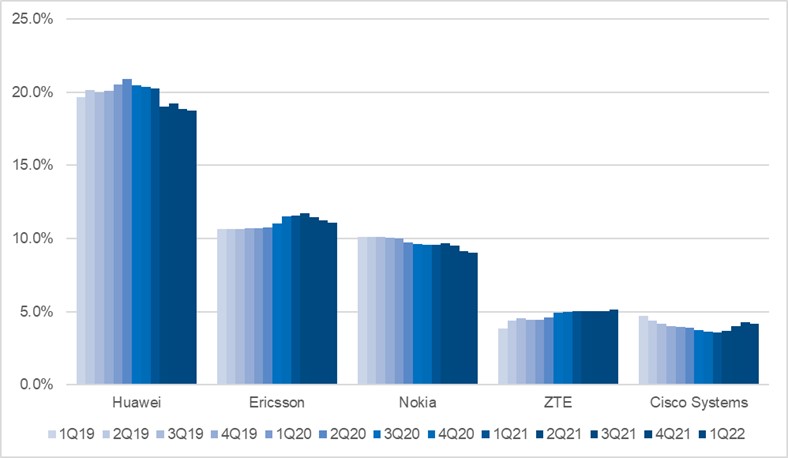
As telco spending has risen post-COVID, the top few vendors remain at the top. While share always varies a bit by quarter, the biggest five network equipment providers (NEPs; excludes China Comservice) have collectively accounted for about 50% of the Telco NI market over the last few years. Figure 1 shows annualized share evolution for these vendors, from 1Q19 through 1Q22.

Figure 1: Annualized market share of top 5 NEPs in the telco vertical, 1Q19-1Q22
Source: MTN Consulting

While the top 5 remain the same and their aggregate share of wallet is stable, there are some significant shifts underway in the vendor landscape.

What drives these shifts? Some are driven by financial machinations or politics, but most are aimed at improving competitive positioning. More specifically, improving a vendor’s ability to address key customer needs. In the telco vertical, these include: deploying telco cloud functions and architectures; monetizing new network capabilities, in particular 5G; lowering the cost of transport and routing; improving the energy efficiency of networks; automating networks; lowering the cost of customer acquisition and retention; and, developing revenue streams in new areas like mobile payments, digital advertising, home networking, connected cars and security. There are probably more shifts underway nowadays because 5G cores are beginning to be implemented in a big way, and Huawei’s problems continue to open up new opportunities for smaller vendors.

Most of the shifts in the vendor landscape involve smaller players, outside the top 5. Ericsson’s acquisition of Vonage is an exception; MTN Consulting published a blog post on this deal in May. Setting aside the top 5, ongoing changes in the vendor landscape fall into a few broad categories.

Growth of the cloud providers

Alphabet (GCP), Amazon (AWS), and Microsoft (Azure) together booked approximately $3 billion in revenues to the telco vertical for the 1Q22 annualized period, from less than half a billion USD in 2Q18-1Q19. They now partner with telcos on a range of areas, as MTN Consulting mapped out in the report “Telcos aim for the cloud by partnering with webscale cloud providers.” Their aggregate share of Telco NI is now about 1.3%, around the same as Accenture and a bit more than IBM. They have a long way to go, but they are already making a dent in the market and continue to invest heavily in the telco vertical.

Most of the cloud providers’ success in telecom stems from organic investment, but not all; Microsoft has completed three acquisitions that accelerated its push into telecom: Affirmed Networks, Metaswitch, and AT&T’s Network Cloud.

Vendor partnerships with webscalers

As webscalers began to make a real dent in the telecom market in 2020, traditional telco-facing vendors realized they could benefit from some joint development and marketing ventures with the webscalers. That was especially apparent as telcos began to deploy 5G cores and needed cloud smarts from their suppliers. Over the last three years, most big telco-focused vendors have entered into partnerships with traditional telco-facing vendors like Ericsson, Nokia, NEC, Fujitsu, and Amdocs. Some of these are generic, some are customized for specific large telco accounts, e.g. Telecom Italia.

Restructuring and realignment 

Dell, including its majority holding in VMWare, saw its revenues in the telco vertical rise steadily in the 2019-21 period. The company’s 2021 revenues in telecom amounted to just over $2.7B. VMWare is responsible for much of this, boosted by its Telco Cloud offerings. Late last year, Dell spun out its majority holding in VMWare. This was aimed partly at raising cash, but also at creating more value in VMWare, which has a different business model and profit margins than parent Dell. The two retain strong connections and partnerships, including in the telco space.

Since the Dell-VMWare spin-off in 4Q21, a bigger shift has occurred: in May 2022, Broadcom agreed to acquire VMWare, for $61 billion. Broadcom says the deal will combine its software portfolio with VMWare’s multi-cloud offerings. Telco is only one of many reasons for this deal, not a central one. Prior to the deal, Broadcom alone did have some small position in Telco NI, due largely to previous acquisitions (Brocade, and CA Technologies). The synergies involved in this deal seem questionable, but importantly Broadcom claims it will allow VMWare to operate with a degree of independence.

In the same quarter as Dell’s spinoff of VMWare, IBM separated its services group into a new company, Kyndryl. This deal was also driven by an interest in separating two companies with significantly different business models and profit margins. Both go after telco business though. Red Hat is at the core of IBM’s efforts to improve its penetration of the telco sector, and it has had some success. Kyndryl inherits many relationships with telcos cultivated by IBM’s services group over the years. That includes deals with Bharti in India, including a blockbuster $1.4B deal for IT operations outsourcing, way back in 2004. Interestingly, 5G monetization is front and center of Kyndryl’s messaging for the telco vertical, which is a similar driver to what’s behind Ericsson-Vonage.

Still pending: CommScope has been attempting to spin out its Home (CPE) division for several quarters, but there is no confirmed buyer. There’s some chance that the company will just reintegrate the division, as options are limited. Acquisition by private equity is likely being considered, though.

Telcos investing directly in technology supply

There are a few cases of telcos either creating a vendor in-house or acquiring a large ownership stake in one which already exists:

  • Rakuten Symphony: Rakuten’s creation of Symphony is most notable in recent years – the highest stakes, and probably the most expensive. Payoffs may be many years down the road, as more telcos consider open RAN for brownfield networks and Symphony develops more of a track record.
  • Tata Sons-Tejas Networks: Tejas Networks sold a controlling stake (43.4%) in July 2021 to Tata Sons group, which wants to help Tejas grow. The Tata group includes a telecom division, Tata Communications, with $2.3B in 2021 revenues, making it India’s fourth largest private telco. Tejas is focused on optical networks.
  • Verizon-Casa: in April 2022, Verizon announced it would invest $40M in one of its smaller vendors, Casa Systems, at the same time as agreeing to a multi-year contract.
  • NTT-NEC: further back, in June 2020, NTT announced a $560M investment into key supplier NEC, for a 4.8% stake in the company. This aimed partly at helping NEC expand its 5G offerings and leverage an opening in the global market for wireless technology opened up when Huawei began to face supply chain and political constraints in 2019-20.

Vendor-vendor M&A deals

The vendor landscape also continues to be impacted by more traditional M&A deals, where a vendor acquires another technology supplier. Some of the recent transactions include: 

  • NEC: this Japanese vendor has committed to expand in the mobile technology space, with focus on open RAN. Earlier in July, NEC agreed to acquire Aspire Technology Unlimited, an Ireland-based systems integrator, to help with this pursuit.
  • ADVA-Adtran: these two small but profitable wireline vendors announced plans to merge in late 2021, and the deal just closed. The new company, ADTRAN Holdings, may have a leg up in pursuing the many transport network upgrades and broadband access buildouts underway worldwide right now. The new ADTRAN may also be better able to deal with supply chain constraints, which continue to be an issue for smaller NEPs.
  • Sterlite: this India-based optical supplier has been growing over the last few quarters, exploring overseas markets for fiber optics, launching a small range of wireless products, and acquiring a UK-based systems integrator, Clearcomm Group, in 2021.
  • Accenture: has spent heavily on a wide range of acquisitions in the last two years, across industry verticals. Deals impacting telecom include Arca, a Spanish engineering services company, in 2020; umlaut, a German network engineering, testing and analytics company, in 2021; and Advocate Networks, a technology consultancy and managed services provider, in 2022.
  • Aviat-Ceragon: most mergers are friendly, where both sides agree. As Elon Musk’s attempted purchase of Twitter reminded the world, there are also less friendly forms of acquisition. This Aviat-Ceragon deal is basically a hostile takeover of Ceragon, proposed by Aviat. It’s still pending and the two parties may not come to agreement. However, the motive is worth noting. Aviat’s hope is that the deal would give the combined company more scale and better margins, and a stronger ability to compete with Huawei, Ericsson and Nokia in the wireless transport space as opportunities arise for 5G backhaul & fronthaul and support for private wireless networks.

Finally, one significant acquisition involves a large established telco-facing vendor acquiring telco assets. In September 2021, Ciena acquired AT&T’s “Vyatta” virtual switching and routing technology.  As Ciena said at the time, the deal aims to address “the growing market opportunity to transform the edge, including 5G networks and cloud environments.” Many shifts in the vendor landscape aim at this same opportunity.

*

Photo by Hans-Peter Gauster on Unsplash

Blog Details

Connected cars: OEM car maker strategies – where does the network operator fit in?

Connected Car Emerging Tech Series Part 3

Author: Waseem Haider

Today’s car industry is not the same as it used to be, thanks to technology. OEMs are not only manufacturing cars but also developing software solutions for a more connected, personalized customer experience. The ever-evolving auto industry provides opportunities to OEMs to advent new revenue streams and to have more direct, ongoing relationships with their consumers. The changing landscape comes with its share of challenges for OEMs as they need to now focus on products and services outside of their core activities and try to improve profitability by selling connectivity as part of their overall offering.

OEMs are developing different strategies to reap the full benefit of the connected car opportunity. Some OEMs are working on their own ecosystem while others are developing partnerships with specialist vendors. The expanded connected car ecosystem plays a significant role in catering to the consumer demand of today and in the future. Among the different stakeholders in the ecosystem, the role of network operators – both telcos and webscalers – cannot be ignored. In this third part of the connected car tech series, we will talk about the strategies of OEM car manufacturers in the connected car space, and the role played by network operators.

OEM connected car strategies

As with any other industry, the digital transformation of the automotive industry poses a great challenge to OEMs. The digital world has pushed car manufacturers to become software companies selling a personalized customer experience to meet changing consumer demands. Future car buyers will not make it easy for OEMs as the world will move to autonomous vehicles with some drastic changes in consumers’ willingness to own a car. OEMs are aware of these challenges, and are implementing different strategies to keep their dominance in the connected car space despite competition from big tech companies. 

In this section, let’s dive into some of the OEMs connected car strategies.

From the premium car manufacturers like BMW, Porsche, Audi, Mercedes etc. to the volume brands like Ford, Opel, Volvo etc., strategies differ based on relative dominance of the OEM, customer engagement, in-house capabilities, innovation, and investment in R&D. To simplify, let us group the OEM strategies in the connected car space into three main approaches:

  1. Developing In-house Capabilities
  2. Partnership/Building an Ecosystem
  3. Working with Global Industry Standards

1 – Developing In-house Capabilities

Big tech companies like Google, Facebook, and Amazon are at the forefront of connected car technology, putting Automotive OEMs in a difficult situation. As the expertise required for connected cars goes beyond the core business of OEMs, they are facing a big challenge to keep a dominant position in the ever-expanding ecosystem. Some of the OEMs are taking on these tech players directly by building in-house assets and capabilities for connected cars. One of most prominent OEMs who is realigning its strategy from car manufacturer to a software-driven mobility provider is Volkswagen.

Case Study: Volkswagen Connected Car Strategy

Volkswagen is reinventing itself into a digital mobility provider by investing heavily into several areas: software development, autonomous driving capabilities, electric vehicles’ battery technologies and other mobility services. With the new Group strategy “NEW AUTO – Mobility for Generations to Come”, the Volkswagen Group is realigning from a vehicle manufacturer to a leading, global software-driven mobility provider.

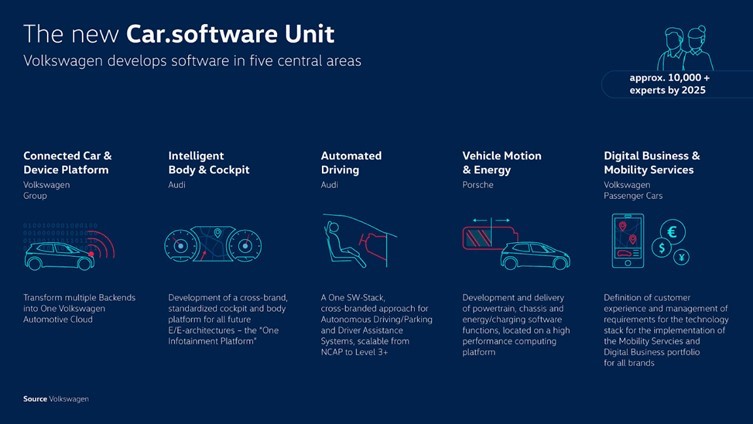
Volkswagen’s Car.Software group is central to this realignment (figure 1, below). The automotive giant is building its own end-to-end software platform with an in-car operating system (VW.OS), and capabilities aimed to enable the next generation of infotainment, vehicle performance, and passenger comfort as well as automated driving.

Figure 1: Volkswagen’s Car.Software organization

Fig 1, VW car software

Source: Volkswagen

In addition, Volkswagen has announced a strategic partnership with Cubic Telecom and Microsoft to develop the Microsoft Connected Vehicle Platform (MCVP).

Together with Microsoft, VW hopes to accelerate the development of one of the largest dedicated automotive industry clouds, known as Volkswagen Automotive Cloud or VW.AC. Designed to provide a smart, scalable foundation for connected vehicles, VW.AC is expected to handle data from millions of vehicles per day, with the goal of delivering connected experiences to customers around the globe starting in 2022 – a key part of the Volkswagen Group strategy to become a leading automotive software innovator.

Volkswagen Group writes less than 10 percent of the software embedded in its vehicles, the rest of which is tied to third party-owned proprietary software. With efforts like the Car.Software Organisation and VW.AC, the Volkswagen Group aims to write 60 percent of the vehicle software by 2025, providing a truly integrated end-to-end software.

Where does the network operator fit in? 

While Volkswagen is focused on in-house capabilities, its work with Microsoft makes clear that this strategy still involves network operators. Microsoft is one of the world’s largest “webscale network operators”, a tech company investing heavily in its own data centers, subsea cables, and related cloud infrastructure. It is possible that other types of operators may play a role in Volkswagen’s strategy over time, including telcos. Apart from providing connectivity, the operator is strongly positioned to offer cloud services, software and hardware solutions to supplement the OEM’s connected car in-house capabilities.

2 – Partnership/Building an Ecosystem

Some automotive OEMs are partnering with other OEMs by building global alliances to develop digital technologies for connected cars and future mobility services. One such global partnership is “The Alliance,” involving three OEM groups – Groupe Renault, Nissan Motor Company and Mitsubishi Motors Corporation –  working together on future mobility technologies and solutions.

Where does the network operator fit in?

With this approach, three big OEMs are working with each other to develop connected car technologies and solutions. Telcos can be helpful partners in such alliances to provide technology software and solutions. As an example, the Renault-Nissan-Mitsubishi alliance is working together with Orange in the field of electric vehicles (EVs). Microsoft also plays a role in The Alliance, as discussed below.

Case Study: Renault-Nissan-Mitsubishi connected car strategy

The Alliance connected vehicle team is developing the Alliance Intelligent Cloud. Microsoft supports the Connected Vehicles Platform component of the Alliance Intelligent Cloud (figure 2, below). The Connected Vehicles Platform manages Alliance connectivity across all markets. 

Figure 2: The Alliance Intelligent Cloud

Fig 2, the Alliance Intelligent Cloud

Source: Microsoft

Microsoft is not the only Alliance partner. In September 2018, the Alliance signed a global multiyear agreement to partner with Google to equip Renault, Nissan, and Mitsubishi Motors vehicles with intelligent infotainment systems. The Alliance will utilize Android to offer customers a new array of services including Google Maps, the Google Assistant, and the Google Play Store.

These services will be combined with Alliance Intelligent Cloud-based remote software upgrades and vehicle diagnostics. By combining the latest technologies from the Alliance and Google, the Alliance member companies’ vehicles aim to have the most intelligent infotainment system in the market. Drivers and passengers can leverage Android capabilities to access an ecosystem that includes several existing applications and an expanding array of new apps. Per Microsoft, vehicles utilizing the Alliance Intelligent Cloud “will benefit from seamless access to the internet, providing enhanced remote diagnostics, continuous software deployment, firmware updates and access to infotainment services.”

The Alliance Intelligent Cloud is designed to leverage the combined scale of the three partners and Azure’s vast footprint. The Alliance cloud aims to consolidate multiple legacy connected vehicle solutions with future connected car features and business operations, and support mobility services. Features built into the connected platform include remote services, proactive monitoring, connected navigation, connected assistance, over-the-air software updates and other customer tailored services. As noted, The Alliance does leverage Google’s Android app ecosystem, but relies heavily on Microsoft for the cloud. The goal is for this partnership of OEMs to own, operate, and design their own intelligent cloud platform on Azure.

The Alliance Intelligent Cloud also aims to connect Alliance vehicles with future smart cities infrastructure, simplifying negotiations and technical development by providing a single point of contact.

3 – Influencing Global Industry Standards

Automotive OEMs are not anymore only manufacturing cars but are also new-age software companies which need to comply with standards. The challenge, though, is for OEMs there are hardly any global industry standards for connected cars. This lack of standards also creates an opportunity; those who write the standards often have a strong position in the market to follow. One strategy is ensuring you have a seat at the table when the standards are drafted.

To address the standards issue, OEMs together with other automotive vendors formed a non-profit alliance in 2009 – GENIVI. The alliance develops standard approaches for integrating operating systems and middleware present in the centralized and connected vehicle cockpit. The GENIVI platform consists of Linux-based core services (kernel, libraries), middleware and an open user interface. The goal is for this platform to form the basis upon which automobile manufacturers and their suppliers can establish a wide variety of products and services.

Notably, the alliance currently has no participation from the network operator side. The only exception is that Github has long been a member, and Github was acquired by Microsoft in 2018. Going forward, telcos and webscalers aiming to play a key role in the connected car market may need to participate in GENIVI.

Conclusion

Regardless of which connected car strategy is adopted, the common thread is that OEMs do not want to give away their dominant position to big tech players or new entrants. The three approaches discussed above should not be seen as exclusive. There are opportunities to combine one or more approaches with other innovative strategies. Network operators from both the telco and webscale/cloud world have opportunities to collaborate with OEMs, offering complementary solutions such as cloud services, software and hardware solutions along with the core asset of an operator, network connectivity.

Image source: Baidu

Blog Details

5G positioning update: Intel and Nokia

Intel and Nokia 5G Update

Author: Arun Menon

MWC was held in person this week, for the first time since February 2019. With all the hype about MWC’s re-emergence, it’s easy to forget that vendors update the analyst community on products & strategy all the time, independent of trade shows and conferences. That’s all the more true since COVID-19 virtually killed the trade show, and a nonstop stream of online events took over the analyst’s schedule. Vendors still do pre-brief analysts in advance of important events like MWC, though. Intel and Nokia both did so in late June. Nokia addressed 5G core and hyperscale issues, while Intel provided an update on its overall 5G network and edge strategy.

Nokia: “The future of 5G Core”

Late last month Nokia held a session for analysts, “The future of 5G Core on hyperscalers and the journey to NaaS.” With the growth of telco spending on 5G cores (including transmission) this year, and Nokia’s repositioning towards more collaboration with the webscale (aka hyperscale) sector, this was an enlightening session.

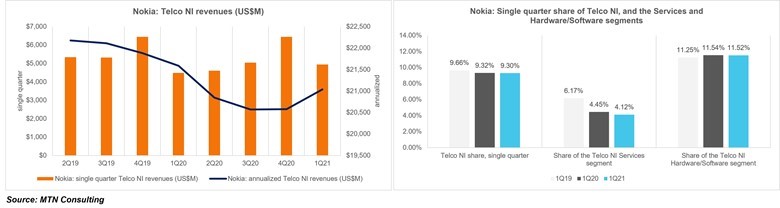
As background, Nokia is ranked 3 in the global market for telco network infrastructure, and places second in the hardware & software segment of telco NI. The below figure illustrates Nokia’s telco NI revenues over the last few quarters and its share in the overall market, as well as the services and hardware/software segments.

Intel-Nokia 1

MTN Consulting’s summary of the Nokia session follows.

  • With the advent of 5G, CSPs (telcos) face challenges brought by multi-layered networks that run complex operations
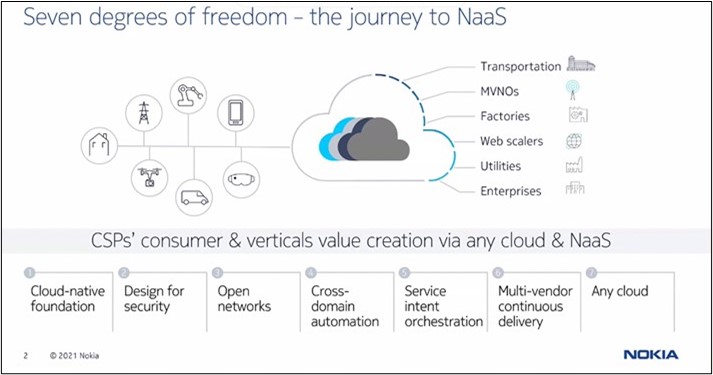
  • “Seven degrees of freedom” are key for CSPs to achieve the full business value of 5G and embark on a journey to a Network-as-a-Service (NaaS) future
  • The seven degrees of freedom represent seven key design principles that can be addressed by CSPs to achieve full freedom in creating value with 5G and transition to NaaS in the most flexible way. The chart below illustrates the seven degrees.

Intel-Nokia 2

  • The seven principles presented by Nokia consist of the following:
    • Cloud-native foundation: Inconsistent or limited implementations of cloud-native real-time applications will restrict a CSP’s ability to achieve a true 5G network that can take full advantage of the cloud’s agility, scaling and efficiency. Software vendors must develop the right disciplines of cloud-native design across the full span of 5G applications, and consistent methodology is key for simplification.
    • Freedom of “any cloud” platform: CSPs gain flexibility by being able to use any platform for cloud and NaaS. The challenge is to ensure multiple vendors’ telco applications can readily use cloud vendors’ Containers-as-a-Service (CaaS) and Platform-as-a-Service (PaaS) capabilities.
    • Openness of networks and ecosystems: Service-oriented architectures (SOAs) have existed in the webscale world for 15+ years, yet telco applications struggle to fully embrace the SOA approach. It is essential for a CSP to build a norm of using open networks and ecosystems in their organization. Strong API design in secure and non-secure environments is the basis for uniform exposure that enables the creation of 5G services and simplified operations.
    • Cross-domain automation: Cloud-native designs increase complexity at the application and sub-domain levels. Also, when automation overlaps with a hybrid private/public cloud strategy, real-time application complexity and lifecycle management needs are enormous compared to a simple web application. There is a need for careful software design for highly complex lifecycle interdependencies.
    • Service intent orchestration: Service intent-driven network orchestration is vital for the design of 5G slicing and agile 5G vertical services. This requires service demand to be attached to a QoS and SLA metric across the network. Core, radio and routing must be tightly connected to deliver the required SLAs and QoS. The orchestration and assurance of these designs is complex.
    • Build a continuous delivery framework: CSPs work with multiple vendors that feed software into their extensive landscape of network and operations. Legacy process models cannot support a continuous feed of new software releases being introduced more often. The software delivery pipeline must be mature enough to handle multi-vendor environments, and it must be secure and consistent in both building and testing frameworks. All integration points must be automated and secure.
    • Design for security: Security is an ever-present and ever-growing challenge. Threat analysis, vulnerability management and software validation are essential considerations when designing and delivering applications. Applications must be built with a “design for security” practice, including a detailed security risk assessment. Security must be end-to-end and continuous across applications, endpoints, management access points and APIs. 
  • Nokia’s lessons learned from deploying with hyperscalers
    • Aggregation required across ISVs as cloud providers have their own continuous integration (CI) / continuous delivery (CD) pipeline and lifecycle management tools
    • Alignment required between cloud provider’s CI/CD pipeline and ISV’s repository
    • VLAN-based network separation not possible in user-plane network functions 
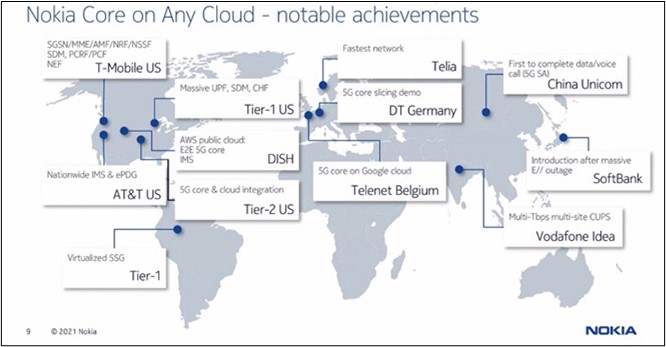
  • Nokia’s key “Any Cloud” achievements:

Intel-Nokia 3

Intel: “Network and Edge Update”

Intel’s role in telco network infrastructure is often overlooked. It sells to OEMs but over the last 3 years has developed a growing set of direct customer relationships with telcos. This session provided an update on Intel’s “network and edge” offerings with a focus on 5G.

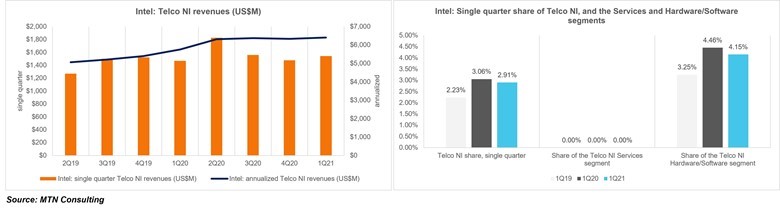
As background, Intel is ranked 9 in the global market for telco network infrastructure, with an annualized market share of just under 3%. That counts all Intel telco revenues as if they were direct to telco arrangements. The below figure illustrates Intel’s telco NI revenues over the last few quarters and its share in the overall market, as well as the services and hardware/software segments. Intel doesn’t record any services revenues in telco NI, hence its share of HW/SW is higher than overall.

Intel-Nokia 4

MTN Consulting’s summary of the Intel session follows.

  • Intel showcased new silicon and software platforms comprising processors, accelerators, Ethernet adaptors, memory, software toolkits – all aimed at the goal of strengthening its position in vRAN and 5G wireless network technologies at the edge.
  • According to Intel, operators of 5G networks want a more agile, flexible infrastructure to unleash the full possibilities of 5G and edge as they address increased network demands from more connected devices. At the same time, global digitalization is creating new opportunities to use the potential of 5G, edge, artificial intelligence (AI), and cloud to reshape industries ranging from manufacturing to retail, health care, education, and more.
  • According to Intel, experts expect 75% of data will be created outside of the datacenter by 2023 — at the edge in factories, hospitals, retail stores, and across cities.
  • Intel wants to target the market where various capabilities can be converged at the edge, such as AI, analytics, media, and networking.
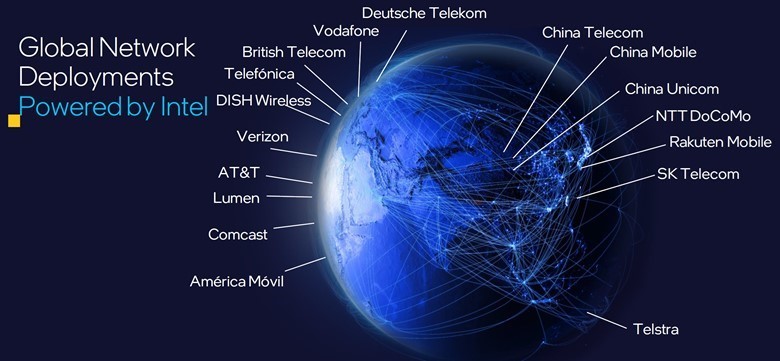
  • A select list of the “Powered by Intel” network deployments, as presented in the session:

Intel-Nokia 5

  • Reliance Jio, Deutsche Telekom, and Dish Wireless are transforming their networks on Intel’s architecture. The vRAN promises cloud-like agility and automation capabilities that can help optimize RAN performance and ultimately improve the experience for users. The company claimed that “Nearly all commercial vRAN deployments are running on Intel technology”
  • Intel is expanding its family of Agilex FPGA by adding a new FPGA with integrated cryptography acceleration that can support MACSec in 5G applications. This adds another layer of security to vRAN at the fronthaul, midhaul, and backhaul levels.
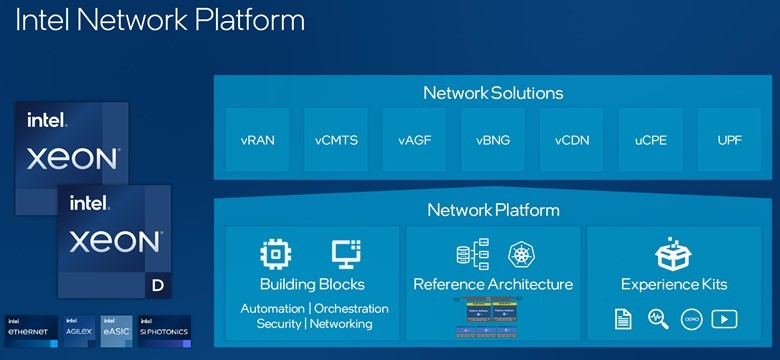
  • The chipmaker also unveiled Intel Network Platform – a technology foundation that (Intel says) can reduce development complexity, accelerate time to market and help to ensure customers and partners can take advantage of the features in Intel hardware, from core to access to edge. INP incorporates building blocks, a reference architecture and experience kits, and can support a range of different network solutions including vRAN but also other (non-5G) applications like vCMTS.

Intel-Nokia 6

  • Intel also announced a new commercial software, Intel Smart Edge, focused on enterprise on-premise use cases, such as private networks and universal Customer Premise equipment.
  • Intel’s Ethernet 800 Series family is expanding, with Intel’s SyncE capable Ethernet Adapter that is designed for space-constrained systems on the edge. It is well-suited for both high-bandwidth 4G and 5G RAN as well as other time- and latency-sensitive applications in sectors such as industrial, financial and energy.

Blog Details

Post-pandemic chip M&A splurge targets the data center market; room for more consolidation in 2021

After a prolonged hiatus, M&A activity in the semiconductor landscape ramped up significantly this year, nearing the record levels of 2015. The consolidation surge was particularly notable during the second half of 2020. These deals targeted many end use markets but the common thread is the cloud data center market: remote work and study amid the COVID-19 pandemic has spiked demand for cloud-based tools and services. The dealmaking is not yet done. Next year is likely to witness more consolidation among chipmakers, despite geopolitical tensions between the US and China and stringent regulatory scrutiny serving as impediments to deal completion.

Flurry of chip deals bring cheers to an otherwise muted first half

Chip M&A activity had a quiet first half of the year, as COVID-19 created high levels of uncertainty and steep drops in GDP. Stock markets settled in 2H20, though, and big companies found ways to operate amidst a pandemic. COVID-19 remains a severe problem for many major economies, but improved business sentiment and a gradual economic recovery have fostered a strong climate for M&A.

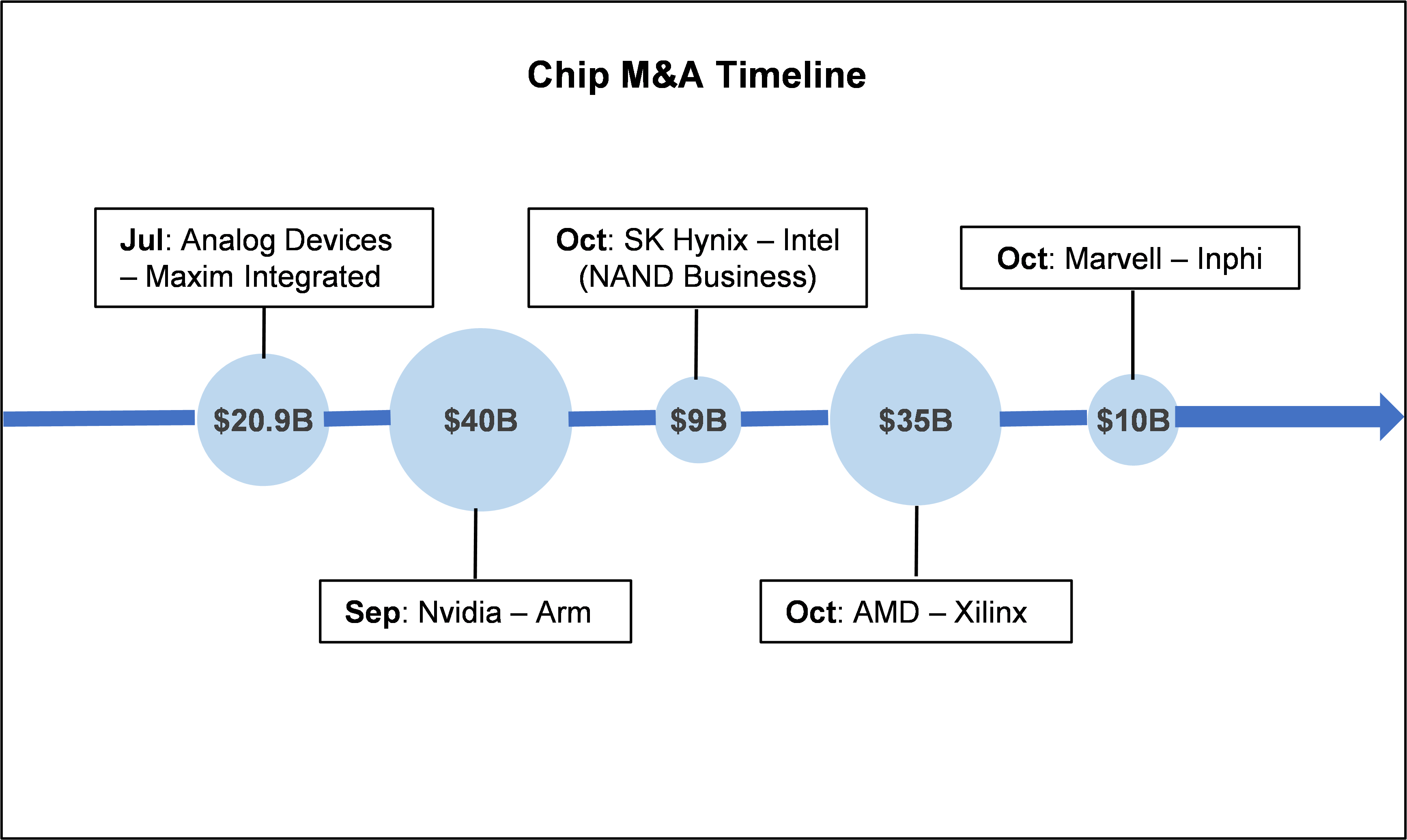
With year-to-date announced deals already topping $100B in value, 2020 is turning out to be a blockbuster year for chip M&A. The mega-deal kickstart to the chip M&A frenzy was Analog Devices’ $20.9B acquisition of rival chipmaker Maxim Integrated Products in July 2020. This was followed by Nvidia’s acquisition of chip design house Arm for $40B in September 2020, the year’s biggest deal so far. The month of October saw a string of M&A agreements featuring the $9B acquisition of Intel’s NAND SSD business by SK Hynix, AMD’s $35B deal to acquire Xilinx, and Marvell’s $10B acquisition of Inphi.

Figure 1: Timeline of semiconductor M&A in 2H20

Source: MTN Consulting

Chipmakers aim at the lucrative cloud data center market

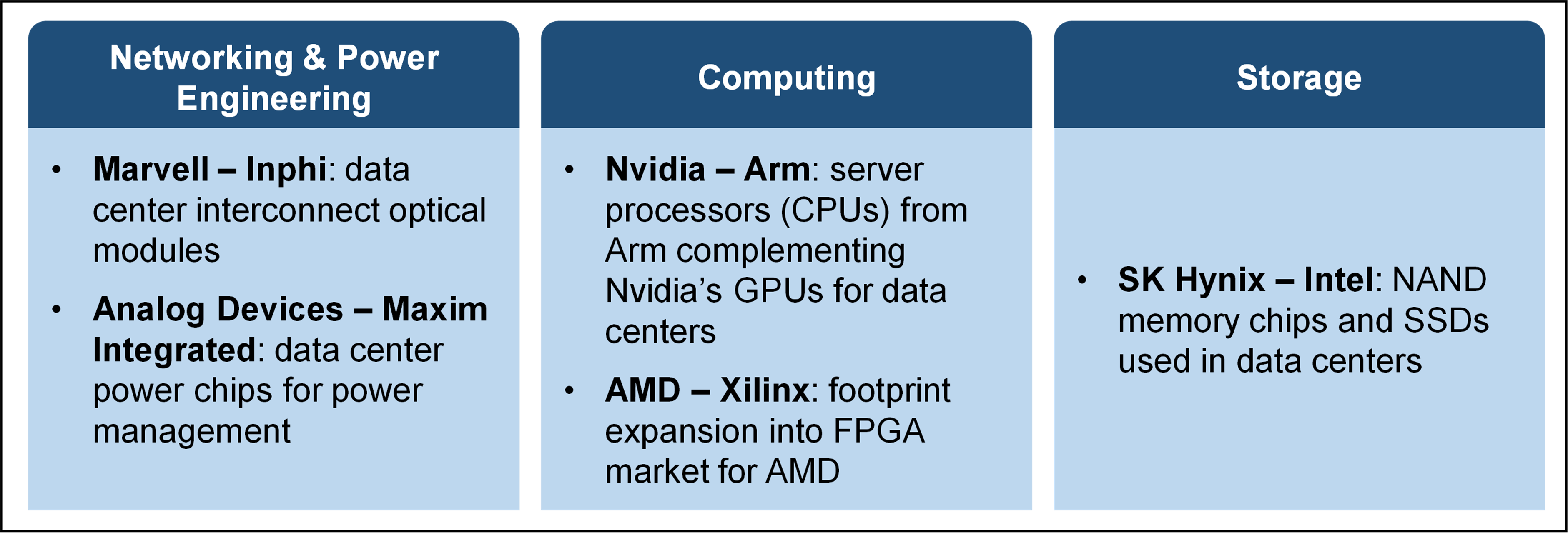
None of the big chip deals are focused narrowly on a single end market, but one key market is of common interest to all – the cloud data center. The deals differ from each other in terms of sub-market focus, though, stretching from power engineering and networking, to computing and storage – see Figure 2 below:

Figure 2: Data center aspects of 2020’s big chip M&A transactions

Source: MTN Consulting

Networking & Power Engineering

Networking and power management form the vital foundation of any data center infrastructure. Optical modules help connect not just the server racks inside data centers but also the data centers to one another across different locations. With the acquisition of Inphi, Marvell aims to target this space by providing interconnect solutions that enable seamless and speedy movement of data between and inside data centers.

Chips for power management have grown in significance over the years to control the biggest expense of running a data center, i.e. power utility costs. Analog Devices is seeking to address this issue through Maxim Integrated’s data center power chips, which also permit greater computational capability to data center operators.

Computing

Data centers typically house thousands of servers that process and run applications along with high performance computing (HPC) workloads. The processing and computational tasks are carried out by server processor chips that come in various forms: CPU, GPU, FPGA (field-programmable gate array), and ASIC (application-specific integrated circuit). Intel, AMD, Nvidia, Xilinx, and Infineon are some of the leading server processor vendors developing either one or most of the chip types.

The acquisitions announced by AMD and Nvidia relate to expansion into new server chip types, and also rivaling Intel as a more formidable force. AMD is looking to dent Intel’s customer base with the acquisition of Xilinx. The FPGA pioneer Xilinx had earlier managed to end Intel’s exclusivity with some its customers such as Microsoft. Meanwhile, GPU maker Nvidia will gain access to server CPU designs through its Arm acquisition. Arm-based server processors are already being adopted by webscalers like Amazon for its data centers. For now, Intel is looking to counter these developments through in-house efforts aimed at the server GPU market for data centers, extending its presence across all the four chip types.

Storage

On the storage side of things for data centers, Intel has agreed to sell off its NAND SSD business to SK Hynix. The assets sold include Intel’s NAND component and wafer business along with the NAND manufacturing plant in Dalian, China, but exclude Intel’s “Optane” memory business. Intel’s NAND memory chips are mostly used in smartphones but also data centers to support in-memory processing demands of the cloud. The business acquisition will elevate SK Hynix’s market share in the NAND memory market, which is currently dominated by Samsung Electronics.

Three key factors are fueling M&A among chipmakers

Three key factors discussed below are driving chip companies to go on a shopping spree:

  • New applications: Key emerging applications based on AI/ML along with new evolving markets in edge computing, self-driving vehicles, and 5G have opened new frontiers for chipmakers. This is in addition to the ever-increasing demand for more media-intensive content such as images, audio, and video streaming over cloud that require faster server processors and networking capabilities for seamless and speedy transmission to end users.
  • Faster time to market: Apart from the obvious reasons of expanding into new markets and accessing proprietary technologies, chipmakers are increasingly exploring M&A to cut down on the costly and lengthy R&D timeline associated with developing advanced process nodes and chips, thus enabling faster scaling. Slowdown in Moore’s law is also pushing chipmakers to look elsewhere.
  • Improved market conditions: A low interest rate environment has enabled chipmakers to borrow modestly and finance acquisitions. Rising stock prices are also aiding large chipmakers such as AMD and Nvidia to fund their purchase either partially or entirely in stocks. Notably, Nvidia surpassed Intel as the largest US chipmaker by market cap in July 2020

More chip industry consolidation on cards but not without hurdles

The M&A activity in the chip market landscape is likely to continue into next year, but probably not at the scale of what has transpired so far in 2020. Even though the deal-making drivers discussed above will persist in 2021, future deals may confront more obstacles related to COVID-19 and geopolitics.

With COVID-19 expected to play out well into 2021, delays in deal-making would keep the deal volumes limited as carrying out negotiations, due-diligence, and audits would be challenging with travel restrictions and limited in-person meetings. For companies having long-term or strong working relationships with prospective acquirer or targets, the pandemic would be less of a worry, as seen with Nvidia-Arm or AMD-Xilinx for instance. These pairings shared strong working relationships prior to acquisition.

Geopolitical tensions between the US and China upsets the stability needed to make M&A deals happen. That’s especially true in the chip sector. With the situation not expected to get any better even under the Biden administration, China has been gearing towards chip self-sufficiency by pouring billions of dollars to support the growth of its domestic chip industry and advanced chip development. Furthermore, open-source chip architectures such as RISC-V have opened the gates for Chinese tech firms like Huawei. Chipmakers will be wary of snapping up companies amid a hostile business climate.

Last but not the least is the regulatory hurdle that an M&A transaction must go through before the final deal closure. Big-ticket deals are subjected to increased scrutiny due to wide-ranging issues such as strict antitrust laws, national security threats, access to proprietary technology, and sanctions imposed under trade disputes. All the chip M&A deals discussed above are pending regulatory approval, in multiple jurisdictions. Among them, the Nvidia-Arm deal is likely to raise eyebrows among the watchdogs, especially in Europe and China. China could essentially prove to be a spoilsport in the Nvidia-Arm deal: Chinese tech firms currently use UK-based Arm’s intellectual property to design chips, which could change post acquisition by US-based Nvidia. If China blocks this transaction, it would not be the first time. Two years ago, China blocked US-based Qualcomm from completing its acquisition of the Netherlands-based chipmaker NXP Semiconductors.

Blog Details

Is the cloud Apple’s next big bet?

As the four-way tussle unfolds among the top tech giants – Apple, Amazon, Google, and Microsoft – for the “world’s most valuable company” tag, Apple could be covertly prepping its entry into the fast-growing cloud computing space.

Ironically, a big operational chunk of Apple’s services (Siri, iTunes, Apple Music, etc.), rely on third-party cloud providers. For instance, Apple apparently shells out US$30 million per month for Amazon’s cloud services and also employs Google’s cloud services. It has also reportedly used Microsoft’s Azure platform.

Despite spending massively on renting cloud resources, the iPhone-maker has been plagued by network outage troubles, along with privacy breach concerns in the past. These issues have compelled Apple to beef up its own data center infrastructure to wean itself from reliance on rival cloud providers. Up until now, Apple‘s cloud presence is limited to iCloud, which is essentially a SaaS-based content storage offering for consumer markets – much different from what big cloud rivals offer.

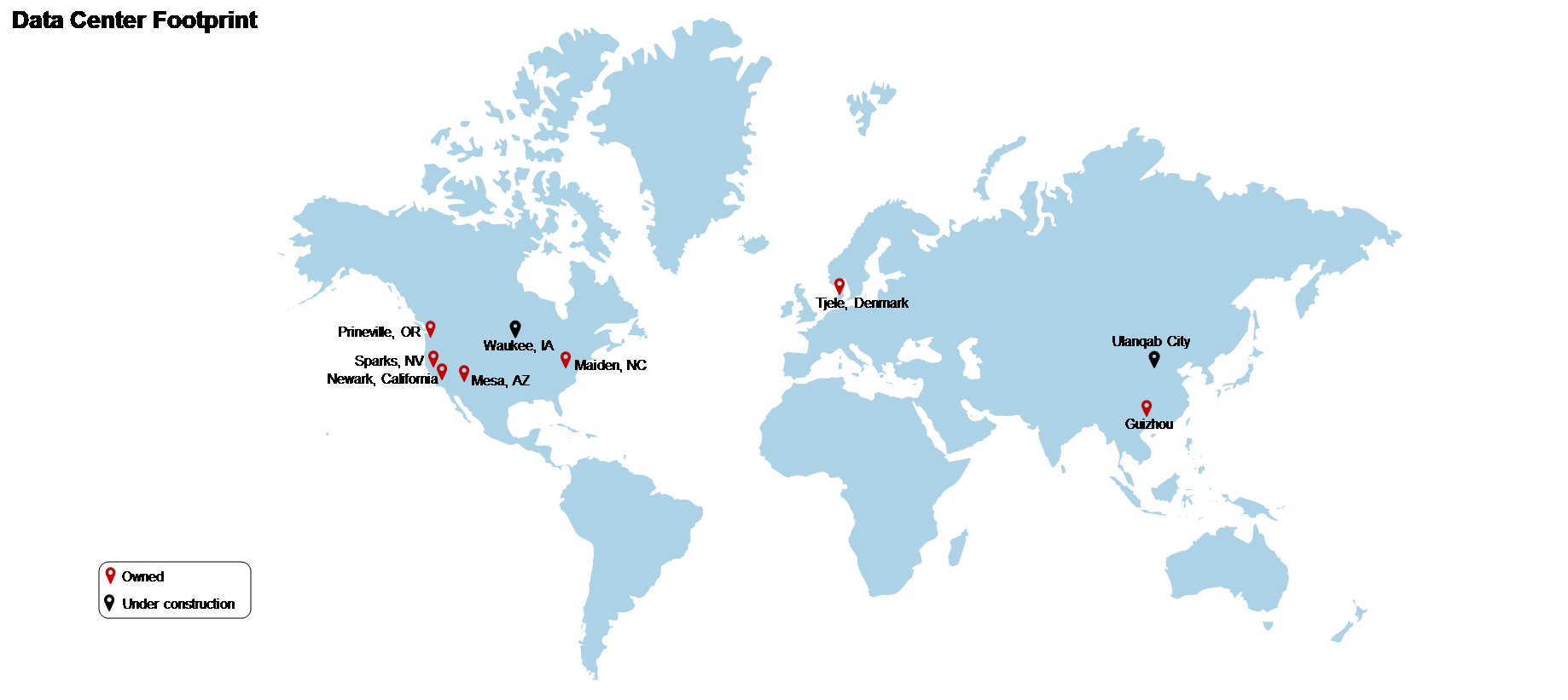
Due to recent expansion efforts, Apple currently owns a total of nine data center sites worldwide, out of which two are under construction (see footprint map below). These data centers meet Apple device users’ demand for services such as iTunes, iCloud, and Apple Music.


Source: MTN Consulting

These nine data centers are also a nice starting point for a cloud business. Apple needs far more infrastructure of its own, but we believe that Apple will look to target the enterprise market with its own cloud computing solutions. Below are a few rationales to suggest that Apple is on its way to make this long-term goal a reality.

#1. Exploring revenue diversity to cut business dependence on iPhone sales

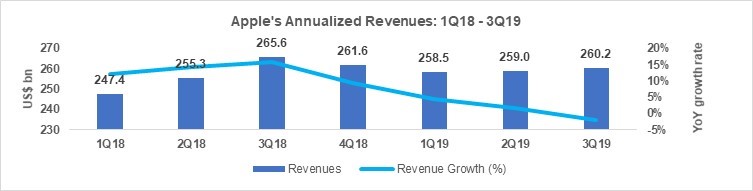
  • Apple’s flagship product and cash cow, iPhone, continues to drag the overall top line. Annualized sales revenues from iPhone declined by 14% YoY in 3Q19. As a result, total company annualized revenues declined by 2% YoY during the same period.

  • The iPhone accounts for more than half (54.7%) of Apple’s total annualized revenues in 3Q19. However, it battles declining loyalty among customers who feel less motivated to buy/upgrade due to less-valued features. Customers are being obliged to pay Apple’s premium mostly for improved camera capabilities in newer models as they are still functionally identical to the iPhone X launched in 2017. To offset its impact partly, Apple is now focusing on non-flagship businesses in “Services” and “Wearable, Home and Accessories”.
  • The Services business, Apple’s second biggest segment, along with the Wearables unit will be key in the near term as sales of iPhone are likely to remain sluggish. The Services unit doubled its contribution to Apple’s total topline since 2015 from 9% to 18% in 2019, implying the growing clout of the segment.
  • But there is a downside – Services and Wearable units are mostly dependent on iPhone sales because they largely operate on handset devices. This is where Apple’s own cloud offerings turn into a desirable plan as it would remain relatively immune to such business inter-dependencies.

#2. Existing efforts to revamp infrastructure (Pie and McQueen) support a cloud push

  • Apple’s cloud quest commenced around 2016 with an infrastructure restructuring program for merging its services (including Siri, iTunes, Apple Music and Apple News) onto a single proprietary cloud platform called “Pie”.
  • Apple is physically relocating its employees in cloud services and related departments scattered across various locations at one place under this project. The aim is to have more control on the infrastructure and resources for improved user experience.
  • Apple also kicked off a self-sufficient cloud infrastructure project called “McQueen” a few years back, in a bid to reduce dependence on other leading cloud vendors such as Amazon and Google.
  • In line with this, Apple announced investments of US$10B late last year to build new and expand existing data centers across the US over a five-year period. Out of this, ~US$4.5B has been likely spent so far.
  • Apple is also expected to open its first data center on the Chinese mainland (Guizhou province) by 2020, construction of which has picked up speed this year. A second data center in the country is also coming up in Ulanqab City. Both these data centers will primarily host iCloud data of Chinese users.
  • Currently, most of iCloud’s data is hosted on Amazon’s AWS or Google’s GCP, according to the iOS Security Guide published by Apple. The current expansion drive will reduce Apple’s reliance on third-party cloud vendors.
  • Once the objectives of both these projects are achieved, Apple could look to venture into the public cloud market – exactly how Amazon started out, i.e. by meeting its own cloud needs first and then renting out excess cloud capacity to the enterprises.

#3. Rising cloud demand driving rivals’ business growth

  • Amazon, considered to be the cloud pioneer, continues to achieve glory and robust business growth in the cloud market through new business models despite being in existence for over a decade. Its cloud computing unit (AWS), which started off as a storage service for its core e-commerce business, has emerged as the most lucrative business and a profit machine – AWS has consistently accounted for >50% of Amazon’s overall operating income per quarter this year.
  • Microsoft is slowly catching up with Amazon in the cloud race, as its cloud business is growing from strength to strength and driving the company’s overall business. In 2Q19, Microsoft’s cloud segment, which includes Azure cloud, emerged as the biggest business unit.
  • Google’s cloud offering might be a distant third behind AWS and Azure but is making modest advances with aggressive pricing strategy in the cloud arena. The Google Cloud segment, which includes its public cloud offering Google Cloud Platform (GCP) along with G Suite tools (Gmail, Hangouts, Calendar, Google+ and Docs), now generates US$8B in annual revenues.
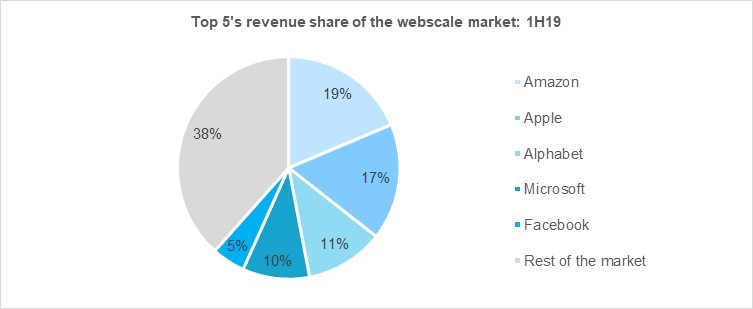
  • With strong earnings and growth still being reported by the “Big Three” cloud providers, Apple could be motivated to replicate the success of its rivals. Out of the top 5 webscale network operators (WNOs), only Apple and Facebook lack cloud offerings (see chart below).

#4. Strong M&A appetite to enter new focus areas

  • Apple’s recent billion-dollar acquisition deal involving Intel’s smartphone modem business reveals the company’s strong desire for M&A to pursue new priorities. The deal ensured Apple’s entry into the 5G-enabled handsets race, albeit a bit late.
  • With a strong kitty of cash and short-term investments worth US$100.5B at the end of September 2019, Apple could go for a similar deal within the cloud space. But instead of acquiring a cloud player, the iPhone-maker may have other plans.
  • Since Apple already has expertise in building cloud infrastructure somewhat with its own data centers, it could instead look to buy a chip company (or assets) that would develop customized chips to power its data centers – a ploy already in practice by cloud rivals. Interestingly, Apple is building in-house custom ARM-based chips for its future Mac lineup.
  • Like 5G, Apple’s potential entry in the public cloud market would again be relatively a late one. To counter established cloud rivals, it would have to compete on network security and reliability, making a chip company acquisition more sensible for Apple.

Potential target market could be much beyond developers

Apple’s initial aim would be to catch the low-hanging fruit – the iOS developers’ market – to sell its cloud offerings. Apple is known to create solutions and platforms that are purposely built for its own ecosystem, and its potential cloud offerings would not be any different. This is one of the aspects developers would lean towards, especially for the development of iOS-based applications, as they could access interfaces and platforms in tune with Apple’s ecosystem for OS development.

Privacy and security are Apple’s priorities with its current portfolio of devices and services. These attributes would help Apple target high-value cloud clients. Government cloud deals, which are always sensitive, are a potential target for Apple. The recent US$10B cloud deal between Microsoft and the Department of Defense is an example.

For small-and-medium enterprises and users with limited IT expertise, current offerings from Amazon and other cloud providers are complex to use. This is where Apple could tap the “bottom of pyramid” with an intuitive and easy-to-use cloud platform.

Despite expansive efforts, Apple may still fall short of becoming a formidable cloud force

The cloud trio of Amazon, Microsoft, and Google would undoubtedly be impacted by Apple’s potential entry to the cloud scene – they would lose a customer (or potential one) and gain a competitor. But Apple is known to focus on high-end markets with priority to profits over market share. Apple may not offer mass-market cloud solutions as its rivals do – just as its iPhones are targeted at a premium consumer base. Apple’s purpose would be to offer reliable cloud computing solutions that operate in its own ecosystem and provide a quality user experience. All this could also end up being a futile endeavor for Apple due to its inexperience relative to cloud rivals. High profile acquisitions or hires will help, though, and Apple has plenty of cash for both. Apple taking the “cloud” path could prove to be a game-changer in the fortunes of the company that is desperately seeking for a life beyond iPhone.


Blog Details

Vodafone Idea to work with Red Hat on distributed cloud platform

Vodafone Idea to work with Red Hat on distributed cloud platform 

On October 21, Red Hat announced that it would help Vodafone Idea “transform its distributed network data centers to open standards, open interfaces based ‘Universal Cloud.’” Vodafone Idea (VI) will deploy several Red Hat platforms: the OpenStack Platform, Ceph Storage, Ansible Automation Platform and Enterprise Linux. 

Marshal Correia, VP/GM of Red Hat India says the company will setup and extend a distributed cloud platform for VI’s customers, and help the operator adopt a “more agile, DevOps-centered workflow based on Red Hat’s open hybrid cloud technologies.”

Red Hat is a unit of IBM, which has supported Vodafone Idea in previous projects. In May, VI signed a five-year agreement with IBM to modernize and consolidate its IT infrastructure. IBM stated at the time that the operator would use IBM’s “hybrid cloud and multicloud services, plus analytics and artificial intelligence (AI) security capabilities, to better engage with customers.” IBM did not disclose the deal value, but press rumors put the value in the hundreds of millions of US dollars. Prior to this deal, IBM had separate data center outsourcing arrangements in place with Vodafone and Idea.

Commentary

Vodafone & Idea completed their merger in August 2018. The merger left a telecom market with three big private players: Vodafone Idea, Jio, and Bharti Airtel. It also left Vodafone Idea with a huge integration task, while India’s telco market continues to recover from the Jio effect. Indian telcos have been laying off employees, selling assets, and – for everyone but Jio – spending capex cautiously (see figure, below). Further, Jio is not just a threat in mobile markets. It signed a sweeping cloud deal with Microsoft this summer. 

Vodafone Idea began its life with some data center assets, but almost entirely consisting of rented space in other providers’ facilities. IBM is the main partner but another is CtrlS, announced in May. Given the need to save capex for 5G, VI seems likely to continue relying on infrastructure partners for its data center and cloud assets. 

These assets are not just needed for cloud and enterprise services. They’re needed to efficiently support network operations and deliver a wide range of services. VI hopes to use Red Hat solutions to improve user experience and reduce latency on its networks. This is important for two reasons. First, VI has been shedding mobile subscribers, per the latest TRAI report. Second, the newly merged Vodafone Idea has begun to focus more on Business Services unit for growth. It claims to have over 40% market share locally in enterprise mobility and IoT, for instance. Keeping market share at that level in the face of Jio’s ongoing expansion will be almost impossible. VI hopes its work with IBM/Red Hat, Cisco, Optiva and other suppliers will help.

Who is Vodafone Idea

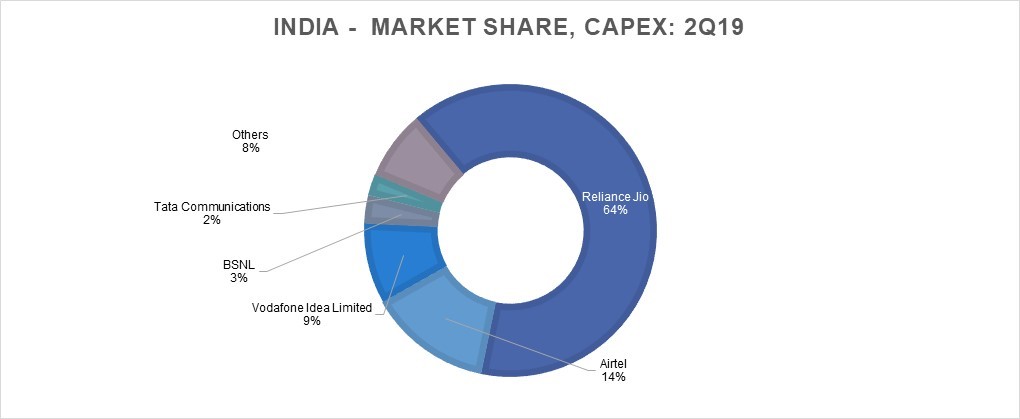
Vodafone Idea is India’s largest mobile operator per the TRAI, with 32% market share as of end August 2019, and corporate revenues of $6.6B over the last 12 months (3Q18-2Q19, i.e. annualized). MTN Consulting figures indicate Vodafone Idea captured 34% of India’s total telecom revenues in 2Q19, with Jio and Airtel lagging with 20% and 18%, respectively. Jio spends over half the market’s capex, for now, as shown in the figure below.

f4

Source: MTN Consulting

Blog Details

Reliance Jio’s aggressive cloud push with Microsoft fret Amazon and Google in India

After taking the Indian telecom scene by storm to reach the pinnacle (by subscriber base) in just three years of commercialization, Reliance Jio Infocomm (Jio) is all set to spread its wings into the booming Indian cloud market. In a 10-year deal with the cloud heavyweight Microsoft, Jio will build new cloud data centers across India that will support Microsoft’s Azure cloud platform to offer economical India-native cloud-based solutions for enterprises. As a part of this, two initial data centers are being built by Jio in the Indian states of Gujarat and Maharashtra – both slated to go live by the end of 2020. These two facilities are reportedly ~7.5MW in capacity, small relative to the largest global facilities but significant for India.

Microsoft has been part of the Indian cloud scene since 2015, before its closest webscale network operator (WNO) rivals Amazon (2016), Google (2017) and Alibaba (2018). Though Microsoft claims to operate three data centers in India, interestingly, these are hosted in a part of existing data center companies such as CtrlS Datacenters and Netmagic (so do Amazon and Google). The partnership with Jio also has a similar set up – Microsoft’s Azure Cloud hosted on Jio’s data centers. By contrast, Microsoft’s recent cloud partnership with AT&T will likely have the telco relying primarily on Microsoft built infrastructure.

The Jio-Microsoft deal also marks telcos’ greater engagement in the Indian webscale arena offering cloud and network connectivity solutions, with Airtel already in the backdrop for quite some time – Airtel operates a wholly-owned data center unit, Nxtra Data, which is prepping for data center footprint expansion.

Jio, Microsoft deal a win-win for both

The key to this deal is how it allows both the firms to focus on their respective competitive edge. While Jio’s scale and infrastructure clout coupled with its understanding of the Indian landscape would assist in delivering seamless connectivity, Microsoft will focus on what it does best – developing and deploying its Azure cloud and AI solutions, on Jio’s network. The deal would also allow Microsoft to grow its cloud market share in India, a key point considering that cloud has now grown to become Microsoft’s biggest business segment by revenues, and is looking at India as a market to boost this growth further.

Jio, on the other hand, will bank on Azure’s brand of solutions to help persuade Indian enterprises to switch from the cloud platforms of Amazon, Google, and Alibaba, onto Azure-backed Jio’s network. Besides, Jio’s quest to explore and build high-growth businesses beyond telecom complements its decision to venture into cloud.

Key deal disruptors – ‘pricing’ and ‘native language compatibility’ – to benefit target market, and unsettle rivals

India being a price conscious market, Jio’s strategy is apparent – triggering a price war by aiming at the bottom of the ‘enterprise pyramid’, primarily comprising the startup ecosystem and SMEs, without compromising on solutions’ quality while leveraging Microsoft’s Azure brand. Jio will offer ‘free’ connectivity and cloud infrastructure to promising startups, and SMEs will be offered customized and bundled solutions encompassing connectivity, productivity and automation tools starting at just INR1,500 (US$21) per month. Similar solutions offered by rivals such as Amazon and Google can cost ~10x that price.

In addition, the Jio-Microsoft duo is looking to plug a key void left by the existing peer offerings for SMEs, i.e. local language compatibility. Jio will leverage Microsoft’s speech and language cognitive services to provide cloud and digital solutions supporting major Indian languages. This could prove to be a game-changer in a market with such language diversity as India. Local language support will likely boost broader adoption among SMEs who still largely cater to the needs of native regions.

These developments are surely going to hurt the existing cloud players, especially Amazon, Google, and Alibaba, who have a lot to ponder on countering Jio-Microsoft threat. Amazon, which has a sizeable SME clientele in India, faces the maximum risk as scores of SME customers are expected to switch from its cloud platform. Alibaba, a Chinese operator, may try to counter the Jio-Microsoft pricing but privacy and political concerns may push customers to Jio.

So how will the peers respond?

It is clear that Jio is looking to replicate its telecom price war success story in the cloud space, i.e. by offering free and discounted cloud solutions which will eventually force bigger peers to match tariffs while pressing smaller rivals to go out of business. Amazon, Google, and Alibaba will, thus, likely come up with bundled connectivity solutions at cheaper rates. Another likelihood is more webscale partnerships with local telco operators. Airtel, which already operates data centers through Nxtra Data and is on an expansion spree across India, could well be the beneficiary. But it remains to be seen if these efforts by peers are competitive enough to keep the Jio-Microsoft duo at bay. Jio’s mobile rivals are still struggling to recover from its disruption of telecom. At the least, the Jio-Microsoft partnership will help accelerate India’s cloud adoption and digital transformation.

Blog Details

Alibaba’s revenue growth from cloud rises steeply, as it looks to outdo Amazon and Microsoft

Top US-based tech providers Amazon, Alphabet/Google and Microsoft dominate the cloud space but they are set to face stiff competition from China’s leading cloud provider Alibaba.

MTN Consulting tracks these and similar operators of webscale (aka hyperscale) cloud networks as part of its “Webscale Network Operator” (WNO) market segment.

AliCloud launched nine years ago, now going global

Alibaba established its cloud computing division in 2009, three years after Amazon launched AWS, and went global by 2015. The Chinese company has set up data centers across the Middle East, Singapore, Japan and Europe through its cloud division (Alibaba Cloud, also known as AliCloud or AliYun). It has been ambitious from the start. In 2015, Simon Hu, President of Alibaba Cloud, predicted the company would surpass Amazon by 2019: “Our goal is to overtake Amazon in four years, whether that’s in customers, technology, or worldwide scale.”

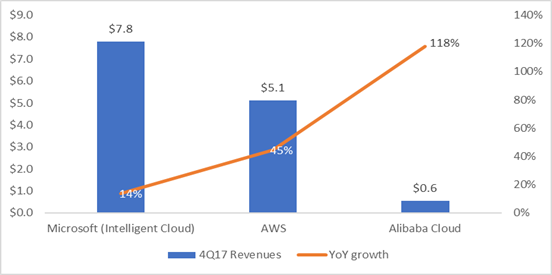
Simon’s goal may have sounded a bit far-fetched then, but with a whopping 118% YoY revenue growth from its cloud segment in 4Q17 (as shown in Figure 1), Alibaba is beginning to live up to its ambitions. While still small on an absolute basis, Alibaba has a history of rapid, aggressive expansion into new markets – it is a serious player in the cloud now.

Figure 1: Webscale network operators’ 4Q17 cloud* revenues (in US$B) and YoY growth rate

Source: company filings

Key takeaways from 4Q17 results

Fourth quarter earnings for top WNOs revealed continued strong growth overall, along with some competitive & strategic shifts. Highlights for the top few providers:

Amazon’s sales hit $60B in 4Q17, up 38% YoY, backed by strong sales in the holiday season, and its net profit was also up 148% in the same period. However, operating margins were low for Amazon’s North America segment, which in FY2017 generated just $2.8B in operating profit on revenues of $106.1B. Amazon Web Services (AWS) is a different story. AWS is Amazon’s cash cow business as it continues to generate profit for its group, despite incurring losses from its international segment. As shown in Figure 1, AWS segment’s 4Q17 revenues were $5.1B (up 45% YoY). In the same period, AWS’ operating profit was $1.35B (up 46% YoY) and was also a major contributor to the company’s overall profitability.

On an annual basis, the AWS segment recorded revenues of $17.5B in 2017, (up 43% over FY2016) and now contributes to about 10% of the company’s sales, from just 3% in 2011. AWS’ operating profit for full-year 2017 was $4.3B (with a margin of 25%), much higher than the 3% margin recorded by Amazon’s North America retail segment.

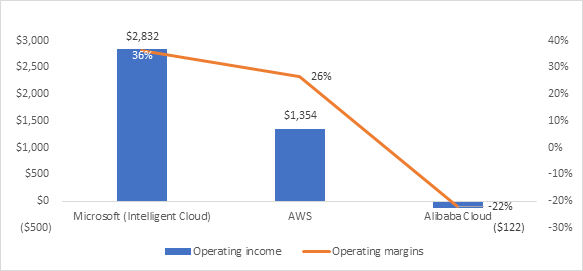
Figure 2: WNO 4Q17 cloud operating profit (US$M) and margin (profit as % of revenues)

Source: company filings

Microsoft’s revenues from Intelligent Cloud* were $7.7B in 4Q17, up 14% YoY. The majority of Intelligent Cloud revenues come from Azure, which grew by 98% during the same period. Intelligent Cloud operating profit was $2.8B, up 18% YoY, giving the division an operating margin of 36% (Figure 2). A key differentiator for Microsoft is its hybrid cloud strategy, which aims to help enterprise users exploit their legacy IT investments. It hit the right note with its acquisition last month of storage vendor, Avere Systems. This acquisition will further enhance Azure’s enterprise capabilities, as Microsoft can merge Avere’s storage capabilities into its own Azure cloud services. That will enable large and complex high-performance workloads to run in Azure.

Alibaba’s cloud computing segment recorded strong revenue growth in 4Q17 (up 118% YoY) but continued to incur losses from this division (Figure 2). In the same period, its cloud segment incurred an operating loss of RMB793M ($122M), and a negative operating margin of around 22%. Unlike Amazon and Microsoft, which generate a good chunk of profits from their cloud segments, Alibaba’s continual losses from its cloud segment are a reminder that its focus is on growth and not profitability. With a free cash flow (operating cash flow – capex) of over $7B in Q4’17, Alibaba has enough cash to plow into its cloud business.

Alphabet’s overall 4Q17 result was promising. Its 2017 corporate revenues crossed $100B for the first time, posting $32.3B in 4Q17 alone. This 24% YoY growth was mainly due to advertising and mobile search. For the first time, Google disclosed its cloud revenues, a little over $1Bn in 4Q17. That figure is lower than that of AWS and Microsoft Azure, but Google Cloud is relatively new. Alphabet has spent over $30B in capex in the last three calendar years, the bulk of which went to its data center and subsea cable network. Alphabet aims to leverage this investment far beyond search. It continues to connect new regions to its Google Cloud Platform, with data centers opening in the Netherlands & Montreal, Canada already this year. The GCP’s network now has 15 regions, 44 zones, and over 100 points of presence.

Alibaba will retain an advantage in China, and is now eyeing global expansion

The cloud computing business in China has long been dominated by domestic players, as the US tech giants find it difficult to make inroads due to the strict laws around censorship and content regulation. The recent stringent law around cross border data transfer will only make life harder for foreign cloud companies, as they are required to store data locally. That will benefit Alibaba, as well as the smaller cloud operations of Baidu and Tencent.

Further, the government restricts foreign ownership of cloud services in China, as they can provide services only via a partnership arrangement with domestic cloud providers in China. For instance, AWS is currently operating in China by partnering with Beijing Sinnet Technology (Sinnet), as AWS is banned from operating under its own brand name in China. In Nov 2017, Amazon sold its hardware to Sinnet, as the law prohibits foreign companies from owning technologies for cloud services. Along similar lines, Apple and Microsoft are currently operating in China through Guizhou on the Cloud Big Data (GCBD) and 21Vianet Group. With US cloud companies forced to wade through tricky regulatory waters in China, Alibaba again benefits.

Alibaba has invested heavily in expanding its network of data centers, and is developing its own proprietary technologies for the AliCloud (Figure 3). As part of its global expansion, India is an initial focus. This will not be easy, as Amazon is clearly the leader in the Indian market. And with Amazon’s failed attempt to flourish in China, the company has all the more reason to defend its turf in India. However, Alibaba has deep pockets and ambitions, too, as it launched a new data center in India in Dec 2017 and in Malaysia recently.

Figure 3: Self-developed infrastructure for the Alibaba Cloud

Source: Alibaba’s 2017 Investor Day.

At the recently concluded Mobile World Congress (MWC) in Spain, Alibaba made clear its intentions to compete in European cloud markets. At the event, AliCloud introduced several new cloud offerings aimed at HPC (high performance computing) workloads, and AI and other data-intensive workloads. To establish a supporting technology ecosystem in Europe, AliCloud is partnering with Vodafone Germany, the Met Office UK and Station F (a France-based startup company). Alibaba hopes to make commercial progress with these new services, and showcase its capabilities in the fields of AI and big data. Ultimately it aims to leverage innovations in these fields across multiple industries. AliCloud’s global expansion is off to a good start.


*Note: For this analysis, we have considered AWS revenue for Amazon and Google Cloud for Alphabet. For Microsoft, we considered total revenues for its Intelligent cloud segment, as the company does not report stand-alone revenues for Azure.


Blog Details

Microsoft & Google pressure Amazon’s prime spot in the cloud; Apple may be prepping for entry

After a decade of dominance in the public cloud market, Amazon’s top spot came under immense strain in 2017. Years of investment in networks & cloud services began to pay off for Microsoft’s Azure and the Google Cloud Platform (GCP). Apple is also making noises in the cloud.

Tides shifting in 2017

At year-end 2016, Amazon’s Amazon Web Services (AWS) was the public cloud’s market leader, as it had been for many years. Per the Cloud Security Alliance, in 2016, AWS had a 42% share of the public cloud application installed base, Azure had 29%, and GCP had 3% (as did IBM’s SoftLayer).

Capex spend has been strong at Amazon’s rivals for many years, though, and it appeared to pay off in 2017.

As shown in the figure below, capex has grown at all three since 2012, but faster at Google and Microsoft. Each of these “webscale network operators” (WNOs) spend capex on items unrelated to the cloud, for instance Amazon’s fulfillment centers, or Microsoft’s retail outlets. But the big driver in the last few years has been cloud capex, concentrated around construction (or expansion, or retrofitting) of data centers, and supporting infrastructure such as data center interconnect.

MTN Consulting - cloud capex WNO

All this cloud investment has created an intense rivalry, with the new entrants pushing hard on Amazon’s top spot. Large and medium enterprise customers (such as Target, Apple, Dropbox, and Spotify) are now looking at alternatives, including a partial shift from Amazon to other leading cloud service providers. Amazon’s loss of such enterprises from the AWS fold has hurt operating margins, not just topline growth.

Microsoft’s “not so soft” approach appears to be hurting Amazon’s AWS margins

Amazon’s AWS unit has continued to grow fast in 2017, but at declining rates: year-over-year (YoY) revenue growth for AWS was 42% in 3Q17, down substantially from 3Q16. By contrast, Microsoft’s Azure revenues have grown at an average of more than 90% in recent quarters (chart, below).

MTN Consulting AWS-Azure rev grate

More important, after margin declines in 2016, Azure saw improvement in the last two quarters. As the chart below shows, Microsoft’s “Intelligent Cloud” (Azure) margins have improved YoY for the last two quarters, while AWS margins did the opposite. The two companies’ margins converged somewhat in both 3Q16 and 3Q17, but Microsoft’s overall level is safely higher. 

MTN Consulting AWS-Azure margins

To support Azure’s growth, Microsoft has invested on multiple fronts, including acquisitions. For instance, the company recently acquired Cycle Computing, a startup software developer that allows businesses to run apps in the cloud, a lucrative business for cloud vendors. As Cycle Computing has been a long-time partner with AWS and Google, Microsoft gets some new customers out of this acquisition: the existing Cycle Computing customers on AWS and Google Cloud will be asked to migrate to Azure, along with the future customers.

Microsoft has also invested heavily in network capex, partnering with such vendor suppliers as ADVA (100G optical for DCI); Cisco (Cisco Cloud Services Router 1000V); Ericsson (IoT accelerator); Huawei (a jointly engineered server product for hybrid cloud apps on the Azure Stack); Mellanox (40G Ethernet switches); Qualcomm (evaluating the new Qualcomm Centriq 2400 processor for cloud applications); and, many others.

Cloud is one of Google’s three big bets

Google Cloud Platform, the tech giant’s cloud division, currently lags far behind AWS but is trying to catch up. The renewed focus on cloud is a result of Google exploring growth outside its core advertising business. This continues to grow nicely, but remains highly vulnerable to economic headwinds.

Google’s CEO Sundar Pichai says “Cloud” is among the top three bets of the firm going forward. Unlike Microsoft, Google does not break out revenues (or report margins) for its cloud business separately. However, we know that GCP is a big part the company’s growing “Google Other” segment, which was 12.3% of total revenues in 3Q17 (3Q16: 10.8%). Google’s CFO Ruth Porat confirms that GCP is a main driver for growth in this segment. One metric of GCP’s growth is the number of big (>$0.5M) cloud deals signed per quarter; the total in 2Q17 was 3x the total for 2Q16.

To support this growth, cloud-specific investments have increased significantly in 2017; overall capex was $3.5B in 3Q17, up 39% YoY, benefiting server manufacturing partners Inventec & Quanta Computer. Cloud opex is rising as well, due to new cloud technical & sales staff hires.

Google racks PRY_20

Google’s push into the cloud market is only a few quarters old

The moderate gains made so far by Google in the cloud market are impressive, considering they just started in 4Q15, with the appointment of VMware co-founder Diane Greene to head its cloud business.

Prior to Greene’s appointment, Google was mostly perceived as the Internet search and advertising giant, which struggled to market cloud solutions to enterprises. The perception has since changed a bit, with GCP’s aggressive pricing strategy and incremental market gains. The GCP got a big boost in September 2017 with a win at Salesforce. Earlier this month, Google made another important hire: Diane Bryant, Intel’s former datacenter unit head, is becoming the COO of Google Cloud.

With this impressive team, Google is now looking to outperform AWS by 2022. Five years is ambitious, but not impossible. To succeed, Google is looking to position itself as a cloud solutions provider for AI- and Big Data-based applications, as these two technologies are considered as next big key adopters to cloud. Google is starting to reap some results from this new positioning. For instance, it recently struck a deal with Zebra Medical Vision to host its AI algorithms on Google’s cloud.

However, Google has to do much more than enticing big-ticket enterprise customers to switch. For rapid growth, and to support an AWS-like breadth of offerings, Google would need a sizable acquisition. Google’s biggest acquisition so far has been Motorola for US$12.5 billion. It would be looking to make a similar-sized acquisition in the medium term to help catch up to Amazon. Per the rumor mill, Salesforce and Workday are options, among many others.

 In the long run, Apple’s project “Pie” could eat into Amazon’s “share of pie”

While Amazon is focused on Microsoft and Google in the short to medium run, Apple may be secretly beefing up its own cloud capabilities to battle Amazon in the long run.

Currently, Apple’s role in the cloud has been mostly in the SaaS space through its iCloud service. However, a number of indicators point to Apple pursuing its own cloud computing strategy beyond SaaS; for example:

  1. Secret restructuring of its cloud computing operations under a project code named “Pie”: This includes moving the infrastructure for Siri, iTunes, Apple Music and Apple News onto a single proprietary cloud platform called “Pie”.
  2. Reduced reliance on other cloud operators to run its iCloud and other services: Apple is having issues relying on other cloud providers, as slow networks and outages disrupt Apple’s services. In late 2015, Apple started exploring how to build its own cloud infrastructure and end dependence on other cloud players completely, through “Project McQueen”.
  3. Increased investments around data centers: in 2017, the company announced two massive data centers in Iowa and Nevada, with construction costs of US$1.3B and US$1.0B respectively.

All the above specifics clearly suggest Apple aims to make a foray into the cloud market. But by no means guarantee it. Apple does not enjoy being predictable.

Amazon fights back

Amazon is not sitting back in face of these threats. The company is adopting a three-pronged strategy of “Innovate-Invest-Collaborate” in the cloud.

As the cloud pioneer, AWS continues to “Innovate”: expanding cloud platform functionalities from 280 new features in 2013 to 1,000 new features in 2016; launching a joint innovation center in Qingdao, China in 2017; rolling out a the AWS Snowmobile, Snowmobile.6824c527b221bfcd0fc284a04576b23d0d5edc1fwhich is a physical data transfer service using a 45-foot long container on a truck. That’s for transport to and/or between AWS data centers. Amazon also continues to “Invest” in (or acquire) cloud-related companies, including cyber security company Harvest.ai in January 2017, Thinkbox Software in March 2017, and GameSparks in July 2017.

The “collaborate” aspect of Amazon’s strategy involves collaboration with rivals where Amazon is weak. For instance, Amazon announced a surprise partnership with Microsoft in October 2017, to launch a free software tool for developers, Gluon, which allows them to build AI and cognitive systems. The alliance is seen as countering Google’s TensorFlow tool, which is already popular among developers. In 1Q17, Amazon teamed up with rival VMware to develop software to help companies move on-premises applications to the public cloud. These moves are significant for Amazon, as it looks to counter its peers in specific product segments in order to maintain its #1 position and lift margins.

For more information about MTN Consulting’s coverage of webscale network operators, please email us.

(Photo sources: Google & AWS)


Blog Details

Cisco Buys BroadSoft For $1.9B In A Cloud & Collaboration-Driven Deal

Cisco Systems is one of the largest suppliers to network operators worldwide, including telcos. Its growth strategy from the start has been reliant heavily on acquisitions, and 2017 has been no exception.

Today the vendor announced it would buy Gaithersburg, Maryland-based BroadSoft for $1.9B. BroadSoft’s software & services help telcos deliver hosted, cloud-based Unified Communications to their enterprise customers. This plays into Cisco’s collaboration offerings.

A mature target for Cisco

BroadSoft’s revenues for the last 4 quarters were $355M. That’s less than 1% of Cisco’s corporate revenues, or about 8% of the division it will be rolled into (see first figure, below). But Cisco often buys companies with no revenues, just a promising technology and/or team. BroadSoft is a relatively mature target for Cisco: it was founded in 1998, and reached its 100th customer milestone over a decade ago (May 2005). The deal size is also manageable for Cisco. Totaling $1.9B, the offer is $55/share, all-cash. Cisco had over $70B in cash & short-term investments at the end of July, so the company’s coffers will be just fine after this transaction.

This is Cisco’s eighth acquisition in 2017. That sounds like a lot, and is, but integrating acquired products & teams effectively is one of Cisco’s core strengths.

revs-mtnconsulting

Cisco’s margins still high, but revenues are falling

Cisco remains loaded with cash, but growth is another issue. Despite heavy R&D spending ($6.1B in FY2017) and an aggressive M&A strategy, Cisco’s revenues have declined for 7 straight quarters, on a year-over-year (YoY) basis. The company’s saving grace are its reliably high margins. Gross margin dropped below 60% in FY2013, but it has averaged over 62% for the last three years. It generates healthy free cash flow each quarter, over $22B for the first two quarters of 2017.

During the late 1990s tech bubble, Cisco was one of the hot stocks in the new “Internet” market – and the company billed itself as “empowering the Internet generation”. That tagline has changed multiple times, but Cisco still sits in a sweet spot of the  infrastructure market: its routers & switches retain high market share with some of the largest network builders around. The market is more competitive now, though, and much “softer” in its technology demands.

Established companies with high share have to scurry to adapt to these shifts: they need to be ready for the next big thing, but also want to leverage their established markets – and extend technology life cycles when possible. With the growth of the cloud, vendors like Cisco have a larger role to play in enabling services, not just building networks. That’s one reason why some key Cisco rivals, e.g. IBM, HPE, SAP, and now Huawei, are investing heavily in cloud networks. It also is a factor in Cisco’s interest in BroadSoft’s capabilities.

What does this deal bring to Cisco?

BroadSoft’s focus is helping telcos roll out & manage new “unified communications” services for their enterprise customers. With 1,720 employees worldwide, BroadSoft claims 25 of the top 30 global “telecommunications service providers” (telcos) as customers. That doesn’t imply global coverage for each of the 25, just 1 (at a minimum) country deployment, but it is impressive scope.

Collectively the vendor is in a total of 80 countries, and its (service provider) customers have deployed 13 million UC subscriber lines over its software. Verizon & Telstra are both major customers, accounting for over 10% of BroadSoft’s revenues recently (Verizon in 2016; Telstra in 2014). Other announced customers include AT&T, BT, Orange Business Services, and Vonage. Overall, revenue from customers outside the US accounted for 48% of sales in 2016, so it has good geographic diversity for a small supplier.

Upon close of this deal in around 1Q18, Broadsoft’s employees will join Cisco’s Unified Communications Technology group, which appears in the vendor’s “Collaboration” segment in financial reporting. Cisco’s collaboration revenues were $4.3B for the FY ended July 2017, down 2% YoY.  The BroadSoft deal should help that segment’s near term prospects, mildly. If BroadSoft’s revenues are added to Cisco’s for both the FY17 and FY16 periods, though, Cisco’s Collaboration revenues would still have fallen last year, by a slighter 0.7%. Clearly the hope is that Cisco’s corporate umbrella (and sales organization) will accelerate combined growth.

sga-mtnconsulting

There’s likely to be some benefit on the cost side. BroadSoft’s gross margins are actually higher than Cisco, but the former has high selling costs. BroadSoft sells through its own sales force in part, not just distributors, VARs, and other partners – as some similar sized companies do rely more heavily on. BroadSoft’s SG&A expenses have averaged over 45% of revenues for the last two years. Cisco’s comparable ratio is about 23% (figure, above). Scale clearly has some benefits.

(Photo credit: James Padolsey)