

Blog Details

Telco-OTT Battle Is Looming In India As Net Neutrality Policy Is Reviewed

Globally, operators are experiencing a rough patch, with sliding core revenues combined with an ongoing need to invest and maintain their networks. The wide usage of apps and services provided by OTTs, purchased easily from a smartphone or other device (e.g. Apple TV, Roku player), are drawing attention & dollars away from the more-expensive traditional telco platforms. With the success of OTT services, telecom operators globally are re-strategizing their traditional offerings. That’s true in India as well; recent service innovations include Vodafone India’s app Vodafone Play, and Jio and Airtel’s partnership with Hotstar and SonyLiv, respectively.

India’s telco-OTT tensions and net neutrality

Like their counterparts in the US, Indian telcos have found multiple ways to complicate life for OTTs and their users.

Telecom network operators (TNOs, or telcos) in the past have either blocked OTTs or throttled internet speed for selective apps on their networks. Notably, in 2014 Airtel introduced differential pricing for VoIP services, such as Skype and Viber. The mobile operator then launched Airtel Zero in mid-2015, which gave preferential treatment to a few select OTTs. Airtel is India’s largest mobile operator, so these were controversial moves – and they helped to spur the current debate on net neutrality in India.

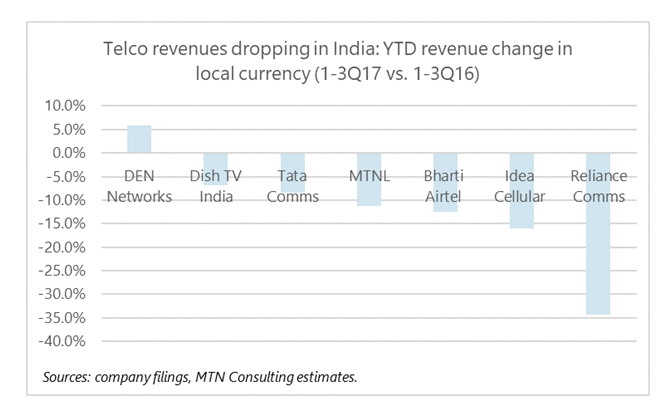
Just recently, in November 2017 the Indian regulator TRAI announced a net neutrality recommendation, concluding that telcos cannot unfairly prioritize content. This was a win for OTTs. India’s telecom regulators are now pursuing more open, pro-consumer policies than the US FCC, which today voted to end America’s version of net neutrality. However, the TRAI’s recommendation still needs to be formally adopted by the government, and India’s telcos are lobbying hard for relief. In fairness, this comes at a tough time for them, as they’re facing high debt and weak revenues, made worse recently by the rapid growth of new entrant Jio. The figure below shows how stark the revenue declines have been for many in recent quarters.
Smartphones are the platform of choice for OTTs in India

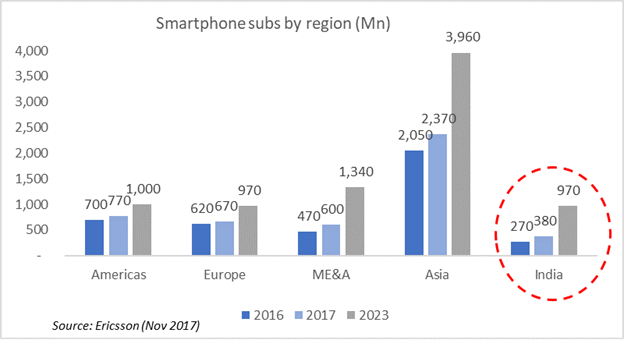
While India’s fixed broadband networks are underdeveloped, it has an enormous base of smartphones. As shown below, by 2023, Ericsson expects India to have 970 million smartphone users, after growing at a 17% CAGR from 2017 . That’s the same as the entire region of Europe.
Given India’s smartphone-centric broadband market, smartphones play a huge role in launching new OTT services and partnerships. For new revenues, telcos are looking at apps and content. A common approach is to bundle traditional offerings with OTT services such as media/cloud storage/video/music, to drive data usage and help migrate users to higher-priced plans.

For instance, video-streaming. Vodafone India has won deals with Eros NowHOOQ, and Amazon’s Prime Video. Vodafone has also partnered with Netflix in a deal which includes carrier-billing, and free Netflix service for a year under a few of the post-paid plans. Netflix plans to strike similar deals with India’s Airtel DTH and Videocon d2h. Starting from scratch, Jio is carving out a niche for itself with app-based services such as JioPlay, Jio Beats, Jio VoD and Jio Security.

As a result of India’s rising smartphone penetration and OTT service adoption, data traffic is booming. Ericsson expects data traffic per smartphone in India to reach 18 GB/month by 2023, from the current 3.9 GB/month. Telcos, of course, claim to worry they’ll be stuck carrying all this traffic, while OTT providers function as free riders of telco network assets. So far, that argument hasn’t held up with regulators.

(Photo credit: Mpho Mojapelo)

Blog Details

Early Telco Reporters Verizon & Rogers Provide Mixed Signals For Vendors

The first sizable telcos reported 3Q17 earnings this morning: Verizon and Rogers. Both can point to reassuring bottom line results. For the 9 months ended September, operating & net margins improved year-over-year, as did earnings per share. Rogers’ EPS through September was C$2.66, up 24% YoY, while Verizon’s $2.80 EPS for the same period was up 32% YoY. The results contain some negatives, too; some company-specific, but some illustrative of broader market challenges.

Wireless not always a growth driver

Rogers was an early mover in Canada’s LTE market, and continues to grow its postpaid subscriber base: 8.8M in September 2017, up 3.3% from 3Q16. That 8.8M amounts to roughly 25% of Canada’s population. Wireless revenue growth this year has averaged 5% YoY. The company’s operating margins are reliably in the 40-50% range; in 3Q17, the figure of 47.9% was up a bit from 47.1% in 3Q16. What helps keep the margins high are stable ARPUs and fairly low churn. Rogers’ blended (postpaid + prepaid) wireless ARPU for the year so far is C$61.94, up just under 3% from the 2016 period. Churn in retail postpaid is 1.11% so far this year, down a bit from 1.19% YoY.

Verizon, also a first mover in the US’ LTE market, retains high operating margins in its wireless division: 46.2% for 3Q17, from 44.9% in 3Q16. However, core service revenues are falling: $47.2B in wireless service revenues for 1-3Q17, down 6% YoY. Total wireless division revenues also fell, by a more modest 3.1%. The difference is equipment. Verizon regularly charges more in “cost of equipment” than it books in equipment revenues; that’s not changing. However, Verizon closed the gap significantly in 2017. The implicit loss (or subsidy) from its wireless device sales was $2.4B YTD17, down from $3.1B in 1-3Q16. This narrowing may not be sustainable. New device releases and sales/distribution strategies can often lead to spikes in equipment subsidies.

On the plus side, nearly 95% of Verizon’s subscribers are on smartphones (from 93% a year ago). Churn also remains low at Verizon: for the high value retail postpaid segment, Verizon’s churn was 1.02% so far this year, essentially unchanged from the 0.98% in 1-3Q16.

Cord cutters and OTT

Wireline accounts for about 30% of revenues at Verizon, and 25% at Rogers (over a cable network). Like most big incumbents with fixed access networks (PSTN or cable TV), both offer video platforms combining voice, data & video over an operator-provided CPE. To do this, they’ve invested heavily in network upgrades, workforce training, and sales & marketing over the last 5+ years.

Despite this investment and overall subscriber growth, both operators are reporting net losses in video/TV subscribers. Consumers have far more OTT video options now. Performance over mobile networks often isn’t good (or economical) enough for heavy video users. The incentive to keep your telco/cable-provided Internet service but cancel video is growing stronger.

Rogers’ reported sub losses have been ongoing; its TV subscribers are now 1.75M, down 4% from the prior year. This was worsened due to Rogers’ growing pains with platform development. It spent nearly half a billion C$ trying to develop a proprietary IPTV platform, similar to BCE’s “Fibe TV” platform, before having to write it off. It’s changed strategy, and will now license the Comcast-developed X1 platform.

Verizon’s had more luck with its custom FiOS box. However, it also lost video subscribers in 3Q17. Overall net adds for FiOS in 3Q17 were 59,000: +66K for Internet, +11K for voice, and -18K for video. Margins remain low in wireline, despite some YoY improvement; EBITDA/revenues so far this year in wireline is 21.2% from 17.1% in 1-3Q16. Further, to sustain its wireline business Verizon’s capital spending is higher as a % of revenues: 14.6% so far this year, from 10.9% YTD16.

Overall revenue trends point to caution

The figure below shows recent YoY revenue trends for the two operators. Rogers’ trend is relatively steady; its early lead in LTE and market-leading broadband position has helped with this consistency. The growth rate is just 2-4% per year though.

Verizon’s growth has been negative until recently, held back by weak mobile service revenues. A modest improvement helped push Verizon’s YoY growth to Rogers’ level in 3Q17, +2.5%. Another factor benefiting Verizon’s measured growth recovery is mobile device equipment revenues, up 5.4% so far this year, to 13.5% of corporate revenues.

rogersvz-mtnconsulting2

Even with slow top-line growth, both Rogers & Verizon generate healthy free cash flow in typical quarters, including $3B for Verizon in 3Q17 and C$372M for Rogers in the same period. They have high debt typical of telcos, but interest costs are on the low end.

Verizon capex 13-14% of revenues, selective M&A activity likely to continue

On the capex front, Verizon is big but not hard to predict: its annualized capital intensity has been in the narrow 13-14% of revenues range for several years now. Variations in the past have come from quick buildouts to gain market position. As Verizon and other telcos move to more software-centric networks, these variations will be less common and less extreme. It’s unlikely that we’ll see Verizon’s capital intensity rise above the 15% mark anytime soon. For 4Q17, Verizon will likely spend about the same as 4Q16, plus maybe 1-2%.

Verizon’s capex is constrained not just by revenue growth & software-based expansion, but also the need to reserve capital for spectrum and acquisitions. Earlier this year, Verizon purchased Straight Path and its spectrum holdings for $3.1B; in early 2015, Verizon spent $9.9B for AWS-3 spectrum in FCC auctions. On the company’s balance sheet, in fact, the value of spectrum assets (“wireless licenses”) is now slightly higher than net property, plant & equipment (PP&E, net): $88B v. $87B.

And Verizon has a healthy track record of acquisitions. That includes a recent deal to purchase fiber optic assets in Chicago from WOW. That deal was just $225M and for one metro area, but it’s a reminder that Verizon and other deep-pocketed telcos are constantly considering build v. buy alternatives. That’s more the case now, as a sector of neutral network operators (NNO) has matured.

rogersvz-mtnconsulting1

Rogers’ capex levels are looking up

As part of its 3Q17 earnings release, Rogers added C$100M to its 2017 target capex (now C$2.35B-C$2.45B). That modest change is, Rogers says, due to “strong growth in our wireless segment and the intended investment of those incremental profits to further enhance the quality of our networks”.

Even with that, Rogers’ full year 2017 capex/revenues is likely to settle around 16%, low by its historic standards. That’s down, in small part, because of a slowdown in its “NextBox” service while a new platform is being developed: Rogers is set to launch its white label partnership with Comcast sometime in 2018. An X1 success would mean more capex at Rogers. Comcast and it supplier partners, though, may be the main beneficiaries of this growth. At least initially. If the platform takes off and helps reverse Rogers’ video sub declines – and lift ARPUs – you can expect more investment in the core of the network to keep the cord cutters at bay.

(Photo credit: Bernd Schulz)

Blog Details

Third Quarter Earnings Season Around The Corner (And Yes, It’s Cloudy)

Over the next 3 weeks, companies across the communications sector will begin reporting third quarter (3Q17) results.

Watch for telco progress

The world has never been so reliant on secure communications, but the underlying market is in a bit of turmoil. The cloud and its key providers keep on growing, but many large telcos are treading water. They’re trying to cut costs (both operating & capital), and use modest investments and partnerships to tap revenue growth in areas like video/content and IoT. Many are also involved in M&A deals, which can help competitiveness if integrated well, but it can also make you lose a step. Nearly all telcos are under some level of competitive pressure from the cloud world, some extreme. As such, the most interesting earnings ahead lie in November, when most telcos report. But we’ll learn a thing or two in October.

Economic outlook stabilizing

The IMF’s Managing Director, Christine Lagarde, gave a relatively optimistic speech yesterday on the global economic outlook. Lagarde noted that the IMF’s last (July 2017) forecast projected 3.5 and 3.6% GDP growth for 2017 and 2018, respectively, adding that the forecast to be released next week “will likely be even more optimistic…Measured by GDP, nearly 75 percent of the world is experiencing an upswing; the broadest-based acceleration since the start of the decade.” She also noted some important risks, “from high levels of debt in many countries, to rapid credit expansion in China, to excessive risk-taking in financial markets.” The broadly positive tone was a plus for the communications sector, though, where revenues tend to be closely linked to overall GDP.

Wide range of companies play into the communications sector

The communications sector’s supply chain is long & complex, from chip vendors selling into networking & data center markets (e.g. Intel, Micron, Amphenol), to infrastructure vendors supplying hardware, software & related services directly to network operators (Ericsson, Huawei, Ciena); to services & software specialists (Amdocs, Mavenir, Nutanix), to the network builders & operators themselves. These can be telcos (Orange, Softbank, Verizon), cloud providers (Microsoft, Amazon, IBM), infrastructure specialists (Equinix, Zayo, Crown Castle), or part of another vertical market building large carrier-scale networks (finance, energy, government).

Most of the suppliers along this chain sell into other markets beyond communications; that’s most obviously the case at the chip level, but also for others, including IT services vendors. Some cloud providers (IBM, HPE, SAP, and Oracle in particular) are also large suppliers of IT equipment & services to telcos, who they compete with in some areas.

Another layer of complexity is manufacturing: few big tech vendors actually do this themselves nowadays, so electronics manufacturing services (EMS) players (e.g. Benchmark, Flex, Jabil) are also relevant. Note that some companies in the cloud (e.g. Facebook, Alphabet/Google) develop their own product designs, and contract with EMS/ODM partners to manufacture and ship to site.

Look for the cloud effect in October results

Despite the IMF’s endorsement for overall growth, the communications sector is less certain. Many big players are struggling with changes wrought from the cloud, and finding top-line growth isn’t easy. The growth of “the cloud” will be seen across earnings, sometimes indirectly. Cloud is motivating business strategy shifts, new investments, mergers, and layoffs. The latter subject will surely come up at Ericsson’s 3Q17 call, set tentatively for October 20.

Many semiconductor players selling into communications markets report earnings later this month, starting the 19th of October (TSMC) to the 30th (Cavium; estimated date). One of the early (19 Oct.) reporters, Maxim Integrated, also illustrates the impact of the cloud.

Maxim’s 2016 revenues were about $2.2B, flat from 2015 and down slightly from 2014. Last month, it announced a “business model update“. One goal was to increase operating margins, another to reduce dependence on individual large customers. Also important, though, is the need to better address cloud applications. Maxim does this through its “Comms & Data Center” unit, focused on data center optical connectivity & power.

When Maxim crafted its strategy shift, Intel’s dedicated “Data Center Group” (DCG) may have been on Maxim’s mind. Intel’s DCG revenues were $17.8B in the 12 months ended June, from $13.4B 3 years prior (3Q13-2Q14). That’s attractive growth, when it’s (mostly) organic and comes with above average margins: in the first half of 2017, 42% of Intel’s operating income came from DCG, which contributed only 29% of revenues. Intel reports on October 26th.

Some positive early news from an unusual reporter

Not all companies follow a calendar year-based fiscal year, and some also stagger their quarters. Accenture is an example. Its fiscal year ends in August. The benefit of this, for a market watcher, is that Accenture already reported its equivalent of 3Q17 (June-August 2017).

The results, published on September 28, are positive for the company’s “Communications, Media, & Technology” (CMT) vertical market. Accenture’s CMT revenues were $1.82B in 3Q17, up 7% YoY; CMT revenues for the 12 months ended August were also up, by 4%, to $6.88B. This is good for Accenture, but it’s too early to tell what it means (if anything) for the sector. Accenture provides a wide range of software & services to CMT players. Its growth could be driven by market share gains, or an expanding market: telcos are leaning more on vendors/partners (e.g. Accenture) in certain areas, which can expand the addressable market. Digital transformation is one area. Importantly, Accenture is offering a number of services geared towards new service rollout & management.  That hits what telcos need most of all: new revenue streams.

(Photo credit: Diego Jimenez)