Blog Details

Cisco, Samsung, and ZTE benefit most from Huawei bans in 2021 telco NI market

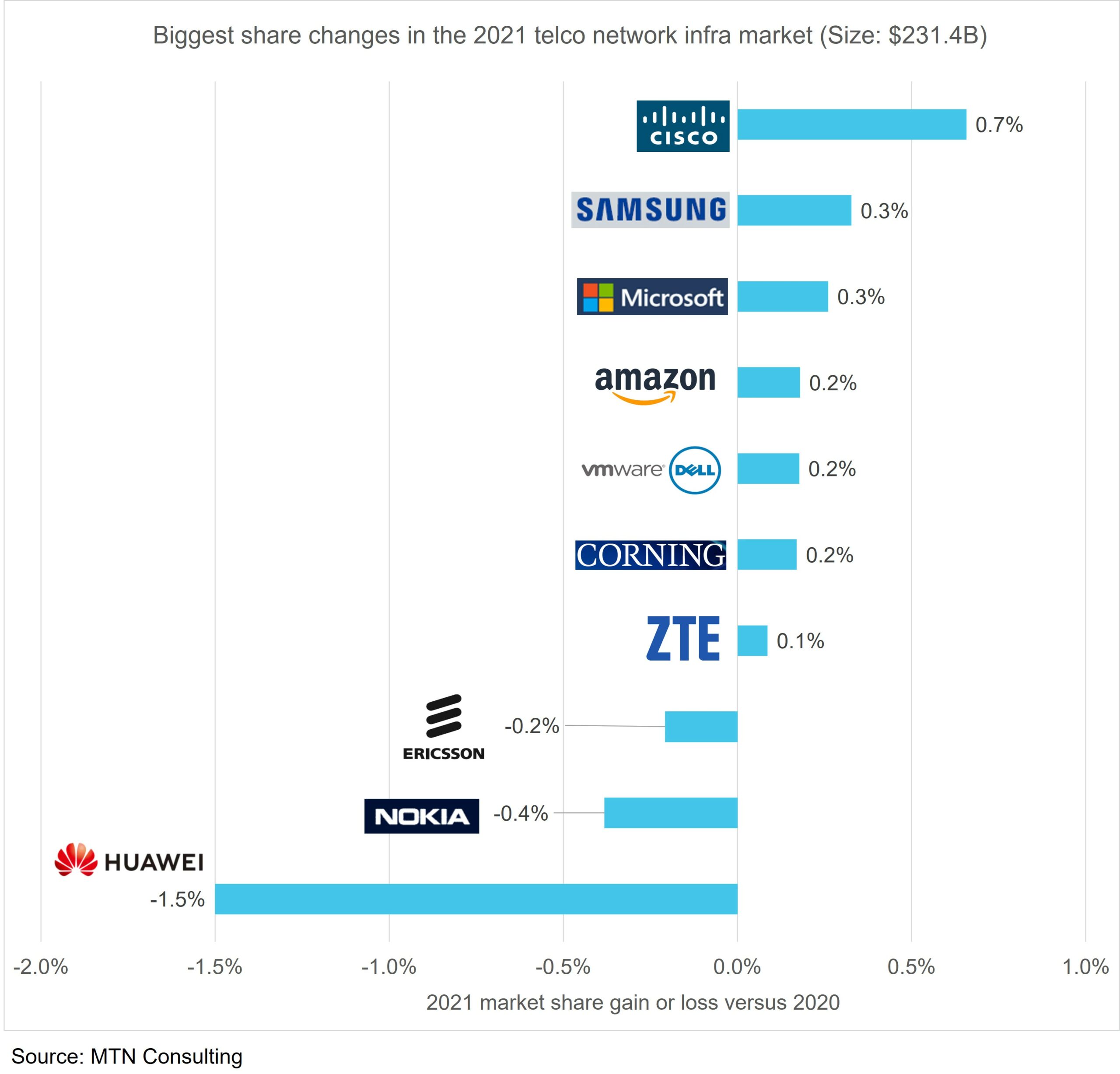
2021 results for the 100+ vendors selling into the telco market are just about finalized. Contrasting 2021 “telco network infrastructure” (Telco NI) share with 2020, Cisco clearly came out on top, gaining 0.7% share in a market worth $231.4 billion (B). Cisco was helped both by a telco shift in 5G spending towards core networks, and Huawei’s entity list troubles. Samsung’s share growth of 0.3% was due to a big win with Verizon and a growing telco interest in seeking RAN alternatives beyond Ericsson and Nokia. ZTE, which has escaped the US entity list to date, also picked up some unexpected 5G wins but its growth is more broad-based due to optical, fixed broadband, and emerging market 4G business.

Dell (including VMWare), Microsoft, and Amazon also picked up share as telcos have begun investing in 5G core and cloud technologies. Their growth has little to do with Huawei, and more due to telcos’ ongoing changes to network architecture and service deployment patterns. Corning was an unexpected winner in 2021, gaining 0.2% share on the back of fiber-rich wireless deployments and government support for rural fiber builds.

On the flip side, both Nokia and Ericsson lost share in the overall telco NI market in 2021. Their RAN revenues benefited from Huawei’s troubles in 2020 but telco spending has since shifted towards product areas with more non-Huawei competition. Both vendors are attempting to diversify beyond the telco market, with Nokia so far having more success; its non-telco revenues grew 12% in 2021.

Huawei’s share of telco NI declined to 18.9% in 2021, down from a bit over 20% in both 2019 and 2020. The US Commerce Department’s entity list restrictions were issued in May 2019 but hit the hardest in late 2020 and 2021, after Huawei’s inventory stockpiles began running out.

Huawei’s messaging on its recent fall is muddled. During its annual report webcast yesterday, it cited three factors behind its 2021 revenue decline: supply continuity challenges, a drop in Chinese 5G construction, and COVID. In MTN Consulting’s opinion, supply continuity was the main factor. A related factor were the many government-imposed restrictions on using Huawei gear around the world, especially in Europe where 5G spending was strong in 2021. The other two factors cited by Huawei’s CFO, however, are misleading. Chinese telco network spending, overall, was relatively strong in 2021: total capex for the big three telcos was $52.8B, up 8% from 2020. Without this rise, Huawei’s 2021 results would have been worse. As for COVID, few other vendors cite the pandemic as a factor restraining 2021 telco spend. More vendors cite the opposite: 2021 spending was strong in part because telcos were forced to delay many projects during COVID’s early spread.   

To date, Huawei’s troubles have impacted RAN markets the most, but in 2022 and 2023 will begin spreading more clearly to IP infrastructure, optical, microwave, fixed broadband, and other areas. A number of vendors are eager to pursue new opportunities as this happens, including Adtran/ADVA, Ciena, Cisco, CommScope, DZS, and Infinera. The CEO of Infinera, in fact, said on its 4Q21 earnings call that “it was a nice taste, a nice appetizer in 2021, but…we said all along that we would see the design wins and RFPs really scaling and we thought that we’d see revenues from that really beginning to take hold as we got into 2023.”

To date, Huawei has been unable to fully adapt to the supply chain restrictions put in place in 2019. It remains the global #1 in telco NI, however, due to dominance in China and a huge installed base across the globe. The company is investing heavily in carrier services & software, Huawei Cloud and new product areas. One certainty is that it won’t simply fade away, despite the current decline.

Blog Details

Telco NI vendor market in 2Q21 – preliminary findings

Growth returns to telco NI market; momentum shifts to cloud, away from Huawei 

Preliminary results show 2% YoY sales growth in 2Q21

Enough vendors have now reported their 2Q21 results to allow for some preliminary conclusions about the market. As of August 10, we have compiled earnings figures and analyzed customer segmentation for 72 vendors, including Huawei. These 72 account for roughly 3/4 of the market based on historic revenue trends.

Focusing on vendors’ sales to the telco vertical, what MTNC refers to as “telco network infrastructure” or telco NI, revenues climbed 2% YoY in 2Q21.

That’s slower than the 8.7% YoY growth rate recorded by this subset of vendors in 1Q21. However, the 1Q21 surge was influenced by a weak base period (1Q20), when economies were dragged down by COVID’s early spread. On a six month basis, telco NI revenues in 1H21 grew 5.1% YoY. Annualized (12 month) telco NI revenues through 2Q21 grew 2.8% over the 2Q20 figure. These growth rates may be modest in other parts of the tech sector, but for telco NI they are an improvement.

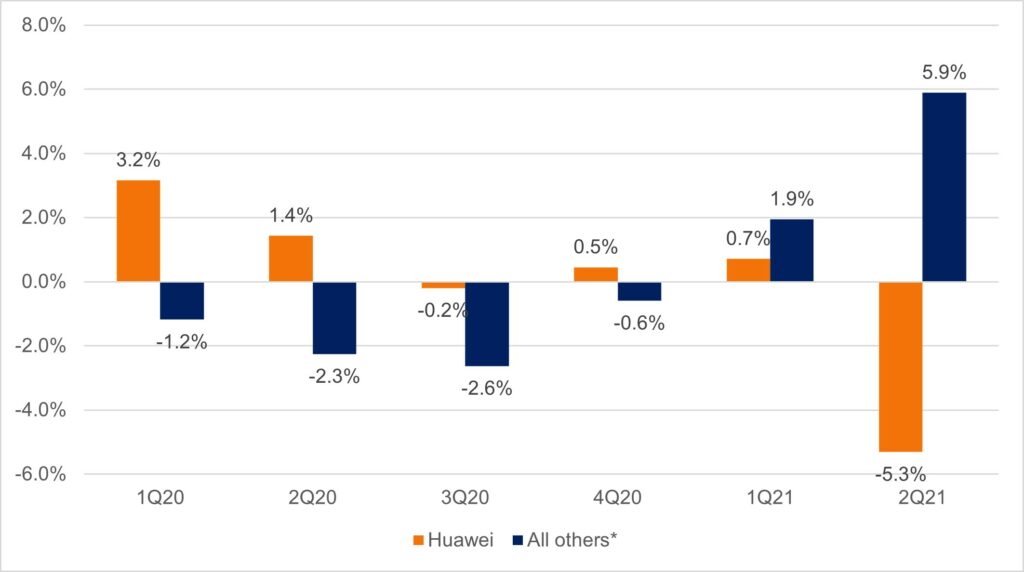
As Figure 1 shows, Huawei has tracked very differently from the overall market: outperforming in 1H20 due to Chinese 5G spending, and lagging in the last two quarters as supply chain restrictions and security concerns caught up to the company. 

Figure 1: YoY change in annualized sales to telcos: Huawei vs. all others (preliminary)

Source: MTN Consulting
*Data for “all others” represents the sum of 71 vendors already reporting 2Q21 earnings, including historical data for acquired companies (e.g. Amdocs-Openet)

This growth is welcome news for the many vendors with strong positions in the telco sector. Moreover, the growth comes despite Huawei’s 7% decline in first half telco NI revenues. As the market’s (still) largest vendor, this 7% drop has a big impact on the overall market. Removing Huawei’s figures from our calculations, for 2Q21 alone preliminary telco NI vendor revenues grew by 11% on a YoY basis.

Among reporting vendors, the best 2Q21 results in terms of YoY change in telco NI revenues (on a USD basis) came from Ericsson, Nokia, Samsung, Microsoft and Capgemini. Ericsson and Nokia are benefiting from uptake of 5G worldwide and picking up some of Huawei’s old business. Samsung’s improvement is due both to its Verizon 5G deal and to making strides in smaller 5G markets like Canada and New Zealand. Microsoft’s result is due to a long list of telco collaborations, as well as two 2020 acquisitions (Affirmed and Metaswitch). Capgemini’s growth is due largely to acquiring Altran, an engineering services business with strong telco roots. As far as YoY drops in telco NI revenues in 2Q21, the only significant one among companies reporting to date is Huawei: we estimate its 2Q21 revenues at $12.2B, down from $14.4B in 2Q20.

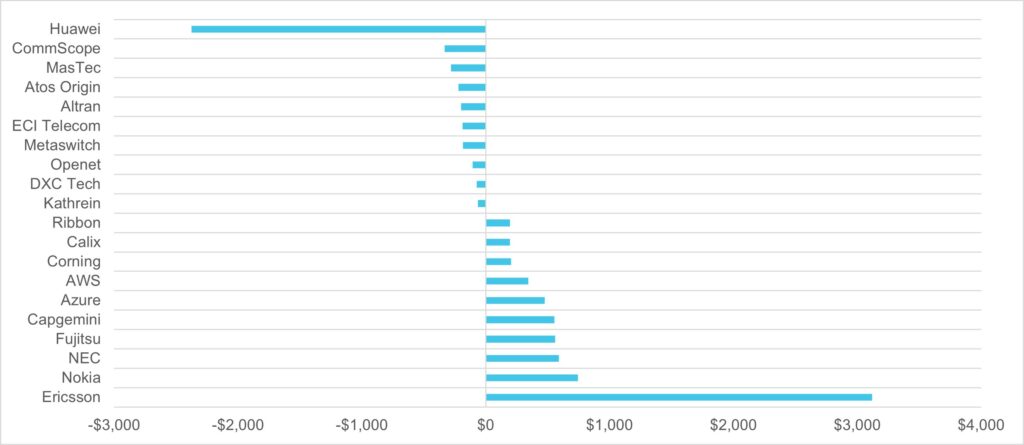
Moving back to a more long-term comparison, Figure 2 illustrates the biggest swings in annualized telco NI revenues for 2Q21 (versus 2Q20 annualized).

Figure 2: Biggest swings in annualized telco NI revenues, 2Q21 vs. 2Q20

Source: MTN Consulting

As Figure 2 makes clear, Microsoft (shown as “Azure”) is not the only cloud provider making progress in the telco sector. AWS also recorded an impressive bump in annualized telco NI revenues in 2Q21, just a bit behind Microsoft. GCP is not in the top 10 but its 2Q21 annualized telco NI revenues measured $129M, double the 3Q19-2Q20 figure. Combined, the three companies accounted for approximately $1.9B in annualized sales to telcos in 2Q21, from $970M a year earlier. That puts the three companies’ collective telco NI market share a bit ahead of Juniper Networks. Increasingly these webscale-based cloud providers are competing against vendors with a much longer track record in the telco industry: Amdocs, Cisco, Nokia, etc. AT&T’s recent deal with Microsoft will accelerate this competition as it entices more telcos to consider outsourcing and collaborating with the cloud. 

Huawei’s changing fortunes opening up opportunities

The Huawei dip in 1H21 is not unexpected. We wrote earlier this year that Chinese telco NI vendors would likely lose $4B of revenues in 2021 due to supply chain restrictions and security concerns. What we predicted is largely coming true:

“US policy will continue to restrict much of the Chinese technology sector’s access to US supply chains; the US government will aim to minimize deployment of Chinese technology in both US communications networks and those in allied countries; and, US policy will support alternative technologies and companies that can help smooth the transition away from China. Implications: Huawei will see market share in the telecom sector decline markedly over the next 2 years; China will push harder on its own allies to purchase Huawei/ZTE gear; Huawei and ZTE will emphasize services and software more, and hardware less; China will explore many ways around the rules but see limited success without crucial chipmaking technology; Open RAN will see an accelerated adoption curve; US companies like Ciena, Cisco, and Infinera, and others (e.g. Fujitsu and NEC), will see telecom opportunities pick up significantly in 2H21 and 2022.”

In recent earnings reports and calls, many vendors are pointing to the recent Huawei weakness as one driver for improved results; for instance:

  • ADVA: “With some of the Chinese competitors being limited in Europe due to security relevant issues, we see additional growth potential here.”
  • Dasan Zhone: cites “numerous Huawei and ZTE replacement opportunities”
  • Infinera: “On the competitive side, we see significant competitive disruption with the situation in Huawei being removed from the European and Asia operator
    networks over the course of the next 2 years to 5 years type time frame”
  • Ribbon: “Competing in large addressable markets such as optical and IP networking…there are opportunities for significant share growth and a favorable competitive environment with the global pressure on Huawei and other Chinese suppliers.”
  • Nokia: “there are cases…where operators for various, sometimes politically-driven
    reasons, have decided to … switch suppliers. And we have already estimated and I can confirm that, that we have won approximately 50% of such opportunities.”

As Nokia’s discrete wording suggests, discussing Huawei publicly can still be tricky for top execs. Many of these companies rely on China for various parts of their supply chain, or as an end use market. Ericsson’s decision to go after Chinese business more aggressively than Nokia has put it in a tough spot. Chinese officials are explicitly linking Sweden’s ban on Huawei in 5G with Chinese telco procurement decisions. This is a good reminder that China’s telcos are not private entities, and that Huawei’s fate is extremely important to Chinese politicians.

Final results available in September

As noted, this short note is based upon roughly 75% of the market reporting. A number of significant vendors have not yet published 2Q21 earnings. The largest of these, by far, are Cisco and ZTE. We will publish final results and commentary on the 2Q21 telco NI market in September.

Blog Details

Organic revenue growth continues to be a stretch for telcos in 1Q21

Organic revenue growth continues to be a stretch for telcos in 1Q21

Two weeks ago, we provided a preliminary view on revenue trends based on the first 13 significant telcos to report 1Q21 earnings. In it, we noted that revenue growth rates appeared promising for 11 of these 13, as the YoY % change in 1Q21 was improved relative to 4Q20. However, we also flagged a trend of concern, namely, that much of the apparent telco revenue growth was coming from sales of equipment (e.g. handsets) rather than core services. This has been happening on the mobile side with new 5G device sales, and also with cable companies catering to the work from home crowd. A survey of 25 additional telcos which have reported since our last newsletter confirms this trend. Telcos are still not persuading investors that the new services they are investing heavily to develop will lead to significant top-line growth. 

Revenue trends in 1Q21 – the latest 25 reporters

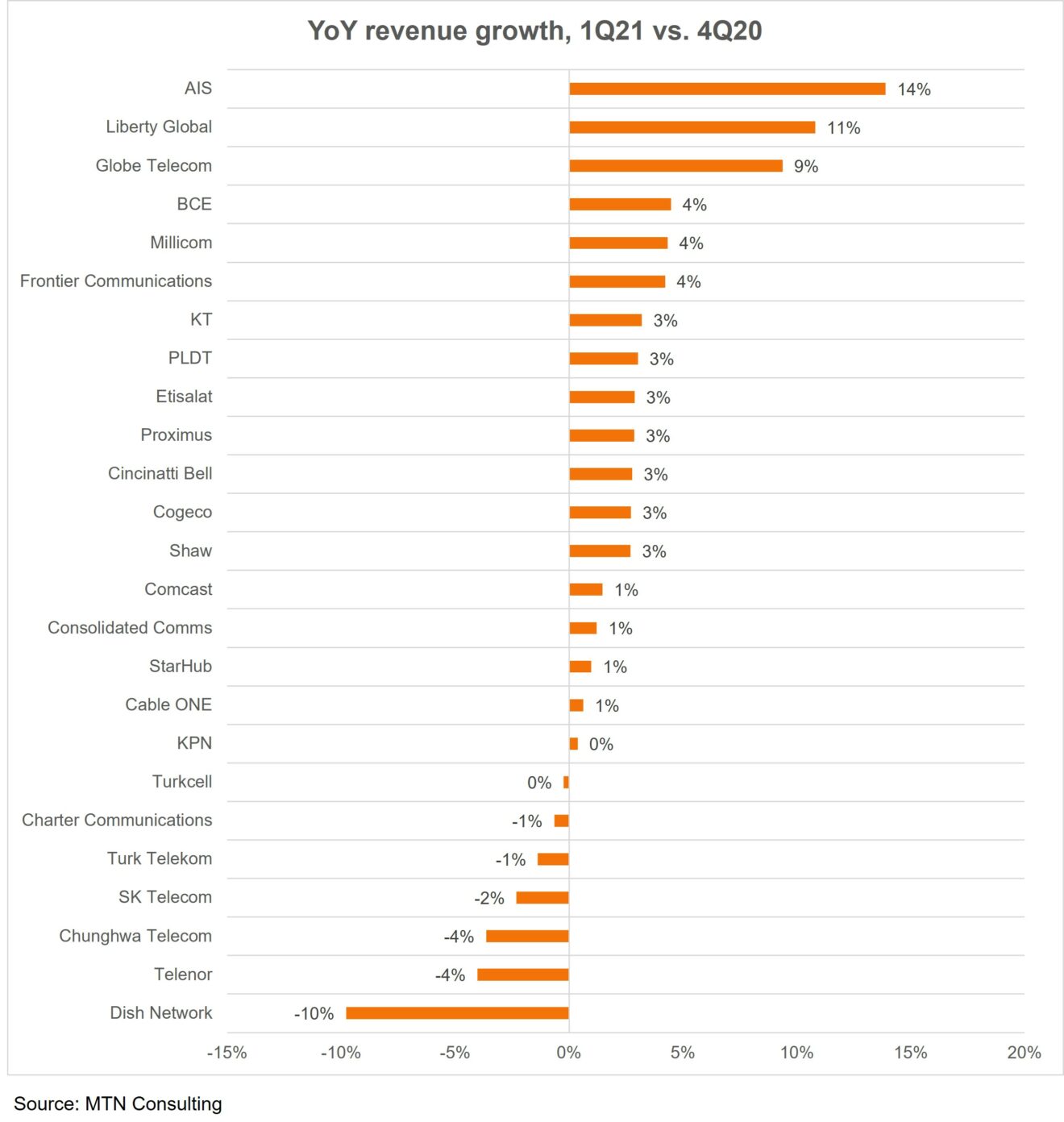
The figure below illustrates the difference in the YoY revenue growth rate achieved for the group of 25, comparing 1Q21/1Q20 to 4Q20/4Q19. As shown, 18 of the 25 improved their YoY revenue trend line at least a bit between 4Q20 and 1Q21. 

YoY revenue growth in 1Q21 for telcos, v2

Thailand’s biggest telco, AIS, had the best result of the 25 due to aggressive investments in both 5G and consumer fiber broadband completed in 2020. Its 4Q20 revenues declined by 7% YoY, while 1Q21 revenues grew by 7%, netting a positive 14%. Liberty Global grew by double digits as well, but that’s almost entirely due to recent acquisitions (of Sunrise, and Vodafone properties). 

The worst performer of the group was Dish Network, but this is misleading as the company is ramping up a new service so growth rates will inevitably decline over time. Telenor had the second worst result of the group, for more substantive reasons: its Myanmar operations have collapsed amidst political unrest, and its Thailand arm DTAC is running behind rivals True and AIS in 5G rollouts. To compensate, DTAC is now accelerating a 5G rollout based on 700MHz spectrum, and Telenor is attempting to gain scale in another regional market, Malaysia, by merging its local operations with Axiata. At the corporate level, Telenor continues its long-running efforts to optimize its operational cost base: it claims a 7% company-wide decline in opex for 1Q21.

For the largest companies in the group of 25 – Comcast (#6 globally by revenues as of 3Q20), Charter (#13), KT (#17), and BCE (#19) – BCE and KT made the biggest gains between 4Q20 and 1Q21. However, as noted below one-time sales of equipment were a major factor for both. It was also a major factor for AIS, in fact.

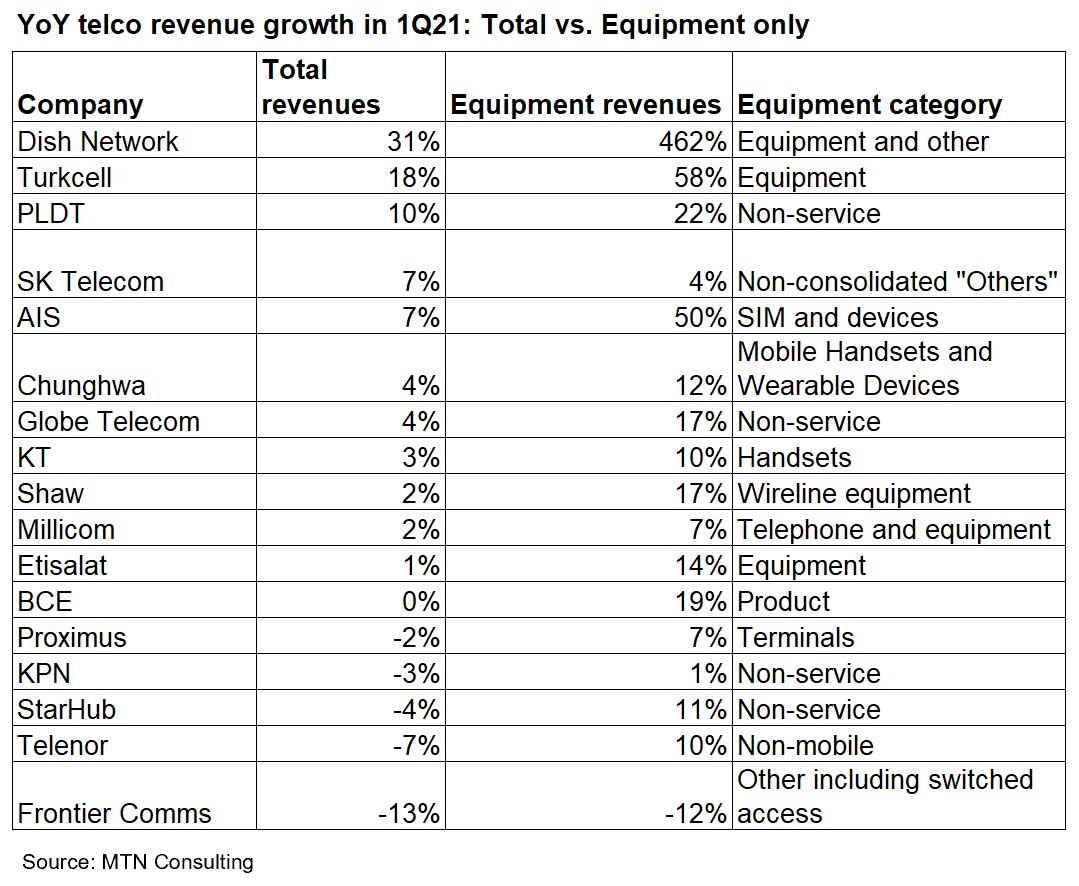
The table below provides a summary of total revenue growth in 1Q21 for a subset of the 25, and the growth reported in non-service (equipment) revenues for the same time period. As shown below, equipment revenue growth outpaced the total company trend line for nearly every telco, in some cases by huge margins (e.g. Dish, AIS, Global Telecom, Etisalat). SKT was the only exception, as its corporate revenues climbed by 7.4% in 1Q21, while the non-consolidated “others” category of sales (which includes handsets) grew by just 3.8%. Not unrelatedly, SKT is planning to spin off part of its operations in the near future, in particular the parts growing faster than its telco core.

rev v eqpt rev 1q21 next 25

Only 17 of the 25 are included above because the rest do not report equipment revenues, as they (generally) lease CPE to customers and capitalize the gear onto their balance sheets. That’s true for Cable ONE, Charter, Cincinnati Bell, Cogeco, Comcast, Consolidated, and Liberty Global; the 8th of this group is Turk Telekom, which does not publish its non-service (equipment) revenue figures for other reasons. 

Capex trends – changes in capital intensity due to 5G, fiber, and transformation

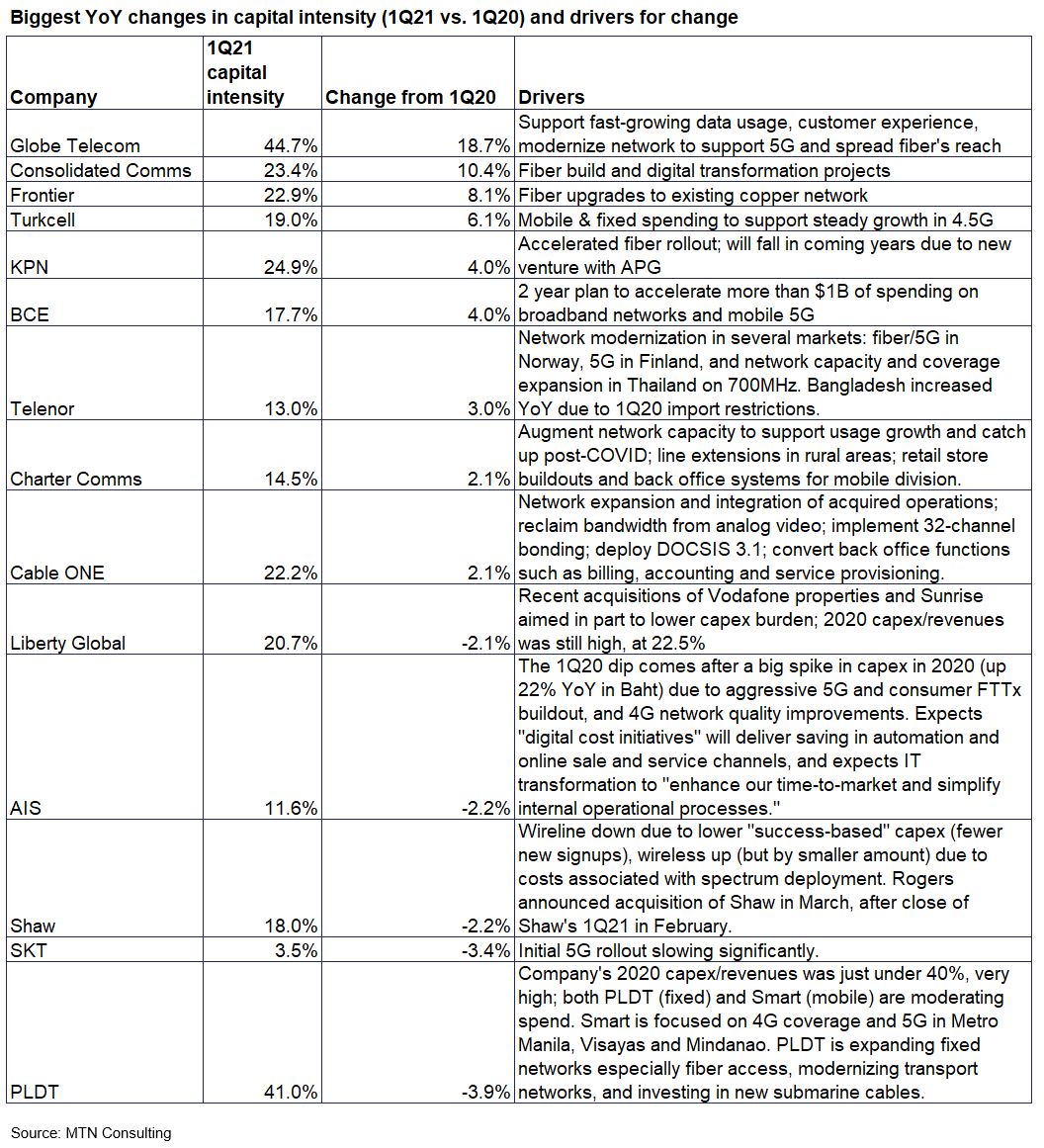
Much of MTN Consulting’s research is concerned with network spending trends, so we track capex closely each quarter. We are projecting a slight uptick in telco capex (in US$) for 2021. Based on early stats for 1Q21, this scenario is still likely. There are a number of sizable companies reporting capital intensity (capex/revenue) ratios higher for 1Q21 than 1Q20, for instance. This alone is not a great benchmark, as some telcos were forced to cut back capex in 1Q20 as the COVID-19 pandemic began to spread. Nonetheless, telcos aren’t shying away from modest capex investments in their network in order to improve operational efficiency (e.g. digital transformation, automation) and support a new generation of services on new 5G networks and FTTH.

The table below presents single quarter capital intensity for 1Q21, the change from 1Q20, and the drivers for that change. Not all 25 telcos are shown below; this table includes only telcos which reported capital intensity either >2.0% higher or lower for 1Q21 than the prior year period, 1Q20. Companies are listed according to their relative in capital intensity across these two periods, high to low.

biggest capint swings in 1q12 to date

Who will capture 5G’s value?

As we noted in our last research, many telcos deploying 5G are seeing a revenue uptick related to sales of 5G-capable devices. This also happened with 4G. Looking back, device and app companies captured much of the revenue upside related to deployment of 4G networks. This is a risk with 5G as well. As telcos deploy stand-alone 5G networks and rollout some of the more sophisticated functionality that comes with 5G, they will need to stay focused on deploying new services that deliver them growth. That will not be easy, and will require collaboration with both their vendors and the adjacent webscale sector of operators.

Blog Details

Device revenues are driving a growth uptick for telcos in 1Q21

Device revenues are driving a growth uptick for telcos in 1Q21

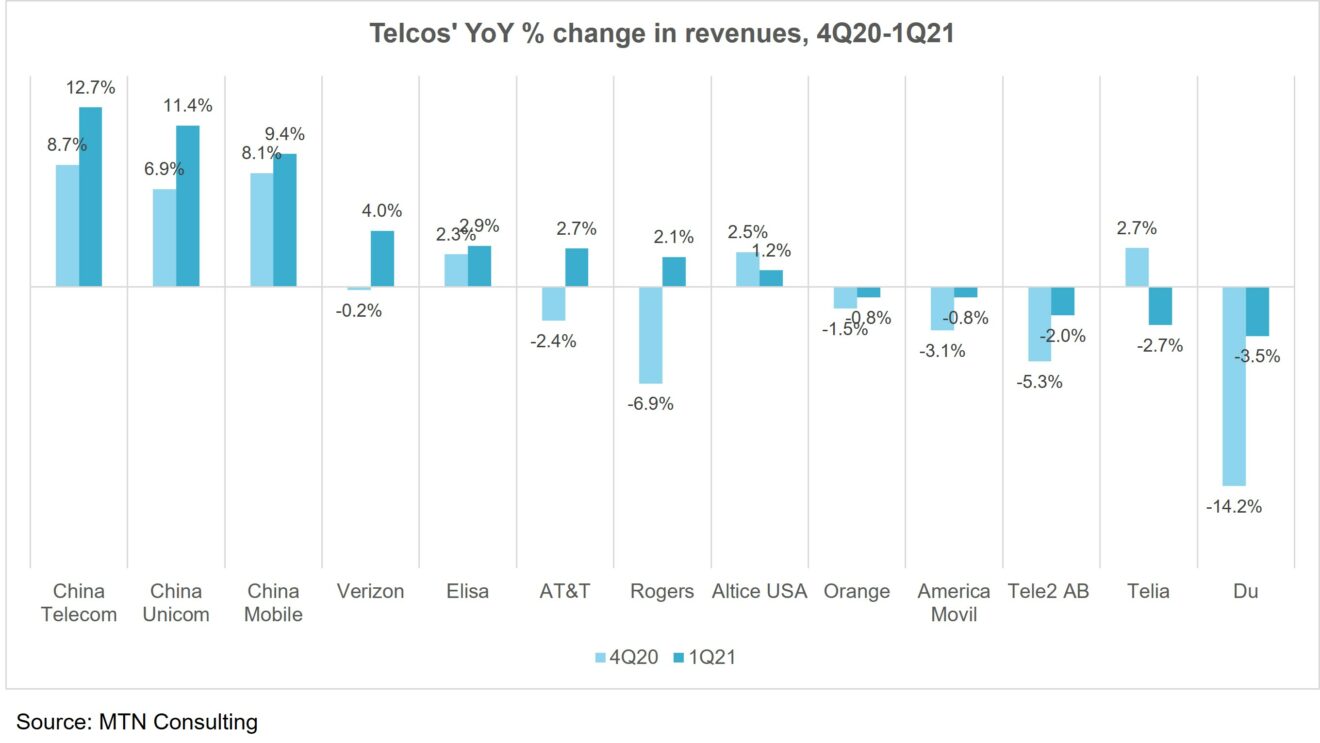
As of April 28, 13 of the 138 telecom operators (telcos) we cover in our quarterly tracker have reported 1Q21 earnings. Revenues for the early reporters have been surprisingly strong: all but 2 of the 13 have reported YoY revenue growth rates greater than the 4Q20 vs. 4Q19 result. This comes with a big caveat, however. Nearly all of the 13 owe their relative success to growth in equipment or device revenues, not to their core operations/services. For instance, 1Q21 device revenues climbed by 218% and 45% for China Telecom and AT&T, respectively. Not surprisingly, revenues for key handset suppliers are surging: Apple’s iPhone product revenues grew by 17.1% YoY in 1Q21 to $65.6B, while Samsung mobile device revenues were up 13.0% YoY in 1Q21 to 25.82 trillion Won (~$23.2B). Huawei is down but that is a company-specific situation, and early signs are that other Chinese handset suppliers (e.g. Oppo, Vivo, Xiaomi) did quite well in 1Q21.

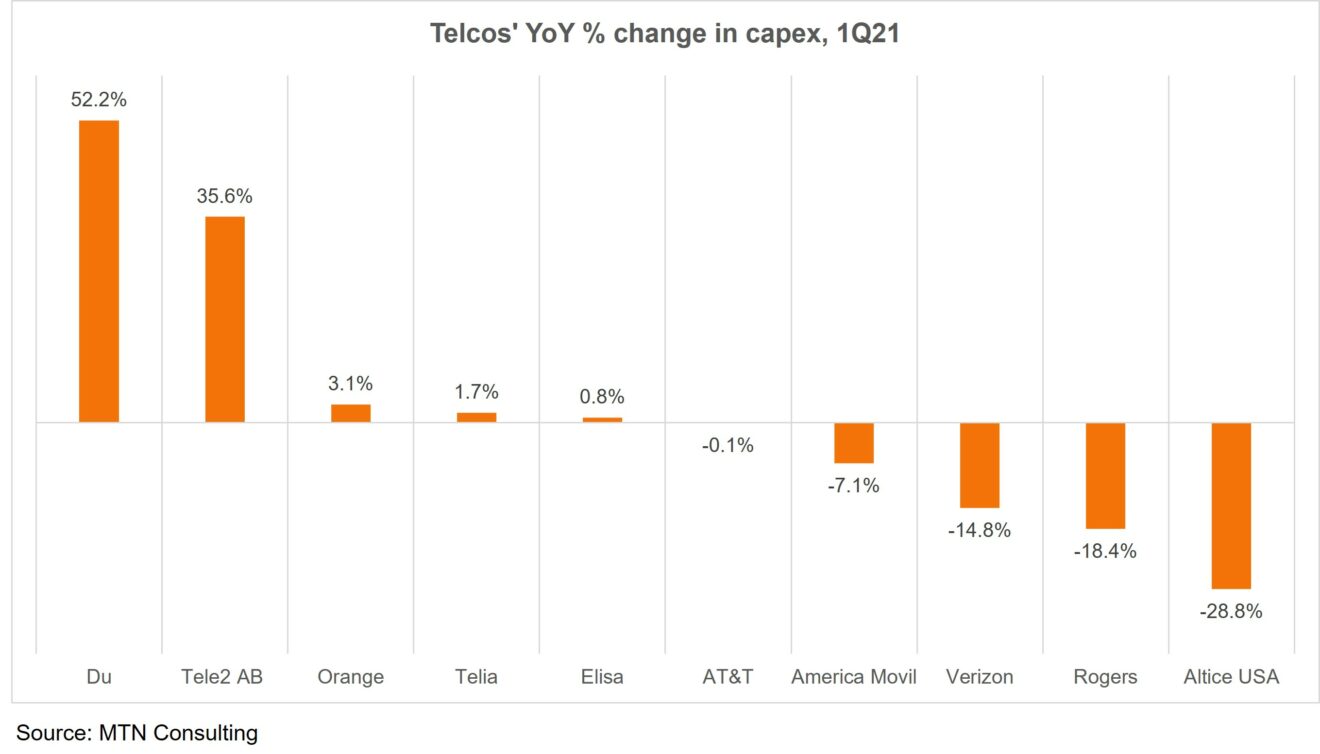
On the network investment side, only 10 of the 13 reported capex for 1Q21, as the three Chinese companies in the group report capex only every 6 months. MTN Consulting expects telco capex to grow roughly 4% in 2021, but there is no obvious pattern of growth yet based on these 10 telcos’ reports. Du and Tele2 reported 52%, and 36% YoY growth, respectively, but most of the larger telcos in the group of 10 reported YoY capex declines. Orange was an exception, as it reported 3.1% YoY growth in capex for the first quarter, due both to fiber builds in rural France and international markets as to 5G.

Revenue trends in 1Q21

As the figure below illustrates, total revenues increased on a YoY basis in 1Q21 for 8 of the 13 companies reporting to date. That’s promising given that 2020 revenues for the global telecom market declined by about 1%. Further, there were a number of significant improvements in growth between 4Q20 and 1Q21, for instance China Unicom’s acceleration from 6.9% YoY growth to 11.4%. Growth flipped from negative to positive for Verizon, AT&T and Rogers. One factor is a pickup in economic activity in many global markets as COVID-19 vaccines started their rollout and government stimulus programs took effect. The more important factor is the 4G to 5G transition. 

telco rev change prelim 1Q21

Most of the telcos reporting above operate in markets where that transition has already started: China, USA, Finland, Canada, France, Sweden, and the UAE. America Movil is an exception, as 5G is still emerging in most of its markets. Altice USA is the other exception as its mobile business is tiny and based on an MVNO with T-Mobile. For all others, though, device/equipment revenues related to 5G were the primary driver behind the YoY improvement in 1Q21 revenues:

  • China Telecom: Device revenues up 218% YoY
  • China Unicom: Device revenues up 51%
  • China Mobile: Device/other sales up 67%
  • Verizon: Wireless equipment revenues up 24%
  • Elisa: Devices up by 11%, and “Digital services” (including content/media) up a bit faster, +12%
  • AT&T: Mobility division’s equipment revenues up 45%
  • Rogers: Wireless equipment revenues up 27%
  • Orange: Equipment sales up 10% YoY
  • Tele2 AB: Equipment revenues up by 12% YoY, services declined by 1%
  • Telia: Equipment up 13% YoY
  • Du: equipment lumped into an “others” segment but company said that “Strong demand for the iPhone 12 fuel handset sales”

In their earnings, not all telcos addressed how much of their growth was attributable to one-time handset purchases that are mostly flow-through revenues. China Mobile was more direct, saying its 67% revenue growth in the sales of “products and others” was due to the the “buoyant growth of handset sales as 5G handsets were available with more varieties and at more affordable prices in the terminal market.”

Capex a mixed bag: 5 up, 5 down

Ten of the 13 telcos reporting have published capex figures for 1Q21. As the figure below shows, half reported YoY growth, half showed declines.

telco capex change prelim 1Q21

For all but Altice, the 5G transition plays into the capex fluctuations of all these telcos – with the cost of spectrum an issue that often arises.

Du’s 52% growth in 1Q21 is due to capex spend “mainly on the core network as well as 5G roll-out and on improving mobile coverage and capacity.” Tele2 cites its rollout of nationwide 5G in Sweden, and Remote-PHY on the fixed side. Orange’s modest growth is due to a ramp-up in its core France market aimed at getting Paris ready for its March 5G launch, as well as growing fiber investments in both rural France and overseas markets like Poland. Telia’s slight increase reflects a decline in fiber investments in Sweden offset by rising 5G costs as it builds out the network based on newly secured spectrum in both Sweden and Denmark. Elisa’s ~1% YoY increase is due to 4G capacity increases and expansion of its 5G coverage to reach 2.5 million people in Finland.

Among the capex decliners, America Movil’s dip is due in part to caution surrounding regional currency fluctuation and its December 2020 joint acquisition (with Telefonica and TIM) of Oi’s Brazil business. Moreover, America Movil is determined to implement 5G with minimum effect on capex: its CEO noted on AM’s 1Q21 earnings call that “I don’t think even for this year or for the next years, we [are] going to have an increase — substantial increase of CapEx for 5G.” Altice USA’s 29% dip is due mainly to a huge decline in CPE purchases, which flow into capex for Altice (as for most cable companies). Rogers also reduced capex in 1Q21, perhaps distracted by its huge pending acquisition of Shaw. Going forward, Rogers has committed publicly to major new investments in the network, in particular in rural and lower-income markets.

The two largest companies in the group of 10, by far, are AT&T and Verizon. Their capex outlays in 1Q21 were on the conservative side, falling 15% for Verizon and staying flat for AT&T (including its vendor financing payments). Their capital deployment focus in recent months has been spectrum: in the last two months, AT&T and Verizon have made payments of and $23 billion and $45 billion for C-Band spectrum, respectively, to the US FCC. 

Both companies have a long way to go to build out nationwide 5G coverage and now face an energized T-Mobile post its acquisition of Sprint. That makes their recent splurges on new C-Band spectrum all the more notable. The high cost may cause some pullbacks on capex, or at least a more eager approach to partnerships that may reduce capex, for instance webscale collaborations (e.g. AT&T-Microsoft cloud connectivity, and Verizon-AWS 5G MEC).

Clearly AT&T and Verizon need to buy equipment and software to turn this new spectrum into a usable resource, but the high cost does constrain them on the capex side. Verizon addressed this indirectly in its earnings call, saying that it is “delighted that the credit rating agencies consider the spectrum asset purchases as strategic and critical to our business operations and held their rating levels unchanged.” It’s true that spectrum is a strategic asset, but the same can be said for fiber and data center and other types of infrastructure that compete for capital within a telco budget. Costly spectrum will continue to be an issue impacting US telcos. To the extent all US telcos face this reality, the main effect will be to slow deployments in lower ARPU areas and increase consumer prices, but also encourage adoption of products & architectures which aim to maximize use of scarce spectrum resources.

Who will capture 5G’s value?

Telcos deploying 5G are clearly seeing a revenue uptick related to sales of 5G-capable devices. This also happened with 4G. Looking back, device and app companies captured much of the revenue upside related to deployment of 4G networks. This is a risk with 5G as well. As telcos deploy stand-alone 5G networks and rollout some of the more sophisticated functionality that comes with 5G, they will need to stay focused on deploying new services that deliver them growth. That will not be easy, and will require collaboration with both their vendors and the adjacent webscale sector of operators.

Blog Details

Webscale earnings and 2021 capex outlook

Amazon drives webscale capex jump in 4Q20, Alphabet lags; Oracle’s 63% YoY increase is sign of OCI ramp 

Webscale capex on track to close 2020 around $122 billion

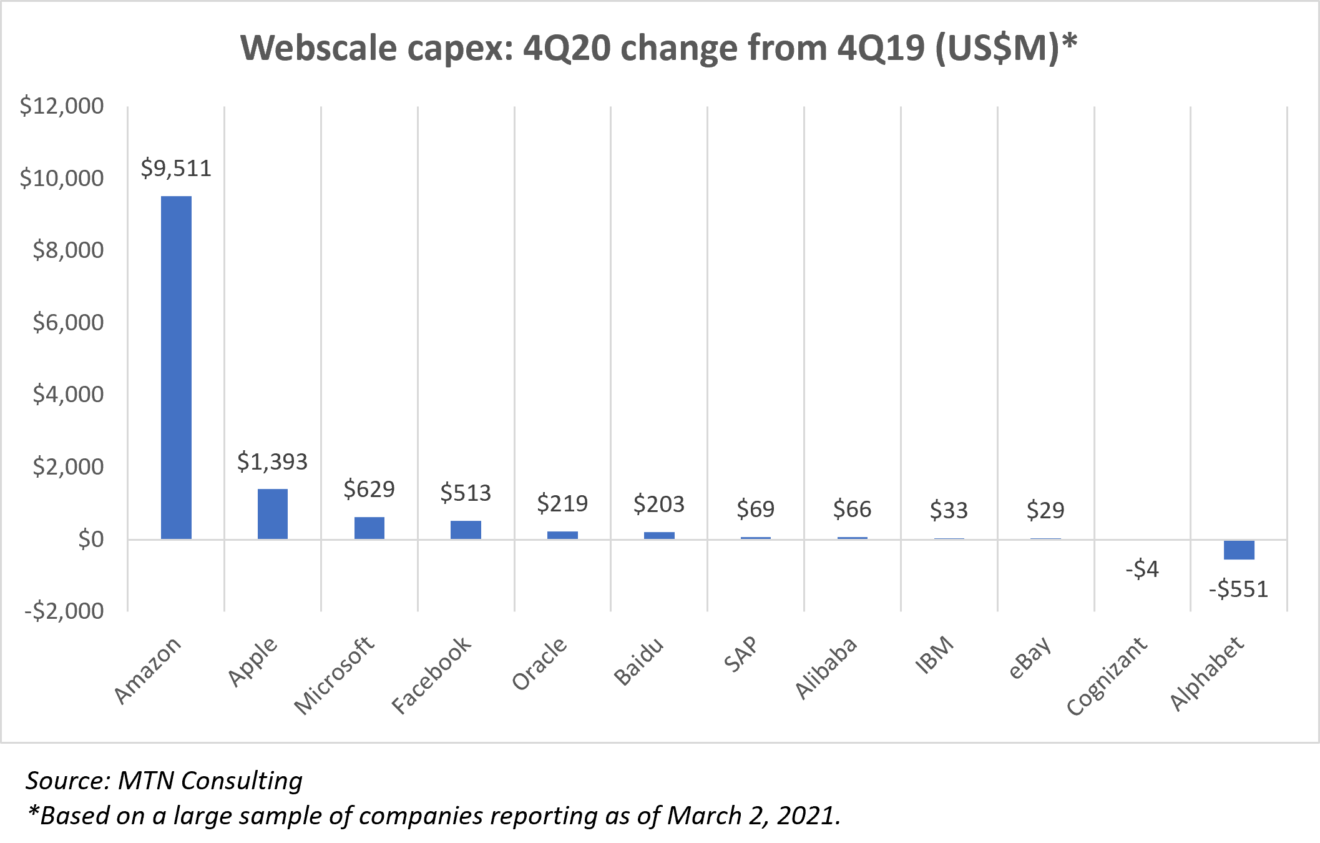
Most webscale network operators (WNOs) have now reported 4Q20 earnings. For a large sample of reporting WNOs, 4Q20 capex jumped by an average of 52% YoY versus 4Q19. Amazon was by far the most significant company, spending over $14 billion on capex in 4Q20, from $5.3B the year prior. Remove Amazon, and the YoY increase was only 14%. This is a sign of both how influential Amazon has become in the cloud and how COVID-19 enticed the ecommerce side of its business to ramp up logistics and fulfillment capacity.

The figure below illustrates YoY changes in capex for key WNOs who have already reported earnings. As shown, all but Cognizant and Alphabet increased capex YoY on an absolute basis (in US$), but nobody comes close to the Amazon surge.

webscale prelim capex change 4Q20

In MTN Consulting’s recently published capex forecast, we projected that webscale capex would close out 2020 around $122 billion, up from $104 billion in 2019. Preliminary results from 4Q20 are consistent with this projection. Looking further out, we still expect webscale capex to continue solid growth, climbing to just over $200B by 2025. The network/IT/software portion of capex will come in at roughly 50% in 2020, as it did in 2019, decline to 42% by 2023 as a spate of new data centers come on line, but grow back up to 50% by 2025 as more of capex is for server/capacity expansion of existing infrastructure. Within the technology part of capex, data centers and their components (networking, compute, storage, power) will soak up the bulk of spending, but subsea cables and satellite networks will become increasingly important over the next 5 years.

Earnings calls: A rundown of webscale capex & plans for 2021

Oracle has big plans for expanding it data centers in 2021, according to its fiscal 2Q (calendar year 4Q20) earnings call on December 2020. The technology corporation, now headquartered in Houston, reported that it plans to continue adding new data centers through 2021, and expects to have 38 by YE-2021.

Oracle is a small cloud player relative to Amazon, especially considering Oracle’s heavy reliance on collocated facilities (mainly with Equinix). However, Oracle is clearly becoming more significant in the cloud, and its use of Ampere’s data center chips could also have an impact on the competitive landscape in the chip market.

Oracle’s frequent mention of its data center plans indicates a high commitment to its cloud rollout and a bullish outlook on its prospects in this business. During the first half of its earnings call, Chairman Larry Ellison noted the company’s “great quarter” would have been even better if it had not been capacity constrained in Oracle Cloud Infrastructure (OCI). He said to remedy this Oracle is adding OCI capacity and building OCI data centers as fast as it can. Ellison claimed that, as of December, Oracle had increased its footprint to 29 regional data centers worldwide, “more than AWS” (per Oracle), adding customers, and growing revenue well over 100% year-on-year.

Ellison explained that Oracle’s strategy recognizes that, because the company has a large existing business and installed base of software customers, “we just have to get into more countries than someone – than Amazon, let’s say, because we have to serve those customers where we have an installed base.”  He pointed to Indonesia and Israel as examples: Indonesia is a very big country with a lot of people where Oracle has a large installed base, “but a lot of people don’t have data centers there.” Ellison said it’s very important to get a good data center in Israel, but “some of the cloud companies have been late to get there.”

CEO and Director Safra Ada Katz noted Oracle has greatly increased its capital spending plans due to strong demand, and expected that it will increase 50% sequentially in 1Q21. Such an increase would imply around $850M of capex in 1Q21, a 144% increase relative to 1Q20. Oracle’s data center strategy has traditionally been capex-light due to the company’s partnership with Equinix, which provides many of the properties into which Oracle installs its equipment. That makes Oracle’s capex increases all the more significant.

Amazon’s earnings call revealed very little about its data center plans, in contrast to Oracle. That’s consistent with history but also may be due to management changes. Amazon promoted its AWS CEO, Andy Jassy, to replace CEO and founder Jeff Bezos just before its earnings call webcast on February 2, 2021. In response to a capex outlook question, CFO Brian Olsavsky said “We are working through our future plans.” Olsavsky did elaborate somewhat, suggesting that its 2020 capex reached $44B due to some unusual one-off investments.

Like Amazon, most other webscale providers avoided specifics on data center investment plans for 2021 on their 4Q20 earnings calls. Oracle was a standout. Clearly Oracle wants to make a splash in the market quickly, and assure its customers and prospects that its infrastructure is rapidly getting up to speed relative to the top 3 (AWS, Azure, and GCP).

Among the 17 WNO companies tracked by MTN Consulting, Alphabet had the second largest annualized capex through 3Q20, at $23B (behind Amazon). Looking forward to 2021, SVP Eric Schindler said he expected the pace of investment to return to normal levels, with spending on servers driving an increase: “Servers will continue to be the largest driver of spend on technical infrastructure.”

In addition to servers and new data centers, Alphabet continues to spend on subsea cables. For instance, Google reported on its blog on February 3, 2021 that its new Dunant subsea cable, which connects US and Europe, is now ready for service. The Dunant cable, which was made in partnership with SubCom, will have ultimate capacity of 250 Terabits per second, “enough to transmit the entire digitized Library of Congress every second.” Google notes that “Dunant is the first long-haul subsea cable to feature a 12 fiber pair space-division multiplexing (SDM) design.”

Facebook is the most bullish of the big webscale providers in terms of its 2021 investment outlook. During its 4Q20 Earnings call, Facebook CFO Dave Wehner said “We continue to expect 2021 capital expenditures to be in the range of $21 billion to $23 billion, driven by data centers, servers, network infrastructure and office facilities.” This compares to a 2020 capex total of just $15.1 billion. Wehner said several projects were delayed in 2020 due to the pandemic.

Microsoft CEO Satya Nadella noted that the company has announced 7 new data center regions recently, in Asia, Europe, and Latin America, which will contribute to capex over the next few quarters. CFO Amy Hood, speaking just after Nadella, said the company expects to see a “sequential increase on a dollar basis” in capital expenditures in 1Q21 as the company continues to meet growing global demand for its cloud services. Microsoft spending on finance leases, a.k.a. capital leases, is also significant and contributes to the company’s network infrastructure footprint.

IBM, which made no specific mention of data centers in its 4Q20 call, had much discussion of its focus on and efforts to bring AI-powered automation across its platform. IBM says it is building out its cloud integration offerings for this purpose. CEO Arvind Krishna also discussed quantum computing, and claimed that this “has the potential to unlock hundreds of billions of dollars of value” for its clients by the end of the decade. IBM says it has a roadmap to build a 1,000 qubit quantum computer by 2023.

Baidu is one of the smaller WNOs but, like Oracle, its 4Q20 capex grew significantly, up 162% from 4Q19 to reach $329M in 4Q20. Baidu did not speak specifically about data centers or capex projections in its earnings call. The company’s focus was on its self-driving and auto-driving projects, mentioning some combination of those terms 51 times. These projects require high levels of R&D spending. During its call, the CFO Cheng Chun Yu noted that it spent about 21% of its $12.1B USD core revenue in 2020 on research and development. During the call, a questioner asked how much time the company spends on different segments and what its priorities are. CEO Yanhong Ling answered that “half of our time and resources are invested in the mobile ecosystem part, and the other half in the AI cloud and intelligent driving and other growth areas…going forward, we will continue to do this”. Baidu has fallen in relative importance over the years, but it will remain an important player in the webscale market.

SAP made one minor reference to capex and data centers in its call. CFO Luka Mucic said there will be additional capex requirements this year and next for the purpose of harmonization and modernization of its cloud infrastructure. Apple and eBay made no mention of future capex or data center investments in their latest earnings calls.

Blog Details

It’s time for tech to take a stand

In 2000, Google famously incorporated a simple catchphrase into its corporate code of conduct: “Don’t be evil.”

The idea, said Google, was that “everything we do in connection with our work at Google will be, and should be, measured against the highest possible standards of ethical business conduct.”

Google’s founders recognized that the growth of its search and ad platforms was turning the company into a powerful entity with the ability to shape user’s understanding of the world. While the “don’t be evil” catchphrase was mocked by some, it did at least imply that the company saw that its growing power came with certain responsibilities. The tech industry could use more of this sentiment in 2020.

Chaos in the streets is a feature, not a bug

Fast forward 20 years, 3.5 years after Facebook helped elect Donald Trump to the presidency, and America is in crisis.

The country is now run by a president who, as Jim Mattis, Trump’s first Secretary of Defense, put it, “is the first president in my lifetime who does not try to unite the American people—does not even pretend to try. Instead, he tries to divide us.” There are parallels in this to how Trump ran his 2016 campaign, deftly using Facebook and other social media to micro-target his messaging.

Since George Floyd was killed by a Minneapolis police officer on May 25, and the video of the killing went viral, protests have spread nationwide, to even the smallest of towns. Some opportunists have used the protests for looting, as is always the case, and some far-right, pro-Trump actors have deliberately engaged in looting and vandalism in order to give cover to any resulting police crackdowns. The bulk of the violence, though, is top-down. Egged on by Trump, police officers and an array of other armed security officers have reacted to largely peaceful assemblies of their fellow Americans with violent tactics and gear designed for fighting wars.

Patrick Skinner, a writer, former intelligence officer, and now police officer in Georgia, implied this violence was by design on his Twitter feed recently:

“Don’t let us off the hook by saying this orgy of violence is a failure in training. It is not. It is the result of training for war. Don’t say it’s a lack of a few de-escalation power points. It is not. It is the result of training for war. Our entire mindset is a war on crime.”

Racism didn’t start with Trump, nor did the militarization of the police. But this President has used a unified right-wing mass media propaganda machine and the tech industry’s social media tools to make both hip again. Cultivating a tough-guy image, he once urged a police group, “Please don’t be too nice” to suspects. Note his focus: “Suspects,” as opposed to convicted criminals.

Today, hundreds of thousands (if not millions) are protesting to be heard, at great personal risk, while the COVID-19 pandemic rages on. Republican politicians are under pressure to preserve an image of a good economy, in hopes of a Trump re-election, so public health concerns take a back seat. The political movement that claimed to be concerned with the lives of the unborn, and responds to “Black Lives Matter” chants with the inane “All Lives Matter,” is now persuading the public to overlook the 100,000+ deaths from COVID-19 and just get back to work.

In my home state of Arizona, which has a population of over 7 million, more than 1,000 people have died from COVID-19. Prior to this, I lived in Thailand for a decade. That country, which has more than 70 million — more than 10 times than that of Arizona — has recorded fewer than 100 COVID-19 deaths. And Arizona’s gross domestic product per capita (nominal) is over five times that of Thailand. What good is wealth if elected leaders don’t use it to invest in things like public health for their constituents?

As Mattis said in his recent statement, “We are witnessing the consequences of three years without mature leadership.”

Tech executives continue to hedge their bets

We are also witnessing how obsessed with money the rich and powerful of this country have become.

The hundreds of Internet companies to make it big since Google’s advent have become even bigger since Trump’s 2017 tax reform directed massive tax cuts to corporations and high-income individuals. Their top execs have become far wealthier. Even with extreme levels of unemployment and a steep GDP drop inevitable in 2020, these folks are doing just fine.

Surely, you would think, the largely liberal (so we’re told) tech sector would have spoken out by now, publicly critiquing not only specific acts of police violence but, more importantly, the messaging sent from the top. Yet, when we surveyed the top few execs of the largest companies in the U.S. Internet and telecom sectors, we came up largely dry. If wealth is supposed to free you to do and say what you want, the results have been revealing (Table 1).

Table 1: Public comments on George Floyd and Racism by Tech Execs 

Company Market cap (U.S. $B) Tech executive Public comments
Alphabet                 977.0 Sundar Pichai, CEO Posted a picture of a modified Google search home page, with new text: “We stand in support of racial equality, and all those who search for it.” Pichai’s post: “Today on US @Google and @YouTube homepages we share our support for racial equality in solidarity with the Black community and in memory of George Floyd, Breonna Taylor, Ahmaud Arbery & others who don’t have a voice. For those feeling grief, anger, sadness and fear, you are not alone.”
Amazon              1,220.0 Jeffrey Wilke, CEO, Consumer Two tweet thread: (1) “A friend who is a Black man sent me an email today that included: “The narrative that security of accomplishment will somehow lead to equality in this country for people of color, especially Black men, is a false narrative. It is simply not real.” (2) “Since I’ve subscribed to this idea — that facilitating achievement was the key to solving the problem — I looked in the mirror and asked “Have I done enough? Have I listened carefully enough?” Clearly the answer to both is “no.””
Amazon              1,220.0 Andrew Jassy, CEO, Amazon Web Services Tweeted “*What* will it take for us to refuse to accept these unjust killings of black people? How many people must die, how many generations must endure, how much eyewitness video is required? What else do we need? We need better than what we’re getting from courts and political leaders.”
Amazon              1,220.0 Jeff Bezos, COB & CEO Posted an essay on Instagram called “Maintaining Professionalism in the Age of Black Death is…A Lot”. Bezos’ personal intro to the essay: “The pain and emotional trauma caused by the racism and violence we are witnessing toward the black community has a long reach. I recommend you take a moment to read this powerful essay from @goldinggirl617, especially if you’re a manager or leader.”
Apple              1,380.0 Tim Cook, CEO, Director Tweeted “Minneapolis is grieving for a reason. To paraphrase Dr. King, the negative peace which is the absence of tension is no substitute for the positive peace which is the presence of justice. Justice is how we heal.”
Disney                 211.9 Robert Iger, Executive COB Tweeted “Below is a link to a statement we sent to our fellow @Disney employees. It’s from Bob Chapek, our CEO, Latondra Newton, our Chief Diversity Officer, and me. Thank you.” The link is a letter to Disney employees that discusses George Floyd.
Microsoft              1,390.0 Satya Nadella, CEO, Director Re-tweeted a Microsoft Corp. post that it would be using its platform to “amplify voices from the Black and African American community at Microsoft.”. Nadella’s post says, “There is no place for hate and racism in our society. Empathy and shared understanding are a start, but we must do more. I stand with the Black and African American community and we are committed to building on this work in our company and in our communities.”
Netflix                 184.6 Reed Hastings, COB, President, CEO Retweeted a video promoting non-violence, which said: “Some protestors in Brooklyn calling to loot the Target, but organizers are rushing in front of the store to stop them, keep things non-violent #nycprotest”
Snap                   27.4 Evan Spiegel, CEO, Co-Founder, Director Posted a Snapchat with intro saying, “We condemn racism. We must embrace profound change. It starts with advocating for creating more opportunity, and for living the American values of freedom, equality and justice for all. Our CEO Evan’s memo to our team:”, followed by a link to a message written by Evan to his team members.
Twitter                   24.3 Jack Dorsey, CEO, Director Active participant in online discussion, largely through re-tweets, several of which highlight police violence. In May, raised Trump’s ire by flagging one of his tweets for “glorifying violence.” An important but small step, though: the New York Times reviewed a set of Trump tweets for the week of May 24th, and found at least 26 out of 139 posts contained clearly false claims.
Verizon                 237.4 Hans Vestberg, COB, CEO Pinned a Tweet and posted the video on Instagram as well as from Verizon’s Twitter feed of a video clip of himself speaking up on the death of Floyd, captioned “We cannot commit to the brand purpose of moving the world forward unless we are committed to helping ensure we move it forward for everyone. We stand united as one Verizon.”
Verizon                 237.4 Ronan Dunne, EVP, CEO Consumer Group Tweeted, “While it’s hard to find the right words, we need to do more than speak — we need to listen and act. I’ll do my part to learn and help elevate the voices that will drive the change we want and need to see in the world. #ForwardTogether”, followed by a link to a video of CEO Hans Vestberg speaking on the subject.

Note: all posts are from the May 30-June 3 timeframe; exact dates available in links.

Most prominent execs have simply kept their heads down. One big exception is Jack Dorsey of Twitter, who appears to have had a recent awakening as to the power of his company’s platform and how well it has been manipulated by the powers that be. Watch Jack.

Snap CEO Evan Spiegel has also started to find a voice, first deciding to stop promoting (for free) content from Trump on Snap, and saying that Snap needs to “embrace profound change.”

Many more execs have issued bland, low-risk statements, sometimes head-scratchingly vague, as with the Verizon CEO’s focus on “the brand purpose of moving the world forward.” Apple CEO Tim Cook quoted the Rev. Dr. Martin Luther King Jr. on Twitter, saying “positive peace” requires the “presence of justice.” Cook also sent a letter to employees which received some public praise.

Yet the Cook letter also risked almost nothing, for Apple as a company and Cook personally. Silicon Valley VC Vinod Khosla pointed this out in response, saying that “it’s easy to support equality & justice…it’s when one has to give up something to support it that belief in our real values show up. @tim_cook easy to talk but why do you suck up to @realDonaldTrump?”

Exactly the point.

Let’s not forget, we are talking about some of the wealthiest, most powerful people in America. The few who have spoken recently are clearly in favor of equality, and pro-human rights, but their statements read as largely vacuous lip service. Recall that clause within the U.S. Declaration of Independence, “All men are created equal.” Inspirational, yes, but, at the time, white male property owners just happened to be a little more “equal” than others.

Words are easy to toss around, then and now. Actions count.

If you have ever read the Bible, whether as a believer or a student of philosophy, this quote seems apt: “To whom much is given, much will be required.”

What can tech do?

The first step to fixing a problem is accepting that you have one. Some tech companies have arrived at this point, notably Twitter.

The second step, in this case, is deciding that you have the resources to fix the problem. On that note, some market data may come in handy.

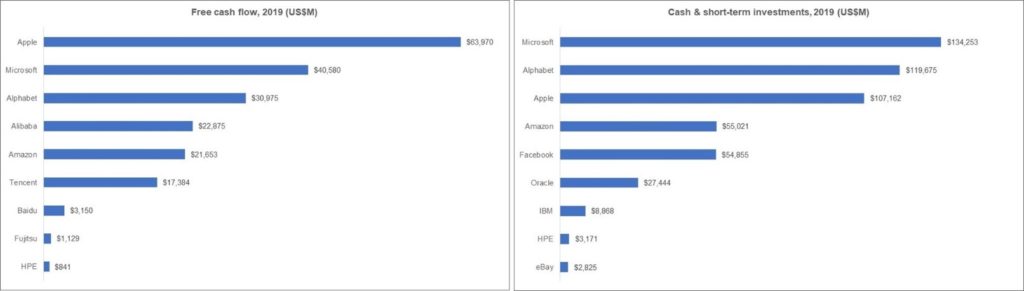
Figure 1 below illustrates just how deep the pockets are in the sector of webscale network operators, tracked by MTN Consulting. The “webscale” sector encompasses big companies in the Internet services industry like Facebook and Google who have built out their own physical network infrastructure to support their services and operations, with data centers taking up much of the spending. The figure shows the free cash flow generated in 2019, and year-end cash reserves, of U.S.-based webscale players.

Figure 1: Free cash flow and cash & short term investments at year-end in the webscale sector, 2019
Source: MTN Consulting, “Webscale Network Operators: 4Q19 Market Review

These are immense companies which have recorded profit margins far above most other sectors, and for many years. There’s always pressure to grow profits more, or use more of the cash for mergers and acquisitions in order to position for growth of forestall new competitors. But saying that they can’t afford to improve their platforms is a hard argument to make.

Then there’s another question: Why should they bother? Many will read this and, even if they oppose Trump, may think it’s not tech’s job to get involved in politics. It’s not a tech CEO’s job to combat rising authoritarianism, racism, or the metaphorical shredding of the Constitution. That, they will argue, is the job of voters.

However, these tech and telecom CEOs do have a responsibility to ensure their platforms are not used and manipulated by evil actors to do evil things. Not just for moral reasons, but also to ensure their platforms can thrive over the long-term. It’s been clear for at least 3.5 years that many are failing at this aspect of their job.

MTN Consulting’s contribution

MTN Consulting is an industry analysis and research firm, not a company that typically comments on politics. We remain focused on companies who build and operate networks, and the vendors who supply them. That isn’t changing. However, we are going to dig into some of the technology issues related to these networks and networking platforms which are having (or will have) negative societal effects.

Specifically, over the next few weeks, we will issue reports on:

  • Bots on social media platforms: How they work, how they shape public opinion, and how they can directly impact elections
  • Privacy: How social media and telecom companies exploit user data to sell more ads, and how this user data is often sold to and misused by third parties (including government actors)
  • Digital advertising and journalism: How tech companies’ takeover of advertising markets has impacted the news industry and complicated citizens’ efforts to get reliable information
  • Deep fakes: How machine learning and artificial intelligence (AI) research, much of it done by the webscale sector, is about to make it even harder to distinguish fact from fiction; how that may reduce the value of social media platforms; and how both webscale players and users will have to cope.

For those of you accustomed to seeing us write about data centers, optical fiber, mobile radio access networks and similarly dry topics, have no fear – that will all continue. This is a moment in time, however, when sitting on the sidelines of more consequential debates is no longer an option.

-end-

Photo by Khalid Naji-Allah, Executive Office of the Mayor via AP

Blog Details

5G vendors report earnings

5G vendors report earnings

The top five vendors selling 5G network infrastructure have now reported 3Q19 earnings. Nokia, Ericsson, and Samsung each reported public earnings data allowing a breakout of revenues to telcos. ZTE provided its usual interim (1st and 3rd quarter) report, which lacks revenues by customer segment. Huawei published a press release including total revenues and high-level commentary on demand trends.

Our take

There are modest signs of an uptick in telco spending in these results. Overall, the five recorded approximately $25.9B in 2Q19 revenues to the telco vertical (“Telco NI”), up 1% from the group’s 3Q18 total of $25.5B. For each of these vendors, except perhaps Samsung, 5G is only a small slice of their overall activities – and many things are being re-branded as 5G, so true 5G breakouts are challenging. Nevertheless, early figures do suggest commercial 5G momentum is spreading, despite ongoing trade wars and supply chain interruptions.

These are preliminary figures, based on a few assumptions. One is that Huawei’s actual carrier (Telco NI) revenues grew 3% in local currency terms; this is an assumption that needs to be further verified given Huawei’s limited reporting. Second is that ZTE’s carrier (Telco NI) revenues amount to 70% of total, which also needs to be confirmed.

With these assumptions, Samsung and ZTE are the clear growth standouts, growing Telco NI revenues by 17% and 13% YoY in 3Q19, respectively. Samsung continues to ride its domestic market’s early adoption of 5G. ZTE’s recorded growth benefits from an unusual 3Q18 base period, when sanctions were in place.

Huawei’s assumed 3% annual growth in RMB translates to a -0.2% decline in USD revenues. If this bears out, this would be a significant improvement over 2Q19, when we estimate that Huawei’s Telco NI revenues declined 6% YoY. The push by Chinese telcos to accelerate 5G and invest in new areas (including overseas, for China Mobile) is helping both Huawei and ZTE, as it has in the past.

Ericsson and Nokia grew Telco NI revenues at roughly the same rate in 2Q19 (in USD), about +2% YoY, but Ericsson opened up a lead in 3Q19 with 0.7% YoY growth (Nokia: -1.3%).

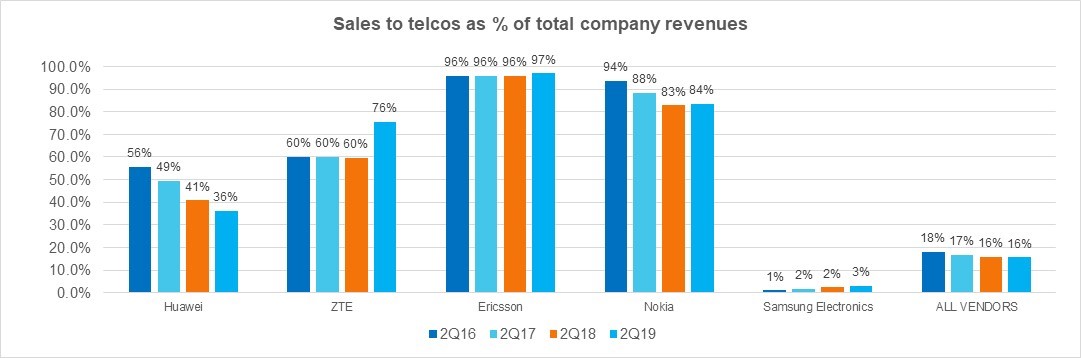
There is lots of noise around the number of signed commercial contracts, especially deals involving deep-pocketed telcos. However, it’s notable that 5G is much more of a multi-vertical technology than previous generations, with complex use cases being laid out across sectors. All key 5G vendors are exploring these. Of the top 5, Ericsson will likely be the most reliant on partnerships, given its relatively high dependence on the telco market for its revenues (Figure, below).   

vendor sales telco ni corp

Source: MTN Consulting

Blog Details

Tencent Holdings: 2Q19 Earnings Snapshot

Tencent posted its 2Q19 earnings on August 14, 2019. MTN Consulting’s one-slide review is now available for download:

MTN Consulting – Earnings snapshot 2Q19 – Tencent


Cover Image: Tencent President Martin Lau (source: Tencent)

Blog Details

AT&T and Verizon’s 4Q18 results hint at more layoffs as operators gear up for 5G

The 4Q18 results of the two US wireless biggies AT&T and Verizon suggests that headcount reduction remains a common focus. Both operators need to reduce their debt burden ahead of the 5G push.

Some highlights from their financial results:

  • Capex drops as Verizon and AT&T prioritize debt repayment: By global standards, capital intensity for AT&T and Verizon is low. Their capital intensity has been in the range of 12-14%, lower than other European telcos such as DT, Orange and Telefonica (with capex/sales of 14-16%). Capex reported by AT&T and Verizon further declined YoY by 17% and 22%, respectively, in 4Q18. Recent M&A could be a major reason for this, as the companies have increased their focus on debt repayment. AT&T’s debt ratio declined from 56% in 3Q17 to 47.7% in 4Q18; strong free cash flow generation (~$8B in 4Q18) supported this drop. On a similar note, Verizon’s debt ratio also fell from 46% in 3Q17 to 43% in 4Q18; and generated a free cash flow of $17.7B in 2018. This might also be early signs of telcos saving cash and reducing debt to prepare for 5G.
  • Unlike Verizon, AT&T shows revenue growth largely due to Time Warner acquisition: Verizon’s service revenues were flat (up just 0.1% YoY), mostly attributed to its media segment (which saw YoY revenue fall by 6%) and wireline segment (YoY revenue was down by 3.2%). However, AT&T reported strong YoY revenue growth (up 15%) in 4Q18 – primarily due to the WarnerMedia acquisition and strong growth from its wireless business. This is good news for AT&T which posted a YoY rise in revenue for the second consecutive quarter, after declining for seven straight quarters.
  • AT&T asserts its position in the media space, while Verizon chooses to focus on its core competency: Verizon continued its momentum in its mobile segment, as wireless subs saw 1.2M postpaid net adds, and wireless revenues increased 2.7% YoY. However, Verizon wants to just stick to partnerships with other companies and not own content – especially after its after its Go90 video platform debacle (which shut down in mid-2018 due to low viewership and uninspiring original video programming). On the flipside, AT&T’s entertainment segment was a huge let down, as it lost 267,000 and 403,000 subs from its DirecTV Now (streaming service) and satellite service, respectively. This was due to the phase out of its promotional pricing of DirecTV Now subscribers. Despite these setbacks, AT&T remains bullish of its streaming and entertainment business. AT&T is pinning its hopes on its ‘to be launched’ standalone streaming service, which will have content from Turner Media networks, HBO, and WarnerMedia films.
  • Verizon’s profit takes a dent as media business struggles: Facing a $4.6B write-down from its Verizon Media business (formed in 2017 post merger of Yahoo! and AOL), the group has accepted that they might have overpaid for media properties. In a Dec. 2018 8-K filing, Verizon stated that the merger of Yahoo! and AOL achieved lower-than-expected benefits. This was evident in 4Q18 results: Verizon’s net profit fell 89% YoY to $2.1B1.

A year after Trump’s tax reforms, US telecom giants continue to slash headcount

Despite receiving huge tax breaks from the ‘Tax Cuts and Jobs Act of 2017,’ the telco giants continued to slash headcount and offshore jobs. In 4Q18, AT&T and Verizon reduced headcount by 7% and 4%, respectively from 4Q17 levels.

In 4Q17, AT&T recorded a whopping $19B profit and $3B of surplus cash due to the new tax law. Publicly, AT&T announced plans to increase its network spending with an estimated capex of $25B for 2018. However, AT&T fell far short of its own estimates as it spent just $20.7B in 2018 (which was just at par with its 2017 capex). Job cuts were also on the rise. According to the 2019 Communications Workers of America (CWA) report, AT&T cut 10,700 union jobs in 2018 and planned closure of three more call centers. To date, it has closed 44 call centers resulting in 16,000 job losses.

The corporate tax overhaul also did not stop Verizon from lowering its headcount:

  • In December 2018, it announced a 7% cut of its workforce as part of its voluntary separation scheme4
  • In early 2019, the company announced plans to sack 800 staff members (of 11,400 employees) from its Verizon Media business, as it struggled to compete with advertising giants such as Google and Facebook.

These cuts come despite the company’s recent growth in operating cash flow, and reduction in deferred tax liabilities, both related at least in part to the Trump tax law. Further, like AT&T, Verizon’s 2018 capex results were disappointing, as 4Q18 capex was down by 22% YoY.

Moreover, AT&T in its latest earnings also cited its plans to increase usage of automation, artificial intelligence (AI), and other technologies to drive efficiency gains – as demand for legacy services drops. This spells more bad news for headcount levels in the telecom industry. There is lots of hype in the market about how operators are undergoing digital transformations, and how this will bring greater efficiencies and new services. The stark reality is that it also means job cuts.

1Verizon 8-K filing
2AT&T 4Q’17 results
3CWA report
4Verizon announces results of voluntary separation offer

Blog Details

Weak network spending climate becoming more apparent

Fidelity’s “Communications Equipment” index is up nearly 11% so far this year, tracking just a few points behind the S&P 500’s YTD gain of about 15%. Looking ahead, though, the communications equipment sector remains challenged, something 3Q17 earnings are making clear.

Ericsson, Nokia and ZTE in a similar boat

Vendors selling mainly to communications markets are reporting sluggish demand. In 3Q17, revenues declined by 4% and 9% YoY at the networks divisions of Ericsson and Nokia, respectively (for Nokia’s trend, see figure below).

Multiple regions are seeing the same issue: weak telco revenue growth is constraining more rapid investment. LTE networks are in place, ready for growth & upgrade via software (mainly). Fixed broadband networks remain expensive to construct, and the video revenue upside is proving to be a challenge for many operators, including AT&T.

ZTE doesn’t break out carrier revenues on a quarterly basis. Corporate revenues fell 5% YoY in 3Q17, and ZTE says carrier demand is stronger than average. We’ve estimated 1% YoY growth for ZTE’s carrier group in 3Q17, in local currency. The China capex outlook is cloudy, though, something which both ZTE and Huawei will have to face next year. They also, I suspect, will reinvigorate their vendor financing programs, as has already come up in Brazil with a potential buyout of Oi with involvement from the China Development Bank.

The figure below confirms, though, that it’s not just ZTE, Ericsson and Nokia facing issues. Many suppliers reported YoY revenue declines in 3Q17.

3q17v2

Accenture’s result is modest evidence that telcos continue to increase spending on services & software, but not definitive as Accenture includes telecom in a larger Communications, Media & Technology (CM&T) vertical.

Adtran’s growth is due largely to an acquisition, namely of CommScope’s active fiber access product line, in late 2016.

Corning’s growth is more interesting. Many vendors are reporting a shortage in actual fiber optic cable supply over the last year or two. New factories or expansions have been announced by CorningFurukawa, and most recently Prysmian. These tend to tie in to specific large telco (or national government) fiber builds, as with Verizon’s FiOS and the NBN in Australia. The economics of these builds require video service profitability, in general, and that has been mixed lately.

Telco capex datapoints not reassuring, but it’s early

Many telcos have reported already, including Rogers & Verizon, Telefonica, Orange, America Movil, AT&T, Telenor, and DoCoMo. Occasionally a big operator reports capex growth, unapologetically – referring to the revenue opportunities that might come with that. DoCoMo comes closest to this model so far. Its capex for the last two quarters is up 9% YoY, in part to support new services in the “Smart Life” business. Most, though, are talking down capex, emphasizing that the bulk of 4G work is done, fiber capex is more targeted & tactical than 2 years ago, etc.

On Telefonica’s 3Q17 earnings call, for instance, COO Angel Vila noted that:

“CapEx is on a declining trend in Spain. We have already 97% LTE coverage. I think it’s close to 70% fiber-to-the-home coverage. We will continue deploying fiber, but reduce speed and focusing on connecting… the CapEx trend in Spain is already declining in terms of CapEx to revenues.”

Many operators have similar stories. Vendors will have to seek out the ones with more budget flexibility. Even with some success, though, it’s likely we will see a pickup in M&A activity around the communications equipment sector over the next 1-2 years.