Blog Details

Network disaggregation shaping up as crucial to telecom industry’s future

Network disaggregation is one of those topics that is hard to build an audience around. The appeal of it mostly is on the cost side. It’s not short and enticing like “5G”. And it means different things to different people, even within the same operators’ network department. Yet OFC sessions made clear how important this concept is becoming for operators, both telcos and webscale.

Post-OFC news reinforced this, as Nvidia announced on March 11 that it would pay $6.9B for Mellanox Technologies. Mellanox has been an advocate of open networking for years in forums like the OCP and ONF, pitching its portfolio as an “Open Ethernet approach to network disaggregation.” For anyone wondering if this approach had market appeal, the Nvidia deal may have tipped the scales.

AT&T, NTT among the big telcos making moves towards disaggregation

In the optical networks space, disaggregation generally refers to open line systems, where systems and transponders are decoupled. That allows for faster upgrades of transponders, and avoids vendor lock-in. AT&T is on board here, as Scott Mountford confirmed at Monday’s “Open Platform Summit”, saying “we’ve been pretty vocal these last few years about open optical networks”. That includes founding support for the Open ROADM MSA, which was featured in a demo at OFC involving AT&T, Orange, Fujitu, Ciena, and the University of Texas, Dallas.

More broadly, large operators and select vendors have been trying to promote a “white box ecosystem” where hardware can be decoupled (or disaggregated) from software. AT&T made a splash in December when it announced it would deploy white box routers at up to 60,000 towers over the next few years. The company will release as open source the software it is writing for the routers. A large operator like AT&T can make this early commitment, but most others are more cautious. At a 5G session on Monday, AT&T Kent McCammon noted that standards bodies like the ONF, Open Compute, and Linux Foundation are important because in order “to reduce costs we need to simplify operator requirements around commonalities”.
For Japan’s NTT, lowering network opex is a central goal of the white box shift. Akira Hirano from NTT discussed how white boxes can help operators lower opex through “zero touch functions”. The company cited its use of the Cassini white box as a success, because it automates L3 network configuration, requiring only 1 command. However, the NTT speaker noted that the application is only for data center interconnect, and that “for sure” this is not in use in long haul networks yet.

AT&T also underscored the gradual nature of change in telco fiber networks. They have been built over decades, have a range of different attached network equipment, and are subject to a variety of depreciation rates. AT&T’s Mountford also noted that “operational systems need development” in this area, in order to actually manage decoupled network elements. That is something the webscale sector is able to attack more easily, given their relatively simple networks.

Google and Microsoft full steam ahead

The biggest webscale providers spend billions per year on their networks. Most have embraced open networking from the start. Microsoft’s Mark Filer stated at the Summit that “open and disaggregated networks are already powering Microsoft’s cloud”. In making this happen, he emphasized the importance of a set of software tools built internally, “Microsoft SDN”, which includes a topology engine, zero touch configuration tools, data collection tools, and alerts & correlations.

Similarly, Google’s Eric Breverman emphasized software in his talk on “Optical Zero Touch Networking”. The goal of ZTN, Breverman explained, is essentially to “keep people from actually touching the network”. Humans make mistakes, and they are too costly to keep hiring at the same pace as traffic. Automatic network configuration is important. Google says it now supports intent-driven networking on 50% of “Google’s Production Optical Network”. OpenConfig is important here, as it allows working across multiple vendors much easier than with TL1 and SNMP.

Telcos need software skills

It’s no surprise that telecom operators are eager to lower the cost of growing & operating their network. Open platforms have the potential to contribute, and not just in optics. Building the right software tools to manage these platforms is crucial, though, and webscale providers are further along than telcos. As an analyst, I have to wonder whether telcos need to reach deeper into their pockets for R&D budgeting. For AT&T, one of the biggest telco spenders, it spent just 0.7% of revenues on R&D in 2018, down from 1.3% in 2014. Webscale R&D spending averages out to about 10% of revenues, and it shows.

Cover image: Shutterstock.

Blog Details

Improving Africa’s connectivity: more subsea cables are a good start

Over the last two decades, submarine cables have become a key growth enabler for trade and communication between Africa and the rest of the world. Subsea cables play this role elsewhere, but the effect is newer in Africa.

With recent investments, Africa’s position has improved: stark declines in the price of international capacity have supported a surge in the volume of data consumed, generated, transmitted, cloud-hosted and processed real-time over Africa’s communication networks.

But does Africa have enough capacity?

Traffic and subscriptions have exploded; for instance, mobile broadband users in Africa reached 253 million in 2017, from 22M in 2011.  Keeping up with this growth momentum requires continual investments in international connectivity. This article explores recent submarine developments in Africa, identifies bottlenecks, and discusses how they can be addressed.

54 countries and not enough fiber to go around…yet 

With 54 countries recognized by United Nations, Africa has 38 countries with a coastline and 16 that are land-locked. The pace of regulatory liberalization, sophistication of telecom infrastructure, and geopolitical stability is quite uneven across the continent. Much of the African growth journey is confined to 10-15 countries. However, this is set to change. Africa’s boom in the construction of new submarine cables is serving as a growth catalyst for regional terrestrial fiber networks connecting multiple countries, fully or partly funded by institutions like African Development Bank (ADB) and other investors.

These investors hope improved international connectivity can create a better business climate for development, reducing prices. As an example of Africa’s challenges, consider the price of a 100G IP port. In London, it available for a monthly recurring charge of $15,000-20,000. Even in South Africa – the most affordable African destination – a 100G port costs 5X higher. This stifles business viability and compels ISPs, MNOs and MSPs to deploy Nx10G incrementally, forfeiting economies of scale.

30 operational cables serve Africa, across 4 corridors

Africa’s cables cover four connectivity corridors – Africa-Europe, Africa-Latam-US, Africa-Asia and Africa-in-region.

Out of Africa’s 38 countries with seashore, 37 countries have at least one submarine cable landing, including 30 operational, and 7 under construction. The best connected country is Egypt, which lands 15 submarine cables. It’s far more common to have just one cable landing, though. Nine African countries face this dilemma, including the Republic of Congo, Togo, Liberia, Sierra Leone, Guinea, Guinea-Bissau, Gambia, Mauritania, and Sao Tome & Principle. Figure 1 illustrates the distribution of subsea cable landing stations in Africa.

Figure 1


Source: MTN Consulting, LLC

The Djibouti hub needs improved terrestrial connectivity

While the count of 30 submarine cables is an impressive figure, most of the upstream IP connectivity is served by 9 submarine cables. One reason for this is, 13 of the 30 cables are basically passing through Africa to Europe via Djibouti and Egypt, as depicted in Figure 2 below.

Figure 2

Source: Submarine Cable Map 2017 

Most of these cables play little role in the African economy. Djibouti, despite being close to Kenya and landing 11 submarine cables, remains isolated from rest of Africa. One reason for this is lack of fiber infrastructure connecting Djibouti and Egypt to other African countries. Ethio Telecom, the incumbent in neighbouring Ethiopia, has made things worse by showing little apparent interest in expanding connectivity.

July 2018 brought good news, though: Liquid Telecom announced that it would expand its growing pan-Africa network north into Egypt, signing an MoU with Telecom Egypt to link its network from Sudan north into Telecom Egypt’s network via a new cross border interconnection. That will create a 60,000km km fiber network from Cape Town to Cairo, sometimes called the “One Africa” broadband network (see figure, below).

Figure 3

Source: Liquid Telecom

Multiple weaknesses exist in Africa’s international connectivity 

“One Africa” will improve things around Djibouti, but that’s just one of many issues. Africa’s international connectivity needs a number of other improvements:

  • more submarine cables with open access cable landing stations,
  • multi-provider terrestrial backhaul options,
  • fair-play interconnect with other submarine cable systems,
  • carrier neutral datacenters and Internet exchanges for traffic localization,
  • deployment of network automation with software controls

To sustain the continent’s growth momentum, Africa’s network operators need to address these issues over the next 3-5 years. Fortunately, they are making progress.

Africa’s cable boom is driving higher end user bandwidth requirements

Africa’s new cables are beginning to change the definition of a “high” and “low” capacity customer.

Globally, 1G is becoming the new STM1 and increasingly deployed for enterprise connectivity. 10G is the new STM4, and select markets are ready for the 100G leap (“replacing”) STM16 in 2019-20. While Africa is a year or two behind, outside South Africa, the pace of transformation is set to accelerate in 2019-20. That is evident from recently 100G network upgrades undertaken by Liquid Telecom, SEACOM, EASSy and MainOne. Also, AAE1 announced it would upgrade to 200G last month. This comes just 18 months after the cable was ready for service (RFS), and 2 years ahead of schedule. (Figure 4)

Figure 4

Source: AAE1

Webscale network operators are now big in submarine; is South Africa the next stop?

The global submarine cable market is transforming rapidly due to participation from Google, Facebook, Amazon and Microsoft. Put together this group has already invested in 21 submarine cables globally, the majority in 2015-20 period. The only regions where they are yet to invest in submarine cables is the Asia-Europe corridor, Middle East and Africa. These companies are laying the groundwork, though:

  • Microsoft and Amazon have edge network nodes in South Africa and work is underway for cloud datacenters with Teraco to be operational by mid-2019.
  • Google and Microsoft have conducted multiple pilot projects across Africa in the last 3 years to bring affordable Internet to underserved regions.
  • Facebook and Amazon are reportedly scouting for partners for submarine cable builds and announcements are expected in early 2019.

Given their long term plans, it’s likely that the deep pocketed webscale players will soon start to expand their massive hyperscale networks (including new submarine cables) in South Africa in 2019-20. These new cables will have a far-reaching impact on the continent, especially when combined with the terrestrial reach of the One Africa network.

One challenge is that, even if a new cable project is announced and funded in 2019, it would not likely be operational before 2022. The webscale operators are likely to engage in a number of partnerships to meet their capacity needs in the interim. For instance, they may consider linkups with Liquid, MTN, and Orange for west Africa, and SEACOM or EASSy for east Africa.

Complimenting submarine cables with terrestrial networks and datacenters

Submarine cables alone cannot alleviate Africa’s connectivity challenges. They have to be complimented with multi-provider terrestrial fiber networks with cross-border alliances to make regional connectivity “affordable” – where a reasonable target is 1G links priced below $5000 per month, and declining by 15% per year.

Along the western coast of southern Africa, Angola, Nigeria, Ghana, Ivory Coast and Morocco have multiple providers developing terrestrial fiber networks, but cautiously with limited reach. Pricing remains high, inhibiting deployment of 1G and 10G links.

The situation is better on the eastern side of southern Africa, including South Africa, Mozambique, Tanzania, Kenya, Uganda, Zimbabwe and Zambia: multiple regional providers are developing fiber footprints with increasing capillarity. Liquid Telecom, Simbanet, WIOCC and SEACOM lead the market. The capacity pricing is competitive, low enough to trigger widespread usage of 1G and 10G links for the largest mobile network operators. By 2022, the entry of cloud and content provider-sponsored cable projects will trigger steeper price declines and stimulate demand.

Africa also needs datacenters that are truly carrier-neutral, and not selective about their neutrality. Developments in this area include:

  • Teraco in South Africa has datacenters in Johannesburg, Cape Town and Durban, and is at the forefront of the carrier-neutral space. That makes it an attractive acquisition target for a company like Equinix to jumpstart its Africa presence.
  • First generation datacenters, supposedly carrier neutral, are also operational in Kenya and Nigeria, with Tanzania, Uganda, Ghana and Ivory Coast lined up for 2019.
  • A new breed of focused datacenter providers like Rack Center, Rack Africa and Djibouti Data Center (DDC) are gaining traction. Their facilities, though, may need to be retrofitted to support technical requirements of the big webscale players.

Kenya and Nigeria poised for big changes in 2019-20

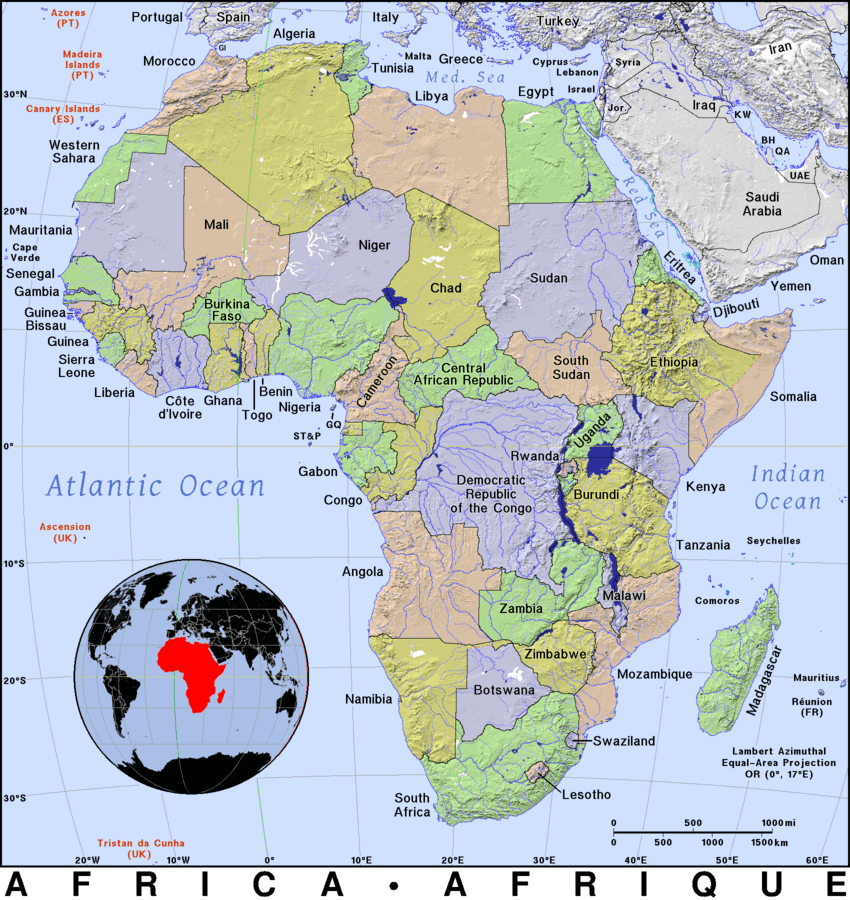
For connected-Africa to be a reality, the playground of new submarine cables, terrestrial networks and datacenters must move beyond South Africa. The two countries set to gain prominence in 2019-20 are Kenya and Nigeria. Both countries land 6 submarine cables each, but differ significantly in terms of cross-border terrestrial fiber connectivity.

Figure 5

Source: https://ian.macky.net/pat/map/afri/afriblu2.gif

Kenya has a distinct lead with robust regional connectivity to Uganda, Tanzania and Rwanda through Liquid Telecom and Simbanet. That is being extended to Malawi, South Sudan, Ethiopia and Djibouti. WIOCC and SEACOM have also created terrestrial routes mirroring their subsea routes to provide connectivity to land locked countries. The provider oligopoly however keeps the market price of 1G and 10G links intimidatingly high.

Nigeria is lagging with respect to regional fiber connectivity. That’s despite the fact that Nigerian operators MainOne and Glo-1 own and operate private submarine cables from Nigeria to Portugal and the UK respectively. MainOne has pursued expansion through Camtel and Orange into Cameroon, Cote D’Ivoire and Senegal. Adding that to its existing links in to Nigeria and Ghana, along with cross-border fiber connectivity to 5 adjoining countries, gives MainOne a regional network spanning 10 countries. For its part, Glo1 operates only in Nigeria and Ghana; its recent focus was developing the Glo2 project, a domestic extension to address the Oil & Gas segment.

Webscale the big open question

Africa has made lots of strides in its international fiber connectivity over the last few years, but has far to go. Impending entry by the globe’s big webscale operators is likely to have a big impact on many markets by 2022, and the effect will filter across Africa in the years after. Between now and then, a lot will happen. One thing to watch is how webscale operators link up with regional telcos and carrier-neutral providers to accelerate their network expansion. Such partnerships happen in other regions too, but Africa will require more of them.

Cover image: Cape Town, South Africa (credit: Dan Grinwis)

Blog Details

Jio sends shock waves across the telecom industry with new FTTH broadband service and JioPhone exchange offer

The recently concluded Annual General Meeting (AGM)1  of Reliance Industries is sure to leave Reliance Jio’s competitors in jitters, as Jio unveiled plans to roll out optical fiber to the home (FTTH) across 1,100 cities in India. Its commercial launch is planned for December 2018. At the same meeting, Jio announced a JioPhone handset offering which will be a major threat to many small handset manufacturers.

Despite not being currently active in the fixed broadband market, JioFiber will benefit from Jio’s wireless internet market share (ranked #1 as per TRAI based on subscriber base) 2. Jio’s recent acquisition of distressed carrier Reliance Communications is also a plus. However, Jio will face hurdles initially given the challenges of underground fiber installation.

Jio hopes to replicate its wireless success with GigaFiber 

After growing from zero to 215 million wireless users in just 22 months on its new 4G network, Jio already has everyone’s eyebrows raised. Jio has now shifted its focus towards its FTTH broadband service via ‘Jio GigaFiber’. The fiber service includes Jio Giga TV, smart home accessories and a landline connection. Jio’s FTTH rollout could kickstart the local broadband market, where penetration is low. TRAI’s March 2018 data estimates that India had only 21.2 million fixed broadband internet users – as against 472.7 million mobile data users.

While Jio is new to the fixed market, Jio has been installing fiber aggressively for the last 4 years. Its fiber optic network now spans over 300,000 kms. That includes metro and access fiber designed to support an eventual FTTH offering. This should allow Jio to differentiate from other Indian operators, which tend to provide fiber optic cables only to the building, and use a variety of technologies for customer access (VDSL, Ethernet, WiFi etc). Jio’s fiber will instead be connected directly to the user’s CPE. Jio does have competition, though. Airtel launched its vectorization-based service, V-Fiber3, in Pune in late 2016. V-Fiber offered up to 100Mbps at launch, but Airtel recently announced upgrades to bring maximum speeds to 300Mbps over W-Fi.

The effect of Jio’s broadband launch is also being felt on the leading fixed player, BSNL, which slashed its broadband plans soon after Jio’s FTTH announcement. In June 2018, BSNL launched two FTTH monthly plans with promotional rates of INR777 ($11.3) and INR1,277 ($18.6) at a speed of up to 50 Mbps and 100 Mbps, respectively. Similarly, Airtel responded to Jio’s fiber announcement by withdrawing FUP (fair usage policy) limits on its fixed broadband plans. Airtel’s 100Mbps monthly broadband plan is priced at INR1,299 ($19.0), and includes a subscription to ‘Amazon Prime’. From an internet speed standpoint, Jio still stands tall as it aims to offer internet speed up to 1Gbps.

Operator Monthly price (INR) Monthly price (USD) Data speed (Mbps) Data cap (GB)
BSNL 777 11.3 50 500
BSNL 1277 18.6 100 750
Airtel 699 10.1 40 3,333
Airtel 1299 18.96 100 3,333


Jio’s purchase of RCom assets will accelerate FTTx network expansion

Last December, RCom announced the sale of its assets to Jio for $3.75 billion4. If the deal goes through, Jio will gain vital assets in the form of spectrum, towers and fiber. The acquisition will also bring opex savings for Jio, as it will avoid some tower related rental expenses. Jio already has 300,000 km of fiber, but this deal will result in addition of 178,000 km of optic fiber to its portfolio. This will help Jio cover a broader section of the population.

Jio’s rich fiber base positions it well for a push into quad play, but the company is sure to face several challenges in FTTH deployment. A major hurdle is getting approvals from state governments and officials for laying fiber and securing the requisite Right of Way (ROW) permits. This process not only delays execution but also increases the cost of implementation. Operators face these challenges elsewhere, but India’s permit process is especially burdensome. The World Bank’s “Doing Business” report5, for instance, places India as nearly last (181st place) among all economies in terms of construction permit process effectiveness. This has contributed to India’s slow fiber rollout.

Moreover, FTTH investments require huge capex especially in rural areas where the penetration is staggeringly low in comparison to national average. Government-supported fiber deployment efforts have struggled in the past, due in part to lack of funding. But the 2014 change in government helped expedite India’s national fiber optic network, now called Bharat Broadband Net Ltd (BBNL)6. This government company aims to rollout 1 million kms of fiber across 250,500 villages by March 2019. This is good news for Jio, and other private operators in need of fiber to fill in FTTH coverage gaps.

Jio continues to disrupt the mobile market, too, with JioPhone offering

The FTTH announcement was not the only news to emerge from Jio’s recent annual meeting. The company also revamped its branded feature phone, the JioPhone.

In July 2017, Jio began selling the JioPhone. The first year of sales was lacklustre, due to a high price point, and non-availability of basic apps. Jio has now addressed both these issues. Through an exchange offer, the device will just cost INR501 ($7.2) – refundable after 3 years of purchase – and will soon support three of the most popular Android apps (WhatsApp, YouTube and Facebook).  Jio is also bundling the device cost with a new ‘Jio SIM”, which includes a prepaid recharge plan valid for six months at just INR594 ($8.6).

When the JioPhone was launched a year ago, Airtel and Idea responded with affordable smartphone offers. They partnered with Karbonn and Itel, respectively, to offer low-end smartphones and with cashback offers. It made sense back then as users could own a smartphone at a slightly higher price than that of JioPhone. But with Jio’s new launch, low-end smartphone makers will have to revamp their pricing model as any handsets costlier than the JioPhone might struggle to find buyers.

Jio also announced release of its top-end variant in the smart feature phone segment – JioPhone 2 – to be launched on August 15th. Priced just at INR2,999 ($43.6), there are not many phones available in this price range. However, a closer look at the phone’s features suggests little difference between the old JioPhone and the JioPhone 2. Apart from a four-way navigation pad and QWERTY keyboard option (which has lost its appeal with the arrival of large screen smartphones), the features of both the phones are similar. They have the same processor, internal storage and RAM, too. The immediate competitor for JioPhone 2 is Airtel’s Karbonn A40 4G7, currently available at INR2,649 ($38.5) on Amazon India. In terms of display and design, it surpasses JioPhone 2 with a 4” IPS LCD display and a resolution of 400×800. However, Karbonn A40 4G fails to impress in terms of battery capacity. With a battery of 2000mAh, JioPhone 2 can last up to 14 hours – whereas Karbonn A40’s 1400mAh battery may not even last for half a day.

At present, 12% of Jio’s total mobile phone subscribers (or about 25 million) are using JioPhone. Jio aims to quadruple its base of JioPhone users to 100 million in the shortest possible time. Though this may seem a tad ambitious it is certainly achievable. Jio’s subsidized device cost and low-priced prepaid recharge plan will be appealing in a market with a limited supply of affordable 4G handsets.

References

  1. Reliance Industries 41st Annual General Meeting (AGM)
  2. TRAI, June 27, 2018
  3. Airtel launches ‘V-Fiber
  4. Reuters: India’s Reliance Jio to buy RCom’s wireless assets in $3.75 billion deal: sources
  5. World Bank’s Doing Business report
  6. Firstpost: Indian government to launch the second phase of BBNL project 
  7. Airtel partners with device manufacturers to offer 4G smartphones 

Blog Details

Understanding The Carrier-Neutral Market (And Why Revenues Will Pass $40B This Year)

MTN Consulting has just published a “Market Review” of the carrier-neutral network operator (CNNO) sector. The report assesses the key role that these tower, data center, and bandwidth specialists are playing in the downsizing of the telecom sector. While many telcos are shrinking, the CNNO sector is growing >10% per year. Revenues for the 25 CNNOs we track should surpass $40B this year, and approach $60B by 2020 (Figure 1).

mtnc-cnno revs through 2020

Takeaways from the study include:

  • CNNO revenue growth has been steady around 10-15% YoY for several years, in line with the growing telco (& other provider) need for low cost, carrier-neutral network resources. 3Q17 revenue growth for CNNOs was 13.1% (Telco Network Operators: 1.0%; Webscale Network Operators: 23%).
  • CNNO capex rose 11% YoY in 3Q17, to $3.6B. Tower specialists spent 24% of their revenues on capex, data center specialists over 43% due to higher (and lumpy) investments in developing new sites. Tower providers’ incremental capex in new sites is primarily for small cells. Bandwidth specialists’ capital intensity has been over 50% for the last 5 quarters, due to the influence of new builds (NBN in particular).
  • CNNO capex hit $15B on an annualized basis in 3Q17; the biggest spenders were Equinix, Level 3, Australia’s NBN, Crown Castle, Digital Realty, American Tower, and Zayo.
  • M&A is a big factor in the sector’s growth, but just one. CNNOs are growing organically too, and expanding their business models to require a broader mix of equipment (Crown Castle is looking at edge computing, for instance). Technology-related operating expenses can be quite high, for repairs & maintenance of old plant, and energy costs in particular.
  • Total capex across telecom, Webscale, & CNNO was $355B in 4Q16-3Q17 (Figure 2).

mtnconsulting 3Q17 capex-summ5

The report also assesses CNNOs’ network holdings across four main categories: fiber, data centers, towers, and small cells. Most big operators have assets in multiple areas, and that will increase over time. Tower companies are building small cells, for instance, while bandwidth specialists are extending their fiber routes to small cell sites.

Table 1 provides a snapshot of the infrastructure assets for a sample of the CNNOs covered in this report.

Table 1: CNNO network assets (excerpt)

mtnc cnno1

Blog Details

Communications Sector M&A Dominated By Infrastructure In 3Q17

October’s seen a few mergers already, including Airtel-TTSL, a tower sale by Zain and the long-rumored Sprint-T-Mobile transaction (confirmed yesterday). Some interesting deals came out of 3Q17 too, especially in infrastructure markets.

63 M&A transactions announced, including OTT/cloud deals

The communications services sector saw 63 merger and acquisition (M&A) transactions announced in 3Q17. These deals accounted for a total $17.4B in deal value. Infrastructure targets accounted for 56% of deal value across 13 deals. Crown Castle’s $7.1B purchase of Lightower was the biggest by far, and exemplifies the quarter’s focus on towers, data centers, and fiber networks.

Other infrastructure deals announced last quarter include:

  • Equinix: $295M for Spanish data center provider Itconic;
  • Verizon: $225M for WOW’s fiber optic network in metro Chicago;
  • Iron Mountain: $128M for Colorado-based MAG Data Centers;
  • Keppel DC REIT: $78M for a colocation data center in Ireland, from Dataplex;
  • Zayo: $3.5M for a data center in Colorado.

Several small deals involving fiber optic and related assets were announced without valuation: FirstLight Fiber’s acquisition of 186 Communications; Neural Path-Infinity Fiber; Ufinet-IFX Networks; and EQT Infrastructure-Spirit Communications. Also, South Africa’s Dimension Data Holdings decided to sell its fiber & wireless business to Vulatel; Dimension’s view on the network assets is that they are no longer core to its “value proposition”.

Fixed-mobile-integrated services: 28 deals totaling a modest $5.2B

3Q17 also saw 28 deals targeting fixed and/or mobile service operations: 18 fixed, 7 mobile, and 3 for integrated (fixed & mobile) assets. There were no very large (>$10B) telco deals announced in 3Q17, though several earlier ones are still pending (including AT&T-Time Warner and Vodafone-Idea Cellular).

Two sizable deals in 3Q17 were international in scope: Vodacom South Africa’s $2.6B purchase of a 35% stake in Kenya’s Safaricom, and Omantel’s $846M acquisition of a 10% stake in Kuwait-based Zain. Most other significant deals were domestic in nature, including:

  • USA: Cincinnati Bell-Hawaiian Telecom ($650M, July 10); T-Mobile US-Iowa Wireless (value unknown; Sept. 26)
  • South Africa: Blue Label Telecoms-45% stake in Cell C ($424M, July 27)
  • Hungary: DIGI-Invitel ($164M, July 11)
  • Russia: Renova Group-AKADO ($120M, July 11)
  • Austria: Hutchison Drei Austria-Tele2 Austria ($112M, July 30)
  • Thailand: AIS-CS Loxinfo ($79M, September 14)
  • Australia: Superloop-NuSkope ($12M, Sept. 10)

Lowering network & selling costs (relative to size) are common dominators across most transactions. Some transactions markedly improve competitiveness through more scale or better access to a customer segment; for instance, Hutchison Drei bought Tele2’s Austria operation to jump into a strong #2 overall position in the market, behind America Movil’s Telekom Austria.

OTT/Cloud network operators also buying companies

Notably, Alphabet/Google made five notable acquisitions in 3Q17, Facebook 3, and Alibaba 2. Their targets are spread across a range of sectors, in line with their business scope. Lots of action centered around Artificial Intelligence in 3Q17, something OTT/cloud operators anticipate having a role in their networks. Alphabet acquired two firms in this space: Bangalore-based Halli Labs, and Belarus-based AIMatter. Baidu acquired Seattle-based Kitt.ai, and Facebook bought conversational AI startup Ozlo.

Infrastructure demand rising, or unstable?

With all the infrastructure deal activity in 3Q17, some wonder if this indicates rising demand for basic network assets. Does it suggest a strong growth outlook for the “neutral network operators” (NNOs) focused on neutral operations of towers, data centers and fiber networks?

The sector is growing, to be sure, especially member companies like Equinix with aggressive M&A strategies. Private equity (PE) is driving much of the deal activity in this sector. That was the case with 3Q17’s biggest deal: Crown Castle bought Lightower from PE owners including Berkshire Partners and Pamlico Capital. This quarter, there’s an even more audacious deal underway in the sector, with a PE consortium looking into an $11B Indian cell tower deal. That is motivated, at least in part, by high debt among many Indian operators & tower companies.

Which brings us back to the market outlook. In telecom, PE firms tend to buy, reorganize, and sell assets – they’re generally not in it for the (very) long-haul. Publicly traded NNOs like Crown Castle provide exit opportunities for the PE investors – as it did for Lightower last quarter. The fact that several PE firms are raising big infrastructure funds now is a positive for telecom dealmaking.  Telecom network operators seem almost certain to continue slimming down their asset base in light of weak top-line growth. PE firms will surely be around to pick up some assets when the price is right.

Blog Details

Rising Costs Plague India’s Tata Teleservices As Competition Intensifies

Tata Group is looking for a clean break

Tata Teleservices (TTSL) has family ties to one of India’s biggest industry groups, but that hasn’t helped it escape the “Jio effect” in recent years.  With just 8.7 million subscribers and a (unified service) license covering only Mumbai and (rest of) Maharashtra & Goa, TTSL has struggled against larger nationwide competitors. Tata Group’s new chairman is now reported to be looking to sever ties with TTSL.

This comes a few months after NTT DoCoMo sold its stake in TTSL back to Tata Sons, consolidating Tata’s ownership in TTSL.

The Jio effect

Reliance Jio has used its nationwide unified license and deep pockets to blanket the country with its new network, and has been pricing and bundling very aggressively. Jio’s push has affected all major operators, but small ones like TTSL have had it especially hard.

TTSL’s license has always limited its growth ceiling. As India’s telecom sector has exploded in recent years, though, TTSL has actually shrunk. Its peak was in March 2011, when it reported 16.9 million subscribers. It now has just over half that subscriber base.

Despite the mobile decline, TTSL’s fixed division has grown recently. While TTSL doesn’t break out details, it does report that wireline grew from 30% of revenues in FY2014-15 to 36% in FY2016-17. Total company revenues have grown a bit (20%) since FY2011, despite TTSL’s mobile user decline and India’s declining mobile ARPUs . TTSL’s wireline business has expanded.

Cost curve has been going in the wrong direction

TTSL’s EBITDA margin (EBITDA divided by revenues) has hovered in the comfortable but not stellar range of 20-30% for each of the last 8 fiscal years (it was slightly higher before that). Despite this operating stability, its net margins (net profit divided by revenues) have been negative for 6 straight years, coming in at -85% in FY2016-17. These steady losses have resulted in high debt, among other challenges.

Finance-related costs main culprit, but network & regulatory also key

While most of the telecom industry faces declining costs, on a per line or per subscriber basis, TTSL’s recent experience has differed.  Focusing just on three fiscal year periods (FY2010-11, FY2013-14, and FY2016-17), the figure below shows TTSL’s costs on a per subscriber basis, in Rupees per year.

MTN Consulting - TTSL costs.png

Five categories are shown. Three are operating (network operations, regulatory-related opex, and the cost of renting infrastructure under sharing agreements), while two are non-operating (net financing costs, i.e. the cost of servicing its debt, and depreciation & amortization, or “D&A”).

In each area, TTSL has faced challenges in recent years.

TTSL’s increase in finance costs have been staggering, and D&A costs have also grown. What’s not shown are results through June 2017 (i.e. 2Q17), when TTSL’s finance costs worsened, to 69% of revenues (from 24% in 2Q16)

Regulatory costs per line doubled from FY11 to FY17. These costs vary by country and the operator’s business model. License fees and spectrum charges are in general high in India. So, the fact that TTSL’s regulatory costs – while they are high – isn’t an immediate red flag. But it hasn’t helped the company.

Infrastructure sharing operating expense (opex) has also risen as TTSL has relied more on other providers for network coverage. One goal of this sharing is to lower capex requirements in the short-term, and eventually also debt. Given TTSL’s ongoing high finance costs, that doesn’t appear to have been successful.

Finally, network operations opex trends at TTSL are unusual. Most operators globally have experienced declining network operations costs over time, due to new technology, greater scale, and other factors. TTSL, though, saw network operations opex (per line) more than double between FY2011 and FY2017.

What might explain the network operations trend? One possibility: TTSL started relying far more on other providers for its infrastructure. Infra sharing costs as a percent of total opex grew from 9.3% in FY11 to 19.2% in FY17. Increased sharing could have resulted in some unexpected internal network operations costs; that’s a topic for further research. Another likely factor is the decline of TTSL’s mobile subscriber base, and a relative growth in fixed operations. Mobile subscribers often carry lower ARPUs, but the cost of supporting them in the network is also lower. That’s not the case for every company, clearly, but TTSL’s recent experience supports this view.

Blog Details

Running Converged Networks Is Costly; A View From Thailand

Mobile operator AIS to consolidate ownership in CS Loxinfo

Thailand’s largest mobile operator AIS announced this month it would spend $79M to buy a 56% stake in CS Loxinfo, an enterprise-focused fixed line operator. AIS is picking up 42% from a Thaicom subsidiary, as well as Singtel’s current 14% stake in CS Loxinfo.

The companies involved in this transaction already have ties. AIS’ parent company, Intouch Holdings, also owns 41% of Thaicom. But this deal is not simply a paper transaction. AIS has good reason to expect integration with CS Loxinfo will accelerate its fixed broadband efforts. AIS entered that market in early 2015, and had ~446,000 subs by June 2017, with an ARPU of 600 Baht/month. That’s over double AIS’ reported blended ARPU of 251 Baht for its mobile subscriber base. The company clearly wants to expand from this modest base.

Regulatory climate improving, bit by bit

AIS was launched in 1990. While a private company, it was set up as a “concession” of Thailand’s Telephone Organization of Thailand (TOT), one of Thailand’s two state operators at the time. AIS received a license, while TOT received a share of AIS revenues. This was a not a small exchange (and TOT did not enthusiastically give it up): AIS’ “regulatory fees” amounted to over 30% of total opex from 2007-2015. Concession fees have lowered dramatically since 2Q16 however, pushing regulatory costs to under 8% for AIS over the last 12 months. Other Thai operators have also enjoyed lower regulatory costs under the new regime, but AIS’ drop is significant.

The operator has other challenges, though.

Converging mobile & fixed

AIS was mobile only from the start. Like many operators only selling mobile services, AIS also built its own fiber backbone. During the last decade, this network’s reach spread further into cities, using both leased capacity and dark fiber. With the move to 4G mobile, the economic logic of AIS owning its own metro fiber resources has become stronger. (AIS is not the only one to have noticed this). Having some base of metro fiber surely helped AIS with its initial broadband launch in 2015. Scaling it has been costly though.

High network operating expenses

From 2007-13 or so, reported network operations expenses at AIS stayed in a fairly tight range: between 150-200 Baht per customer, per year. Expressed as a percent of total opex, network opex ranged from 5-10% in that same timeframe.  By both metrics, network opex began to climb in 2015, dramatically. Over the last 12 months (3Q16-2Q17), it reached just under 500 Baht per customer, per year (figure).

12

A primary reason for this shift is AIS struggling to manage the costs of its fixed broadband rollout, as many operators have. Prep for this rollout started in 2013-4. Once the service was available, the cost of on-site customer installs was likely higher than expected. Or simply high, period: the problem AIS ran into is not unique, and they likely expected it.

Truckrolls are costly everywhere

Thailand has loads of attractions, but a first-class wireline infrastructure is not one of them. State-run fixed operators, antiquated regulations, a challenging construction environment – there are many factors behind this. One result is a chaotic web of wiring, strung along nearly every utility pole in the country.

This is what AIS network engineers are now dealing with daily, as they extend fiber nodes and install service at customer premises. For a company used to dealing with thousands of base stations, not millions of customer premises, this is costly & time-consuming work.

CS Loxinfo has itself been providing fixed services in Thailand, for over 2 decades. Its reach is not vast, but Thailand’s fixed market has a small number of mostly small players – and CS Loxinfo is well known. Mostly for its leased line business, as these are still big in Thailand; CS has just under 6,000 leased lines in service. Also under its “ICT” business line, CS Loxinfo offers a range of data center services, and reports racks in service (554 as of June)

Network cost pressures lurk behind many mergers

Most mergers have many drivers, some tied to cost savings, others to expanding market opportunities, etc. The AIS-Loxinfo deal is no different; lowering network costs is one of many goals.

AIS has been #1 in Thailand’s mobile market for many years, but has only started going after fixed. Market acceptance of its “AISFibre” offering has been good, and the company has accelerated initial rollout plans. The company is in a bit of a land grab, though. Teaming up with CS Loxinfo might help accelerate the AIS broadband push without breaking the bank.


Blog Details

Mobile operators & towers: to own or not?

Over the last few years, the independent tower sector has grown dramatically. Much of the growth has come from asset spin-offs: a mobile operator sells some portion of its towers to a specialist, in exchange for cash and a commitment to lease the towers back. The logic is simple: the telco raises cash, and outsources the nuisance of running a relatively undifferentiated part of its operations. The tower company grows its network, and gets a long-term customer.

China Tower

In the case of China, things are different (once again): the China Tower Company was created by a government-mandated spin-off exercise. No cash exchanged hands, but each of China’s major operators now own a stake in China Tower. This independent company is hoping to use its towers for other services, such as electric car charging stations.  While the government involvement was unique, the deal was premised on the same idea motivating most tower spin-offs: mobile operators don’t need to own their own towers.

Axiata buying towers

That belief is not universal, though. An example of this is Axiata, which has over 320M mobile customers spread across 10 countries. Axiata is buying towers, not selling.

Last month Axiata closed a deal to buy 13,000 towers in Pakistan from PMCL, for nearly $1B. This follows a smaller deal earlier in the summer, the $89M acquisition of Pakistan’s Tanzanite Tower Private Ltd and its 700 towers. Axiata says the two deals make its tower subsidiary, “edotco”, among the world’s top 10 tower owners. More important is Pakistan, where its vast tower holdings make it the leading independent – in a market where tower sharing had struggled until recently.

Small cells & fiber

As telcos pursue a mix of own/rent strategies, the independent tower sector will continue evolving. One driver is the need for small cell coverage. That will likely get more important as 5G gets closer.

There’s a related need to deploy more network intelligence closer to the end user. This need drove an interesting deal earlier this week: European tower player Cellex paid 133M Euros, for just 30 towers, from Dutch provider Alticom. Cellnex explains that the towers position them well for 5G: they’re long-range, supporting 15km radius cells, and are suitable for hosting caching servers for data processing and storage. As 5G networks evolve, we may see tower companies get in the business of operating more of the edge intelligence in the network.