Blog Details

Commentary: ZTE’s fixed broadband win at Rostelecom

What happened

Rostelecom recently awarded ZTE 70% of a large access network modernization project. ZTE will provide its C350M/C300M MSAN product for the first stage, using VDSL, and move to G.vectoring and G.fast in the second stage. Rostelecom is currently testing the proposed second stage solutions.

What we think

ZTE is one of the world’s largest network infrastructure vendors, and one of just a few with a full set of fixed broadband products. It’s a top supplier domestically, and has a large number of overseas broadband deployments. Many of ZTE’s international accounts are on the small side, though.

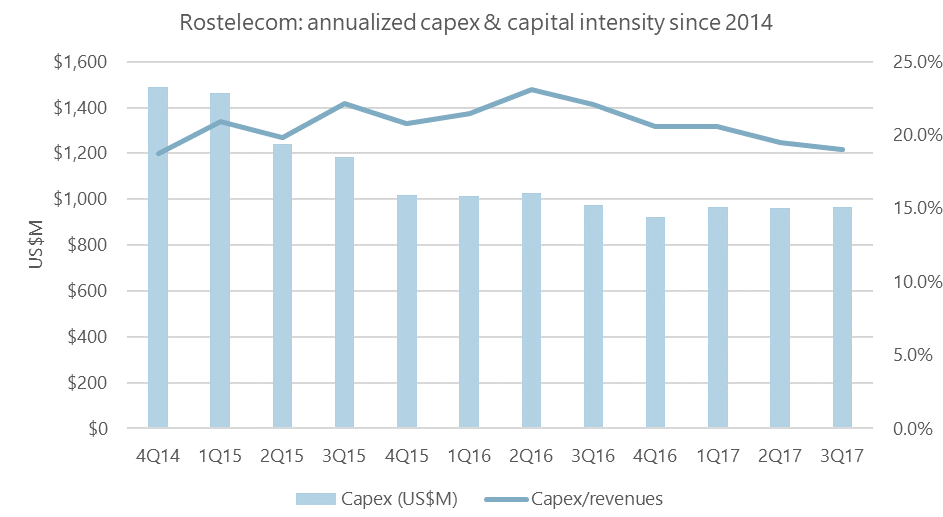
Rostelecom is Russia’s largest fixed operator, including in pay TV where it has over 10M customers. The company spent about US$1B on capex in the 12 months ended Sept. 2017. Capital intensity has fallen to about 20% (figure), but that’s still high by global standards.

This is a nice win for ZTE, helping it validate its fixed broadband credibility with a major account. Russia has faced political & macroeconomic turmoil recently, but it is a large market, and ZTE is one of only a few competitive vendors. Given the recent slowing of China’s infrastructure market, having a potential growth account like Rostelecom could come in handy for ZTE.

Reference graphic

The figure below illustrates Rostelecom’s annualized (12 month) capital expenditures (capex) and capex/revenue ratio (capital intensity) since 2014.

Source: MTN Consulting, LLC

Also see First few 3Q17 telecom vendor reports: YTD revenues down 3.4%, or this article from the Financial Times: Apple found guilty of price-fixing in Russia over iPhone prices


Blog Details

Weak network spending climate becoming more apparent

Fidelity’s “Communications Equipment” index is up nearly 11% so far this year, tracking just a few points behind the S&P 500’s YTD gain of about 15%. Looking ahead, though, the communications equipment sector remains challenged, something 3Q17 earnings are making clear.

Ericsson, Nokia and ZTE in a similar boat

Vendors selling mainly to communications markets are reporting sluggish demand. In 3Q17, revenues declined by 4% and 9% YoY at the networks divisions of Ericsson and Nokia, respectively (for Nokia’s trend, see figure below).

Multiple regions are seeing the same issue: weak telco revenue growth is constraining more rapid investment. LTE networks are in place, ready for growth & upgrade via software (mainly). Fixed broadband networks remain expensive to construct, and the video revenue upside is proving to be a challenge for many operators, including AT&T.

ZTE doesn’t break out carrier revenues on a quarterly basis. Corporate revenues fell 5% YoY in 3Q17, and ZTE says carrier demand is stronger than average. We’ve estimated 1% YoY growth for ZTE’s carrier group in 3Q17, in local currency. The China capex outlook is cloudy, though, something which both ZTE and Huawei will have to face next year. They also, I suspect, will reinvigorate their vendor financing programs, as has already come up in Brazil with a potential buyout of Oi with involvement from the China Development Bank.

The figure below confirms, though, that it’s not just ZTE, Ericsson and Nokia facing issues. Many suppliers reported YoY revenue declines in 3Q17.

3q17v2

Accenture’s result is modest evidence that telcos continue to increase spending on services & software, but not definitive as Accenture includes telecom in a larger Communications, Media & Technology (CM&T) vertical.

Adtran’s growth is due largely to an acquisition, namely of CommScope’s active fiber access product line, in late 2016.

Corning’s growth is more interesting. Many vendors are reporting a shortage in actual fiber optic cable supply over the last year or two. New factories or expansions have been announced by CorningFurukawa, and most recently Prysmian. These tend to tie in to specific large telco (or national government) fiber builds, as with Verizon’s FiOS and the NBN in Australia. The economics of these builds require video service profitability, in general, and that has been mixed lately.

Telco capex datapoints not reassuring, but it’s early

Many telcos have reported already, including Rogers & Verizon, Telefonica, Orange, America Movil, AT&T, Telenor, and DoCoMo. Occasionally a big operator reports capex growth, unapologetically – referring to the revenue opportunities that might come with that. DoCoMo comes closest to this model so far. Its capex for the last two quarters is up 9% YoY, in part to support new services in the “Smart Life” business. Most, though, are talking down capex, emphasizing that the bulk of 4G work is done, fiber capex is more targeted & tactical than 2 years ago, etc.

On Telefonica’s 3Q17 earnings call, for instance, COO Angel Vila noted that:

“CapEx is on a declining trend in Spain. We have already 97% LTE coverage. I think it’s close to 70% fiber-to-the-home coverage. We will continue deploying fiber, but reduce speed and focusing on connecting… the CapEx trend in Spain is already declining in terms of CapEx to revenues.”

Many operators have similar stories. Vendors will have to seek out the ones with more budget flexibility. Even with some success, though, it’s likely we will see a pickup in M&A activity around the communications equipment sector over the next 1-2 years.

Blog Details

Decades-Long Copper Retirement Process Is Just Starting For Verizon And AT&T

Incumbent telcos in markets like the US have built their networks gradually, over many decades. In the access plant, the trend towards more fiber began in the 1990s – but applications, products, and overall economics have come together just in the last several years. The speed of fiber deployment varies by operator; it’s driven by the company’s overall broadband strategy, but constrained by financial and accounting issues. Despite the apparent rush to fiber, we have several more decades before big telcos get rid of all their copper cables.

Fiber getting some good press

Recent disasters have highlighted the reliability advantages of fiber, beyond its (cost per) bandwidth benefits. The US Federal Communications Commission (FCC) Chairman Ajit Pai noted recently that the effects of recent hurricanes on Puerto Rico’s cell network were far worse than Houston. The reason, Pai argued, was that most of Houston’s cell backhaul is done on fiber (versus copper in PR), and buried fiber is far more resilient to water damage than copper cables. Houston also made out well versus the big 2005 hurricane, Katrina. The FCC estimated only about 300 of the 7,804 cell sites in Harvey’s path went down during Harvey, from over 1,000 sites during Katrina.

This is a new twist on the safety debate. In the past, the debate has focused more on the fact that fiber-based broadband services (such as Verizon’s FiOS) require a battery backup to ensure emergency operations .

Despite Chairman Pai’s praise of fiber, incumbent telcos still face a myriad of rules relating to fiber deployment – especially if a retirement of copper-based service is involved. The rules aim at protecting consumers who rely on the network, and other operators who interconnect with the incumbent. Public notice of any planned retirements is required. That’s why we’re hearing more about copper phase-outs lately, mainly from Verizon, AT&T and CenturyLink. The topic is also coming up in the FCC’s 2017 Wireline Infrastructure NOPR.

Actual change is far slower than the news flow

Look a bit closer, and the headlines are less impressive.

Verizon, for instance, announced copper retirements in eight states last month. The states include some of Verizon’s largest incumbent operations, including New York, Pennsylvania, and New Jersey. However, they are not statewide shutdowns. They’re for “select towns and cities” in these eight states. The process is typically done by individual central office, or “wire center”. One example: Verizon plans to retire all copper terminated at the “FKLNMAMC” wire center in Franklin, Massachusetts by August 2018. This is a tactical process that’s planned very carefully.

These retirements are important, as they symbolize a transition to all-IP, all-fiber networking that telcos have been working towards for many years. But they are piecemeal, given Verizon’s scale. The company had $46B of cables, poles, and conduit on its balance sheet last year; the copper parts of this are not disappearing overnight. All else equal, copper retirements are first targeting wire centers with lots of enterprise customers, and denser residential neighborhoods with above average disposable incomes – both areas where there is likely to be competition to protect against.

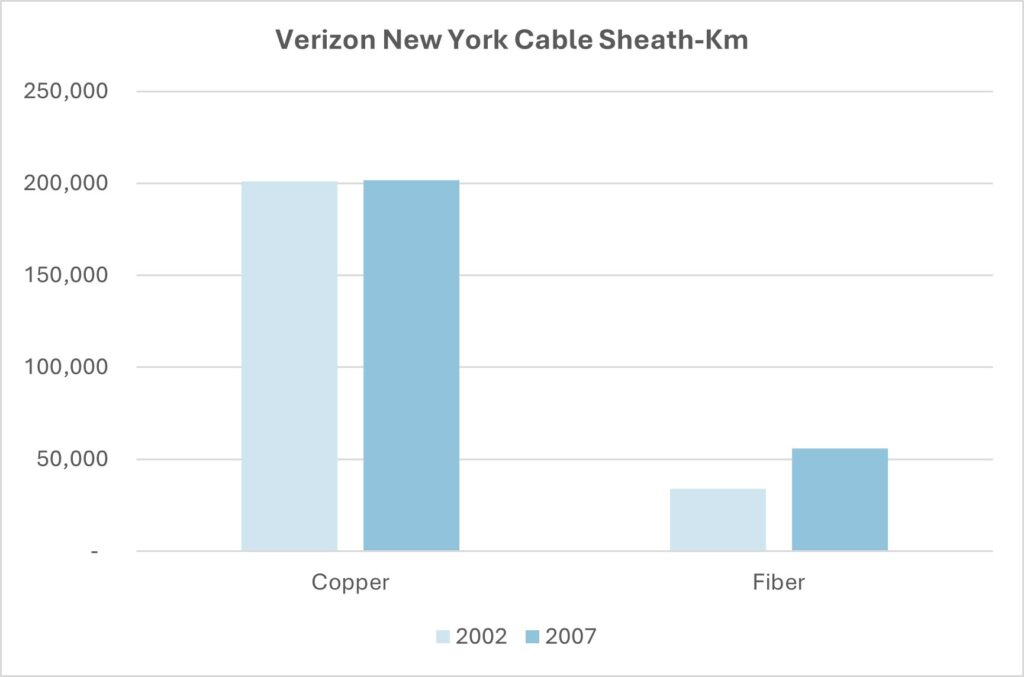
Very little new copper is being deployed, but Verizon and other incumbents are eager to leverage what’s installed. In the case of Verizon’s New York operations, the figure below illustrates how vast that (copper) base is.

Source: FCC Report 43-07, the ARMIS Infrastructure Report (2007 & 2002)


More flexibility, please

The current regulatory climate in Washington, DC is favorable to incumbent telcos, i.e. those running fixed networks with universal service obligations. Their views on net neutrality debates are now in favor at the FCC. Mergers & acquisitions are welcomed by the Trump administration’s Federal Trade Commission (FTC). The smart regulatory lawyers working for telcos are trying to use this favorable climate to their advantage.

Relatedly, copper retirement filings have ticked up at the FCC lately, from a range of incumbents. As part of this, incumbents are requesting more flexibility, especially in reporting requirements: shorter lead time, fewer details disclosed, etc. Based on the current climate, they might get what they want at the FCC. And at the state level, incumbents tend to be even more tightly knit to regulators, which will come in handy during retirement-related debates.

Competitive carriers should be concerned. Google’s investment in fiber, and its failure to scale, reminds us how hard it is to overbuild – which is the only option once the copper is gone.

Blog Details

Running Converged Networks Is Costly; A View From Thailand

Mobile operator AIS to consolidate ownership in CS Loxinfo

Thailand’s largest mobile operator AIS announced this month it would spend $79M to buy a 56% stake in CS Loxinfo, an enterprise-focused fixed line operator. AIS is picking up 42% from a Thaicom subsidiary, as well as Singtel’s current 14% stake in CS Loxinfo.

The companies involved in this transaction already have ties. AIS’ parent company, Intouch Holdings, also owns 41% of Thaicom. But this deal is not simply a paper transaction. AIS has good reason to expect integration with CS Loxinfo will accelerate its fixed broadband efforts. AIS entered that market in early 2015, and had ~446,000 subs by June 2017, with an ARPU of 600 Baht/month. That’s over double AIS’ reported blended ARPU of 251 Baht for its mobile subscriber base. The company clearly wants to expand from this modest base.

Regulatory climate improving, bit by bit

AIS was launched in 1990. While a private company, it was set up as a “concession” of Thailand’s Telephone Organization of Thailand (TOT), one of Thailand’s two state operators at the time. AIS received a license, while TOT received a share of AIS revenues. This was a not a small exchange (and TOT did not enthusiastically give it up): AIS’ “regulatory fees” amounted to over 30% of total opex from 2007-2015. Concession fees have lowered dramatically since 2Q16 however, pushing regulatory costs to under 8% for AIS over the last 12 months. Other Thai operators have also enjoyed lower regulatory costs under the new regime, but AIS’ drop is significant.

The operator has other challenges, though.

Converging mobile & fixed

AIS was mobile only from the start. Like many operators only selling mobile services, AIS also built its own fiber backbone. During the last decade, this network’s reach spread further into cities, using both leased capacity and dark fiber. With the move to 4G mobile, the economic logic of AIS owning its own metro fiber resources has become stronger. (AIS is not the only one to have noticed this). Having some base of metro fiber surely helped AIS with its initial broadband launch in 2015. Scaling it has been costly though.

High network operating expenses

From 2007-13 or so, reported network operations expenses at AIS stayed in a fairly tight range: between 150-200 Baht per customer, per year. Expressed as a percent of total opex, network opex ranged from 5-10% in that same timeframe.  By both metrics, network opex began to climb in 2015, dramatically. Over the last 12 months (3Q16-2Q17), it reached just under 500 Baht per customer, per year (figure).

12

A primary reason for this shift is AIS struggling to manage the costs of its fixed broadband rollout, as many operators have. Prep for this rollout started in 2013-4. Once the service was available, the cost of on-site customer installs was likely higher than expected. Or simply high, period: the problem AIS ran into is not unique, and they likely expected it.

Truckrolls are costly everywhere

Thailand has loads of attractions, but a first-class wireline infrastructure is not one of them. State-run fixed operators, antiquated regulations, a challenging construction environment – there are many factors behind this. One result is a chaotic web of wiring, strung along nearly every utility pole in the country.

This is what AIS network engineers are now dealing with daily, as they extend fiber nodes and install service at customer premises. For a company used to dealing with thousands of base stations, not millions of customer premises, this is costly & time-consuming work.

CS Loxinfo has itself been providing fixed services in Thailand, for over 2 decades. Its reach is not vast, but Thailand’s fixed market has a small number of mostly small players – and CS Loxinfo is well known. Mostly for its leased line business, as these are still big in Thailand; CS has just under 6,000 leased lines in service. Also under its “ICT” business line, CS Loxinfo offers a range of data center services, and reports racks in service (554 as of June)

Network cost pressures lurk behind many mergers

Most mergers have many drivers, some tied to cost savings, others to expanding market opportunities, etc. The AIS-Loxinfo deal is no different; lowering network costs is one of many goals.

AIS has been #1 in Thailand’s mobile market for many years, but has only started going after fixed. Market acceptance of its “AISFibre” offering has been good, and the company has accelerated initial rollout plans. The company is in a bit of a land grab, though. Teaming up with CS Loxinfo might help accelerate the AIS broadband push without breaking the bank.