Blog Details

Telco capital intensity hits 10 year peak in 2Q22

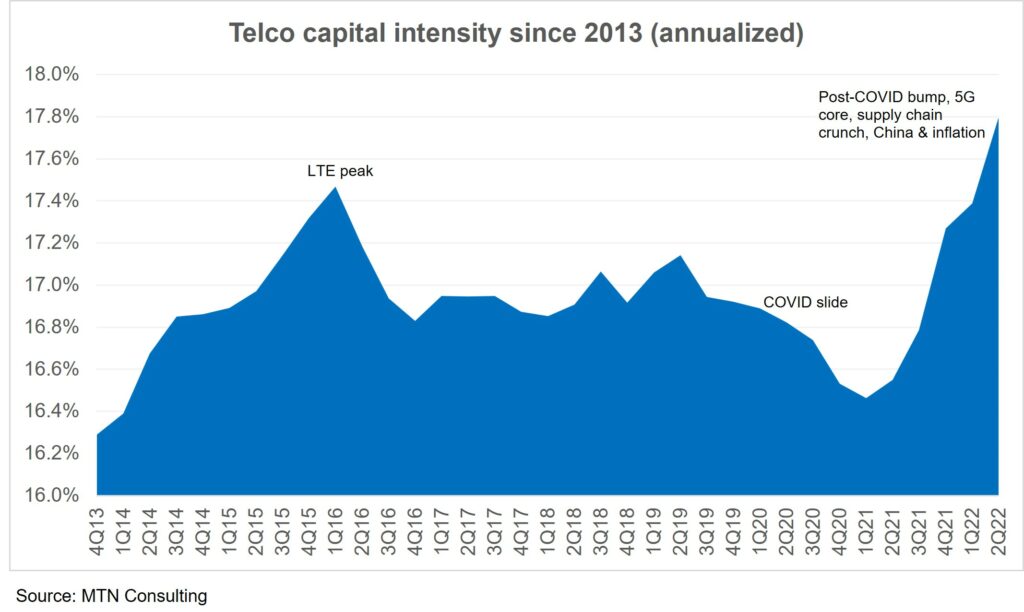
Vendors continue to wrestle with supply chain constraints in the telecom sector. That’s clear from several recent vendor earnings reports, including those issued by Dell, HPE, and Ciena in recent weeks. Telco spending, though, has surged in recent quarters. With 2Q22 results now compiled, the industry has reached a new capex peak. For the 12 months ended June 2022, telco capex was $329.5 billion (B), while the ratio of capex to revenues (i.e. capital intensity) was 17.8%. Both figures represent new record highs, at least for the 46 quarter (11.5 year) period that MTN Consulting data covers (1Q11-2Q22).  

On the supply side, vendors selling into the telco vertical are seeing some growth, in aggregate. For the broadly defined “telco network infrastructure” (telco NI) market, revenues were $60.1B in 2Q22 (up 4.1% YoY), or $237.6B on an annualized basis, up 6.7% YoY. The telco NI market includes some vendor revenue streams which dip into telco opex, not capex, but there is usually a correlation between total capex and vendor revenues.

The figure below illustrates telco capital intensity over the last several years.
What’s behind recent capex growth

One factor behind the recent capex spending spike is a post-COVID bump. Economies shutdown during COVID, depressing network spend. The capital intensity effect is shown in the figure, above (“COVID slide”). Capex also dropped in absolute terms. Annualized capex bottomed out at $299.8B in 2Q20. Some of the current growth is just making up for lost time. The quarterly average hasn’t changed much, if you expand the time horizon. For the last ten quarters, from 1Q20 (the onset of COVID) through 2Q22, telco capex averaged out to about $77.9B per quarter. For the ten pre-COVID quarters, the average was $78.5B.

Another factor is many telcos are scaling up initially small 5G deployments, and beginning to build out 5G SA core networks. 5G RAN builds have been underway for several years, but the spending has been small to start due both to the software-centric nature of 5G networks and telcos’ desire to wait for new revenue models to emerge. Incidentally, a shift to 5G core spending tends to benefit a different type of vendor – not just the Ericssons and Nokias of the world. Cloud providers AWS, Azure and GCP, for instance, are all actively involved in helping telcos with 5G core migrations. Their collective revenues in the telco vertical were about $3.4B for the 12 months ended June 2022, up nearly 80% YoY. Many of the vendors involved in this are less vulnerable to supply chain issues.

Another capex plus: fiber spending is strong in a number of markets, especially the US but also in Europe, Australia, China, and India. That’s to support FTTx deployments but also to connect together all the new radio infrastructure needed to support 5G. Government subsidies and other investment incentives are a factor as well. Vendors focused on fiber optics are seeing strong growth right now. For instance, Corning and Clearfield saw their telco vertical revenues grow by 25% and 84% YoY in 2Q22, respectively.

Supply chain limitations have a mixed effect. They sometimes mean delay or cancellation of projects, which cuts capex in the short term. They also can mean price increases, though, as telcos push suppliers to accelerate timelines or adjust designs to work with available alternatives. This can result in projects costing more than expected. Let’s not forget, though, that a huge portion of telco spend is unaffected by current supply chain constraints. Services- and software- focused vendors – like Accenture, Amdocs, IBM, Infosys, TCS and Tech Mahindra – are not citing supply chain issues as a drag on results. 

Inflation is a bit more straightforward. This has impacted the entire telecom food chain, from chips to components to systems to services. All else equal it causes an increase in US$ capex, though the impact on capital intensity is less clear. 

Finally, there’s China. Given how closed a market this is, there’s not as much attention paid to it nowadays. But China’s capex has been growing recently. For the 2Q22 annualized period, Chinese telco capex totaled $58.3B, up 12% from 2Q21. That growth comes despite efforts to share costs on the network side.

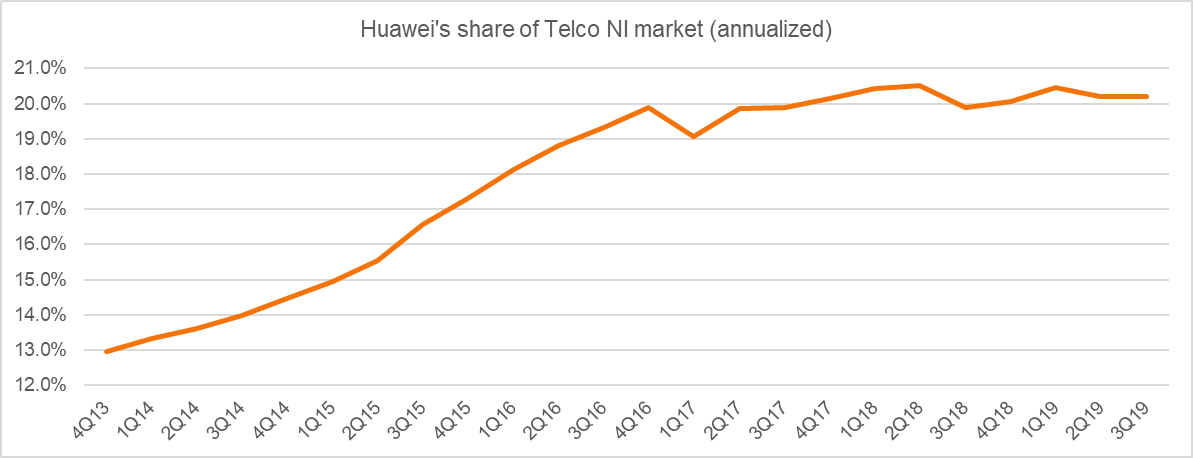
China is also relevant to the vendor share question. Huawei continues to rank at the top of the global telco network infrastructure (telco NI) market. For the 2Q22 annualized period, we estimate its telco NI share at 18.7%, far ahead of Ericsson (10.9%) and Nokia (8.9%). This surprises some, as Huawei has become a non-factor in many markets over the last two years. Yet Huawei’s stability is no mystery. It’s dominant at home, and local telcos have been spending big, and steering more of their capex dollars to local suppliers over the last couple of years. Huawei also has a huge customer list overseas – these revenue streams don’t just disappear overnight, especially since many telcos remain loyal to the vendor.

Hardware hit hardest in supply chain crunch

Vendors recorded about $237.6B in sales to the telco vertical for the 2Q22 annualized period. This is a huge market, with many different players; MTN Consulting stats track 132. Some supply the latest and greatest hardware innovations. They often have high margins but can also be subject to supply chain hiccups. Vendors specializing in solutions which revolve more around software and/or services tend to have different constraints. Labor cost and availability is always a concern, but hardware is rarely an issue. We believe the current supply chain disruptions will improve in the next couple of quarters, though. Even those vendors hit by short-term supply issues are generally optimistic. For instance, Gary Smith, Ciena’s CEO, noted last week that “Despite supply chain challenges and elongated lead times, strong secular demand trends show no signs of abating. And we remain confident that the fundamental macro drivers propelling this demand are durable over the long term.”

The biggest near-term risk to that is China’s ongoing series of COVID shutdowns. Longer term, the bigger risk is any interruption to Taiwan’s ability to continue functioning as an independent, self-governing country – it plays a key role in the telecom supply chain, and that of many other sectors. This issue is the elephant in the room that few like to address, but all vendors need to have a plan for this worst case scenario.

*

Source of cover image: iStock

Blog Details

Tough times at Huawei in 1Q20

Tough times at Huawei in 1Q20 

If you’re a Huawei watcher – and who isn’t in telecom nowadays – keeping up with the newsflow of the last few months has been a challenge. The company has long generated a lot of press, but this is different.

Looking at just the last three months, three things seem clear. One, US policymakers from both major parties are skeptical of Huawei. At a minimum, they oppose use of Huawei in US networks; at the fringes, some would like to put Huawei out of business. Two, a number of large countries aligned with the US are unable to resist Huawei’s offering, and/or not eager to cope with bullying from China Inc. Three, Huawei sees self-sufficiency as even more important now than a year ago, and the Chinese state budget will support that desire.

Pressure on Huawei 

The most important recent speech on Huawei was delivered at last month’s Munich Security Conference by Nancy Pelosi, Speaker of the US House of Representatives. Her speech reminds us that concerns about Huawei are generally bipartisan in the US. Pelosi warned that “China is seeking to export its digital autocracy through its telecommunication giant, Huawei, threatening economic retaliation against those who do not adopt their technologies….We must instead move towards . . . an internationalization of digital infrastructure that does not enable autocracy.”

Some other recent developments causing headaches for Huawei’s management team include:

  • Huawei’s rags to riches story has taken hits lately. On December 25, 2019, WSJ published a biting investigative piece called “State Support Helped Fuel Huawei’s Global Rise: China’s tech champion got as much as $75 billion in tax breaks, financing and cheap resources as it became the world’s top telecom vendor”
  • Chinese state officials continue to exert political pressure to support Huawei; recently the Chinese ambassador to Germany threatened retaliation if Berlin excludes Huawei from developing its 5G network. This is not only wrong, it is self-defeating for a company that is trying to appear a purely private concern.
  • Some European telcos (notably Vodafone) are being forced to rip and replace Huawei equipment in their network; even when these efforts are subsidized, it will make telcos think twice about future commitments.
  • On February 6, Trump’s attorney general, Bill Barr, suggested having a US company invest directly (or acquire) one of the two European mobile RAN suppliers, Nokia or Ericsson. While unlikely to take place, there is real support for US government subsidies to the growing ecosystem of open RAN vendors based in the US.
  • In early February the US Department of Justice charged Huawei with  racketeering and conspiracy to steal trade secrets in a new indictment. Around the same time, the WSJ reported that U.S. officials said they have obtained evidence of Huawei’s ability to access mobile networks through a “back door,” and have shared such information with several European governments in recent months
  • In late February Intel entered the 5G base station chip market, threatening indirectly Huawei’s competitive positioning in the 5G RAN market

Also, let’s not forget that Huawei’s CFO remains under house arrest in Canada pending the outcome of an extradition hearing.

Huawei is keeping its eye on the long-term prize

Despite a growing list of problems, Huawei has had plenty of wins lately, and appears focused on the long term.

In December, Telefonica Deutschland awarded its 5G rollout to Huawei and Nokia, jointly. In January, the UK chose to allow Huawei participation in 5G networks, with some limitations (by market share and application). Also in January, India’s regulator allowed Huawei and ZTE to participate in 5G trials.

In late February Huawei announced it had secured more than 90 commercial 5G contracts to date, versus 79 for Ericsson. Huawei also made the most of an MWC-less February, communicating with analysts and customers virtually via webinars and targeted briefings. Huawei also reorganized recently, creating the “Cloud & AI” business unit, to function in parallel to the legacy Carrier, Enterprise, and Consumer business groups. For telcos considering a bet on further Huawei deployment, these are all positive signs.

Behind the scenes, though, I suspect Huawei sees the writing on the wall – its US problems did not start with Trump, and they won’t end with a new President. As such, Huawei continues to work towards its long-term goal of self-sufficiency. This is not new, but has been accelerated by recent events. It’s especially important at the chip level. For instance, Huawei has increased its investments recently in subsidiary HiSilicon, increased collaboration with local chipmaker SMIC, and placed orders with Taiwan-based TSMC to be fulfilled out of China-based factories in Nanjing. Huawei has an enormous R&D budget and always-growing ambitions, so its efforts to bypass the US for technology development will persist. 

v4q19-3

Source: MTN Consulting

Blog Details

Indian government’s decision to welcome Huawei for 5G trials receives mixed response

The Indian government’s recent decision to invite Huawei for 5G trials has sparked a debate between two opposing bodies. Indian telecom export body TEPC (or Telecom Equipment and Services Export Promotion Council) has proposed a ban on Chinese telecom equipment citing recent similar moves by the US and other developed countries over cybersecurity concerns.

On the other hand, Cellular Operators Association of India (COAI), which represents the country’s telecom operators, defies the proposed ban. The COAI suggests that there is little evidence to confirm the claims of the countries that banned the Chinese giant. COAI’s stance is not surprising considering operators are heavily dependent on Huawei’s kit.

India’s support for including Huawei was expected

Huawei is facing political obstacles in a number of the world’s largest markets – the US, Japan, Australia, and likely more to come. Indian policymakers also have security concerns about Huawei. Those are being set aside, for now.

The Indian government’s openness toward Huawei rests on three major reasons. First, a ban on Chinese telecom equipment would be detrimental to operators who had already purchased gear from Huawei on a long-term supplier’s credit and at discounted prices. Second, Huawei is one of only a few competitive 5G network infrastructure vendors. Third, a wider range of companies taking part in the trials bodes well for 5G growth prospects and gives operators more clout during price negotiations.

Publicly, Huawei has received widespread support from the telcos. That’s clear from a statement issued by Rajan Mathews, head of the COAI: Huawei is “suitably equipped to prepare operators and industry to build 5G capabilities in operations, in organisation and most importantly in the ecosystem and to ensure they are fully compliant with all government requirements.”

AnchorIndia still struggling to develop a local telecom equipment sector

Rival vendors and trade groups oppose the government’s openness towards Huawei. One reason they point to is a need to support local vendors, or local R&D by foreign vendors (e.g. Ericsson’s 5G partnership with India’s IITs).

Currently most of India’s telecom capex goes to foreign vendors, who dominate the Indian market for wireless base stations, transmission equipment, and data/IP gear. Nearly all of India’s telecom network infrastructure is imported. Besides China and Hong Kong, Indian operators import network equipment from South Korea, Vietnam (Samsung Vietnam), Taiwan and the USA. This has resulted in a huge telecom equipment trade deficit.

Further, most handsets sold in India are either just assembled or imported from other countries. Electronic parts such smartphone cameras and screens, PCBs, sensors and camera modules are imported (mostly from Chinese vendors). PCBs are especially important, as they can account for up to 50% or more of the device cost. For the Indian market, generally handset vendors import PCBs which are already loaded with components, and then assemble them in a semi-knocked-down (SKD) format. A PCB constitutes several key components such as memory, wireless chip sets and processors that forms the core to any device.

Indian policymakers continue to search for ways to grow the local vendor market. Some policy ideas are aimed at the supply side, designed to stir up new local innovation and attract venture capital. Some ideas aim at coercing private operators to buy local. These top-down policy ideas will take time to achieve consensus, though. In the meantime, foreign tech companies are announcing new investments in India as a result of US-China trade disputes. That includes a recent decision by Foxconn to move some iPhone assembly to India.

Huawei might face a few hiccups post the import duty hike

In October 2018, the pressure to promote local manufacturing prompted the government to double the import duty to 20% on several types of network equipment. The products include ethernet switches, IP radios, base stations, media gateways, optical transport equipment, MIMO/4G LTE gear, VoIP phones, gateway controllers, packet transport nodes and optical transport product or switches. Further, a 10% customs duty (compared to zero import duty earlier) was also levied on products like printed circuit boards (PCBs).

However, countries such as South Korea and Vietnam which have a free trade agreement (FTA) with India are exempted from these import duty charges. This could be a major hindrance for Chinese network equipment vendors who might lose ground to their peers. It benefits others, though. South Korean giant Samsung is already reaping the benefit of import duty exemption, both from its home base and via its manufacturing hub in Vietnam. A glimpse of this is already seen in the trade data. According to the latest data published by Ministry of Commerce and Industry Trade, telecom equipment imports from Vietnam increased by 35% YoY in the period Jan-Oct 2018, while imports from China/HK fell by 12% YoY for the same comparable period. The import duty hike could also benefit Taiwanese vendors, if Taiwan ever manages to finalize an FTA with India.

Apart from the import duty challenge, market consolidation is also having an impact on Huawei. The industry is just left with four large integrated operators, compared to eight operators in 2017. Huawei’s managed services business in India took a hit after it lost two of its big-ticket clients Vodafone India (which was merged with Idea) and Telenor (which got acquired by Airtel) due to market consolidation. The effects of this are already seen as Huawei shut its Chennai SEZ plant –which assembles telecom equipment– due to reduced demand. Despite these challenges, Huawei hopes that its long-standing customer relationships, robust R&D, and competitively priced products will keep customers coming back.