
Blog Details

India unlikely to rise above 4% share of telco NI in 2021

Prediction: India-based vendors almost certain to capture less than 4% of global telco network infrastructure market in 2021  

Prospects for 2021

The year 2021 is likely to see some significant shifts in vendor share in the global market for telecom network infrastructure products & services (“Telco NI”). Spending on 5G is picking up, interest is growing in open RAN architectures (and open networking in general), telcos are making more carefully thought out decisions without the chaos of COVID-19 dominating discussions, software’s share of capex is rising, and Chinese vendors continue to face supply chain and security constraints to their global position. Many telcos, and policymakers in the US, have pointed to India as a potential alternative player in the Telco NI market. India and the US are allies, after all, and India has a program aimed at developing local manufacturing – which calls to mind similar programs in China that helped Huawei and ZTE. The question arises, then: what are the prospects for India-based vendors globally in 2021? More specifically: what is the chance that India-based vendors can grow their share of Telco NI above 4% in 2021?

After reviewing the question, our conclusion is that there is less than 10% chance of this happening. Not impossible, but nearly so. Here is our assessment of a few key issues.

Current share below 3%

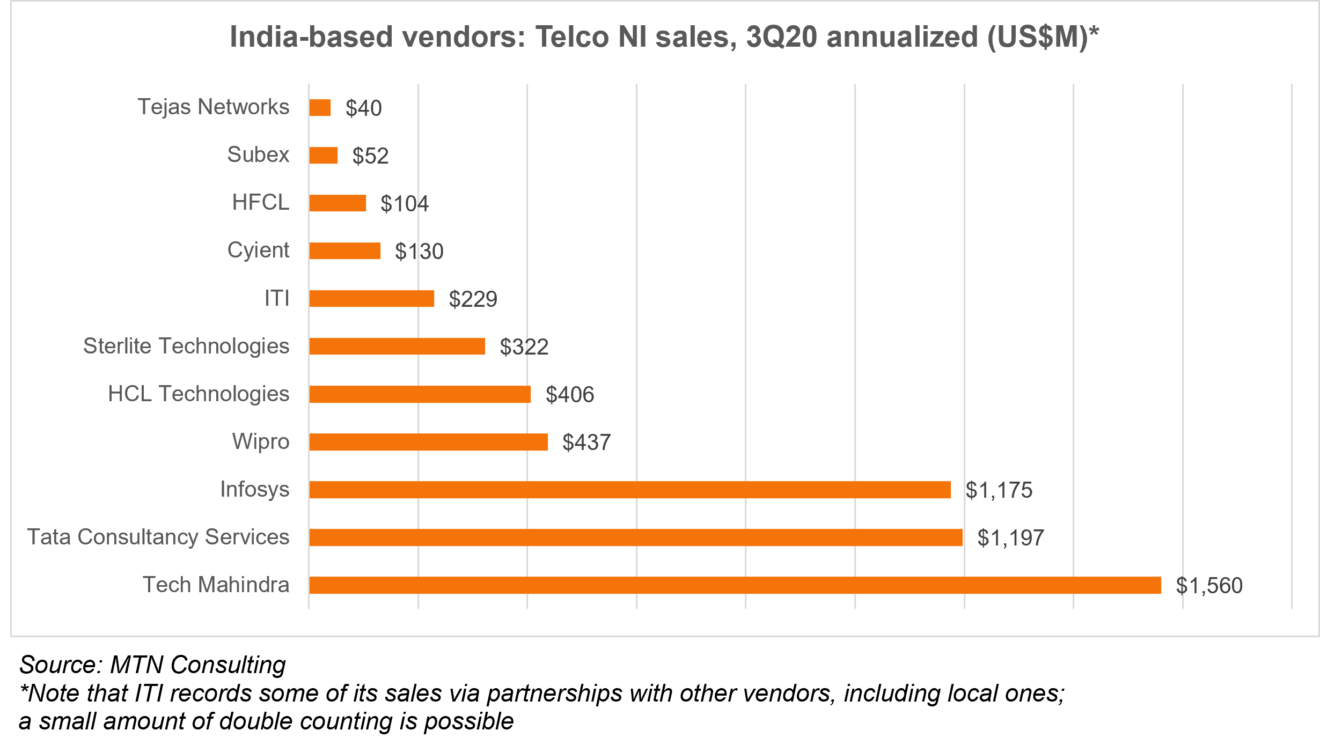
For the four quarters ended 3Q20, MTN Consulting estimates that vendors based in India captured roughly 2.6% of vendor revenues in the global telco network infrastructure (telco NI) market. That is based on sales to telcos for eight vendors we currently track (HCL, Infosys, Sterlite, Subex, TCS, Tech Mahindra, Tejas Networks, and Wipro), plus three vendors we are in the process of adding to our database: Cyient, HFCL, and ITI Limited. Annualized telco NI revenues for these 11 companies, by our estimation, amounted to $5.7 billion in 3Q20, out of a global market of $216.3 billion.  Nearly 70% of that $5.7 billion is recorded by three IT services players: Infosys, TCS, and Tech Mahindra, with the latter slightly ahead of the first two. (see chart, below)
India telcoNI vendors 3Q20-2

So, India’s starting point is low. Jumping from less than 3% to above 4% in the space of a few quarters is a challenge. Adding one percentage point in share is not the issue; larger vendors with the ability to ramp manufacturing to satisfy big one-time orders can do this easily. Most of India’s Telco NI strength lies in services, integration, and software development contracts, though, which tend to take more time to implement. Moreover, India is a relatively small market within global telecom. Local vendors do benefit from set-asides and easier access to local customers, but India accounted for less than 3% of global capex in the last four quarters. It has been higher in the past, in fact reaching 6.1% of global capex in the 1Q19 annualized period. But that was during Jio’s massive network buildout and aimed at helping the company jump ahead of the competition rapidly, which it succeeded in. 

India’s 5G buildout will be hobbled by pricey spectrum

Last month the FCC held an auction for 5G-suitable spectrum in the US. Winning bids totaled up to just under $81 billion, a bit more than 90% of the US telco market’s total annual capex of $88B (2019). Many observers have warned that this outcome could hobble the telcos financially, as they now also need to come up with capital to deploy the networks. These concerns are well-founded.

India could be in an even more precarious situation. Its primary 5G auction won’t be held until next month, but could potentially raise up to $50B or more for the Indian state treasury. This figure is several times India’s 2019 telco capex figure of $10.9B. 

Contrast this with China’s approach, where spectrum is generally given away for free (or nearly so), and the government uses its control of key operators to drive procurement practices and the pace of deployment. Because of this, 5G in China is seeing rapid adoption and local vendors have benefited massively. Huawei and ZTE gained share last year in the Telco NI market, in fact, despite all of their problems. 

A slow 5G rollout in India means fewer opportunities for local vendors to win new deals and gain crucial experience that they could leverage in global markets.

State-run operators are small and procurement is slow 

One area where India’s vendors clearly shine is with state-run operators BSNL and MTNL. Government procurement rules favor local suppliers strongly. However, the two together accounted for just $614M in 2019 capex, under 6% of India’s total. Further, the hoops they must jump through to build new network projects are cumbersome. Disputes about winners and losers can slow down final decisions and the actual spending connected to the decision.

BSNL’s long-planned 4G tender is a good example. It’s now more than 4 years since Jio debuted its 4G network in 2016, and BSNL is still at the early procurement stage with 4G. The project has been delayed several times. Most recently, BSNL did issue an expression of interest document covering a potential network with 57,000 sites. As promising as that sounds, it remains unclear what it means to be local. Partnering with a foreign vendor such as Samsung or Ericsson might qualify; having a large R&D presence in India (e.g. Mavenir) might also allow one to slip through. The challenge is that there does not exist a truly Indian company able to build a 4G network end-to-end, and it cannot be created overnight.

Hiring a truly Indian services firm like Tech Mahindra is one option for BSNL, as TM can get more experience putting together the piece parts for a network in way that will help with Open RAN opportunities. Tech Mahindra already works with Telefonica and Rakuten on Open RAN.   

Jio succeeded while avoiding local NI vendors

Indian telecom’s big success story in recent years is clearly that of Jio Platforms, which emerged from little in 2016 to become the market’s largest wireless provider in just over three years. Jio did many things differently than its rivals, one of which was to rely almost entirely on foreign vendors – but avoiding the Chinese. Jio has some gear from Tejas in its network and a few other small local vendors, but it’s minimal given the telco’s size. There is no current sign to suggest Jio will be more eager to adopt local tech as part of a future 5G rollout. If spectrum was to be issued on a cheaper (or even free) basis but come with some ‘buy local’ requirements, clearly the outcome would differ.  

Bharatnet is not that big a project in global terms

India has made impressive strides in expanding connectivity in rural regions over the last few years, due largely to the Bharat Broadband Network, or Bharatnet. This project has been especially helpful to local fiber manufacturers. It continues, but the scope of the project needs context. For the fiscal year 2020-21, approximately $800M was budgeted for Bharatnet. That is a sizable amount, and many local vendors (e.g. Tejas) cite national or state-level Bharatnet projects as contributing to recent revenue growth. But $800M works out to roughly 2% of telco industry capex in China alone for 2019. The project is just not big enough to help a local vendor go global. 

What could swing things the other way?

In my opinion, it would be great to see a globally competitive vendor emerge from India. At one point in the distant past, it seemed that Tejas had potential to be a real player in the optical market. That has not happened; lack of a local supply chain and manufacturing are among the many issues.

Currently Tech Mahindra is looking like it has real potential, with a growing focus on the blossoming Open RAN market, and helping telcos integrate these new networks. Tech Mahindra’s collaboration with Rakuten on this point is promising. TM will have competition from many other companies going after these projects, though – not just RAN vendors but other telcos, including NTT DoCoMo. It’s not just Tech Mahindra with potential, though; Infosys, TCS, and Wipro are already active in 5G RAN networks. If these IT services specialists can quickly help telcos review and implement new network architectures that have verifiable cost savings, then India’s vendor prospects may brighten. 

The biggest thing that could support the local industry, though, is a different government philosophy on spectrum auctions. Clearly the government needs to raise funds to operate, and auctions are one easy way. But if there is interest in developing local 5G ecosystems and helping local companies make it big globally, then maximizing auction proceeds cannot be the overriding goal.

Blog Details

Reliance Jio’s aggressive cloud push with Microsoft fret Amazon and Google in India

After taking the Indian telecom scene by storm to reach the pinnacle (by subscriber base) in just three years of commercialization, Reliance Jio Infocomm (Jio) is all set to spread its wings into the booming Indian cloud market. In a 10-year deal with the cloud heavyweight Microsoft, Jio will build new cloud data centers across India that will support Microsoft’s Azure cloud platform to offer economical India-native cloud-based solutions for enterprises. As a part of this, two initial data centers are being built by Jio in the Indian states of Gujarat and Maharashtra – both slated to go live by the end of 2020. These two facilities are reportedly ~7.5MW in capacity, small relative to the largest global facilities but significant for India.

Microsoft has been part of the Indian cloud scene since 2015, before its closest webscale network operator (WNO) rivals Amazon (2016), Google (2017) and Alibaba (2018). Though Microsoft claims to operate three data centers in India, interestingly, these are hosted in a part of existing data center companies such as CtrlS Datacenters and Netmagic (so do Amazon and Google). The partnership with Jio also has a similar set up – Microsoft’s Azure Cloud hosted on Jio’s data centers. By contrast, Microsoft’s recent cloud partnership with AT&T will likely have the telco relying primarily on Microsoft built infrastructure.

The Jio-Microsoft deal also marks telcos’ greater engagement in the Indian webscale arena offering cloud and network connectivity solutions, with Airtel already in the backdrop for quite some time – Airtel operates a wholly-owned data center unit, Nxtra Data, which is prepping for data center footprint expansion.

Jio, Microsoft deal a win-win for both

The key to this deal is how it allows both the firms to focus on their respective competitive edge. While Jio’s scale and infrastructure clout coupled with its understanding of the Indian landscape would assist in delivering seamless connectivity, Microsoft will focus on what it does best – developing and deploying its Azure cloud and AI solutions, on Jio’s network. The deal would also allow Microsoft to grow its cloud market share in India, a key point considering that cloud has now grown to become Microsoft’s biggest business segment by revenues, and is looking at India as a market to boost this growth further.

Jio, on the other hand, will bank on Azure’s brand of solutions to help persuade Indian enterprises to switch from the cloud platforms of Amazon, Google, and Alibaba, onto Azure-backed Jio’s network. Besides, Jio’s quest to explore and build high-growth businesses beyond telecom complements its decision to venture into cloud.

Key deal disruptors – ‘pricing’ and ‘native language compatibility’ – to benefit target market, and unsettle rivals

India being a price conscious market, Jio’s strategy is apparent – triggering a price war by aiming at the bottom of the ‘enterprise pyramid’, primarily comprising the startup ecosystem and SMEs, without compromising on solutions’ quality while leveraging Microsoft’s Azure brand. Jio will offer ‘free’ connectivity and cloud infrastructure to promising startups, and SMEs will be offered customized and bundled solutions encompassing connectivity, productivity and automation tools starting at just INR1,500 (US$21) per month. Similar solutions offered by rivals such as Amazon and Google can cost ~10x that price.

In addition, the Jio-Microsoft duo is looking to plug a key void left by the existing peer offerings for SMEs, i.e. local language compatibility. Jio will leverage Microsoft’s speech and language cognitive services to provide cloud and digital solutions supporting major Indian languages. This could prove to be a game-changer in a market with such language diversity as India. Local language support will likely boost broader adoption among SMEs who still largely cater to the needs of native regions.

These developments are surely going to hurt the existing cloud players, especially Amazon, Google, and Alibaba, who have a lot to ponder on countering Jio-Microsoft threat. Amazon, which has a sizeable SME clientele in India, faces the maximum risk as scores of SME customers are expected to switch from its cloud platform. Alibaba, a Chinese operator, may try to counter the Jio-Microsoft pricing but privacy and political concerns may push customers to Jio.

So how will the peers respond?

It is clear that Jio is looking to replicate its telecom price war success story in the cloud space, i.e. by offering free and discounted cloud solutions which will eventually force bigger peers to match tariffs while pressing smaller rivals to go out of business. Amazon, Google, and Alibaba will, thus, likely come up with bundled connectivity solutions at cheaper rates. Another likelihood is more webscale partnerships with local telco operators. Airtel, which already operates data centers through Nxtra Data and is on an expansion spree across India, could well be the beneficiary. But it remains to be seen if these efforts by peers are competitive enough to keep the Jio-Microsoft duo at bay. Jio’s mobile rivals are still struggling to recover from its disruption of telecom. At the least, the Jio-Microsoft partnership will help accelerate India’s cloud adoption and digital transformation.

Blog Details

Indian government’s decision to welcome Huawei for 5G trials receives mixed response

The Indian government’s recent decision to invite Huawei for 5G trials has sparked a debate between two opposing bodies. Indian telecom export body TEPC (or Telecom Equipment and Services Export Promotion Council) has proposed a ban on Chinese telecom equipment citing recent similar moves by the US and other developed countries over cybersecurity concerns.

On the other hand, Cellular Operators Association of India (COAI), which represents the country’s telecom operators, defies the proposed ban. The COAI suggests that there is little evidence to confirm the claims of the countries that banned the Chinese giant. COAI’s stance is not surprising considering operators are heavily dependent on Huawei’s kit.

India’s support for including Huawei was expected

Huawei is facing political obstacles in a number of the world’s largest markets – the US, Japan, Australia, and likely more to come. Indian policymakers also have security concerns about Huawei. Those are being set aside, for now.

The Indian government’s openness toward Huawei rests on three major reasons. First, a ban on Chinese telecom equipment would be detrimental to operators who had already purchased gear from Huawei on a long-term supplier’s credit and at discounted prices. Second, Huawei is one of only a few competitive 5G network infrastructure vendors. Third, a wider range of companies taking part in the trials bodes well for 5G growth prospects and gives operators more clout during price negotiations.

Publicly, Huawei has received widespread support from the telcos. That’s clear from a statement issued by Rajan Mathews, head of the COAI: Huawei is “suitably equipped to prepare operators and industry to build 5G capabilities in operations, in organisation and most importantly in the ecosystem and to ensure they are fully compliant with all government requirements.”

AnchorIndia still struggling to develop a local telecom equipment sector

Rival vendors and trade groups oppose the government’s openness towards Huawei. One reason they point to is a need to support local vendors, or local R&D by foreign vendors (e.g. Ericsson’s 5G partnership with India’s IITs).

Currently most of India’s telecom capex goes to foreign vendors, who dominate the Indian market for wireless base stations, transmission equipment, and data/IP gear. Nearly all of India’s telecom network infrastructure is imported. Besides China and Hong Kong, Indian operators import network equipment from South Korea, Vietnam (Samsung Vietnam), Taiwan and the USA. This has resulted in a huge telecom equipment trade deficit.

Further, most handsets sold in India are either just assembled or imported from other countries. Electronic parts such smartphone cameras and screens, PCBs, sensors and camera modules are imported (mostly from Chinese vendors). PCBs are especially important, as they can account for up to 50% or more of the device cost. For the Indian market, generally handset vendors import PCBs which are already loaded with components, and then assemble them in a semi-knocked-down (SKD) format. A PCB constitutes several key components such as memory, wireless chip sets and processors that forms the core to any device.

Indian policymakers continue to search for ways to grow the local vendor market. Some policy ideas are aimed at the supply side, designed to stir up new local innovation and attract venture capital. Some ideas aim at coercing private operators to buy local. These top-down policy ideas will take time to achieve consensus, though. In the meantime, foreign tech companies are announcing new investments in India as a result of US-China trade disputes. That includes a recent decision by Foxconn to move some iPhone assembly to India.

Huawei might face a few hiccups post the import duty hike

In October 2018, the pressure to promote local manufacturing prompted the government to double the import duty to 20% on several types of network equipment. The products include ethernet switches, IP radios, base stations, media gateways, optical transport equipment, MIMO/4G LTE gear, VoIP phones, gateway controllers, packet transport nodes and optical transport product or switches. Further, a 10% customs duty (compared to zero import duty earlier) was also levied on products like printed circuit boards (PCBs).

However, countries such as South Korea and Vietnam which have a free trade agreement (FTA) with India are exempted from these import duty charges. This could be a major hindrance for Chinese network equipment vendors who might lose ground to their peers. It benefits others, though. South Korean giant Samsung is already reaping the benefit of import duty exemption, both from its home base and via its manufacturing hub in Vietnam. A glimpse of this is already seen in the trade data. According to the latest data published by Ministry of Commerce and Industry Trade, telecom equipment imports from Vietnam increased by 35% YoY in the period Jan-Oct 2018, while imports from China/HK fell by 12% YoY for the same comparable period. The import duty hike could also benefit Taiwanese vendors, if Taiwan ever manages to finalize an FTA with India.

Apart from the import duty challenge, market consolidation is also having an impact on Huawei. The industry is just left with four large integrated operators, compared to eight operators in 2017. Huawei’s managed services business in India took a hit after it lost two of its big-ticket clients Vodafone India (which was merged with Idea) and Telenor (which got acquired by Airtel) due to market consolidation. The effects of this are already seen as Huawei shut its Chennai SEZ plant –which assembles telecom equipment– due to reduced demand. Despite these challenges, Huawei hopes that its long-standing customer relationships, robust R&D, and competitively priced products will keep customers coming back.

Blog Details

Can India use 5G to improve local vendors’ position in global supply chains?

In the six years since India’s last telecom sector reform, operators have made big investments in their networks, the country’s subscriber levels have grown, and prices have declined. 4G is now well established, and fixed line broadband finally has decent prospects .

Local (aka indigenous) vendors have sat on the sidelines, unable to keep up

While telecom has grown in India, local suppliers have not. India has many globally competitive companies in the IT services and software space, such as TCS, Wipro and Infosys. But hardware manufacturing remains a challenge. The bulk of telecom capex goes to foreign vendors, who dominate Indian markets for wireless base stations, transmission equipment, and data/IP gear. Most local equipment vendors, such as ITI, HFCL, and even Tejas Networks, rely heavily on government set-asides.

This imbalance is reflected in trade data. Over the 5-year 2013-2017 period, imports of telecom equipment were an astounding $58B more than exports in India. Imports have been 10x the value of exports, or higher, in the last three years. (Figure 1).

Figure 1

For the 2012-14 timeframe, 4G network equipment accounted for a good chunk of the deficit. Since then, the smartphone boom has driven deficits higher. Indian regulators started addressing this in 2017, by imposing a 10% duty on smartphone imports. That has been increased twice, and is now at 20%.

The import duties have encouraged foreign device companies to increase local production. That includes an announcement last week from Xiaomi: its supply partner Holitech Technology will build a factory in Tirupati, employing up to 6,000, and producing camera modules, transistors, touch screens, flexible PCBs, and sensors. This adds to Xiaomi’s already significant local production in India. Samsung, Huawei and others also have facilities.

However, even with some handset production now done in India, much of the value added still comes from overseas. Per Ministry of Commerce trade data, parts account for 30-40% or more of total telecom equipment imports (in value). High-end components for handsets are one part of this. The same issue arises with production of network equipment (e.g. routers): even when produced locally, many of the component parts are imported. That includes semiconductor content in particular.

Further, when foreign vendors set up factories in India, it’s generally to sell gear into local markets, not for exports. There are notable exceptions to that, some in the network infrastructure space: for instance, Ericsson’s Pune plant exports microwave gear to Africa, Southeast Asia and other markets. But the value of these exceptions are small, relative to the huge volume of locally produced & sold gear.

Regulators try again: TRAI’s latest report

As India’s telecom deficit has grown, the government has not ignored the problem.

In Sept. 2017, the Telecom Regulatory Authority of India (TRAI) issued a consultation paper, on the topic of promoting local manufacturing of equipment. The paper addressed the trade deficit issue, and highlighted as the primary cause “relentless” competition from China, “known for large-scale production and export of low-cost equipment”. Imports from Sweden, Finland and America were secondary factors.

Earlier this month, the TRAI concluded its inquiry on the topic. The final report is a comprehensive assessment of the factors limiting India’s ability to compete in telecom equipment markets. The document is impressive as an analytic effort. It identifies a wide range of factors & prescribes recommendations in each area: from university training to patent protection to customs reform to the creation of a number of new boards and agencies.

However, it lacks focus. It suggests doing a bit of everything, and with little new funding: for example, the TRAI’s recommended “Telecom Research and Development Fund” (TRDF) would be equipped with $170M at the outset. That’s better than the status quo, but hardware startups are expensive. One of the smaller US venture capital funds focused mainly on communications technology, Kodiak Ventures, manages $681M or roughly 4x that of the proposed TRDF. The most promising India-based startups are not likely to work with a government VC fund that cannot offer competitive levels of funding and other support.

5G is an opportunity, in theory

In the near term, one intriguing opportunity for vendors – whether local or not – is in fixed broadband, where FTTx rollouts are underway at several companies, including Jio, Bharti Airtel, and BSNL. In the longer term, the shift to 5G is a far bigger opportunity.

While India was late to 4G, policymakers hope to change that with 5G. As India’s Telecom Minister, Manoj Sinha, stated recently, “We missed [the] 2G, 3G, and 4G bus but we are not going to miss [the] 5G bus. A lot of work has been done in our department” to ensure that.

India’s Telecom Secretary, Aruna Sundararajan, has been outspoken in saying India should embrace 5G aggressively, not just for services but to help develop India’s export sector. She is also plugging C-DOT as a technology developer. At the MWC event in Barcelona this year, she met with a number of global tech vendors, commenting that “all the players are positioning themselves for India as a big 5G market. One of the leading chipset [suppliers] in a meeting told us that India will have one of the biggest IoT user base[s] and the company is keen to partner with C-DOT for developing various IoT solutions.”

Beyond enthusiasm, the government is making some modest direct investments in 5G. For instance, C-DOT announced in Feb 2018 that it would set up testbeds in Delhi and Bangalore, led by Anurag Gupta (who attended MWC for C-DOT). The goal is to set up the testbeds in phases, starting with the first in Dec. 2018. C-DOT also signed agreements in June 2018 with three UK universities to conduct joint 5G R&D in several areas, including massive MIMO and mmWave.

In addition, India’s IITs recently announced a 5G commitment from the Telecom Department. Press reports suggest a budget of ~$75M, supporting the work of around 200 engineers.  The IIT 5G project will create testbeds across all 5 IIT campuses. At its Delhi campus, IIT will also work with Ericsson on a new 5G “Center of Excellence,” focusing on massive MIMO R&D.

C-DOT could play an intriguing role

The TRAI report suggests creating several new boards and councils, some multi-agency. To a skeptic, this sounds like a recipe for delay and indecision. That same skeptic might wonder if India already has a well-established organization charged with the development of local telecom equipment production.

The Centre for Development of Telematics (C-DOT) is an autonomous agency of the Indian government focused on R&D in the area of telecommunications. It has just over 1,000 employees across two main R&D campuses, in Delhi and Bangalore. C-DOT develops technologies & licenses them to both government-supported entities such as ITI, and local private sector companies like Tejas Networks.

C-DOT’s employee count has grown in recent years, and it has picked up the pace of its transfer of technology (ToT) announcements. Recent policy changes give C-DOT the charge to seek out overseas business more actively.  Under the government’s “Synergy Plan” released in January 2018, C-DOT is to work with ITI and Telecommunications Consultants of India Ltd (TCIL) on future exports of products & services. That includes granting a manufacturing license to ITI for C-DOT’s terabit router.

Several C-DOT partners, including ITI and BEL, are actively looking to increase exports with the help of C-DOT product. C-DOT executives have appeared recently at public conferences, making a direct pitch to help Indian manufacturers increase exports.

R&D wholesale model, limited funding both need to be addressed

While C-DOT has potential to contribute to 5G and other areas, it is currently viewed as merely a government R&D institute, in effect a wholesaler of R&D to local vendors. C-DOT’s manufacturing partners are responsible for implementation and customer support. To thrive, C-DOT will have to participate more fully in individual projects, getting their hands dirty and talking to customers. After all, many vendors – notably Huawei – include R&D engineers in all aspects of the process, through field deployment and maintenance. India’s vendors can’t just rely on an R&D outsourcing body, and one which licenses its products to multiple players. For C-DOT to help Indian industry drum up more overseas business, functional changes will be needed, along with significantly more funding. As a reference point, C-DOT’s entire budget for fiscal year 2016-17 was about $60M. In 2016, Huawei spent $32M on R&D per day.

-end-

Email Matt

Image credit: Shutterstock

Blog Details

Alibaba Takes On Amazon, Google, And Microsoft Head-On In India’s Cloud Market

It’s a battle between the emerging giant of the east and the pioneers of the west in the highly competitive Indian cloud computing market, as Alibaba prepares to take on the “big three”: Amazon, Microsoft, and Google.

The Chinese ecommerce behemoth, which announced international ambitions for its cloud business (called Alibaba Cloud/AliCloud or AliYun) in 2015, recently launched a cloud data center in Mumbai, India. Alibaba has been active in India since 2007, but this data center is the first notable cloud investment made by any Chinese player in India.

Alibaba’s decision to open an India-based data center looks like a step to kill two birds with one stone: grab cloud market share from the big three, and, allay data privacy fears by establishing a local data center. This was a logical move, and low risk given the company’s deep pockets; it has over $33B in cash & stock on hand. Alibaba’s progress in India’s SME segment is worth watching over the next few quarters. Alibaba aims to be a top global cloud player, and India is one important testing ground. It will also test Alibaba’s ability to navigate some messy international political conflicts.

AWS, Azure, and GCP all opened data centers in India in 2016-17

Global cloud giants Amazon and Microsoft continue to scale up their cloud businesses in India: Amazon pumped US$215 million mid last year into its Indian data services arm, which offers cloud computing solutions. Microsoft recently partnered with the Indian ecommerce giant Flipkart and ride hailing services provider Ola to provide custom solutions via its Azure platform. Google completed three data centers across India in 2017.

The table below summarizes the India presence & cloud capabilities of the world’s largest webscale network operators. Amazon, Microsoft & Google are shown first, as they have the largest presence locally, followed by Alibaba. Apple, Facebook, Baidu, and Tencent each have India operations but no local data center (yet).

Table 1: Webscale network operators in India: local presence & data centers

Company Commercial Operations Network Infrastructure
Amazon
  • Amazon India opened June 2013
  • Acquired local payments company Emvantage Payments Pvt. Ltd. in 2016
  • AWS India has six office locations in Bengaluru, Chennai, Hyderabad, Mumbai, New Delhi and Pune
  • Launched its India network with two data centers in Mumbai in 2016
  • Since the launch, AWS customer base in India grew by more than 50% from 75,000 in 2016 to 120,000 in 2017
Microsoft
  • Active since 1988
  • 6,500 employees
  • First of the top three cloud vendors to launch cloud data centers in India at three locations in 2015: Pune, Chennai, and Mumbai
  • Serves Central India, South India, and West India regions respectively
  • Provides all three forms of cloud: public, private and hybrid
  • Has more than 9,000 cloud partners in India
Google
  • Started operations in 2004
  • Approximately 1,850 employees
  • Launched its first cloud region in Mumbai, India in 2017, hosted across three data centers
  • Primarily serves West India and South India regions
Alibaba
  • Active in India since 2007, mostly through notable investments in online retail (Snapdeal), digital payments (PayTM), and online grocery (BigBasket)
  • First India-based data center launched in Mumbai in January 2018
  • Provides large-scale computing, storage resources, and Big Data processing capabilities
Apple
  • Started operations in 1996
  • Opened a development center in Hyderabad in 2016, and an app accelerator facility in Bengaluru in 2017
  • None in India currently
Facebook
  • Started operations in 2010
  • Has offices in Hyderabad, Mumbai, and Delhi NCR
  • None in India currently
Baidu
  • Launched its India office in Delhi NCR in 2015 which employs ~10 people
  • Claims to have 45 million active monthly users in India for its mobile applications
  • None in India currently
Tencent
  • Active since 2015 through investments in Indian startups such as Practo (2015), Hike Messenger (2016), Flipkart (2017) and Ola (2017)
  • Announced reviving its India business in early 2018, with an investment of US$200 million in gaming
  • None in India currently

Source: MTN Consulting

Alibaba is the only Chinese webscale provider with a data center in India.

Mumbai data center to support a range of cloud capabilities, including AI-based solutions

According to Alex Li (Asia Pacific General Manager – Alibaba Cloud), Alibaba’s new Mumbai facility is a “mega-scale” (aka webscale) data center that will cater to the regional customers in the Indian peninsula, and could support the regional cloud needs for the next 3-5 years. Prior to its construction, Alibaba provided services to a number of Indian companies through its data centers located elsewhere. Now Alibaba will be better positioned to serve these existing customers more cheaply and reliably, while offering localized services to address the increasing market demand from small and medium enterprises (SMEs).

The Mumbai data center provides a broad suite of cloud computing and data intelligence capabilities that include elastic computing, database, storage and CDN, networking, analytics and big data, containers, middleware, and security. In addition, Alibaba Cloud may introduce its proprietary AI-based offering, ET Brain, into the Indian market. ET Brain has applications in industrial manufacturing, city administration, urban transport, and logistics. This strategic step could help capture the lucrative infrastructure and government sectors in the country, as AliCloud has started to do in Malaysia where its City Brain AI-based offering is used to help ease traffic woes. Such an offering could play into the Indian government’s Smart Cities Initiative.

Alibaba will target the underpenetrated yet growing SME segment

In evaluating services, large enterprises tend to emphasize brand, reliability and global coverage issues. SMEs are more open to a new entrant, niche provider as long as the price is right. This is the case in India’s cloud services market. As cloud adoption rates grow in India, Alibaba sees an opening for itself in targeting the country’s 51 million-strong SMEs. This effort is a key part of Alibaba’s globalization strategy.

As a new cloud entrant, Alibaba needs to build its brand and customer confidence. Partnerships will help Alibaba build compelling service offerings. That’s especially important in the network space, where Alibaba needs on-ramps to its cloud network. Recognizing this, the Chinese cloud giant has partnered with Global Cloud Xchange (GCX), a subsidiary of Reliance Communications, to enable direct access to Alibaba Cloud Express Connect via GCX’s CLOUD X Fusion service. Prior to this, AliCloud relied on Tata Communications’ IZOTM Private Connect service.

But can it survive the increased scrutiny over data security concerns on Chinese players?

Alibaba’s reasonably priced offerings seem positioned well to gain interest in the Indian SME market. However, Alibaba is a Chinese company, and viewed as such by Indian government authorities. Many countries, including India, have raised concerns around data security and privacy in their dealings with Chinese tech companies.

Just a few months before AliCloud’s Mumbai data center launch, in fact, Alibaba faced a huge controversy in India: its internet browser offering, UCWeb, came under the Indian government’s lens for allegedly sending personal data on its Indian users to Chinese servers. Alibaba risked a ban if found guilty. A few months later, their mobile browser application was taken down from Google Play Store.

With this case fresh on the Indian public’s mind, Alibaba has worked hard to alleviate the fears of Indian customers and government authorities surrounding data security and privacy prior to its cloud data center launch. The company claims to comply with highest cyber protection standards recognized by a number of international organizations. For instance, Alibaba Cloud is the first Asian cloud provider to complete the assessment for the Cloud Computing Compliance Controls Catalogue (C5) set out by the Federal Office for Information Security in Germany with the additional requirements. This definitely boosts Alibaba’s credentials, as only five cloud providers, including Amazon and Microsoft, have obtained the C5 validation.

Blog Details

Indian Operators Divesting Tower Assets To Raise Cash

Faced with tough competition and high debt, Indian telecom operators are spinning off their tower assets to investors or independent tower companies to improve their financial situation. The 2016 sale of Tata Teleservices’ tower business (Viom) to ATC, and RCom’s planned sale of its tower unit (Reliance Infratel) to Brookfield are just two examples.

Operators in many other regions have divested towers to raise cash, not just India. This is part of an ongoing trend, enabled by the maturity of independent asset management companies. Such divestments in India, though, come against a backdrop of urgent debt reduction needs. Funding network capex while navigating this transition will be a challenge.

Do operators really gain from tower divestments?

Though operators benefit from a cash influx after an infrastructure sale, the devil is in the details. Tower sales typically come with long-term leaseback arrangements, with pre-determined pricing levels locked in. Operators need to set aside sufficient funds for recurring rental costs.

There have been instances where tower companies have shutdown service to operators following rental defaults; RCom is one case. Since the details of the outgoing rental costs incurred by operators are not revealed, it does question the merit of the tower sale. On the other hand, many towers remain underutilized, and operators see benefits not only from the initial sale but in lower ongoing costs as tower space is shared. It also helps them avoid new tower construction, hence avoiding some capex (all else equal).

In India, mobile operators increasingly are focused on their main telecom business, relying for tower assets on a mix of dedicated private equity firms and pure tower infrastructure companies. Deals continue to happen. For instance, now that Vodafone’s acquisition of Idea Cellular has been approved by the antitrust regulator, Bharti Infratel will likely try to buy Vodafone’s 42% stake in Indus Towers. It’s also possible that, post-merger, Vodafone/Idea’s combined 20,000 towers will be acquired by ATC.

Below are a few cases of Indian operators selling towers, or their holdings in tower subsidiaries. Two are completed deals, one is in progress, and two are still under discussion.

Tower asset transfers are affected directly by the broader services market, and M&A changes at that level. We’re seeing this now in India. Vodafone’s merger with Idea, for instance, set to complete in 1H18, is forcing a realignment of ownership in Indus Towers. RCOM’s hoped-for big payout from its tower sale to Brookfield is now in question, since the RCOM-Aircel merger collapsed. Meanwhile, Jio continues to push aggressively to expand, keeping margin pressure high on rivals.

Mobile market consolidation might free up capital for network expansion

In the wake of heavy competition and high debt, Indian operators are exploring various financial deals, not just asset spinoffs.

The recent Tata Teleservices (TTSL) sale of its mobile arm to Airtel, and Vodafone-Idea merger, may just be a silver lining for the Indian telecom mobile market. Over the next five years, we might see a drop in the number of mobile players from 9 to 5. Such consolidation should be beneficial for operators, which can merge network and spectrum holdings. That would free up more capital to invest in network expansions and upgrades; recently Indian operator capex has dipped. Tata Communications’ capital intensity (capex/revenues) averaged just 9.5% for the last three fiscal years, for instance.

With growing demand for a complex range of new mobile services (including in the IoT space), there is a strong argument that operators shift tower management to independent, specialized companies, and focus on providing better quality of service and coverage. India may soon provide a test for that argument.

Blog Details

India’s RCom Under Pressure After Its Failed Merger With Aircel

Reliance Communications’ (RCom) long-planned merger with Aircel, part of Maxis, fell apart last week in the face of legal and regulatory hurdles. This news comes as multiple operators in India are struggling with debt and declining margins.

Both RCom and Aircel face debt issues and declining revenues

The primary reason behind the planned RCom-Aircel merger was to consolidate and reduce losses. The combined entity would have become India’s fourth largest in terms of subscriber base, and the scale would have (hopefully) enabled both to better manage their debt. RCom’s total debt is roughly INR470B, while Aircel’s is INR200B. Both are also facing revenue declines; in 1Q17, for instance, RCom’s revenues fell by 24% QoQ , while Aircel’s QoQ drop was far worse at 47%.

The merger’s failure opens up a debate on the survival of India’s weaker operators, burdened with debt and some on the verge of insolvency.

Grim industry outlook

Many of India’s operators today are in dire straits, facing high competition and coping with high levels of financial stress. In addition to RCom and Aircel, Tata Teleservices (TTSL), for instance, has a debt burden of INR340B, and is considering exiting the business.

Given the large number of players in the market and the high capital investment needed to compete, more consolidation was always in the cards. Earlier this year, Airtel acquired the India operations of Telenor and its over 40M subscribers, for instance. Vodafone India’s pending merger with Idea Cellular is likely to be completed in 2018, producing a combined entity with ~400 million customers. Vodafone hopes for “substantial cost and capex synergies” from the merger.

After these big deals, the remaining players have fewer options to revive their business. Without a good M&A option, selling assets to raise cash is one option being explored. Spectrum sales may come in handy, but it’s a buyer’s market. In the event of a failure to sustain their business, an operator can be compelled to surrender spectrum (one possible outcome facing TTSL).

Uncertain future for RCom and Aircel

The future for Aircel and RCom looks bleak, as competition is heating up. Most Indian operators are facing the heat of Jio’s September 2016 nationwide launch. Jio’s aggressive pricing, though, has been especially difficult for RCom and Aircel to replicate.

RCom desperately wanted this merger as it was vital for its debt reduction efforts. The merger would have resulted in a combined entity with an asset base of close to INR650B (US$10B) and a net worth of INR350B. This greater scale would have allowed faster debt repayments and a 40% overall debt reduction for RCom by the end of 2017. Moreover, tower companies are pressuring RCom to pay back dues on its tower rental contracts. RCom has to pay American Tower Company and Bharti Infratel about INR200-250M each; and about INR95M to GTL Infra (including its unit CNIL).

RCom had plans for selling the towers of the combined RCom-Aircel entity to Brookfield Asset Management to clear a significant portion of its debt. But with the merger now being called off, the tower deal will have to be reassessed. Brookfield had apparently wanted to buy the combined tower base for up to INR110B. RCom is still hopeful about reviving its business by deploying 4G services, via a spectrum agreement with Jio. It also hopes to monetize its 2G and 3G spectrum and sell some real estate assets. But RCom has a long way to go in growing and sustaining its subscriber base in a highly disruptive mobile market.

Can Jio bailout RCom from this crisis?

Despite Mukesh Ambani, founder of Jio, and Anil Ambani, owner of RCom, denying all rumors surrounding a possible merger, it would not be a surprise if it happens.

In early 2016, the companies entered into a spectrum sharing deal, where RCom sold its spectrum in nine circles to Jio and approved spectrum sharing in another 17 circles; fiber sharing was also involved. By most accounts, the deal was a success for Jio, as it enabled a quick national launch. The deal has brought fewer benefits to RCom, which is now incurring losses and running out of funds for network expansion.

RCom might also be considering a bail out option. In June 2017, RCOM requested government support (through an “inter-ministerial group”) to withdraw the 10% cross holding restriction. This rule states that operators are not authorized to own more than 10% equity in two different operators in the same circle, thus hinting at a possible sale of its equity to operators. Considering its past association with RCom, Jio seems the most likely other operator to buy equity in RCom. And if such a deal takes place, it will provide Jio with greater access to RCom’s towers, fiber and spectrum. Only time can answer if Mukesh Ambani will come to his brother’s aid in bailing him out from this crisis.

(Photo credit: Pablo Garcia Saldana)