

Blog Details

Telcos are upgrading their workforce, but it comes at a price

One of the many telecom stats we track is “labor costs”, i.e. what telcos spend in salaries and benefits to support their workforce. Not a lot of other analyst firms track labor costs, if any. It’s not an easy one to track, as telcos aren’t required to report it, and the data can be hidden. But it is essential to understanding the telco’s business and challenges they face.

What’s important to know about labor costs and the telco workforce in general?

Labor costs represent a lot of money. The capex spent by telcos on their networks gets lots of attention, and for good reason. It’s a huge cost, at roughly 17% of revenues across the globe. Yet spending on the workforce is nearly as much as capex. In 2021, telco capex was $326 billion (B), while labor costs totaled $273B. Some telcos spend significantly more on labor costs than capex. Saudi Telecom (stc), for instance, spent $2.6B on labor costs in 2021, 60% more than that year’s $1.6B capex figure for the company. The labor cost to capex ratio exceeded 1 for a number of other large telcos in 2021, including: Chunghwa (1.26), Orange (1.10), Singtel (1.2), Telecom Argentina (1.20), Telefonica (1.23), and Telstra (1.26).

Labor costs are not just salaries. When we say “labor costs”, we mean to capture the fully-loaded cost of an employee. That includes salaries and wages, short-term benefits, retirement benefits, any required government contributions, and share-based compensation. Labor costs are around 20-60% more than just direct salaries, depending on the company. Some companies report the breakout of the various categories, but many do not. For Verizon and AT&T, we estimate the labor cost to salary ratio as 1.4.

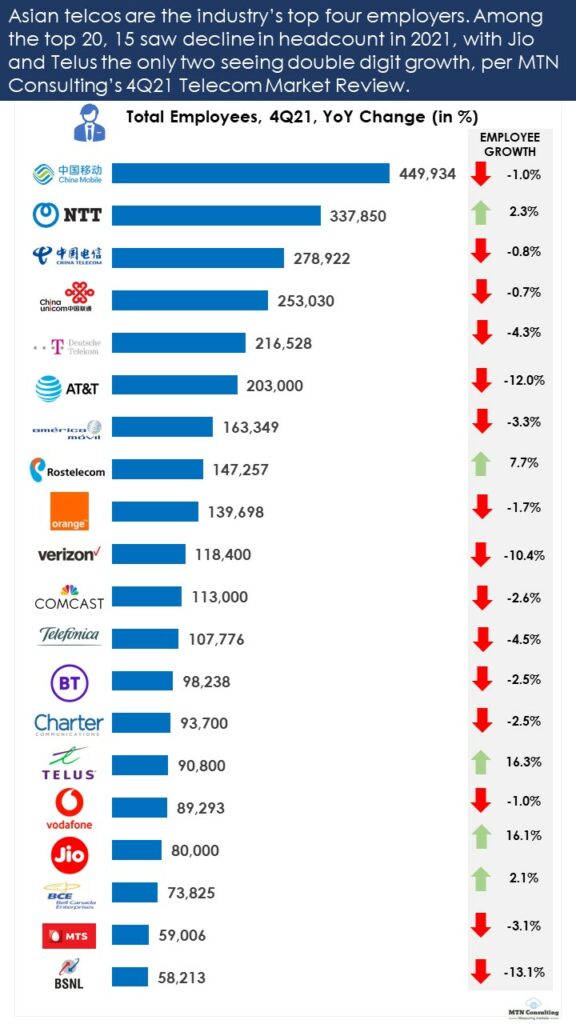
Headcount is falling. As MTN Consulting detailed in its 4Q21 market review for the telco sector, headcount in the telco industry continued to fall last year. Total employees dropped 2% in 2021, to 4.69 million. Only 5 of the top 20 telcos increased headcount in 2021. The 2021 decline follows a much worse 3.7% drop for the industry in 2020, when COVID forced cutbacks, office closures and acceleration of timelines for digital transformation and automation programs. Prior to COVID, telcos were already in staff-cutting mode, but COVID sped up the process. Looking down the road a bit, telco headcount should fall to ~4.4M by 2026. Figure 1 illustrates changes in 2021 for the top 20 telco employers.

Figure 1: Total employees and YoY % change of top 20 telcos, 2021
Source: MTN Consulting

Labor cost per employee is rising. Amidst this drop in headcount, average labor costs have been rising. From $49.2K in 2017, the average telco employee in 2021 cost $57.6K, or 17% more. Prior to 2018, labor costs per employee were flat for most of the last decade, hovering around US$50K per employee. The inflationary pressures of late 2021 may have played a small role, but more important is the changing nature of a telco. With deployment of software-based platforms in the network, and digitization of a whole range of processes across the company, a different type of employee is required. Some may be younger, but their skills are in demand and can be costly. There is rising competition for these employee types, including from cloud providers like GCP and AWS.

Labor costs a large part of opex. The rising cost per employee is interesting, but even more important may be labor cost’s contribution to opex. As a percentage of opex, excluding the non-cash items of depreciation & amortization, labor costs can exceed 30%. That was the case for a number of large telcos in 2021, including BCE (labor costs equal to 32.6% of opex ex-D&A), BT (31.7%), KPN (30.8%), Swisscom (39.8%), and Telecom Italia (35.9%). Some of these companies face constraints in how they structure their workforce, for instance, union rules limiting layoffs or locking in salary increases. On average, labor costs account for about 22% of opex ex-D&A.

The labor cost burden isn’t equal across markets. Telcos across the globe face similar price levels for their technology inputs. Prices vary somewhat, of course, but the variation is rarely on the order of 3-5x. More important is the variation in technology choices made across different markets, and the way they finance capex. For labor costs, though, the variation in the cost of an employee can be huge. Labor markets are highly localized, even with a more remote/hybrid workforce than in the past. The average employee at UAE-based Du, for instance, cost US$199.8K in 2021, nearly 6x that of another UAE-based telco, Etisalat ($34.0K). The reason for that is most of Etisalat’s workforce is in lower cost countries such as Pakistan, Egypt, and Morocco, whereas Du operates solely out of high-cost UAE.

Telcos investing in upskilling. As telcos deploy more software in their networks and digitally transform all aspects of their operations (including sales & customer support), many are investing heavily in upskilling their employee base. Vodafone, for instance, says “the transformation into a new generation connectivity and digital services provider requires new skills and capabilities in our organization, such as software engineering, automation and data analysis.” Vodafone invested an average of 470 Euros in FY2021 on “training each employee to build future capabilities.” Similar things are occurring at many other telcos, including Deutsche Telekom, which is investing in “upskilling and reskilling programs with a focus on digital skills”. There is also a growing focus on hiring younger employees with skills more appropriate to the digital age.

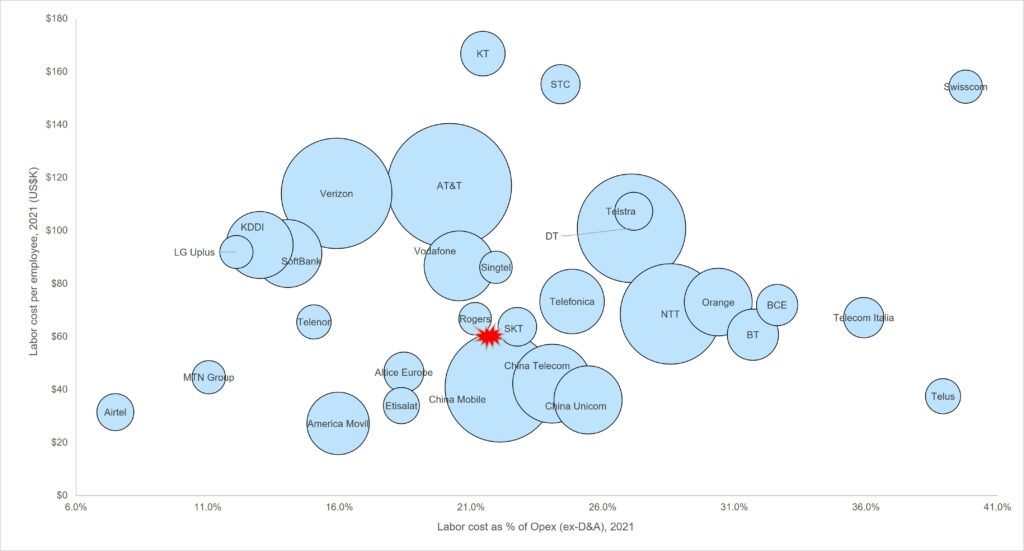
Propensity to adopt automation varies widely. Vendors talk a lot about how their solutions allow customers to do more with less: automate tasks and processes which previously required manual intervention. This has always been a part of the telecom industry, from the days when telcos migrated away from manual telephone switchboards. It continues to be important as telcos aim to lower their cost of operations, deploy services more rapidly, and maintain network quality. The importance of automation varies widely across country and operator, however. Companies which face high unit labor costs tend to be more eager to adopt automation, all else equal. When labor costs are a relatively high portion of overall opex, that eagerness multiplies. Figure 2 below illustrates the issue.

Figure 2: Labor cost burden variation across 30 large telcos, 2021
Source: MTN Consulting
Notes: Size of bubble is indicator of relative revenues. Red star icon represents the global average. 

For 30 large telcos, the above figure shows labor cost as a % of opex (ex-D&A) on the x-axis, and labor cost per employee on the y-axis. The companies in the top right quadrant tend to be more open to automation, while the bottom left (low labor costs) are the opposite. Swisscom is a bit of an outlier, as its labor costs are so high. That’s a reason for Swisscom’s adoption of Red Hat’s Ansible Automation Platform in 2018, for instance. Other big telcos with an economic inclination to automate include: Telefonica, DT, Telstra, NTT, Orange, BT, BCE, and Telecom Italia.

One thing that telcos won’t be automating anytime soon is the CEO. The top few managers in many leading telcos continue to earn millions of US$ per year, and there often seems to be little relationship between these sky-high pay packages and the company’s performance. Light Reading detailed this situation recently in an insightful article. LR notes that the ratio of CEOs’ pay packages with the median employee in 2021 was 312:1 for T-Mobile, 231:1 for AT&T, 166:1 for Verizon, and 106:1 for Telefonica. Swisscom’s CEO Urs Schaeppi had to make do with a relatively paltry margin of 14:1.

*

Cover image credit: Scott Webb on Unsplash

Blog Details

Operators feel the pinch of rising labor costs

Global telecom operators are facing a cost crunch. Based on MTN Consulting’s analysis, annualized operating profit margins have fallen for five straight quarters, from 13.7% in 2Q17 to 12.7% in 3Q18. This profit dip comes during strong economic times; a recession would make this far worse. Further, telcos need cash to fund their 5G migrations and to pursue M&A opportunities. As the pressure to improve profitability rises, telcos are looking to reduce their labor costs.

Labor costs average over 15% of revenues

For the 12 months ended Sept. 2018, telecom network operator (TNO) capex was $304B, or 16.5% of revenues. This is the single biggest component of costs for most TNOs. Labor costs come in a bit lower at 15.3% of revenues, based on an MTN Consulting analysis of 40 large operators. As TNOs reshape their workforces to meet new requirements – hiring software developers, retaining fewer field engineers – they are getting serious about managing their labor costs more smartly.

Across the globe, TNOs pursue a wide range of business strategies and face a range of relative input costs. Labor costs vary widely as a share of total. Generally, the higher the GDP per capita, the more salient is the issue of labor costs. Also, fixed operators tend to have more employees per subscriber, or per dollar of revenue, than their mobile counterparts. As Figure 1 below shows, mobile operators in emerging markets have the lowest labor cost burdens, in general: Bharti Airtel, Idea Cellular, the MTN Group, Axiata.


*BSNL and MTNL are not shown

Every rule has exceptions, though. Japan-based KDDI, an integrated (fixed-mobile) TNO in a high-income market, reports labor costs totalling just 8% of revenues. In this case, KDDI has abnormally high non-staff costs, in particular sales commission costs and handset expenses: these two totalled $11.7B in FY2018, about 3x the level of staff costs ($3.8B).

Labor cost pressures are rising

Our analysis of 2011-17 finds that many telecom operators are already struggling with labor costs. Some operators, such as BSNL and MTNL (not shown in figure), face labor costs in excess of 50% of revenues. These two operators represent an extreme example of a problem many other TNOs face: laws and union agreements restricting their hiring and firing. These are good things for social welfare, but do pose challenges for telcos facing competitors with more nimble workforces. More commonly, TNO labor costs are in the 10-20% range of revenues. When measured on a per-employee basis, the global average for labor costs in 3Q18 was $57,800 per year, slightly up from the year earlier.

Some of the reasons behind recent TNO labor cost growth include: surge in wages or headcount, rise in pension costs, and in some cases, inflationary pressures.

To substantiate this point, let’s look at the recent labor cost data for a few sample telcos:

  • China Mobile and China Unicom saw a drop in their headcount but their labor costs for 2017 surged by 5% and 12%, respectively. The surge could be attributable to the operators’ strategy to boost the sales and productivity of their broadband business and the consequent increase in compensation of its front-line staff.
  • Despite a 3% drop in headcount, labor costs for Canada-based Rogers increased by 4%. This increase was due to high salaries and pensions paid to the players of Toronto Blue Jays (Canada’s only Major League Baseball team owned by Rogers) and higher TSC merchandise costs. Likewise, BCE’s labor cost was up 5% YoY as its headcount increased by 7% – post the integration of MTS employees.
  • SK Telecom’s labor cost was up 8% YoY in 2017; however, this arose from SKTs formation of a newly formed subsidiary “Home & Service”, in effect insourcing a service which was earlier outsourced to third party vendors. Behind the 8% cost increase is an 18.4% increase in headcount.

Telcos often rely on early retirement plans or come up with outsourcing options to save on their labor costs. Here are recent developments at a few large telcos that exemplify this:

  • In the case of Deutsche Telekom, it introduced an early retirement plan in 2017 for its civil servants which resulted in a 4% YoY decline in its labor costs, compared to revenues, which grew 4.6%” in 2017.
  • In September 2018, Verizon offered a voluntary severance package (VSP) to about 44,000 employees – and it also struck a $700 Mn deal with India based Infosys to outsource over 2,500 IT staff or more.
  • Loss making Indian PSUs –BSNL and MTNL – spent close to 56% and 94% of their revenue toward labor costs in 2017. Contrary to other private players such as Airtel and Idea – which spent only 5% and 6% of its revenues towards staff costs. BSNL and MTNL have a headcount of 185,000 and 25,000, respectively, which makes cutting staff a pressing need for these operators. Both companies have had to resort to voluntary retirement scheme (VRS) to achieve a break-even point. A VRS scheme for MTNL was always on the cards, especially with its huge debt burden (INR170 Bn, approx. US$2.5B).

Automation leading to fewer jobs in Europe

Telecom operators are increasingly using automation, artificial intelligence (AI), and a range of other technologies to drive efficiency gains. Recent trends suggest that most operators headquartered in Europe are either on a hiring freeze or on a lay-off spree (figure, below).

The below developments at some of the leading European telcos exemplify this trend.

  • Telecom Italia reduced its headcount by 1,800 in 2017 – about 3% of its total employees. The operator further plans to downsize its staff by 4,500. Technology investments will make this possible. Under a new plan named ‘DigiTIM’ – Telecom Italia aims to reduce human-operated interactions” by 30% and get 85% of its customers to use self-care apps. It also partnered with Microsoft to use its AI technology to develop chatbots.
  • Similarly, Telefonica reduced its headcount by 5.1% in 2017, as it launched its own AI-powered digital assistant ‘Aura’ to improve customer service. This was accompanied by an 8% drop in the average labor cost per employee, to $62,075.
  • Deutsche Telekom (DT) also plans to restructure its staff and prioritize automation and digitalisation. The company claims these investments will lead to a 1.5B Euros annual reduction in annual “indirect costs.


However, the telco job market is not all about managing decline. Many operators are employing automation and digitalisation and retraining and reskilling their workforce at the same time. 1According to Ernst & Young’s 2018 Global Capital Confidence Barometer, about 57% of the surveyed executives see AI and automation as the most prominent technologies on their boardroom agenda.

Rising M&A, shrinking employee numbers

M&A activity is a part of life for telecom network operators. While many large deals have already been closed in recent years, M&A will continue to reshape the market, blurring the lines between TNOs, webscale, carrier-neutral, media, and other network operators. Given competitive pressures and the need to improve margins, we expect M&A in telecom to remain vigorous. According to Ernst & Young’s 2018 Global Capital Confidence Barometer, there is an increased appetite for M&A in the near term, with 59% of interviewed telecom executives intending to pursue M&A in the next 12 months.

Acquisitions can have a big impact on the average cost of the TNO employee. When BT acquired EE, its average employee costs dropped dramatically. Acquisitions of cable or other fixed operators by mobile TNOs, by contrast, tend to drive labor costs upwards.

M&A deals often result in workforce redundancies as there is a natural overlap of jobs. For example, AT&T has a long history of cutting jobs as part of its M&A evolution. Post its DirecTV acquisition in 2015, AT&T’s headcount reduced from 281,450 in 2015 to 254,000 in 2017. Though no major restructuring has been announced so far, AT&T’s plans to build its own 5G network and its recent purchase of Time Warner could mean that AT&T employees will soon feel the heat.

CenturyLink is following a similar path – as it confirms reduction of 2% of its headcount post its acquisition of Level 3 Communications. In May 2018, CenturyLink’s spokesman Mark Molzen said that

“The combination of two large companies also creates redundant positions that must be addressed to remain competitive. In addition, as part of our ongoing efforts to deliver high levels of customer service, we are implementing best practices and increasing automation. As a result of these two factors, we are reducing our workforce by approximately 2 percent.” 

The largest labor union in the US telecom sector, Communications Workers of America (CWA), estimates that the much-awaited merger of T-Mobile and Sprint could potentially result in huge headcount reductions – about 28,000 jobs. The CWA estimate conflicts with official company estimates, which – perhaps not surprisingly – claim the merger would create new jobs.  This conflict will continue.

In India, the telecom labor market is in a gloomy state as consolidation has become the norm and job losses are mounting. As per a report published by CIEL HR Service, job losses could reach up to 90,000 by 2018. The recent Vodafone and Idea merger, which already cut 5,000 employees, could lay off 2,500 more people in the next few months, as part of realizing its targeted $10 billion “synergy benefits” from the merger. Similarly, post Airtel’s merger with Telenor India, Airtel said only 50% of the latter’s employees would still be employed by the merged entity.

As top-line growth remains low, and new capex requirements are on the way, operators are compelled to reduce their labor costs. To achieve this, we expect telcos to use the tools of both AI and M&A.

————

References:
1 EY Telecommunications Global Capital Confidence Barometer

Cover image: Shutterstock