
Blog Details

Big telco merger in Canada comes as industry capex poised for uptick in 2021

Telcos choose M&A to cope with weak revenues and new capex needs: surprise?

Rogers to buy Shaw, leaving Canada with 3 big telco groups

Earlier this week, Canadians woke up to a shock: Rogers Communications agreed to buy Shaw Communications, for US$21 billion (including assumed debt).

Rogers is Canada’s second largest telco, with a mix of wireless (61%), cable (28%), and media (11%) revenues. Among its media holdings is the Toronto Blue Jays, a baseball team. Shaw is Canada’s fourth largest telco, with just 22% of revenues coming from wireless (largely through the 2016 acquisition of Freedom Mobile), 68% in wireline consumer, and 10% wireline business. Shaw’s “wireline” revenues are delivered primarily over a cable TV network, complemented by satellite. 

Rogers-Shaw would be a big deal in any market, but adjusted for Canada’s relatively small market, it is immense. A deal of similar magnitude in the US market, 8.3 times the size of Canada (based on 2019 telco revenues), would be $174 billion. For context, three of the largest recent US telco mergers were far smaller: AT&T-Time Warner in 2016 ($85.4B, 2016); AT&T-DirecTV in 2014 ($67B); and, T-Mobile-Sprint in 2020 ($26.5B). 

The figure below shows 2019 revenues for Canada’s top telco groups, per MTN Consulting stats.
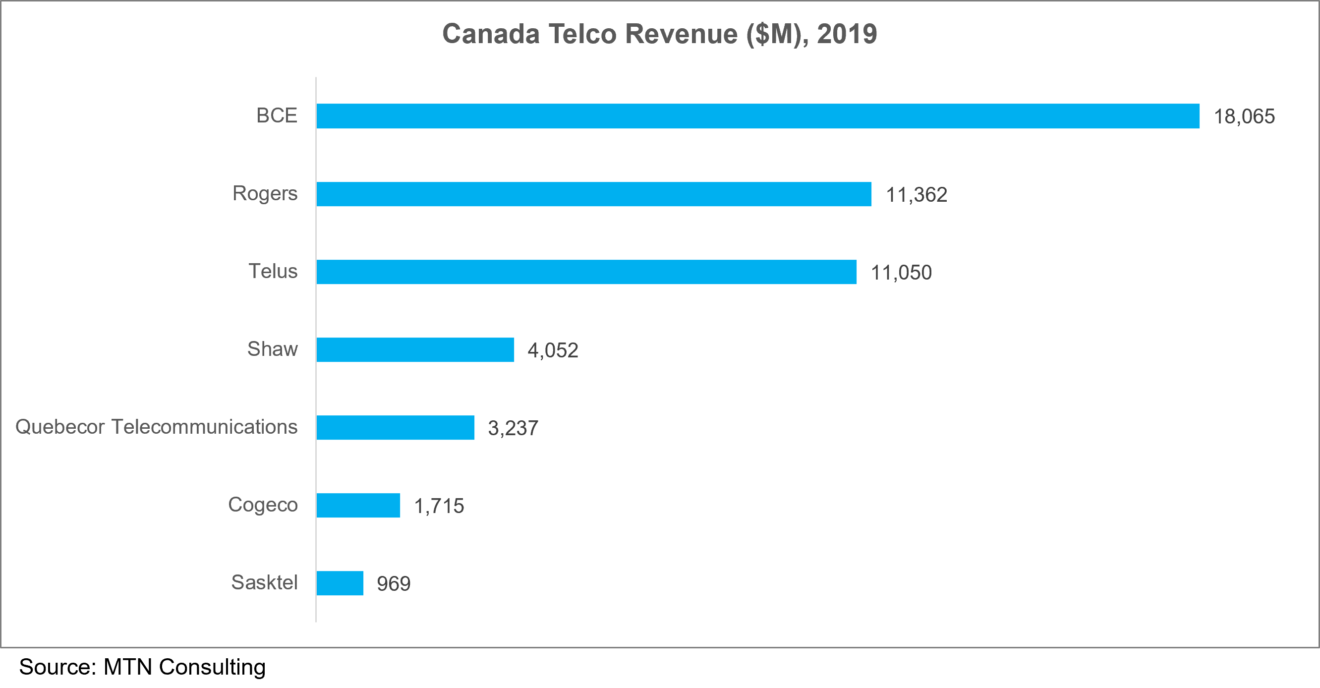
canada telco revenue

While many analysts are shocked at the deal, it’s almost a surprise that it took so long to happen. Many markets larger than Canada have consolidated around three large national telco groups. For countries like the US and Canada, with a viable cable TV sector, that consolidation has taken longer. But assuming that all three are national competitors across wireline and wireless, the number three doesn’t appear unreasonable on its face. That’s especially true as telcos struggle with both flat revenues and growing competition from the cloud/webscale sector.

5G isn’t cheap

What’s worth looking at it is, why is such a deal taking place now?

One obvious answer is the turmoil caused by COVID-19. Like telcos elsewhere, those in Canada saw revenue declines in 2020. Annualized telco revenues began falling for the Canadian telco market in 2Q19, however, and the declines seen in 2020 were in the same ballpark.

Margins aren’t an obvious issue, either. For Rogers, margins have held steady, with EBITDA margin improving in 2020 vs 2019 for both its wireless and cable units (media dropped slightly). Shaw’s most recent quarter, ended November 2020, saw company EBITDA margins up to 44.3% from 42.5% in the quarter ended November 2019.

The more likely answer is the need to ramp up 5G networks and roll out services. And that is exactly what Rogers’ CEO argued in the analyst conference:

“Without question, the deal will accelerate deployment of 5G around the country and will assure competition and capital continue to be prioritized and reinvested in new technologies at home here in Canada and especially in Western Canada…Today, both companies invest $3.7 billion annually in CapEx. And the underlying investment in 5G inherent in this total will only go up as 5G technologies continue to roll out across the country. This is a big task for both companies. And when combined, both companies are up for the challenge.”

This statement came along with a specific commitment to invest C$2.5B “to build 5G networks in Western Canada,” and C$1B for the creation of a “Rural and Indigenous Connectivity Fund.” 

Rogers says it expects up to C$1B in cost synergies, a mix of opex and capex, but says that most of the capex savings will be put back into the network: “more fiber, more connectivity, more rural connectivity and a few other programs related to the network,” per the CFO. The opex part is significant. New service platforms can require huge investments in expense categories like sales & marketing, among others, something which a combined Rogers-Shaw may be better able to cope with.

Beyond Canada

MTN Consulting expects global telco capex to rise slightly this year, from approximately $280 billion in 2020 to $292B in 2021. This modest growth is consistent across regions, as shown in the figure below from our latest capex forecast.
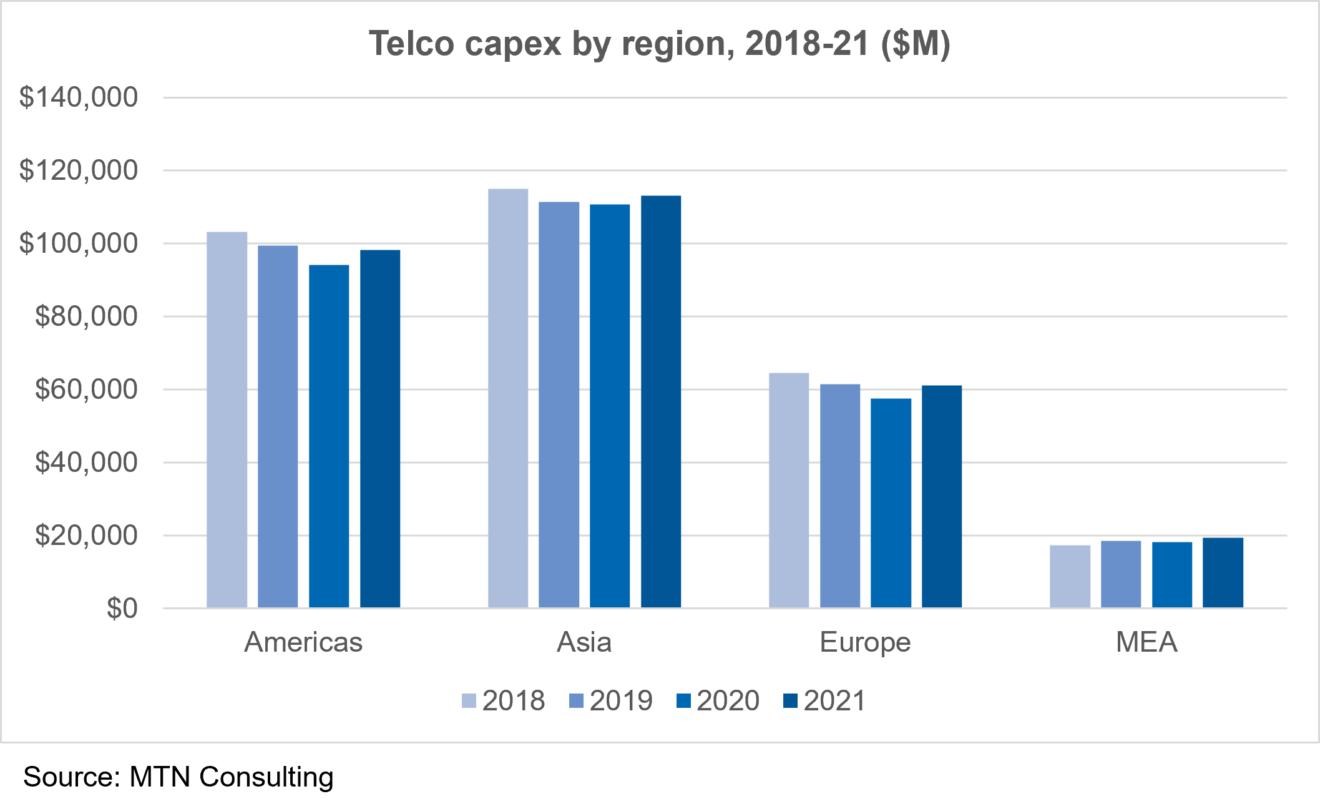
telco capex by region

In Canada, capex has been on the decline, from US$13.9B in 2018 to $13.8B in 2019 to $12.6B for the 12 months ended September 2020. Canadian telcos, however, are just beginning to deploy 5G – the bulk of the work is in the future, with many key vendor awards just concluded in mid-2020. Like the global market, Canada can expect a capex uptick in the next couple of years, albeit a modest one. Market leader BCE, for instance, has pledged to spend an extra C$1B to C$1.2B in 2021-22, with most (C$700M) in 2021; roughly 2/3 of the spending increase is for wireline, 1/3 for wireless. The second largest player, Telus, has projected 2021 capex to be flat with 2020; whether Telus is forced to increase in response to a faster rollout by others, though, is a real possibility.

What about other markets? What do 4Q20 earnings reports from key telcos suggest is on the way in 2021 and 2022 with regards to capex? Below are a few highlights:

  • America Movil: 2021 capex in line with 2020 at around US$8B
  • Charter: 2021 capex to be consistent as a percentage of revenue with 2020
  • China Telecom: 87B RMB in capex, from 85B in 2020, much lower spend on 4G, higher spend on “industrial digitization” 
  • China Unicom: 2021 capex of 70B RMB flat with 2020, 5G still roughly half of total in both years.
  • Comcast: “we are confident in our ability to increase profitability, expand margins and improve [i.e. reduce] CapEx intensity both in 2021 and thereafter”
  • DT: cash capex excluding spectrum is “expected to amount to around EUR 18.4 billion in 2021 and to remain stable in 2022. We want to continue investing heavily in building out our network infrastructure in Germany, the United States, and Europe in order to safeguard our technology leadership in the long term.”
  • Etisalat: capital intensity in 2021 of 16-18%, from 13.7% in 2020 due largely to 5G spend.
  • KPN: forecasts 1.2B Euros in capex for 2021, up from 1.1B, as it expects “another step-up in fiber CapEx to roll out or ramp up further to approximately 500,000 households.”
  • KT: 2021 capex likely flat but a much different mix, with more digital, AI and cloud focus.
  • STC: “expecting a slight decline” in capex for 2021 despite investing heavily in 5G expansion
  • Swisscom: “CapEx outlook is at around CHF 2.3 billion for the group, of which Switzerland a bit more than CHF 1.6 billion. We expect the CapEx slightly higher because of the FTTH rollout, and Fastweb steady at EUR 0.6 billion.”
  • Tele2: 2020 capex of 2.7B SEK was up from 2.4B in 2019; capex will grow to 2.8-3.3B range in 2021 due to 5G rollout. But company says “expect capex to be at low levels compared to peers even during the roll-out of 5G and Remote-PHY”
  • Telefonica: after capex declines in 2020, “CapEx to sales will trend back to normalized pre-COVID level, up to 15% of sales”
  • Turkcell: “We will continue to invest our infrastructure at around 20% of sales, driven mainly by capacity and software investment upgrades as well as expansion of fiber infrastructure.”
  • Veon: increased capex from $1.74B in 2019 to $1.9B in 2020 and expects a similar level for 2021 and 2022.
  • Verizon: capex of $17.5-18.5B in 2021, from $18.2B in 2020; focus on “further expansion of our 5G Ultra-Wideband network in new and existing markets”

As shown above, most telcos suggest capex in 2021 will be roughly flat, either on an absolute basis or capex/revenue basis. Nowadays few telcos want to boast of high spending to shareholders. However, quite a few telcos do expect capex growth over the next year or two. Not exactly a surge of spending, but on net consistent with MTN Consulting’s forecast of a slight uptick in the market.

On the supply side there will be significant change underway over the next two years, with Huawei taking more of a backseat. Some telcos worry that this may leave them paying too much for their network infrastructure, due to weaker supply side competition. Telcos will hedge their bets by ramping up collaboration with webscalers when possible, and continuing to explore open networking and network disaggregation. 
Blog Details

Cell tower companies pondering what to be when they grow up

Cellnex steps into fiber and data center infrastructure through new joint venture with DT

Europe’s largest cell tower specialist, Cellnex, is creating a joint venture with DT in the Netherlands for the two parties’ tower assets. DT’s contribution is its 3,150 Dutch towers while Cellnex adds another 984. The combined entity will be known as Cellnex Netherlands BV, or Cellnex NL. T-Mobile Netherlands will have access to Cellnex NL’s sites through a long-term lease-back arrangement.

Small deal with a twist

This is a small deal, relative to Cellnex’s size. Cellnex ended 3Q20 with 50,185 tower sites under its management, and is in the process of acquiring 24,500 European towers from CK Hutchison. However, there is a twist that makes the deal more significant. Cellnex and DT are also creating a new, independently managed fund called “Digital Infrastructure Vehicle” (DIV), whose aim is to invest in fiber networks, cell towers, and data centers across Europe.

DIV’s initial owners are Cellnex and DT, with exact ownership stakes unclear from public reports. DIV will be led by the DT side: Vicente Vento, co-founder of Deutsche Telekom Capital Partners. DIV is likely to pursue third party investments to help it grow, most likely through acquisition of existing properties across Europe. DT’s CEO Tim Hottges says that DIV’s goal is to “identify and promote exceptional digital infrastructure projects in partnership with Europe’s leading telecommunications group and the leading tower company”, and that is has an existing pipeline of projects under consideration.

Cellnex deal raises business model questions

At MTN Consulting, we classify Cellnex as a carrier-neutral network operator (CNNO), specialized in owning and selling access to network assets on a neutral basis to multiple service providers. Most CNNOs specialize in either towers, fiber, or data center assets. However, over the years there has been some blending across the infrastructure types, especially towers and fiber. Most of that has been via acquisition, as for example Crown Castle’s $7.1B acquisition of Lightower in 2017. Tower companies have also been branching into small cell development through organic investments, and building fiber out to the small cell and between their tower assets. Some data center specialists have also invested in high-capacity fiber routes linking their facilities, for instance Equinix.

The Cellnex deal with DT raises questions about what extent CNNOs should own assets across the tower/fiber/data center boundaries. The traditional CNNO business model is to function similar to a real estate holding company. CNNOs spend most of their capex on property investments, not network equipment. They generally function as wholesalers of simple network services (e.g. space on a tower, a colocation cage, dark fiber) to other providers who have their own end user customer base. Telcos are going through massive adjustments, though, looking to raise cash and simplify their own business models. That may involve spinning off more of their passive network assets, and also creating investment vehicles like DIV to attempt to profit from the growth of this adjacent market.

Our forecast for CNNO expansion: capex and M&A equally important

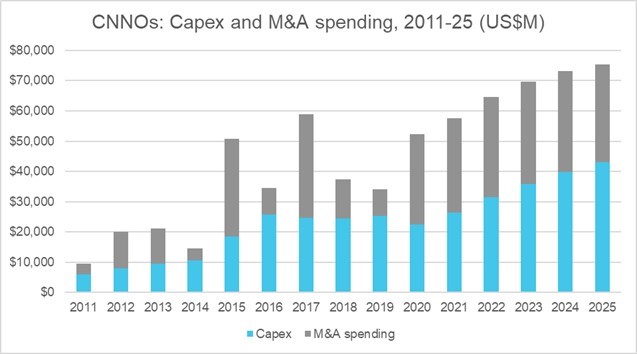
As explained in our recently published network operator capex forecast, MTN Consulting expects the CNNO sector to grow its asset base over the next several years as it has historically: through a blend of high capex and acquisition of both small existing CNNOs and assets from other sectors.

Over the 2011-19 period, CNNO capex totaled $152.9B, while M&A spend was $127.7B. For the 2019-25 period, we expect capex to again outpace M&A but not by much: 2020-25 capex is projected to total $199B, with M&A spend amounting to $194B (figure, below). 

CNNO capex

Source: MTN Consulting

We expect capital intensity to come in at the relatively low rate of 30% in 2020, rising gradually to 40% by 2025 as CNNOs find fewer big M&A opportunities for expansion. M&A starts out high (40% of revenues in 2020) and scales back gradually to 30% of revenues by 2025. In reality, both data series will be much choppier this, especially M&A because of the nature of big deals.

As a result of all this investment, we expect the asset base of all segments within CNNO to grow considerably: 

  • Data centers: From 635 data centers and approximately 56 million net rentable square feet in 2019, the DC segment will reach 727 data centers and 73.3M NRSF by 2025. Historically the average NRSF per data center has been declining but we expect this to reverse as CNNOs invest in higher power, larger footprint designs leveraging some of the efficiencies gained by the webscale sector. NRSF per facility was 88K in 2019, but is likely to grow to 101K by 2025.
  • Towers: In 2019, there were roughly 2.5M towers within this segment, of which just under 2 million (or 80% of total) were managed by a single company, China Tower. We expect the tower segment to reach 3.1M total towers by 2025, and China’s share to decline slightly to 78%. The average global tenancy ratio will rise incrementally, from 1.62 in 2019 to 1.68 in 2025. That’s driven by tenancy improvements in China, primarily, which currently has a lower tenancy rate than seen elsewhere.
  • Fiber/bandwidth: measured in fiber route miles, the footprint of this segment more than tripled between 2011 and 2019, reaching 553K. By 2025, we expect fiber route mileage for this sector to grow to just under 880K.

The Cellnex-DT deal makes clear that some CNNOs are eager to own assets across these three segments. 

American Tower’s acquisition of Telefonica-linked tower business reinforces tower specialization

 Specializing in just one type of infrastructure will continue to be preferred by a number of large CNNOs.

On January 13, a week before the Cellnex-DT deal, Telefonica announced a sale of most of its tower infrastructure to American Tower, for 7.7 billion Euros, in cash. Specifically, AT is acquiring the Latin American and European tower assets held by Telxius, an arms-length infrastructure affiliate of Telefonica. Telxius is 50.01% owned by Telefonica, 40% by KKR (a private equity group), and 9.99% by Pontegadea, the personal investment vehicle of founder of the Zara fashion group, Amancio Ortega. Notably, American Tower is not acquiring the submarine assets also owned by Telxius, for which Telefonica is seeking a separate buyer.

Cellnex was apparently in the running to acquire the Telefonica assets, but got outbid by American Tower. That may be a blessing in disguise considering Cellnex is already in the process of acquiring 24,500 towers from CK Hutchison in Europe.

Despite the name, American Tower is already a global provider. As of 3Q20, only 41,000 of its 181,000 wireless properties were in the US market. However, Europe only accounted for 3% of AT properties; the Telxius deal will raise that significantly, and help position AT as a rival to Cellnex, at least in Spain and Germany. AT already has a big Latin American presence, with over 40,000 towers there at 3Q20’s end. In total, AT is acquiring 30,722 towers from Telxius, adding over 17% to AT’s global tower count.

Cellnex’s new infrastructure JV with DT, the Digital Infrastructure Vehicle (DIV), represents a tower CNNO venturing into fiber and data centers, albeit indirectly. American Tower’s acquisition of Telxius towers represents a more traditional deal: a tower specialist getting bigger, expanding its share of multiple geographic markets. American Tower does have some fiber assets but in general the company has avoided expansion into other types of infrastructure.

AT’s preference has some support in the investment community. Elliot Management lobbied last summer against Crown Castle’s choice to spend so heavily on its fiber business, for instance. Similarly, a well known financial analyst in the tower space, Jonathan Lawrence with Pinpoint Capital Advisors, recently argued that “You don’t want to detract from your core tower business. New business offerings such as fiber or data centers, where we have started to see tower companies invest, take significant expertise and resources to manage effectively.”

MTN Consulting expects there to be more than one approach to this issue. There are some clear synergies to owning both towers and fiber assets, or data centers and fiber. The assets have to be priced right to make entry into the adjacent market worthwhile, first and foremost, as the CNNO market is a relatively low margin business. 

Telco turmoil creates opportunities for CNNOs to grow

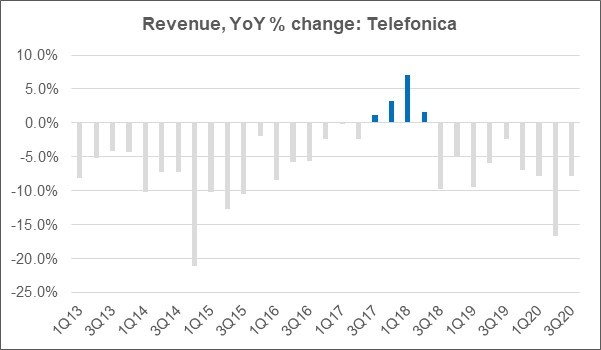
From the telco side, Telefonica’s decision to sell Telxius assets reflects the parent company’s ongoing financial challenges. A weak top line is the starting point: Telefonica’s revenues have been on the decline since 2018 (figure, below).

telefonica revenue1

Source: MTN Consulting

Telefonica ended 3Q20 with 52.5 Billion Euros in debt (financial liabilities), with only 5.9B of cash on hand. The fact that the 7.7B Euro deal with AT is all-cash is a big plus for the company. It may also help Telefonica justify a more liberal capex budget as it continues with 5G buildouts and participates in 5G-related spectrum auctions this year, including in the UK. For the first 9 months of 2020, Telefonica spent 4.1B on capex (excluding spectrum), from 5.2B in the same period in 2019.

It’s notable that Telefonica is among the most aggressive telcos in its embrace of open RAN and open networking in general. Telefonica has also been especially active in its collaboration with the webscale sector, establishing cloud partnerships with GCP (2020; 5G mobile edge computing), Azure (2019; service design), and AWS (2018; digital transformation). Eagerness to work with webscale operators and an open approach to network disaggregation are hallmarks of the more capex-constrained telcos.

Blog Details

Post-pandemic chip M&A splurge targets the data center market; room for more consolidation in 2021

After a prolonged hiatus, M&A activity in the semiconductor landscape ramped up significantly this year, nearing the record levels of 2015. The consolidation surge was particularly notable during the second half of 2020. These deals targeted many end use markets but the common thread is the cloud data center market: remote work and study amid the COVID-19 pandemic has spiked demand for cloud-based tools and services. The dealmaking is not yet done. Next year is likely to witness more consolidation among chipmakers, despite geopolitical tensions between the US and China and stringent regulatory scrutiny serving as impediments to deal completion.

Flurry of chip deals bring cheers to an otherwise muted first half

Chip M&A activity had a quiet first half of the year, as COVID-19 created high levels of uncertainty and steep drops in GDP. Stock markets settled in 2H20, though, and big companies found ways to operate amidst a pandemic. COVID-19 remains a severe problem for many major economies, but improved business sentiment and a gradual economic recovery have fostered a strong climate for M&A.

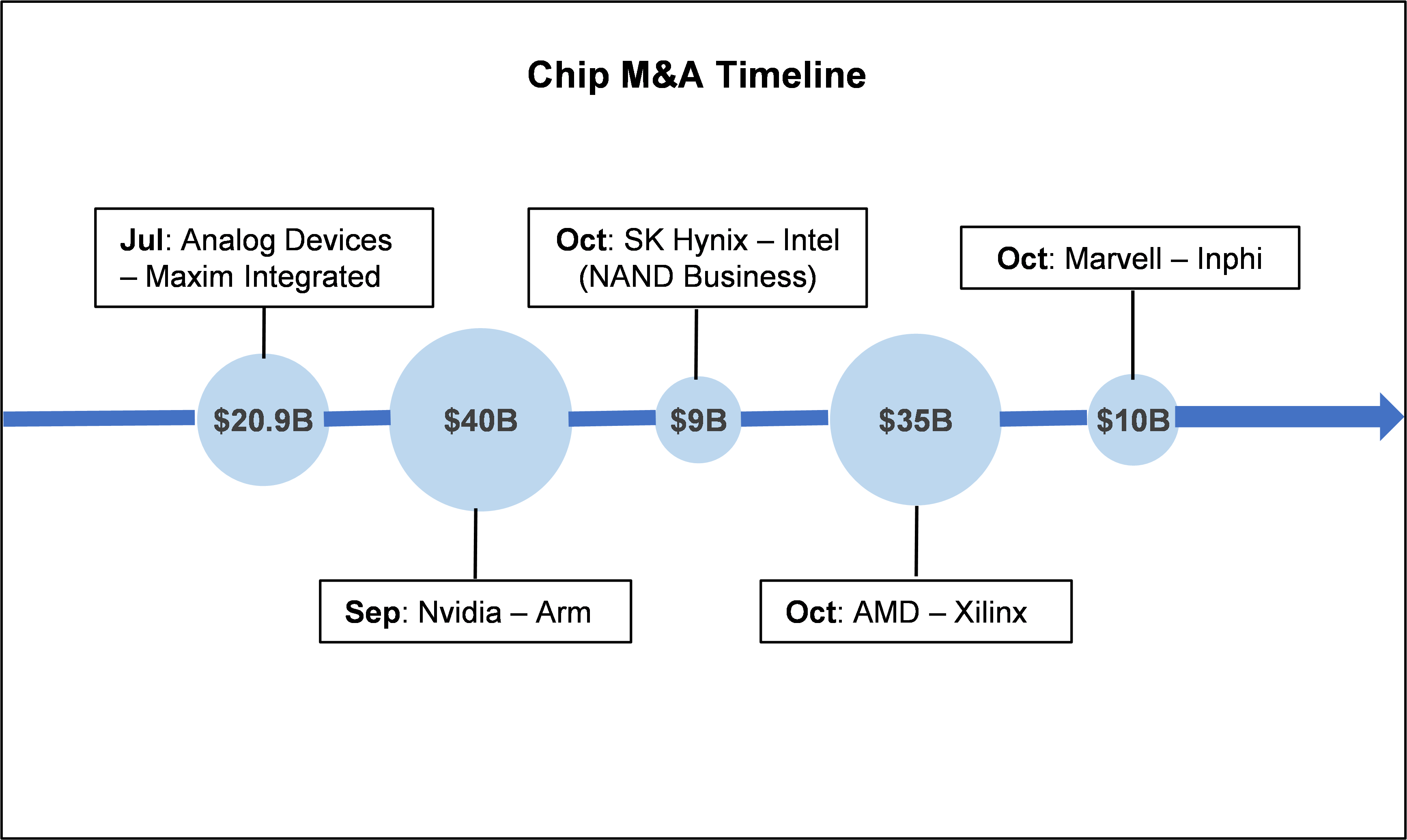
With year-to-date announced deals already topping $100B in value, 2020 is turning out to be a blockbuster year for chip M&A. The mega-deal kickstart to the chip M&A frenzy was Analog Devices’ $20.9B acquisition of rival chipmaker Maxim Integrated Products in July 2020. This was followed by Nvidia’s acquisition of chip design house Arm for $40B in September 2020, the year’s biggest deal so far. The month of October saw a string of M&A agreements featuring the $9B acquisition of Intel’s NAND SSD business by SK Hynix, AMD’s $35B deal to acquire Xilinx, and Marvell’s $10B acquisition of Inphi.

Figure 1: Timeline of semiconductor M&A in 2H20

Source: MTN Consulting

Chipmakers aim at the lucrative cloud data center market

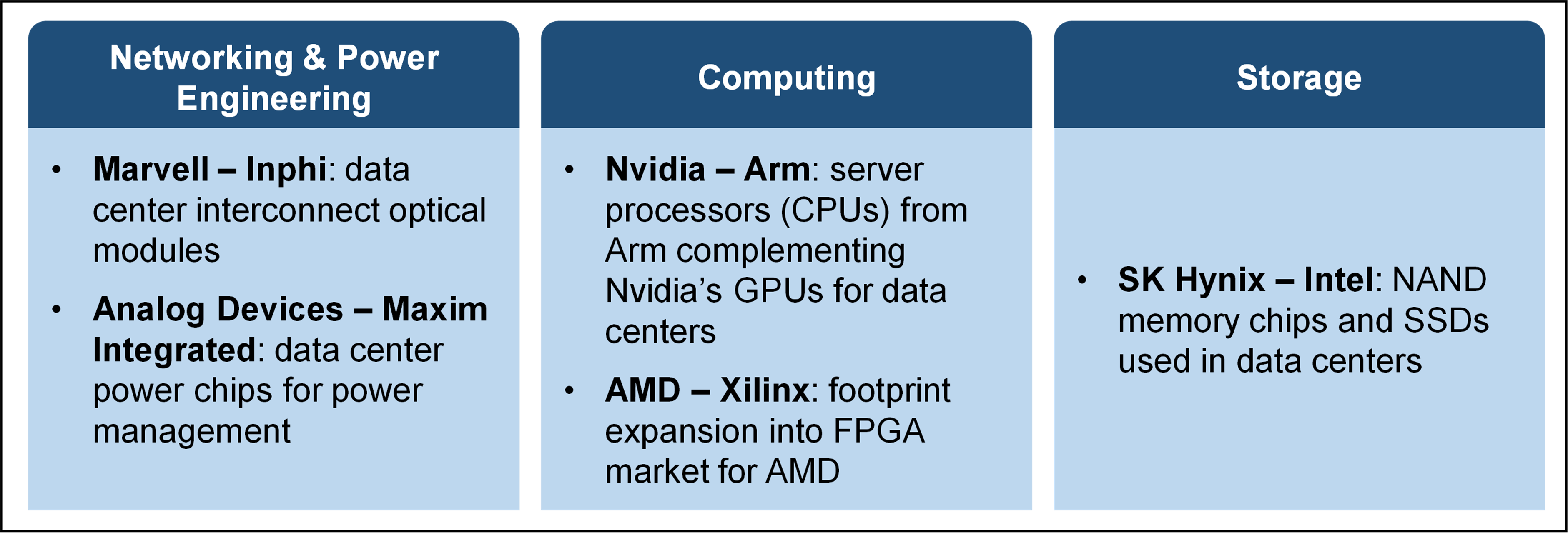
None of the big chip deals are focused narrowly on a single end market, but one key market is of common interest to all – the cloud data center. The deals differ from each other in terms of sub-market focus, though, stretching from power engineering and networking, to computing and storage – see Figure 2 below:

Figure 2: Data center aspects of 2020’s big chip M&A transactions

Source: MTN Consulting

Networking & Power Engineering

Networking and power management form the vital foundation of any data center infrastructure. Optical modules help connect not just the server racks inside data centers but also the data centers to one another across different locations. With the acquisition of Inphi, Marvell aims to target this space by providing interconnect solutions that enable seamless and speedy movement of data between and inside data centers.

Chips for power management have grown in significance over the years to control the biggest expense of running a data center, i.e. power utility costs. Analog Devices is seeking to address this issue through Maxim Integrated’s data center power chips, which also permit greater computational capability to data center operators.

Computing

Data centers typically house thousands of servers that process and run applications along with high performance computing (HPC) workloads. The processing and computational tasks are carried out by server processor chips that come in various forms: CPU, GPU, FPGA (field-programmable gate array), and ASIC (application-specific integrated circuit). Intel, AMD, Nvidia, Xilinx, and Infineon are some of the leading server processor vendors developing either one or most of the chip types.

The acquisitions announced by AMD and Nvidia relate to expansion into new server chip types, and also rivaling Intel as a more formidable force. AMD is looking to dent Intel’s customer base with the acquisition of Xilinx. The FPGA pioneer Xilinx had earlier managed to end Intel’s exclusivity with some its customers such as Microsoft. Meanwhile, GPU maker Nvidia will gain access to server CPU designs through its Arm acquisition. Arm-based server processors are already being adopted by webscalers like Amazon for its data centers. For now, Intel is looking to counter these developments through in-house efforts aimed at the server GPU market for data centers, extending its presence across all the four chip types.

Storage

On the storage side of things for data centers, Intel has agreed to sell off its NAND SSD business to SK Hynix. The assets sold include Intel’s NAND component and wafer business along with the NAND manufacturing plant in Dalian, China, but exclude Intel’s “Optane” memory business. Intel’s NAND memory chips are mostly used in smartphones but also data centers to support in-memory processing demands of the cloud. The business acquisition will elevate SK Hynix’s market share in the NAND memory market, which is currently dominated by Samsung Electronics.

Three key factors are fueling M&A among chipmakers

Three key factors discussed below are driving chip companies to go on a shopping spree:

  • New applications: Key emerging applications based on AI/ML along with new evolving markets in edge computing, self-driving vehicles, and 5G have opened new frontiers for chipmakers. This is in addition to the ever-increasing demand for more media-intensive content such as images, audio, and video streaming over cloud that require faster server processors and networking capabilities for seamless and speedy transmission to end users.
  • Faster time to market: Apart from the obvious reasons of expanding into new markets and accessing proprietary technologies, chipmakers are increasingly exploring M&A to cut down on the costly and lengthy R&D timeline associated with developing advanced process nodes and chips, thus enabling faster scaling. Slowdown in Moore’s law is also pushing chipmakers to look elsewhere.
  • Improved market conditions: A low interest rate environment has enabled chipmakers to borrow modestly and finance acquisitions. Rising stock prices are also aiding large chipmakers such as AMD and Nvidia to fund their purchase either partially or entirely in stocks. Notably, Nvidia surpassed Intel as the largest US chipmaker by market cap in July 2020

More chip industry consolidation on cards but not without hurdles

The M&A activity in the chip market landscape is likely to continue into next year, but probably not at the scale of what has transpired so far in 2020. Even though the deal-making drivers discussed above will persist in 2021, future deals may confront more obstacles related to COVID-19 and geopolitics.

With COVID-19 expected to play out well into 2021, delays in deal-making would keep the deal volumes limited as carrying out negotiations, due-diligence, and audits would be challenging with travel restrictions and limited in-person meetings. For companies having long-term or strong working relationships with prospective acquirer or targets, the pandemic would be less of a worry, as seen with Nvidia-Arm or AMD-Xilinx for instance. These pairings shared strong working relationships prior to acquisition.

Geopolitical tensions between the US and China upsets the stability needed to make M&A deals happen. That’s especially true in the chip sector. With the situation not expected to get any better even under the Biden administration, China has been gearing towards chip self-sufficiency by pouring billions of dollars to support the growth of its domestic chip industry and advanced chip development. Furthermore, open-source chip architectures such as RISC-V have opened the gates for Chinese tech firms like Huawei. Chipmakers will be wary of snapping up companies amid a hostile business climate.

Last but not the least is the regulatory hurdle that an M&A transaction must go through before the final deal closure. Big-ticket deals are subjected to increased scrutiny due to wide-ranging issues such as strict antitrust laws, national security threats, access to proprietary technology, and sanctions imposed under trade disputes. All the chip M&A deals discussed above are pending regulatory approval, in multiple jurisdictions. Among them, the Nvidia-Arm deal is likely to raise eyebrows among the watchdogs, especially in Europe and China. China could essentially prove to be a spoilsport in the Nvidia-Arm deal: Chinese tech firms currently use UK-based Arm’s intellectual property to design chips, which could change post acquisition by US-based Nvidia. If China blocks this transaction, it would not be the first time. Two years ago, China blocked US-based Qualcomm from completing its acquisition of the Netherlands-based chipmaker NXP Semiconductors.

Blog Details

Coronavirus will accelerate consolidation in vendor market

The S&P 500 Index fell 12% yesterday after a weekend full of bad news surrounding the coronavirus and its spread. This health crisis is rapidly turning into an economic crisis.   

A lot can happen in three weeks

In a report published 3 weeks ago, MTN Consulting concluded that vigorous consolidation in the vendor market was likely for 2020:

“As enticing as 5G may be, many factors are holding back a telco capex surge right now, including supply chain issues surrounding China-U.S. trade and Huawei, as well as business model uncertainties around how telcos will monetize 5G. The rest of 2020 is likely to be challenging for vendors, as telcos continue to slim assets, share networks, deploy more software, embrace open networking, and delay or downsize major network upgrades pending a more certain investment climate…Add in the coronavirus, which is already impacting telecom supply chains, and 2020 is looking like a potentially bleak year for the vendors selling into the telco market.”

Since the “Bumpy road ahead for 5G transition” report was published, coronavirus has spread rapidly throughout the world. While several Asian countries have gotten it under control, the US, Canada, and most of Europe has shut down normal life to slow the spread and avoid healthcare system overload. In the US, the social distancing, quarantines and curfews that initially seemed like short-term necessities are now looking like they may be long-term solutions until a workable vaccine is produced. Everyone is being encouraged to work from home (WFH), and students are being forced into online learning as schools close. This is unprecedented. As author Stephen King tweeted yesterday, “This is going to change America, long-term.”

Stay healthy, keep your company afloat, and prepare for the long term

Given the highly contagious element of coronavirus and its relatively high mortality rate, everyone should be first and foremost concerned with health and safety issues. But business leaders also need to keep their eyes on the horizon, to consider how their companies can escape this crisis afloat and prosper in the long run.

As coronavirus lingers, both telecom operators and their suppliers are going to see demand erosion. This could be severe in the next 6-12 months. Many companies in telecom will struggle to survive during this period, even with government stimulus. It’s hard to know how bad it will get. As a NYSE trader said yesterday, “It’s very hard to model what that real impact is going to be… because it’s going to be very large.”

Based on current trends, a few things will likely happen to telecom in 2020:

  • telco revenues will fall in most countries, along with consumer spending overall
  • major telcos will layoff staff in the thousands
  • telco capex will decline in 2020 by 5% at minimum
  • mobile operators will stretch their 4G networks, and slow 5G network deployment rates
  • telcos will actively lobby for state relief on multiple fronts, from subsidies to antitrust review of mergers to reimbursement for Chinese vendor rip and replace efforts
  • Some governments, including the US, Canada and most of Europe, will consider massive stimulus projects in areas like physical infrastructure – in particular fiber construction – but most support will take 1-2 years to materialize 
  • China’s government will double down on state support for its tech sector

Based on this likely path, there will be severe pressure on many vendors selling into the telco market. That’s where M&A comes in.

Consolidation will pick up once markets stabilize

MTN Consulting tracks quarterly revenues for over 100 vendors, with a focus on those selling into the telecom network operator (TNO, or telco) market. As part of this, we track entry and exit into the market, as well as M&A among vendors. In the telecom vendor space, M&A is an ongoing reality – a way to enter new markets, and to improve your cost position. Huawei’s nonstop growth has added pressure on others to team up, as with Nokia’s 2015-6 acquisition of Alcatel-Lucent. Even though M&A often fails, it often appears to be the only option for a company under pressure.

Looking ahead to 2020, a number of vendors will be hit hard by the inevitable downturn facing the telecom market. Those vendors most at risk are the ones highly leveraged to the telco market, as telco spending may take a deep cut in 2020. Other signs of vulnerability include relatively low operating margins, limited cash reserve, and/or high debt loads. Some of the companies that have weak spots going into the coronavirus downturn are shown in Table 1, below. Potential problem areas are shaded red.

Table 1: Select telecom vendors and their financial position as of 4Q19 

Company 4Q19 revenue (M) Currency Telco/total revenues Operating margin Cash months of opex Net debt to Revenue* 
Adtran        116.0 USD 100% -12.1%          2.47         (0.71)
Aviat Networks          56.0 USD 47% -1.8%          2.00         (0.52)
Casa Systems        113.0 USD 100% 8.8%          3.32          1.58
Ceragon Networks        286.0 USD 80% 2.8%          0.26         (0.03)
CommScope Holding     2,299.0 USD 82% -14.7%          0.68          4.02
Infinera        385.0 USD 87% -15.6%          0.73          0.65
Kudelski        208.0 USD 48% -0.5%          1.77          1.87
Ribbon Communications        161.0 USD 71% 13.0%          0.96          0.09
Technicolor     1,033.0 Euro 51% -0.1%          0.23          1.18

Sources: FT, MTN Consulting
*Net debt = total debt minus cash & short term investments.

Several companies in Table 1 face a challenging 2020. Two are US-based companies still recovering from major acquisitions, CommScope Holding (ARRIS) and Infinera (Coriant). These vendors focus on connectivity/cabling and optical transmission, respectively. The other two, Kudelski and Technicolor, are European companies with exposure to the media segment and cable television, in particular. In addition, several of the companies in Table 1 are highly exposed to a single product market within the telecom space: microwave for Ceragon and Aviat, access for Adtran and Casa. Diversification can help in a downturn.

Telecom’s two biggest (publicly traded) vendors are not included in Table 1. Nokia is probably the subject of the most M&A rumors nowadays, due to a relatively slow start in 5G commercial rollouts. Nokia benefits from its US ties, though, as well as its good position outside the telco vertical, in transport, energy and government networks. By contrast, Ericsson gets almost all its revenues from telcos, and has bet big on a quick 5G uptake. Given both companies’ broad exposure to telco spending, though, 2020 will be a jittery year for both vendors.

Photo by CDC on Unsplash.

Blog Details

Indian Operators Divesting Tower Assets To Raise Cash

Faced with tough competition and high debt, Indian telecom operators are spinning off their tower assets to investors or independent tower companies to improve their financial situation. The 2016 sale of Tata Teleservices’ tower business (Viom) to ATC, and RCom’s planned sale of its tower unit (Reliance Infratel) to Brookfield are just two examples.

Operators in many other regions have divested towers to raise cash, not just India. This is part of an ongoing trend, enabled by the maturity of independent asset management companies. Such divestments in India, though, come against a backdrop of urgent debt reduction needs. Funding network capex while navigating this transition will be a challenge.

Do operators really gain from tower divestments?

Though operators benefit from a cash influx after an infrastructure sale, the devil is in the details. Tower sales typically come with long-term leaseback arrangements, with pre-determined pricing levels locked in. Operators need to set aside sufficient funds for recurring rental costs.

There have been instances where tower companies have shutdown service to operators following rental defaults; RCom is one case. Since the details of the outgoing rental costs incurred by operators are not revealed, it does question the merit of the tower sale. On the other hand, many towers remain underutilized, and operators see benefits not only from the initial sale but in lower ongoing costs as tower space is shared. It also helps them avoid new tower construction, hence avoiding some capex (all else equal).

In India, mobile operators increasingly are focused on their main telecom business, relying for tower assets on a mix of dedicated private equity firms and pure tower infrastructure companies. Deals continue to happen. For instance, now that Vodafone’s acquisition of Idea Cellular has been approved by the antitrust regulator, Bharti Infratel will likely try to buy Vodafone’s 42% stake in Indus Towers. It’s also possible that, post-merger, Vodafone/Idea’s combined 20,000 towers will be acquired by ATC.

Below are a few cases of Indian operators selling towers, or their holdings in tower subsidiaries. Two are completed deals, one is in progress, and two are still under discussion.

Tower asset transfers are affected directly by the broader services market, and M&A changes at that level. We’re seeing this now in India. Vodafone’s merger with Idea, for instance, set to complete in 1H18, is forcing a realignment of ownership in Indus Towers. RCOM’s hoped-for big payout from its tower sale to Brookfield is now in question, since the RCOM-Aircel merger collapsed. Meanwhile, Jio continues to push aggressively to expand, keeping margin pressure high on rivals.

Mobile market consolidation might free up capital for network expansion

In the wake of heavy competition and high debt, Indian operators are exploring various financial deals, not just asset spinoffs.

The recent Tata Teleservices (TTSL) sale of its mobile arm to Airtel, and Vodafone-Idea merger, may just be a silver lining for the Indian telecom mobile market. Over the next five years, we might see a drop in the number of mobile players from 9 to 5. Such consolidation should be beneficial for operators, which can merge network and spectrum holdings. That would free up more capital to invest in network expansions and upgrades; recently Indian operator capex has dipped. Tata Communications’ capital intensity (capex/revenues) averaged just 9.5% for the last three fiscal years, for instance.

With growing demand for a complex range of new mobile services (including in the IoT space), there is a strong argument that operators shift tower management to independent, specialized companies, and focus on providing better quality of service and coverage. India may soon provide a test for that argument.

Blog Details

Weak network spending climate becoming more apparent

Fidelity’s “Communications Equipment” index is up nearly 11% so far this year, tracking just a few points behind the S&P 500’s YTD gain of about 15%. Looking ahead, though, the communications equipment sector remains challenged, something 3Q17 earnings are making clear.

Ericsson, Nokia and ZTE in a similar boat

Vendors selling mainly to communications markets are reporting sluggish demand. In 3Q17, revenues declined by 4% and 9% YoY at the networks divisions of Ericsson and Nokia, respectively (for Nokia’s trend, see figure below).

Multiple regions are seeing the same issue: weak telco revenue growth is constraining more rapid investment. LTE networks are in place, ready for growth & upgrade via software (mainly). Fixed broadband networks remain expensive to construct, and the video revenue upside is proving to be a challenge for many operators, including AT&T.

ZTE doesn’t break out carrier revenues on a quarterly basis. Corporate revenues fell 5% YoY in 3Q17, and ZTE says carrier demand is stronger than average. We’ve estimated 1% YoY growth for ZTE’s carrier group in 3Q17, in local currency. The China capex outlook is cloudy, though, something which both ZTE and Huawei will have to face next year. They also, I suspect, will reinvigorate their vendor financing programs, as has already come up in Brazil with a potential buyout of Oi with involvement from the China Development Bank.

The figure below confirms, though, that it’s not just ZTE, Ericsson and Nokia facing issues. Many suppliers reported YoY revenue declines in 3Q17.

3q17v2

Accenture’s result is modest evidence that telcos continue to increase spending on services & software, but not definitive as Accenture includes telecom in a larger Communications, Media & Technology (CM&T) vertical.

Adtran’s growth is due largely to an acquisition, namely of CommScope’s active fiber access product line, in late 2016.

Corning’s growth is more interesting. Many vendors are reporting a shortage in actual fiber optic cable supply over the last year or two. New factories or expansions have been announced by CorningFurukawa, and most recently Prysmian. These tend to tie in to specific large telco (or national government) fiber builds, as with Verizon’s FiOS and the NBN in Australia. The economics of these builds require video service profitability, in general, and that has been mixed lately.

Telco capex datapoints not reassuring, but it’s early

Many telcos have reported already, including Rogers & Verizon, Telefonica, Orange, America Movil, AT&T, Telenor, and DoCoMo. Occasionally a big operator reports capex growth, unapologetically – referring to the revenue opportunities that might come with that. DoCoMo comes closest to this model so far. Its capex for the last two quarters is up 9% YoY, in part to support new services in the “Smart Life” business. Most, though, are talking down capex, emphasizing that the bulk of 4G work is done, fiber capex is more targeted & tactical than 2 years ago, etc.

On Telefonica’s 3Q17 earnings call, for instance, COO Angel Vila noted that:

“CapEx is on a declining trend in Spain. We have already 97% LTE coverage. I think it’s close to 70% fiber-to-the-home coverage. We will continue deploying fiber, but reduce speed and focusing on connecting… the CapEx trend in Spain is already declining in terms of CapEx to revenues.”

Many operators have similar stories. Vendors will have to seek out the ones with more budget flexibility. Even with some success, though, it’s likely we will see a pickup in M&A activity around the communications equipment sector over the next 1-2 years.

Blog Details

Cisco Buys BroadSoft For $1.9B In A Cloud & Collaboration-Driven Deal

Cisco Systems is one of the largest suppliers to network operators worldwide, including telcos. Its growth strategy from the start has been reliant heavily on acquisitions, and 2017 has been no exception.

Today the vendor announced it would buy Gaithersburg, Maryland-based BroadSoft for $1.9B. BroadSoft’s software & services help telcos deliver hosted, cloud-based Unified Communications to their enterprise customers. This plays into Cisco’s collaboration offerings.

A mature target for Cisco

BroadSoft’s revenues for the last 4 quarters were $355M. That’s less than 1% of Cisco’s corporate revenues, or about 8% of the division it will be rolled into (see first figure, below). But Cisco often buys companies with no revenues, just a promising technology and/or team. BroadSoft is a relatively mature target for Cisco: it was founded in 1998, and reached its 100th customer milestone over a decade ago (May 2005). The deal size is also manageable for Cisco. Totaling $1.9B, the offer is $55/share, all-cash. Cisco had over $70B in cash & short-term investments at the end of July, so the company’s coffers will be just fine after this transaction.

This is Cisco’s eighth acquisition in 2017. That sounds like a lot, and is, but integrating acquired products & teams effectively is one of Cisco’s core strengths.

revs-mtnconsulting

Cisco’s margins still high, but revenues are falling

Cisco remains loaded with cash, but growth is another issue. Despite heavy R&D spending ($6.1B in FY2017) and an aggressive M&A strategy, Cisco’s revenues have declined for 7 straight quarters, on a year-over-year (YoY) basis. The company’s saving grace are its reliably high margins. Gross margin dropped below 60% in FY2013, but it has averaged over 62% for the last three years. It generates healthy free cash flow each quarter, over $22B for the first two quarters of 2017.

During the late 1990s tech bubble, Cisco was one of the hot stocks in the new “Internet” market – and the company billed itself as “empowering the Internet generation”. That tagline has changed multiple times, but Cisco still sits in a sweet spot of the  infrastructure market: its routers & switches retain high market share with some of the largest network builders around. The market is more competitive now, though, and much “softer” in its technology demands.

Established companies with high share have to scurry to adapt to these shifts: they need to be ready for the next big thing, but also want to leverage their established markets – and extend technology life cycles when possible. With the growth of the cloud, vendors like Cisco have a larger role to play in enabling services, not just building networks. That’s one reason why some key Cisco rivals, e.g. IBM, HPE, SAP, and now Huawei, are investing heavily in cloud networks. It also is a factor in Cisco’s interest in BroadSoft’s capabilities.

What does this deal bring to Cisco?

BroadSoft’s focus is helping telcos roll out & manage new “unified communications” services for their enterprise customers. With 1,720 employees worldwide, BroadSoft claims 25 of the top 30 global “telecommunications service providers” (telcos) as customers. That doesn’t imply global coverage for each of the 25, just 1 (at a minimum) country deployment, but it is impressive scope.

Collectively the vendor is in a total of 80 countries, and its (service provider) customers have deployed 13 million UC subscriber lines over its software. Verizon & Telstra are both major customers, accounting for over 10% of BroadSoft’s revenues recently (Verizon in 2016; Telstra in 2014). Other announced customers include AT&T, BT, Orange Business Services, and Vonage. Overall, revenue from customers outside the US accounted for 48% of sales in 2016, so it has good geographic diversity for a small supplier.

Upon close of this deal in around 1Q18, Broadsoft’s employees will join Cisco’s Unified Communications Technology group, which appears in the vendor’s “Collaboration” segment in financial reporting. Cisco’s collaboration revenues were $4.3B for the FY ended July 2017, down 2% YoY.  The BroadSoft deal should help that segment’s near term prospects, mildly. If BroadSoft’s revenues are added to Cisco’s for both the FY17 and FY16 periods, though, Cisco’s Collaboration revenues would still have fallen last year, by a slighter 0.7%. Clearly the hope is that Cisco’s corporate umbrella (and sales organization) will accelerate combined growth.

sga-mtnconsulting

There’s likely to be some benefit on the cost side. BroadSoft’s gross margins are actually higher than Cisco, but the former has high selling costs. BroadSoft sells through its own sales force in part, not just distributors, VARs, and other partners – as some similar sized companies do rely more heavily on. BroadSoft’s SG&A expenses have averaged over 45% of revenues for the last two years. Cisco’s comparable ratio is about 23% (figure, above). Scale clearly has some benefits.

(Photo credit: James Padolsey)

Blog Details

Early Telco Reporters Verizon & Rogers Provide Mixed Signals For Vendors

The first sizable telcos reported 3Q17 earnings this morning: Verizon and Rogers. Both can point to reassuring bottom line results. For the 9 months ended September, operating & net margins improved year-over-year, as did earnings per share. Rogers’ EPS through September was C$2.66, up 24% YoY, while Verizon’s $2.80 EPS for the same period was up 32% YoY. The results contain some negatives, too; some company-specific, but some illustrative of broader market challenges.

Wireless not always a growth driver

Rogers was an early mover in Canada’s LTE market, and continues to grow its postpaid subscriber base: 8.8M in September 2017, up 3.3% from 3Q16. That 8.8M amounts to roughly 25% of Canada’s population. Wireless revenue growth this year has averaged 5% YoY. The company’s operating margins are reliably in the 40-50% range; in 3Q17, the figure of 47.9% was up a bit from 47.1% in 3Q16. What helps keep the margins high are stable ARPUs and fairly low churn. Rogers’ blended (postpaid + prepaid) wireless ARPU for the year so far is C$61.94, up just under 3% from the 2016 period. Churn in retail postpaid is 1.11% so far this year, down a bit from 1.19% YoY.

Verizon, also a first mover in the US’ LTE market, retains high operating margins in its wireless division: 46.2% for 3Q17, from 44.9% in 3Q16. However, core service revenues are falling: $47.2B in wireless service revenues for 1-3Q17, down 6% YoY. Total wireless division revenues also fell, by a more modest 3.1%. The difference is equipment. Verizon regularly charges more in “cost of equipment” than it books in equipment revenues; that’s not changing. However, Verizon closed the gap significantly in 2017. The implicit loss (or subsidy) from its wireless device sales was $2.4B YTD17, down from $3.1B in 1-3Q16. This narrowing may not be sustainable. New device releases and sales/distribution strategies can often lead to spikes in equipment subsidies.

On the plus side, nearly 95% of Verizon’s subscribers are on smartphones (from 93% a year ago). Churn also remains low at Verizon: for the high value retail postpaid segment, Verizon’s churn was 1.02% so far this year, essentially unchanged from the 0.98% in 1-3Q16.

Cord cutters and OTT

Wireline accounts for about 30% of revenues at Verizon, and 25% at Rogers (over a cable network). Like most big incumbents with fixed access networks (PSTN or cable TV), both offer video platforms combining voice, data & video over an operator-provided CPE. To do this, they’ve invested heavily in network upgrades, workforce training, and sales & marketing over the last 5+ years.

Despite this investment and overall subscriber growth, both operators are reporting net losses in video/TV subscribers. Consumers have far more OTT video options now. Performance over mobile networks often isn’t good (or economical) enough for heavy video users. The incentive to keep your telco/cable-provided Internet service but cancel video is growing stronger.

Rogers’ reported sub losses have been ongoing; its TV subscribers are now 1.75M, down 4% from the prior year. This was worsened due to Rogers’ growing pains with platform development. It spent nearly half a billion C$ trying to develop a proprietary IPTV platform, similar to BCE’s “Fibe TV” platform, before having to write it off. It’s changed strategy, and will now license the Comcast-developed X1 platform.

Verizon’s had more luck with its custom FiOS box. However, it also lost video subscribers in 3Q17. Overall net adds for FiOS in 3Q17 were 59,000: +66K for Internet, +11K for voice, and -18K for video. Margins remain low in wireline, despite some YoY improvement; EBITDA/revenues so far this year in wireline is 21.2% from 17.1% in 1-3Q16. Further, to sustain its wireline business Verizon’s capital spending is higher as a % of revenues: 14.6% so far this year, from 10.9% YTD16.

Overall revenue trends point to caution

The figure below shows recent YoY revenue trends for the two operators. Rogers’ trend is relatively steady; its early lead in LTE and market-leading broadband position has helped with this consistency. The growth rate is just 2-4% per year though.

Verizon’s growth has been negative until recently, held back by weak mobile service revenues. A modest improvement helped push Verizon’s YoY growth to Rogers’ level in 3Q17, +2.5%. Another factor benefiting Verizon’s measured growth recovery is mobile device equipment revenues, up 5.4% so far this year, to 13.5% of corporate revenues.

rogersvz-mtnconsulting2

Even with slow top-line growth, both Rogers & Verizon generate healthy free cash flow in typical quarters, including $3B for Verizon in 3Q17 and C$372M for Rogers in the same period. They have high debt typical of telcos, but interest costs are on the low end.

Verizon capex 13-14% of revenues, selective M&A activity likely to continue

On the capex front, Verizon is big but not hard to predict: its annualized capital intensity has been in the narrow 13-14% of revenues range for several years now. Variations in the past have come from quick buildouts to gain market position. As Verizon and other telcos move to more software-centric networks, these variations will be less common and less extreme. It’s unlikely that we’ll see Verizon’s capital intensity rise above the 15% mark anytime soon. For 4Q17, Verizon will likely spend about the same as 4Q16, plus maybe 1-2%.

Verizon’s capex is constrained not just by revenue growth & software-based expansion, but also the need to reserve capital for spectrum and acquisitions. Earlier this year, Verizon purchased Straight Path and its spectrum holdings for $3.1B; in early 2015, Verizon spent $9.9B for AWS-3 spectrum in FCC auctions. On the company’s balance sheet, in fact, the value of spectrum assets (“wireless licenses”) is now slightly higher than net property, plant & equipment (PP&E, net): $88B v. $87B.

And Verizon has a healthy track record of acquisitions. That includes a recent deal to purchase fiber optic assets in Chicago from WOW. That deal was just $225M and for one metro area, but it’s a reminder that Verizon and other deep-pocketed telcos are constantly considering build v. buy alternatives. That’s more the case now, as a sector of neutral network operators (NNO) has matured.

rogersvz-mtnconsulting1

Rogers’ capex levels are looking up

As part of its 3Q17 earnings release, Rogers added C$100M to its 2017 target capex (now C$2.35B-C$2.45B). That modest change is, Rogers says, due to “strong growth in our wireless segment and the intended investment of those incremental profits to further enhance the quality of our networks”.

Even with that, Rogers’ full year 2017 capex/revenues is likely to settle around 16%, low by its historic standards. That’s down, in small part, because of a slowdown in its “NextBox” service while a new platform is being developed: Rogers is set to launch its white label partnership with Comcast sometime in 2018. An X1 success would mean more capex at Rogers. Comcast and it supplier partners, though, may be the main beneficiaries of this growth. At least initially. If the platform takes off and helps reverse Rogers’ video sub declines – and lift ARPUs – you can expect more investment in the core of the network to keep the cord cutters at bay.

(Photo credit: Bernd Schulz)

Blog Details

Communications Sector M&A Dominated By Infrastructure In 3Q17

October’s seen a few mergers already, including Airtel-TTSL, a tower sale by Zain and the long-rumored Sprint-T-Mobile transaction (confirmed yesterday). Some interesting deals came out of 3Q17 too, especially in infrastructure markets.

63 M&A transactions announced, including OTT/cloud deals

The communications services sector saw 63 merger and acquisition (M&A) transactions announced in 3Q17. These deals accounted for a total $17.4B in deal value. Infrastructure targets accounted for 56% of deal value across 13 deals. Crown Castle’s $7.1B purchase of Lightower was the biggest by far, and exemplifies the quarter’s focus on towers, data centers, and fiber networks.

Other infrastructure deals announced last quarter include:

  • Equinix: $295M for Spanish data center provider Itconic;
  • Verizon: $225M for WOW’s fiber optic network in metro Chicago;
  • Iron Mountain: $128M for Colorado-based MAG Data Centers;
  • Keppel DC REIT: $78M for a colocation data center in Ireland, from Dataplex;
  • Zayo: $3.5M for a data center in Colorado.

Several small deals involving fiber optic and related assets were announced without valuation: FirstLight Fiber’s acquisition of 186 Communications; Neural Path-Infinity Fiber; Ufinet-IFX Networks; and EQT Infrastructure-Spirit Communications. Also, South Africa’s Dimension Data Holdings decided to sell its fiber & wireless business to Vulatel; Dimension’s view on the network assets is that they are no longer core to its “value proposition”.

Fixed-mobile-integrated services: 28 deals totaling a modest $5.2B

3Q17 also saw 28 deals targeting fixed and/or mobile service operations: 18 fixed, 7 mobile, and 3 for integrated (fixed & mobile) assets. There were no very large (>$10B) telco deals announced in 3Q17, though several earlier ones are still pending (including AT&T-Time Warner and Vodafone-Idea Cellular).

Two sizable deals in 3Q17 were international in scope: Vodacom South Africa’s $2.6B purchase of a 35% stake in Kenya’s Safaricom, and Omantel’s $846M acquisition of a 10% stake in Kuwait-based Zain. Most other significant deals were domestic in nature, including:

  • USA: Cincinnati Bell-Hawaiian Telecom ($650M, July 10); T-Mobile US-Iowa Wireless (value unknown; Sept. 26)
  • South Africa: Blue Label Telecoms-45% stake in Cell C ($424M, July 27)
  • Hungary: DIGI-Invitel ($164M, July 11)
  • Russia: Renova Group-AKADO ($120M, July 11)
  • Austria: Hutchison Drei Austria-Tele2 Austria ($112M, July 30)
  • Thailand: AIS-CS Loxinfo ($79M, September 14)
  • Australia: Superloop-NuSkope ($12M, Sept. 10)

Lowering network & selling costs (relative to size) are common dominators across most transactions. Some transactions markedly improve competitiveness through more scale or better access to a customer segment; for instance, Hutchison Drei bought Tele2’s Austria operation to jump into a strong #2 overall position in the market, behind America Movil’s Telekom Austria.

OTT/Cloud network operators also buying companies

Notably, Alphabet/Google made five notable acquisitions in 3Q17, Facebook 3, and Alibaba 2. Their targets are spread across a range of sectors, in line with their business scope. Lots of action centered around Artificial Intelligence in 3Q17, something OTT/cloud operators anticipate having a role in their networks. Alphabet acquired two firms in this space: Bangalore-based Halli Labs, and Belarus-based AIMatter. Baidu acquired Seattle-based Kitt.ai, and Facebook bought conversational AI startup Ozlo.

Infrastructure demand rising, or unstable?

With all the infrastructure deal activity in 3Q17, some wonder if this indicates rising demand for basic network assets. Does it suggest a strong growth outlook for the “neutral network operators” (NNOs) focused on neutral operations of towers, data centers and fiber networks?

The sector is growing, to be sure, especially member companies like Equinix with aggressive M&A strategies. Private equity (PE) is driving much of the deal activity in this sector. That was the case with 3Q17’s biggest deal: Crown Castle bought Lightower from PE owners including Berkshire Partners and Pamlico Capital. This quarter, there’s an even more audacious deal underway in the sector, with a PE consortium looking into an $11B Indian cell tower deal. That is motivated, at least in part, by high debt among many Indian operators & tower companies.

Which brings us back to the market outlook. In telecom, PE firms tend to buy, reorganize, and sell assets – they’re generally not in it for the (very) long-haul. Publicly traded NNOs like Crown Castle provide exit opportunities for the PE investors – as it did for Lightower last quarter. The fact that several PE firms are raising big infrastructure funds now is a positive for telecom dealmaking.  Telecom network operators seem almost certain to continue slimming down their asset base in light of weak top-line growth. PE firms will surely be around to pick up some assets when the price is right.

Blog Details

India’s RCom Under Pressure After Its Failed Merger With Aircel

Reliance Communications’ (RCom) long-planned merger with Aircel, part of Maxis, fell apart last week in the face of legal and regulatory hurdles. This news comes as multiple operators in India are struggling with debt and declining margins.

Both RCom and Aircel face debt issues and declining revenues

The primary reason behind the planned RCom-Aircel merger was to consolidate and reduce losses. The combined entity would have become India’s fourth largest in terms of subscriber base, and the scale would have (hopefully) enabled both to better manage their debt. RCom’s total debt is roughly INR470B, while Aircel’s is INR200B. Both are also facing revenue declines; in 1Q17, for instance, RCom’s revenues fell by 24% QoQ , while Aircel’s QoQ drop was far worse at 47%.

The merger’s failure opens up a debate on the survival of India’s weaker operators, burdened with debt and some on the verge of insolvency.

Grim industry outlook

Many of India’s operators today are in dire straits, facing high competition and coping with high levels of financial stress. In addition to RCom and Aircel, Tata Teleservices (TTSL), for instance, has a debt burden of INR340B, and is considering exiting the business.

Given the large number of players in the market and the high capital investment needed to compete, more consolidation was always in the cards. Earlier this year, Airtel acquired the India operations of Telenor and its over 40M subscribers, for instance. Vodafone India’s pending merger with Idea Cellular is likely to be completed in 2018, producing a combined entity with ~400 million customers. Vodafone hopes for “substantial cost and capex synergies” from the merger.

After these big deals, the remaining players have fewer options to revive their business. Without a good M&A option, selling assets to raise cash is one option being explored. Spectrum sales may come in handy, but it’s a buyer’s market. In the event of a failure to sustain their business, an operator can be compelled to surrender spectrum (one possible outcome facing TTSL).

Uncertain future for RCom and Aircel

The future for Aircel and RCom looks bleak, as competition is heating up. Most Indian operators are facing the heat of Jio’s September 2016 nationwide launch. Jio’s aggressive pricing, though, has been especially difficult for RCom and Aircel to replicate.

RCom desperately wanted this merger as it was vital for its debt reduction efforts. The merger would have resulted in a combined entity with an asset base of close to INR650B (US$10B) and a net worth of INR350B. This greater scale would have allowed faster debt repayments and a 40% overall debt reduction for RCom by the end of 2017. Moreover, tower companies are pressuring RCom to pay back dues on its tower rental contracts. RCom has to pay American Tower Company and Bharti Infratel about INR200-250M each; and about INR95M to GTL Infra (including its unit CNIL).

RCom had plans for selling the towers of the combined RCom-Aircel entity to Brookfield Asset Management to clear a significant portion of its debt. But with the merger now being called off, the tower deal will have to be reassessed. Brookfield had apparently wanted to buy the combined tower base for up to INR110B. RCom is still hopeful about reviving its business by deploying 4G services, via a spectrum agreement with Jio. It also hopes to monetize its 2G and 3G spectrum and sell some real estate assets. But RCom has a long way to go in growing and sustaining its subscriber base in a highly disruptive mobile market.

Can Jio bailout RCom from this crisis?

Despite Mukesh Ambani, founder of Jio, and Anil Ambani, owner of RCom, denying all rumors surrounding a possible merger, it would not be a surprise if it happens.

In early 2016, the companies entered into a spectrum sharing deal, where RCom sold its spectrum in nine circles to Jio and approved spectrum sharing in another 17 circles; fiber sharing was also involved. By most accounts, the deal was a success for Jio, as it enabled a quick national launch. The deal has brought fewer benefits to RCom, which is now incurring losses and running out of funds for network expansion.

RCom might also be considering a bail out option. In June 2017, RCOM requested government support (through an “inter-ministerial group”) to withdraw the 10% cross holding restriction. This rule states that operators are not authorized to own more than 10% equity in two different operators in the same circle, thus hinting at a possible sale of its equity to operators. Considering its past association with RCom, Jio seems the most likely other operator to buy equity in RCom. And if such a deal takes place, it will provide Jio with greater access to RCom’s towers, fiber and spectrum. Only time can answer if Mukesh Ambani will come to his brother’s aid in bailing him out from this crisis.

(Photo credit: Pablo Garcia Saldana)