
Blog Details

Telco capital intensity hits 10 year peak in 2Q22

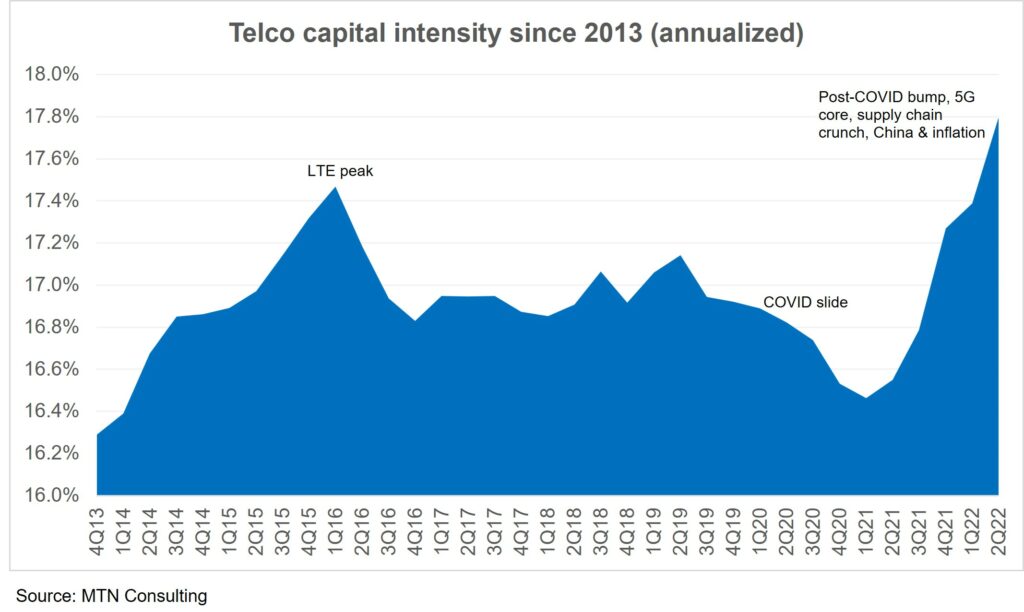
Vendors continue to wrestle with supply chain constraints in the telecom sector. That’s clear from several recent vendor earnings reports, including those issued by Dell, HPE, and Ciena in recent weeks. Telco spending, though, has surged in recent quarters. With 2Q22 results now compiled, the industry has reached a new capex peak. For the 12 months ended June 2022, telco capex was $329.5 billion (B), while the ratio of capex to revenues (i.e. capital intensity) was 17.8%. Both figures represent new record highs, at least for the 46 quarter (11.5 year) period that MTN Consulting data covers (1Q11-2Q22).  

On the supply side, vendors selling into the telco vertical are seeing some growth, in aggregate. For the broadly defined “telco network infrastructure” (telco NI) market, revenues were $60.1B in 2Q22 (up 4.1% YoY), or $237.6B on an annualized basis, up 6.7% YoY. The telco NI market includes some vendor revenue streams which dip into telco opex, not capex, but there is usually a correlation between total capex and vendor revenues.

The figure below illustrates telco capital intensity over the last several years.
What’s behind recent capex growth

One factor behind the recent capex spending spike is a post-COVID bump. Economies shutdown during COVID, depressing network spend. The capital intensity effect is shown in the figure, above (“COVID slide”). Capex also dropped in absolute terms. Annualized capex bottomed out at $299.8B in 2Q20. Some of the current growth is just making up for lost time. The quarterly average hasn’t changed much, if you expand the time horizon. For the last ten quarters, from 1Q20 (the onset of COVID) through 2Q22, telco capex averaged out to about $77.9B per quarter. For the ten pre-COVID quarters, the average was $78.5B.

Another factor is many telcos are scaling up initially small 5G deployments, and beginning to build out 5G SA core networks. 5G RAN builds have been underway for several years, but the spending has been small to start due both to the software-centric nature of 5G networks and telcos’ desire to wait for new revenue models to emerge. Incidentally, a shift to 5G core spending tends to benefit a different type of vendor – not just the Ericssons and Nokias of the world. Cloud providers AWS, Azure and GCP, for instance, are all actively involved in helping telcos with 5G core migrations. Their collective revenues in the telco vertical were about $3.4B for the 12 months ended June 2022, up nearly 80% YoY. Many of the vendors involved in this are less vulnerable to supply chain issues.

Another capex plus: fiber spending is strong in a number of markets, especially the US but also in Europe, Australia, China, and India. That’s to support FTTx deployments but also to connect together all the new radio infrastructure needed to support 5G. Government subsidies and other investment incentives are a factor as well. Vendors focused on fiber optics are seeing strong growth right now. For instance, Corning and Clearfield saw their telco vertical revenues grow by 25% and 84% YoY in 2Q22, respectively.

Supply chain limitations have a mixed effect. They sometimes mean delay or cancellation of projects, which cuts capex in the short term. They also can mean price increases, though, as telcos push suppliers to accelerate timelines or adjust designs to work with available alternatives. This can result in projects costing more than expected. Let’s not forget, though, that a huge portion of telco spend is unaffected by current supply chain constraints. Services- and software- focused vendors – like Accenture, Amdocs, IBM, Infosys, TCS and Tech Mahindra – are not citing supply chain issues as a drag on results. 

Inflation is a bit more straightforward. This has impacted the entire telecom food chain, from chips to components to systems to services. All else equal it causes an increase in US$ capex, though the impact on capital intensity is less clear. 

Finally, there’s China. Given how closed a market this is, there’s not as much attention paid to it nowadays. But China’s capex has been growing recently. For the 2Q22 annualized period, Chinese telco capex totaled $58.3B, up 12% from 2Q21. That growth comes despite efforts to share costs on the network side.

China is also relevant to the vendor share question. Huawei continues to rank at the top of the global telco network infrastructure (telco NI) market. For the 2Q22 annualized period, we estimate its telco NI share at 18.7%, far ahead of Ericsson (10.9%) and Nokia (8.9%). This surprises some, as Huawei has become a non-factor in many markets over the last two years. Yet Huawei’s stability is no mystery. It’s dominant at home, and local telcos have been spending big, and steering more of their capex dollars to local suppliers over the last couple of years. Huawei also has a huge customer list overseas – these revenue streams don’t just disappear overnight, especially since many telcos remain loyal to the vendor.

Hardware hit hardest in supply chain crunch

Vendors recorded about $237.6B in sales to the telco vertical for the 2Q22 annualized period. This is a huge market, with many different players; MTN Consulting stats track 132. Some supply the latest and greatest hardware innovations. They often have high margins but can also be subject to supply chain hiccups. Vendors specializing in solutions which revolve more around software and/or services tend to have different constraints. Labor cost and availability is always a concern, but hardware is rarely an issue. We believe the current supply chain disruptions will improve in the next couple of quarters, though. Even those vendors hit by short-term supply issues are generally optimistic. For instance, Gary Smith, Ciena’s CEO, noted last week that “Despite supply chain challenges and elongated lead times, strong secular demand trends show no signs of abating. And we remain confident that the fundamental macro drivers propelling this demand are durable over the long term.”

The biggest near-term risk to that is China’s ongoing series of COVID shutdowns. Longer term, the bigger risk is any interruption to Taiwan’s ability to continue functioning as an independent, self-governing country – it plays a key role in the telecom supply chain, and that of many other sectors. This issue is the elephant in the room that few like to address, but all vendors need to have a plan for this worst case scenario.

*

Source of cover image: iStock

Blog Details

Vendor landscape continues to shift in telecom market as cloud and 5G scale

Telco network spending has been on the rise over the last few quarters. Vendor sales of network infrastructure to the telco vertical (“Telco NI”) totaled $55.5B in 1Q22, up 5.7% YoY. On an annualized basis, Telco NI revenues through 1Q22 were $234.8B, the highest total in our 1Q13-1Q22 database and 6.8% higher than the 1Q21 annualized figure. Telco capex has been strong the last few quarters, and vendors are benefiting. The growth is not dramatic, but any kind of growth at all in telecom is a plus, and often a surprise.

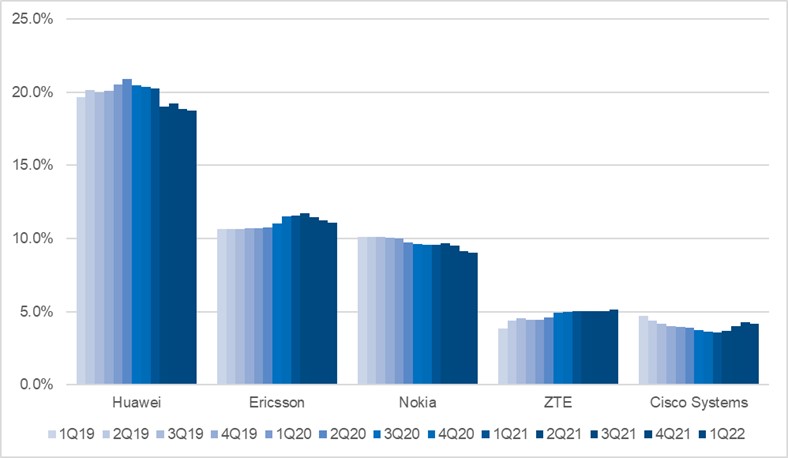
As telco spending has risen post-COVID, the top few vendors remain at the top. While share always varies a bit by quarter, the biggest five network equipment providers (NEPs; excludes China Comservice) have collectively accounted for about 50% of the Telco NI market over the last few years. Figure 1 shows annualized share evolution for these vendors, from 1Q19 through 1Q22.

Figure 1: Annualized market share of top 5 NEPs in the telco vertical, 1Q19-1Q22

Source: MTN Consulting

While the top 5 remain the same and their aggregate share of wallet is stable, there are some significant shifts underway in the vendor landscape.

What drives these shifts? Some are driven by financial machinations or politics, but most are aimed at improving competitive positioning. More specifically, improving a vendor’s ability to address key customer needs. In the telco vertical, these include: deploying telco cloud functions and architectures; monetizing new network capabilities, in particular 5G; lowering the cost of transport and routing; improving the energy efficiency of networks; automating networks; lowering the cost of customer acquisition and retention; and, developing revenue streams in new areas like mobile payments, digital advertising, home networking, connected cars and security. There are probably more shifts underway nowadays because 5G cores are beginning to be implemented in a big way, and Huawei’s problems continue to open up new opportunities for smaller vendors.

Most of the shifts in the vendor landscape involve smaller players, outside the top 5. Ericsson’s acquisition of Vonage is an exception; MTN Consulting published a blog post on this deal in May. Setting aside the top 5, ongoing changes in the vendor landscape fall into a few broad categories.

Growth of the cloud providers

Alphabet (GCP), Amazon (AWS), and Microsoft (Azure) together booked approximately $3 billion in revenues to the telco vertical for the 1Q22 annualized period, from less than half a billion USD in 2Q18-1Q19. They now partner with telcos on a range of areas, as MTN Consulting mapped out in the report “Telcos aim for the cloud by partnering with webscale cloud providers.” Their aggregate share of Telco NI is now about 1.3%, around the same as Accenture and a bit more than IBM. They have a long way to go, but they are already making a dent in the market and continue to invest heavily in the telco vertical.

Most of the cloud providers’ success in telecom stems from organic investment, but not all; Microsoft has completed three acquisitions that accelerated its push into telecom: Affirmed Networks, Metaswitch, and AT&T’s Network Cloud.

Vendor partnerships with webscalers

As webscalers began to make a real dent in the telecom market in 2020, traditional telco-facing vendors realized they could benefit from some joint development and marketing ventures with the webscalers. That was especially apparent as telcos began to deploy 5G cores and needed cloud smarts from their suppliers. Over the last three years, most big telco-focused vendors have entered into partnerships with traditional telco-facing vendors like Ericsson, Nokia, NEC, Fujitsu, and Amdocs. Some of these are generic, some are customized for specific large telco accounts, e.g. Telecom Italia.

Restructuring and realignment 

Dell, including its majority holding in VMWare, saw its revenues in the telco vertical rise steadily in the 2019-21 period. The company’s 2021 revenues in telecom amounted to just over $2.7B. VMWare is responsible for much of this, boosted by its Telco Cloud offerings. Late last year, Dell spun out its majority holding in VMWare. This was aimed partly at raising cash, but also at creating more value in VMWare, which has a different business model and profit margins than parent Dell. The two retain strong connections and partnerships, including in the telco space.

Since the Dell-VMWare spin-off in 4Q21, a bigger shift has occurred: in May 2022, Broadcom agreed to acquire VMWare, for $61 billion. Broadcom says the deal will combine its software portfolio with VMWare’s multi-cloud offerings. Telco is only one of many reasons for this deal, not a central one. Prior to the deal, Broadcom alone did have some small position in Telco NI, due largely to previous acquisitions (Brocade, and CA Technologies). The synergies involved in this deal seem questionable, but importantly Broadcom claims it will allow VMWare to operate with a degree of independence.

In the same quarter as Dell’s spinoff of VMWare, IBM separated its services group into a new company, Kyndryl. This deal was also driven by an interest in separating two companies with significantly different business models and profit margins. Both go after telco business though. Red Hat is at the core of IBM’s efforts to improve its penetration of the telco sector, and it has had some success. Kyndryl inherits many relationships with telcos cultivated by IBM’s services group over the years. That includes deals with Bharti in India, including a blockbuster $1.4B deal for IT operations outsourcing, way back in 2004. Interestingly, 5G monetization is front and center of Kyndryl’s messaging for the telco vertical, which is a similar driver to what’s behind Ericsson-Vonage.

Still pending: CommScope has been attempting to spin out its Home (CPE) division for several quarters, but there is no confirmed buyer. There’s some chance that the company will just reintegrate the division, as options are limited. Acquisition by private equity is likely being considered, though.

Telcos investing directly in technology supply

There are a few cases of telcos either creating a vendor in-house or acquiring a large ownership stake in one which already exists:

  • Rakuten Symphony: Rakuten’s creation of Symphony is most notable in recent years – the highest stakes, and probably the most expensive. Payoffs may be many years down the road, as more telcos consider open RAN for brownfield networks and Symphony develops more of a track record.
  • Tata Sons-Tejas Networks: Tejas Networks sold a controlling stake (43.4%) in July 2021 to Tata Sons group, which wants to help Tejas grow. The Tata group includes a telecom division, Tata Communications, with $2.3B in 2021 revenues, making it India’s fourth largest private telco. Tejas is focused on optical networks.
  • Verizon-Casa: in April 2022, Verizon announced it would invest $40M in one of its smaller vendors, Casa Systems, at the same time as agreeing to a multi-year contract.
  • NTT-NEC: further back, in June 2020, NTT announced a $560M investment into key supplier NEC, for a 4.8% stake in the company. This aimed partly at helping NEC expand its 5G offerings and leverage an opening in the global market for wireless technology opened up when Huawei began to face supply chain and political constraints in 2019-20.

Vendor-vendor M&A deals

The vendor landscape also continues to be impacted by more traditional M&A deals, where a vendor acquires another technology supplier. Some of the recent transactions include: 

  • NEC: this Japanese vendor has committed to expand in the mobile technology space, with focus on open RAN. Earlier in July, NEC agreed to acquire Aspire Technology Unlimited, an Ireland-based systems integrator, to help with this pursuit.
  • ADVA-Adtran: these two small but profitable wireline vendors announced plans to merge in late 2021, and the deal just closed. The new company, ADTRAN Holdings, may have a leg up in pursuing the many transport network upgrades and broadband access buildouts underway worldwide right now. The new ADTRAN may also be better able to deal with supply chain constraints, which continue to be an issue for smaller NEPs.
  • Sterlite: this India-based optical supplier has been growing over the last few quarters, exploring overseas markets for fiber optics, launching a small range of wireless products, and acquiring a UK-based systems integrator, Clearcomm Group, in 2021.
  • Accenture: has spent heavily on a wide range of acquisitions in the last two years, across industry verticals. Deals impacting telecom include Arca, a Spanish engineering services company, in 2020; umlaut, a German network engineering, testing and analytics company, in 2021; and Advocate Networks, a technology consultancy and managed services provider, in 2022.
  • Aviat-Ceragon: most mergers are friendly, where both sides agree. As Elon Musk’s attempted purchase of Twitter reminded the world, there are also less friendly forms of acquisition. This Aviat-Ceragon deal is basically a hostile takeover of Ceragon, proposed by Aviat. It’s still pending and the two parties may not come to agreement. However, the motive is worth noting. Aviat’s hope is that the deal would give the combined company more scale and better margins, and a stronger ability to compete with Huawei, Ericsson and Nokia in the wireless transport space as opportunities arise for 5G backhaul & fronthaul and support for private wireless networks.

Finally, one significant acquisition involves a large established telco-facing vendor acquiring telco assets. In September 2021, Ciena acquired AT&T’s “Vyatta” virtual switching and routing technology.  As Ciena said at the time, the deal aims to address “the growing market opportunity to transform the edge, including 5G networks and cloud environments.” Many shifts in the vendor landscape aim at this same opportunity.

*

Photo by Hans-Peter Gauster on Unsplash

Blog Details

Telecom’s top 3 vendors betting big on enterprise expansion; Huawei has early lead

Telco NI’s top 3

Telcos buy products & services from dozens of different vendors. Our research tracks 130. Some are relatively easy to classify into a segment, e.g. Corning, a “cabling & connectivity” vendor in our terminology. Most are much harder. Even those which may once have been called NEPs (network equipment providers), such as Ericsson, went beyond the implications of this term long ago. They also provide software and services, and most of their future development – measured by both R&D spend and acquisitions – is targeted towards software and the cloud.

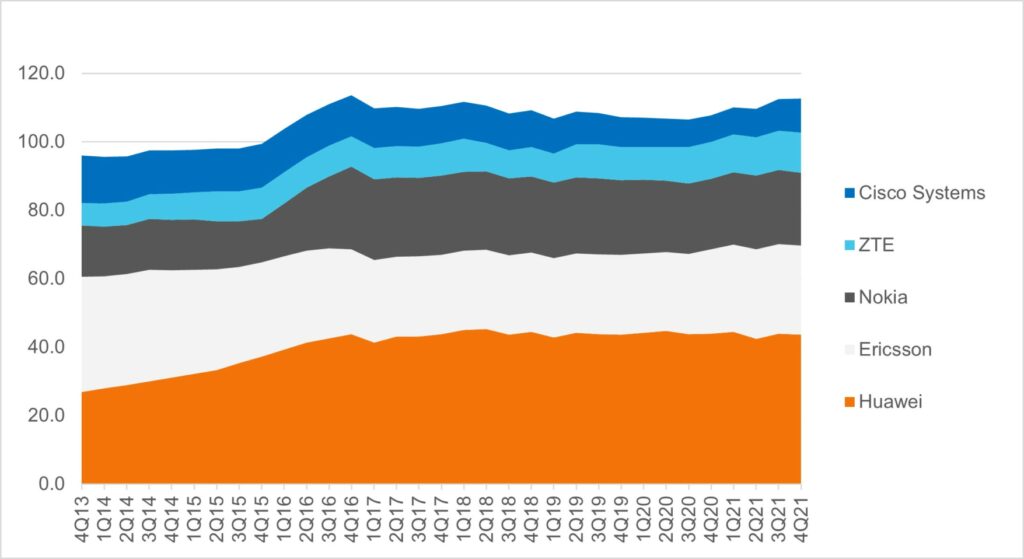
Setting aside the vendor classifications, there is less dispute about who the overall top suppliers are in telecom. According to MTN Consulting’s most recent vendor share report on this “telco network infrastructure” (telco NI) market, the top 3 are Huawei, Ericsson, and Nokia. Nobody else comes close. ZTE and Cisco round out the top 5, if you set aside the strange creature that is China Comservice, a services specialist which is majority-owned by China’s telcos. Figure 1 illustrates recent trends in annualized telco NI revenues for these top 5.

Figure 1: Vendor revenues in telco vertical, annualized ($B)


Source: MTN Consulting

Top 3 trying to expand beyond telecom

Focusing on the top 3, all face challenges related to addressable market. For Ericsson and Nokia, the common issue is that telco spending is relatively flat, even with the occasional growth spurt from a new generation of technology (e.g. 5G RAN). For Huawei, the problem is due to US-driven supply chain restrictions and boycotts by a number of countries that used to be important markets for the vendor.

Prior to Huawei’s current issues, its diversification was impressive, as its huge consumer business helped offset some of the risk in focusing on one primary market, telcos. But Huawei’s consumer business revenues have collapsed in the last 2 years: they ended 1Q22 at approximately 209.7B RMB (annualized), from 462.9B RMB  in the 1Q20 annualized period. Its carrier revenues have also fallen, as overseas telcos have been reticent to commit, but the drop is modest due to strong support from Chinese telcos and key overseas partners. Still, the writing is on the wall. Huawei recognized two years ago that it needed to reinvent itself, committing more to R&D and exploring new business opportunities beyond telco. One major focus is finding ways to expand its enterprise market. Its starting point in this expansion is a strong position in global optical and IP markets, and a solid offering for data centers. The company’s April analyst event made clear that its datacom group would play a central role in attacking the enterprise (CloudCampus, SD-WAN, Wi-Fi 6 and 7, etc.), as would Huawei Cloud

Both Ericsson and Nokia also view enterprise as important. Ericsson is focused mainly on private wireless, and acquired Cradlepoint in large part to pursue this opportunity. Ericsson’s microwave transport gear, security and software, and IoT solutions also have applications outside the telco. Nokia has a larger enterprise business to begin with. It’s also pursuing private wireless, and trying to leverage its wireline gear (optical and IP) further into enterprise markets. It also has had success in the webscale market, including a data center switching at Microsoft recently.

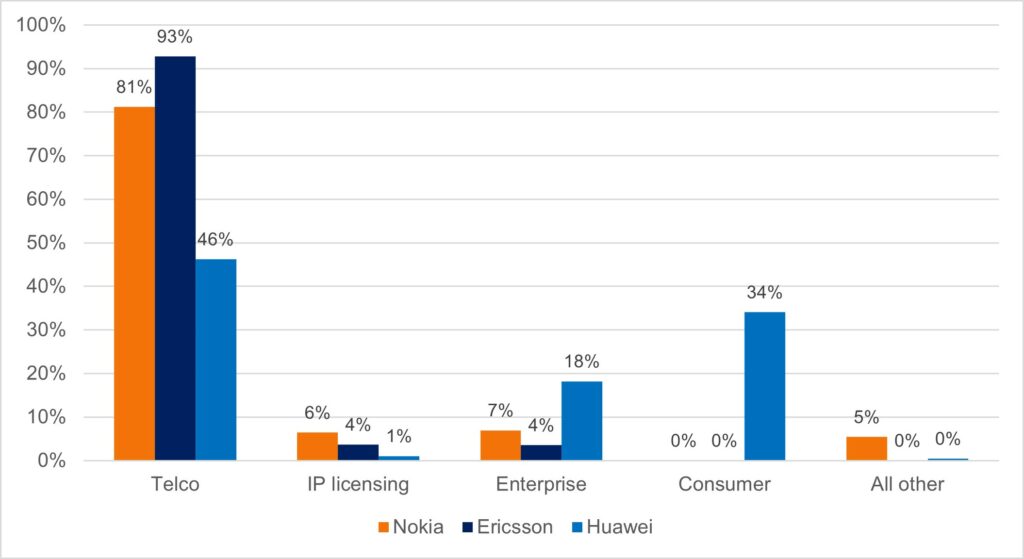
Figure 2 illustrates the revenue breakdown for these three vendors into several major categories: telco, enterprise, consumer, IP licensing, and all other.

Figure 2: Annualized revenues by market, % total (2Q21-1Q22) 

Source: MTN Consulting

 As shown above, Huawei gets less than half its corporate revenues from telcos, even after Consumer’s decline. What may surprise some is how much of its revenue base comes from enterprise. For the 1Q22 annualized period, the enterprise market accounted for 18% of Huawei revenues. Nokia and Ericsson recorded 7% and 4%, respectively.

Moreover, enterprise as a percent of total revenues was about the same for Ericsson and Nokia two years ago, in the 1Q20 annualized period. For Huawei, though, enterprise has nearly doubled, from about 9.7% in 2Q19-1Q20 to 18.2% in the most recent four quarters. As Huawei has faced pressure in other markets, the enterprise has proved to be more resilient. And Huawei has plowed new resources into enterprise to grow it further.

The enterprise is not a hobby  

To date, Huawei’s big enterprise wins are mostly in China. For the company overall, 65% of 2021 revenues were in China. It’s likely that well over 80% of enterprise division revenues are in China. But this was true of Huawei’s carrier group revenues in the early years. With any new product line or market, Huawei has usually penetrated Chinese accounts first while it has ramped up resources overseas to support an expansion. 

Clearly there is no guarantee that Huawei’s enterprise group will thrive outside China. For larger enterprises subject to public pressure, some will still be concerned about the politics of picking Huawei. Even without concerns about appearances, Huawei’s reputation has taken a hit over the last couple of years, which it is working to overcome. Another challenge is channels. Even for the large enterprise targets – such as big banks, government agencies, railways, and energy companies – Huawei will need to rely on channel partners. It can’t develop its own internal team as it did with telco; there are too many enterprises, and the average size is too small. Huawei needs to identify the best country and vertical markets to attack, and develop a network of trusted, certified partners to both sell into this market and support it after the sale. Enterprise market leader Cisco has invested heavily in building and maintaining its network of channel partners for decades. Huawei also has to battle numerous vendors with established positions in specific enterprise verticals (e.g. energy) or product areas (e.g. Ethernet switching).

All this won’t be easy, but don’t count out Huawei. It has exceeded expectations many times in the past, and views the enterprise as crucial to growth. One indicator of the importance of the enterprise market to Huawei is its leadership. For most of the last half of the 2010s through 2020, Yan Li Da served as Enterprise group president. Yan was in charge of international marketing for Huawei’s early 2000s push into overseas optical markets. That push was key to Huawei initially establishing its name in the global telecom market. Yan is now on Huawei’s board of directors. 

*

Cover image: Marvin Meyer on Unsplash