Blog Details

5G – Need for Harmonized Spectrum

Optimistic 5G forecasts assume that telcos’ spectrum needs are met

Ericsson recently predicted that by 2024 5G subscriptions will reach 1.9 billion, 35 percent of traffic will be carried by 5G networks and up to 65 percent of the global population could be covered by 5G. This is one of the many forecasts that predict the success of 5G, however there are many variables attached to it. A key one is the availability of suitable, affordable and importantly harmonized radio frequency spectrum, which is the focus of this blog.

Harmonized spectrum is key for 5G success

At the upcoming World Radiocommunication Conference (WRC), the overall goal of the telecommunication world at is to secure a sizeable chunk of harmonized spectrum for 5G.

Spectrum harmonization drives economies of scale, better battery life (as phones don’t need multiple radio modules and to toggle between frequencies), less cumbersome roaming and lesser cross border interference. It’s essential for 5G to succeed.

Government policymakers want to auction or license this harmonized spectrum to cover their current and future budgets. Telecom network operators on the other hand are interested in getting this harmonized band(s) at a reasonable cost from governments in order to meet operational excellence requirements and achieve their business targets in partnership with their vendors.

Background on spectrum

Wireless communications require airwaves to provide services. Airwaves, or electromagnetic spectrum, consist of a range of all types of electromagnetic radiation, from radio waves to gamma rays. The range of frequencies that are used for providing mobile and WiFi connectivity falls under the radio frequency (RF) portion of the electromagnetic spectrum. RF spectrum ranges from 3 kHz to 300 GHz (Figure 1).

Figure 1: Range of frequencies in wireless communications
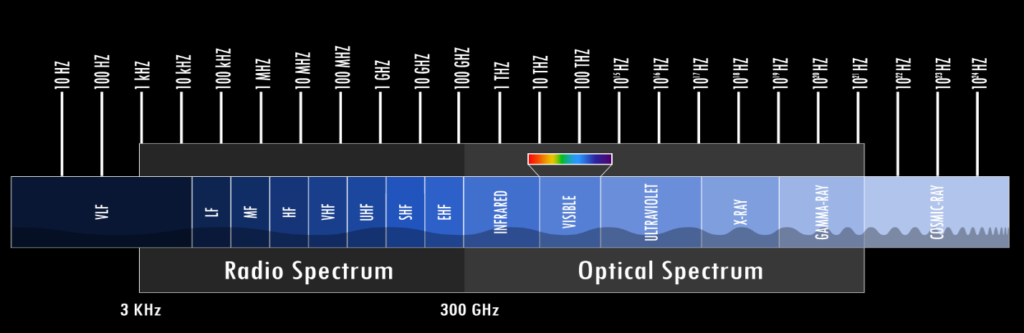
Source: Nasa (https://imagine.gsfc.nasa.gov/science/toolbox/emspectrum1.html)

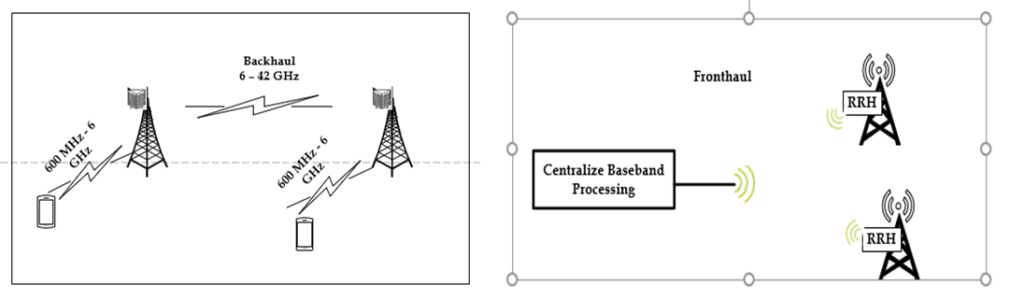
Mobile communications – a subset of wireless communications – primarily takes place in the range of 600 MHz to 42 GHz. The lower frequency bands are suitable for addressing communications between mobile phones and base stations (radio towers) while the high bands are used for supporting backhaul connectivity between radio towers. Fronthaul, which is a much newer concept, connects remote radio heads mounted on towers to baseband units located in a centralized location. Fronthaul requires much higher bandwidth and minimal latency and thus for the most part it is supported with optical fiber. However, in case fiber is not available, a wireless medium can be used (e.g. microwave). (Figure 2).

Figure 2: Use of radio waves in cellular networks
Source: MTN Consulting

The electromagnetic spectrum requires proper management, allocation, assignment and harmonization at a global level. That’s because wireless communications isn’t limited by national boundaries, and a global approach helps facilitate economies of scale. This huge function is performed by the ITU (International Telecommunication Union), which is the United Nations’ specialized agency covering information and communication technologies (ICTs). More specifically, the ITU’s Radiocommunication sector (ITU-R) takes care of this obligation at the global level.

ITU-R allocates spectrum through the pivotal World Radiocommunication Conference (WRC), which takes place once every 3-4 years. WRC is the most significant inter-governmental event related to the frequency spectrum. WRC has a mandate to review, and, if necessary, revise global Radio Regulations, the international treaty governing the use of the radio-frequency spectrum and the geostationary-satellite and non-geostationary-satellite orbits. This treaty is the basis for the harmonization of spectrum worldwide.

WRC allocates frequencies to everything that needs airwaves for execution – from as small as garage door openers all the way to space satellites, and everything in between (terrestrial, aviation, maritime, etc.).

Once spectrum is allocated at the WRC, national regulatory bodies such as the FCC and can assign specific bands to specific service providers (such as AT&T, Sprint, etc.) through a license for a specific number of years.

To predict the future, you have to understand the past

The focus of this blog is three-fold: (a) to provide a brief summary of the key activities that took place at WRC-15 (b) to give a sneak preview of the upcoming WRC-19 and (c) to analyze the cost and global implications of spectrum for 5G.

Recap from WRC-15

The demand for wireless connectivity and applications on the go is continuously on the rise. The wireless industry requires quick access to frequency spectrum and a lot of it, on a worldwide basis. Back in 2014, the ITU-R predicted that the world would need an additional 1340-1960 MHz for broadband services by 2020. The aim of the world body was to get harmonized spectrum in the range suggested by ITU-R, preferably on a global scale, if not then at least to some extent on the regional basis.

To keep the story short, WRC-15 can be considered as the first major international event that looked into allocating frequency spectrum for 5G. However due to some geopolitical challenges and presence of many existing services, the WRC-15 was only able to allocate 51 MHz for IMT (International Mobile Telecommunications) systems on the worldwide basis. In addition to this 51 MHz allocation which was made in the L-band (1-2 GHz), sizeable additional allocations were made on a regional basis. The total allocation was over 1500 MHz, satisfying the regional requirements for the most part (Table 1).

To clarify, IMT is the flagship project of the ITU-R and covers 3G, 4G and 5G systems. The ITU-R doesn’t allocate spectrum for a specific mobile generation but rather in generic terms of MOBILE and IMT. This capitalization means that the service has been allocated on a primary basis and no other service can interfere in its operations.

In the past, the identification of spectrum as MOBILE for cellular/broadband systems (including 2G) was sufficient. However, the advent of 4G/5G has the brought the concept of IMT systems to the limelight and now even if a service is already allocated for MOBILE, it doesn’t necessarily mean that it can be used for it unless it has been identified as IMT in the footnotes.

Table 1: IMT allocation at WRC-15

Band (MHz) Regions (or parts thereof) * Bandwidth (MHz)
450-470 2 20
470-698 2 & 3 228
694/698-960 1, 2 & 3 (not worldwide) 262
1427-1452 Worldwide 25
1452-1492 2 & 3 40
1492-1518 Worldwide 26
1710-2025 2 315
2110-2200 2 90
2300-2400 2 100
2500-2690 2 190
3300-3400 1, 2 & 3 (not worldwide) 100
3400-3600 1, 2 & 3 (not worldwide) 200
3600-3700 2 100
4800-4990 2 & 3 190

Sources: 5G Mobile Communications: Concepts and Technologies, and the ITU.
*Region 1 comprises of Europe, Africa, the former Soviet Union, Mongolia, and the Middle East west of the Persian Gulf, including Iraq. Region 2 includes Americas including Greenland, and some of the eastern Pacific Islands. Region 3 covers non-FSU (former Soviet Union) east of and including Iran, and most of Oceania.

WRC-15 also identified several bands as study items for their potential usage for IMT. The range covers various bands from 24.25 GHz to 86 GHz. These bands are already providing a number of services particularly backhaul and satellite. The specific services in these bands also can differ by region to some degree. Therefore, spectrum sharing and compatibility studies were required to look at their applicability of co-existence with IMT.

WRC-19 Preview

Before diving into WRC-19 it is worthwhile to look into the work executed by 3GPP in this regard after WRC-15. 3GPP, the flagship organization for 4G and 5G specifications, identified the following two frequency ranges:

  • Frequency Range 1 (FR1): 410 MHz to 6000 MHz with channel bandwidths in the range of 5 to 100 MHz with increments of either 5 or 10 MHz. This frequency range is applicable for both frequency and time division multiplexing modes.
  • Frequency Range 2 (FR2): 24.25 GHz to 52.60 GHz with channel bandwidths of 50, 100, 200 and 400 MHz supporting operations only in time division multiplexing mode.

3GPP focuses more on the nitty gritty of spectrum which has been identified in broad terms by ITU-R. 3GPP works more on the lines of identifying channel bandwidths and duplexing modes to support the underlying mobile services.

In preparations for WRC-19, the ITU-R as per its practice executed the two Conference Preparatory Meeting (CPM) sessions. In February 2019, the ITU-R issued a close to 1,000-page “CPM 19-2” report, designed to assist in preparations for and deliberations at WRC-19. It can be said that hundreds of resources, thousands of workforce hours and millions of dollars have been spent to study the subject frequency range.

The upcoming WRC-19, scheduled to take place later this quarter, has two major tasks when it comes to the allocation for MOBILE/IMT.

First to conclude on the applicability of the identified bands for MOBILE / IMT as required by agenda item 1.13 (Table 2). The CPM 19-2 report forecasted that IMT will require 0.33 GHz to 12 GHz of spectrum in the ranges of 24.25-33.4 GHz, 37-52.6 GHz and 66-86 GHz, depending upon the metrics, assumptions and frequency range. The problem is that all the bands listed in Table 2 are already in use. Further identification for IMT on a primary basis could face stiff opposition particularly from the satellite community at the WRC-19. Opposition from satellite is even more an issue than 2015 as many new players have entered this space, including some deep-pocketed companies like Amazon and Facebook.

Table 2: Applicability of identified bands for MOBILE/IMT (WRC-19 conference prep, Agenda item 1.13)

Band (GHz) Bandwidth (GHz) Key Current Primary Allocation Services Potential Additional Services
24.25 – 27.5 3.25 FIXED, FIXED-SATELLITE,

EARTH EXPLORATION-SATELLITE, MOBILE, INTER-SATELLITE

Identified by CPM to be used for IMT
31.8 – 33.4 1.6 FIXED, INTER-SATELLITE, SPACE RESEARCH, RADIONAVIGATION Has not been identified by CPM for IMT
37 – 40.5 3.5 FIXED, FIXED-SATELLITE, SPACE RESEARCH, MOBILE, MOBILE-SATELLITE Identified by CPM to be used for IMT .
40.5 – 43.5 3.0


FIXED, FIXED-SATELLITE, BROADCASTING, BROADCASTING-SATELLITE Identified by CPM to be used for IMT
45.5 – 50.2


4.7


FIXED, FIXED-SATELLITE, MOBILE Identified by CPM to be used for IMT
50.4 – 52.6


2.2


FIXED, FIXED-SATELLITE Identified by CPM to be used for IMT
66-76


10 FIXED, FIXED-SATELLITE, BROADCASTING-SATELLITE, MOBILE, MOBILE-SATELLITE, RADIONAVIGATION, RADIONAVIGATION-SATELLITE Identified by CPM to be used for IMT
81-86 5 FIXED, FIXED-SATELLITE Identified by CPM to be used for IMT

Source: ITU (https://www.itu.int/dms_pub/itu-r/opb/act/R-ACT-WRC.12-2015-PDF-E.pdf, and https://www.itu.int/dms_pub/itu-r/opb/act/R-ACT-CPM-2019-PDF-E.pdf)

Second, WRC-19 will need to look into spectrum allocation issues affecting several other big markets as listed in agenda items 1.11, 1.12, 1.14 and 1.16 and their implications on existing and future IMT systems:

  1. Railway radiocommunication systems between train and trackside within existing mobile service allocations – RSTT
  2. Intelligent Transport Systems (ITS) under existing mobile-service allocations
  3. High-altitude Platform Stations (HAPS), within existing fixed-service allocations, and
  4. Radio local area networks (RLAN), in the frequency bands between 5.150 GHz and 5.925 GHz

A brief summary of the key bands under consideration for these services is provided in Table 3 below. There are several bands that are already in use for IMT and thus any allocation to any new service needs to be justified and obtain consensus from administrators.

Table 3: Key bands for RSST, ITS, HAPS & WLAN

Potential Service Key Bands Under Consideration
RSST 138-174, 335.4-470, 703-748, 758-803, 873-925, 918-960, and 1770-1880 MHz; 43.5-45.592 GHz and 92-109.5 GHz
ITS 5850-5925 MHz
HAPS 6.44-6.52, 21.4-22, 24.25-27.5, 27.9-28.2, 31-31.3, 38-39.5, 47.2-47.5 and 47.9-48.2 GHz
RLAN 5150 – 5925 MHz

Source: MTN Consulting


Big battles lie ahead

At this stage, the telecom industry is not close to achieving its target of harmonized, adequate 5G spectrum resources. Basically, there are two camps – one is favored by China and other by the USA. Disagreements are not settled easily at this stage as there is a first mover advantage in the development of mobile wireless generations. The market leader can set the stage for future infrastructure development, product development and specifications. In this context, three ranges of spectrum bands have been considered namely:

• low band (sub 1 GHz) which is used heavily for broadcasting and wireless services.
• mid band (1 GHz to 6 GHz) which is primarily used for wireless services.
• millimeter wave or mmWave (24 GHz to 100 GHz) which is used for many non-mobile services (Table 2)

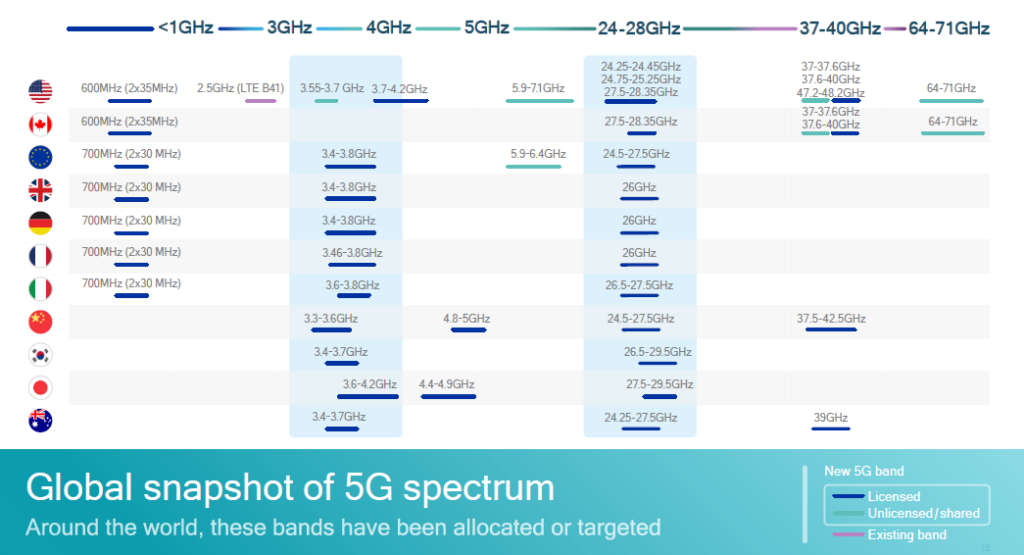
The battle hovers around the sub 6 GHz and mmWave bands. China is looking towards 3.5 GHz whereas the USA is focusing on multiple millimeter bands. The mid band, particularly the 3.5 GHz band that ranges from 3.3 to 3.8 GHz, is the most sought after band for use as a core band for 5G. That’s because of this band’s availability and lower deployment costs as compared to mmWave bands. China already assigned 200 MHz in this mid band. By contrast Japan and South Korea are working in both mid and mmWave bands. The rest of the world for the most part is playing catch-up on 5G spectrum assignments (Figure 3)

Figure 3: 5G spectrum bands by region
Source: https://www.everythingrf.com/community/5g-frequency-bands

The US faces a unique problem in the mid-band. Namely, the US Department of Defense currently holds roughly 500 MHz in the 4 GHz range and thus it cannot be used for commercial operations. According to a DoD report, the estimated time required to clear spectrum (relocate existing users and systems to other parts of the spectrum) and then release it to the civil sector, either through auction, direct assignment, or other methods could take 10 years. Spectrum sharing between entities is another option and is a slightly faster process, but it could still take five years according to the same DoD report. Thus, the FCC has focused on the mmWave band. It had to auction out 24 GHz and 28 GHz bands and is planning to offer 37, 39 and 47 bands as well in the future. This is one of the key factors behind the limited coverage launches of 5G in USA. Verizon’s 5G network is based on the 28 GHz and 39 GHz bands, AT&T uses 39 GHz, and T-Mobile is planning 28 GHz. Sprint is eyeing the 2.5 GHz band as it doesn’t have any spectrum assets in the mmWave range.

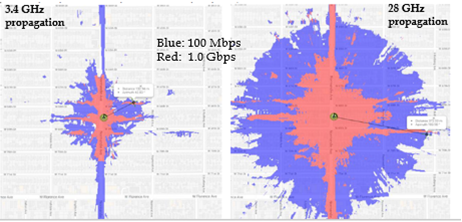
A study conducted by Google for DoD found severe limitations in the mmWave band. It concluded that for the same number of cell sites (macro cell sites and rooftops), 1 Gbps can only be provided to 3.9% coverage area at 28 GHz (US model) as compared to 21.2% at 3.4 GHz (Chinese model). The same study also estimated that it will require approximately 13 million utility pole-mounted 28-GHz base stations (one of the key choices of US operators for mmWave) and $400B in capex to deliver 100 Mbps edge rate at 28 GHz to 72% of the U.S. population, and up to 1 Gbps to approximately 55% of the U.S. population. Figure 4 illustrates the problem, showing the propagation difference between 28 GHz and 3.4 GHz deployments on the same pole height in a relatively flat part of Los Angeles.

Figure 4: Propagation difference in Los Angeles: 28GHz vs 3.4GHz
Source: “The 5G Ecosystem: Risks & Opportunities for DoD,” April 2019.

In a nutshell, mmWave bands will likely have a detrimental impact on operators’ budgets, at a time when they are not eager to ramp up capex. At the end of 2018, Verizon held ~$120B in debt with ~4% dividend yields, while AT&T held ~$175B in debt with over 6% dividend yields. T-Mobile holds ~$25B in debt, and Sprint holds ~$40B in debt. These companies are at the forefront of the U.S. effort to develop 5G, but their balance sheets suggest that they may struggle with the cost of a full mmWave network roll-out and the infrastructure it would require.

Conclusion

The wireless world’s technology leadership role will be at stake at WRC-19. History has proven that having access to the right set of spectrum assets can deliver a competitive advantage in the overall supply chain for years to come. The implications are vast both from the commercial and strategic point of views, impacting governments, operators, vendors, and ultimately jobs.

As of today, the industry lacks harmonized frequency bands for 5G. Perhaps at the end of WRC-19 the world will be closer to achieving this goal.

Stay tuned for more news from MTN Consulting on RF Spectrum and WRC-19!

*Saad Asif is a Contributing Analyst for MTN Consulting and a recognized industry expert in wireless communications. He has worked in the field of telecommunication for over 21 years, and has authored three books and multiple peer-reviewed technical papers. Saad has been granted multiple patents and is a senior member of the IEEE.
Blog Details

5G to follow a politicized path in developing markets – telcos beware

Huawei has dominated telecom news since the arrest last December of the Chinese vendor’s CFO in Vancouver. Since then, the US Commerce Department has restricted Huawei’s access to US-built tech components, including Google’s Android ecosystem. Huawei needs these components, so the heat is on. What happens next?

Let the Huawei chaos begin

Those waiting for a grand resolution to US-China disputes surrounding Huawei will be disappointed – the company’s problems did not arise with the Trump administration’s trade battles. Concerns about Huawei’s private company origins and independence from the Chinese state are fairly bipartisan in the US, at least two decades old, and shared by many European and Asian governments.

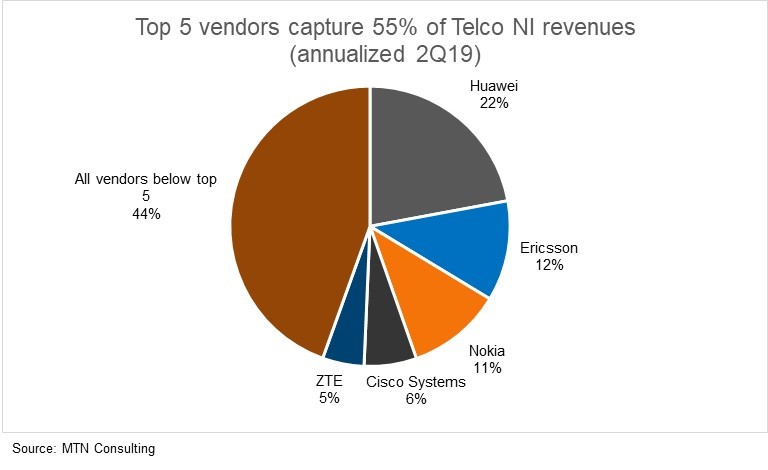
Yet Huawei certainly isn’t going anywhere; it has the broadest portfolio of products in the industry, and its 22% market share in network infrastructure sales to telcos (“Telco NI”) is nearly as much as Nokia and Ericsson combined (figure, below). Since Meng’s arrest, the vendor has hardly backed away from its ambitions – and the Chinese government has made clear its support for Huawei’s long term growth.

In the developing world, Huawei’s network infra share is over 30%, and its share in most developing markets is rising, due in part to “China Inc”. Huawei – and its customers – continue to benefit from cut-rate financing available from Chinese banks, among other incentives. This activity has picked up as Belt and Road Initiative (BRI)-related projects have got underway. Egypt’s new capital is an example – Huawei is supplying nearly all of the new telecom network infrastructure for an entirely new city intended to house 6.5 million.

Given Huawei’s position as a powerhouse in the developing world, it’s impossible to discuss 5G without addressing Huawei’s prospects.

5G not a rush in low ARPU markets

In developing regions such as CIS, Latin America (LA), and Sub-Saharan Africa, 3G remains the primary mobile connection technology. While 4G will overtake 3G soon even in these low ARPU markets, 5G will take years to emerge. According to stats from the GSMA, these regions will respectively see 5G account for 12%, 8%, and 3% of their total connections by 2025.

These are cellular connections and don’t factor in IoT – a big caveat given 5G’s promise for device to device connections. However, the point remains that 5G will be a slow evolution – telcos like to stretch the life of technologies whenever possible.

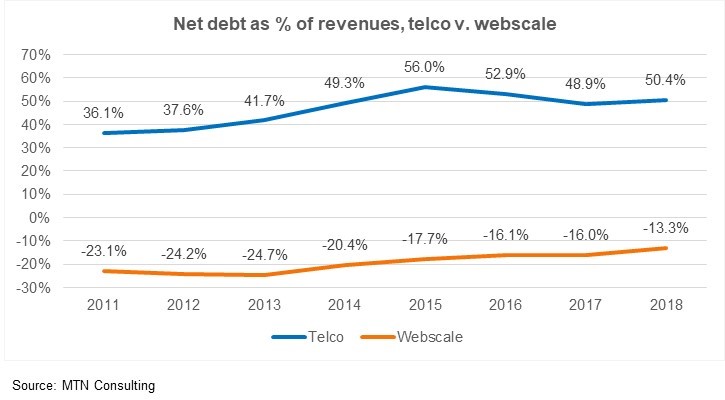
That’s especially true for telcos with high debt levels – and there are a lot of these. The net debt (debt minus cash) of the global telco sector was roughly half of revenues in 2018, having been in the 30-40% range of revenues at the cusp of the LTE buildout cycle. Few telcos have room in their budgets for a 5G capex splurge. Even if there are 5G trials underway across the developed world, the developing world will need 10 years or more for widespread migrations to complete.

Individual operators reflect this different pace. Etisalat for example is already advertising ZTE-provided 5G in its home market of the UAE ($41K GDP per capita); however, in the west African country of Togo ($617 GDP per capita), its local unit Moov Togo only launched 4G in mid-2018. There is little need or incentive for Etisalat to push 5G anytime soon in Togo.

The natural conservatism of telcos is heightened when lots of things are changing on the supply side. Right now, Huawei-related uncertainty is slowing down procurement. Even if a product is on the shelf, a telco needs to know it can be supported after the sale. Given that some countries are considering restrictions on Huawei, it’s only natural for telcos to take a breath.

Supply side push likely from Huawei

Any good vendor sales rep talks to customers frequently about new products, in search of interest and/or commitments. Huawei has been especially proactive about stirring up business in small markets like Togo, and successful in turning single-country projects into much larger ones. If Huawei can keep its supply chains running – although this is not certain – it will likely launch an aggressive supply side push for 5G in its strongest developing markets (e.g. Thailand). We can expect more low-cost financing, joint R&D facilities, university partnerships, tie-ins with Huawei’s device and cloud business, and lobbying. Huawei wants to seize the moment.

This could all end up being good for operators if they play it smartly. A better pitch from Huawei should provoke its rivals into doing the same, ultimately benefiting telco customers. The complication is on the financing end and the use of China’s state-owned banks – primarily CDB and Ex-Im. Politics are by definition part of the decision-making process of these banks, and telcos may not want to embroil themselves in that process.

This is now a political issue, as concerns about foreign debt levels grow. Just last month the Kiel Institute for the World Economy issued a report on “China’s Overseas Lending”, noting that for the 50 main recipients of Chinese direct lending, “the average stock of debt owed to China has increased from less than 1% of GDP in 2005 to more than 15% of debtor country GDP in 2017.” The study also found that “about one half of China’s overseas loans to the developing world are ‘hidden’”.

Telcos forced to do more with less as webscale operators splurge

Telcos’ network department headcounts and R&D budgets have been declining for many years. This has made telcos more reliant on vendors for knowledge and technical support, and even rudimentary design. In effect telcos have outsourced much of their R&D to their suppliers. This tends to benefit incumbent vendors.

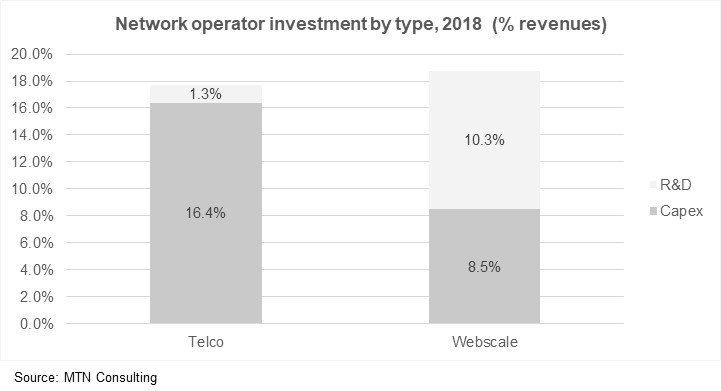
Network operators in the webscale world – Amazon, Facebook, Microsoft etc – are by contrast splurging on staff. They spend heavily on R&D, an average of 10.3% of revenues in 2018 (vs. 1.3% for telcos; figure). Webscale R&D projects are all over the map, in line with the range of the companies’ business interests. Most important, all of the big WNOs spend heavily on network R&D, designing equipment to suit their high-capacity, high-growth needs precisely. They typically use original design manufacturers (ODMs) to build and then ship the gear to sites worldwide.

These webscale companies have pushed open networking and open source efforts for years, starting in a big way with Facebook’s founding of the Open Compute Project (OCP) in 2014. Much of the webscale network equipment deployed in their cloud is either compliant with or derived from these open source-oriented bodies.

Change comes slower to the telco world, but AT&T giving open networking a push

However, telco adoption of open networking/open source has been slow due to weak OSS/BSS system support and telcos’ slow buying cycle: they do not introduce change into the network quickly. There are signs that this is changing; for instance with AT&T’s Dec. 2018 commitment to deploy “white box routers” at up to 60,000 5G cell towers over the next few years. AT&T first laid out its virtualization plan in 2013, which included using its own developed platform ONAP (Open Networking Automation Platform) and SDN to virtualize its network functions.

With AT&T’s white box commitment, open source hardware in the 5G RAN has become more attractive – even if just for routers. However, AT&T’s open source commitment comes at a cost. The company does have a significant R&D budget, totaling $1.4B in 2018 (or 0.9% of revenues). In the case of the cell site routers, AT&T is not just buying something off the shelf. The “UfiSpace” white box is powered by a network operating system called Vyatta. This OS required both internal development (i.e. R&D) and an acquisition (of Brocade’s Vyatta division) to develop. On the flip side, AT&T has managed to keep its capex outlays to just 12.2% of revenues (2018), among the lowest of all big telcos worldwide.

Not all carriers in the developing world can develop their own network operating system, clearly. Most need to allocate more funding to R&D, though, with the explicit goal of capex reduction – and increased leverage over their suppliers. That’s all the more important to do now as supply chains are in upheaval. Telcos with country operations in the developing world should be more involved in key bodies like ONF, OCP, O-RAN Alliance, and the Telecom Infrastructure Project (TIP).

There is a benefit to being an early mover, and that’s especially true now – lots of small players are eager to sign deals that give them bragging rights. Accton’s Edgecore Networks, for instance, is working on white box cell site gateways with large carriers Vodafone, Telefonica, TIM Brasil, BT, and Orange – all but BT have significant operations in developing markets where deployment is possible. Locally owned competitors would have strong incentives to follow.

New vendor opportunities emerging amidst the Huawei chaos

As 5G becomes a reality and Huawei still has issues, vendors elsewhere in Asia are looking to exploit uncertainty. That doesn’t just mean other RAN suppliers; it involves fiber, transmission, router/switch, and other product areas, and software/IT services. It also involves many countries: India, Korea, Taiwan, and Japan all host competitive players in the telecom network infrastructure space. None approach the scope of even a mini-Huawei but telcos are more willing to buy a la carte nowadays.

India is interesting because its latest Telecom Policy (2018) explicitly called for the development of its telecom equipment sector. Well before the Huawei crisis, India’s Telecom Secretary, Aruna Sundararajan, argued that India should embrace 5G aggressively, not just for services but to help develop India’s export sector. India is a big enough market that the big global RAN vendors are making local investments in R&D and manufacturing, and partnering locally. Ultimately this could expand prospects (and product lines) for companies in other segments like Sterlite and Tejas. It could also help open networking specialist Radisys, now owned by India’s largest telco Jio.

India becomes more interesting in terms of network infrastructure when you consider Taiwan. Its local tech trade association, TAITRA, is pushing hard on India for both export and partnership opportunities. India’s traditional strength (workforce-wise) has been in software (e.g. Wipro, Tech Mahindra), while Taiwan is strong in electronics manufacturing, chips, displays, and sensors. There are some partnership opportunities that look attractive on paper. Already Taiwan’s Foxconn is moving some iPhone production to India, for instance. But politics are a factor in the India-Taiwan avenue. And if politics is what motivates a deal, then a new political environment could make the deal unstable, so things are likely to go slowly here.

What’s an operator to do?

Mobile operators face an unsettled vendor landscape and tight capex budgets. Planning 5G in this climate is not easy. If I led a developing market mobile telco – Axiata, say, or America Movil – I would use this time to:

  • Study my current network equipment inventory (including software elements) to gauge security and regulatory risks – for all vendors;
  • Push regulators to guarantee no future unfunded mandates to rip & replace;
  • Adopt network design and procurement practices from webscale players when workable, but avoid adopting their lax security and privacy practices;
  • Increase R&D budget by at least 0.1% of revenues. This modest increase could potentially fund hundreds of new R&D hires for a company like America Movil; and,
  • Use the new hires to fully evaluate cost saving opportunities related to open networking, and infrastructure spinoffs to the carrier neutral sector of network operators.

Finally, I would make sure I was getting objective advice on prospects for 5G business use cases, and the right investment strategy to pursue them. More capex isn’t always the answer.

-end-


Source of cover image: My Edmonds News

Blog Details

A Telecom Analyst’s Take On CES 2018

For most of my career, I’ve been focused on the telecom industry and its components. I’ve been to dozens of telecom-focused conferences & exhibitions, in Asia and the Americas. I had never been to a consumer-focused show, though. In order to learn a bit (and check out some cool new devices), I spent a few days at CES in Las Vegas last week.

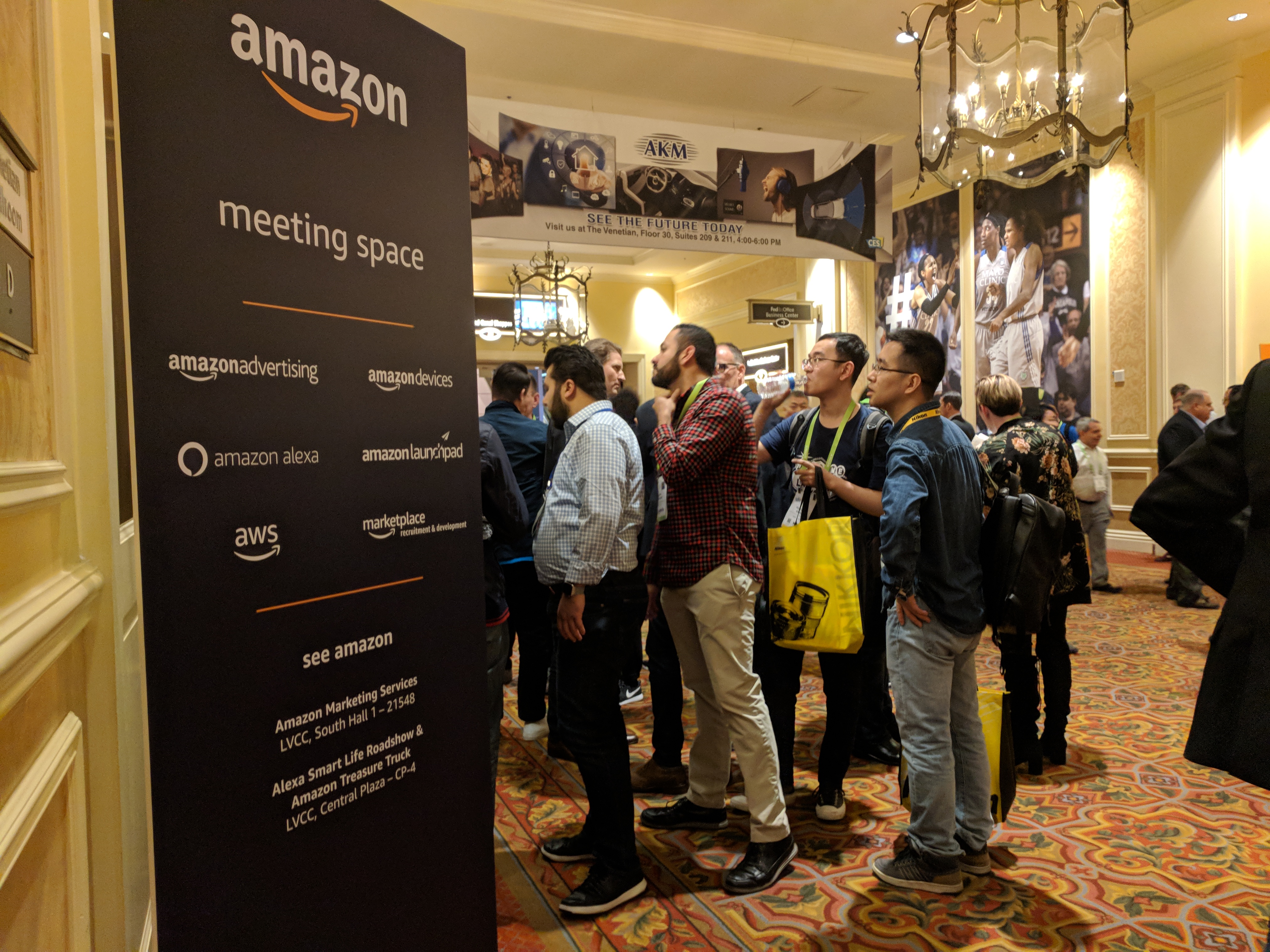
It was as chaotic as promised, but also a geek’s paradise. Loads of new tech was shown off in AI, IoT and smart cars. Telcos had a limited presence, but another type of network operator – those building webscale networks – was well represented.

Webscale at CES

Of the biggest companies building webscale networks, most had some sort of CES presence.

As covered widely elsewhere, Google’s Assistant and Amazon’s Alexa were hard to hide from, and overpowered Microsoft Cortana’s limited presence. Apple’s late 2017 decision to postpone the launch of its HomePod (powered by Siri) prevented it from making any kind of CES splash. The absence of Apple in the market, and Cortana’s failure to withstand the competition, left the turf wide open for Google to take on Amazon.

Monorail sponsorship paying off for Google

Chinese providers Baidu and Alibaba were also standouts; both sent impressive speakers and invested heavily in booth space. Baidu’s CES presence had self-driving as the centerpiece. The company formally announced its “Apollo 2.0” platform, in collaboration with 90 partners. Its booth showcased partners’ applications of Apollo in various mobility scenarios, including passenger vehicles, public buses and shared transport services. At the event’s “Mobile Innovation” keynote session, Baidu’s COO Qi Lu expanded on the driving focus, saying the company is “scaling everything around cars”. One positive for vendors: Lu argued that the transition to 5G should accelerate because of advances in AI – and the attendant need for more speed, security, and mobility.

For its part, Alibaba positioned itself well as an industry matchmaker at CES. It sponsored dozens of tiny suppliers in its “sourcing” tent – all of which use the Alibaba platform to serve customers. These suppliers sold every type of electronic under the sun. Some don’t even have products; Alibaba GM Kuo Zhang explained that he encouraged Chinese companies with “incomplete ideas” to come to CES, to meet people. On the buyer side, Alibaba explained in a breakout session how it aims to “de-risk” transactions by providing services like virtual reality factory inspection. That not only drives commerce on Alibaba.com, it also generates lots of traffic for the Alibaba Cloud to manage.

To provide some context, Figure 1 illustrates network-related spending for the top 8 webscale network operators, in 2016. As shown, Baidu & Alibaba are among the smaller companies, but both are growing quickly.

Figure 1

Source: MTN Consulting, LLC

Robots? Be patient. Drones? Watch your head.

CES had hundreds of companies demo’ing robotics of various flavors. This is far from my usual focus, but intriguing. Luckily, I got an hour before CES opened to tour the robotics section. Lots of neat toys, but my impression is the space is very early stage. In a conference session, a speaker noted that the closest thing to a mass market consumer robotic device so far is a vacuum cleaner, iRobot’s Roomba. While this is now being equipped with WiFi connectivity, app control, and dead zone detectors, (because, why not), it’s a simple product yet still only has sold 20 million units since its 2002 release; Apple sold over 200 million iPhones in its last fiscal year.

Beyond household appliances, there is a lot of innovation around sports & games. For instance, one exhibitor demo’d a robotic ping-pong player; cool, but rudimentary so far, and hard to see a mass market application. They will come, though.

Omron’s ping-pong playing robot

As for drones, also beyond my usual telecom focus, they were all over the place. Up, down, and in your face. The range of applications (agricultural monitoring, vaccine delivery), form factors, and swarming capability was impressive. But as with many devices, drones come along with privacy and security issues. China’s drone industry is proliferating rapidly, and aiming for US growth. That could raise some national security implications. With news last week that Huawei & ZTE are facing political opposition in the US again, watch this space.

IoT devices

For anyone skeptical of the Internet of Things, CES did not disappoint. Loads of ideas seemed to have little practical use, or were overly complex. The Daily Beast’s recap put it well: CES Was Full of Useless Robots and Machines That Don’t Work. The popular Internetofshit Twitter feed suggested CES should just be renamed IOS.

But this is too easy a critique. The market is young, and the barriers to entry are low – naturally lots of inane ideas get floated. And let’s not forget that major innovations often have unexpected sources, or look silly at the time. One exhibitor, Petrics, was presenting a smart dog bed last week, equipped with sensors to monitor weight & activity. I laughed at first, but the only pet I own is a desert tortoise. Not much of a commitment. Dog-owners, though, spend hundreds of dollars per year on food and medical care. In the US, it works out to about 1% of spending for the “average” household; pet-owning households spend more. Dogs are often integral members of their owners’ family, so naturally health is important. IoT for pets could go somewhere.

Petrics’ Smart Pet Bed

Who will benefit from this sort of thing? Telcos clearly want a piece of any IoT action, and have home networking & monitoring solutions to target this, on top of connectivity. The actual revenues from these sorts of consumer-focused services are largely speculative though.

Among the many reasons for this: interoperability in the IoT space is not well developed. That was made clear at the CES session on “Connected Ecosystems”. These devices not only have to work on their own – which they often don’t – but also interoperate with other devices. T-Mobile VP for IoT and M2M, Balaji Sridharan, noted that there is “huge value in two or more IoT systems talking to each other,” as interoperability is mostly ad-hoc right now. Zigbee’s President, Tobin Richardson, says it aims to help create a “frictionless environment” for connecting devices, but admitted this is extraordinarily complex in practice. Even for a relatively simple use case, lighting, just defining “on” and “off” in a standard is not straightforward. And Zigbee is not the only standards/certification body to consider; the Open Connectivity Foundation is also important. There are also a wide range of other standards, certification, energy usage, and other bodies relevant to specific types of equipment in the home (televisions, speakers, etc.) and for general safety (e.g. NSF International).

Beyond ease of use and interoperability, security & privacy is crucial in the home. Sridhar Kumaraswamy, who oversees Home Systems for Philips Lighting, noted that devices & home networks must not only be secure when installed, but easy to keep updated since consumers tend to be busy and not technically sophisticated. Currently, IoT is very much a “caveat emptor” environment for consumers. On that note, Amazon Web Services’ GM for IoT Analytics & Applications, Sarah Cooper, noted that AWS assumes it cannot secure every device on the network, so it focuses on monitoring “behavior and deviations.” That’s increasingly the approach taken by cloud-based providers.

The rise of “AI first” companies

Companies old and new see the benefits of artificial intelligence (AI)-based tools; that was an important theme at CES. Some are going further, and putting AI at the center of their messaging. Baidu and Google speakers both emphasized last week that they were “AI first” companies, or had AI at the center of their strategies. IBM is getting there, as it develops Watson and leverages recent acquisitions. These three companies are between 17 (Baidu) and 106 years old (IBM), though. While all three are positioned well now (along with several others), is this market likely to be kind to incumbents? Over three years, maybe, but 10 or 15? The shift to autonomous autos alone is likely to create some new industry giants we haven’t yet heard of.

As awe-inspiring (and frightening) as some AI innovations are – especially when combined with robotics – it’s early. Humans are still in control. The singularity isn’t here yet. Moreover, AI has limitations. Lacking a moral code is one; as Cisco’s VP for Worldwide Services Strategy & Innovation, Rajat Mishra, noted, “we cannot outsource morality to AI.” That puts the brakes on lots of things. Or should. IBM Watson’s CTO Robert High reminded the audience of another limit of today’s AI: “these things are not deterministic, so you should not apply to applications that require high levels of accuracy” such as financial statement auditing.

One takeaway from CES overall, in the AI arena: tech companies are not being frank about job loss questions. When this issue arises, the answer is often something like this: AI will improve the drudgery of jobs, and let employees focus on more meaningful tasks; some job loss may occur in the transition, but it will be the dull jobs that go away. There is plenty of truth to that. But it’s also true that companies are already investing in AI, and it’s often specifically in order to reduce headcount. The use of things like chatbots in call centers won’t decimate entire industries, but things will get worse. This is something we’re watching closely in the telco arena. We expect telcos to be get more aggressive about cutting staff count in the next 2 years, and AI tools are one way to get there.

Blog Details

Telco-OTT Battle Is Looming In India As Net Neutrality Policy Is Reviewed

Globally, operators are experiencing a rough patch, with sliding core revenues combined with an ongoing need to invest and maintain their networks. The wide usage of apps and services provided by OTTs, purchased easily from a smartphone or other device (e.g. Apple TV, Roku player), are drawing attention & dollars away from the more-expensive traditional telco platforms. With the success of OTT services, telecom operators globally are re-strategizing their traditional offerings. That’s true in India as well; recent service innovations include Vodafone India’s app Vodafone Play, and Jio and Airtel’s partnership with Hotstar and SonyLiv, respectively.

India’s telco-OTT tensions and net neutrality

Like their counterparts in the US, Indian telcos have found multiple ways to complicate life for OTTs and their users.

Telecom network operators (TNOs, or telcos) in the past have either blocked OTTs or throttled internet speed for selective apps on their networks. Notably, in 2014 Airtel introduced differential pricing for VoIP services, such as Skype and Viber. The mobile operator then launched Airtel Zero in mid-2015, which gave preferential treatment to a few select OTTs. Airtel is India’s largest mobile operator, so these were controversial moves – and they helped to spur the current debate on net neutrality in India.

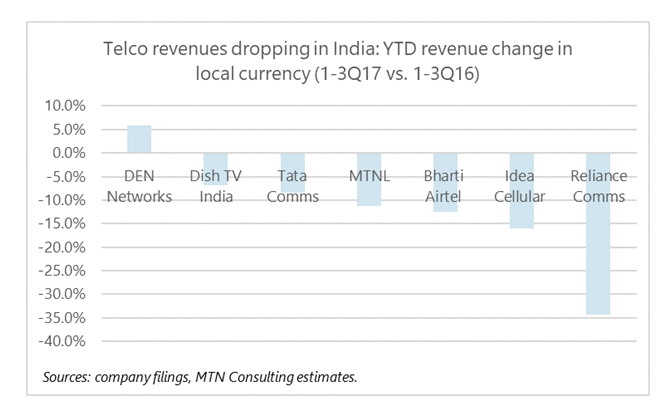
Just recently, in November 2017 the Indian regulator TRAI announced a net neutrality recommendation, concluding that telcos cannot unfairly prioritize content. This was a win for OTTs. India’s telecom regulators are now pursuing more open, pro-consumer policies than the US FCC, which today voted to end America’s version of net neutrality. However, the TRAI’s recommendation still needs to be formally adopted by the government, and India’s telcos are lobbying hard for relief. In fairness, this comes at a tough time for them, as they’re facing high debt and weak revenues, made worse recently by the rapid growth of new entrant Jio. The figure below shows how stark the revenue declines have been for many in recent quarters.

Smartphones are the platform of choice for OTTs in India

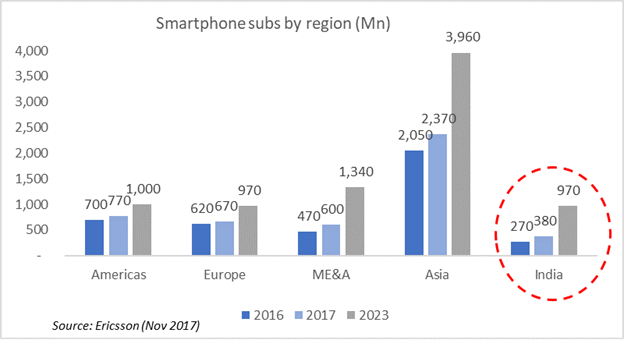
While India’s fixed broadband networks are underdeveloped, it has an enormous base of smartphones. As shown below, by 2023, Ericsson expects India to have 970 million smartphone users, after growing at a 17% CAGR from 2017 . That’s the same as the entire region of Europe.

Given India’s smartphone-centric broadband market, smartphones play a huge role in launching new OTT services and partnerships. For new revenues, telcos are looking at apps and content. A common approach is to bundle traditional offerings with OTT services such as media/cloud storage/video/music, to drive data usage and help migrate users to higher-priced plans.

For instance, video-streaming. Vodafone India has won deals with Eros NowHOOQ, and Amazon’s Prime Video. Vodafone has also partnered with Netflix in a deal which includes carrier-billing, and free Netflix service for a year under a few of the post-paid plans. Netflix plans to strike similar deals with India’s Airtel DTH and Videocon d2h. Starting from scratch, Jio is carving out a niche for itself with app-based services such as JioPlay, Jio Beats, Jio VoD and Jio Security.

As a result of India’s rising smartphone penetration and OTT service adoption, data traffic is booming. Ericsson expects data traffic per smartphone in India to reach 18 GB/month by 2023, from the current 3.9 GB/month. Telcos, of course, claim to worry they’ll be stuck carrying all this traffic, while OTT providers function as free riders of telco network assets. So far, that argument hasn’t held up with regulators.

(Photo credit: Mpho Mojapelo)

Blog Details

Indian Operators Divesting Tower Assets To Raise Cash

Faced with tough competition and high debt, Indian telecom operators are spinning off their tower assets to investors or independent tower companies to improve their financial situation. The 2016 sale of Tata Teleservices’ tower business (Viom) to ATC, and RCom’s planned sale of its tower unit (Reliance Infratel) to Brookfield are just two examples.

Operators in many other regions have divested towers to raise cash, not just India. This is part of an ongoing trend, enabled by the maturity of independent asset management companies. Such divestments in India, though, come against a backdrop of urgent debt reduction needs. Funding network capex while navigating this transition will be a challenge.

Do operators really gain from tower divestments?

Though operators benefit from a cash influx after an infrastructure sale, the devil is in the details. Tower sales typically come with long-term leaseback arrangements, with pre-determined pricing levels locked in. Operators need to set aside sufficient funds for recurring rental costs.

There have been instances where tower companies have shutdown service to operators following rental defaults; RCom is one case. Since the details of the outgoing rental costs incurred by operators are not revealed, it does question the merit of the tower sale. On the other hand, many towers remain underutilized, and operators see benefits not only from the initial sale but in lower ongoing costs as tower space is shared. It also helps them avoid new tower construction, hence avoiding some capex (all else equal).

In India, mobile operators increasingly are focused on their main telecom business, relying for tower assets on a mix of dedicated private equity firms and pure tower infrastructure companies. Deals continue to happen. For instance, now that Vodafone’s acquisition of Idea Cellular has been approved by the antitrust regulator, Bharti Infratel will likely try to buy Vodafone’s 42% stake in Indus Towers. It’s also possible that, post-merger, Vodafone/Idea’s combined 20,000 towers will be acquired by ATC.

Below are a few cases of Indian operators selling towers, or their holdings in tower subsidiaries. Two are completed deals, one is in progress, and two are still under discussion.

Tower asset transfers are affected directly by the broader services market, and M&A changes at that level. We’re seeing this now in India. Vodafone’s merger with Idea, for instance, set to complete in 1H18, is forcing a realignment of ownership in Indus Towers. RCOM’s hoped-for big payout from its tower sale to Brookfield is now in question, since the RCOM-Aircel merger collapsed. Meanwhile, Jio continues to push aggressively to expand, keeping margin pressure high on rivals.

Mobile market consolidation might free up capital for network expansion

In the wake of heavy competition and high debt, Indian operators are exploring various financial deals, not just asset spinoffs.

The recent Tata Teleservices (TTSL) sale of its mobile arm to Airtel, and Vodafone-Idea merger, may just be a silver lining for the Indian telecom mobile market. Over the next five years, we might see a drop in the number of mobile players from 9 to 5. Such consolidation should be beneficial for operators, which can merge network and spectrum holdings. That would free up more capital to invest in network expansions and upgrades; recently Indian operator capex has dipped. Tata Communications’ capital intensity (capex/revenues) averaged just 9.5% for the last three fiscal years, for instance.

With growing demand for a complex range of new mobile services (including in the IoT space), there is a strong argument that operators shift tower management to independent, specialized companies, and focus on providing better quality of service and coverage. India may soon provide a test for that argument.

Blog Details

Weak network spending climate becoming more apparent

Fidelity’s “Communications Equipment” index is up nearly 11% so far this year, tracking just a few points behind the S&P 500’s YTD gain of about 15%. Looking ahead, though, the communications equipment sector remains challenged, something 3Q17 earnings are making clear.

Ericsson, Nokia and ZTE in a similar boat

Vendors selling mainly to communications markets are reporting sluggish demand. In 3Q17, revenues declined by 4% and 9% YoY at the networks divisions of Ericsson and Nokia, respectively (for Nokia’s trend, see figure below).

Multiple regions are seeing the same issue: weak telco revenue growth is constraining more rapid investment. LTE networks are in place, ready for growth & upgrade via software (mainly). Fixed broadband networks remain expensive to construct, and the video revenue upside is proving to be a challenge for many operators, including AT&T.

ZTE doesn’t break out carrier revenues on a quarterly basis. Corporate revenues fell 5% YoY in 3Q17, and ZTE says carrier demand is stronger than average. We’ve estimated 1% YoY growth for ZTE’s carrier group in 3Q17, in local currency. The China capex outlook is cloudy, though, something which both ZTE and Huawei will have to face next year. They also, I suspect, will reinvigorate their vendor financing programs, as has already come up in Brazil with a potential buyout of Oi with involvement from the China Development Bank.

The figure below confirms, though, that it’s not just ZTE, Ericsson and Nokia facing issues. Many suppliers reported YoY revenue declines in 3Q17.

3q17v2

Accenture’s result is modest evidence that telcos continue to increase spending on services & software, but not definitive as Accenture includes telecom in a larger Communications, Media & Technology (CM&T) vertical.

Adtran’s growth is due largely to an acquisition, namely of CommScope’s active fiber access product line, in late 2016.

Corning’s growth is more interesting. Many vendors are reporting a shortage in actual fiber optic cable supply over the last year or two. New factories or expansions have been announced by CorningFurukawa, and most recently Prysmian. These tend to tie in to specific large telco (or national government) fiber builds, as with Verizon’s FiOS and the NBN in Australia. The economics of these builds require video service profitability, in general, and that has been mixed lately.

Telco capex datapoints not reassuring, but it’s early

Many telcos have reported already, including Rogers & Verizon, Telefonica, Orange, America Movil, AT&T, Telenor, and DoCoMo. Occasionally a big operator reports capex growth, unapologetically – referring to the revenue opportunities that might come with that. DoCoMo comes closest to this model so far. Its capex for the last two quarters is up 9% YoY, in part to support new services in the “Smart Life” business. Most, though, are talking down capex, emphasizing that the bulk of 4G work is done, fiber capex is more targeted & tactical than 2 years ago, etc.

On Telefonica’s 3Q17 earnings call, for instance, COO Angel Vila noted that:

“CapEx is on a declining trend in Spain. We have already 97% LTE coverage. I think it’s close to 70% fiber-to-the-home coverage. We will continue deploying fiber, but reduce speed and focusing on connecting… the CapEx trend in Spain is already declining in terms of CapEx to revenues.”

Many operators have similar stories. Vendors will have to seek out the ones with more budget flexibility. Even with some success, though, it’s likely we will see a pickup in M&A activity around the communications equipment sector over the next 1-2 years.

Blog Details

India’s RCom Under Pressure After Its Failed Merger With Aircel

Reliance Communications’ (RCom) long-planned merger with Aircel, part of Maxis, fell apart last week in the face of legal and regulatory hurdles. This news comes as multiple operators in India are struggling with debt and declining margins.

Both RCom and Aircel face debt issues and declining revenues

The primary reason behind the planned RCom-Aircel merger was to consolidate and reduce losses. The combined entity would have become India’s fourth largest in terms of subscriber base, and the scale would have (hopefully) enabled both to better manage their debt. RCom’s total debt is roughly INR470B, while Aircel’s is INR200B. Both are also facing revenue declines; in 1Q17, for instance, RCom’s revenues fell by 24% QoQ , while Aircel’s QoQ drop was far worse at 47%.

The merger’s failure opens up a debate on the survival of India’s weaker operators, burdened with debt and some on the verge of insolvency.

Grim industry outlook

Many of India’s operators today are in dire straits, facing high competition and coping with high levels of financial stress. In addition to RCom and Aircel, Tata Teleservices (TTSL), for instance, has a debt burden of INR340B, and is considering exiting the business.

Given the large number of players in the market and the high capital investment needed to compete, more consolidation was always in the cards. Earlier this year, Airtel acquired the India operations of Telenor and its over 40M subscribers, for instance. Vodafone India’s pending merger with Idea Cellular is likely to be completed in 2018, producing a combined entity with ~400 million customers. Vodafone hopes for “substantial cost and capex synergies” from the merger.

After these big deals, the remaining players have fewer options to revive their business. Without a good M&A option, selling assets to raise cash is one option being explored. Spectrum sales may come in handy, but it’s a buyer’s market. In the event of a failure to sustain their business, an operator can be compelled to surrender spectrum (one possible outcome facing TTSL).

Uncertain future for RCom and Aircel

The future for Aircel and RCom looks bleak, as competition is heating up. Most Indian operators are facing the heat of Jio’s September 2016 nationwide launch. Jio’s aggressive pricing, though, has been especially difficult for RCom and Aircel to replicate.

RCom desperately wanted this merger as it was vital for its debt reduction efforts. The merger would have resulted in a combined entity with an asset base of close to INR650B (US$10B) and a net worth of INR350B. This greater scale would have allowed faster debt repayments and a 40% overall debt reduction for RCom by the end of 2017. Moreover, tower companies are pressuring RCom to pay back dues on its tower rental contracts. RCom has to pay American Tower Company and Bharti Infratel about INR200-250M each; and about INR95M to GTL Infra (including its unit CNIL).

RCom had plans for selling the towers of the combined RCom-Aircel entity to Brookfield Asset Management to clear a significant portion of its debt. But with the merger now being called off, the tower deal will have to be reassessed. Brookfield had apparently wanted to buy the combined tower base for up to INR110B. RCom is still hopeful about reviving its business by deploying 4G services, via a spectrum agreement with Jio. It also hopes to monetize its 2G and 3G spectrum and sell some real estate assets. But RCom has a long way to go in growing and sustaining its subscriber base in a highly disruptive mobile market.

Can Jio bailout RCom from this crisis?

Despite Mukesh Ambani, founder of Jio, and Anil Ambani, owner of RCom, denying all rumors surrounding a possible merger, it would not be a surprise if it happens.

In early 2016, the companies entered into a spectrum sharing deal, where RCom sold its spectrum in nine circles to Jio and approved spectrum sharing in another 17 circles; fiber sharing was also involved. By most accounts, the deal was a success for Jio, as it enabled a quick national launch. The deal has brought fewer benefits to RCom, which is now incurring losses and running out of funds for network expansion.

RCom might also be considering a bail out option. In June 2017, RCOM requested government support (through an “inter-ministerial group”) to withdraw the 10% cross holding restriction. This rule states that operators are not authorized to own more than 10% equity in two different operators in the same circle, thus hinting at a possible sale of its equity to operators. Considering its past association with RCom, Jio seems the most likely other operator to buy equity in RCom. And if such a deal takes place, it will provide Jio with greater access to RCom’s towers, fiber and spectrum. Only time can answer if Mukesh Ambani will come to his brother’s aid in bailing him out from this crisis.

(Photo credit: Pablo Garcia Saldana)

Blog Details

Comtech Expects Flat 2018; US Market An Issue?

If you follow telecom closely yet haven’t heard of Comtech, that’s no surprise.

Acquisition of TCS in 2016 doubled the company’s size

Comtech Telecommunications Corp. is far smaller than the biggest vendors in the  market (Huawei, Ericsson, Nokia, Cisco etc). But it’s nearly doubled revenues in the last two years, to $550M for the 12 months ended July 2017. A rough estimate of the telco piece of this is $200M, including both wireless & satellite. It’s worth checking out.

Most of Comtech’s recent growth has come from the acquisition of TeleCommunications Systems (TCS) in Feb 2016. That deal reinforced Comtech’s already strong position supplying specialty transmission and mobile data products to government end users. The deal also gave the company valuable distribution links into wireless operators, where TCS does well with “mission-critical C4ISR solutions and next generation emergency 911 services.”

For the new Comtech, the TCS deal has clearly helped it most in one segment: US customers not part of the federal government (figure, below). That includes US state & local governments, but lots of telcos as well. Comtech’s announced US telco customers include AT&T, Comcast, Sprint, Telefonica, and Verizon.

comtech-mtnconsulting

From zero to $201M in debt

Comtech is in a stronger position post-TCS to sell both to government & wireless telco customers, but the deal came with costs. Prior to buying TCS, Comtech had $151M in cash on hand and no debt (July 2015). After the deal (as of July 2017), Comtech’s cash and cash equivalents balance was just $42M, and it now has $201M in debt.

To service its new debt, it needs growth (among other things). Yet revenues for the three months ended July 2017 fell 3% YoY, and Comtech is guiding the market for just 0-4% revenue growth in FY18. A tighter government spending climate in the US could be an issue. A coming slump in US wireless capex is another likely contributor. (And this is something to look for as Verizon, AT&T, and Sprint report earnings over the next few weeks.) It wouldn’t surprise me if these twin pressures encourage Comtech to make a bolder play in search for growth. As the CEO said on last month’s earnings call, “the integration of our TCS acquisition and focus on gross margin is largely complete. We have now shifted our focus from integration to growing our business.” Turning back to M&A is one option for Comtech, although it could end up being the target.

(Photo credit: Jake Sloop)

Blog Details

China Mobile To Go (More) Global?

Buying opportunities

During the 2008-9 financial crisis, some wondered (including me) if the relatively flush Chinese operators would use the downturn as a buying opportunity into overseas telco markets. China Mobile seemed promising, given its (now even higher) cash reserve. CM did make a small move before the crash, when in 2007 it bought into Pakistan’s mobile market.

What’s actually happened in the last decade was, not much.

China Mobile has continued to invest in Pakistan, helping its “Zong” unit become the third-ranked player in the market. This year, roughly $200M of China Mobile’s 2017 capex will support Zong, to expand 3G/4G coverage. That’s less than 1% of CM’s projected capex of 176B RMB for this year, though. Overseas growth simply hasn’t been a priority for CM or its main rivals, given the size and growth rate of the domestic market.

State ownership implications

Chinese government entities retain majority control over each of the big 3 telcos. There’s nothing nefarious about this; it used to be common in most of Europe, and still pops up in a handful of other large countries. But it does clearly color investment priorities.

That’s certainly been the case in China. The government has been aggressive in using its ownership stakes, not just regulations, to manage the sector. China Mobile’s choice to invest in Pakistan in 2007, as opposed to say its neighbor to the east, was part of a larger strategy. That’s now culminated in the China Pakistan Economic Corridor.

Bailing out Oi?

With that, one recent story is interesting.

China Daily reported last week that China Mobile might be buying Oi (once known as Telemar), a Brazilian operator plagued by debt issues and undergoing restructuring.

Assuming it’s true, CM’s primary motivation would be ROI (return on investment). However. The China Development Bank would also be involved, per the story. CDB has been an active overseas lender in the telecom sector for many years (in Africa, for instance). It’s also active in Latin American telecom, partly through a $1B 2009 loan to America Movil. CDB has more of a political role than China’s other banks.

CDB lending is typically tied to some commitment to rely heavily on Chinese technology, and/or Chinese labor. As such, a CM/CDB-led acquisition/bailout of Oi will benefit Chinese tech vendors, all else equal. Ericsson, Nokia, Cisco and others active in Brazil will have to watch this very closely.

The bigger question is, will CM start to spend more of its cash stockpile overseas? It has 5B RMB in debt, true, but in the first six months of 2017 its free cash flow was 53B RMB, over 10 times that. Its cash and cash equivalents balance in June was 406B RMB, around US$61B. That’s plenty of buffer to expand, especially with support from the China Development Bank.

Blog Details

Rising Costs Plague India’s Tata Teleservices As Competition Intensifies

Tata Group is looking for a clean break

Tata Teleservices (TTSL) has family ties to one of India’s biggest industry groups, but that hasn’t helped it escape the “Jio effect” in recent years.  With just 8.7 million subscribers and a (unified service) license covering only Mumbai and (rest of) Maharashtra & Goa, TTSL has struggled against larger nationwide competitors. Tata Group’s new chairman is now reported to be looking to sever ties with TTSL.

This comes a few months after NTT DoCoMo sold its stake in TTSL back to Tata Sons, consolidating Tata’s ownership in TTSL.

The Jio effect

Reliance Jio has used its nationwide unified license and deep pockets to blanket the country with its new network, and has been pricing and bundling very aggressively. Jio’s push has affected all major operators, but small ones like TTSL have had it especially hard.

TTSL’s license has always limited its growth ceiling. As India’s telecom sector has exploded in recent years, though, TTSL has actually shrunk. Its peak was in March 2011, when it reported 16.9 million subscribers. It now has just over half that subscriber base.

Despite the mobile decline, TTSL’s fixed division has grown recently. While TTSL doesn’t break out details, it does report that wireline grew from 30% of revenues in FY2014-15 to 36% in FY2016-17. Total company revenues have grown a bit (20%) since FY2011, despite TTSL’s mobile user decline and India’s declining mobile ARPUs . TTSL’s wireline business has expanded.

Cost curve has been going in the wrong direction

TTSL’s EBITDA margin (EBITDA divided by revenues) has hovered in the comfortable but not stellar range of 20-30% for each of the last 8 fiscal years (it was slightly higher before that). Despite this operating stability, its net margins (net profit divided by revenues) have been negative for 6 straight years, coming in at -85% in FY2016-17. These steady losses have resulted in high debt, among other challenges.

Finance-related costs main culprit, but network & regulatory also key

While most of the telecom industry faces declining costs, on a per line or per subscriber basis, TTSL’s recent experience has differed.  Focusing just on three fiscal year periods (FY2010-11, FY2013-14, and FY2016-17), the figure below shows TTSL’s costs on a per subscriber basis, in Rupees per year.

MTN Consulting - TTSL costs.png

Five categories are shown. Three are operating (network operations, regulatory-related opex, and the cost of renting infrastructure under sharing agreements), while two are non-operating (net financing costs, i.e. the cost of servicing its debt, and depreciation & amortization, or “D&A”).

In each area, TTSL has faced challenges in recent years.

TTSL’s increase in finance costs have been staggering, and D&A costs have also grown. What’s not shown are results through June 2017 (i.e. 2Q17), when TTSL’s finance costs worsened, to 69% of revenues (from 24% in 2Q16)

Regulatory costs per line doubled from FY11 to FY17. These costs vary by country and the operator’s business model. License fees and spectrum charges are in general high in India. So, the fact that TTSL’s regulatory costs – while they are high – isn’t an immediate red flag. But it hasn’t helped the company.

Infrastructure sharing operating expense (opex) has also risen as TTSL has relied more on other providers for network coverage. One goal of this sharing is to lower capex requirements in the short-term, and eventually also debt. Given TTSL’s ongoing high finance costs, that doesn’t appear to have been successful.

Finally, network operations opex trends at TTSL are unusual. Most operators globally have experienced declining network operations costs over time, due to new technology, greater scale, and other factors. TTSL, though, saw network operations opex (per line) more than double between FY2011 and FY2017.

What might explain the network operations trend? One possibility: TTSL started relying far more on other providers for its infrastructure. Infra sharing costs as a percent of total opex grew from 9.3% in FY11 to 19.2% in FY17. Increased sharing could have resulted in some unexpected internal network operations costs; that’s a topic for further research. Another likely factor is the decline of TTSL’s mobile subscriber base, and a relative growth in fixed operations. Mobile subscribers often carry lower ARPUs, but the cost of supporting them in the network is also lower. That’s not the case for every company, clearly, but TTSL’s recent experience supports this view.