
Blog Details

After failure to adapt to 4G, telcos need to evolve

It was the Greek philosopher Heraclitus who coined the phrase, “Change is the only constant in life.”

Well over a thousand years later, Benjamin Franklin continued the thought, saying, “When you are finished changing, you are finished.”

From the wheel to the internet and beyond, the need for change, for new ideas, new technologies, has been a defining element of humanity. Through trial and error, innovators conceive of an idea, conduct research, prove their hypotheses, and develop and refine their concepts. Such research and development have become absolutely vital to the success of the telecommunications industry. Without R&D, humanity might never have evolved past the rotary-dial telephone. There would be no internet, no cell phones, none of the technological marvels we often take for granted … amazing tools that our predecessors likely could not have envisioned even in their dreams.

Or… perhaps they did. After all, the myriad technologies of science fiction are continually becoming science fact. For example, many of the technologies of the original “Star Trek” are commonplace today. The communicators, viewscreens and tricorders of that fictional future exist today as cell phones, laptops, video chats, and advanced sensor packages.

AT&T is another example. Back in 1993, the telecommunications provider (telco) aired commercials that examined what its researchers were developing, and extrapolated the impact of those technologies on the future. The commercials accurately predicted global positioning systems, laptops, tablets, smart watches, keyless entry and on-demand video entertainment … in an era before most homes even had internet connections or home computers.

That was nearly three decades ago. In the time since, you’d expect that AT&T would be spending more on R&D, particularly this far into the digital age.

You’d be wrong.

From 2000 to 2021, AT&T’s annual spending on R&D hovered between 0.7 percent to 1.3 percent of its total revenue. For 16 of those 22 years, AT&T’s R&D expenditures remained less than 1 percent of the company’s total revenue.

Surprised?

Don’t be.

Other telcos show much the same spending pattern. From 2018 to 2020, SK Telecom spent an annual average of a mere 2.2 percent of its revenue for R&D expenses. Telefonica spent less, at 2 percent. NTT spent 1.9 percent; Chunghwa Telecom, 1.8 percent; Orange, 1.6 percent; Comcast and KT Corp., 1.1 percent; and China Telecom, 1.0 percent. Most others, including AT&T (0.7 percent) and LG Uplus (0.4 percent), spent less than one percent of their overall revenue on R&D.

“Telcos (tend to) spend very little on R&D, instead relying mainly on their suppliers for innovation,” Matt Walker, chief analyst at MTN Consulting. “The world has hundreds of telcos but only a few dozen significant suppliers, so some of this is inevitable. The smaller telcos can’t afford to do it all themselves,” said Walker, as they often lack the staffing or the financial resources to conduct their own R&D.

On top of their lack of spending, telcos are also largely slow to innovate. When 4G wireless debuted, telcos rejoiced at the idea of earning new revenues from the networks, which were expensive. However, the majority of the revenue from the new networks went to the companies that build telecommunications devices, like Apple; app companies; content providers, like Netflix; and cloud services companies. This left telcos out in the cold, as they could buy the technology needed to provide 4G, but not truly profit from it.

When 5G networks emerged, the telcos spent big, again hoping for a revenue upside from the investment. Thus far, however, they are in the same position where 4G left them … not benefitting financially, and still wary of spending much on their own innovation and R&D.

“This arrangement worked alright when telcos had limited competition from other sectors,” Walker noted. “However, in the last five years or so, these new ‘big tech’/webscale players have begun encroaching on different aspects of the telco turf.”

Are telcos doomed to repeat the same mistakes? Hopefully not.

Should they be spending more on R&D to help develop new revenue streams? Yes.

Are there examples of leaders in the sector to learn from? Yes.

Telcos should not have to wait on their downstream vendors to innovate and create new technologies, from which they can benefit. Instead, they should take advantage of the growing and rapidly evolving technologies and innovate on their own.

Indeed, some industry leaders are already beginning to call for such a paradigm shift. Aaron Boasman-Patel, vice president of AI & Customer Experience at TM Forum, and Brian Smyth, Accenture’s Global Comms & Media Innovation Lead, conducted research on the matter, the results of which they published in their white paper, “The tech-driven telco.”

“At the most basic level, the world has changed since the telco business model was introduced,” said Smyth. “… At Accenture, we see three mega trends, the first one being the customer – so how we live our life, how we engage with civil society and government, how we work; the second being business model reinvention, … how technology transforms not only customer experiences, but also how customers buy into products and services. We’re seeing within this also a big focus on partnership and partnering together with other organizations to offer new services and experiences.”

“And then finally, it’s the technology revolution. So, in telcos a lot of talk today is around 5G, edge networks, and a lot of this is the confluence of these three points of customer imagination, reinvention, and the technology revolution I think are all leading to this transformation from the traditional telco” to a more tech-driven model.”

Added Boasman-Patel, “If you don’t evolve, then you’re not going to be able to take a slice of the pie – the $700 billion worth of new revenues which are out there today. … If you think about, what we’ve seen through the pandemic, telecoms shares have increased by about 4.8 percent compared to other industries like semiconductors and electronics up by nearly 50 percent, media technology, high 35 percent. … I think when you get above 20% of (revenue spending), whether in industrial manufacturing, or sensor management or whatever it may be, that’s where you can start to say you have become a true techco,” he said.

In November 2021, Ericsson, the world’s second-largest supplier of technology to telcos,  surprised many observers by announcing that it was purchasing Vonage, a cloud communications company. That one company would acquire another is standard fare for financial news. Also, it wouldn’t be unprecedented for a telco to buy one of its vendors. The November deal, however, was the reverse: Ericsson, a vendor/supplier to telcos, was buying Vonage, a telco.

“That deal was surprising because it was a traditional vendor buying what seemed to be a telecom provider/telco, i.e. Vonage,” noted Walker.

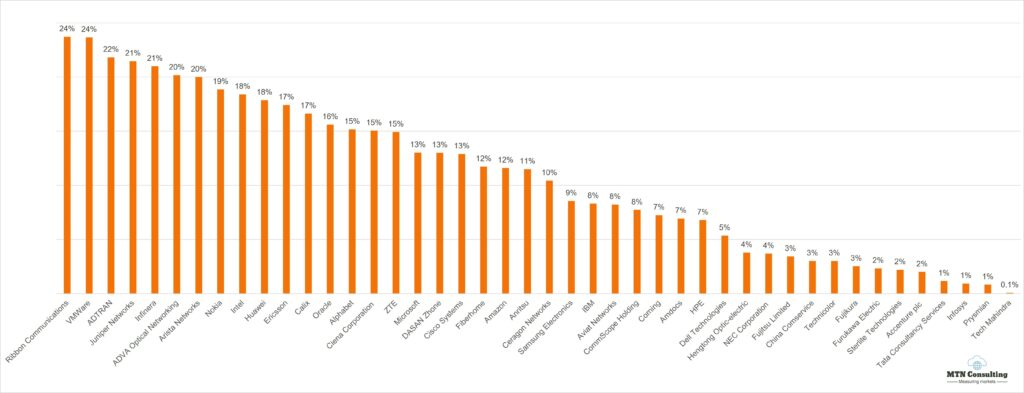
Unlike the typical telco, vendors do usually spend quite a bit on R&D. Ericsson, for example, spent an annual average of 17 percent of its revenue for 2019-2021. Many others spend less, including Alphabet and ZTE (15 percent each); Microsoft (13 percent); Amazon (12 percent); Samsung (9 percent) and IBM (8 percent). In contrast, Ribbon Communications spent 24 percent; Juniper Networks (21 percent); Nokia (19 percent); and Huawei (18 percent). Alphabet and Microsoft are included in these figures because their cloud divisions GCP and Azure, respectively) have become important suppliers to telcos.

Figure 1: R&D spending as % of revenues for select Telco NI vendors, 2019-21 average

Source: MTN Consulting

Ericsson made the $6.2 billion deal in the hopes that, if approved by regulators, its acquisition will help it work with telcos to better monetize apps and services. Ericsson has mapped out a plan to help their telco customers get new sources of revenue from the new networks currently being built.  Its acquisition of Vonage means that it now has a telco subsidiary with a dedicated R&D mission. Indeed, unlike the regular low numbers shown at other telcos, Vonage’s R&D numbers tend to trend higher.  In 2011, Vonage spent 1.8 percent of its revenue of R&D. In 2014, that number rose to 2.4 percent. In 2019, it hit 5.8 percent, then rose to a high of 6.5 percent in 2020 before dipping to 5.7 percent.

Indeed, Vonage hews closer to the “techco” model favored by Boasman-Patel and Smyth than it does to that of a standard telco model.

“I think mindsets are really important here to drive that change,” said Smyth. “A really interesting example is Microsoft. When Satya Nadella took over Microsoft in 2014, at that point they were hugely profitable as an organization, but not very exciting. And Satya talked about actually wanting to build an organization and products and services that customers would love. And they had missed big trends at this point. They had missed things like search (engines) and mobile, and a lot of people were questioning whether Microsoft’s best days were really behind it at that point, where he came in with this focus on building this growth mindset.

Smyth continued, “The growth mindset is actually … about shifting from the sort of know-it-all to the learn-it -all mindset and being hungry and open to change and collaboration. And what we’ve seen since is a 10x growth in the market cap of Microsoft. And an incredible performance and a complete refresh of the brand, attracting young talent, attracting the next generation of sort of leaders across new technology domains and re-cementing their position in future technologies, whether it’s cloud, or now looking at the metaverse.”

Vonage, like Microsoft, leaned into its own evolution.

“Vonage was no longer just a telco” by the time Ericsson announced the acquisition deal in 2021, said Walker. “It started life as this, but had evolved more into a hybrid in the last five years, creating lots of its own intellectual properties (IP). From 2018 to 2021, Vonage spent about 6 percent of revenues on R&D, way higher than the average telco, and closer to a vendor.”

Indeed, Vonage’s most recent annual report tells the story of its evolution from telco to techco: ““Founded in 2001, Vonage was among the first companies to provide Voice over Internet Protocol technology offering feature-rich, low-cost home phone services. Through a series of strategic acquisitions and organic growth, Vonage since has transformed from a VoIP-based residential service provider to a global leader in business cloud communications.”

Vonage also has a long list of patents, which helps fuel its innovations.

“Vonage does some things that don’t look like what a vendor (Ericsson) would normally do,” noted Walker. “But Vonage’s R&D creations (will) allow Ericsson, in theory, to provide valuable support to its other telco customers in an important area, i.e. monetizing the network through use of APIs,” or Application Programming Interfaces, which permit different applications to communicate.

Although most U.S. telcos continue to play it safe, telcos in the United Kingdom have begun to increase their R&D sending. In 2020, they spent over 1 billion pounds (1.2 billion pounds, or $1.56 billion USD) on R&D … the first time they have done so in nearly 10 years.

According to the British Office for National Statistics, the telco sector boosted its R&D spending by 4.5 percent during 2020, to 1.03 billion pounds. They last spent that type of money on R&D in 2011, when they spent 1.04 billion pounds.

However, not surprisingly for a time during a pandemic, UK R&D spending by telcos and all other industries remained in the shadow of pharmaceutical sector, which boosted its R&D spending by 6 percent to 5.02 billion pounds ($6.19 billion USD).

“There’s a demand from industry to actually partner and collaborate with (communications service providers) to build out these new services,” said Smyth. “… It’s quite interesting from some of the initial feedback we’re hearing there is a desire on the CSP side to really just offer connectivity solutions, sell connectivity. So, I think what industry is looking for is support in solving their business problems. And I think there’s great opportunity for CSPs as they’re building the scalable platforms to actually go in and partner and co-create with industry to build solutions.”

4G set sail some years ago, and telcos largely missed the boat. It’s still relatively early in the rise and growth of 5G. Hopefully, telcos will learn from the mistakes they made with 4G. If they prioritize creating and funding new R&D initiatives, they can evolve into more technology-driven companies. This will allow them to benefit, in terms of technology and revenues, from 5G.

It’s not too late for telcos to fully get on board with 5G … before that opportunity also sails out of reach.

About the author

Melvin Bankhead III is the founder of MB Ink Media Relations, a boutique public relations firm based in Buffalo, New York. An experienced journalist, he is the president of the Buffalo Association of Black Journalists, and a former editor at The Buffalo News.  

*

Cover image: iStock

Blog Details

It’s time for tech to take a stand

In 2000, Google famously incorporated a simple catchphrase into its corporate code of conduct: “Don’t be evil.”

The idea, said Google, was that “everything we do in connection with our work at Google will be, and should be, measured against the highest possible standards of ethical business conduct.”

Google’s founders recognized that the growth of its search and ad platforms was turning the company into a powerful entity with the ability to shape user’s understanding of the world. While the “don’t be evil” catchphrase was mocked by some, it did at least imply that the company saw that its growing power came with certain responsibilities. The tech industry could use more of this sentiment in 2020.

Chaos in the streets is a feature, not a bug

Fast forward 20 years, 3.5 years after Facebook helped elect Donald Trump to the presidency, and America is in crisis.

The country is now run by a president who, as Jim Mattis, Trump’s first Secretary of Defense, put it, “is the first president in my lifetime who does not try to unite the American people—does not even pretend to try. Instead, he tries to divide us.” There are parallels in this to how Trump ran his 2016 campaign, deftly using Facebook and other social media to micro-target his messaging.

Since George Floyd was killed by a Minneapolis police officer on May 25, and the video of the killing went viral, protests have spread nationwide, to even the smallest of towns. Some opportunists have used the protests for looting, as is always the case, and some far-right, pro-Trump actors have deliberately engaged in looting and vandalism in order to give cover to any resulting police crackdowns. The bulk of the violence, though, is top-down. Egged on by Trump, police officers and an array of other armed security officers have reacted to largely peaceful assemblies of their fellow Americans with violent tactics and gear designed for fighting wars.

Patrick Skinner, a writer, former intelligence officer, and now police officer in Georgia, implied this violence was by design on his Twitter feed recently:

“Don’t let us off the hook by saying this orgy of violence is a failure in training. It is not. It is the result of training for war. Don’t say it’s a lack of a few de-escalation power points. It is not. It is the result of training for war. Our entire mindset is a war on crime.”

Racism didn’t start with Trump, nor did the militarization of the police. But this President has used a unified right-wing mass media propaganda machine and the tech industry’s social media tools to make both hip again. Cultivating a tough-guy image, he once urged a police group, “Please don’t be too nice” to suspects. Note his focus: “Suspects,” as opposed to convicted criminals.

Today, hundreds of thousands (if not millions) are protesting to be heard, at great personal risk, while the COVID-19 pandemic rages on. Republican politicians are under pressure to preserve an image of a good economy, in hopes of a Trump re-election, so public health concerns take a back seat. The political movement that claimed to be concerned with the lives of the unborn, and responds to “Black Lives Matter” chants with the inane “All Lives Matter,” is now persuading the public to overlook the 100,000+ deaths from COVID-19 and just get back to work.

In my home state of Arizona, which has a population of over 7 million, more than 1,000 people have died from COVID-19. Prior to this, I lived in Thailand for a decade. That country, which has more than 70 million — more than 10 times than that of Arizona — has recorded fewer than 100 COVID-19 deaths. And Arizona’s gross domestic product per capita (nominal) is over five times that of Thailand. What good is wealth if elected leaders don’t use it to invest in things like public health for their constituents?

As Mattis said in his recent statement, “We are witnessing the consequences of three years without mature leadership.”

Tech executives continue to hedge their bets

We are also witnessing how obsessed with money the rich and powerful of this country have become.

The hundreds of Internet companies to make it big since Google’s advent have become even bigger since Trump’s 2017 tax reform directed massive tax cuts to corporations and high-income individuals. Their top execs have become far wealthier. Even with extreme levels of unemployment and a steep GDP drop inevitable in 2020, these folks are doing just fine.

Surely, you would think, the largely liberal (so we’re told) tech sector would have spoken out by now, publicly critiquing not only specific acts of police violence but, more importantly, the messaging sent from the top. Yet, when we surveyed the top few execs of the largest companies in the U.S. Internet and telecom sectors, we came up largely dry. If wealth is supposed to free you to do and say what you want, the results have been revealing (Table 1).

Table 1: Public comments on George Floyd and Racism by Tech Execs 

Company Market cap (U.S. $B) Tech executive Public comments
Alphabet                 977.0 Sundar Pichai, CEO Posted a picture of a modified Google search home page, with new text: “We stand in support of racial equality, and all those who search for it.” Pichai’s post: “Today on US @Google and @YouTube homepages we share our support for racial equality in solidarity with the Black community and in memory of George Floyd, Breonna Taylor, Ahmaud Arbery & others who don’t have a voice. For those feeling grief, anger, sadness and fear, you are not alone.”
Amazon              1,220.0 Jeffrey Wilke, CEO, Consumer Two tweet thread: (1) “A friend who is a Black man sent me an email today that included: “The narrative that security of accomplishment will somehow lead to equality in this country for people of color, especially Black men, is a false narrative. It is simply not real.” (2) “Since I’ve subscribed to this idea — that facilitating achievement was the key to solving the problem — I looked in the mirror and asked “Have I done enough? Have I listened carefully enough?” Clearly the answer to both is “no.””
Amazon              1,220.0 Andrew Jassy, CEO, Amazon Web Services Tweeted “*What* will it take for us to refuse to accept these unjust killings of black people? How many people must die, how many generations must endure, how much eyewitness video is required? What else do we need? We need better than what we’re getting from courts and political leaders.”
Amazon              1,220.0 Jeff Bezos, COB & CEO Posted an essay on Instagram called “Maintaining Professionalism in the Age of Black Death is…A Lot”. Bezos’ personal intro to the essay: “The pain and emotional trauma caused by the racism and violence we are witnessing toward the black community has a long reach. I recommend you take a moment to read this powerful essay from @goldinggirl617, especially if you’re a manager or leader.”
Apple              1,380.0 Tim Cook, CEO, Director Tweeted “Minneapolis is grieving for a reason. To paraphrase Dr. King, the negative peace which is the absence of tension is no substitute for the positive peace which is the presence of justice. Justice is how we heal.”
Disney                 211.9 Robert Iger, Executive COB Tweeted “Below is a link to a statement we sent to our fellow @Disney employees. It’s from Bob Chapek, our CEO, Latondra Newton, our Chief Diversity Officer, and me. Thank you.” The link is a letter to Disney employees that discusses George Floyd.
Microsoft              1,390.0 Satya Nadella, CEO, Director Re-tweeted a Microsoft Corp. post that it would be using its platform to “amplify voices from the Black and African American community at Microsoft.”. Nadella’s post says, “There is no place for hate and racism in our society. Empathy and shared understanding are a start, but we must do more. I stand with the Black and African American community and we are committed to building on this work in our company and in our communities.”
Netflix                 184.6 Reed Hastings, COB, President, CEO Retweeted a video promoting non-violence, which said: “Some protestors in Brooklyn calling to loot the Target, but organizers are rushing in front of the store to stop them, keep things non-violent #nycprotest”
Snap                   27.4 Evan Spiegel, CEO, Co-Founder, Director Posted a Snapchat with intro saying, “We condemn racism. We must embrace profound change. It starts with advocating for creating more opportunity, and for living the American values of freedom, equality and justice for all. Our CEO Evan’s memo to our team:”, followed by a link to a message written by Evan to his team members.
Twitter                   24.3 Jack Dorsey, CEO, Director Active participant in online discussion, largely through re-tweets, several of which highlight police violence. In May, raised Trump’s ire by flagging one of his tweets for “glorifying violence.” An important but small step, though: the New York Times reviewed a set of Trump tweets for the week of May 24th, and found at least 26 out of 139 posts contained clearly false claims.
Verizon                 237.4 Hans Vestberg, COB, CEO Pinned a Tweet and posted the video on Instagram as well as from Verizon’s Twitter feed of a video clip of himself speaking up on the death of Floyd, captioned “We cannot commit to the brand purpose of moving the world forward unless we are committed to helping ensure we move it forward for everyone. We stand united as one Verizon.”
Verizon                 237.4 Ronan Dunne, EVP, CEO Consumer Group Tweeted, “While it’s hard to find the right words, we need to do more than speak — we need to listen and act. I’ll do my part to learn and help elevate the voices that will drive the change we want and need to see in the world. #ForwardTogether”, followed by a link to a video of CEO Hans Vestberg speaking on the subject.

Note: all posts are from the May 30-June 3 timeframe; exact dates available in links.

Most prominent execs have simply kept their heads down. One big exception is Jack Dorsey of Twitter, who appears to have had a recent awakening as to the power of his company’s platform and how well it has been manipulated by the powers that be. Watch Jack.

Snap CEO Evan Spiegel has also started to find a voice, first deciding to stop promoting (for free) content from Trump on Snap, and saying that Snap needs to “embrace profound change.”

Many more execs have issued bland, low-risk statements, sometimes head-scratchingly vague, as with the Verizon CEO’s focus on “the brand purpose of moving the world forward.” Apple CEO Tim Cook quoted the Rev. Dr. Martin Luther King Jr. on Twitter, saying “positive peace” requires the “presence of justice.” Cook also sent a letter to employees which received some public praise.

Yet the Cook letter also risked almost nothing, for Apple as a company and Cook personally. Silicon Valley VC Vinod Khosla pointed this out in response, saying that “it’s easy to support equality & justice…it’s when one has to give up something to support it that belief in our real values show up. @tim_cook easy to talk but why do you suck up to @realDonaldTrump?”

Exactly the point.

Let’s not forget, we are talking about some of the wealthiest, most powerful people in America. The few who have spoken recently are clearly in favor of equality, and pro-human rights, but their statements read as largely vacuous lip service. Recall that clause within the U.S. Declaration of Independence, “All men are created equal.” Inspirational, yes, but, at the time, white male property owners just happened to be a little more “equal” than others.

Words are easy to toss around, then and now. Actions count.

If you have ever read the Bible, whether as a believer or a student of philosophy, this quote seems apt: “To whom much is given, much will be required.”

What can tech do?

The first step to fixing a problem is accepting that you have one. Some tech companies have arrived at this point, notably Twitter.

The second step, in this case, is deciding that you have the resources to fix the problem. On that note, some market data may come in handy.

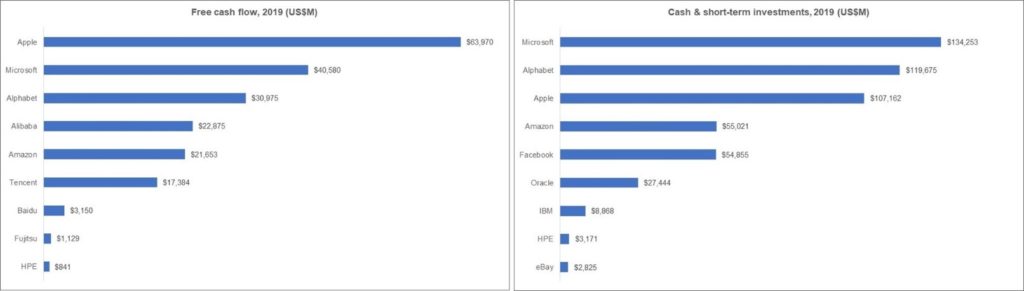
Figure 1 below illustrates just how deep the pockets are in the sector of webscale network operators, tracked by MTN Consulting. The “webscale” sector encompasses big companies in the Internet services industry like Facebook and Google who have built out their own physical network infrastructure to support their services and operations, with data centers taking up much of the spending. The figure shows the free cash flow generated in 2019, and year-end cash reserves, of U.S.-based webscale players.

Figure 1: Free cash flow and cash & short term investments at year-end in the webscale sector, 2019

Source: MTN Consulting, “Webscale Network Operators: 4Q19 Market Review

These are immense companies which have recorded profit margins far above most other sectors, and for many years. There’s always pressure to grow profits more, or use more of the cash for mergers and acquisitions in order to position for growth of forestall new competitors. But saying that they can’t afford to improve their platforms is a hard argument to make.

Then there’s another question: Why should they bother? Many will read this and, even if they oppose Trump, may think it’s not tech’s job to get involved in politics. It’s not a tech CEO’s job to combat rising authoritarianism, racism, or the metaphorical shredding of the Constitution. That, they will argue, is the job of voters.

However, these tech and telecom CEOs do have a responsibility to ensure their platforms are not used and manipulated by evil actors to do evil things. Not just for moral reasons, but also to ensure their platforms can thrive over the long-term. It’s been clear for at least 3.5 years that many are failing at this aspect of their job.

MTN Consulting’s contribution

MTN Consulting is an industry analysis and research firm, not a company that typically comments on politics. We remain focused on companies who build and operate networks, and the vendors who supply them. That isn’t changing. However, we are going to dig into some of the technology issues related to these networks and networking platforms which are having (or will have) negative societal effects.

Specifically, over the next few weeks, we will issue reports on:

  • Bots on social media platforms: How they work, how they shape public opinion, and how they can directly impact elections
  • Privacy: How social media and telecom companies exploit user data to sell more ads, and how this user data is often sold to and misused by third parties (including government actors)
  • Digital advertising and journalism: How tech companies’ takeover of advertising markets has impacted the news industry and complicated citizens’ efforts to get reliable information
  • Deep fakes: How machine learning and artificial intelligence (AI) research, much of it done by the webscale sector, is about to make it even harder to distinguish fact from fiction; how that may reduce the value of social media platforms; and how both webscale players and users will have to cope.

For those of you accustomed to seeing us write about data centers, optical fiber, mobile radio access networks and similarly dry topics, have no fear – that will all continue. This is a moment in time, however, when sitting on the sidelines of more consequential debates is no longer an option.

-end-

Photo by Khalid Naji-Allah, Executive Office of the Mayor via AP

Blog Details

Alibaba aims to undercut US chipmakers’ dominance

Alibaba entered the club of webscale network operators (WNOs) developing their own chips recently, joining Amazon, Apple, Facebook, and Google. The Chinese e-commerce giant announced plans, in September 2018, to develop its own customized neural network chip, called Ali-NPU, to aid its growing cloud and IoT businesses. But unlike its WNO peers who want more flexibility and cost-efficiency in their operations by running in-house chips, Alibaba’s move is motivated by a grave external risk: the US-China trade war fallout.

A series of trade disputes set alarm bells ringing for Alibaba

Alibaba views its move as a precautionary response to a series of hostile trade events this year, starting with the leading US carriers, Verizon and AT&T, deciding to halt selling phones of the Chinese handset maker, Huawei, in January 2018.

Multiple factors were involved but there’s no doubt that the carriers felt pressure from the US government over national security concerns. This was followed by an even bigger move: an executive order issued by the US President, Donald Trump, prohibiting the Qualcomm-Broadcom deal in March 2018.

The order was driven by national security concerns over the deal’s (mainly indirect) benefits to Huawei and other Chinese institutions. The US Commerce Department’s April 2018 crackdown on the Chinese telecom giant, ZTE, seemed to be the final “wake-up call” for Alibaba. The Commerce Department imposed a seven-year ban on chipset exports to ZTE. The ban was based on some serious misbehavior at ZTE, not just a political stunt. While it was resolved in July 2018, for several months ZTE was forced to essentially cease operations.

ZTE’s problems highlighted how dependent Chinese tech companies remain on US firms in specific markets, including parts of the semiconductor industry. The aftermath of these events prompted Alibaba to pull back its overall presence in the US in June 2018, followed by scaling down expansion of its cloud business, AliCloud, in September 2018.

Alibaba goes rogue

Also at the end of 3Q18, Alibaba started to formalize its chip self-development plans.

The main one involves the recent launch of a semiconductor subsidiary, Pingtouge, that will start manufacturing AI-based chip, Ali-NPU, along with quantum computing processors in the second half of 2019. The subsidiary set-up comes close on the heels of Alibaba acquiring Chinese chipmaker Hangzhou C-SKY Microsystems in April 2018, to boost its chip production capacity.

Earlier this week, the US Commerce Department issued another export ban affecting Alibaba indirectly, this time on the Fujian Jinhua Integrated Circuit Company. Whether well-founded or not, this ban pushes Alibaba (and other Chinese WNOs) further down the road of self-development.

Global expansion unaffected

There are no signs that its supply chain headaches are slowing down Alibaba’s cloud construction efforts.

In fact, following its decision to scale back expansion in the US, Alibaba is looking at South-East Asia, India, and Europe as the “new target markets” for its cloud business. And the company has been aggressive about it – in 2018 alone, Alibaba launched five cloud data center operational sites across three international locations: the UK (2), India (2), and Indonesia (1). That explains the spike in annualized capex and capital intensity for the period ending 2Q18 in the figure below.

The capex growth trend is expected to continue in the medium to long run, given Alibaba’s data center buildout plans along with its efforts to disrupt industries such as hospitality, smart cities, and logistics. (For a complete analysis, see MTN Consulting’s Webscale Playbook: Alibaba, published October 2018).

US-based chip vendors feel the heat

With some semiconductor-related goods in the tariff list, the mounting trade friction between the US and China is making US-based chip developers nervous. That’s understandable as China buys chips more than any other nation in the world, accounting for 29% (US$100 bn) of the global demand for semiconductors, according to a 2016 study by the US Department of Commerce. The threat of new competition from China intensifies concerns.

One US-based vendor facing direct fallout from the ongoing trade dispute is Qualcomm. After the Qualcomm-Broadcom deal fallout in March 2018, another big-ticket merger deal involving Qualcomm became victim to the US-China trade spat. This time, China played spoilsport due to its failure to approve Qualcomm’s US$44 billion deal to acquire the Netherlands-based NXP Semiconductors in July 2018. Adding salt to the wounds, Qualcomm had to pay a massive US$2 billion termination fee to NXP Semiconductors for scrapping the deal.

Another issue is the US chipmakers’ high exposure to Chinese markets that makes them even more vulnerable to the situation. Qualcomm features here again, topping the list with a huge revenue exposure of 65% in FY17. Intel’s biggest market by revenues is China, deriving close to a quarter (23.6%) of revenues in FY17, while NVIDIA accounted for about a fifth (19.5%) of revenues from China during the same period.

US-based webscale operators (Amazon, Facebook, Google, etc.) efforts to design their own chips has already made some vendors nervous, and the trade dispute has only worsened this. Alibaba’s response with its chip push could just be the “tip of the iceberg” as more Chinese companies could follow suit; case in point being Baidu launching its own AI chip, Kunlun, in July 2018.

Beijing’s technology ambitions complement Alibaba’s move but challenges remain

China is looking to use its supportive domestic policies to close the technology gap with the US in the medium to long run. In line with this, it is investing billions of RMB in homegrown chipmakers such as Fujian Jinhua (from this week’s ban) and Tsinghua Unigroup. It also announced plans to create a US$47 billion fund in May 2018 to boost semiconductor industry, and is seeking to surpass the US as the global leader in AI by 2030. Alibaba wants to play a big part in effecting the transition. But this transition will require foreign technology and scarcely available talent.

(Photo credit: Alibaba)

Blog Details

Facebook’s Plan To Design Its Own AI Chips Has Set Alarm Bells Ringing For Qualcomm, Nvidia And Intel

[Ed. note: see Sept. 2018 publication, Webscale Network Operators: 3Q18 Market Landscape]

Rumors about Facebook’s likely entry in the hardware segment were put to rest after the company posted job openings for chip designers. Facebook was looking for candidates specialized in architecting and designing ASIC and FPGA chips, to help build “custom solutions targeted at multiple verticals including AI/ML, compression, and video encoding.” Facebook has data center applications on the mind, such as live video content filtering, but the company may also be building chips to support its Oculus virtual reality headset and long-planned smart speaker.

Facebook’s chip plans are risky but may bring increased control over supply chain

Facebook’s recent move to make its own artificial intelligence (AI) chips and get a foothold in the hardware segment is a step in the right direction, as it looks to reduce dependence on chip manufacturers (Intel, Nvidia and Qualcomm) while putting a lid on its costs. However, designing a chip is by no means a simple task and not a core competency at Facebook. Matching the performance and efficiency of Intel, Nvidia and others will be a challenge.

Why would Facebook take the risk? It’s loaded with cash ($41.7B in Dec 2017) and used to making high-stakes tech investments. But the chip market is competitive, and Facebook has substantial buying power – it could certainly rely on the open market. Time to market may improve with self-design, for sure. However, another benefit may be more persuasive: Facebook gets greater control over intellectual property rights and information flow. It likely has a few surprises in store.

Big technology investments needed to support social networking

Facebook’s growth has been driven by acquiring and strengthening complementary services to its social networking business, such as WhatsApp and Instagram. Supporting this growth enticed Facebook to build a huge core network.

Like other webscale providers, Facebook works with contract manufacturers to build custom servers and other gear for their massive data centers. Facebook has played an important industry role in this regard, serving as an early sponsor for both the Open Compute Project (OCP) and Telecom Infrastructure Projects (TCP). Now Facebook is testing the waters in consumer electronics markets, initially with its Oculus virtual reality headsets, a smart speaker to be launched in 2018, and complementary AI software. These efforts have contributed to both high capital spending and R&D expenses at Facebook (Figure 1).

Facebook believes that creating its own custom designed chips will result in better integration of hardware and software, and give it tighter control over the development of the product. One factor behind Facebook’s chip push is an interest in running AI algorithms in-house, to avoid sharing with third-party vendors like Intel or Qualcomm. Not every webscale company can do this, but Facebook is positioned better than most due to its deep capex budget & its pioneering work at the OCP, TIP, and other groups.

Working in Facebook’s favor is its recent partnership with Intel to manufacture its own AI processor last year.

Impact of Facebook’s entry into the semiconductor space on the big chipmakers

In the past two years, there has been growing tension between the tech players building cloud networks and the vendors they rely on, mainly Intel, Qualcomm, and Nvidia. Historically the largest cloud builders, “webscale network operators” (WNOs) in our terminology, have heavily relied on Intel’s microprocessors and Nvidia’s GPUs to power their data centers (Figure 2).

However, Facebook is not the only WNO to look at building its own chip. Many webscale providers are starting to look in-house to build custom AI chips to reduce costs and improve on efficiency. For instance, Google developed an AI chip, Cloud Tensor Processing Unit (TPU), two years back, to boost its AI workloads. Google released a latest version this month, indicating that Nvidia’s dominance as a supplier of AI chips could soon be in jeopardy. Similarly, Apple plans to build its own chips for its Mac desktops by 2020, thus reducing its dependence on Intel. Amazon is building its own custom hardware to improve its Alexa enabled devices. Microsoft has launched a new cloud service for image-recognition projects powered by its FPGA technology, codenamed “Project Brainwave”.  This will rely on Intel Stratix 10 chips and support a neural network based on the ResNet-50 architecture. Microsoft claims that this new technology will be capable of handling AI tasks rapidly enough to be used for real-time jobs and at a reduced cost in comparison to the graphics chips (e.g. NVIDIA) used in machine learning tasks.

As webscale tech players build more of their own chips, traditional chip developers are getting nervous.

One company affected in a big way by Facebook’s move is Qualcomm. Facebook’s new chips may be used to power its VR headset, Oculus Go, which currently runs on a Qualcomm Snapdragon 821 chip. This could be a huge blow for Qualcomm. And it comes at a time when Qualcomm is already struggling after its legal battle with Apple, an attempted acquisition from Broadcom, and a still-pending merger with NXP.

The chip vendor’s fears are not just theoretical. Webscale players have already had an impact on the supply chain, hurting server vendors like IBM and HPE in past years by going to white box/contract manufacturing. Now they’re big enough to design their own chips. That cuts out the middleman, avoids having to share secret IP, maybe speeds time to market, and may result in some proprietary advances.

Facebook will have to win back faith amidst data privacy scandal

While Facebook engineers will continue to find ways to make their network cheaper and smarter, the company faces more complex challenges in the area of data privacy & public perceptions.

Facebook’s privacy practices have come under global scrutiny in recent months, due to the recent Cambridge Analytica and Android call data scandals, not helped by a photo tagging-related lawsuit. As a consumer-facing brand with plans to build its own IoT hardware, a lot is at stake. The company needs to build trust and improve transparency. It cannot do this while also maximizing ad revenue growth. Not all Facebook executives seem willing to accept this.

Amid all the public outcry, the launch of Facebook’s smart speaker has unsurprisingly been delayed. With recent news that Amazon’s Alexa has some interesting privacy-related glitches, Facebook’s decision is probably best. Now seems like a good time to focus on the basics.

Blog Details

A Telecom Analyst’s Take On CES 2018

For most of my career, I’ve been focused on the telecom industry and its components. I’ve been to dozens of telecom-focused conferences & exhibitions, in Asia and the Americas. I had never been to a consumer-focused show, though. In order to learn a bit (and check out some cool new devices), I spent a few days at CES in Las Vegas last week.

It was as chaotic as promised, but also a geek’s paradise. Loads of new tech was shown off in AI, IoT and smart cars. Telcos had a limited presence, but another type of network operator – those building webscale networks – was well represented.

Webscale at CES

Of the biggest companies building webscale networks, most had some sort of CES presence.

As covered widely elsewhere, Google’s Assistant and Amazon’s Alexa were hard to hide from, and overpowered Microsoft Cortana’s limited presence. Apple’s late 2017 decision to postpone the launch of its HomePod (powered by Siri) prevented it from making any kind of CES splash. The absence of Apple in the market, and Cortana’s failure to withstand the competition, left the turf wide open for Google to take on Amazon.

Monorail sponsorship paying off for Google

Chinese providers Baidu and Alibaba were also standouts; both sent impressive speakers and invested heavily in booth space. Baidu’s CES presence had self-driving as the centerpiece. The company formally announced its “Apollo 2.0” platform, in collaboration with 90 partners. Its booth showcased partners’ applications of Apollo in various mobility scenarios, including passenger vehicles, public buses and shared transport services. At the event’s “Mobile Innovation” keynote session, Baidu’s COO Qi Lu expanded on the driving focus, saying the company is “scaling everything around cars”. One positive for vendors: Lu argued that the transition to 5G should accelerate because of advances in AI – and the attendant need for more speed, security, and mobility.

For its part, Alibaba positioned itself well as an industry matchmaker at CES. It sponsored dozens of tiny suppliers in its “sourcing” tent – all of which use the Alibaba platform to serve customers. These suppliers sold every type of electronic under the sun. Some don’t even have products; Alibaba GM Kuo Zhang explained that he encouraged Chinese companies with “incomplete ideas” to come to CES, to meet people. On the buyer side, Alibaba explained in a breakout session how it aims to “de-risk” transactions by providing services like virtual reality factory inspection. That not only drives commerce on Alibaba.com, it also generates lots of traffic for the Alibaba Cloud to manage.

To provide some context, Figure 1 illustrates network-related spending for the top 8 webscale network operators, in 2016. As shown, Baidu & Alibaba are among the smaller companies, but both are growing quickly.

Figure 1

Source: MTN Consulting, LLC

Robots? Be patient. Drones? Watch your head.

CES had hundreds of companies demo’ing robotics of various flavors. This is far from my usual focus, but intriguing. Luckily, I got an hour before CES opened to tour the robotics section. Lots of neat toys, but my impression is the space is very early stage. In a conference session, a speaker noted that the closest thing to a mass market consumer robotic device so far is a vacuum cleaner, iRobot’s Roomba. While this is now being equipped with WiFi connectivity, app control, and dead zone detectors, (because, why not), it’s a simple product yet still only has sold 20 million units since its 2002 release; Apple sold over 200 million iPhones in its last fiscal year.

Beyond household appliances, there is a lot of innovation around sports & games. For instance, one exhibitor demo’d a robotic ping-pong player; cool, but rudimentary so far, and hard to see a mass market application. They will come, though.

Omron’s ping-pong playing robot

As for drones, also beyond my usual telecom focus, they were all over the place. Up, down, and in your face. The range of applications (agricultural monitoring, vaccine delivery), form factors, and swarming capability was impressive. But as with many devices, drones come along with privacy and security issues. China’s drone industry is proliferating rapidly, and aiming for US growth. That could raise some national security implications. With news last week that Huawei & ZTE are facing political opposition in the US again, watch this space.

IoT devices

For anyone skeptical of the Internet of Things, CES did not disappoint. Loads of ideas seemed to have little practical use, or were overly complex. The Daily Beast’s recap put it well: CES Was Full of Useless Robots and Machines That Don’t Work. The popular Internetofshit Twitter feed suggested CES should just be renamed IOS.

But this is too easy a critique. The market is young, and the barriers to entry are low – naturally lots of inane ideas get floated. And let’s not forget that major innovations often have unexpected sources, or look silly at the time. One exhibitor, Petrics, was presenting a smart dog bed last week, equipped with sensors to monitor weight & activity. I laughed at first, but the only pet I own is a desert tortoise. Not much of a commitment. Dog-owners, though, spend hundreds of dollars per year on food and medical care. In the US, it works out to about 1% of spending for the “average” household; pet-owning households spend more. Dogs are often integral members of their owners’ family, so naturally health is important. IoT for pets could go somewhere.

Petrics’ Smart Pet Bed

Who will benefit from this sort of thing? Telcos clearly want a piece of any IoT action, and have home networking & monitoring solutions to target this, on top of connectivity. The actual revenues from these sorts of consumer-focused services are largely speculative though.

Among the many reasons for this: interoperability in the IoT space is not well developed. That was made clear at the CES session on “Connected Ecosystems”. These devices not only have to work on their own – which they often don’t – but also interoperate with other devices. T-Mobile VP for IoT and M2M, Balaji Sridharan, noted that there is “huge value in two or more IoT systems talking to each other,” as interoperability is mostly ad-hoc right now. Zigbee’s President, Tobin Richardson, says it aims to help create a “frictionless environment” for connecting devices, but admitted this is extraordinarily complex in practice. Even for a relatively simple use case, lighting, just defining “on” and “off” in a standard is not straightforward. And Zigbee is not the only standards/certification body to consider; the Open Connectivity Foundation is also important. There are also a wide range of other standards, certification, energy usage, and other bodies relevant to specific types of equipment in the home (televisions, speakers, etc.) and for general safety (e.g. NSF International).

Beyond ease of use and interoperability, security & privacy is crucial in the home. Sridhar Kumaraswamy, who oversees Home Systems for Philips Lighting, noted that devices & home networks must not only be secure when installed, but easy to keep updated since consumers tend to be busy and not technically sophisticated. Currently, IoT is very much a “caveat emptor” environment for consumers. On that note, Amazon Web Services’ GM for IoT Analytics & Applications, Sarah Cooper, noted that AWS assumes it cannot secure every device on the network, so it focuses on monitoring “behavior and deviations.” That’s increasingly the approach taken by cloud-based providers.

The rise of “AI first” companies

Companies old and new see the benefits of artificial intelligence (AI)-based tools; that was an important theme at CES. Some are going further, and putting AI at the center of their messaging. Baidu and Google speakers both emphasized last week that they were “AI first” companies, or had AI at the center of their strategies. IBM is getting there, as it develops Watson and leverages recent acquisitions. These three companies are between 17 (Baidu) and 106 years old (IBM), though. While all three are positioned well now (along with several others), is this market likely to be kind to incumbents? Over three years, maybe, but 10 or 15? The shift to autonomous autos alone is likely to create some new industry giants we haven’t yet heard of.

As awe-inspiring (and frightening) as some AI innovations are – especially when combined with robotics – it’s early. Humans are still in control. The singularity isn’t here yet. Moreover, AI has limitations. Lacking a moral code is one; as Cisco’s VP for Worldwide Services Strategy & Innovation, Rajat Mishra, noted, “we cannot outsource morality to AI.” That puts the brakes on lots of things. Or should. IBM Watson’s CTO Robert High reminded the audience of another limit of today’s AI: “these things are not deterministic, so you should not apply to applications that require high levels of accuracy” such as financial statement auditing.

One takeaway from CES overall, in the AI arena: tech companies are not being frank about job loss questions. When this issue arises, the answer is often something like this: AI will improve the drudgery of jobs, and let employees focus on more meaningful tasks; some job loss may occur in the transition, but it will be the dull jobs that go away. There is plenty of truth to that. But it’s also true that companies are already investing in AI, and it’s often specifically in order to reduce headcount. The use of things like chatbots in call centers won’t decimate entire industries, but things will get worse. This is something we’re watching closely in the telco arena. We expect telcos to be get more aggressive about cutting staff count in the next 2 years, and AI tools are one way to get there.

Blog Details

Third Quarter Earnings Season Around The Corner (And Yes, It’s Cloudy)

Over the next 3 weeks, companies across the communications sector will begin reporting third quarter (3Q17) results.

Watch for telco progress

The world has never been so reliant on secure communications, but the underlying market is in a bit of turmoil. The cloud and its key providers keep on growing, but many large telcos are treading water. They’re trying to cut costs (both operating & capital), and use modest investments and partnerships to tap revenue growth in areas like video/content and IoT. Many are also involved in M&A deals, which can help competitiveness if integrated well, but it can also make you lose a step. Nearly all telcos are under some level of competitive pressure from the cloud world, some extreme. As such, the most interesting earnings ahead lie in November, when most telcos report. But we’ll learn a thing or two in October.

Economic outlook stabilizing

The IMF’s Managing Director, Christine Lagarde, gave a relatively optimistic speech yesterday on the global economic outlook. Lagarde noted that the IMF’s last (July 2017) forecast projected 3.5 and 3.6% GDP growth for 2017 and 2018, respectively, adding that the forecast to be released next week “will likely be even more optimistic…Measured by GDP, nearly 75 percent of the world is experiencing an upswing; the broadest-based acceleration since the start of the decade.” She also noted some important risks, “from high levels of debt in many countries, to rapid credit expansion in China, to excessive risk-taking in financial markets.” The broadly positive tone was a plus for the communications sector, though, where revenues tend to be closely linked to overall GDP.

Wide range of companies play into the communications sector

The communications sector’s supply chain is long & complex, from chip vendors selling into networking & data center markets (e.g. Intel, Micron, Amphenol), to infrastructure vendors supplying hardware, software & related services directly to network operators (Ericsson, Huawei, Ciena); to services & software specialists (Amdocs, Mavenir, Nutanix), to the network builders & operators themselves. These can be telcos (Orange, Softbank, Verizon), cloud providers (Microsoft, Amazon, IBM), infrastructure specialists (Equinix, Zayo, Crown Castle), or part of another vertical market building large carrier-scale networks (finance, energy, government).

Most of the suppliers along this chain sell into other markets beyond communications; that’s most obviously the case at the chip level, but also for others, including IT services vendors. Some cloud providers (IBM, HPE, SAP, and Oracle in particular) are also large suppliers of IT equipment & services to telcos, who they compete with in some areas.

Another layer of complexity is manufacturing: few big tech vendors actually do this themselves nowadays, so electronics manufacturing services (EMS) players (e.g. Benchmark, Flex, Jabil) are also relevant. Note that some companies in the cloud (e.g. Facebook, Alphabet/Google) develop their own product designs, and contract with EMS/ODM partners to manufacture and ship to site.

Look for the cloud effect in October results

Despite the IMF’s endorsement for overall growth, the communications sector is less certain. Many big players are struggling with changes wrought from the cloud, and finding top-line growth isn’t easy. The growth of “the cloud” will be seen across earnings, sometimes indirectly. Cloud is motivating business strategy shifts, new investments, mergers, and layoffs. The latter subject will surely come up at Ericsson’s 3Q17 call, set tentatively for October 20.

Many semiconductor players selling into communications markets report earnings later this month, starting the 19th of October (TSMC) to the 30th (Cavium; estimated date). One of the early (19 Oct.) reporters, Maxim Integrated, also illustrates the impact of the cloud.

Maxim’s 2016 revenues were about $2.2B, flat from 2015 and down slightly from 2014. Last month, it announced a “business model update“. One goal was to increase operating margins, another to reduce dependence on individual large customers. Also important, though, is the need to better address cloud applications. Maxim does this through its “Comms & Data Center” unit, focused on data center optical connectivity & power.

When Maxim crafted its strategy shift, Intel’s dedicated “Data Center Group” (DCG) may have been on Maxim’s mind. Intel’s DCG revenues were $17.8B in the 12 months ended June, from $13.4B 3 years prior (3Q13-2Q14). That’s attractive growth, when it’s (mostly) organic and comes with above average margins: in the first half of 2017, 42% of Intel’s operating income came from DCG, which contributed only 29% of revenues. Intel reports on October 26th.

Some positive early news from an unusual reporter

Not all companies follow a calendar year-based fiscal year, and some also stagger their quarters. Accenture is an example. Its fiscal year ends in August. The benefit of this, for a market watcher, is that Accenture already reported its equivalent of 3Q17 (June-August 2017).

The results, published on September 28, are positive for the company’s “Communications, Media, & Technology” (CMT) vertical market. Accenture’s CMT revenues were $1.82B in 3Q17, up 7% YoY; CMT revenues for the 12 months ended August were also up, by 4%, to $6.88B. This is good for Accenture, but it’s too early to tell what it means (if anything) for the sector. Accenture provides a wide range of software & services to CMT players. Its growth could be driven by market share gains, or an expanding market: telcos are leaning more on vendors/partners (e.g. Accenture) in certain areas, which can expand the addressable market. Digital transformation is one area. Importantly, Accenture is offering a number of services geared towards new service rollout & management.  That hits what telcos need most of all: new revenue streams.

(Photo credit: Diego Jimenez)

Blog Details

Cloud R&D And Network Investment

A little accounting background: To expense or capitalize R&D

There’s an ongoing debate in accounting circles (yes, they argue) about whether R&D spending should be expensed or capitalized.

Under US GAAP, R&D is expensed. Another set of reporting standards, IFRS, require development-related spending to be capitalized. Once an internal project has met certain criteria, mostly related to technical feasibility, capex rules apply. For instance: let’s say Tencent spends $1M researching new data center cooling systems, all for basic research – no actual design or prototyping. That spending shows up in opex under IFRS. If Tencent then spends another $1M on a small-scale trial based on its research, IFRS says this spending is capitalized. Digital Marketing Agency

Most cloud providers report in US GAAP, but not all. And some that do report US GAAP results, report non-GAAP (e.g. IFRS) results for comparison sake. That may just be to pretty up earnings, in some cases, but there’s also sound reason to push some R&D into capex. If you want companies to spend more R&D, in general, you would let them pay for it over time. Fluctuations in capex are much easier to deal with than operating expenses.

Selling tech to cloud providers

Vendors of all stripes, including those from the telecom world, are eager to sell to cloud providers. They have enormous technology budgets. Much of that is internal, but the external spend share has been climbing due to network investments. In the cloud space there is a fairly direct link between internal R&D and (mostly external) capex.

For telecom service providers (aka telcos), there is also a link. But few telcos have big R&D budgets to rely upon. There are notable exceptions to this, such as NTT, Verizon, AT&T, Telefonica, China Mobile, China Telecom, China Unicom, etc.). But they’re exceptions. Even NTT’s R&D spend is just over 2% of opex, and this is high for a telco. In the cloud space, Priceline –  a travel website with a small cloud – also spends about 2% of opex on R&D. The average spend in cloud is well over 10% of opex, and has been rising.

Moreover, telco R&D spending is weighted towards the “R” part of “R&D”. They tend to lean heavily on vendors for products that are already fully developed.

The R&D-capex link

The chart below hints at why it’s worth watching R&D budgets carefully, if you’re trying to sell tech to a cloud player.

mtnconsulting employee-rd.png

Higher levels of R&D spend, as a share of total opex, suggest higher capex levels on a per-employee basis.

This is just correlation, not causation. But much R&D spend (even when expensed) spills over directly into capex. The lag depends on the project. Some cloud provider R&D is focused on practical near-term issues, such as server design. Artificial intelligence R&D has a longer time horizon.

The cases of Facebook & Microsoft

In many ways Facebook is a standout, even outlier (as in the figure above, top right bubble). Its R&D spend is no exception. Facebook spent 46% of its 2016 opex on R&D, the highest among large cloud players (it was 36% in 2012). The company spends big on product development, innovates quickly, and has high labor costs. It also recorded the highest capital expenditures (capex) per employee in our group, at over $250,000 per employee. And this is nothing new; Facebook’s capex has been high since the start, averaging a telco-level 16% of revenues since 2006.

Microsoft makes for an interesting comparison. This is an older, more established company than Facebook – a tanker in the ocean, which takes some time to change directions. On an absolute level, Microsoft’s total capex last year ($9.1B) was more than double Facebook’s, but Microsoft spends far less capex per employee (about 30%). Given Microsoft’s legacy, though, its cloud commitment has been serious: capex per employee at Microsoft was just over $30K in 2012, it is now just under $80K. On a per revenue basis, capex also rose, from 4% capital intensity in 2012 to 10.6% in 2016. During this growth, Microsoft’s R&D spend was a steady ~20% of opex on R&D. Its R&D emphasis has shifted to cloud though; now, one of three stated R&D goals is to “build the intelligent cloud platform” (June 2017 10K).

Cloud employees don’t work cheap

R&D is conducted by people, still (sorry AI fans), and they require competitive salaries. In the cloud sector, R&D employees tend to be highly skilled and expensive. Apple is a standout in our database. In CY2016 its operating expense per employee (ex-D&A) worked out to just under $1.2 million. Facebook, Alphabet, and Twitter – other household names in pricey Silicon Valley – also recorded high opex, in the $700-900K per employee in CY16. At the other end of the spectrum is Cognizant, an India-based IT services vendor with its own cloud; its annual opex per employee was just over $40K last year.

Capex always includes a healthy share of labor costs, across sectors; telco and cloud are no exception. In a given sector, though, the amount of labor in capex can vary dramatically by company. Labor might be just 20% of total capex for a cloud provider based in Asia, but over 50% for one based in Silicon Valley. If you track capex, then, being able to assess the relative contribution of internal labor costs is important.

More to come on this topic soon.