
Blog Details

Connected cars and telecom

Connected Car Emerging Tech Series Part 1: Role of Telcos

Author: Waseem Haider

Connected Car Ecosystem

Mobility today is changing rapidly, and connected cars are the driving force behind this disruption. The future of mobility is all about autonomous driving, electric vehicles, carsharing and connected cars. The biggest impact of this shift unquestionably is on Automotive OEMs and their suppliers. However, the connected car space is a dynamic ecosystem which includes OEMs and various stakeholders ranging from telcos, software & platform providers, equipment suppliers and consumers.

The connected car ecosystem is evolving extremely fast and many other key stakeholders apart from telcos are trying to establish or have already made a mark in the connected car value chain.

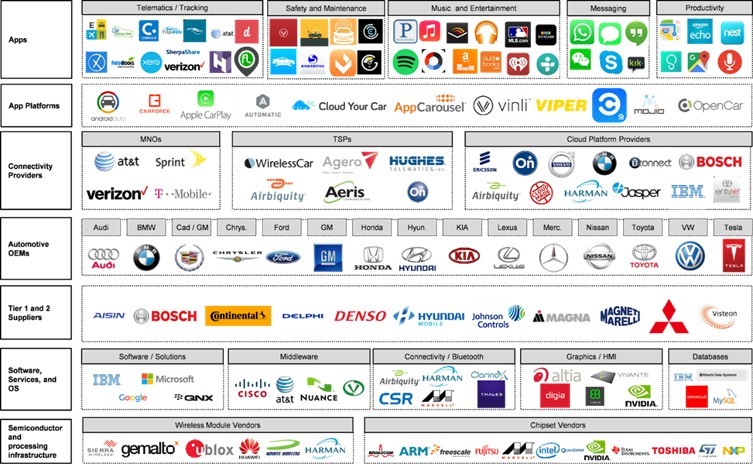
Figure 1 illustrates how complex the connected car ecosystem is becoming.

Figure 1: Connected Car Ecosystem
CC fig1

Source: Red Chalk Group

Some of the key elements in the connected car ecosystem include:

  • Telecom Operators – AT&T, Deutsche Telekom, Telia, Telefonica, Vodafone etc.
  • Technology Vendors – Nokia, Ericsson etc.
  • Cloud Providers – Google, Amazon, Microsoft etc.
  • Original Equipment Manufacturers (OEMs) – VW, Ford, BMW, Audi, Hyundai etc.
  • System Integrators (SIs) – IBM, Accenture etc.
  • Over-the-Top (OTTs) Players – Google, Apple etc.
  • Platform Providers – Jasper, Airbiquity
  • Other Suppliers – OnStar, Continental etc.

The connected car is providing fresh opportunities to traditional players such as TSPs (Telematics Service Providers) e.g., Airbiquity, Tier 1&2 automotive suppliers like Bosch, new players such as webscalers Google, Alibaba, and Apple, as well as traditional telcos. In fact telcos have a crucial role to play as this market evolves.

For instance, Bosch supplies infotainment systems to a majority of OEMs globally but these systems require cellular connections provided by telcos’ 3G/4G networks. Bosch is also involved in pilot projects to test 5G technology for future systems for new innovative services and better connectivity. 

The Role of Telcos in Connected Cars

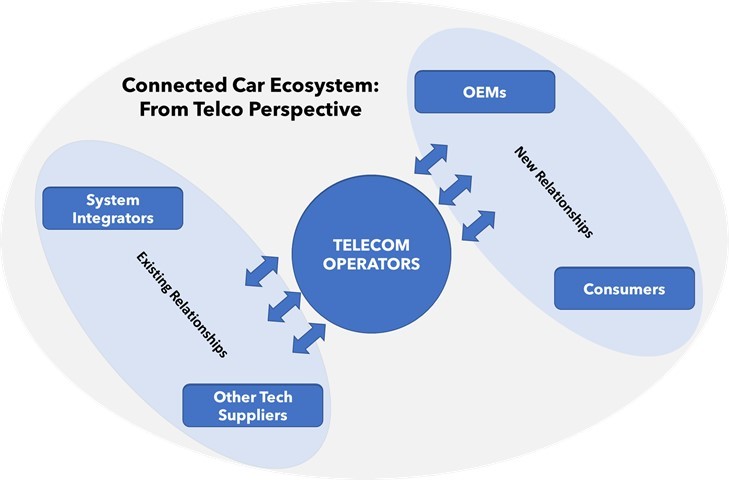
In this first part of the connected car series, we will focus on the role of telecom network operators (telcos) in a connected car ecosystem. Telcos act as the backbone of any connected car by providing the required communication network. 

Figure 2: Telcos play a central role in the connected car ecosystem
CC fig2

Source: MTN Consulting

Telecom operators have a competitive advantage when it comes to providing fast and reliable connectivity for connected cars. Further, the ever-evolving connected car ecosystem offers telcos some interesting new revenue opportunities. That is important as telcos are struggling to attain any top-line revenue growth in their current scope of operations. Even with 5G now emerging around the globe, most telcos continue to see flat to down service revenue trends. Developing new types of services and penetrating new vertical markets is essential for telcos to grow.

There are two basic types of services envisioned for telcos in the connected car space:

  • In(side)-car services: Infotainment (music, weather, social), and Navigation (location/traffic, landmarks, etc.)
  • Out(side)-car services: Telematics/M2M (insurance, repairs, parts, etc.), Remote (stolen vehicle, parking information, etc.).

Telcos are playing a significant role in both types of above services. For in(side)-car services, Telcos and OTTs (aka webscalers) are trying to build a niche in the infotainment/apps space. Apple and Google for example have already launched their connected car offerings – CarPlay and Android Auto respectively – while Telcos provide the SIM cards and Wi-Fi connectivity to access the services offered by OTTs.

However, the big opportunity for telcos in the connected car space, where they have an edge over other ecosystem players are – out(side)-car services. Telcos are uniquely positioned to provide Telematics/M2M and remote services by leveraging their core connectivity assets as well as strong cloud offerings. Depending upon the service provided, Telcos are working on both B2C and B2B business models. Telcos have grabbed this opportunity by launching dedicated connected car offerings and facilitating key partnerships with major OEMs and other ecosystem players.

A few examples of telcos making a huge difference in the connected car space are: 

  • AT&T considers the connected car business as one of the “key growth areas” and it serves over 30 million connected cars on its network. In the US, 31 different car brands are working with AT&T, where the carrier provides cellular connectivity to virtually the entire industry. LTE is the main connectivity technology but AT&T is exploring 5G for next-generation connectivity to future vehicles. 
  • Vodafone goes a step further by providing hardware and software to be fitted in connected cars, as well as the network to connect everything. Vodafone also provides managed services to car customers and is supplying telematics systems to major OEMs like Audi, BMW, Porsche etc. 
  • Orange has taken a slightly different approach by providing the connected car ecosystem with infrastructure services incorporating mobile and information technology. For example, Orange is supplying M2M SIM cards to all the Renault vehicles which are installed with an in-house developed connected tablet equipped with a R-Link system.

Future Development

Apart from the existing use cases for connected cars, telcos are actively involved in pilot projects to benefit from implementation of 5G technology. One of the most talked-about 5G-enabled wireless communication is called URLLC (Ultra-Reliable and Low-Latency Communication). URLLC is aimed at mission critical communications, and ideal for latency sensitive applications such as autonomous driving.  For instance, several URLLC use cases are under research like automated driving, road safety and intelligent navigation systems, to name a few.

Deutsche Telekom and BMW

Deutsche Telekom is an example of a telco that has embraced the connected car market and is actively developing a role in the ecosystem. Key to that role is a partnership with BMW.

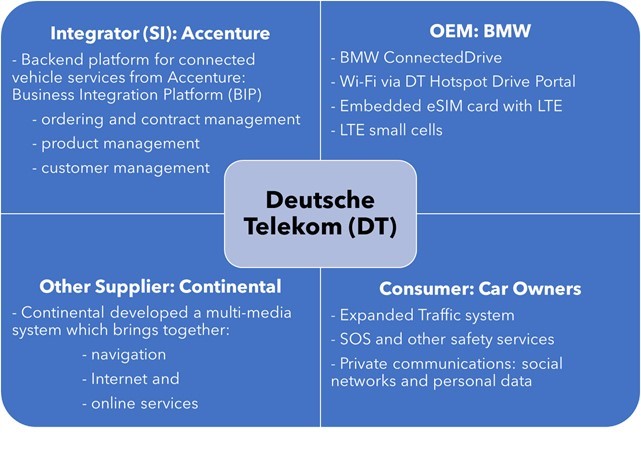
Deutsche Telekom has been part of the BMW connected car journey since 2015. BMW ConnectedDrive is the name of the connected car service provided by BMW together with Deutsche Telekom and other ecosystem partners (see below figure). The Wi-Fi Hotspot within ConnectedDrive vehicles is provided by Deutsche Telekom. The BMW ConnectedDrive system now comes with an LTE eSIM which is permanently embedded into the vehicles.

By partnering with OEMs like BMW, Deutsche Telekom is playing a significant role in providing a seamless customer experience (CX) for car drivers and/or travellers. Together with Continental, a tier 1 automotive supplier, DT has developed a multi-media system to provide car drivers best in-car services: real-time navigation, automatic SOS (eCall) and online infotainment services. 

Figure 3: Case Study —  Deutsche Telekom and BMW ConnectedDrive
CC fig3

Sources: Deutsche Telekom, BMW, and MTN Consulting

The Deutsche Telekom Wi-Fi Hotspot makes it possible to connect 10 Wi-Fi enabled devices to high-speed internet all over Europe. Not only that, but Deutsche Telekom is also fitting BMW ConnectedDrive cars with LTE technology in the form of embedded eSIMs which can be updated via over-the-air (OTA) whenever required from outside.

Another service offering from Deutsche Telekom is the Smart Home app which can be used to control the devices at home via a mobile phone. The Smart Home app has been available for use in the BMW ConnectedDrive system since 2015. Working hand-in-hand with Deutsche Telekom, the system makes it possible, for example, to control the lighting or heating system at home. The remote home control system is plugged into BMW’s vehicle operating system through a feature that allows users to integrate third-party apps via BMW ConnectedDrive.

In Conclusion 

Telcos have a competitive edge in the connected car ecosystem as they already have a proven track record of working together and partnering with related verticals for providing fast and reliable connectivity. The value a telco can bring to the connected car is not only limited to its core assets (networks) but also existing partnerships with system integrators (IBM, Accenture), technology vendors (Nokia, Ericsson) and other tier 1/2  automotive suppliers (Continental, Bosch).

Most of the major telecom players, such as AT&T, DT, Telefonica, Telia, and Vodafone, are ahead of the curve to benefit from this opportunity. Deutsche Telekom has a dedicated connected car division, and most of the telcos mentioned here offer innovative solutions and services to OEMs along with other ecosystem players.  

MTNC believes that moving forward, there are a plethora of opportunities in the connected car space for telcos, especially with the implementation and adoption of 5G technology. The future of mobility will be car-sharing, electric vehicles and autonomous driving, where 5G will be able to enhance the customer experience with innovation such as ultra-reliable low-latency communication (URLLC), putting telcos at the forefront of the connected car ecosystem.

Image source: Samsung Newsroom
Blog Details

Organic revenue growth continues to be a stretch for telcos in 1Q21

Organic revenue growth continues to be a stretch for telcos in 1Q21

Two weeks ago, we provided a preliminary view on revenue trends based on the first 13 significant telcos to report 1Q21 earnings. In it, we noted that revenue growth rates appeared promising for 11 of these 13, as the YoY % change in 1Q21 was improved relative to 4Q20. However, we also flagged a trend of concern, namely, that much of the apparent telco revenue growth was coming from sales of equipment (e.g. handsets) rather than core services. This has been happening on the mobile side with new 5G device sales, and also with cable companies catering to the work from home crowd. A survey of 25 additional telcos which have reported since our last newsletter confirms this trend. Telcos are still not persuading investors that the new services they are investing heavily to develop will lead to significant top-line growth. 

Revenue trends in 1Q21 – the latest 25 reporters

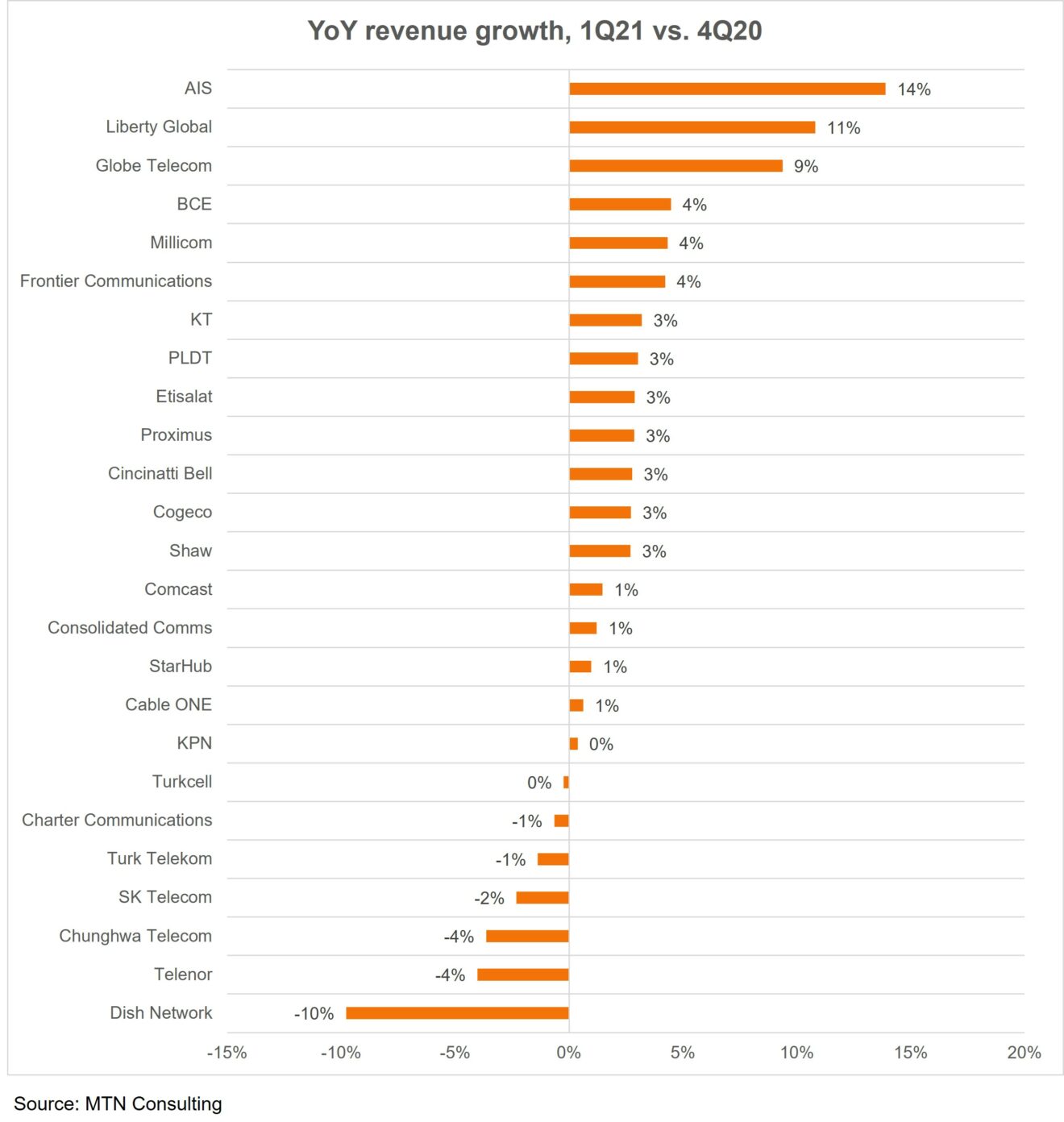
The figure below illustrates the difference in the YoY revenue growth rate achieved for the group of 25, comparing 1Q21/1Q20 to 4Q20/4Q19. As shown, 18 of the 25 improved their YoY revenue trend line at least a bit between 4Q20 and 1Q21. 

YoY revenue growth in 1Q21 for telcos, v2

Thailand’s biggest telco, AIS, had the best result of the 25 due to aggressive investments in both 5G and consumer fiber broadband completed in 2020. Its 4Q20 revenues declined by 7% YoY, while 1Q21 revenues grew by 7%, netting a positive 14%. Liberty Global grew by double digits as well, but that’s almost entirely due to recent acquisitions (of Sunrise, and Vodafone properties). 

The worst performer of the group was Dish Network, but this is misleading as the company is ramping up a new service so growth rates will inevitably decline over time. Telenor had the second worst result of the group, for more substantive reasons: its Myanmar operations have collapsed amidst political unrest, and its Thailand arm DTAC is running behind rivals True and AIS in 5G rollouts. To compensate, DTAC is now accelerating a 5G rollout based on 700MHz spectrum, and Telenor is attempting to gain scale in another regional market, Malaysia, by merging its local operations with Axiata. At the corporate level, Telenor continues its long-running efforts to optimize its operational cost base: it claims a 7% company-wide decline in opex for 1Q21.

For the largest companies in the group of 25 – Comcast (#6 globally by revenues as of 3Q20), Charter (#13), KT (#17), and BCE (#19) – BCE and KT made the biggest gains between 4Q20 and 1Q21. However, as noted below one-time sales of equipment were a major factor for both. It was also a major factor for AIS, in fact.

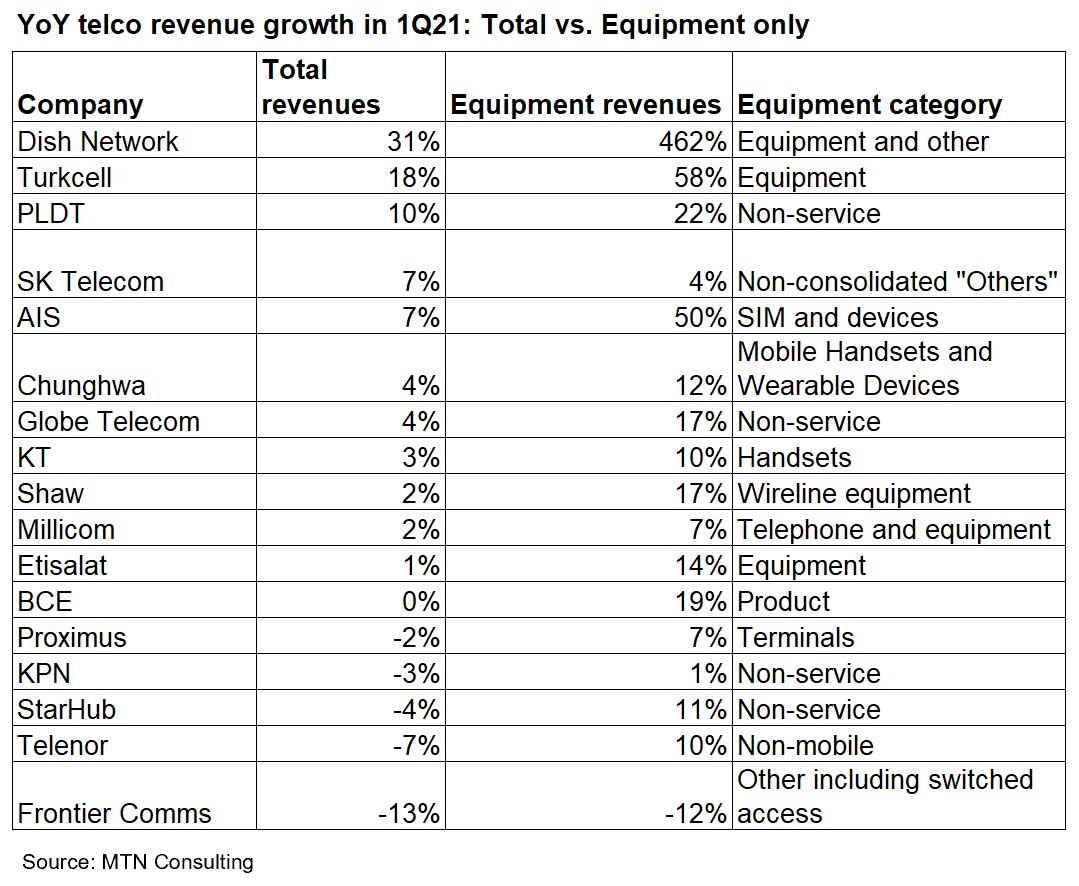
The table below provides a summary of total revenue growth in 1Q21 for a subset of the 25, and the growth reported in non-service (equipment) revenues for the same time period. As shown below, equipment revenue growth outpaced the total company trend line for nearly every telco, in some cases by huge margins (e.g. Dish, AIS, Global Telecom, Etisalat). SKT was the only exception, as its corporate revenues climbed by 7.4% in 1Q21, while the non-consolidated “others” category of sales (which includes handsets) grew by just 3.8%. Not unrelatedly, SKT is planning to spin off part of its operations in the near future, in particular the parts growing faster than its telco core.

rev v eqpt rev 1q21 next 25

Only 17 of the 25 are included above because the rest do not report equipment revenues, as they (generally) lease CPE to customers and capitalize the gear onto their balance sheets. That’s true for Cable ONE, Charter, Cincinnati Bell, Cogeco, Comcast, Consolidated, and Liberty Global; the 8th of this group is Turk Telekom, which does not publish its non-service (equipment) revenue figures for other reasons. 

Capex trends – changes in capital intensity due to 5G, fiber, and transformation

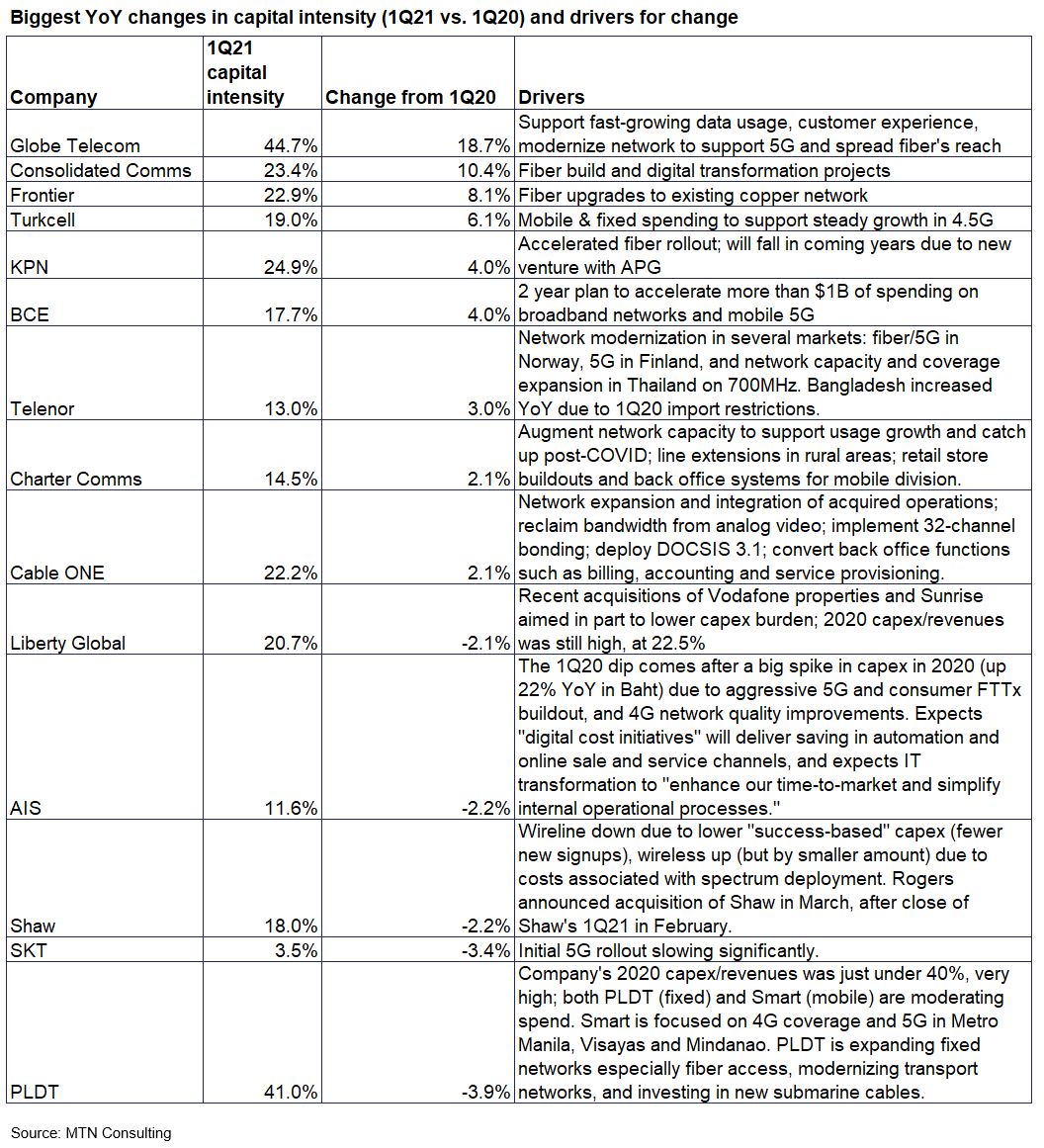
Much of MTN Consulting’s research is concerned with network spending trends, so we track capex closely each quarter. We are projecting a slight uptick in telco capex (in US$) for 2021. Based on early stats for 1Q21, this scenario is still likely. There are a number of sizable companies reporting capital intensity (capex/revenue) ratios higher for 1Q21 than 1Q20, for instance. This alone is not a great benchmark, as some telcos were forced to cut back capex in 1Q20 as the COVID-19 pandemic began to spread. Nonetheless, telcos aren’t shying away from modest capex investments in their network in order to improve operational efficiency (e.g. digital transformation, automation) and support a new generation of services on new 5G networks and FTTH.

The table below presents single quarter capital intensity for 1Q21, the change from 1Q20, and the drivers for that change. Not all 25 telcos are shown below; this table includes only telcos which reported capital intensity either >2.0% higher or lower for 1Q21 than the prior year period, 1Q20. Companies are listed according to their relative in capital intensity across these two periods, high to low.

biggest capint swings in 1q12 to date

Who will capture 5G’s value?

As we noted in our last research, many telcos deploying 5G are seeing a revenue uptick related to sales of 5G-capable devices. This also happened with 4G. Looking back, device and app companies captured much of the revenue upside related to deployment of 4G networks. This is a risk with 5G as well. As telcos deploy stand-alone 5G networks and rollout some of the more sophisticated functionality that comes with 5G, they will need to stay focused on deploying new services that deliver them growth. That will not be easy, and will require collaboration with both their vendors and the adjacent webscale sector of operators.

Blog Details

Device revenues are driving a growth uptick for telcos in 1Q21

Device revenues are driving a growth uptick for telcos in 1Q21

As of April 28, 13 of the 138 telecom operators (telcos) we cover in our quarterly tracker have reported 1Q21 earnings. Revenues for the early reporters have been surprisingly strong: all but 2 of the 13 have reported YoY revenue growth rates greater than the 4Q20 vs. 4Q19 result. This comes with a big caveat, however. Nearly all of the 13 owe their relative success to growth in equipment or device revenues, not to their core operations/services. For instance, 1Q21 device revenues climbed by 218% and 45% for China Telecom and AT&T, respectively. Not surprisingly, revenues for key handset suppliers are surging: Apple’s iPhone product revenues grew by 17.1% YoY in 1Q21 to $65.6B, while Samsung mobile device revenues were up 13.0% YoY in 1Q21 to 25.82 trillion Won (~$23.2B). Huawei is down but that is a company-specific situation, and early signs are that other Chinese handset suppliers (e.g. Oppo, Vivo, Xiaomi) did quite well in 1Q21.

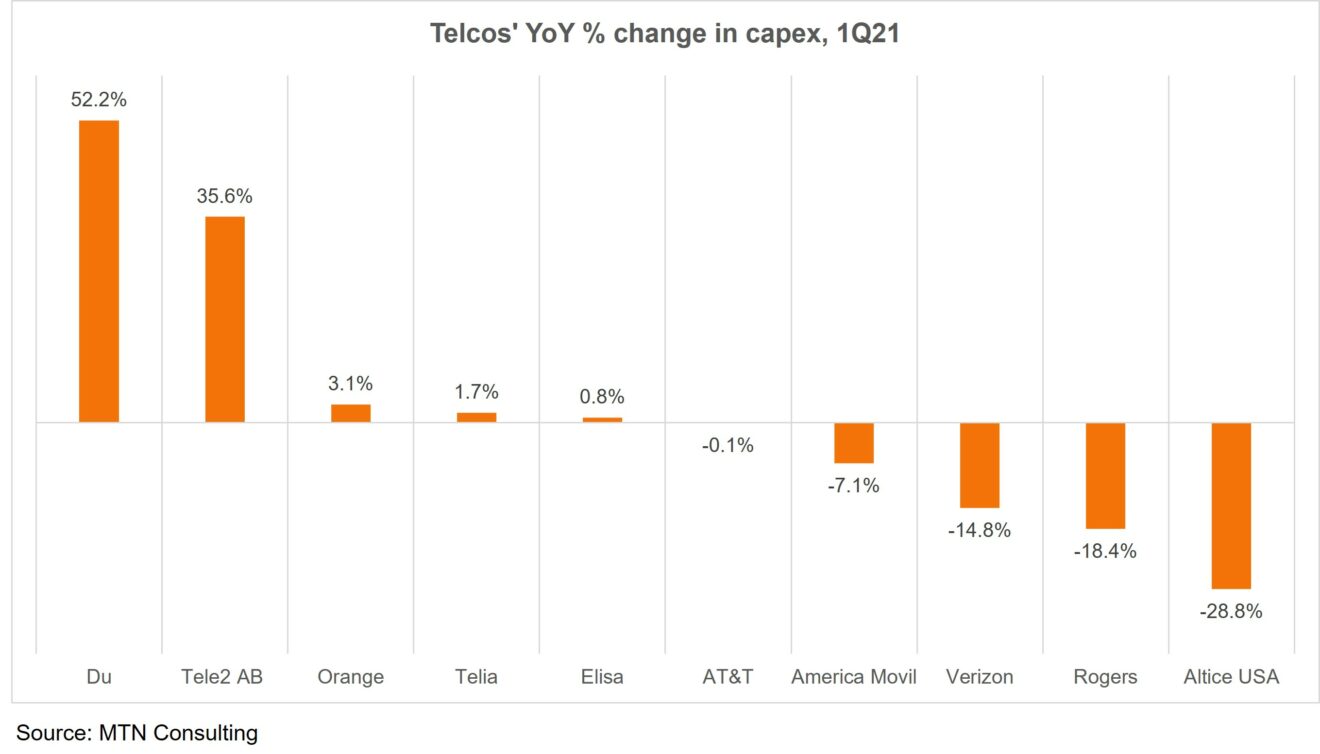
On the network investment side, only 10 of the 13 reported capex for 1Q21, as the three Chinese companies in the group report capex only every 6 months. MTN Consulting expects telco capex to grow roughly 4% in 2021, but there is no obvious pattern of growth yet based on these 10 telcos’ reports. Du and Tele2 reported 52%, and 36% YoY growth, respectively, but most of the larger telcos in the group of 10 reported YoY capex declines. Orange was an exception, as it reported 3.1% YoY growth in capex for the first quarter, due both to fiber builds in rural France and international markets as to 5G.

Revenue trends in 1Q21

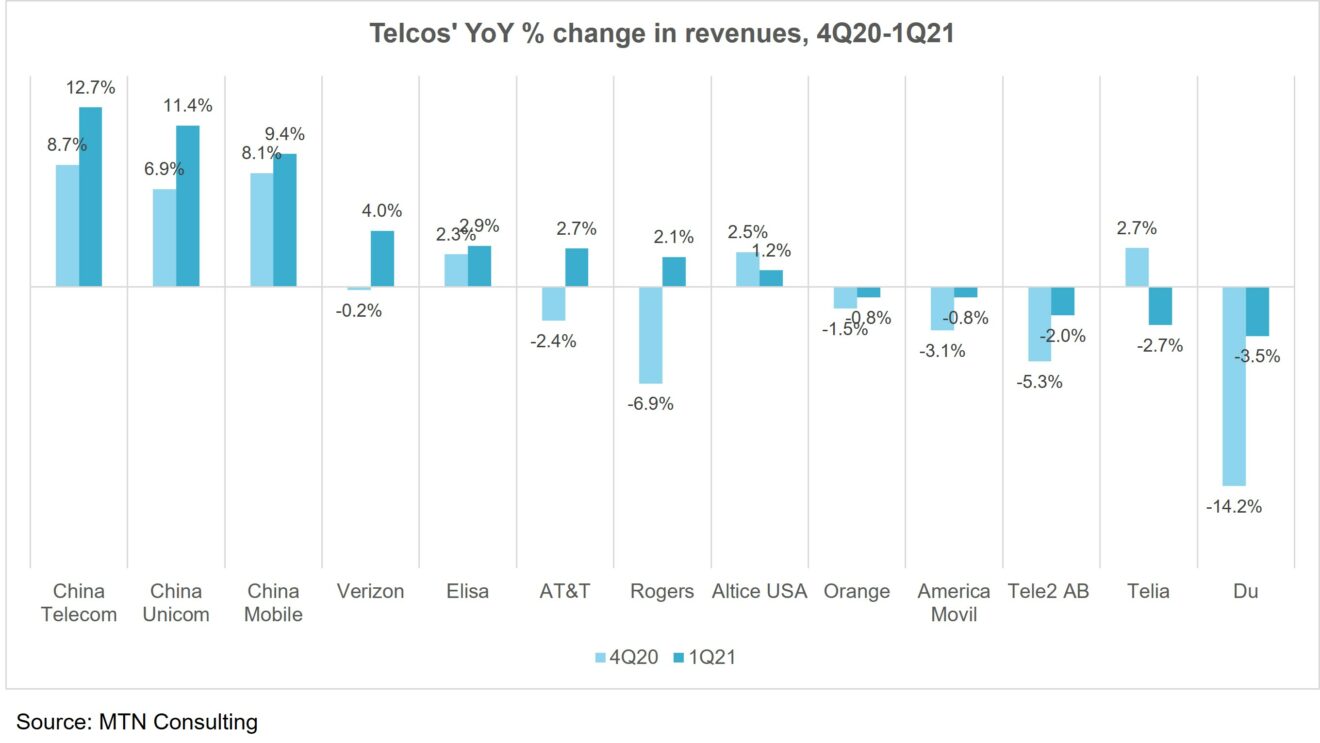
As the figure below illustrates, total revenues increased on a YoY basis in 1Q21 for 8 of the 13 companies reporting to date. That’s promising given that 2020 revenues for the global telecom market declined by about 1%. Further, there were a number of significant improvements in growth between 4Q20 and 1Q21, for instance China Unicom’s acceleration from 6.9% YoY growth to 11.4%. Growth flipped from negative to positive for Verizon, AT&T and Rogers. One factor is a pickup in economic activity in many global markets as COVID-19 vaccines started their rollout and government stimulus programs took effect. The more important factor is the 4G to 5G transition. 

telco rev change prelim 1Q21

Most of the telcos reporting above operate in markets where that transition has already started: China, USA, Finland, Canada, France, Sweden, and the UAE. America Movil is an exception, as 5G is still emerging in most of its markets. Altice USA is the other exception as its mobile business is tiny and based on an MVNO with T-Mobile. For all others, though, device/equipment revenues related to 5G were the primary driver behind the YoY improvement in 1Q21 revenues:

  • China Telecom: Device revenues up 218% YoY
  • China Unicom: Device revenues up 51%
  • China Mobile: Device/other sales up 67%
  • Verizon: Wireless equipment revenues up 24%
  • Elisa: Devices up by 11%, and “Digital services” (including content/media) up a bit faster, +12%
  • AT&T: Mobility division’s equipment revenues up 45%
  • Rogers: Wireless equipment revenues up 27%
  • Orange: Equipment sales up 10% YoY
  • Tele2 AB: Equipment revenues up by 12% YoY, services declined by 1%
  • Telia: Equipment up 13% YoY
  • Du: equipment lumped into an “others” segment but company said that “Strong demand for the iPhone 12 fuel handset sales”

In their earnings, not all telcos addressed how much of their growth was attributable to one-time handset purchases that are mostly flow-through revenues. China Mobile was more direct, saying its 67% revenue growth in the sales of “products and others” was due to the the “buoyant growth of handset sales as 5G handsets were available with more varieties and at more affordable prices in the terminal market.”

Capex a mixed bag: 5 up, 5 down

Ten of the 13 telcos reporting have published capex figures for 1Q21. As the figure below shows, half reported YoY growth, half showed declines.

telco capex change prelim 1Q21

For all but Altice, the 5G transition plays into the capex fluctuations of all these telcos – with the cost of spectrum an issue that often arises.

Du’s 52% growth in 1Q21 is due to capex spend “mainly on the core network as well as 5G roll-out and on improving mobile coverage and capacity.” Tele2 cites its rollout of nationwide 5G in Sweden, and Remote-PHY on the fixed side. Orange’s modest growth is due to a ramp-up in its core France market aimed at getting Paris ready for its March 5G launch, as well as growing fiber investments in both rural France and overseas markets like Poland. Telia’s slight increase reflects a decline in fiber investments in Sweden offset by rising 5G costs as it builds out the network based on newly secured spectrum in both Sweden and Denmark. Elisa’s ~1% YoY increase is due to 4G capacity increases and expansion of its 5G coverage to reach 2.5 million people in Finland.

Among the capex decliners, America Movil’s dip is due in part to caution surrounding regional currency fluctuation and its December 2020 joint acquisition (with Telefonica and TIM) of Oi’s Brazil business. Moreover, America Movil is determined to implement 5G with minimum effect on capex: its CEO noted on AM’s 1Q21 earnings call that “I don’t think even for this year or for the next years, we [are] going to have an increase — substantial increase of CapEx for 5G.” Altice USA’s 29% dip is due mainly to a huge decline in CPE purchases, which flow into capex for Altice (as for most cable companies). Rogers also reduced capex in 1Q21, perhaps distracted by its huge pending acquisition of Shaw. Going forward, Rogers has committed publicly to major new investments in the network, in particular in rural and lower-income markets.

The two largest companies in the group of 10, by far, are AT&T and Verizon. Their capex outlays in 1Q21 were on the conservative side, falling 15% for Verizon and staying flat for AT&T (including its vendor financing payments). Their capital deployment focus in recent months has been spectrum: in the last two months, AT&T and Verizon have made payments of and $23 billion and $45 billion for C-Band spectrum, respectively, to the US FCC. 

Both companies have a long way to go to build out nationwide 5G coverage and now face an energized T-Mobile post its acquisition of Sprint. That makes their recent splurges on new C-Band spectrum all the more notable. The high cost may cause some pullbacks on capex, or at least a more eager approach to partnerships that may reduce capex, for instance webscale collaborations (e.g. AT&T-Microsoft cloud connectivity, and Verizon-AWS 5G MEC).

Clearly AT&T and Verizon need to buy equipment and software to turn this new spectrum into a usable resource, but the high cost does constrain them on the capex side. Verizon addressed this indirectly in its earnings call, saying that it is “delighted that the credit rating agencies consider the spectrum asset purchases as strategic and critical to our business operations and held their rating levels unchanged.” It’s true that spectrum is a strategic asset, but the same can be said for fiber and data center and other types of infrastructure that compete for capital within a telco budget. Costly spectrum will continue to be an issue impacting US telcos. To the extent all US telcos face this reality, the main effect will be to slow deployments in lower ARPU areas and increase consumer prices, but also encourage adoption of products & architectures which aim to maximize use of scarce spectrum resources.

Who will capture 5G’s value?

Telcos deploying 5G are clearly seeing a revenue uptick related to sales of 5G-capable devices. This also happened with 4G. Looking back, device and app companies captured much of the revenue upside related to deployment of 4G networks. This is a risk with 5G as well. As telcos deploy stand-alone 5G networks and rollout some of the more sophisticated functionality that comes with 5G, they will need to stay focused on deploying new services that deliver them growth. That will not be easy, and will require collaboration with both their vendors and the adjacent webscale sector of operators.

Blog Details

Webscalers ramp up push into telecom in 1Q21

Webscalers ramp up push into telecom in 1Q21

MTN Consulting’s formal review of 4Q20 performance for the webscale sector will be published within a week. Based on preliminary stats, it is clear that the webscale market of operators continued blockbuster growth in 2020, ending the year with just over $1.7 trillion in revenues, from $1.45T in 2019. The growth is due to several factors: acquisitions (e.g. Alibaba-Sun Art, Amazon-Zoox, and Microsoft-Zenimax); strong digital advertising spend (e.g. Google up 9% YoY to $146.9B), and increased cloud spending across a number of verticals amidst the COVID-19 pandemic.

Webscalers have been attacking the telco vertical for several years. Since the close of 4Q20, over the last three months the webscale sector’s efforts to engage telcos have picked up steam. A number of telcos have recently announced new deals with webscalers in the areas of edge computing, service development, digital transformation, and workload shift. At the same time, more traditional suppliers to telcos (e.g. Nokia) have expanded their own collaboration with the cloud providers who dominate the webscale market. These deals aim to differentiate among traditional telco vendors, prevent webscalers growing too fast in the market, and save costs for telcos. What follows is a brief outline of some of the key developments in 1Q21.

Telco deals with webscalers

Key deals from 1Q21 include the following.

Telefonica has engaged IBM, classified as a webscale operator in our coverage, to act as a systems integrator for an open RAN trial in Argentina. The proof of concept includes software and hardware components from Altiostar, Red Hat (an IBM subsidiary), Quanta, Gigatera, and Kontron. SDx Central notes that the trial follows on recent work between IBM and Telefonica on an overhaul of the telco’s enterprise-focused cloud platform (“Cloud Garden 2.0”)

TIM Brasil announced it would work with Oracle and Microsoft to migrate all of its on-premises workloads to the cloud. Capacity Media notes that the telco will “leverage Oracle Cloud Infrastructure (OCI) and Microsoft Azure, to move its mission-critical applications to the cloud, optimising and simplifying management of its IT infrastructure, as well as improving scalability and agility.”

SK Telecom made several announcements in 1Q21:

  • The company will connect its 5G mobile edge computing services with 34 other telcos across multiple regions via the Bridge Alliance. 
  • With Dell Technologies and its subsidiary VMWare, SK Telecom will create a technology called OneBox MEC to combine private wireless capabilities with an edge computing platform.
  • In early January, the Korean telco announced the launch of SKT 5GX Edge in collaboration with Amazon Web Services. The service allows its customers to build mobile applications that require ultra-low latency, according to Capacity Media.

South African provider Vodacom Business announced that it was certified as “the first” AWS partner in Africa to attain the AWS Outposts Ready designation. Vodacom clients can purchase datacenter managed services from both Vodacom and AWS, choosing a mix of private cloud on-premises, Vodacom data center hosting, public cloud using a local AWS availability zone, or a combination of multiple options.

Telecom Egypt has selected IBM and its Red Hat unit to develop an open hybrid cloud strategy. Per Computer Weekly, the largest telco in Egypt “has implemented IBM Cloud Pak for Automation to infuse artificial intelligence (AI) into its workflows to provide the flexibility to scale automation projects quickly, across any cloud or on-premise environment.”

Google Cloud announced a win at Canada’s Telus billed as a 10-year strategic alliance. The two will co-develop “new services and solutions that support digital transformation within key industries, including communications technology, healthcare, agriculture, security, and connected home.” The collaboration will also target network modernization within Telus’ operations. Telus will use GCP’s managed application platform, Anthos, to support 5G services and mobile edge computing.

Singtel announced it would offer 5G edge computing over the Microsoft Azure cloud platform. Trials will start later this year, and ultimately allow Singtel clients to run applications such as autonomous vehicles, drones, robots, and VR/AR with very low latency.

Australia’s Optus, a unit of Singtel, signed a 3-year partnership with Google Cloud to transform its customer support operations, using GCP’s Contact Center AI solution.

Globe Telecom in the Philippines announced it would use AWS to accelerate its own digital transformation and improve customer experience. Per the Manila Standard, Globe has “migrated carrier-grade and mission-critical applications, including contact center operations, customer analytics, network and service assurance systems and infrastructure operations, monitoring, and security, from its on-premises data centers to AWS.” That includes transitioning 3,000 customer service agents from a legacy Avaya solution to Amazon Connect.

Liberty Global’s Belgium unit, Telenet, announced vendors for its 5G rollout in March which include Ericsson, Nokia and Google Cloud. Ericsson won the radio access, and Nokia the core. Nokia will leverage Google Cloud’s Anthos for Telecom platform in Telenet data centers. Liberty says the Anthos platform will provide “the innovation infrastructure with solutions and applications for 5G users, to drive better customer experiences and service.”

Telecom-focused vendors partnering with cloud providers

Nokia was by far the most active of telco-focused vendors in 1Q21, announcing several collaborations with the webscale sector. 

In January, Nokia announced a partnership with GCP to develop cloud-native 5G core solutions. Nokia is supplying its voice core, cloud packet core, network exposure function, data management, and 5G core, while GCP’s Anthos for Telecom platform will serve as the platform for deploying applications. In March, Nokia expanded its work with GCP, announcing it would also partner to develop cloud-based 5G radio solutions. The collaboration leverages Nokia’s RAN, Open RAN, Cloud vRAN and edge cloud technologies with GCP’s edge computing platform and application ecosystem. Initial efforts center around Cloud RAN, and aim at integrating Nokia’s 5G virtualized distributed unit and virtualized centralized unit with Google’s edge computing platform running on Anthos. Nokia aims to certify its AirFrame Open Edge hardware with Anthos.

At the same time as the March GCP announcement, Nokia announced deals with Microsoft and Amazon. 

The Microsoft agreement will develop “new market-ready 4G and 5G private wireless use cases designed for enterprises”, combing Nokia’s Cloud RAN, Open RAN, radio access controller, and multi-access edge cloud technologies with the Azure Private Edge Zone.

With Amazon Web Services, Nokia and AWS will conduct joint R&D into enabling Nokia’s RAN, Open RAN, Cloud RAN, and edge solutions to operate “seamlessly” with AWS Outposts. The goal is to develop new customer-focused 5G solutions. Per Nokia, “operators will be able to simplify the network virtualization and platform layers for the Core and RAN network functions by leveraging the agility and scalability of cloud.” Ultimately Nokia will be able to leverage Amazon services like EC2, EKS, Local Zones and others to help automate network functions and deploy end customer applications.

Intel, which has attacked the telco market aggressively over the last few quarters, signed a deal with GCP in February to develop “reference architectures and integrated solutions” for telcos to enable 5G and edge network solutions. The collaboration involves three main aspects: virtualized RAN and open RAN solution development; a network functions validation lab; and, service delivery to the edge.

Israeli telco vendor Radcom announced the integration of its 5G assurance solution (ACE) with Microsoft Azure. Radcom says that the integration of ACE with Azure “enables operators to assure the quality of 5G services by leveraging AI and machine learning-driven assurance and automation” ACE runs as a cloud native function over the Azure Kubernetes Service.

Vendor collaborations with webscalers will continue throughout 2021, no doubt. Mavenir’s SVP for Business Development, John Baker, addressed this trend indirectly in a January interview with SDx Central: “I really do believe the hyperscalers are going to become the new telecom providers going forward…Apart from the physical radio that goes on a tower, everything we’re doing now follows the data center model, and these guys know how to manage data centers, software, and applications.”

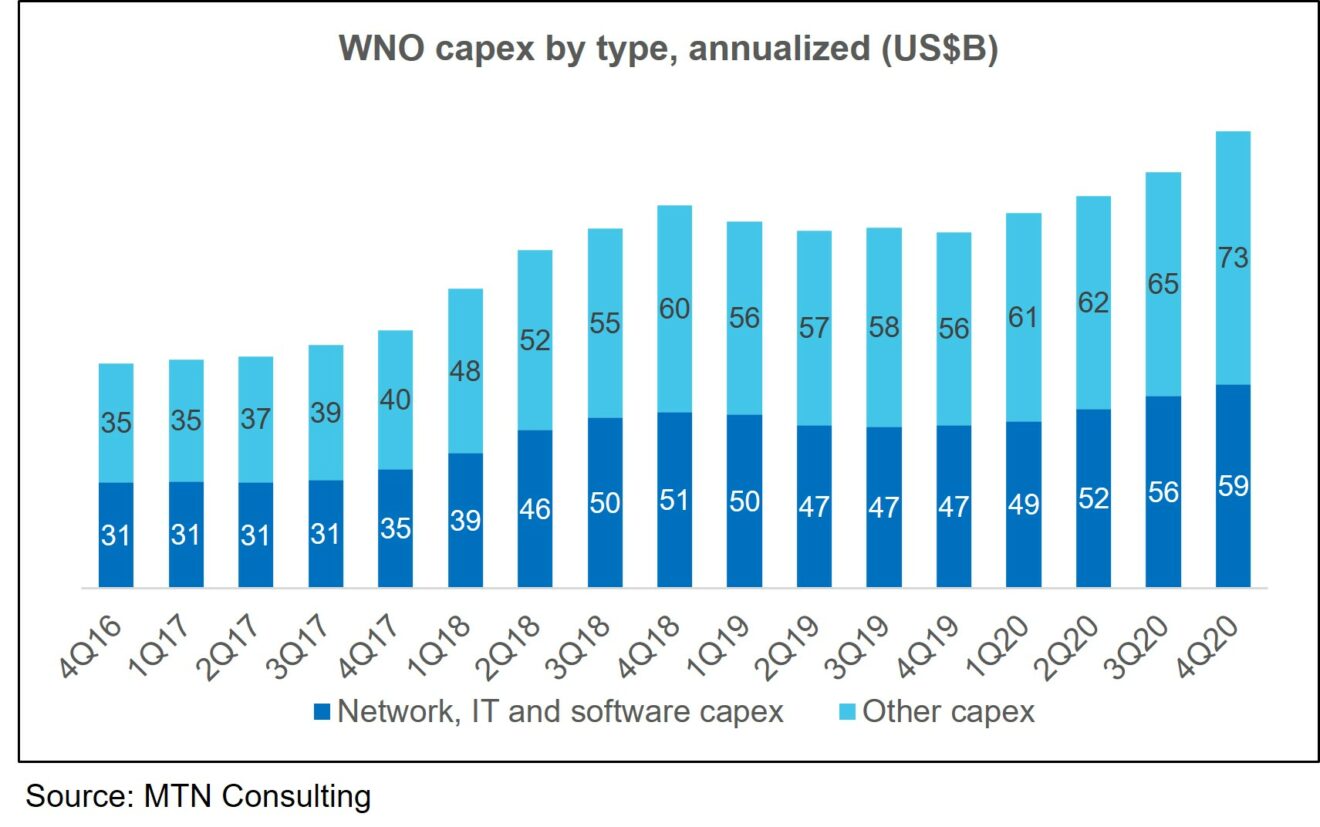
For webscale operators to support all these new activities requires heavy investment in network infrastructure. The figure below shows capex by type, on an annualized basis, for the total webscale network operator market since 2016.

webscale capex trendline2

Blog Details

Big telco merger in Canada comes as industry capex poised for uptick in 2021

Telcos choose M&A to cope with weak revenues and new capex needs: surprise?

Rogers to buy Shaw, leaving Canada with 3 big telco groups

Earlier this week, Canadians woke up to a shock: Rogers Communications agreed to buy Shaw Communications, for US$21 billion (including assumed debt).

Rogers is Canada’s second largest telco, with a mix of wireless (61%), cable (28%), and media (11%) revenues. Among its media holdings is the Toronto Blue Jays, a baseball team. Shaw is Canada’s fourth largest telco, with just 22% of revenues coming from wireless (largely through the 2016 acquisition of Freedom Mobile), 68% in wireline consumer, and 10% wireline business. Shaw’s “wireline” revenues are delivered primarily over a cable TV network, complemented by satellite. 

Rogers-Shaw would be a big deal in any market, but adjusted for Canada’s relatively small market, it is immense. A deal of similar magnitude in the US market, 8.3 times the size of Canada (based on 2019 telco revenues), would be $174 billion. For context, three of the largest recent US telco mergers were far smaller: AT&T-Time Warner in 2016 ($85.4B, 2016); AT&T-DirecTV in 2014 ($67B); and, T-Mobile-Sprint in 2020 ($26.5B). 

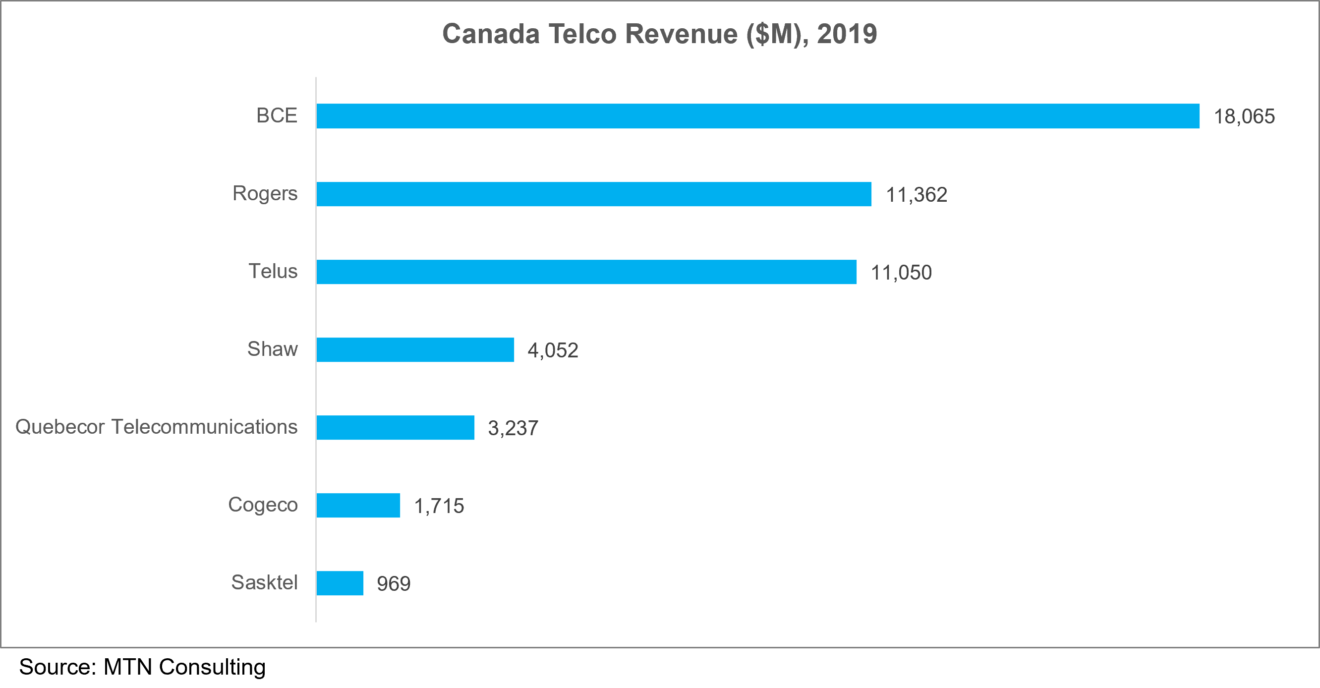
The figure below shows 2019 revenues for Canada’s top telco groups, per MTN Consulting stats.

canada telco revenue

While many analysts are shocked at the deal, it’s almost a surprise that it took so long to happen. Many markets larger than Canada have consolidated around three large national telco groups. For countries like the US and Canada, with a viable cable TV sector, that consolidation has taken longer. But assuming that all three are national competitors across wireline and wireless, the number three doesn’t appear unreasonable on its face. That’s especially true as telcos struggle with both flat revenues and growing competition from the cloud/webscale sector.

5G isn’t cheap

What’s worth looking at it is, why is such a deal taking place now?

One obvious answer is the turmoil caused by COVID-19. Like telcos elsewhere, those in Canada saw revenue declines in 2020. Annualized telco revenues began falling for the Canadian telco market in 2Q19, however, and the declines seen in 2020 were in the same ballpark.

Margins aren’t an obvious issue, either. For Rogers, margins have held steady, with EBITDA margin improving in 2020 vs 2019 for both its wireless and cable units (media dropped slightly). Shaw’s most recent quarter, ended November 2020, saw company EBITDA margins up to 44.3% from 42.5% in the quarter ended November 2019.

The more likely answer is the need to ramp up 5G networks and roll out services. And that is exactly what Rogers’ CEO argued in the analyst conference:

“Without question, the deal will accelerate deployment of 5G around the country and will assure competition and capital continue to be prioritized and reinvested in new technologies at home here in Canada and especially in Western Canada…Today, both companies invest $3.7 billion annually in CapEx. And the underlying investment in 5G inherent in this total will only go up as 5G technologies continue to roll out across the country. This is a big task for both companies. And when combined, both companies are up for the challenge.”

This statement came along with a specific commitment to invest C$2.5B “to build 5G networks in Western Canada,” and C$1B for the creation of a “Rural and Indigenous Connectivity Fund.” 

Rogers says it expects up to C$1B in cost synergies, a mix of opex and capex, but says that most of the capex savings will be put back into the network: “more fiber, more connectivity, more rural connectivity and a few other programs related to the network,” per the CFO. The opex part is significant. New service platforms can require huge investments in expense categories like sales & marketing, among others, something which a combined Rogers-Shaw may be better able to cope with.

Beyond Canada

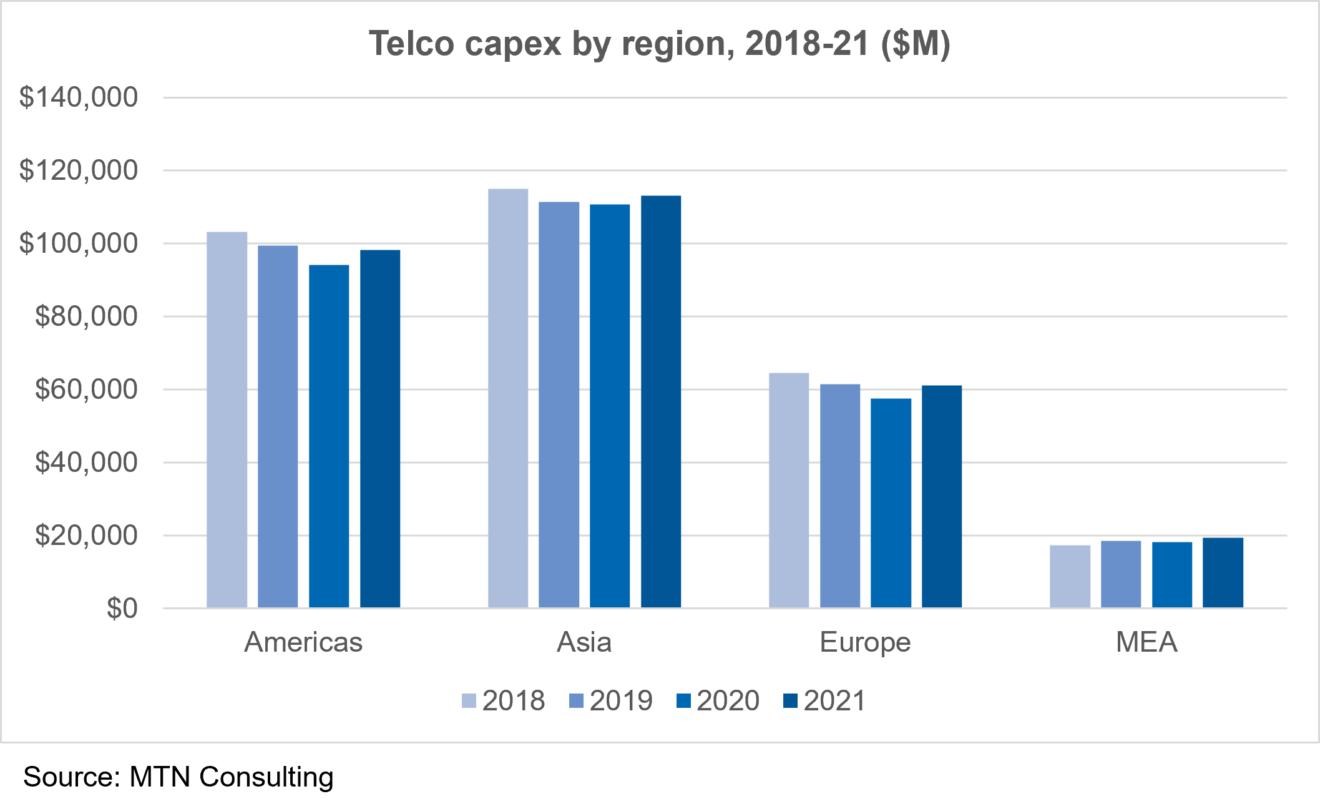
MTN Consulting expects global telco capex to rise slightly this year, from approximately $280 billion in 2020 to $292B in 2021. This modest growth is consistent across regions, as shown in the figure below from our latest capex forecast.

telco capex by region

In Canada, capex has been on the decline, from US$13.9B in 2018 to $13.8B in 2019 to $12.6B for the 12 months ended September 2020. Canadian telcos, however, are just beginning to deploy 5G – the bulk of the work is in the future, with many key vendor awards just concluded in mid-2020. Like the global market, Canada can expect a capex uptick in the next couple of years, albeit a modest one. Market leader BCE, for instance, has pledged to spend an extra C$1B to C$1.2B in 2021-22, with most (C$700M) in 2021; roughly 2/3 of the spending increase is for wireline, 1/3 for wireless. The second largest player, Telus, has projected 2021 capex to be flat with 2020; whether Telus is forced to increase in response to a faster rollout by others, though, is a real possibility.

What about other markets? What do 4Q20 earnings reports from key telcos suggest is on the way in 2021 and 2022 with regards to capex? Below are a few highlights:

  • America Movil: 2021 capex in line with 2020 at around US$8B
  • Charter: 2021 capex to be consistent as a percentage of revenue with 2020
  • China Telecom: 87B RMB in capex, from 85B in 2020, much lower spend on 4G, higher spend on “industrial digitization” 
  • China Unicom: 2021 capex of 70B RMB flat with 2020, 5G still roughly half of total in both years.
  • Comcast: “we are confident in our ability to increase profitability, expand margins and improve [i.e. reduce] CapEx intensity both in 2021 and thereafter”
  • DT: cash capex excluding spectrum is “expected to amount to around EUR 18.4 billion in 2021 and to remain stable in 2022. We want to continue investing heavily in building out our network infrastructure in Germany, the United States, and Europe in order to safeguard our technology leadership in the long term.”
  • Etisalat: capital intensity in 2021 of 16-18%, from 13.7% in 2020 due largely to 5G spend.
  • KPN: forecasts 1.2B Euros in capex for 2021, up from 1.1B, as it expects “another step-up in fiber CapEx to roll out or ramp up further to approximately 500,000 households.”
  • KT: 2021 capex likely flat but a much different mix, with more digital, AI and cloud focus.
  • STC: “expecting a slight decline” in capex for 2021 despite investing heavily in 5G expansion
  • Swisscom: “CapEx outlook is at around CHF 2.3 billion for the group, of which Switzerland a bit more than CHF 1.6 billion. We expect the CapEx slightly higher because of the FTTH rollout, and Fastweb steady at EUR 0.6 billion.”
  • Tele2: 2020 capex of 2.7B SEK was up from 2.4B in 2019; capex will grow to 2.8-3.3B range in 2021 due to 5G rollout. But company says “expect capex to be at low levels compared to peers even during the roll-out of 5G and Remote-PHY”
  • Telefonica: after capex declines in 2020, “CapEx to sales will trend back to normalized pre-COVID level, up to 15% of sales”
  • Turkcell: “We will continue to invest our infrastructure at around 20% of sales, driven mainly by capacity and software investment upgrades as well as expansion of fiber infrastructure.”
  • Veon: increased capex from $1.74B in 2019 to $1.9B in 2020 and expects a similar level for 2021 and 2022.
  • Verizon: capex of $17.5-18.5B in 2021, from $18.2B in 2020; focus on “further expansion of our 5G Ultra-Wideband network in new and existing markets”

As shown above, most telcos suggest capex in 2021 will be roughly flat, either on an absolute basis or capex/revenue basis. Nowadays few telcos want to boast of high spending to shareholders. However, quite a few telcos do expect capex growth over the next year or two. Not exactly a surge of spending, but on net consistent with MTN Consulting’s forecast of a slight uptick in the market.

On the supply side there will be significant change underway over the next two years, with Huawei taking more of a backseat. Some telcos worry that this may leave them paying too much for their network infrastructure, due to weaker supply side competition. Telcos will hedge their bets by ramping up collaboration with webscalers when possible, and continuing to explore open networking and network disaggregation. 

Blog Details

Telco network spending bounces back with strong 4Q20 vendor results

Telco network spending bounces back with strong 4Q20 vendor results

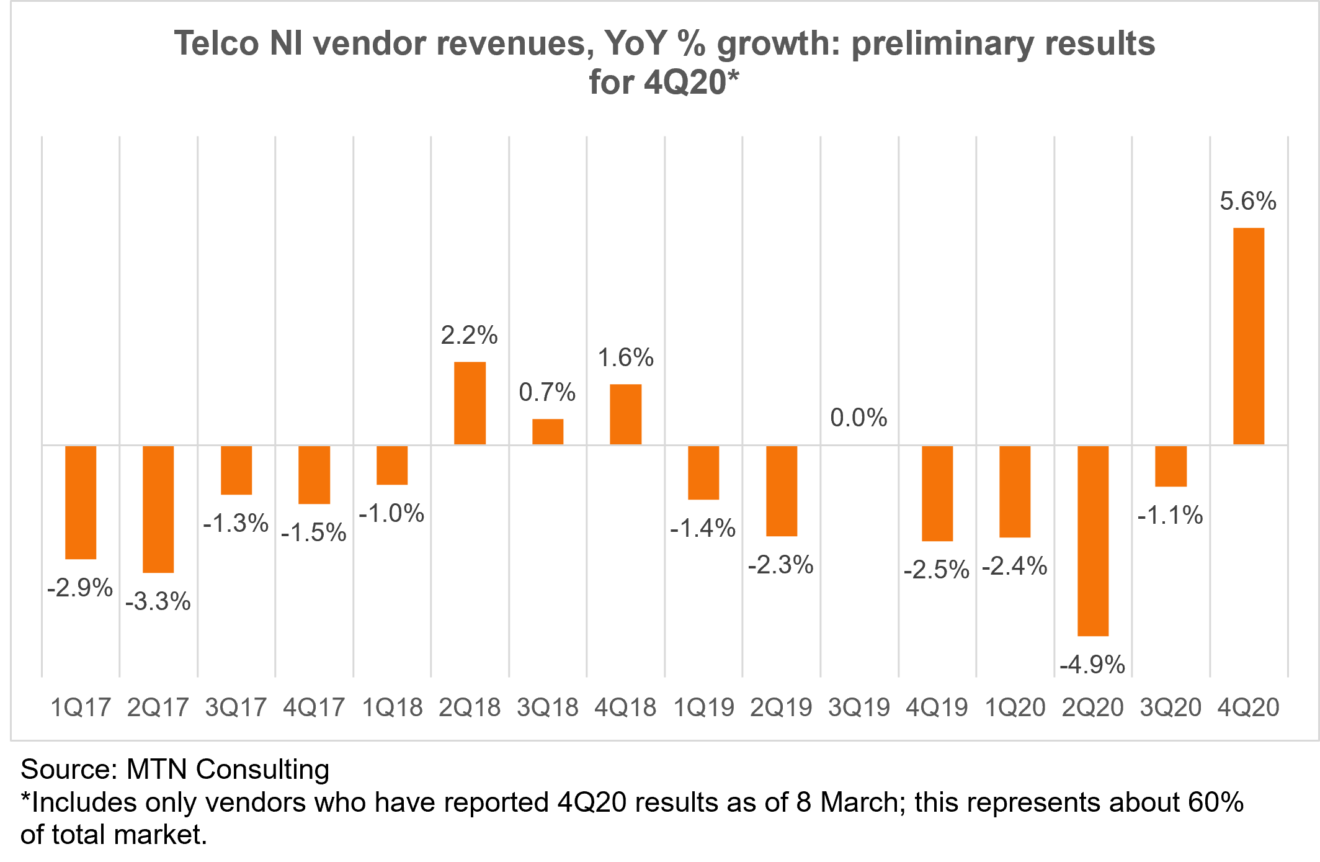
Preliminary Telco NI revenues up 5.6% YoY, powered by Japan and US

Chinese vendors haven’t reported yet, but the 60% of the market that has reported makes clear that network infrastructure spending by telcos (ex-China) bounced back firmly in the fourth quarter of 2020.

Setting aside China-based vendors, the market for telco network infrastructure products & services (“telco NI”) has been weak for the last two years. For the total market excluding Huawei and ZTE, telco NI revenues declined for each of the four quarters of 2019, and full-year results declined by 2.4% on a year-over-year (YoY) basis. This streak worsened in 2020 as COVID-19 hit, and telco NI revenues for the first 9 months of the year were down 4.2% YoY (again, excluding Huawei & ZTE). A survey of 62 non-Chinese vendors reporting 4Q20 results, however, estimates growth for the quarter as +5.6% YoY. Strong 5G spending in a number of countries, including Japan and the US, were clear drivers. A possible tailing off of the COVID-19 crisis also helped telcos to justify committing to major projects.

The 62 vendors in the preliminary results include virtually all significant non-Chinese players in the telco NI market. They supply a wide range of products and services, with a handful providing nearly everything needed to build and run a network, to many more focused on a narrow product or geographic niche. The largest of the 62 is Ericsson ($7.88B in telco NI sales for 4Q20), while the smallest one is Tejas Networks ($16.5M). 

The 62 vendors do not include any vendor based in China, simply because of reporting schedules. However, there are benefits to excluding China, if the point is to gauge global demand: China has always been a unique market with demand driven more by government policy than market imperatives. That was all the more true in 2020 when telcos were enticed to rush ahead with an extremely rapid 5G buildout. This rush served both to support China’s industrial policy goal to lead in 5G and to give Huawei and ZTE a revenue cushion as overseas opportunities faded.

The figure below illustrates YoY revenue growth (and decline) for the group of 62 vendors included in the preliminary analysis.

Telco NI 4Q20 prelim

With Chinese vendors excluded from this analysis, the two largest vendors in the sample are Ericsson and Nokia. Both reported good results in North America, with total revenues in NA up 11% YoY in 4Q20 for Nokia and +10.0% for Ericsson. A good portion of the improvement in NA likely came after positive news on the vaccine front in early November, which made a year-end budget flush by telcos a bit easier to justify. Also, Deutsche Telekom’s US unit continues to ramp spending, after closing its acquisition of Sprint in April of 2020. T-Mobile’s US capex was 3.3 billion Euros in 4Q20, triple the pre-merger figure of 1.1B in 4Q19. 

Japan was also clearly important in 4Q20, with telcos improving 5G coverage and expanding the market with sales promotions. That can be seen in the capex stats: NTT’s group capex in 4Q20 increased by 4.5% YoY (in Japanese Yen), KDDI’s capex increased 11.5% YoY, while Rakuten surged 41.6% YoY. It’s also clearly visible in results for NEC and Fujitsu. 

Ericsson beats all with $1.2B YoY revenue growth in 4Q20

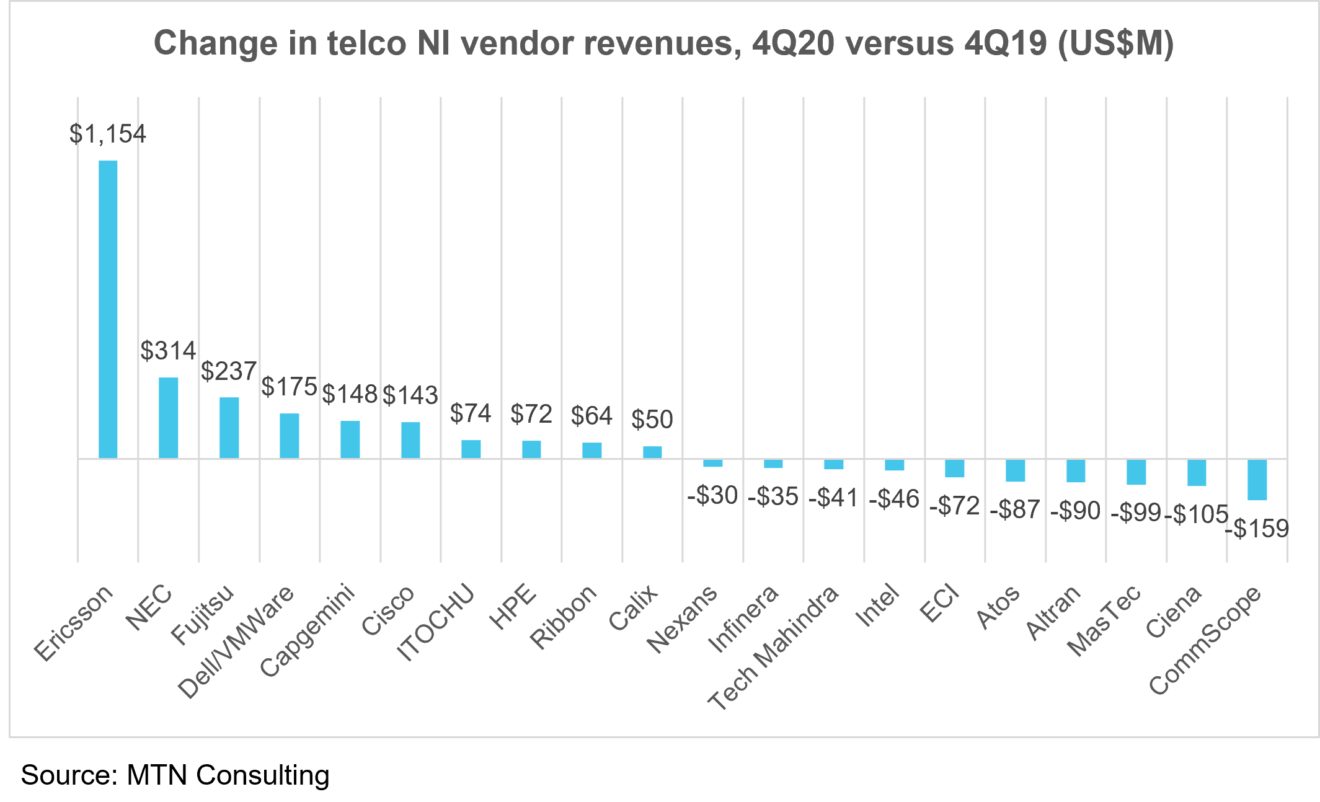
Digging into results for individual companies, Ericsson was the clear winner in 4Q20, growing revenues by nearly $1.2 billion versus 4Q19. Despite the hype about Ericsson’s China push, the vendor’s revenues there were 8% of the company’s total in 4Q20, the same as 4Q19. The US went from 27 to 29%, however, while Japan grew from 6 to 9%. These two markets accounted for much of Ericsson’s YoY growth. Improvements in 2021 will have to be driven by a broader set of markets and customers, especially given the pickup in open RAN interest across the globe. 

On the opposite end of the spectrum, CommScope continued to struggle in 4Q20, and among the 62 company sample saw the biggest YoY sales decline (-$159M). The company’s broadband and outdoor wireless divisions did well in 4Q20, up 17% and 1% YoY respectively. But a steep drop-off in its video CPE business caused home networks division revenues to fall 31% YoY; CommScope points to “continuing OTT trends.” These trends won’t reverse in 2021, but CommScope has some valuable relationships with telcos, especially cable TV players like Comcast, and remains one of three major players in the fiber connectivity market outside China. Corning and Prysmian are the other two.

The figure below presents the most significant revenue gains and declines in 4Q20, on a US$ basis.

Telco NI 4Q20 winners losers

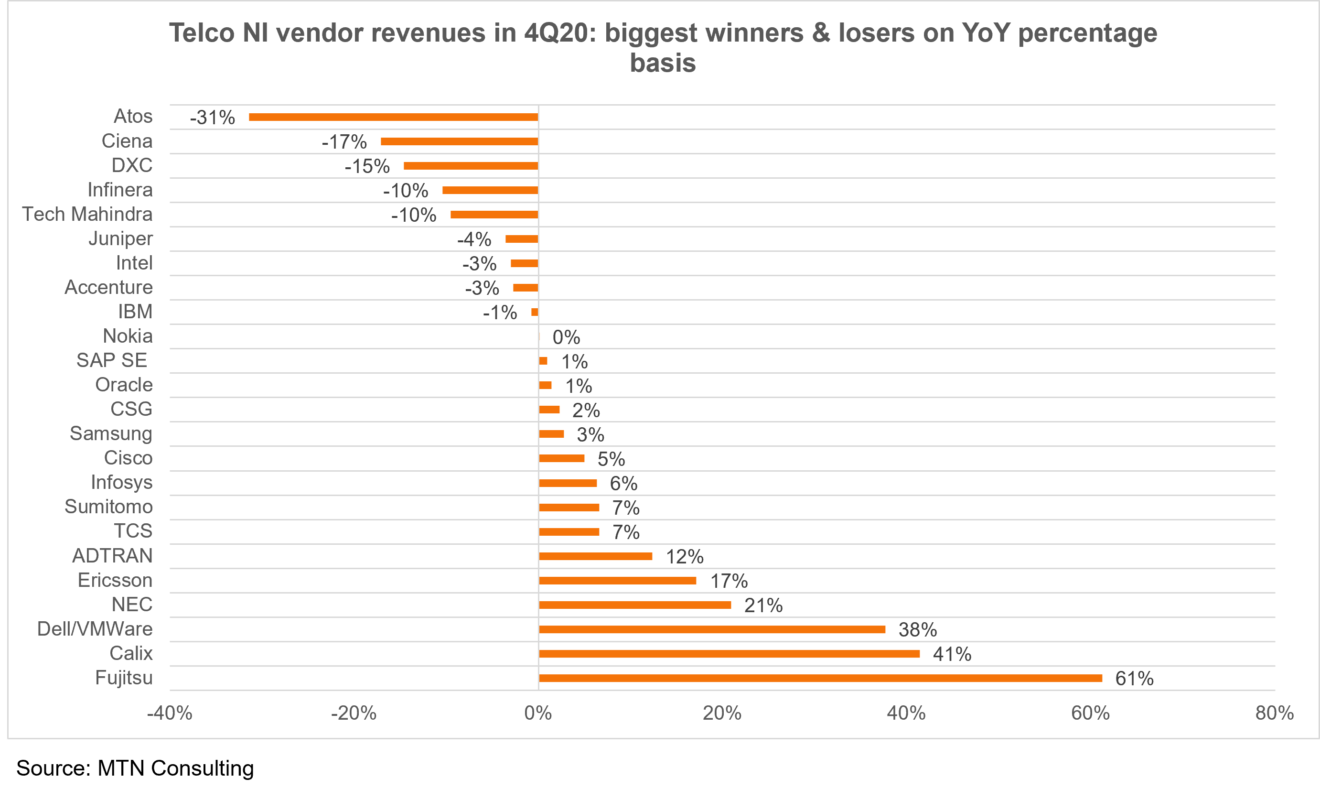
Fujitsu, Calix and Dell/VMWare outperformed in 4Q20 on percentage basis 

On a percentage growth basis, trends were slightly different in 4Q20. The figure below considers which vendors had the biggest YoY percentage swings in telco NI revenues in 4Q20. The chart is focused on companies with over US$500M in 2020 telco NI sales, and excludes companies focused on engineering services & construction (e.g. Mastec and Dycom) or fiber cable (e.g. Corning and Fujikura). It also excludes a handful of companies whose revenue figures are impacted by recent large acquisitions, such as Capgemini (Altran) and Ribbon (ECI).

Telco NI 4Q20 percentage gains

As shown above, three significant Japanese vendors had sizable YoY improvements in 4Q20: Fujitsu, NEC, and Sumitomo. Fujitsu’s gain was the largest of all. However, the company notes that, while is is “now generating some profits from 5G base stations…almost all of the profit is from Japan” and it is “constantly thinking about what kind of structure—not limited to Fujitsu on its own—would enable us to expand our business globally.” Fujitsu is now supplying radios to Dish’s US 5G buildout, which is a start.

Calix and VMWare were also standouts in 4Q20, for very different reasons.

Calix saw a surge in broadband spending in its core US market, especially among smaller customers. Surprisingly, telcos with fewer than 250K subscribers were 85% of 4Q20 revenues, from 71% a year earlier. This is due both to some new small customers and to existing clients scaling up their contracts. Demand was high for new platforms, including Calix Cloud. Calix expects YoY revenue growth of 5-10% for 1Q21.

Dell Technologies-controlled VMWare, meanwhile, continues to be one of the industry’s success stories. VMWare has invested heavily to bring its vision to the telco market, pitching a range of “Telco Cloud” solutions focused on the network (RAN, edge, cable), enterprise services (SD-WAN, digital workspace), and IT modernization. Rogers, DoCoMo, DT, and SK Telecom are among its telco clients. VMWare is also providing the cloud platform for DISH’s new 5G rollout in the US.     

On the downside, Atos Origin, Ciena, and DXC all recorded significant (>10%) YoY declines in telco NI revenues in 4Q20.

Ciena’s drop is in part due to market-wide trends, as several rivals also fell. For instance Nokia’s terrestrial optical business revenues were down 9% YoY in 4Q20, while telco NI revenues for Infinera and Juniper dropped 10% and 4%, respectively. It’s possible that telcos’ recent emphasis on 5G is having a short-term crowding out effect on transmission and IP budgets. Ciena has maintained its guidance for revenue growth of 0 to 3% for the fiscal year ended October 2021.  

For Atos and DXC, intensified competition in the IT services segment of telco NI is a factor, with Accenture, Capgemini, India-based companies and others increasing investments in the telco sector; note the revenue gains by TCS and Infosys in the above figure. Heavy exposure to the European market was also a factor for Atos, at least for 4Q20.

Chinese vendors yet to report: what to expect?

Over the next few weeks, earnings will be released by Huawei, ZTE, Hengtong, China Comservice, Fiberhome, AsiaInfo and others. Many will report good revenue growth for the year in the telco segment due to China’s 5G push. The group’s outlook for 2021 is weaker, though: domestic spending will ease up and international reluctance to rely heavily on Chinese technology in core networks will remain high. There will be exceptions, naturally; Airtel just signed a big deal with Huawei in India, as did KPN in the Netherlands. Without outright government bans, many telcos will continue to give Huawei a chance. On net, though, national security concerns and supply chain constraints will hobble many Chinese players in 2021 and force strategy shifts. Several non-Chinese vendors explicitly point to Huawei’s troubles as opening up new doors to them. Infinera put this bluntly in its earnings call: “the geopolitical dynamics that are constraining Huawei’s ability to grow have opened up a longer-term incremental $500 million to $1 billion annual market opportunity for us to pursue.”

Blog Details

India unlikely to rise above 4% share of telco NI in 2021

Prediction: India-based vendors almost certain to capture less than 4% of global telco network infrastructure market in 2021  

Prospects for 2021

The year 2021 is likely to see some significant shifts in vendor share in the global market for telecom network infrastructure products & services (“Telco NI”). Spending on 5G is picking up, interest is growing in open RAN architectures (and open networking in general), telcos are making more carefully thought out decisions without the chaos of COVID-19 dominating discussions, software’s share of capex is rising, and Chinese vendors continue to face supply chain and security constraints to their global position. Many telcos, and policymakers in the US, have pointed to India as a potential alternative player in the Telco NI market. India and the US are allies, after all, and India has a program aimed at developing local manufacturing – which calls to mind similar programs in China that helped Huawei and ZTE. The question arises, then: what are the prospects for India-based vendors globally in 2021? More specifically: what is the chance that India-based vendors can grow their share of Telco NI above 4% in 2021?

After reviewing the question, our conclusion is that there is less than 10% chance of this happening. Not impossible, but nearly so. Here is our assessment of a few key issues.

Current share below 3%

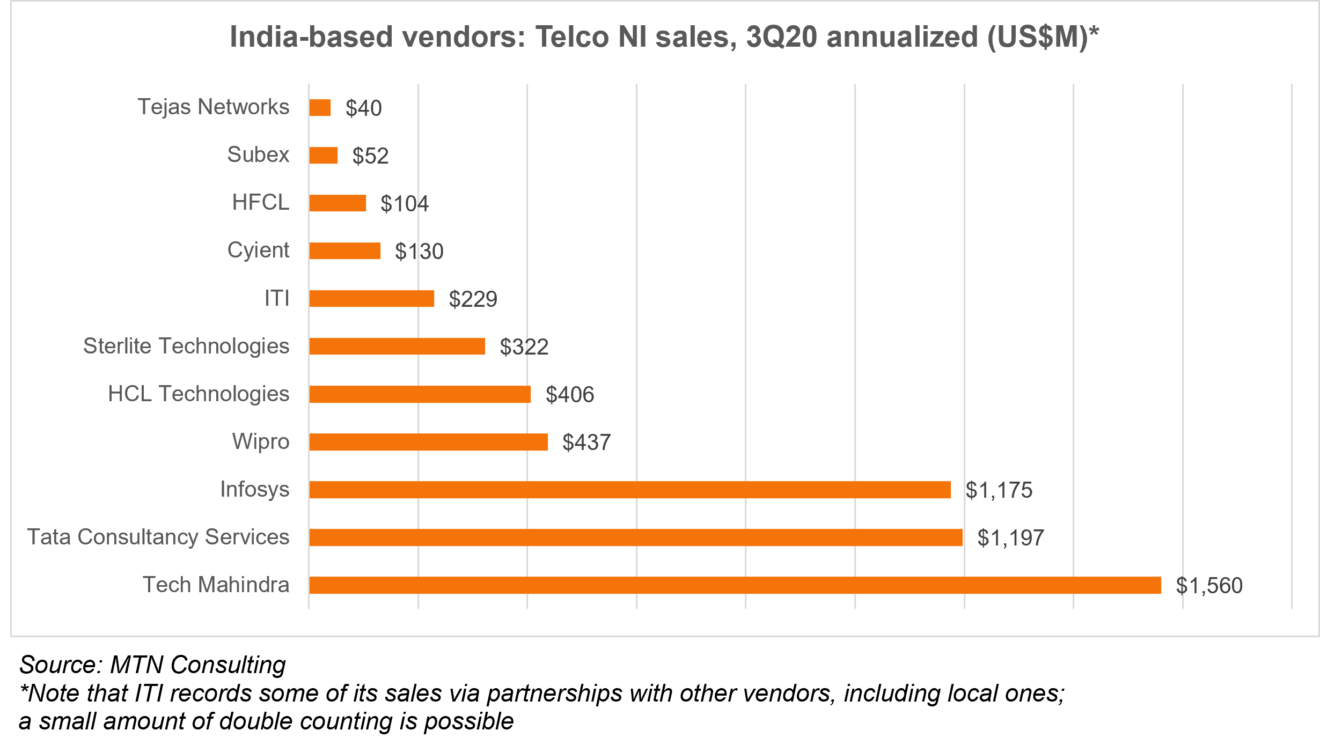
For the four quarters ended 3Q20, MTN Consulting estimates that vendors based in India captured roughly 2.6% of vendor revenues in the global telco network infrastructure (telco NI) market. That is based on sales to telcos for eight vendors we currently track (HCL, Infosys, Sterlite, Subex, TCS, Tech Mahindra, Tejas Networks, and Wipro), plus three vendors we are in the process of adding to our database: Cyient, HFCL, and ITI Limited. Annualized telco NI revenues for these 11 companies, by our estimation, amounted to $5.7 billion in 3Q20, out of a global market of $216.3 billion.  Nearly 70% of that $5.7 billion is recorded by three IT services players: Infosys, TCS, and Tech Mahindra, with the latter slightly ahead of the first two. (see chart, below)

India telcoNI vendors 3Q20-2

So, India’s starting point is low. Jumping from less than 3% to above 4% in the space of a few quarters is a challenge. Adding one percentage point in share is not the issue; larger vendors with the ability to ramp manufacturing to satisfy big one-time orders can do this easily. Most of India’s Telco NI strength lies in services, integration, and software development contracts, though, which tend to take more time to implement. Moreover, India is a relatively small market within global telecom. Local vendors do benefit from set-asides and easier access to local customers, but India accounted for less than 3% of global capex in the last four quarters. It has been higher in the past, in fact reaching 6.1% of global capex in the 1Q19 annualized period. But that was during Jio’s massive network buildout and aimed at helping the company jump ahead of the competition rapidly, which it succeeded in. 

India’s 5G buildout will be hobbled by pricey spectrum

Last month the FCC held an auction for 5G-suitable spectrum in the US. Winning bids totaled up to just under $81 billion, a bit more than 90% of the US telco market’s total annual capex of $88B (2019). Many observers have warned that this outcome could hobble the telcos financially, as they now also need to come up with capital to deploy the networks. These concerns are well-founded.

India could be in an even more precarious situation. Its primary 5G auction won’t be held until next month, but could potentially raise up to $50B or more for the Indian state treasury. This figure is several times India’s 2019 telco capex figure of $10.9B. 

Contrast this with China’s approach, where spectrum is generally given away for free (or nearly so), and the government uses its control of key operators to drive procurement practices and the pace of deployment. Because of this, 5G in China is seeing rapid adoption and local vendors have benefited massively. Huawei and ZTE gained share last year in the Telco NI market, in fact, despite all of their problems. 

A slow 5G rollout in India means fewer opportunities for local vendors to win new deals and gain crucial experience that they could leverage in global markets.

State-run operators are small and procurement is slow 

One area where India’s vendors clearly shine is with state-run operators BSNL and MTNL. Government procurement rules favor local suppliers strongly. However, the two together accounted for just $614M in 2019 capex, under 6% of India’s total. Further, the hoops they must jump through to build new network projects are cumbersome. Disputes about winners and losers can slow down final decisions and the actual spending connected to the decision.

BSNL’s long-planned 4G tender is a good example. It’s now more than 4 years since Jio debuted its 4G network in 2016, and BSNL is still at the early procurement stage with 4G. The project has been delayed several times. Most recently, BSNL did issue an expression of interest document covering a potential network with 57,000 sites. As promising as that sounds, it remains unclear what it means to be local. Partnering with a foreign vendor such as Samsung or Ericsson might qualify; having a large R&D presence in India (e.g. Mavenir) might also allow one to slip through. The challenge is that there does not exist a truly Indian company able to build a 4G network end-to-end, and it cannot be created overnight.

Hiring a truly Indian services firm like Tech Mahindra is one option for BSNL, as TM can get more experience putting together the piece parts for a network in way that will help with Open RAN opportunities. Tech Mahindra already works with Telefonica and Rakuten on Open RAN.   

Jio succeeded while avoiding local NI vendors

Indian telecom’s big success story in recent years is clearly that of Jio Platforms, which emerged from little in 2016 to become the market’s largest wireless provider in just over three years. Jio did many things differently than its rivals, one of which was to rely almost entirely on foreign vendors – but avoiding the Chinese. Jio has some gear from Tejas in its network and a few other small local vendors, but it’s minimal given the telco’s size. There is no current sign to suggest Jio will be more eager to adopt local tech as part of a future 5G rollout. If spectrum was to be issued on a cheaper (or even free) basis but come with some ‘buy local’ requirements, clearly the outcome would differ.  

Bharatnet is not that big a project in global terms

India has made impressive strides in expanding connectivity in rural regions over the last few years, due largely to the Bharat Broadband Network, or Bharatnet. This project has been especially helpful to local fiber manufacturers. It continues, but the scope of the project needs context. For the fiscal year 2020-21, approximately $800M was budgeted for Bharatnet. That is a sizable amount, and many local vendors (e.g. Tejas) cite national or state-level Bharatnet projects as contributing to recent revenue growth. But $800M works out to roughly 2% of telco industry capex in China alone for 2019. The project is just not big enough to help a local vendor go global. 

What could swing things the other way?

In my opinion, it would be great to see a globally competitive vendor emerge from India. At one point in the distant past, it seemed that Tejas had potential to be a real player in the optical market. That has not happened; lack of a local supply chain and manufacturing are among the many issues.

Currently Tech Mahindra is looking like it has real potential, with a growing focus on the blossoming Open RAN market, and helping telcos integrate these new networks. Tech Mahindra’s collaboration with Rakuten on this point is promising. TM will have competition from many other companies going after these projects, though – not just RAN vendors but other telcos, including NTT DoCoMo. It’s not just Tech Mahindra with potential, though; Infosys, TCS, and Wipro are already active in 5G RAN networks. If these IT services specialists can quickly help telcos review and implement new network architectures that have verifiable cost savings, then India’s vendor prospects may brighten. 

The biggest thing that could support the local industry, though, is a different government philosophy on spectrum auctions. Clearly the government needs to raise funds to operate, and auctions are one easy way. But if there is interest in developing local 5G ecosystems and helping local companies make it big globally, then maximizing auction proceeds cannot be the overriding goal.

Blog Details

Telco-webscale collaboration growing in 2021

Telco-webscale collaboration gains momentum in January 2021

One key research theme for MTN Consulting in 2021 is the impact of the cloud on how telcos run their networks. Among other things, this involves a growing level of collaboration between telcos and the webscale sector, particularly the cloud services divisions of Alphabet (GCP), Alibaba (AliCloud) Amazon (AWS), Microsoft (Azure), and Tencent (Tencent Cloud). The three US-based providers are especially important given their global scope. In our annual forecast of network operator spending, published in late December 2020, we advised telcos to embrace collaboration with the webscale sector:

“Telcos remain constrained at the top line and will remain in the “running to stand still” mode that has characterized their last decade. They will continue to shift towards more software-centric operations and automation of networks and customer touch points. What will become far more important is for telcos to actively collaborate with webscale operators … in order to operate profitable businesses. The webscale sector is now targeting the telecom sector actively as a vertical market. Successful telcos will embrace the new webscale offerings to lower their network costs, digitally transform their internal operations, and develop new services more rapidly.”

In 2021, we already see this collaboration growing, much of which fits into the general theme of telco cloud, broadly defined. As such we are tracking the growing deals and partnerships related to this collaboration. Here is a brief recap of recent developments:

Amazon elevates AWS Chief Andy Jasser to CEO, Bezos steps back

On February 3, Amazon announced that AWS’ current CEO, Andy Jassy, would take over for Jeff Bezos as the company’s CEO in a few months. Amazon founder and current CEO, Jeff Bezos, will transition to executive chair of Amazon’s board. This announcement doesn’t relate strictly relate to telco cloud but is a sign of the success of Amazon’s AWS division, which has marketed heavily to telcos in the last two years.

Rakuten Communications Platform picking up steam

On February 5, Japanese greenfield mobile player Rakuten announced that it has 15 global customers for its RCP, and “these are not small customers. Some of them are very, very massive”, per CTO Tareq Amin. Rakuten’s RCP is essentially the company’s effort to sell its approach to building disaggregated, virtualized cloud-based mobile networks to the rest of the mobile industry. The RCP effort is ambitious and faces competitors across the industry, including from the mobile operators’ network divisions themselves, but it clearly has potential. Telcos are looking to cut operational costs and simplify networks, and Rakuten has some valuable experience to offer. 

AWS and Telstra sign framework agreement on 5G

On January 27, Telstra announced a new agreement with Amazon Web Services focused on developing “differentiated multi-access edge computing solutions.” AWS says its edge computing solutions will allow Telstra to “build and deploy applications even closer to its customers, and deliver more seamless user experiences in such areas as industrial robotic and drone automation, connected vehicles, ML-assisted healthcare, and immersive entertainment.” Related to the AWS deal, Telstra will be setting up a “cloud guild” to train up to 4,000 of its employees on AWS cloud operations.

Ford and Google tie up on connected cars

On February 1, Ford and Google entered into a 6-year deal worth hundreds of millions of dollars, under which Google will be responsible for much of the car company’s in-vehicle connectivity, as well as cloud computing and other technology services. 

One potential revenue opportunity for telcos lies in the area of connected cars, aka autonomous vehicles. The market for true autonomy is years away, but will inevitably require a highly responsive, low latency network. Telcos should be in the pole position to enable this level of performance (and reap the revenue upside), but increasingly they are relying on webscale operators to provide edge computing support for 5G. For the Ford-Google deal, it’s not clear if Google itself will need partnerships with telcos at the edge of their mobile networks to make the connectivity piece work. If not, this deal calls into question whether telcos will play a significant role in the connected car market. This is definitely a space to watch.

  • News release from Ford

Singtel works with Microsoft Azure on 5G edge computing

On February 2, Singtel announced it would rely on Azure for 5G edge computing, with trials planned for later in 2021. As with the Telstra-AWS deal mentioned above, Singtel expects the Azure platform to enable enterprises to deploy a range of new applications requiring low latency, such as autonomous vehicles, drones, robots, and virtual/augmented reality. 

Google and Nokia partner to help telcos deploy 5G edge computing

On January 14, Google Cloud agreed to work with Nokia to develop solutions aimed at telcos deploying 5G in need of edge computing support. The idea is to make it easier for telcos to build and deploy cloud-native applications across public and private clouds and edge locations. Again, like Telstra and Singtel above, the focus is likely to be on applications requiring low latency and back-end cloud support.

The collaboration relies heavily on Anthos, Google’s Kubernetes-based application management platform. Google Cloud is signing similar partnerships directly with telcos for 5G mobile edge computing solutions, but working with Nokia may give both an edge at least when Nokia supplies the key mobile network components.

  • News release from Nokia

Huawei shifts Richard Yi to head the Cloud division

As Huawei has faced more challenges in its carrier networks division over the last two years, the company has started to shift emphasis to services, software and its Huawei Cloud division. R&D efforts have matched that shift. Now a big executive change also reflects the change. On January 27, Huawei named Richard Yu as the head of Huawei Cloud. Yu’s previous assignment was to oversee the Consumer Business Group in charge of devices/handsets.

Huawei remains the #1 global supplier to telcos, and has strength across a wide range of product lines. Huawei Cloud has steadily been expanding its overseas data center infrastructure, largely built off of Huawei-developed products (servers, storage, power solutions, etc.). Huawei has a clear opportunity to push ahead into cloud services with a focus on the telco market, and has incentive to do this given its ongoing supply chain constraints. The vendor inevitably will struggle with supply chain issues on the server side as well, however, as long as it’s blocked from reliance on companies like TSMC and ASML. This is a space to watch closely in 2021. 

Optus using Google Cloud for customer service transformation

In a much different kind of announcement, Australia’s Optus announced on January 19 that it would rely on a Google Cloud contact center to power a customer service transformation effort. This is a three year partnership, comprising three GCP products: Dialogflow for automating interactions and self-service, Agent Assist to help contact center agents find information while they are on calls, and a contact center “insights” tool. What’s notable here is that some of the more traditional software- and services-focused telecom vendors provide similar platforms to what GCP is offering. The webscale providers are clearly going to be competing more directly with these specialist telecom vendors in coming years. 

Blog Details

Telco collaboration with webscale sector picking up steam

Telco-Webscale Collaboration

In our recently published capex forecast, we discussed how essential collaboration will be for the future of telecommunications network operators (telcos). In particular, collaboration with the webscale sector.

Many of the largest webscale network operators (WNOs) operate cloud services, serving a wide range of vertical markets. Over the last 3 years, the telco sector has become an increasingly important vertical market for webscale services. This telco-webscale collaboration activity picked up in 2020. WNOs help telcos with service and application development, shifting of workloads, and development and marketing of cloud services. Managing costs is a central purpose of telcos’ willingness to partner with webscale providers. Also, with the emergence of 5G, webscale operators are developing a range of edge compute services aimed at facilitating 5G rollouts and service deployment. Collaborations can involve delivery of a portfolio of 5G edge computing solutions that leverage the telco’s 5G network and the webscale operator’s global cloud coverage, as well as its expertise in areas like Kubernetes, AI/ML, and data analytics. 

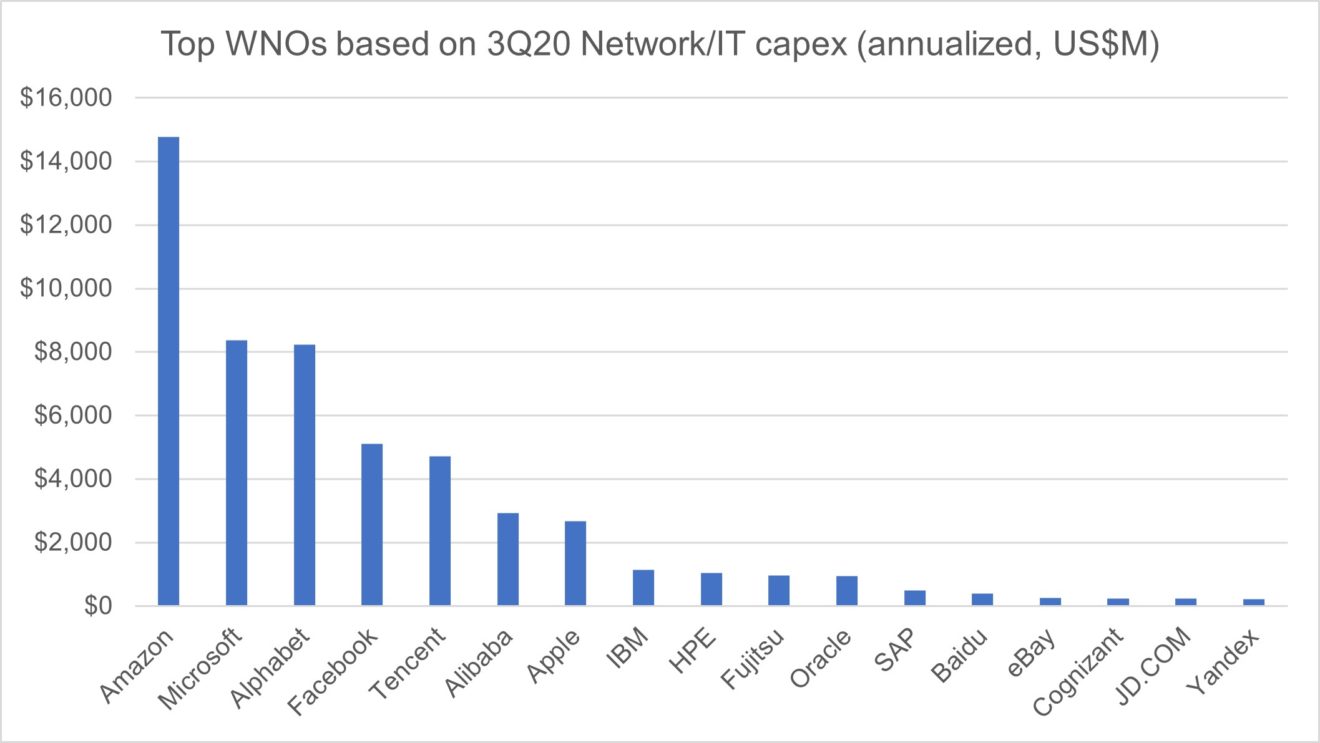
While many observers – including more than a few telco execs – look at the webscale sector with trepidation, the smart ones are now pursuing collaboration. A wave of promising partnerships between telcos and webscale providers has emerged over the last 12-18 months. We expect this activity to accelerate in 2021 as telcos search for cost savings and webscale operators reap the benefits of their cash stockpiles and an unexpectedly strong 2020. As a reference point, here is a chart depicting the top webscale providers as of 3Q20 based upon annualized Network/IT/Software capex:

top wnos network capex 3q20

Below, we discuss some recent developments of note.

Alibaba knocked back by Chinese regulators, cloud aspirations may take a hit

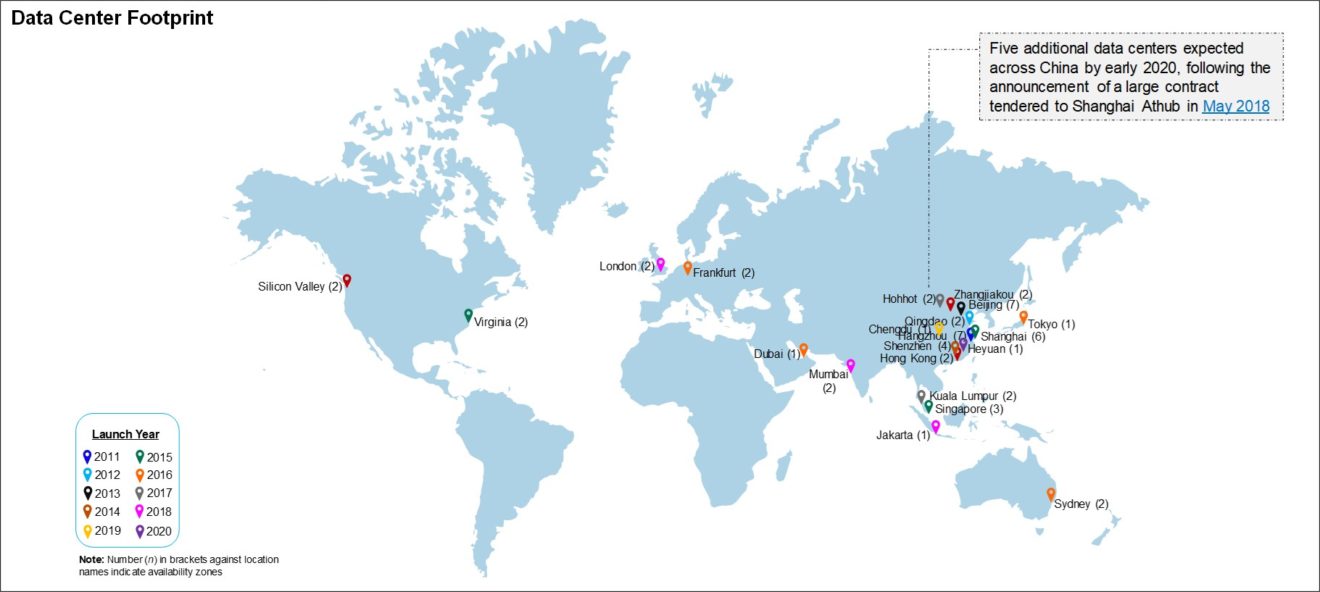
Alibaba is regularly ranked as the top domestic provider of cloud services in China, and has invested heavily in a network of data centers to support this (Figure 1). Alibaba’s corporate capex amounted to $6.2 billion in the four quarters ended 3Q20. Its aspirations have grown rapidly in the last two years with a series of acquisitions and search for growth beyond ecommerce, and aim for cloud growth beyond China’s borders. 

Figure 1: Alibaba Data Center Footprint 

Alibaba DC map

They say the tall trees get cut down first, though, and that appears to be happening. Alibaba’s effort to launch an IPO of its fintech division Ant – possibly the largest ever IPO, anywhere – was pulled in November after company founder Jack Ma went a little too far in criticism of the Chinese government. Then China’s State Administration of Market Regulation (SAMR) announced an antitrust probe of Alibaba on December 24, focused on Alibaba’s alleged monopolistic business practices. Now Ma hasn’t been seen in public for a couple months, as he reportedly “lays low” – whether that’s his own choice or not is an open question.

Adding to the pressure on Alibaba, US President Trump – on his way out, possibly sooner than expected – issued an executive order on January 6 banning transactions between US companies and individuals with eight Chinese apps, including Alipay, Alibaba’s payment app. This ban takes effect in mid-February, so could be reversed by the Biden administration, but that seems unlikely.

One reason it’s unlikely is the news from mid-December, when a report found that the company “openly offers Uyghur/’ethnic minority’ recognition as [a] service [on Alibaba Cloud], allowing customers to be alerted any time Alibaba detects a Uyghur.” This blatantly racist affront to human rights and dignity is not going over well.

The only significant overseas cloud win with a telco announced by Alibaba recently was in Saudi Arabia, interestingly enough, a land where money talks a bit more loudly than human rights concerns. stc announced in December that it would invest $500 million in a cloud services partnership with venture fund eWTP Arabia Capital and Alibaba Cloud. Through this project, stc aims “to reinforce digital infrastructure and to leverage the proven cloud-based technologies and services of Alibaba Cloud to accelerate the growth of local technology ecosystem.” 

Alibaba also retains a cloud partnership agreement with China Telecom, and in fact held a press event for the venture in mid-December. China Telecom faces its own restrictions in a number of overseas markets, though, particularly in the US where it has been the subject of claims of hijacking Internet traffic. Alibaba’s challenges outside its home market open up new opportunities for Microsoft Azure, GCP, and AWS, including in the telco vertical.

Huawei aiming for cloud expansion to offset lagging equipment business

Huawei’s carrier networks division had a good 2020 but due almost entirely to China’s rush to deploy 5G. Elsewhere, the company faces severe restrictions in its ability to bid on 5G network contracts and continues to cope with supply chain restrictions limiting its access to core semiconductor technologies with US origin.

One way Huawei has coped with these challenges is to lean more heavily on services and software contracts, where supply chain constraints are less of a concern. Another way is to push ahead in deploying its own network of data centers – built on Huawei technology, largely – and offering its own cloud services through the Huawei Cloud unit. 

This strategy became all the more clear recently with a leaked internal speech from company founder & CEO, Ren Zhengfei. The speech expressed some disappointment with Huawei Cloud’s progress to date, suggesting the company needs to narrow its focus: “Huawei can’t take the same path as Alibaba and Amazon, since we don’t have ‘endless money’ from the US stock market like them.” 

One clear point was the need for Huawei to build an application ecosystem similar to Amazon AWS. But the speech reads more aimed to foster discussion than one with clear marching orders.

Ren stated, “Alibaba Cloud, Tencent Cloud, and Amazon’s AWS have introduced more and more hardware-software fusion devices. Huawei’s advantage lies in hardware. We must strengthen the software and application ecosystem and should not give up the advantages that hardware brings to Huawei Cloud.” 

Huawei is not the first traditional vendor to build a cloud division. IBM, HPE, Oracle, and others from the IT services vendor world are all tracked as webscale operators by MTN Consulting due to their large network of owned data centers. But Huawei remains the number 1 vendor based on sales to telcos, worldwide. And it’s not even close; Huawei’s annualized sales to telcos through 3Q20 were approximately $46.2 billion, more than the sum of second and third ranked Ericsson and Nokia. As such, Huawei’s plans for its Cloud unit could have a big impact on the shape of telco-webscale collaboration to come, in parts of the world.

Whether it makes sense to call Huawei Cloud a webscale operator or not is not a crucial question at this point. What is more important is to what degree Huawei can leverage its huge installed base of customer relationships in the telco world to help grow its position in the cloud. In this regard, Huawei and Alibaba are going after some of the same business: telcos in MEA, CALA and emerging Asia who are more concerned about price and less concerned about technology origins. 

Mavenir SVP predicts webscalers will play big role in telecom going forward

SDxCentral published a fascinating interview on January 6 with John Baker, the SVP of business development for open RAN proponent Mavenir. He predicted that the webscale operators (which Baker calls “hyperscalers”) are going to “become the new telecom providers going forward.” That’s due to the rising importance of cloud computing in network infrastructure. Baker stated: “Apart from the physical radio that goes on a tower, everything we’re doing now follows the data center model, and these guys know how to manage data centers, software, and applications…If you look at open RAN essentially as being a collection of applications that run on a server, then it really is falling into their camp.”

This prediction might imply that telcos have much to fear from webscale operators simply taking over their business. It’s not that simple, though. More likely is that the telcos will rely more and more on webscale infrastructure for incremental network functionality and capacity (and service development) over time. Telcos will aim to stick to their core business of managing and marketing services to the customers they have had a lock over for decades, and retaining control over a large portion of their network infrastructure. Importantly, change in the access portion of telco networks is measured by decades, not months or years, so there is some time to work out this transition. 

Read more at SDxCentral.

SKT launches edge cloud in collaboration with AWS

In early January, SK Telecom announced the launch of an edge cloud service with AWS known as ‘SKT 5GX Edge’. This leverages AWS Wavelength to enable SKT customers to build mobile applications requiring the ultra-low latency 5G is supposed to deliver. The rollout will start in Daejeon and move to other areas including Seoul later in 021. 

AWS has no plans (or ability) to take over SKT’s operations or its interaction with its customers. This is about using the familiar AWS services, API, and tools to develop new services on SKT’s 5G network. It sounds like a win-win. SKT is not the average telco, though, as it’s an early adopter of new technologies with a healthy R&D budget of its own, and strong ties to a range of domestic manufacturers and software developers. What will be interesting to see is whether AWS Wavelength deals with telcos in less sophisticated markets than Korea will be structured in the same way.

Read more at Capacity Media.

Deutsche Telekom extends its reliance on the Microsoft Azure network

In mid-December, DT announced it would shift the majority of its internal IT workloads to the public cloud by 2025, with Azure central to that plan. DT has been working with Azure for several years, but this 7-year deal is a significant expansion. DT will also offer its customers access to Azure’s cloud and AI services, including ExpressRoute. 

Read more at the Microsoft News Center.

Blog Details

It’s time for tech to take a stand

In 2000, Google famously incorporated a simple catchphrase into its corporate code of conduct: “Don’t be evil.”

The idea, said Google, was that “everything we do in connection with our work at Google will be, and should be, measured against the highest possible standards of ethical business conduct.”

Google’s founders recognized that the growth of its search and ad platforms was turning the company into a powerful entity with the ability to shape user’s understanding of the world. While the “don’t be evil” catchphrase was mocked by some, it did at least imply that the company saw that its growing power came with certain responsibilities. The tech industry could use more of this sentiment in 2020.

Chaos in the streets is a feature, not a bug

Fast forward 20 years, 3.5 years after Facebook helped elect Donald Trump to the presidency, and America is in crisis.

The country is now run by a president who, as Jim Mattis, Trump’s first Secretary of Defense, put it, “is the first president in my lifetime who does not try to unite the American people—does not even pretend to try. Instead, he tries to divide us.” There are parallels in this to how Trump ran his 2016 campaign, deftly using Facebook and other social media to micro-target his messaging.

Since George Floyd was killed by a Minneapolis police officer on May 25, and the video of the killing went viral, protests have spread nationwide, to even the smallest of towns. Some opportunists have used the protests for looting, as is always the case, and some far-right, pro-Trump actors have deliberately engaged in looting and vandalism in order to give cover to any resulting police crackdowns. The bulk of the violence, though, is top-down. Egged on by Trump, police officers and an array of other armed security officers have reacted to largely peaceful assemblies of their fellow Americans with violent tactics and gear designed for fighting wars.

Patrick Skinner, a writer, former intelligence officer, and now police officer in Georgia, implied this violence was by design on his Twitter feed recently:

“Don’t let us off the hook by saying this orgy of violence is a failure in training. It is not. It is the result of training for war. Don’t say it’s a lack of a few de-escalation power points. It is not. It is the result of training for war. Our entire mindset is a war on crime.”

Racism didn’t start with Trump, nor did the militarization of the police. But this President has used a unified right-wing mass media propaganda machine and the tech industry’s social media tools to make both hip again. Cultivating a tough-guy image, he once urged a police group, “Please don’t be too nice” to suspects. Note his focus: “Suspects,” as opposed to convicted criminals.

Today, hundreds of thousands (if not millions) are protesting to be heard, at great personal risk, while the COVID-19 pandemic rages on. Republican politicians are under pressure to preserve an image of a good economy, in hopes of a Trump re-election, so public health concerns take a back seat. The political movement that claimed to be concerned with the lives of the unborn, and responds to “Black Lives Matter” chants with the inane “All Lives Matter,” is now persuading the public to overlook the 100,000+ deaths from COVID-19 and just get back to work.

In my home state of Arizona, which has a population of over 7 million, more than 1,000 people have died from COVID-19. Prior to this, I lived in Thailand for a decade. That country, which has more than 70 million — more than 10 times than that of Arizona — has recorded fewer than 100 COVID-19 deaths. And Arizona’s gross domestic product per capita (nominal) is over five times that of Thailand. What good is wealth if elected leaders don’t use it to invest in things like public health for their constituents?

As Mattis said in his recent statement, “We are witnessing the consequences of three years without mature leadership.”

Tech executives continue to hedge their bets

We are also witnessing how obsessed with money the rich and powerful of this country have become.

The hundreds of Internet companies to make it big since Google’s advent have become even bigger since Trump’s 2017 tax reform directed massive tax cuts to corporations and high-income individuals. Their top execs have become far wealthier. Even with extreme levels of unemployment and a steep GDP drop inevitable in 2020, these folks are doing just fine.

Surely, you would think, the largely liberal (so we’re told) tech sector would have spoken out by now, publicly critiquing not only specific acts of police violence but, more importantly, the messaging sent from the top. Yet, when we surveyed the top few execs of the largest companies in the U.S. Internet and telecom sectors, we came up largely dry. If wealth is supposed to free you to do and say what you want, the results have been revealing (Table 1).

Table 1: Public comments on George Floyd and Racism by Tech Execs 

Company Market cap (U.S. $B) Tech executive Public comments
Alphabet                 977.0 Sundar Pichai, CEO Posted a picture of a modified Google search home page, with new text: “We stand in support of racial equality, and all those who search for it.” Pichai’s post: “Today on US @Google and @YouTube homepages we share our support for racial equality in solidarity with the Black community and in memory of George Floyd, Breonna Taylor, Ahmaud Arbery & others who don’t have a voice. For those feeling grief, anger, sadness and fear, you are not alone.”
Amazon              1,220.0 Jeffrey Wilke, CEO, Consumer Two tweet thread: (1) “A friend who is a Black man sent me an email today that included: “The narrative that security of accomplishment will somehow lead to equality in this country for people of color, especially Black men, is a false narrative. It is simply not real.” (2) “Since I’ve subscribed to this idea — that facilitating achievement was the key to solving the problem — I looked in the mirror and asked “Have I done enough? Have I listened carefully enough?” Clearly the answer to both is “no.””
Amazon              1,220.0 Andrew Jassy, CEO, Amazon Web Services Tweeted “*What* will it take for us to refuse to accept these unjust killings of black people? How many people must die, how many generations must endure, how much eyewitness video is required? What else do we need? We need better than what we’re getting from courts and political leaders.”
Amazon              1,220.0 Jeff Bezos, COB & CEO Posted an essay on Instagram called “Maintaining Professionalism in the Age of Black Death is…A Lot”. Bezos’ personal intro to the essay: “The pain and emotional trauma caused by the racism and violence we are witnessing toward the black community has a long reach. I recommend you take a moment to read this powerful essay from @goldinggirl617, especially if you’re a manager or leader.”
Apple              1,380.0 Tim Cook, CEO, Director Tweeted “Minneapolis is grieving for a reason. To paraphrase Dr. King, the negative peace which is the absence of tension is no substitute for the positive peace which is the presence of justice. Justice is how we heal.”
Disney                 211.9 Robert Iger, Executive COB Tweeted “Below is a link to a statement we sent to our fellow @Disney employees. It’s from Bob Chapek, our CEO, Latondra Newton, our Chief Diversity Officer, and me. Thank you.” The link is a letter to Disney employees that discusses George Floyd.
Microsoft              1,390.0 Satya Nadella, CEO, Director Re-tweeted a Microsoft Corp. post that it would be using its platform to “amplify voices from the Black and African American community at Microsoft.”. Nadella’s post says, “There is no place for hate and racism in our society. Empathy and shared understanding are a start, but we must do more. I stand with the Black and African American community and we are committed to building on this work in our company and in our communities.”
Netflix                 184.6 Reed Hastings, COB, President, CEO Retweeted a video promoting non-violence, which said: “Some protestors in Brooklyn calling to loot the Target, but organizers are rushing in front of the store to stop them, keep things non-violent #nycprotest”
Snap                   27.4 Evan Spiegel, CEO, Co-Founder, Director Posted a Snapchat with intro saying, “We condemn racism. We must embrace profound change. It starts with advocating for creating more opportunity, and for living the American values of freedom, equality and justice for all. Our CEO Evan’s memo to our team:”, followed by a link to a message written by Evan to his team members.
Twitter                   24.3 Jack Dorsey, CEO, Director Active participant in online discussion, largely through re-tweets, several of which highlight police violence. In May, raised Trump’s ire by flagging one of his tweets for “glorifying violence.” An important but small step, though: the New York Times reviewed a set of Trump tweets for the week of May 24th, and found at least 26 out of 139 posts contained clearly false claims.
Verizon                 237.4 Hans Vestberg, COB, CEO Pinned a Tweet and posted the video on Instagram as well as from Verizon’s Twitter feed of a video clip of himself speaking up on the death of Floyd, captioned “We cannot commit to the brand purpose of moving the world forward unless we are committed to helping ensure we move it forward for everyone. We stand united as one Verizon.”
Verizon                 237.4 Ronan Dunne, EVP, CEO Consumer Group Tweeted, “While it’s hard to find the right words, we need to do more than speak — we need to listen and act. I’ll do my part to learn and help elevate the voices that will drive the change we want and need to see in the world. #ForwardTogether”, followed by a link to a video of CEO Hans Vestberg speaking on the subject.

Note: all posts are from the May 30-June 3 timeframe; exact dates available in links.

Most prominent execs have simply kept their heads down. One big exception is Jack Dorsey of Twitter, who appears to have had a recent awakening as to the power of his company’s platform and how well it has been manipulated by the powers that be. Watch Jack.

Snap CEO Evan Spiegel has also started to find a voice, first deciding to stop promoting (for free) content from Trump on Snap, and saying that Snap needs to “embrace profound change.”

Many more execs have issued bland, low-risk statements, sometimes head-scratchingly vague, as with the Verizon CEO’s focus on “the brand purpose of moving the world forward.” Apple CEO Tim Cook quoted the Rev. Dr. Martin Luther King Jr. on Twitter, saying “positive peace” requires the “presence of justice.” Cook also sent a letter to employees which received some public praise.

Yet the Cook letter also risked almost nothing, for Apple as a company and Cook personally. Silicon Valley VC Vinod Khosla pointed this out in response, saying that “it’s easy to support equality & justice…it’s when one has to give up something to support it that belief in our real values show up. @tim_cook easy to talk but why do you suck up to @realDonaldTrump?”

Exactly the point.

Let’s not forget, we are talking about some of the wealthiest, most powerful people in America. The few who have spoken recently are clearly in favor of equality, and pro-human rights, but their statements read as largely vacuous lip service. Recall that clause within the U.S. Declaration of Independence, “All men are created equal.” Inspirational, yes, but, at the time, white male property owners just happened to be a little more “equal” than others.

Words are easy to toss around, then and now. Actions count.

If you have ever read the Bible, whether as a believer or a student of philosophy, this quote seems apt: “To whom much is given, much will be required.”

What can tech do?

The first step to fixing a problem is accepting that you have one. Some tech companies have arrived at this point, notably Twitter.

The second step, in this case, is deciding that you have the resources to fix the problem. On that note, some market data may come in handy.

Figure 1 below illustrates just how deep the pockets are in the sector of webscale network operators, tracked by MTN Consulting. The “webscale” sector encompasses big companies in the Internet services industry like Facebook and Google who have built out their own physical network infrastructure to support their services and operations, with data centers taking up much of the spending. The figure shows the free cash flow generated in 2019, and year-end cash reserves, of U.S.-based webscale players.

Figure 1: Free cash flow and cash & short term investments at year-end in the webscale sector, 2019

Source: MTN Consulting, “Webscale Network Operators: 4Q19 Market Review

These are immense companies which have recorded profit margins far above most other sectors, and for many years. There’s always pressure to grow profits more, or use more of the cash for mergers and acquisitions in order to position for growth of forestall new competitors. But saying that they can’t afford to improve their platforms is a hard argument to make.

Then there’s another question: Why should they bother? Many will read this and, even if they oppose Trump, may think it’s not tech’s job to get involved in politics. It’s not a tech CEO’s job to combat rising authoritarianism, racism, or the metaphorical shredding of the Constitution. That, they will argue, is the job of voters.

However, these tech and telecom CEOs do have a responsibility to ensure their platforms are not used and manipulated by evil actors to do evil things. Not just for moral reasons, but also to ensure their platforms can thrive over the long-term. It’s been clear for at least 3.5 years that many are failing at this aspect of their job.

MTN Consulting’s contribution

MTN Consulting is an industry analysis and research firm, not a company that typically comments on politics. We remain focused on companies who build and operate networks, and the vendors who supply them. That isn’t changing. However, we are going to dig into some of the technology issues related to these networks and networking platforms which are having (or will have) negative societal effects.

Specifically, over the next few weeks, we will issue reports on:

  • Bots on social media platforms: How they work, how they shape public opinion, and how they can directly impact elections
  • Privacy: How social media and telecom companies exploit user data to sell more ads, and how this user data is often sold to and misused by third parties (including government actors)
  • Digital advertising and journalism: How tech companies’ takeover of advertising markets has impacted the news industry and complicated citizens’ efforts to get reliable information
  • Deep fakes: How machine learning and artificial intelligence (AI) research, much of it done by the webscale sector, is about to make it even harder to distinguish fact from fiction; how that may reduce the value of social media platforms; and how both webscale players and users will have to cope.

For those of you accustomed to seeing us write about data centers, optical fiber, mobile radio access networks and similarly dry topics, have no fear – that will all continue. This is a moment in time, however, when sitting on the sidelines of more consequential debates is no longer an option.

-end-

Photo by Khalid Naji-Allah, Executive Office of the Mayor via AP