
Blog Details

Transition to autonomous vehicles poised to have a big impact on telcos

I’m one of those people who loves driving, but not picky about the actual car. I’ve driven some rusty, falling-apart junkers in my life, lots of forgettable rentals, and too many SUVs – I like driving them all. As long as I’m not stuck in traffic.

What I like less is, the idea of the car driving me. Even worse is the idea of no steering wheel at all, now a reality in some concept cars. Power-steering is a great innovation, true; ask anyone who has ever parallel parked in New York City. But gesture-based steering is another thing. Waving a hand (or wrinkling your nose?) in front of a built-in camera to tell the car to go left or right is a bit much. Even if the car is doing most of the steering, the user (this one, anyways) still wants to be in control. Especially when security and safety are such important considerations. The whole issue of hacking becomes even more frightening in a world of autonomous vehicles.

CES makes a self-driving future seem within (our kids’) reach

So, I’m probably an unlikely analyst to get excited about the self-driving car movement. But I am, especially after visiting CES last week.

Cars were a big part of the show, both on the floor and in conference sessions. Companies from across the (emerging) connected & autonomous vehicle (CAV) ecosystem showed up, from across the globe. There was loads of hype, and way more companies than can survive. But things are getting real.

Some interesting announcements specific to 5G network connectivity from the show include:

  • Continental announced a new V2X solution designed to support both DSRC and Cellular-V2X communication protocols. C-V2X is becoming increasingly important as 5G emerges, but supporting DSRC is still important (more so in certain regions than others, such as the US). Notably, the US Dept. of Transportation just opened up an inquiry on V2X technologies last month.
  • Ford Motor Co. announced that starting in 2022 every new vehicle it sells in the US will be equipped with C-V2X, piggybacking on growing 5G cellular network rollouts. Ford is now reliant on favorable regulatory rulings on C-V2X.
  • Taiwan’s Wistron NeWeb Corporation showed 5G and C-V2X system and modular solutions
  • Audi, Ducati, Ford and Qualcomm demonstrated use cases enabled by C-V2X
  • Veniam and Bosch presented a jointly developed central control unit for V2X data management and communication.
  • Velodyne Lidar announced a new camera, the VelaDome, as well as a new software platform “Vella” which supports the company’s advanced driver assistance system (ADAS).
  • Denso-TomTom: mapping company TomTom has partnered with Japanese company Denso, a key maker of car sensors (e.g. cameras, radars). DENSO will provide processed sensor data to TomTom, which will use it to update its mapping data in real time.
  • California-based Udelv announced it is using Baidu’s self-driving OS in delivery vans that will be supplied to Walmart later this year, in Arizona. Baidu wants Apollo to function similar to Google’s Android, but for cars.
  • IoT software company Wind River announced upgrades to its Chassis automotive software. The updates integrate Chassis with the company’s “Titanium Cloud” virtualization software, aiming to address the reality that “in order for autonomous driving to reach mass production, it will require ultra-low latency and dynamic compute architectures for the cloud as well as in the car.”

Telco interest in connected cars is growing

AT&T has been (justifiably) bragging about its connected car success, and that continued in Las Vegas. The company had 24 million connected car connections in Sept 2018, mostly through partnerships with manufacturers. It also has about 1 million consumer connections for car WiFi hotspots. Impressive numbers, but the network requirements are still fairly limited. AT&T’s VP for IoT Solutions, Joe Mosele noted on a CES panel that this will change. Networks will need very low end-to-end latency (<20ms) to make self-driving a reality. Some edge processing will be required to support this latency; that is one reason AT&T expects edge computing to be important, and why it supports the “central office rearchitected as a data center” (CORD).

It’s not just AT&T. The transition to connected & autonomous vehicles (CAVs) is going to have a big impact on the broader sector of telecommunications network operators (TNOs). New types of companies will see a need for communications network infrastructure, e.g. to support a CAV offering. New companies may find use for old/unused infrastructure or rights of way (e.g. power companies). Telcos will find ways to create things like “super bundles” by adding in monthly car service, and partner with or buy a shared transport provider like Uber or Lyft. Over time the roadway infrastructure itself will change to accommodate different types of vehicles. People who like to drive old cars that aren’t retrofitted with V2X gear may only be allowed in certain parts of a city. Cars will come in more shapes and sizes, have fewer windows, but more screens, cameras, sensors, storage, and networking capability. As the market scales, data consumed per vehicle will rise and use cases will get more complex. The “data center on wheels” term may come to fit. Telcos will have a big role to play.

A slow, patchwork evolution

After 20+ analyst years watching technologies come and go, usually far slower & chaotically than expected, I’m a bit of a cynic. Or a realist, anyways.

A full global transition to connected & autonomous vehicles will take 30-50 years or more, depending on how you define the end state. There will be huge regional variation, partly because of different regulatory regimes. Also important is the reality that CAVs can only function safely within a specified geographical space. Geofencing will be used to control – and slowly grow – the scope of CAV deployments. Autonomous tractors working together to manage large farms, for instance. Pepsi’s experimental snack delivery system, made by Robby Technologies, in use on the University of the Pacific campus in California. More ambitiously, Volvo aims to have a Level 4 robotaxi available in China by 2021, working with Baidu. This effort will be limited to specific areas too, though; the quality of the local maps are essential, not just the network. China’s rapidly changing streets and skyline makes the mapping issue even more demanding.

Telcos need an upside, and cars could help

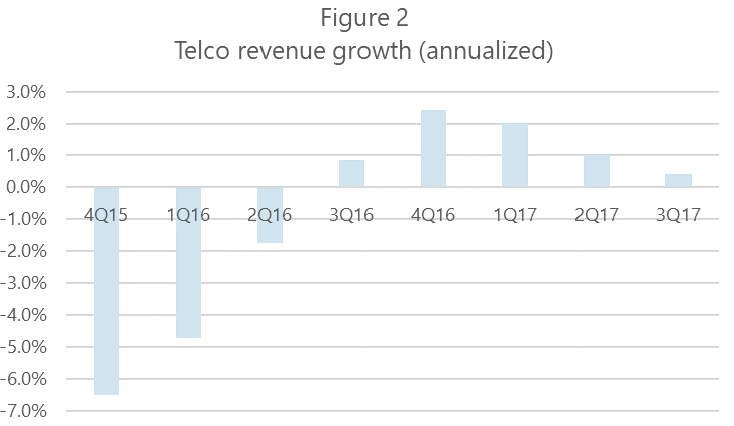
Telcos have faced weak revenue growth for many years. Given this reality, they are focused on costs: building & managing network infrastructure, as efficiently as possible. With self-driving, though, there is some upside potential. As the autonomous car market evolves, we expect telcos to pursue a range of different approaches. Some will be pure pipe (or bandwidth) suppliers, some will partner selectively with automotive specialists (car makers, ride sharing, etc), some will transform their operations more dramatically to address self-driving. None will be unaffected.

Blog Details

Indian government’s decision to welcome Huawei for 5G trials receives mixed response

The Indian government’s recent decision to invite Huawei for 5G trials has sparked a debate between two opposing bodies. Indian telecom export body TEPC (or Telecom Equipment and Services Export Promotion Council) has proposed a ban on Chinese telecom equipment citing recent similar moves by the US and other developed countries over cybersecurity concerns.

On the other hand, Cellular Operators Association of India (COAI), which represents the country’s telecom operators, defies the proposed ban. The COAI suggests that there is little evidence to confirm the claims of the countries that banned the Chinese giant. COAI’s stance is not surprising considering operators are heavily dependent on Huawei’s kit.

India’s support for including Huawei was expected

Huawei is facing political obstacles in a number of the world’s largest markets – the US, Japan, Australia, and likely more to come. Indian policymakers also have security concerns about Huawei. Those are being set aside, for now.

The Indian government’s openness toward Huawei rests on three major reasons. First, a ban on Chinese telecom equipment would be detrimental to operators who had already purchased gear from Huawei on a long-term supplier’s credit and at discounted prices. Second, Huawei is one of only a few competitive 5G network infrastructure vendors. Third, a wider range of companies taking part in the trials bodes well for 5G growth prospects and gives operators more clout during price negotiations.

Publicly, Huawei has received widespread support from the telcos. That’s clear from a statement issued by Rajan Mathews, head of the COAI: Huawei is “suitably equipped to prepare operators and industry to build 5G capabilities in operations, in organisation and most importantly in the ecosystem and to ensure they are fully compliant with all government requirements.”

AnchorIndia still struggling to develop a local telecom equipment sector

Rival vendors and trade groups oppose the government’s openness towards Huawei. One reason they point to is a need to support local vendors, or local R&D by foreign vendors (e.g. Ericsson’s 5G partnership with India’s IITs).

Currently most of India’s telecom capex goes to foreign vendors, who dominate the Indian market for wireless base stations, transmission equipment, and data/IP gear. Nearly all of India’s telecom network infrastructure is imported. Besides China and Hong Kong, Indian operators import network equipment from South Korea, Vietnam (Samsung Vietnam), Taiwan and the USA. This has resulted in a huge telecom equipment trade deficit.

Further, most handsets sold in India are either just assembled or imported from other countries. Electronic parts such smartphone cameras and screens, PCBs, sensors and camera modules are imported (mostly from Chinese vendors). PCBs are especially important, as they can account for up to 50% or more of the device cost. For the Indian market, generally handset vendors import PCBs which are already loaded with components, and then assemble them in a semi-knocked-down (SKD) format. A PCB constitutes several key components such as memory, wireless chip sets and processors that forms the core to any device.

Indian policymakers continue to search for ways to grow the local vendor market. Some policy ideas are aimed at the supply side, designed to stir up new local innovation and attract venture capital. Some ideas aim at coercing private operators to buy local. These top-down policy ideas will take time to achieve consensus, though. In the meantime, foreign tech companies are announcing new investments in India as a result of US-China trade disputes. That includes a recent decision by Foxconn to move some iPhone assembly to India.

Huawei might face a few hiccups post the import duty hike

In October 2018, the pressure to promote local manufacturing prompted the government to double the import duty to 20% on several types of network equipment. The products include ethernet switches, IP radios, base stations, media gateways, optical transport equipment, MIMO/4G LTE gear, VoIP phones, gateway controllers, packet transport nodes and optical transport product or switches. Further, a 10% customs duty (compared to zero import duty earlier) was also levied on products like printed circuit boards (PCBs).

However, countries such as South Korea and Vietnam which have a free trade agreement (FTA) with India are exempted from these import duty charges. This could be a major hindrance for Chinese network equipment vendors who might lose ground to their peers. It benefits others, though. South Korean giant Samsung is already reaping the benefit of import duty exemption, both from its home base and via its manufacturing hub in Vietnam. A glimpse of this is already seen in the trade data. According to the latest data published by Ministry of Commerce and Industry Trade, telecom equipment imports from Vietnam increased by 35% YoY in the period Jan-Oct 2018, while imports from China/HK fell by 12% YoY for the same comparable period. The import duty hike could also benefit Taiwanese vendors, if Taiwan ever manages to finalize an FTA with India.

Apart from the import duty challenge, market consolidation is also having an impact on Huawei. The industry is just left with four large integrated operators, compared to eight operators in 2017. Huawei’s managed services business in India took a hit after it lost two of its big-ticket clients Vodafone India (which was merged with Idea) and Telenor (which got acquired by Airtel) due to market consolidation. The effects of this are already seen as Huawei shut its Chennai SEZ plant –which assembles telecom equipment– due to reduced demand. Despite these challenges, Huawei hopes that its long-standing customer relationships, robust R&D, and competitively priced products will keep customers coming back.

Blog Details

Operators feel the pinch of rising labor costs

Global telecom operators are facing a cost crunch. Based on MTN Consulting’s analysis, annualized operating profit margins have fallen for five straight quarters, from 13.7% in 2Q17 to 12.7% in 3Q18. This profit dip comes during strong economic times; a recession would make this far worse. Further, telcos need cash to fund their 5G migrations and to pursue M&A opportunities. As the pressure to improve profitability rises, telcos are looking to reduce their labor costs.

Labor costs average over 15% of revenues

For the 12 months ended Sept. 2018, telecom network operator (TNO) capex was $304B, or 16.5% of revenues. This is the single biggest component of costs for most TNOs. Labor costs come in a bit lower at 15.3% of revenues, based on an MTN Consulting analysis of 40 large operators. As TNOs reshape their workforces to meet new requirements – hiring software developers, retaining fewer field engineers – they are getting serious about managing their labor costs more smartly.

Across the globe, TNOs pursue a wide range of business strategies and face a range of relative input costs. Labor costs vary widely as a share of total. Generally, the higher the GDP per capita, the more salient is the issue of labor costs. Also, fixed operators tend to have more employees per subscriber, or per dollar of revenue, than their mobile counterparts. As Figure 1 below shows, mobile operators in emerging markets have the lowest labor cost burdens, in general: Bharti Airtel, Idea Cellular, the MTN Group, Axiata.


*BSNL and MTNL are not shown

Every rule has exceptions, though. Japan-based KDDI, an integrated (fixed-mobile) TNO in a high-income market, reports labor costs totalling just 8% of revenues. In this case, KDDI has abnormally high non-staff costs, in particular sales commission costs and handset expenses: these two totalled $11.7B in FY2018, about 3x the level of staff costs ($3.8B).

Labor cost pressures are rising

Our analysis of 2011-17 finds that many telecom operators are already struggling with labor costs. Some operators, such as BSNL and MTNL (not shown in figure), face labor costs in excess of 50% of revenues. These two operators represent an extreme example of a problem many other TNOs face: laws and union agreements restricting their hiring and firing. These are good things for social welfare, but do pose challenges for telcos facing competitors with more nimble workforces. More commonly, TNO labor costs are in the 10-20% range of revenues. When measured on a per-employee basis, the global average for labor costs in 3Q18 was $57,800 per year, slightly up from the year earlier.

Some of the reasons behind recent TNO labor cost growth include: surge in wages or headcount, rise in pension costs, and in some cases, inflationary pressures.

To substantiate this point, let’s look at the recent labor cost data for a few sample telcos:

  • China Mobile and China Unicom saw a drop in their headcount but their labor costs for 2017 surged by 5% and 12%, respectively. The surge could be attributable to the operators’ strategy to boost the sales and productivity of their broadband business and the consequent increase in compensation of its front-line staff.
  • Despite a 3% drop in headcount, labor costs for Canada-based Rogers increased by 4%. This increase was due to high salaries and pensions paid to the players of Toronto Blue Jays (Canada’s only Major League Baseball team owned by Rogers) and higher TSC merchandise costs. Likewise, BCE’s labor cost was up 5% YoY as its headcount increased by 7% – post the integration of MTS employees.
  • SK Telecom’s labor cost was up 8% YoY in 2017; however, this arose from SKTs formation of a newly formed subsidiary “Home & Service”, in effect insourcing a service which was earlier outsourced to third party vendors. Behind the 8% cost increase is an 18.4% increase in headcount.

Telcos often rely on early retirement plans or come up with outsourcing options to save on their labor costs. Here are recent developments at a few large telcos that exemplify this:

  • In the case of Deutsche Telekom, it introduced an early retirement plan in 2017 for its civil servants which resulted in a 4% YoY decline in its labor costs, compared to revenues, which grew 4.6%” in 2017.
  • In September 2018, Verizon offered a voluntary severance package (VSP) to about 44,000 employees – and it also struck a $700 Mn deal with India based Infosys to outsource over 2,500 IT staff or more.
  • Loss making Indian PSUs –BSNL and MTNL – spent close to 56% and 94% of their revenue toward labor costs in 2017. Contrary to other private players such as Airtel and Idea – which spent only 5% and 6% of its revenues towards staff costs. BSNL and MTNL have a headcount of 185,000 and 25,000, respectively, which makes cutting staff a pressing need for these operators. Both companies have had to resort to voluntary retirement scheme (VRS) to achieve a break-even point. A VRS scheme for MTNL was always on the cards, especially with its huge debt burden (INR170 Bn, approx. US$2.5B).

Automation leading to fewer jobs in Europe

Telecom operators are increasingly using automation, artificial intelligence (AI), and a range of other technologies to drive efficiency gains. Recent trends suggest that most operators headquartered in Europe are either on a hiring freeze or on a lay-off spree (figure, below).

The below developments at some of the leading European telcos exemplify this trend.

  • Telecom Italia reduced its headcount by 1,800 in 2017 – about 3% of its total employees. The operator further plans to downsize its staff by 4,500. Technology investments will make this possible. Under a new plan named ‘DigiTIM’ – Telecom Italia aims to reduce human-operated interactions” by 30% and get 85% of its customers to use self-care apps. It also partnered with Microsoft to use its AI technology to develop chatbots.
  • Similarly, Telefonica reduced its headcount by 5.1% in 2017, as it launched its own AI-powered digital assistant ‘Aura’ to improve customer service. This was accompanied by an 8% drop in the average labor cost per employee, to $62,075.
  • Deutsche Telekom (DT) also plans to restructure its staff and prioritize automation and digitalisation. The company claims these investments will lead to a 1.5B Euros annual reduction in annual “indirect costs.


However, the telco job market is not all about managing decline. Many operators are employing automation and digitalisation and retraining and reskilling their workforce at the same time. 1According to Ernst & Young’s 2018 Global Capital Confidence Barometer, about 57% of the surveyed executives see AI and automation as the most prominent technologies on their boardroom agenda.

Rising M&A, shrinking employee numbers

M&A activity is a part of life for telecom network operators. While many large deals have already been closed in recent years, M&A will continue to reshape the market, blurring the lines between TNOs, webscale, carrier-neutral, media, and other network operators. Given competitive pressures and the need to improve margins, we expect M&A in telecom to remain vigorous. According to Ernst & Young’s 2018 Global Capital Confidence Barometer, there is an increased appetite for M&A in the near term, with 59% of interviewed telecom executives intending to pursue M&A in the next 12 months.

Acquisitions can have a big impact on the average cost of the TNO employee. When BT acquired EE, its average employee costs dropped dramatically. Acquisitions of cable or other fixed operators by mobile TNOs, by contrast, tend to drive labor costs upwards.

M&A deals often result in workforce redundancies as there is a natural overlap of jobs. For example, AT&T has a long history of cutting jobs as part of its M&A evolution. Post its DirecTV acquisition in 2015, AT&T’s headcount reduced from 281,450 in 2015 to 254,000 in 2017. Though no major restructuring has been announced so far, AT&T’s plans to build its own 5G network and its recent purchase of Time Warner could mean that AT&T employees will soon feel the heat.

CenturyLink is following a similar path – as it confirms reduction of 2% of its headcount post its acquisition of Level 3 Communications. In May 2018, CenturyLink’s spokesman Mark Molzen said that

“The combination of two large companies also creates redundant positions that must be addressed to remain competitive. In addition, as part of our ongoing efforts to deliver high levels of customer service, we are implementing best practices and increasing automation. As a result of these two factors, we are reducing our workforce by approximately 2 percent.” 

The largest labor union in the US telecom sector, Communications Workers of America (CWA), estimates that the much-awaited merger of T-Mobile and Sprint could potentially result in huge headcount reductions – about 28,000 jobs. The CWA estimate conflicts with official company estimates, which – perhaps not surprisingly – claim the merger would create new jobs.  This conflict will continue.

In India, the telecom labor market is in a gloomy state as consolidation has become the norm and job losses are mounting. As per a report published by CIEL HR Service, job losses could reach up to 90,000 by 2018. The recent Vodafone and Idea merger, which already cut 5,000 employees, could lay off 2,500 more people in the next few months, as part of realizing its targeted $10 billion “synergy benefits” from the merger. Similarly, post Airtel’s merger with Telenor India, Airtel said only 50% of the latter’s employees would still be employed by the merged entity.

As top-line growth remains low, and new capex requirements are on the way, operators are compelled to reduce their labor costs. To achieve this, we expect telcos to use the tools of both AI and M&A.

————

References:
1 EY Telecommunications Global Capital Confidence Barometer

Cover image: Shutterstock

Blog Details

Telco-OTT Battle Is Looming In India As Net Neutrality Policy Is Reviewed

Globally, operators are experiencing a rough patch, with sliding core revenues combined with an ongoing need to invest and maintain their networks. The wide usage of apps and services provided by OTTs, purchased easily from a smartphone or other device (e.g. Apple TV, Roku player), are drawing attention & dollars away from the more-expensive traditional telco platforms. With the success of OTT services, telecom operators globally are re-strategizing their traditional offerings. That’s true in India as well; recent service innovations include Vodafone India’s app Vodafone Play, and Jio and Airtel’s partnership with Hotstar and SonyLiv, respectively.

India’s telco-OTT tensions and net neutrality

Like their counterparts in the US, Indian telcos have found multiple ways to complicate life for OTTs and their users.

Telecom network operators (TNOs, or telcos) in the past have either blocked OTTs or throttled internet speed for selective apps on their networks. Notably, in 2014 Airtel introduced differential pricing for VoIP services, such as Skype and Viber. The mobile operator then launched Airtel Zero in mid-2015, which gave preferential treatment to a few select OTTs. Airtel is India’s largest mobile operator, so these were controversial moves – and they helped to spur the current debate on net neutrality in India.

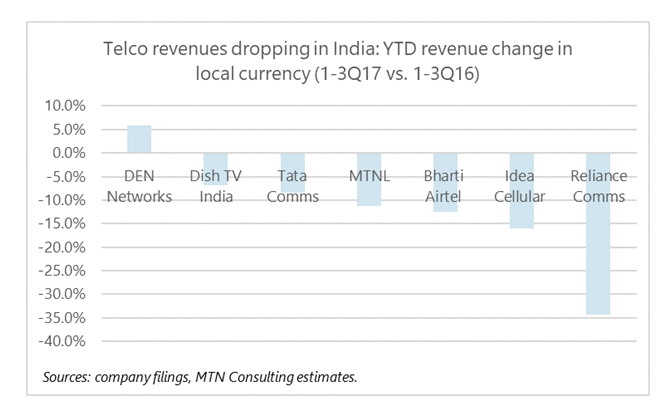
Just recently, in November 2017 the Indian regulator TRAI announced a net neutrality recommendation, concluding that telcos cannot unfairly prioritize content. This was a win for OTTs. India’s telecom regulators are now pursuing more open, pro-consumer policies than the US FCC, which today voted to end America’s version of net neutrality. However, the TRAI’s recommendation still needs to be formally adopted by the government, and India’s telcos are lobbying hard for relief. In fairness, this comes at a tough time for them, as they’re facing high debt and weak revenues, made worse recently by the rapid growth of new entrant Jio. The figure below shows how stark the revenue declines have been for many in recent quarters.

Smartphones are the platform of choice for OTTs in India

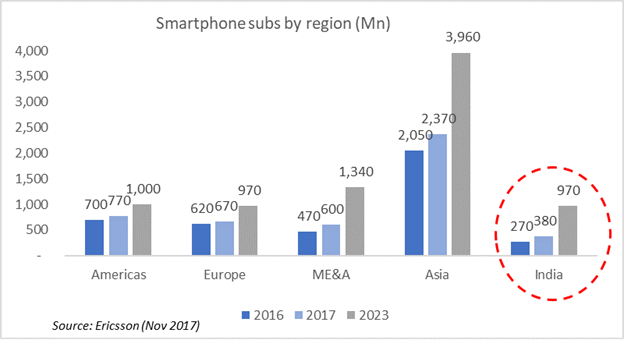
While India’s fixed broadband networks are underdeveloped, it has an enormous base of smartphones. As shown below, by 2023, Ericsson expects India to have 970 million smartphone users, after growing at a 17% CAGR from 2017 . That’s the same as the entire region of Europe.

Given India’s smartphone-centric broadband market, smartphones play a huge role in launching new OTT services and partnerships. For new revenues, telcos are looking at apps and content. A common approach is to bundle traditional offerings with OTT services such as media/cloud storage/video/music, to drive data usage and help migrate users to higher-priced plans.

For instance, video-streaming. Vodafone India has won deals with Eros NowHOOQ, and Amazon’s Prime Video. Vodafone has also partnered with Netflix in a deal which includes carrier-billing, and free Netflix service for a year under a few of the post-paid plans. Netflix plans to strike similar deals with India’s Airtel DTH and Videocon d2h. Starting from scratch, Jio is carving out a niche for itself with app-based services such as JioPlay, Jio Beats, Jio VoD and Jio Security.

As a result of India’s rising smartphone penetration and OTT service adoption, data traffic is booming. Ericsson expects data traffic per smartphone in India to reach 18 GB/month by 2023, from the current 3.9 GB/month. Telcos, of course, claim to worry they’ll be stuck carrying all this traffic, while OTT providers function as free riders of telco network assets. So far, that argument hasn’t held up with regulators.

(Photo credit: Mpho Mojapelo)

Blog Details

Understanding The Carrier-Neutral Market (And Why Revenues Will Pass $40B This Year)

MTN Consulting has just published a “Market Review” of the carrier-neutral network operator (CNNO) sector. The report assesses the key role that these tower, data center, and bandwidth specialists are playing in the downsizing of the telecom sector. While many telcos are shrinking, the CNNO sector is growing >10% per year. Revenues for the 25 CNNOs we track should surpass $40B this year, and approach $60B by 2020 (Figure 1).

mtnc-cnno revs through 2020

Takeaways from the study include:

  • CNNO revenue growth has been steady around 10-15% YoY for several years, in line with the growing telco (& other provider) need for low cost, carrier-neutral network resources. 3Q17 revenue growth for CNNOs was 13.1% (Telco Network Operators: 1.0%; Webscale Network Operators: 23%).
  • CNNO capex rose 11% YoY in 3Q17, to $3.6B. Tower specialists spent 24% of their revenues on capex, data center specialists over 43% due to higher (and lumpy) investments in developing new sites. Tower providers’ incremental capex in new sites is primarily for small cells. Bandwidth specialists’ capital intensity has been over 50% for the last 5 quarters, due to the influence of new builds (NBN in particular).
  • CNNO capex hit $15B on an annualized basis in 3Q17; the biggest spenders were Equinix, Level 3, Australia’s NBN, Crown Castle, Digital Realty, American Tower, and Zayo.
  • M&A is a big factor in the sector’s growth, but just one. CNNOs are growing organically too, and expanding their business models to require a broader mix of equipment (Crown Castle is looking at edge computing, for instance). Technology-related operating expenses can be quite high, for repairs & maintenance of old plant, and energy costs in particular.
  • Total capex across telecom, Webscale, & CNNO was $355B in 4Q16-3Q17 (Figure 2).

mtnconsulting 3Q17 capex-summ5

The report also assesses CNNOs’ network holdings across four main categories: fiber, data centers, towers, and small cells. Most big operators have assets in multiple areas, and that will increase over time. Tower companies are building small cells, for instance, while bandwidth specialists are extending their fiber routes to small cell sites.

Table 1 provides a snapshot of the infrastructure assets for a sample of the CNNOs covered in this report.

Table 1: CNNO network assets (excerpt)

mtnc cnno1

Blog Details

Telco capex in 3Q17 up 4% YoY (preliminary); what’s in store for 2018?

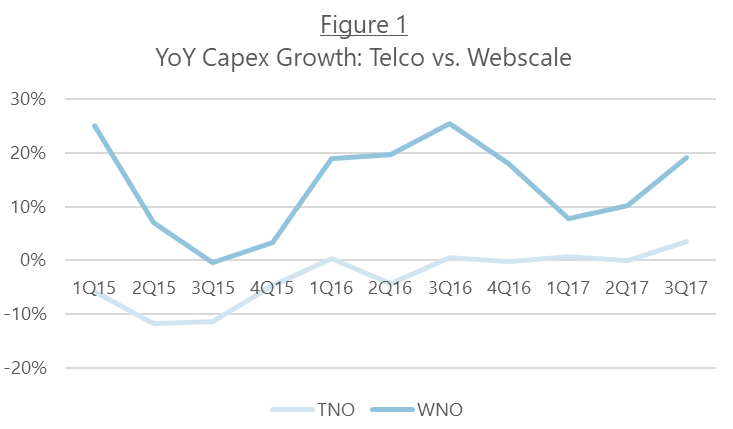
Not all telcos have reported, but a large sample (of 60 companies) has spent US$50.2B on capex in 3Q17. That’s up 4% year-over-year (YoY), after adjustments for acquisitions.

A 4% growth rate for telco capex is relatively high by recent standards (Fig. 1). LTE spending declines have plagued YoY capex comparisons since 2015. In this same time frame, the Webscale sector – led by Alphabet (Google), Amazon, Apple, Facebook, & Microsoft – has increased capex by double digit percentages in most quarters.

Source: Company filings. Preliminary results of 60 telcos (ex-China), and 17 webscale providers

Looking forward, Webscale sector capex will continue to grow much faster than telcos, by 5-15% per year. The outlook for telco capex remains challenged, however.

Weak top-line growth not just a short-term problem

In 3Q17, telco revenues grew just 0.8% for the sum of the 60 companies we’ve captured to date. That pushed down the annualized growth rate to under 1% (Fig. 2).

Source: Company filings. Preliminary results for 60 telcos. China excluded from the chart

Telecom operator revenues have been challenged for several years, and it’s not a regional problem, or one that will go away soon. Many telcos are facing margin squeeze as subscriptions decline in key areas (e.g. consumer broadband), & mobile churn remains too high. Telcos like KDDI and (many) others are investing in new service areas based, for instance, on IoT. Seeing a return from these investments has been slow, though.

3Q17 results & operator plans

Capex for our group of 60 was $50.2B in 3Q17, up 3.6% YoY. That pushed annualized capital intensity for the group to 15.3% in 3Q17, up slightly from 15.2% a year ago. (Note that the sample of 60 excludes China).

As telcos move to more software-based networks, most aim to keep a lid on network spending – at least, the capex component of network spend. That was clear from 3Q17 earnings calls, for instance:

  • Telefonica says its “radical network virtualization” helps to optimize capex, enable faster deployments, and incorporate big data into network planning. Its capex has been in the 16-17% of revenue range steadily since 2014, though, without a noticeable decline. Looking ahead, Telefonica suggests a “distinctive declining capex trend” will be needed to drive growth in free cash flow and reductions in net debt
  • NTT projects capex of 1,700 Billion Yen for the fiscal year ended March 2018. That’s flat year-over-year. But the last 6 months of the year (4Q17-1Q18) will fall YoY, from 1,034B Yen to 942B Yen.
  • Deutsche Telekom’s 9.24B Euros in capex so far this year is up nicely (+12%), but the company projects capex in its core market of Germany to be flat through 2021 at around 4.3B/year; only regulatory relief would bring any upside.
  • Comcast’s capital intensity was 15.6% in 3Q17, but will average 15.0% for the full year. The company is under pressure from rising content costs (despite ownership of NBCUniversal; AT&T, take note!).
  • Orange is spending €7.2 billion on capex this year, from 7.0B in 2016, with a practical focus on raising 4G & FTTx coverage. Fiber investments helped Orange grow its base of “very high-speed broadband” customers to 24.6M households in September, up 46% YoY.

Not all bad news for vendors

The telco shift to more virtualized, software-driven, open sourced networks is real, and it will bring many benefits, but it doesn’t guarantee lower capex. That’s in part because it’s a very gradual shift for most. Big telcos with millions of subscribers & thousands of employees do not change processes that quickly. Many big operators are raising capex, or at least keeping levels flat despite revenue declines. At the global level, though, a 5-10% drop in telco capex is likely next year. The changes by technology area & region will be more extreme; more on this topic soon.

A side note on this week’s news: AT&T-Time Warner and net neutrality

Two major events took place in the US this week: the US Department of Justice (DoJ) announced it would file suit to block AT&T’s purchase of Time Warner, and the FCC made clear it would soon be gutting net neutrality provisions. What’s the impact on capex?

The AT&T situation is too complex & politicized to assess yet. I was never a big believer in the merger, in part because of Comcast’s troubles, within an (already) integrated content-cable group. It seemed a big gamble, given AT&T’s lack of history in content, and limited experience with large cross-sector acquisitions. It also would clearly distract the company during a time of industry upheaval. So, if the merger falls apart, it wouldn’t be the worst thing for AT&T. In the meantime, I would not be surprised if it targeted a bit more of its total capex overseas, in Latin America, pending more certainty.

Regarding net neutrality, my two cents: the FCC’s new rules will have approximately zero impact on US telecom capex. They may change the distribution by company slightly, and you can be sure Verizon, AT&T and others advertise loudly any investment that can be positioned as “new,” and incented by the FCC rule change. But that’s marketing, not reality.

(Photo credit: Jason Blackeye)

Blog Details

Indian Operators Divesting Tower Assets To Raise Cash

Faced with tough competition and high debt, Indian telecom operators are spinning off their tower assets to investors or independent tower companies to improve their financial situation. The 2016 sale of Tata Teleservices’ tower business (Viom) to ATC, and RCom’s planned sale of its tower unit (Reliance Infratel) to Brookfield are just two examples.

Operators in many other regions have divested towers to raise cash, not just India. This is part of an ongoing trend, enabled by the maturity of independent asset management companies. Such divestments in India, though, come against a backdrop of urgent debt reduction needs. Funding network capex while navigating this transition will be a challenge.

Do operators really gain from tower divestments?

Though operators benefit from a cash influx after an infrastructure sale, the devil is in the details. Tower sales typically come with long-term leaseback arrangements, with pre-determined pricing levels locked in. Operators need to set aside sufficient funds for recurring rental costs.

There have been instances where tower companies have shutdown service to operators following rental defaults; RCom is one case. Since the details of the outgoing rental costs incurred by operators are not revealed, it does question the merit of the tower sale. On the other hand, many towers remain underutilized, and operators see benefits not only from the initial sale but in lower ongoing costs as tower space is shared. It also helps them avoid new tower construction, hence avoiding some capex (all else equal).

In India, mobile operators increasingly are focused on their main telecom business, relying for tower assets on a mix of dedicated private equity firms and pure tower infrastructure companies. Deals continue to happen. For instance, now that Vodafone’s acquisition of Idea Cellular has been approved by the antitrust regulator, Bharti Infratel will likely try to buy Vodafone’s 42% stake in Indus Towers. It’s also possible that, post-merger, Vodafone/Idea’s combined 20,000 towers will be acquired by ATC.

Below are a few cases of Indian operators selling towers, or their holdings in tower subsidiaries. Two are completed deals, one is in progress, and two are still under discussion.

Tower asset transfers are affected directly by the broader services market, and M&A changes at that level. We’re seeing this now in India. Vodafone’s merger with Idea, for instance, set to complete in 1H18, is forcing a realignment of ownership in Indus Towers. RCOM’s hoped-for big payout from its tower sale to Brookfield is now in question, since the RCOM-Aircel merger collapsed. Meanwhile, Jio continues to push aggressively to expand, keeping margin pressure high on rivals.

Mobile market consolidation might free up capital for network expansion

In the wake of heavy competition and high debt, Indian operators are exploring various financial deals, not just asset spinoffs.

The recent Tata Teleservices (TTSL) sale of its mobile arm to Airtel, and Vodafone-Idea merger, may just be a silver lining for the Indian telecom mobile market. Over the next five years, we might see a drop in the number of mobile players from 9 to 5. Such consolidation should be beneficial for operators, which can merge network and spectrum holdings. That would free up more capital to invest in network expansions and upgrades; recently Indian operator capex has dipped. Tata Communications’ capital intensity (capex/revenues) averaged just 9.5% for the last three fiscal years, for instance.

With growing demand for a complex range of new mobile services (including in the IoT space), there is a strong argument that operators shift tower management to independent, specialized companies, and focus on providing better quality of service and coverage. India may soon provide a test for that argument.

Blog Details

Weak network spending climate becoming more apparent

Fidelity’s “Communications Equipment” index is up nearly 11% so far this year, tracking just a few points behind the S&P 500’s YTD gain of about 15%. Looking ahead, though, the communications equipment sector remains challenged, something 3Q17 earnings are making clear.

Ericsson, Nokia and ZTE in a similar boat

Vendors selling mainly to communications markets are reporting sluggish demand. In 3Q17, revenues declined by 4% and 9% YoY at the networks divisions of Ericsson and Nokia, respectively (for Nokia’s trend, see figure below).

Multiple regions are seeing the same issue: weak telco revenue growth is constraining more rapid investment. LTE networks are in place, ready for growth & upgrade via software (mainly). Fixed broadband networks remain expensive to construct, and the video revenue upside is proving to be a challenge for many operators, including AT&T.

ZTE doesn’t break out carrier revenues on a quarterly basis. Corporate revenues fell 5% YoY in 3Q17, and ZTE says carrier demand is stronger than average. We’ve estimated 1% YoY growth for ZTE’s carrier group in 3Q17, in local currency. The China capex outlook is cloudy, though, something which both ZTE and Huawei will have to face next year. They also, I suspect, will reinvigorate their vendor financing programs, as has already come up in Brazil with a potential buyout of Oi with involvement from the China Development Bank.

The figure below confirms, though, that it’s not just ZTE, Ericsson and Nokia facing issues. Many suppliers reported YoY revenue declines in 3Q17.

3q17v2

Accenture’s result is modest evidence that telcos continue to increase spending on services & software, but not definitive as Accenture includes telecom in a larger Communications, Media & Technology (CM&T) vertical.

Adtran’s growth is due largely to an acquisition, namely of CommScope’s active fiber access product line, in late 2016.

Corning’s growth is more interesting. Many vendors are reporting a shortage in actual fiber optic cable supply over the last year or two. New factories or expansions have been announced by CorningFurukawa, and most recently Prysmian. These tend to tie in to specific large telco (or national government) fiber builds, as with Verizon’s FiOS and the NBN in Australia. The economics of these builds require video service profitability, in general, and that has been mixed lately.

Telco capex datapoints not reassuring, but it’s early

Many telcos have reported already, including Rogers & Verizon, Telefonica, Orange, America Movil, AT&T, Telenor, and DoCoMo. Occasionally a big operator reports capex growth, unapologetically – referring to the revenue opportunities that might come with that. DoCoMo comes closest to this model so far. Its capex for the last two quarters is up 9% YoY, in part to support new services in the “Smart Life” business. Most, though, are talking down capex, emphasizing that the bulk of 4G work is done, fiber capex is more targeted & tactical than 2 years ago, etc.

On Telefonica’s 3Q17 earnings call, for instance, COO Angel Vila noted that:

“CapEx is on a declining trend in Spain. We have already 97% LTE coverage. I think it’s close to 70% fiber-to-the-home coverage. We will continue deploying fiber, but reduce speed and focusing on connecting… the CapEx trend in Spain is already declining in terms of CapEx to revenues.”

Many operators have similar stories. Vendors will have to seek out the ones with more budget flexibility. Even with some success, though, it’s likely we will see a pickup in M&A activity around the communications equipment sector over the next 1-2 years.

Blog Details

First Few 3Q17 Telecom Vendor Reports: YTD Revenues Down 3.4%

If you’re looking for a capex bump in the telecom sector, results for 3Q17 so far won’t reassure you.

The vendors that have reported are not seeing much growth. For six vendors (or divisions) with high exposure to telecom, annualized revenues continued their decline in 3Q17 (figure).

vendor-1

On a nine month (year to date) basis, revenues for this same group were $33.2B, down 3.4% from $34.4B in 1-3Q16.

This is not a random sample, just a view on the early reporters. Many more significant vendors in the sector have yet to report. However, the weak spending trend is consistent with what many vendors have been reporting for several quarters. It’s also consistent with operators cutting their capex targets.

The figure below shows YoY % change in revenues for each of the 6 companies/divisions, for the last five quarters.

vendor-2

The steady negatives at Ericsson are concerning, as is the 3Q17 decline at ZTE. That could signal weakness in China, where operators were already guiding down capex projections. Juniper’s telecom/cable revenues declined, but that was one point of the vendor’s recent segmentation, to highlight growth differences: its “Cloud” segment is up 16% YTD.

Adtran’s growth is due partly to its CommScope acquisition, so hard to decipher. Wipro is a small services/software player in telecom, and hasn’t been helped by a weak Indian spending climate. Corning, though, is reporting steady YoY growth in optical communications segment revenues, noting yesterday “especially strong demand” for its carrier products, where Verizon is an important customer.

More to come soon, as more vendors report.

(Photo credit: Maarten van den Heuvel)

Blog Details

Cisco Buys BroadSoft For $1.9B In A Cloud & Collaboration-Driven Deal

Cisco Systems is one of the largest suppliers to network operators worldwide, including telcos. Its growth strategy from the start has been reliant heavily on acquisitions, and 2017 has been no exception.

Today the vendor announced it would buy Gaithersburg, Maryland-based BroadSoft for $1.9B. BroadSoft’s software & services help telcos deliver hosted, cloud-based Unified Communications to their enterprise customers. This plays into Cisco’s collaboration offerings.

A mature target for Cisco

BroadSoft’s revenues for the last 4 quarters were $355M. That’s less than 1% of Cisco’s corporate revenues, or about 8% of the division it will be rolled into (see first figure, below). But Cisco often buys companies with no revenues, just a promising technology and/or team. BroadSoft is a relatively mature target for Cisco: it was founded in 1998, and reached its 100th customer milestone over a decade ago (May 2005). The deal size is also manageable for Cisco. Totaling $1.9B, the offer is $55/share, all-cash. Cisco had over $70B in cash & short-term investments at the end of July, so the company’s coffers will be just fine after this transaction.

This is Cisco’s eighth acquisition in 2017. That sounds like a lot, and is, but integrating acquired products & teams effectively is one of Cisco’s core strengths.

revs-mtnconsulting

Cisco’s margins still high, but revenues are falling

Cisco remains loaded with cash, but growth is another issue. Despite heavy R&D spending ($6.1B in FY2017) and an aggressive M&A strategy, Cisco’s revenues have declined for 7 straight quarters, on a year-over-year (YoY) basis. The company’s saving grace are its reliably high margins. Gross margin dropped below 60% in FY2013, but it has averaged over 62% for the last three years. It generates healthy free cash flow each quarter, over $22B for the first two quarters of 2017.

During the late 1990s tech bubble, Cisco was one of the hot stocks in the new “Internet” market – and the company billed itself as “empowering the Internet generation”. That tagline has changed multiple times, but Cisco still sits in a sweet spot of the  infrastructure market: its routers & switches retain high market share with some of the largest network builders around. The market is more competitive now, though, and much “softer” in its technology demands.

Established companies with high share have to scurry to adapt to these shifts: they need to be ready for the next big thing, but also want to leverage their established markets – and extend technology life cycles when possible. With the growth of the cloud, vendors like Cisco have a larger role to play in enabling services, not just building networks. That’s one reason why some key Cisco rivals, e.g. IBM, HPE, SAP, and now Huawei, are investing heavily in cloud networks. It also is a factor in Cisco’s interest in BroadSoft’s capabilities.

What does this deal bring to Cisco?

BroadSoft’s focus is helping telcos roll out & manage new “unified communications” services for their enterprise customers. With 1,720 employees worldwide, BroadSoft claims 25 of the top 30 global “telecommunications service providers” (telcos) as customers. That doesn’t imply global coverage for each of the 25, just 1 (at a minimum) country deployment, but it is impressive scope.

Collectively the vendor is in a total of 80 countries, and its (service provider) customers have deployed 13 million UC subscriber lines over its software. Verizon & Telstra are both major customers, accounting for over 10% of BroadSoft’s revenues recently (Verizon in 2016; Telstra in 2014). Other announced customers include AT&T, BT, Orange Business Services, and Vonage. Overall, revenue from customers outside the US accounted for 48% of sales in 2016, so it has good geographic diversity for a small supplier.

Upon close of this deal in around 1Q18, Broadsoft’s employees will join Cisco’s Unified Communications Technology group, which appears in the vendor’s “Collaboration” segment in financial reporting. Cisco’s collaboration revenues were $4.3B for the FY ended July 2017, down 2% YoY.  The BroadSoft deal should help that segment’s near term prospects, mildly. If BroadSoft’s revenues are added to Cisco’s for both the FY17 and FY16 periods, though, Cisco’s Collaboration revenues would still have fallen last year, by a slighter 0.7%. Clearly the hope is that Cisco’s corporate umbrella (and sales organization) will accelerate combined growth.

sga-mtnconsulting

There’s likely to be some benefit on the cost side. BroadSoft’s gross margins are actually higher than Cisco, but the former has high selling costs. BroadSoft sells through its own sales force in part, not just distributors, VARs, and other partners – as some similar sized companies do rely more heavily on. BroadSoft’s SG&A expenses have averaged over 45% of revenues for the last two years. Cisco’s comparable ratio is about 23% (figure, above). Scale clearly has some benefits.

(Photo credit: James Padolsey)